Chemistry 9701/23 — October/November 2013
Cambridge AS Level · AS Level Structured Questions · worked solutions for every part, with the mark scheme
Topics Introduction to Organic Chemistry · Chemical Bonding · Atoms, Molecules and Stoichiometry · Hydroxy Compounds · Hydrocarbons · Chemical Energetics · +3 more
Ammonia, NH₃, and methane, CH₄, are the hydrides of elements which are next to one another in the Periodic Table.
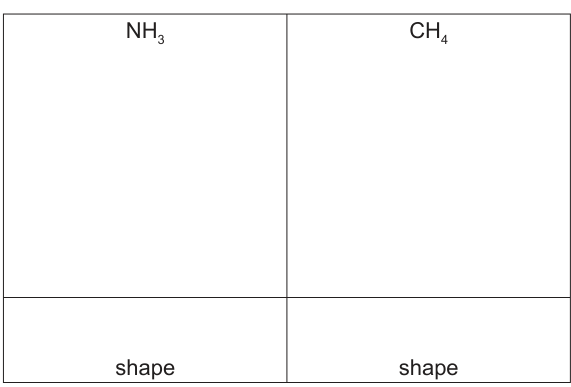
In the boxes below, draw the ‘dot-and-cross’ diagram of a molecule of each of these compounds. Show outer electrons only.
State the shape of each molecule.
Ammonia is polar whereas methane is non-polar. The physical properties of the two compounds are different.
Explain, using ammonia as the example, the meaning of the term bond polarity.
Explain why the ammonia molecule is polar.
State one physical property of ammonia which is caused by its polarity.
When ammonia gas is mixed with hydrogen chloride, white, solid ammonium chloride is formed.
State each type of bond that is present in one formula unit of ammonium chloride and how many of each type are present.
You may draw diagrams.
The rest of this paper
4 more questions- Q2Introduction to Organic Chemistry · Hydrocarbons · Chemical Energetics · Atoms, Molecules and Stoichiometry13M
- Q3Group 17 · Chemical Bonding · Atomic Structure15M
- Q4Introduction to Organic Chemistry · Carboxylic Acids and Derivatives · Hydroxy Compounds · Atoms, Molecules and Stoichiometry15M
- Q5Introduction to Organic Chemistry · Hydroxy Compounds7M