Chemistry 9701/23 — May/June 2012
Cambridge AS Level · AS Level Structured Questions · worked solutions for every part, with the mark scheme
Topics Atoms, Molecules and Stoichiometry · Introduction to Organic Chemistry · Hydrocarbons · Hydroxy Compounds · Atomic Structure · Chemical Periodicity · +4 more
Although the actual size of an atom cannot be measured exactly, it is possible to measure the distance between the nuclei of two atoms. For example, the 'covalent radius' of the Cl atom is assumed to be half of the distance between the nuclei in a Cl₂ molecule. Similarly, the 'metallic radius' is half of the distance between two metal atoms in the crystal lattice of a metal. These two types of radius are generally known as 'atomic radii'.
The table below contains the resulting atomic radii for the elements of period three of the Periodic Table, Na to Cl.
| element | Na | Mg | Al | Si | P | S | Cl |
|---|---|---|---|---|---|---|---|
| atomic radius / nm | 0.186 | 0.160 | 0.143 | 0.117 | 0.110 | 0.104 | 0.099 |
Explain qualitatively this variation in atomic radius.
Suggest why it is not possible to use the same type of measurement for argon, Ar.
Use the Data Booklet to complete the following table of radii of the cations and anions formed by some of the period three elements.
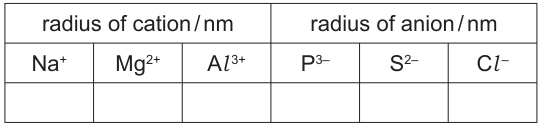
Explain the differences in size between the cations and the corresponding atoms.
Explain the differences in size between the anions and the corresponding atoms.
Each of the elements Na to Cl forms at least one oxide. Na₂O is an ionic oxide, SO₂ is a covalent oxide. Both oxides react with water.
Write an equation for the reaction of each of these oxides with water.
Na₂O ..........................................................................................................................
SO₂ ..........................................................................................................................
What is the pH of the resulting solution in each case?
Na₂O ................ SO₂ .....................
Write an equation for the reaction that occurs between the products of your reactions in (i).
The rest of this paper
4 more questions- Q2Atoms, Molecules and Stoichiometry8M
- Q3Chemical Energetics · Introduction to Organic Chemistry · Chemical Bonding12M
- Q4Hydrocarbons · Atoms, Molecules and Stoichiometry · Introduction to Organic Chemistry · Polymerisation · Hydroxy Compounds14M
- Q5Carboxylic Acids and Derivatives · Hydroxy Compounds · Hydrocarbons · Atoms, Molecules and Stoichiometry · Introduction to Organic Chemistry12M