Chemistry 9701/22 — May/June 2012
Cambridge AS Level · AS Level Structured Questions · worked solutions for every part, with the mark scheme
Topics Atoms, Molecules and Stoichiometry · Carboxylic Acids and Derivatives · Hydroxy Compounds · Introduction to Organic Chemistry · Chemical Periodicity · Chemical Bonding · +4 more
The elements of the third period of the Periodic Table, sodium to sulfur, all form chlorides by direct combination.
Sulfur forms a number of chlorides which are liquid at room temperature.
Which other element of the third period forms a chloride which is liquid at room temperature?
Name one element of the third period which burns in chlorine with a coloured flame.
Aluminium chloride may be produced by passing a stream of chlorine over heated aluminium powder in a long hard-glass tube.
State two observations you could make during this reaction.
Write a balanced equation, with state symbols, for this reaction of aluminium with chlorine.
No chloride of argon has ever been produced.
Suggest a reason for this.
When chlorides of the elements of the third period are added to water, some simply dissolve while others can be seen to react with the water.
Complete the table below, stating how the chlorides of Na, Al, and Si behave when mixed with water. In the first column use only the terms ‘dissolve’ or ‘react’.
| element | Does the chloride dissolve or react? | approximate pH of the resulting solution |
|---|---|---|
| Na | ||
| Al | ||
| Si |
What type of reaction takes place between a chloride and water?
Sulfur forms the compound SN with nitrogen. The structure of SN is shown below. Assume all bonds shown are single bonds.
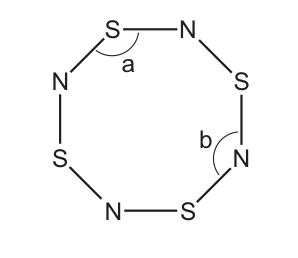
Determine the number of lone pairs of electrons around a nitrogen atom and a sulfur atom in SN.
nitrogen atom ................................
sulfur atom ................................
Which bond angle, a or b, in the SN molecule will be smaller? Explain your answer.
The rest of this paper
3 more questions- Q2Chemical Energetics · Reaction Kinetics12M
- Q3Carboxylic Acids and Derivatives · Hydroxy Compounds · Hydrocarbons · Introduction to Organic Chemistry · Atoms, Molecules and Stoichiometry19M
- Q4Hydroxy Compounds · Carboxylic Acids and Derivatives · Carbonyl Compounds · Atoms, Molecules and Stoichiometry · Introduction to Organic Chemistry13M