Chemistry 9701/12 — May/June 2012
Cambridge AS Level · Multiple Choice (AS Level) · answer key with instant marking and worked solutions
40
questions
40
marks
60
minutes
Topics Chemical Bonding · Hydrocarbons · Introduction to Organic Chemistry · Equilibria · Electrochemistry · Hydroxy Compounds · +12 more
Tap an option under each question to check it — your score builds as you go.
Q11MReaction KineticsFree sample
The molecular energy distribution curve represents the variation in energy of the molecules of a gas at room temperature.
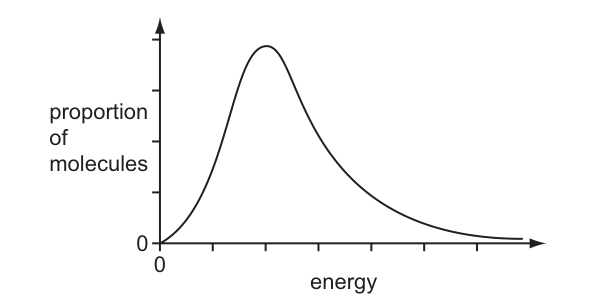
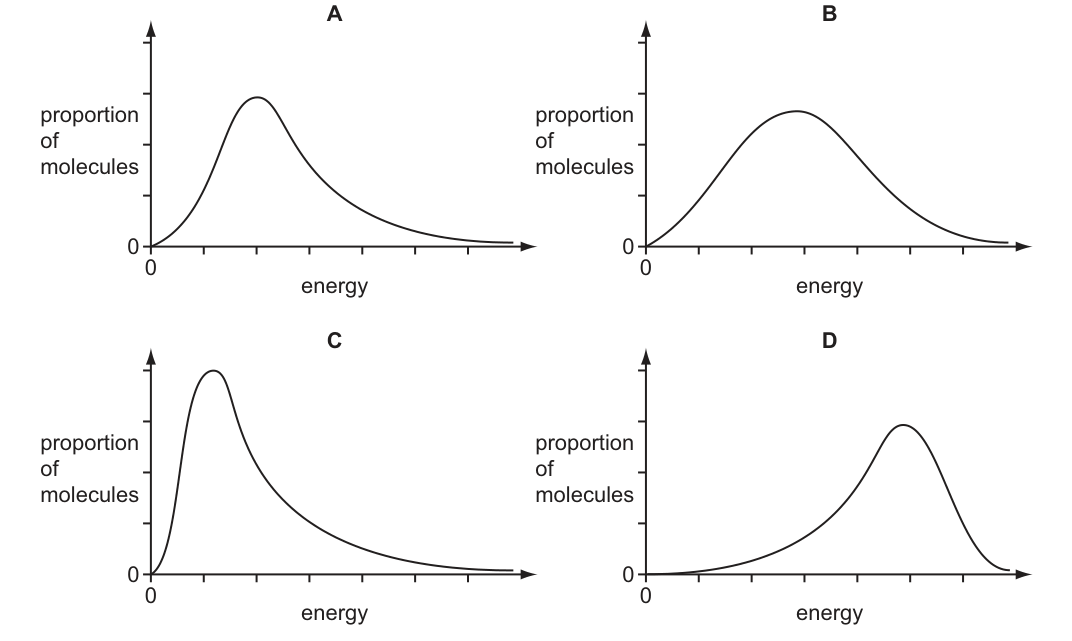
Which curve applies for the same gas at a lower temperature?
Options
The rest of this paper
39 more questions- Q2Atomic Structure1M
- Q3Chemical Bonding1M
- Q4Chemical Bonding1M
- Q5Chemical Bonding1M
- Q6States of Matter · Atoms, Molecules and Stoichiometry1M
- Q7Equilibria1M
- Q8Atomic Structure1M
- Q9Equilibria1M
- Q10Chemical Bonding1M
- Q11Electrochemistry1M
- Q12Chemical Energetics1M
- Q13Nitrogen and Sulfur1M
- Q14Chemical Energetics1M
- Q15Chemical Periodicity1M
- Q16Group 17 · Electrochemistry1M
- Q17Group 21M
- Q18Atomic Structure1M
- Q19Hydrocarbons · Nitrogen and Sulfur1M
- Q20Carboxylic Acids and Derivatives · Atoms, Molecules and Stoichiometry1M
- Q21Introduction to Organic Chemistry1M
- Q22Halogen Compounds · Hydroxy Compounds1M
- Q23Hydrocarbons1M
- Q24Hydrocarbons1M
- Q25Halogen Compounds1M
- Q26Hydroxy Compounds1M
- Q27Introduction to Organic Chemistry1M
- Q28Introduction to Organic Chemistry · Halogen Compounds1M
- Q29Carbonyl Compounds · Carboxylic Acids and Derivatives · Hydroxy Compounds1M
- Q30Hydroxy Compounds1M
- Q31Chemical Bonding1M
- Q32Electrochemistry · Nitrogen and Sulfur1M
- Q33Equilibria1M
- Q34Chemical Bonding · Electrochemistry · Equilibria1M
- Q35Chemical Bonding1M
- Q36Equilibria · Reaction Kinetics1M
- Q37Hydrocarbons1M
- Q38Introduction to Organic Chemistry1M
- Q39Hydrocarbons · Introduction to Organic Chemistry1M
- Q40Introduction to Organic Chemistry · Carbonyl Compounds · Hydrocarbons1M
Loading the full paper…