Chemistry 9701/23 — October/November 2010
Cambridge AS Level · AS Level Structured Questions · worked solutions for every part, with the mark scheme
Topics Atoms, Molecules and Stoichiometry · Chemical Bonding · Halogen Compounds · Atomic Structure · Equilibria · Electrochemistry · +7 more
The element magnesium, Mg, proton number 12, is a metal which is used in many alloys which are strong and light.
Magnesium has several naturally occurring isotopes.
What is meant by the term isotope?
Answer
Atoms of the same element (with the same proton number / number of protons) but with different numbers of neutrons (or different nucleon / mass numbers).
Atoms of the same element with the same proton number but different numbers of neutrons.
Background Concept
Isotopes are variants of a particular chemical element which differ in neutron number, and consequently in nucleon number (mass number). All isotopes of a given element have the same number of protons but different numbers of neutrons in each atom. Because they have the same number of protons and electrons, isotopes of the same element have virtually identical chemical properties, but their physical properties (such as mass and density) differ slightly.
Understanding the Question
The question asks for the definition of the term 'isotope'. This is a foundational concept in atomic structure, requiring a precise two-part statement: what is the same, and what is different.
Approach
Recall the standard IUPAC definition of an isotope. It must mention that they are atoms of the same element (implying the same atomic/proton number) and that they differ in their mass number (implying a different number of neutrons).
Step-by-Step Reasoning
- Same element / same proton number: Isotopes belong to the same element, so they must have the same number of protons (atomic number). This defines the element's identity and its chemical behaviour.
- Different neutrons / different mass number: To be an isotope and not just the same atom, the number of neutrons in the nucleus must differ. This results in a different mass number (nucleon number).
Key Takeaways
- Isotopes have the same proton number but different neutron numbers.
- The term 'isotope' refers to the atoms themselves, not the element as a whole (e.g., 'carbon isotopes' are correct; 'isotopes of carbon' is also acceptable, but 'isotopes' alone is vague).
Common Mistakes
- Saying 'same mass number' (incorrect; they have different mass numbers).
- Saying 'different number of electrons' (incorrect; neutral atoms of the same isotope have the same number of electrons, and ions are not isotopes).
- Using the word 'molecule' instead of 'atom'.
Things to Be Careful About
- Ensure both parts of the definition are present: what is the same (protons/element) and what is different (neutrons/mass number). Missing either part costs a mark.
Complete the table below for two of the isotopes of magnesium.
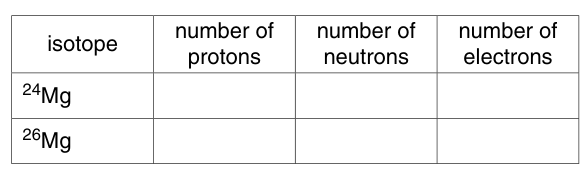
Answer
| isotope | number of protons | number of neutrons | number of electrons |
|---|---|---|---|
| 12 | 12 | 12 | |
| 12 | 14 | 12 |
See table above.
Background Concept
The notation for an isotope is , where is the chemical symbol, is the proton number (atomic number), and is the mass number (nucleon number).
- Proton number (): The number of protons in the nucleus. This defines the element. For magnesium, .
- Mass number (): The total number of protons and neutrons in the nucleus (, where is the number of neutrons).
- Number of neutrons (): Calculated as .
- Number of electrons: In a neutral atom, the number of electrons equals the number of protons (). If the species is an ion, electrons are added or subtracted based on the charge.
Understanding the Question
The question provides a table to complete for two isotopes of magnesium: and . The columns require the number of protons, neutrons, and electrons. The proton number for magnesium is given in the question stem as 12.
Approach
- Identify the proton number () for Mg from the stem (12). This is the same for all Mg isotopes.
- For a neutral atom, the number of electrons equals the proton number (12).
- Calculate the number of neutrons for each isotope using .
- For : .
- For : .
Step-by-Step Reasoning
- : Protons = 12. Electrons = 12 (neutral atom). Neutrons = .
- : Protons = 12. Electrons = 12 (neutral atom). Neutrons = .
Key Takeaways
- The proton number is constant for all isotopes of an element.
- The mass number is the sum of protons and neutrons.
- Neutral atoms have equal numbers of protons and electrons.
Common Mistakes
- Calculating neutrons as instead of .
- Assuming the number of electrons changes for different isotopes (electrons only change if the atom is ionised).
Things to Be Careful About
- Ensure the values are placed in the correct rows for the correct isotopes.
A sample of magnesium had the following isotopic composition:
, 78.60%; , 10.11%; , 11.29%.
Calculate the relative atomic mass, , of magnesium in the sample.
Express your answer to an appropriate number of significant figures.
Working
Answer
24.33
24.33
Background Concept
The relative atomic mass () of an element is the weighted average mass of an atom of the element relative to of the mass of a carbon-12 atom. Because elements exist as a mixture of isotopes, the is calculated by taking the sum of the mass numbers (or more precisely, isotopic masses) multiplied by their relative abundances (percentage or fraction), divided by the total abundance (100% or 1).
Formula:
Understanding the Question
The question gives the isotopic composition of a magnesium sample: (78.60%), (10.11%), and (11.29%). We are to calculate the and express it to an appropriate number of significant figures.
Approach
- Multiply each isotope's mass number by its percentage abundance.
- Sum these products.
- Divide by 100 to get the weighted average.
- Round the final answer to the correct number of significant figures (usually matching the precision of the input data, which is 4 sig figs here).
Step-by-Step Reasoning
- Contribution from :
- Contribution from :
- Contribution from :
- Total sum:
- Rounding to 4 significant figures (as the percentages are given to 4 sig figs): .
Key Takeaways
- is a weighted average, not a simple average.
- The number of significant figures in the final answer should reflect the precision of the given data (usually 3 or 4 sig figs for values in exams).
Common Mistakes
- Forgetting to divide by 100 (if using percentages directly).
- Rounding to too few or too many significant figures.
- Using atomic mass unit values (e.g., 24.305) instead of the integer mass numbers provided in the question (unless specified; CIE typically accepts integer mass numbers for these calculations unless high-precision data is given).
Things to Be Careful About
- Check the significant figures of the input data. Here, 78.60% has 4 sig figs, so the answer should be given to 4 sig figs (24.33).
Antimony, Sb, proton number 51, is another element which is used in alloys.
Magnesium and antimony each react when heated separately in chlorine.
Construct a balanced equation for the reaction between magnesium and chlorine.
Answer
(Note: state symbols are often not strictly required unless specified, but the balanced equation is the core mark.)
Mg + Cl2 -> MgCl2
Background Concept
Magnesium is a Group 2 metal and chlorine is a Group 17 non-metal (halogen). When heated together, they undergo a combination (synthesis) reaction to form an ionic compound, magnesium chloride. Magnesium loses 2 electrons to form , and each chlorine atom gains 1 electron to form .
Understanding the Question
The question asks for a balanced equation for the reaction between magnesium and chlorine. Magnesium is a solid metal, and chlorine is a diatomic gas at room temperature.
Approach
- Write the unbalanced equation: .
- Check if it is balanced: 1 Mg on both sides, 2 Cl on both sides. It is already balanced.
- Add state symbols if required (though the mark scheme often accepts without for simple synthesis, it's good practice: Mg(s), Cl2(g), MgCl2(s)).
Step-by-Step Reasoning
- Reactants: (solid) and (gas, diatomic).
- Product: (ionic solid).
- Balancing: One Mg atom reacts with one molecule to form one formula unit of .
- Equation: .
Key Takeaways
- Halogens are diatomic molecules (, , ).
- Group 2 metals react with halogens to form 1:2 ionic halides ().
Common Mistakes
- Writing chlorine as instead of .
- Writing the product as instead of (ignoring the +2 oxidation state of Mg).
Things to Be Careful About
- Ensure the equation is balanced. In this case, it is naturally balanced with 1:1:1 stoichiometry.
When a 2.45 g sample of antimony was heated in chlorine under suitable conditions, 4.57 g of a chloride A were formed.
Calculate the amount, in moles, of antimony atoms that reacted.
Working
Answer
0.0200 mol
0.0200 mol
Background Concept
The amount of substance in moles () is calculated by dividing the mass of the substance () by its molar mass ( or ). For an element, the molar mass is numerically equal to the relative atomic mass () in g/mol.
Understanding the Question
We are given 2.45 g of antimony (Sb) and asked to calculate the amount in moles. The of Sb is 122 (from the periodic table or data booklet).
Approach
Use the formula .
Step-by-Step Reasoning
- Mass of Sb = 2.45 g.
- Molar mass of Sb = 122 g/mol.
- (to 3 sig figs).
Key Takeaways
- Always use the correct molar mass for the element or compound.
- Keep track of significant figures (3 sig figs is appropriate here as 2.45 has 3 sig figs).
Common Mistakes
- Using the wrong molar mass for Sb.
- Forgetting to convert mass to moles.
Things to Be Careful About
- Antimony's is 121.76, often rounded to 122 in CIE data booklets. Use the value provided in the question's data booklet.
Calculate the amount, in moles, of chlorine atoms that reacted.
Working
Mass of chlorine in A = mass of A - mass of Sb
Answer
0.0600 mol
0.0600 mol
Background Concept
In a reaction where an element combines with chlorine to form a chloride, the mass of the chloride is the sum of the mass of the element and the mass of the chlorine that reacted. By finding the mass of chlorine by difference, we can then calculate the moles of chlorine atoms.
Understanding the Question
A 2.45 g sample of Sb reacts with chlorine to form 4.57 g of chloride A. We need to find the moles of chlorine atoms that reacted (not molecules).
Approach
- Calculate the mass of chlorine that reacted: .
- Calculate the moles of Cl atoms using .
Step-by-Step Reasoning
- Mass of A = 4.57 g.
- Mass of Sb = 2.45 g.
- Mass of Cl = g.
- Molar mass of Cl = 35.5 g/mol.
- .
Key Takeaways
- Use the law of conservation of mass to find the mass of the second reactant.
- Be careful to calculate moles of atoms (Cl), not molecules (), unless specified. The question asks for 'chlorine atoms'.
Common Mistakes
- Using the mass of A (4.57 g) directly to calculate moles of Cl.
- Calculating moles of instead of Cl atoms (would give half the value).
Things to Be Careful About
- The question specifically asks for 'chlorine atoms'. If it asked for 'chlorine molecules', you would divide by 71 (or divide the atom moles by 2). Here, of Cl = 35.5 is used.
Use your answers to (i) and (ii) to determine the empirical formula of A.
Working
Mole ratio
Divide by the smallest number of moles (0.0200):
Simplest ratio is 1 : 3.
Answer
SbCl3
Background Concept
The empirical formula is the simplest whole-number ratio of atoms of each element in a compound. To find it, calculate the moles of each element, then divide by the smallest number of moles to get a ratio. If the ratio is not whole numbers (e.g., 1.5), multiply by a small integer (e.g., 2) to make them whole.
Understanding the Question
Using the moles of Sb (0.0200 mol) and Cl (0.0600 mol) calculated in parts (i) and (ii), determine the empirical formula of chloride A.
Approach
- Write the mole ratio of Sb to Cl.
- Divide both by the smaller value to get the simplest ratio.
- Write the empirical formula.
Step-by-Step Reasoning
- Moles of Sb = 0.0200 mol.
- Moles of Cl = 0.0600 mol.
- Ratio .
- Divide by 0.0200: .
- Empirical formula is .
Key Takeaways
- The empirical formula is derived from the mole ratio, not the mass ratio.
- Always divide by the smallest number of moles to simplify the ratio.
Common Mistakes
- Using the mass ratio instead of the mole ratio.
- Failing to simplify the ratio to whole numbers (though here it is already simple).
Things to Be Careful About
- Ensure the ratio is simplified correctly. In this case, exactly.
The empirical and molecular formulae of A are the same.
Construct a balanced equation for the reaction between antimony and chlorine.
Answer
Working
Since the empirical and molecular formulae are the same, the formula is .
Reactants: and (diatomic).
Unbalanced: .
Balance Cl: need 3 and 2 .
Balance Sb: need 2 .
Balanced: .
2Sb + 3Cl2 -> 2SbCl3
Background Concept
Antimony is a metalloid (Group 15) and forms covalent chlorides. The empirical formula is , and the question states the molecular formula is the same. The reaction is between solid antimony and chlorine gas (diatomic, ) to form antimony trichloride.
Understanding the Question
Construct a balanced equation for the reaction between antimony and chlorine, given that the product is .
Approach
- Write the unbalanced equation with correct formulas for reactants and products.
- Balance the atoms, starting with the most complex molecule or the element that appears in the fewest places.
Step-by-Step Reasoning
- Reactants: (solid) and (gas).
- Product: .
- Unbalanced: .
- To balance Cl, we need a common multiple of 2 and 3, which is 6. So use and .
- This gives 2 Sb on the right, so we need on the left.
- Balanced equation: .
Key Takeaways
- Halogens are diatomic (), not monatomic ().
- Balancing equations with diatomic molecules often requires fractional coefficients or multiplying through to clear fractions.
Common Mistakes
- Writing instead of as a reactant.
- Balancing incorrectly (e.g., ).
Things to Be Careful About
- Ensure the equation is fully balanced with whole-number coefficients.
The chloride A melts at 73.4 °C while magnesium chloride melts at 714 °C.
What type of bonding is present in magnesium chloride?
Answer
Ionic
Ionic
Background Concept
Ionic bonding occurs between metals and non-metals, where electrons are transferred from the metal to the non-metal, forming a lattice of oppositely charged ions. Ionic compounds typically have high melting and boiling points due to the strong electrostatic forces of attraction between the ions in the lattice.
Understanding the Question
Magnesium chloride () has a high melting point (714 °C). We are asked to identify the type of bonding present.
Approach
- Mg is a metal, Cl is a non-metal. Compounds formed between metals and non-metals are typically ionic.
- The high melting point (714 °C) is characteristic of a giant ionic lattice with strong electrostatic forces.
Step-by-Step Reasoning
- Element types: Mg (Group 2 metal) + Cl (Group 17 non-metal) -> Ionic compound.
- Physical property: High melting point (714 °C) -> Strong bonds in a giant structure -> Ionic bonding.
Key Takeaways
- High melting points and metal+non-metal combination indicate ionic bonding.
Common Mistakes
- Saying 'metallic' (only for pure metals or alloys).
- Saying 'covalent' (typically lower melting points, though network covalent can be high, MgCl2 is not).
Things to Be Careful About
- Just state 'ionic'. No need for further explanation unless asked.
Suggest what type of bonding is present in A.
Answer
Covalent
Covalent
Background Concept
Covalent bonding involves the sharing of electron pairs between atoms. Simple molecular covalent substances have low melting and boiling points because the intermolecular forces (van der Waals forces, dipole-dipole, hydrogen bonding) between molecules are weak, even though the covalent bonds within the molecules are strong.
Understanding the Question
Chloride A () has a much lower melting point (73.4 °C) compared to magnesium chloride (714 °C). We are to suggest the type of bonding in A.
Approach
- The low melting point indicates weak intermolecular forces, characteristic of simple molecular covalent substances.
- Sb is a metalloid and Cl is a non-metal; their electronegativity difference is not large enough to form a purely ionic bond. They share electrons.
- The bonding within the molecules is covalent.
Step-by-Step Reasoning
- Melting point of A = 73.4 °C (low). This suggests a simple molecular structure.
- In simple molecular substances, the atoms within the molecule are held together by covalent bonds.
- Therefore, the bonding present in A (referring to the intramolecular bonding that defines the molecule) is covalent.
- Note: The question asks for 'bonding present in A'. While there are van der Waals forces between molecules, the primary chemical bonding holding the atoms together in the formula unit is covalent. The mark scheme explicitly rejects 'van der Waals' forces as the answer for 'bonding'.
Key Takeaways
- Low melting points indicate simple molecular structures with covalent bonding within molecules.
- Distinguish between intramolecular bonding (covalent) and intermolecular forces (van der Waals). The question asks for 'bonding', which typically refers to the chemical bonds (covalent/ionic/metallic).
Common Mistakes
- Answering 'van der Waals' forces or 'intermolecular forces'. These are forces between molecules, not the chemical bonding within the molecule. The mark scheme specifically rejects this.
- Answering 'ionic' (contradicted by the low melting point).
Things to Be Careful About
- Read the question carefully: 'What type of bonding'. In CIE marking, 'covalent' is the expected answer for molecular compounds, not the intermolecular forces. The mark scheme note 'not van der Waals' forces' is a crucial hint.
The rest of this paper
4 more questions- Q2Equilibria · Atoms, Molecules and Stoichiometry · Electrochemistry · Nitrogen and Sulfur16M
- Q3Chemical Bonding · Introduction to Organic Chemistry · Polymerisation · Carbonyl Compounds · Hydrocarbons13M
- Q4Atoms, Molecules and Stoichiometry · Halogen Compounds · Hydroxy Compounds12M
- Q5Halogen Compounds · Group 17 · Chemical Bonding5M