Chemistry 9701/35 — May/June 2010
Cambridge AS Level · Advanced Practical Skills · worked solutions for every part, with the mark scheme
Topics Manipulation, Measurement and Observation · Analysis, Conclusions and Evaluation · Presentation of Data and Observations · Qualitative Analysis
You are required to find the molar enthalpy change for the decomposition of sodium hydrogencarbonate, .
- FA 1 is anhydrous sodium hydrogencarbonate.
- FA 2 is anhydrous sodium carbonate.
- FA 3 is hydrochloric acid.
You will determine the value for the molar enthalpy change of neutralisation for each of FA 1 and FA 2, using an excess of FA 3. You will then use these values to calculate the molar enthalpy change for the decomposition of sodium hydrogencarbonate.
Warning: hydrochloric acid is an irritant.
Very rapid effervescence occurs when FA 1 or FA 2 are added to FA 3.
For safe working, and to minimize the formation of 'acid mist', the solid must be added carefully, with stirring, to the acid. See further instructions below.
Before starting any practical work read through the instructions in (a) and draw up two tables to record your results.
Determining the molar enthalpy change of neutralisation between FA 1 and FA 3
Follow the instructions below to determine the temperature change when a known mass of FA 1, sodium hydrogencarbonate, reacts with an excess of FA 3, hydrochloric acid.
- Weigh the stoppered tube labelled FA 1 containing sodium hydrogencarbonate.
- Use a measuring cylinder to transfer of FA 3 into a beaker.
- Stir the acid in the beaker with the thermometer. Record the temperature of the acid; this is the temperature at .
- Record the temperature each minute for 3 minutes.
- At , start to carefully add the weighed sample of FA 1 to the acid.
- Add the solid in at least 4 or 5 portions to prevent excessive effervescence.
- While adding the solid stir the mixture constantly with the thermometer, but do not record the temperature.
- Continue to stir the mixture throughout the experiment.
- Record the temperature at , then every minute until .
- Reweigh the tube labelled FA 1, its stopper and any residual sodium hydrogencarbonate.
- Empty and rinse the beaker and dry it using a paper towel.
- In one of your tables record the balance readings and the mass of FA 1 added; in the second table record all measurements of time and temperature.
Table of results
Graph plotting
- Plot a graph of temperature (-axis) against time (-axis) on the grid below.
- Draw two straight lines of best fit; one through the points up to ; the second through the points from to . Extrapolate both lines to .
- From the extrapolated lines read the minimum and the maximum temperatures at . Record these values in the spaces provided below.
- Determine the value for the temperature fall at .

- The minimum temperature at is ............. °C.
- The maximum temperature at is ............. °C.
- The temperature fall, , at is ............. °C.
Calculations
Working should be shown in all calculations.
Use the equation below and the temperature fall, , from (b) to calculate the change in heat energy during the reaction of FA 1 with FA 3.
The change in heat energy = ................. J.
Calculate how many moles of FA 1, , were used in your experiment.
[: ; ; ; ]
.................. mol of FA 1 were used in the experiment.
Calculate the enthalpy change when of FA 1 reacts with an excess of the hydrochloric acid, FA 3.
This is the molar enthalpy change of neutralisation, .
Make certain that your answer is given in and has the appropriate sign.
Explain the significance of the sign you have given in (iii) and how it is related to your experimental results.
Determining the molar enthalpy change of neutralisation between FA 2 and FA 3
Follow the instructions below to find the temperature change when a known mass of FA 2, sodium carbonate, reacts with an excess of FA 3, hydrochloric acid.
You are provided with two samples of sodium carbonate. You should use the sample labelled in experiment 1 and the sample labelled FA 2 in experiment 2.
Experiment 1
- Enter all results in the table below.
- Weigh the stoppered tube containing sodium carbonate, which is labelled .
- Use a measuring cylinder to transfer of FA 3 into the rinsed and dried beaker used in (a).
- Stir the acid in the beaker with the thermometer and record the temperature.
- Start to add carefully the weighed sample of to the acid.
- As in the experiment in (a), add the solid in at least 4 or 5 portions to prevent excessive effervescence.
- While adding the solid stir the mixture constantly with the thermometer.
- Record the maximum temperature obtained during the reaction.
- Reweigh the tube labelled , its stopper and any residual sodium carbonate.
- Empty and rinse the beaker and dry it using a paper towel.
Experiment 2
- Enter all results in the table below.
- Weigh a clean, dry, boiling-tube.
- Weigh between and of FA 2, sodium carbonate, into the boiling-tube.
- Repeat the procedure in experiment 1 and record the maximum temperature obtained when this mass of FA 2 reacts with of FA 3.
- Reweigh the boiling-tube and any residual sodium carbonate.
Results
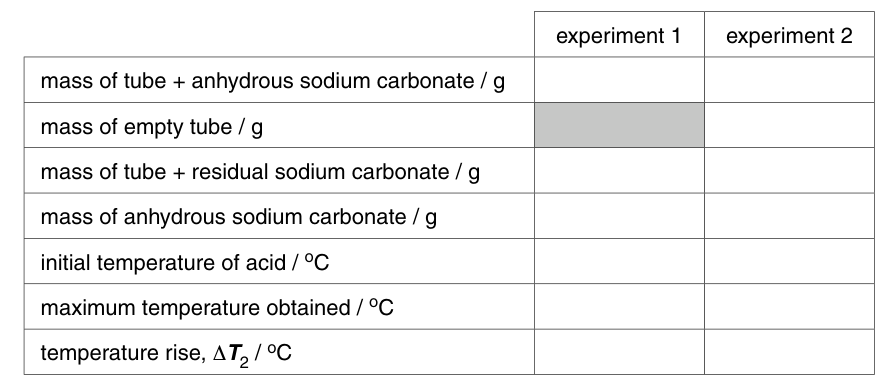
Calculations
Working should be shown in all calculations.
Use the equation below and the temperature rise, , from (d) for experiment 1 to calculate the change in heat energy during the reaction of sodium carbonate with FA 3.
Change in heat energy = ................. J.
Calculate how many moles of sodium carbonate were used in your experiment 1.
[: ; ; ]
.................. mol of sodium carbonate were used in experiment 1.
Calculate the enthalpy change when of sodium carbonate reacts with an excess of the hydrochloric acid, FA 3.
This is the molar enthalpy change of reaction, .
Make certain that your answer is given in and has the appropriate sign.
Explain the significance of the sign you have given in (iii) and how it is related to your experimental results.
Calculating the enthalpy change of decomposition of FA 1,
Use your values for and in the expression below to calculate a value for the molar enthalpy change of decomposition, , for FA 1.
Evaluation
An alternative method for the determination of gave a value of .
The value you have obtained may be significantly different from this value.
Calculate the difference between your value of and that obtained by the alternative method.
Record this difference below. Express this difference as a percentage of the alternative value.
- difference = .................
- percentage difference = ................. %
Sources of error
Describe one major source of error in this experiment. Suggest an improvement which would significantly increase the accuracy of the experiment. Explain why your suggestion would produce a more accurate value.
- description of major source of error
......................................................................................................................................... - suggested improvement
......................................................................................................................................... - explanation of why suggestion would increase experimental accuracy
.........................................................................................................................................
The rest of this paper
1 more questions- Q2Qualitative Analysis · Manipulation, Measurement and Observation · Analysis, Conclusions and Evaluation15M