Chemistry 9701/22 — May/June 2010
Cambridge AS Level · AS Level Structured Questions · worked solutions for every part, with the mark scheme
Topics States of Matter · Atomic Structure · Introduction to Organic Chemistry · Hydroxy Compounds · Hydrocarbons · Chemical Bonding · +7 more
In the 19th and 20th centuries, experimental results showed scientists that atoms consist of a positive, heavy nucleus which is surrounded by electrons.
Then in the 20th century, theoretical scientists explained how electrons are arranged in orbitals around atoms.
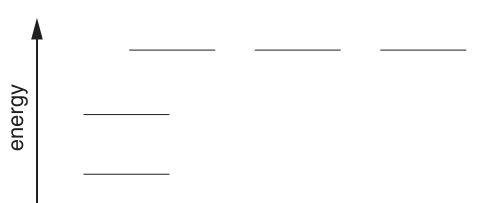
The diagram below represents the energy levels of the orbitals present in atoms of the second period (Li to Ne).
Label the energy levels to indicate the principal quantum number and the type of orbital at each energy level.
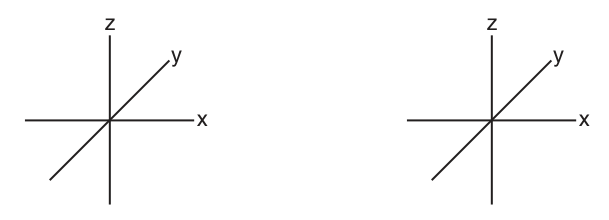
On the axes below, draw a sketch diagram of one of each different type (shape) of orbital that is occupied by the electrons in a second-period element.
Label each type.
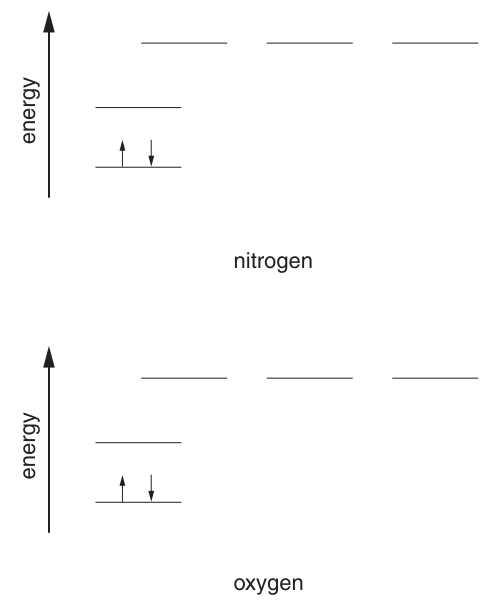
Complete the electronic configurations of nitrogen atoms and oxygen atoms on the energy level diagrams below.
Use arrows to represent electrons.
Use the Data Booklet to state the value of the first ionisation energy of nitrogen and of oxygen.
N ...............................
O ...............................
Explain, with reference to your answer to (a)(iii), the relative values of these two ionisation energies.
The rest of this paper
4 more questions- Q2States of Matter · Chemical Bonding · Electrochemistry · Atomic Structure10M
- Q3Chemical Periodicity · States of Matter12M
- Q4Atoms, Molecules and Stoichiometry · States of Matter · Introduction to Organic Chemistry · Carboxylic Acids and Derivatives · Carbonyl Compounds · Hydroxy Compounds · Hydrocarbons · Halogen Compounds16M
- Q5Hydrocarbons · Introduction to Organic Chemistry · States of Matter · Hydroxy Compounds · Polymerisation13M