Chemistry 9701/21 — May/June 2010
Cambridge AS Level · AS Level Structured Questions · worked solutions for every part, with the mark scheme
Topics Chemical Bonding · Introduction to Organic Chemistry · Halogen Compounds · Carboxylic Acids and Derivatives · Carbonyl Compounds · Reaction Kinetics · +9 more
Elements and compounds which have small molecules usually exist as gases or liquids.
Chlorine, , is a gas at room temperature whereas bromine, , is a liquid under the same conditions.
Explain these observations.
The gases nitrogen, , and carbon monoxide, , are isoelectronic, that is they have the same number of electrons in their molecules.
Suggest why has a lower boiling point than .
A 'dot-and-cross' diagram of a molecule is shown below. Only electrons from outer shells are represented.
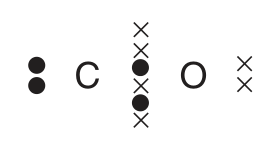
In the table below, there are three copies of this structure.
On the structures, draw a circle round a pair of electrons that is associated with each of the following.
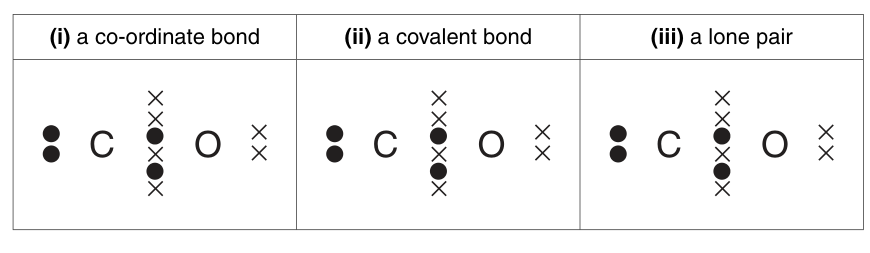
a co-ordinate bond
a covalent bond
a lone pair
Hydrogen cyanide, , is a gas which is also isoelectronic with and with .
Each molecule contains a strong triple bond with the following bond energies.
| bond | bond energy / |
|---|---|
| in | 890 |
| 994 | |
| 1078 |
Although each compound contains the same number of electrons and a strong triple bond in its molecule, and are both very reactive whereas is not.
Suggest a reason for this.
reacts with ethanal, .
Give the displayed formula of the organic product formed.
What type of reaction is this?
Draw the mechanism of this reaction. You should show all full and partial charges and represent the movement of electron pairs by curly arrows.
The rest of this paper
4 more questions- Q2Reaction Kinetics · Equilibria · Halogen Compounds12M
- Q3Atomic Structure · Group 2 · Group 17 · Chemical Bonding · Chemical Periodicity · States of Matter12M
- Q4Organic Synthesis · Hydrocarbons · Halogen Compounds · Carboxylic Acids and Derivatives10M
- Q5Introduction to Organic Chemistry · Carboxylic Acids and Derivatives · Atoms, Molecules and Stoichiometry13M