Chemistry 9701/51 — October/November 2025
Cambridge A-Level · Planning, Analysis and Evaluation · worked solutions for every part, with the mark scheme
Topics Analysis, Conclusions and Evaluation · Planning
The concentration of aqueous chloride ions can be found by titration with aqueous silver nitrate, .
The indicator used is aqueous potassium chromate(VI), .
As is added to aqueous chloride ions, a white precipitate of is formed.
When all the chloride ions have reacted, further addition of leads to the formation of a red precipitate of silver chromate(VI), . The first appearance of the red precipitate shows the end-point of the titration.
A student carries out an experiment to determine the number of molecules of water of crystallisation, , in hydrated barium chloride, .
The student makes of to use for the titration.
Calculate the mass of solid silver nitrate, , needed to make of .
Give your answer to two decimal places.
mass of .............................. g
Working
Answer
mass of = 2.12 g
2.12 g
Background Concept
The amount of a substance in moles is related to its concentration and the volume of solution by , where is the amount in mol, is the concentration in mol dm, and is the volume in dm. To convert an amount into a mass of solid, use , where is the mass in g and is the relative molecular mass (molar mass) in g mol. These two relationships underpin nearly every volumetric calculation in A-Level chemistry.
Understanding the Question
The student needs 250.0 cm of a 0.0500 mol dm silver nitrate solution. The task is to find the mass of solid AgNO that must be weighed out to prepare this solution. The volume is given in cm, so it must first be converted to dm before substitution into .
Approach
- Convert 250.0 cm to dm by dividing by 1000.
- Calculate the amount of AgNO needed using .
- Calculate the relative molecular mass of AgNO from its formula.
- Convert the amount to a mass using .
- Round the answer to two decimal places.
Step-by-Step Reasoning
Convert the volume: because .
Calculate the amount of AgNO needed:
Calculate the relative molecular mass of AgNO:
(Ag = 107.9, N = 14.0, O = 16.0).
Convert to mass:
Rounded to two decimal places, the mass is 2.12 g.
Key Takeaways
- Always convert cm to dm before using .
- The mass of solid required is found by multiplying the amount in moles by the molar mass.
- Round only at the final stage to the precision requested.
Common Mistakes
- Forgetting to convert cm to dm, which makes the answer 1000 times too large.
- Using an incorrect relative molecular mass (e.g. missing the three oxygen atoms in AgNO).
- Rounding intermediate values, which can shift the final answer.
Things to Be Careful About
- The answer must be given to two decimal places: 2.12 g, not 2.1 g or 2.123 g.
- g mol — check each element's atomic mass before adding.
Describe how the student should make of starting from the mass of calculated in (a)(i) in a beaker.
Give the name and size of any key apparatus used.
Write your answer using a series of numbered steps.
Answer
- Add a small volume of distilled water to the 50 cm beaker containing the and swirl or stir to dissolve the solid completely.
- Pour the solution through a funnel into a 250 cm volumetric flask.
- Rinse the beaker, stirring rod and funnel with distilled water and add the washings to the flask.
- Make up to the calibration mark with distilled water, adding the final drops with a dropping pipette.
- Stopper the flask and invert it several times to mix thoroughly.
Dissolve in a small volume of water, transfer with washings to a 250 cm³ volumetric flask, make up to the mark, stopper and invert to mix.
Background Concept
To prepare a solution of accurately known concentration, the solid must be dissolved and transferred quantitatively into a volumetric flask of the stated volume, then made up to the calibration mark. "Quantitatively" means that no solute is lost — every crystal and every drop of washings must reach the flask. The volumetric flask is the key piece of apparatus because it is calibrated to contain an exact volume (here 250.0 cm).
Understanding the Question
The student has weighed the calculated mass of AgNO into a 50 cm beaker. They must now describe, in numbered steps, how to turn this into exactly 250.0 cm of solution, naming the key apparatus and its size. The question explicitly requires a series of numbered steps.
Approach
The standard procedure has three credited stages: (1) dissolve the solid in a small volume of water, (2) transfer the solution and washings into the volumetric flask, (3) make up to the mark and mix. Each stage must be described with the correct apparatus named.
Step-by-Step Reasoning
Stage 1 — dissolving (M1): Add a small volume of distilled water to the beaker and swirl or stir until all the solid has dissolved. A small volume is used so that the beaker can be rinsed effectively afterwards.
Stage 2 — transfer (M2): Pour the solution through a funnel into a 250 cm volumetric flask. Rinse the beaker, the stirring rod and the funnel with distilled water and add these washings to the flask. This ensures that no AgNO is left behind — quantitative transfer.
Stage 3 — making up and mixing (M3): Add distilled water until the liquid level is near the calibration mark, then add the final drops with a dropping pipette so the bottom of the meniscus sits exactly on the mark. Stopper the flask and invert it several times to mix the solution thoroughly.
Key Takeaways
- The volumetric flask is the essential apparatus for preparing an exact volume of solution.
- Washing the beaker, rod and funnel is essential for quantitative transfer.
- The solution must be mixed by inverting after making up to the mark.
Common Mistakes
- Omitting the washings — this loses solute and makes the concentration too low.
- Overshooting the calibration mark — the solution must be discarded and restarted.
- Mixing before making up to the mark, or not mixing at all.
Things to Be Careful About
- Name the 250 cm volumetric flask specifically; the size is part of the mark.
- The final drops must be added with a dropping pipette to avoid overshooting.
The student uses the following method.
step 1 Dissolve of to form of aqueous solution. Label this solution A.
step 2 Transfer of solution A into a conical flask.
step 3 Add aqueous sodium sulfate, , to the flask and swirl the mixture to remove barium ions from the solution.
step 4 Add 2–3 drops of indicator to the flask.
step 5 Titrate the contents of the flask against .
step 6 Repeat steps 2 to 5 to collect sufficient data for analysis.
Answer
A 20.0 cm pipette (used with a pipette filler).
20.0 cm³ pipette
Background Concept
A pipette is calibrated to deliver one fixed volume of liquid very accurately (e.g. 20.0 cm). A burette delivers variable volumes, and a measuring cylinder is far less accurate. For a titration, the aliquot must be transferred with high precision, so a pipette is the correct choice.
Understanding the Question
Step 2 of the method requires transferring exactly 20.0 cm of solution A into a conical flask. The candidate must name the apparatus.
Approach
Recognise that a fixed, accurate volume transfer requires a pipette of the matching size.
Step-by-Step Reasoning
A 20.0 cm pipette, used with a pipette filler, delivers exactly 20.0 cm of solution. This is the standard apparatus for transferring a fixed aliquot in a titration.
Key Takeaways
- Pipettes deliver fixed volumes accurately; burettes deliver variable volumes.
- The pipette size must match the volume required.
Common Mistakes
- Suggesting a measuring cylinder (insufficient accuracy) or a burette (for variable volumes).
Things to Be Careful About
- State the size: 20.0 cm pipette.
Answer
Barium ions would react with the chromate(VI) ions in the indicator, so the endpoint would not be seen clearly.
Barium ions would react with the chromate(VI) indicator.
Background Concept
The indicator is potassium chromate(VI), KCrO(aq). Barium ions form an insoluble precipitate with chromate(VI) ions — barium chromate(VI), BaCrO(s), is insoluble. If Ba remained in solution, it would react with the indicator and interfere with the endpoint.
Understanding the Question
Barium ions are removed in step 3 before the titration. The candidate must explain why this is necessary.
Approach
Identify that Ba would react with the chromate(VI) indicator, consuming it or obscuring the endpoint.
Step-by-Step Reasoning
If Ba ions were present, they would react with the chromate(VI) ions of the indicator to form a precipitate of barium chromate(VI), BaCrO(s). This would either consume the indicator or produce a precipitate that obscures the red AgCrO endpoint. Removing Ba (by precipitation with sulfate) ensures that the indicator only reacts with Ag at the endpoint.
Key Takeaways
- Ba forms an insoluble chromate(VI).
- The indicator must only react with Ag at the endpoint.
Common Mistakes
- Saying Ba reacts with Ag — it does not; AgCl is the precipitate being formed.
- Not mentioning the chromate(VI) indicator specifically.
Things to Be Careful About
- The mark scheme requires the idea that barium ions react with chromate ions.
Answer
Potassium chromate(VI), , is an irritant/corrosive.
K₂CrO₄(aq) is an irritant/corrosive.
Background Concept
Potassium chromate(VI) is a chromium(VI) compound. Chromium(VI) compounds are classified as irritants and corrosives, and many are also toxic or carcinogenic. Appropriate personal protective equipment, such as chemically resistant gloves, is required when handling them.
Understanding the Question
The candidate must suggest why chemically resistant gloves should be worn when adding the KCrO indicator in step 4.
Approach
Recall the hazard classification of potassium chromate(VI).
Step-by-Step Reasoning
Potassium chromate(VI), KCrO(aq), is an irritant and corrosive (and toxic). Wearing chemically resistant gloves protects the skin from contact with this hazardous reagent during the addition in step 4.
Key Takeaways
- Chromium(VI) compounds are hazardous — irritant, corrosive, toxic.
- Safety precautions (gloves) are chosen to match the specific hazard.
Common Mistakes
- Giving a vague answer such as "it is dangerous" without naming the specific hazard (irritant/corrosive).
Things to Be Careful About
- The mark scheme requires the hazard: "Potassium chromate(VI) / K2CrO4(aq) is an irritant / corrosive."
The student’s results are shown in Table 1.1.
Table 1.1
| rough titration | titration 1 | titration 2 | titration 3 | |
|---|---|---|---|---|
| burette reading (final) / | 20.10 | 40.55 | 20.75 | 20.90 |
| burette reading (initial) / | 0.00 | 20.25 | 0.05 | 0.30 |
| titre / | 20.10 | 20.30 | 20.70 | 20.60 |
The student uses the titres from titrations 2 and 3 shown in Table 1.1 to calculate a mean titre value of .
Answer
They are the only concordant titres (within 0.10 cm of each other).
They are the only concordant titres.
Background Concept
Concordant titres are those that agree within 0.10 cm of each other. Only concordant values are averaged to give a reliable mean titre. The rough titration is always discarded because it is an approximate value used to gauge the endpoint.
Understanding the Question
The student used the titres from titrations 2 (20.70 cm) and 3 (20.60 cm) to calculate a mean of 20.65 cm, ignoring the rough (20.10 cm) and titration 1 (20.30 cm). The candidate must explain why only these two values are used.
Approach
Note that 20.70 and 20.60 are within 0.10 cm of each other (concordant), while the rough and titration 1 are not concordant with them.
Step-by-Step Reasoning
The rough titration (20.10 cm) is always discarded — it is an approximate value. Titration 1 (20.30 cm) differs from titrations 2 and 3 by more than 0.10 cm, so it is not concordant. Titrations 2 (20.70) and 3 (20.60) are concordant because they are within 0.10 cm of each other, so only these are averaged to give the reliable mean titre of 20.65 cm.
Key Takeaways
- Concordant titres are within 0.10 cm of each other.
- Rough and non-concordant titres are discarded before averaging.
Common Mistakes
- Averaging all four values, including the rough and non-concordant titration.
- Not mentioning the 0.10 cm concordance criterion.
Things to Be Careful About
- The mark scheme: "They are (the only ones that are) concordant."
Calculate the percentage error in the titre volume for titration 3.
Show your working.
percentage error = ..............................
Working
Each burette reading has an uncertainty of cm, and a titre is the difference of two readings, so the total uncertainty is cm.
Answer
percentage error = 0.49%
0.49%
Background Concept
The burette has an uncertainty of cm on each reading. A titre is calculated as the difference between the final and initial readings, so the total uncertainty is the sum of the two reading uncertainties: cm. Percentage error is the absolute uncertainty divided by the measured value, multiplied by 100.
Understanding the Question
Calculate the percentage error in the titre volume for titration 3, whose titre is 20.60 cm. Working must be shown.
Approach
- Determine the absolute uncertainty: cm.
- Divide by the titre (20.60 cm) and multiply by 100.
Step-by-Step Reasoning
The titre for titration 3 is 20.60 cm. The burette readings are recorded to the nearest 0.05 cm, so each reading has an uncertainty of cm. Since the titre is the difference between two readings, the total uncertainty is cm.
Calculate the percentage error:
The mark scheme accepts 0.48(54)% — both 0.48% and 0.49% are reasonable roundings.
Key Takeaways
- Burette error is doubled because two readings are taken (final and initial).
- Percentage error = (absolute uncertainty / measured value) × 100.
Common Mistakes
- Using only 0.05 cm instead of 0.10 cm — forgetting that two readings are involved.
- Using the wrong titre (e.g. the mean 20.65 instead of 20.60 for titration 3).
Things to Be Careful About
- The titre for titration 3 is 20.60 cm, not the mean 20.65 cm.
- Show the working clearly, as the mark is for the calculation as well as the value.
The equation for the reaction of silver nitrate with barium chloride is shown.
Calculate the amount, in mol, of in the mean titre of .
amount of .............................. mol
Working
Answer
amount of = 1.03 × 10⁻³ mol
1.03 × 10⁻³ mol
Background Concept
The amount of a substance in solution is given by , where is the concentration in mol dm and is the volume in dm. The titre volume is in cm, so it must be divided by 1000.
Understanding the Question
The mean titre is 20.65 cm of 0.0500 mol dm AgNO. The candidate must find the amount of AgNO in this titre.
Approach
Convert the titre to dm and multiply by the concentration.
Step-by-Step Reasoning
This is approximately mol.
Key Takeaways
- with volume in dm.
- The mean titre (20.65 cm) is used, not an individual titre.
Common Mistakes
- Forgetting to convert cm to dm.
- Using an individual titre instead of the mean.
Things to Be Careful About
- The mark scheme: 20.65 × 0.05 / 1000 = 0.00103(25).
Calculate the amount, in mol, of in of solution A.
amount of .............................. mol
Working
From the equation, 2 mol reacts with 1 mol .
Answer
amount of = 6.45 × 10⁻³ mol
6.45 × 10⁻³ mol
Background Concept
The balanced equation shows that 2 mol AgNO reacts with 1 mol BaCl. The amount of BaCl in the 20.0 cm aliquot is therefore half the amount of AgNO used. The aliquot is only a fraction of the total 250 cm solution, so the amount must be scaled up by the factor .
Understanding the Question
Given the amount of AgNO in the mean titre (found in (d)(i)), find the amount of BaCl in the whole 250 cm of solution A.
Approach
- Halve the AgNO amount to find the BaCl in the 20.0 cm aliquot (stoichiometry).
- Multiply by to scale to the full 250 cm.
Step-by-Step Reasoning
Amount of BaCl in the 20.0 cm aliquot:
Scale to 250 cm:
This is approximately mol.
Key Takeaways
- Use the stoichiometric ratio from the balanced equation.
- The scaling factor is total volume / aliquot volume = 250/20 = 12.5.
Common Mistakes
- Forgetting to halve for the 2:1 stoichiometry.
- Using the wrong scale factor (e.g. 20/250 instead of 250/20).
Things to Be Careful About
- The mark scheme: = (d)(i) / 2 × (250/20) = (d)(i) × 6.25.
Working
Answer
= 2
x = 2
Background Concept
The molar mass of the hydrated salt is found from , using the mass of the sample (1.58 g) and the amount of BaCl found in (d)(ii). The difference between this molar mass and the molar mass of anhydrous BaCl (208.3 g mol) is the mass of water of crystallisation per mole. Dividing by 18 (the molar mass of water) gives .
Understanding the Question
Given 1.58 g of BaClHO contains the amount of BaCl found in (d)(ii), find .
Approach
- Calculate (hydrate) = mass / amount.
- Subtract (BaCl) = 208.3.
- Divide by 18 to find , and round to an integer.
Step-by-Step Reasoning
First, (BaCl) = 137.3 + 2(35.5) = 208.3 g mol.
From (d)(ii), the amount of BaCl in 250 cm is 0.006453125 mol, and this is the amount in the 1.58 g sample.
Molar mass of the hydrate:
Mass of water per mole:
Number of water molecules:
So , and the formula is BaClHO.
Key Takeaways
- .
- Water of crystallisation is found from the mass difference between hydrate and anhydrous salt.
- must be an integer.
Common Mistakes
- Using the wrong for BaCl (e.g. forgetting the two chlorines).
- Not rounding to an integer.
- Using the amount in the 20 cm aliquot instead of the 250 cm solution.
Things to Be Careful About
- must be an integer (mark scheme requirement).
- Some working must be shown for both marks.
Another student uses a different experimental method to check the value of obtained by the method described in (b).
Give a brief description of another method, not involving titration, that could be used to determine the value of in the formula . Write your answer using a series of numbered steps.
Your plan should include details of the following:
- the apparatus and method you would use
- the measurements you would make.
You are provided with standard laboratory apparatus.
Answer
- Weigh a clean, dry crucible (with lid) and record its mass.
- Add a known mass of (e.g. about 1–2 g) and record the total mass.
- Heat the crucible strongly with a Bunsen burner (supported on a pipeclay triangle) to drive off the water of crystallisation.
- Cool the crucible in a desiccator and reweigh.
- Repeat heating, cooling and reweighing until constant mass is obtained (no further mass loss).
- Mass of water lost = mass before heating − mass after heating.
- Amount of water = mass of water / 18; amount of BaCl = mass of residue / 208.3.
- = amount of water / amount of BaCl.
See working — gravimetric method: heat to constant mass, mass loss gives moles of water and hence x.
Background Concept
Water of crystallisation can be determined gravimetrically. Heating the hydrated salt drives off the water, leaving anhydrous BaCl. The loss in mass equals the mass of water driven off. From the masses of water and anhydrous salt, the mole ratio gives .
Understanding the Question
Another student wants to check the value of using a method that does not involve titration. The candidate must describe a complete plan in numbered steps, including apparatus, method, and measurements. Standard laboratory apparatus is available.
Approach
The classic gravimetric method: heat a known mass of the hydrate to constant mass, measure the mass loss, and calculate the mole ratio of water to BaCl.
Step-by-Step Reasoning
Apparatus: A crucible (with lid), a pipeclay triangle, a tripod, a Bunsen burner, a desiccator, and a balance.
Method:
- Weigh the empty crucible with its lid.
- Add a known mass of the hydrated salt and weigh again — the difference is the mass of hydrate used.
- Heat strongly to drive off the water.
- Cool in a desiccator (to prevent reabsorption of moisture) and reweigh.
- Repeat heating, cooling and reweighing until constant mass — this ensures all the water has been driven off.
Calculations:
- Mass of water = mass of hydrate − mass of anhydrous residue.
- Amount of water = mass of water / 18.
- Amount of BaCl = mass of residue / 208.3.
- = amount of water / amount of BaCl.
Key Takeaways
- Gravimetric analysis measures a mass change to find composition.
- Heating to constant mass ensures complete dehydration.
- Cooling in a desiccator prevents reabsorption of water.
Common Mistakes
- Not heating to constant mass — incomplete dehydration gives a low value of .
- Weighing hot samples — convection currents affect the balance reading.
- Not cooling in a desiccator — the anhydrous salt reabsorbs moisture.
Things to Be Careful About
- The mark scheme also accepts an alternative precipitation method (e.g. precipitate BaSO with sulfate, filter, wash, dry to constant mass, and use the mass of precipitate).
- The plan must include apparatus, measurements, and a key step (heat to constant mass).
Effusion is the process in which a gas escapes through a small hole.
A student investigates the relationship between rate of effusion and relative molar mass of a gas using the apparatus shown in Fig. 2.1.
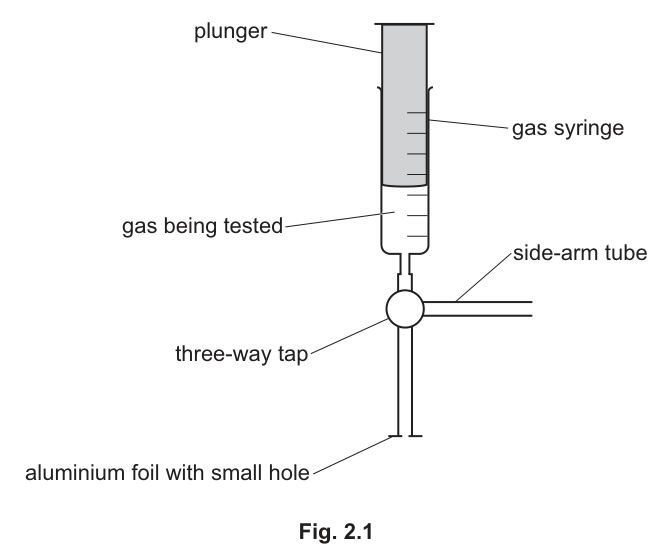
The following method is used:
step 1 Turn the tap and remove any gas from the syringe through the side-arm tube, by pushing in the plunger.
step 2 Add of the gas being tested to the syringe through the side-arm tube.
step 3 Remove the gas from the syringe, through the side-arm tube, by pushing in the plunger.
step 4 Add of the gas being tested to the syringe through the side-arm tube.
step 5 Turn the tap to connect the syringe to the tube with the aluminium foil and small hole.
step 6 Allow the syringe plunger to fall and start a timer when the volume of gas in the syringe reaches .
step 7 Stop the timer when the volume of gas in the syringe reaches . Record the time taken.
step 8 Repeat steps 1 to 7 with different gases.
Suggest why the student adds of the gas being tested to the syringe in step 2 and then removes this gas in step 3.
Answer
To ensure no air (or other gas) remains in the syringe.
To ensure no air or other gas remains in the syringe.
Background Concept
In experiments measuring gas properties like effusion or diffusion, the purity of the gas sample is critical. If the apparatus contains air (which is a mixture of nitrogen, oxygen, argon, etc.), the measured rate will be an average of the test gas and air, leading to inaccurate results.
Understanding the Question
The question asks why the student adds 50 cm³ of the test gas and then immediately removes it before adding the final 70 cm³. This is a procedural step designed to clean the apparatus.
Approach
Think about what is inside the syringe before step 2. It contains atmospheric air. When the test gas is added and then expelled, it pushes the air out. The final 70 cm³ added in step 4 is therefore pure test gas.
Step-by-Step Reasoning
- Before step 2, the syringe and connecting tubes contain air.
- Adding 50 cm³ of test gas and pushing the plunger in (step 3) forces this air out through the side-arm tube.
- This purges the system, ensuring that the 70 cm³ added in step 4 is pure test gas with no contamination from air.
Key Takeaways
Purging a system with the gas to be tested is a standard technique to remove atmospheric gases that could contaminate the sample and skew results.
Common Mistakes
Writing "to clean the syringe" (too vague) or "to remove water vapour" (not necessarily true unless specified). The key is removing air or other gases.
Things to Be Careful About
Be precise: say "air" or "atmospheric gas", not just "impurities". The mark scheme specifically looks for the removal of air/other gas.
The student’s results are shown in Table 2.1.
Table 2.1
| gas | hydrogen, | helium, | neon, | argon, | krypton, |
|---|---|---|---|---|---|
| relative molar mass, | 2.0 | 4.0 | 20.2 | 39.9 | 83.8 |
| time taken / s | 10.8 | 15.3 | 34.5 | 39.7 | 70.4 |
| rate of effusion / |
Complete Table 2.1.
Give the values for to three significant figures.
Give the values for rate of effusion to two decimal places.
Working
For : , , , , .
For rate of effusion: .
; ; ; ; .
Answer
| gas | hydrogen, | helium, | neon, | argon, | krypton, |
|---|---|---|---|---|---|
| relative molar mass, | 2.0 | 4.0 | 20.2 | 39.9 | 83.8 |
| 0.707 | 0.500 | 0.222 | 0.158 | 0.109 | |
| time taken / s | 10.8 | 15.3 | 34.5 | 39.7 | 70.4 |
| rate of effusion / cm s | 4.63 | 3.27 | 1.45 | 1.26 | 0.71 |
sqrt(1/M): 0.707, 0.500, 0.222, 0.158, 0.109; Rate: 4.63, 3.27, 1.45, 1.26, 0.71
Background Concept
Graham's law of effusion states that the rate of effusion of a gas is inversely proportional to the square root of its molar mass: . To test this, we calculate and the rate of effusion () for each gas.
Understanding the Question
Complete the table by calculating to 3 significant figures and the rate of effusion to 2 decimal places. The volume of gas effusing is 50 cm³ (from 60 cm³ down to 10 cm³).
Approach
Use a calculator to compute the values. Pay close attention to the requested significant figures and decimal places.
Step-by-Step Reasoning
-
Calculate :
- H₂: (3 s.f.)
- He: (3 s.f.)
- Ne: (3 s.f.)
- Ar: (3 s.f.)
- Kr: (3 s.f.)
-
Calculate rate of effusion ():
- H₂: (2 d.p.)
- He: (2 d.p.)
- Ne: (2 d.p.)
- Ar: (2 d.p.)
- Kr: (2 d.p.)
Key Takeaways
Always check the required precision (s.f. or d.p.) before finalizing table values. The volume effusing is the difference between the start and end volumes: cm³.
Common Mistakes
Forgetting that the volume is 50 cm³, not 70 cm³ (70 cm³ is the total in the syringe, but only 50 cm³ effuses during the timed interval). Rounding intermediate values too early.
Things to Be Careful About
must be to 3 s.f., not 3 d.p. Rate must be to 2 d.p. Ensure units are correct (cm³ s⁻¹).
Answer
Time taken.
Time taken
Background Concept
In an experiment, the dependent variable is the one that is measured or observed in response to changes in the independent variable. Here, the independent variable is the molar mass of the gas (which is changed by selecting different gases).
Understanding the Question
Identify what is being measured as the outcome of the experiment. The student records the time taken for a fixed volume of gas to effuse.
Approach
Look at the data table. The column that varies based on the gas chosen and is measured directly is 'time taken'.
Step-by-Step Reasoning
The student changes the gas (independent variable) and measures how long it takes for 50 cm³ to effuse. Therefore, 'time taken' is the dependent variable.
Key Takeaways
The dependent variable is what you measure. The independent variable is what you change. Controlled variables are what you keep the same.
Common Mistakes
Saying 'rate of effusion' is the dependent variable. While rate is calculated, the direct measurement is time. Rate is a derived variable. Mark schemes often accept 'time taken'.
Things to Be Careful About
Be precise: 'time taken' or 'time'. Not just 'time'.
Identify a variable, other than temperature, that is controlled when carrying out this experiment.
Answer
Size of the hole (in the aluminium foil).
Size of the hole
Background Concept
Graham's law applies to a specific hole size and pressure. If the hole size changes, the rate of effusion changes for all gases, not just due to molar mass. Temperature also affects rate (kinetic energy), so it must be controlled. Pressure must also be constant (atmospheric pressure is usually assumed constant, but the pressure difference driving effusion should be consistent).
Understanding the Question
Identify a variable other than temperature that is kept constant to ensure a fair test.
Approach
Think about what affects the rate of effusion besides molar mass. The apparatus has a fixed hole size, which must remain constant.
Step-by-Step Reasoning
The size of the hole in the aluminium foil determines how easily gas can escape. If the hole were different for each gas, the results would be invalid. Therefore, the size of the hole is a controlled variable.
Key Takeaways
Controlled variables are those that could affect the outcome but are kept constant to isolate the effect of the independent variable.
Common Mistakes
Saying 'pressure' without justification, or 'volume' (volume is fixed for measurement, but 'size of hole' is the more direct apparatus control). The mark scheme specifically looks for 'size of hole'.
Things to Be Careful About
Ensure you don't say 'temperature' as the question excludes it. 'Size of hole' or 'diameter of the hole' is the precise answer.
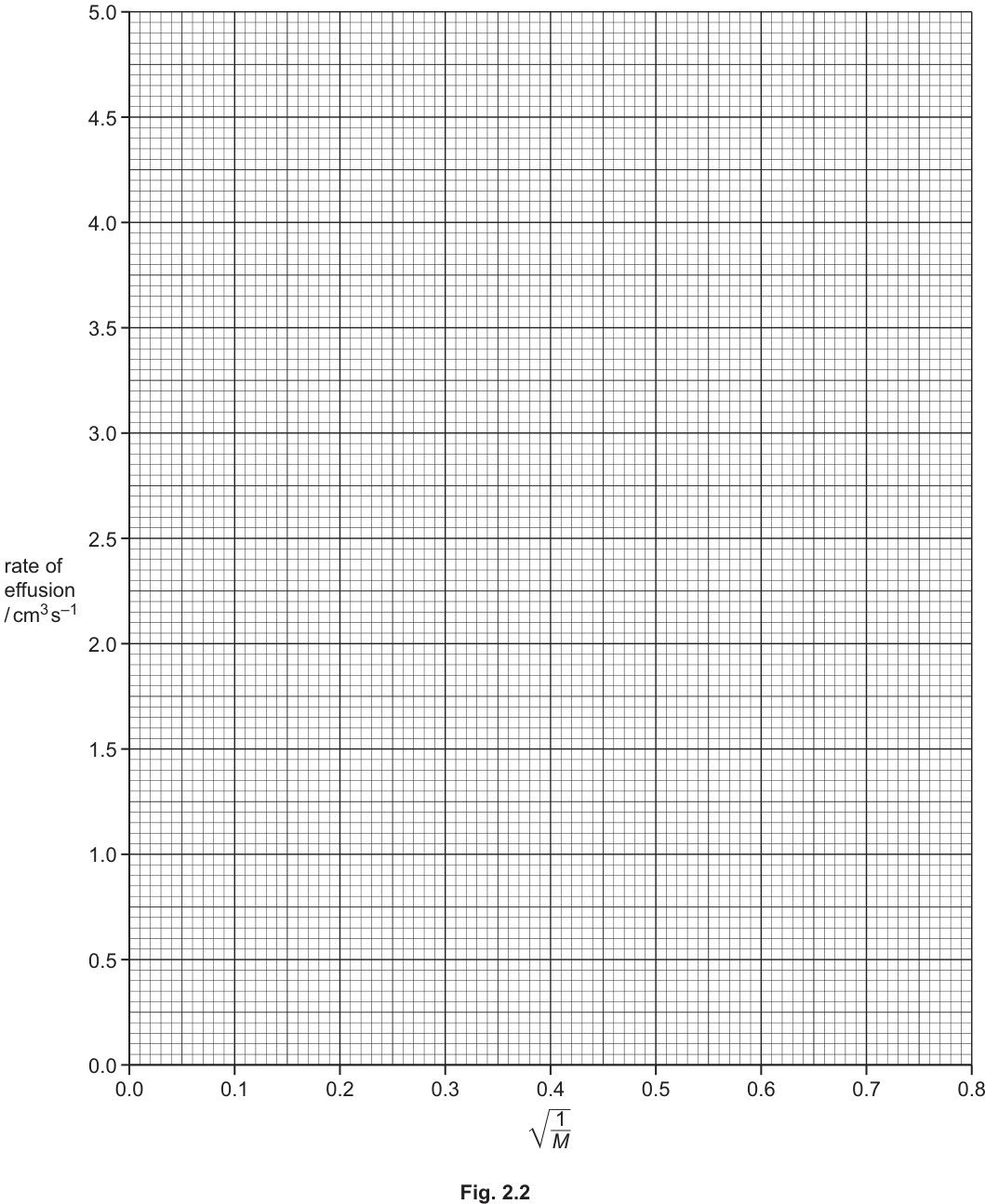
Plot a graph on the grid in Fig. 2.2 to show the relationship between rate of effusion and .
Use a cross (×) to plot each data point. Draw a suitable line of best fit.
Answer
Points plotted: (0.707, 4.63), (0.500, 3.27), (0.222, 1.45), (0.158, 1.26), (0.109, 0.71). A straight line of best fit drawn through the origin and the points.
See diagram
Background Concept
Graphical analysis is used to verify relationships. If , a plot of against gives a straight line through the origin.
Understanding the Question
Plot rate of effusion (y-axis) against (x-axis) using the calculated values. Draw a line of best fit.
Approach
Use the coordinates from part (b)(i). Plot each point as a cross (×). Draw a straight line that passes as close as possible to all points, ideally through the origin (0,0).
Step-by-Step Reasoning
- Plot (0.707, 4.63): x ≈ 0.71, y ≈ 4.63.
- Plot (0.500, 3.27): x = 0.50, y ≈ 3.27.
- Plot (0.222, 1.45): x ≈ 0.22, y ≈ 1.45.
- Plot (0.158, 1.26): x ≈ 0.16, y ≈ 1.26.
- Plot (0.109, 0.71): x ≈ 0.11, y ≈ 0.71.
Draw a straight line through these points. The line should pass through (0,0) and extend to the top right.
Key Takeaways
Always use the correct symbol (×) for plotted points. A line of best fit should not be a 'join-the-dots' line; it should represent the trend.
Common Mistakes
Joining the dots with straight line segments instead of drawing a smooth line of best fit. Forgetting to include the origin (0,0) if the theoretical relationship requires it.
Things to Be Careful About
The mark scheme awards M1 for all 5 points plotted correctly and M2 for a straight line of best fit. Ensure points are within half a small square of the correct position.
Circle one point on the graph in Fig. 2.2 which you consider to be most anomalous.
Suggest one reason for this anomaly. Assume there is no error in .
Answer
Circle the point for argon (0.158, 1.26) as it is furthest below the line of best fit.
Reason: The measured time was longer than the true time (or the hole was slightly smaller than expected, causing slower effusion).
Circle argon point; measured time > true time
Background Concept
An anomalous result is a data point that does not fit the general trend of the data. It can be caused by experimental error, equipment malfunction, or human error.
Understanding the Question
Identify the point most anomalous to the line of best fit and suggest a reason, assuming no error in .
Approach
Look at the graph. The point for argon (0.158, 1.26) is clearly below the line. This means the rate is lower than expected, so the time taken was longer than it should have been.
Step-by-Step Reasoning
- The argon point is below the line of best fit.
- This means the measured rate of effusion is lower than predicted.
- Since rate = volume / time, a lower rate means a longer time was recorded.
- Possible reasons: timing error (started late or stopped late), the hole was slightly smaller for this test, or the gas was not pure.
Key Takeaways
If a point is below the line (lower y for same x), the measured value is too low. For rate, this means time was too long.
Common Mistakes
Saying 'human error' (too vague). Be specific: 'time recorded was too long' or 'hole size was smaller'.
Things to Be Careful About
The mark scheme requires linking the position of the point to the direction of the error. If above the line, time < true time. If below, time > true time.
Graham’s law of effusion can be expressed as:
State whether or not the student’s results support Graham’s law of effusion.
Explain your answer, using the graph in Fig. 2.2.
Answer
Yes. The graph of rate of effusion against is a straight line passing through the origin, showing direct proportionality.
Yes; straight line through origin
Background Concept
Graham's law states: . If this is true, a plot of rate against should yield a straight line passing through the origin (0,0).
Understanding the Question
State whether the results support Graham's law and explain using the graph.
Approach
Look at the line of best fit. Is it straight? Does it go through (0,0)? If yes, the data supports the law.
Step-by-Step Reasoning
- The graph is a straight line.
- The line passes through the origin (0,0).
- This indicates that rate is directly proportional to .
- Therefore, the results support Graham's law.
Key Takeaways
To support a proportional relationship, the graph must be a straight line through the origin.
Common Mistakes
Saying 'yes' without explaining why. Must mention 'straight line' and 'through the origin'.
Things to Be Careful About
Don't say 'the points lie on the line' because there is an anomalous point. Say 'the line of best fit is straight and passes through the origin'.
Suggest how the position of the plotted points relative to the line of best fit in Fig. 2.2 is related to the reliability of the results.
Answer
The results are not reliable as there is an anomalous result (the argon point is far from the line of best fit).
Not reliable due to anomalous result
Background Concept
Reliability refers to the consistency of results. If there are anomalous results (outliers), the data is less reliable because there may be uncontrolled variables or errors.
Understanding the Question
How does the position of points relative to the line of best fit relate to reliability?
Approach
There is an anomalous point (argon). This suggests an error occurred, making the results less reliable.
Step-by-Step Reasoning
- Most points lie close to the line of best fit.
- However, the argon point is significantly below the line.
- This anomalous result indicates an error in that specific measurement.
- Therefore, the overall results are not fully reliable.
Key Takeaways
Anomalous results reduce the reliability of an experiment. Reliability is improved by repeating measurements and removing outliers.
Common Mistakes
Saying 'the results are reliable because the line is straight'. The presence of an outlier means reliability is compromised.
Things to Be Careful About
Use the word 'reliable' or 'reliability'. Link it directly to the anomalous result.
The student then repeats this method to determine the value of of a sample of natural gas.
The time recorded in step 7 is .
Use the graph in Fig. 2.2 and the student’s result to calculate the value of for this sample.
.........................................................
Working
.
From the graph, for rate = 1.58, .
.
.
Answer
(or 21)
20.7
Background Concept
To find an unknown molar mass using Graham's law, calculate the rate, find the corresponding on the graph, then solve for M.
Understanding the Question
Given time = 31.6 s for 50 cm³, calculate M using the graph.
Approach
- Calculate rate = 50 / 31.6.
- Read from the x-axis for this rate on the y-axis.
- Square the value to get .
- Invert to get M.
Step-by-Step Reasoning
- Rate = cm³ s⁻¹.
- On the graph, y = 1.58 corresponds to x ≈ 0.22 (or 0.222 from the neon data, which is close).
- .
- .
Key Takeaways
When reading from a graph, estimate to the nearest reasonable division. The calculated value should be close to a known gas (neon, M = 20.2).
Common Mistakes
Using 70 cm³ instead of 50 cm³ for the volume. Forgetting to square before inverting. Reading the graph incorrectly.
Things to Be Careful About
Allow for error in reading the graph. A value between 19 and 22 is acceptable. Show the working clearly: rate calculation, graph reading, and algebraic rearrangement.
Natural gas is a mixture of mainly methane, , with small amounts of other gases.
Suggest what your calculated value of the of natural gas in (g)(i) tells you about the other gases in the mixture.
Answer
The calculated M (≈ 20.7) is greater than that of methane (16). This suggests the other gases in the mixture have a higher molar mass than methane.
Other gases have higher M than methane
Background Concept
Natural gas is mainly methane (CH₄, M = 16). If there are other gases, the average molar mass of the mixture will be different from 16.
Understanding the Question
The calculated M is ~20.7, which is > 16. What does this say about the other gases?
Approach
If the average is higher than 16, the impurities must have a higher molar mass to pull the average up.
Step-by-Step Reasoning
- Methane has M = 16.
- The calculated average M is ~20.7.
- Since 20.7 > 16, the other gases must have M > 16 to increase the average.
Key Takeaways
The average molar mass of a mixture is a weighted average. If it's higher than the main component, the impurities are heavier.
Common Mistakes
Saying 'the other gases are heavier' without referencing molar mass or methane. Be precise: 'higher molar mass than methane'.
Things to Be Careful About
Don't say 'the other gases are neon' unless asked. Just say they have a higher M. The mark scheme accepts 'average M of other components is greater than 16'.
The experiment described in (g) is repeated at a higher temperature.
Suggest how the rate of effusion for this sample of natural gas would change, if at all.
Explain your answer.
effect on the rate of effusion .....................................................................................................
explanation ...............................................................................................................................
Answer
effect on the rate of effusion: increases
explanation: At higher temperature, gas particles have more kinetic energy and move more quickly, so they effuse faster.
Increases; particles move faster at higher temperature
Background Concept
Temperature is a measure of average kinetic energy. Higher temperature means particles move faster. Effusion rate depends on particle speed.
Understanding the Question
How does increasing temperature affect the rate of effusion, and why?
Approach
State the effect (increases) and explain using kinetic theory (particles move faster).
Step-by-Step Reasoning
- Effect: Rate of effusion increases.
- Explanation: At higher temperature, gas particles have higher average kinetic energy ().
- Higher kinetic energy means higher average speed.
- Faster particles pass through the hole more frequently, increasing the rate of effusion.
Key Takeaways
Temperature affects rate of effusion because it affects particle speed. This is distinct from Graham's law, which compares different gases at the same temperature.
Common Mistakes
Saying 'particles expand' (gases don't expand individually; the container does, or pressure increases). Say 'move more quickly' or 'have higher speed'.
Things to Be Careful About
The mark scheme requires both the effect and the explanation. 'Increases' and 'particles move more quickly'. Don't just say 'kinetic energy increases' without linking to speed.