Chemistry 9701/44 — October/November 2025
Cambridge A-Level · A Level Structured Questions · worked solutions for every part, with the mark scheme
Topics Introduction to A Level Organic Chemistry · Carboxylic Acids and Derivatives · Chemical Energetics · Nitrogen Compounds · Analytical Techniques · Transition Elements · +7 more
Answer
A transition element is an element that forms one or more stable ions with incomplete (partially filled) d orbitals.
An element that forms one or more stable ions with incomplete (partially filled) d orbitals.
Background Concept
The IUPAC definition of a transition element is strictly based on the electronic configuration of its ions, not just the neutral atom. An element is a transition metal if it has an incomplete d sub-shell in at least one of its stable oxidation states (ions). This is why scandium (Sc, ) and zinc (Zn, ) are not considered transition elements: Sc forms only (, empty d sub-shell) and Zn forms only (, full d sub-shell).
Understanding the Question
The question asks for the formal definition of a transition element. This is a foundational concept in transition metal chemistry, setting the stage for understanding properties like variable oxidation states, catalytic activity, and coloured complexes.
Approach
Recall the precise IUPAC definition. It is crucial to mention that the incomplete d sub-shell must be present in a stable ion (or compound/oxidation state), not necessarily the neutral atom.
Step-by-Step Reasoning
- The definition requires the formation of at least one stable ion.
- This ion must have an incomplete or partially filled d sub-shell (d orbitals).
- Combining these: "forms (one or more) stable ions with incomplete (partially filled) d orbitals."
Key Takeaways
- Transition elements are defined by the electron configuration of their ions, not just their neutral atoms.
- "Incomplete d sub-shell" is the key phrase.
Common Mistakes
- Defining a transition element as simply "an element with incomplete d orbitals" (missing the requirement for stable ions).
- Confusing the definition with properties like "forms coloured compounds" or "has variable oxidation states", which are consequences, not the definition.
Things to Be Careful About
- Ensure you use the word "ions" or "oxidation states". Saying "an element with a partially filled d sub-shell" is technically incorrect for elements like Zinc where the neutral atom is full but the ion is also full, or Scandium where the ion is empty.
The orbitals in an isolated gaseous ion are degenerate.
Answer
Degenerate orbitals are orbitals that have the same energy.
Orbitals that are at the same energy.
Background Concept
In an isolated atom or ion (without any external fields or ligands), the five 3d orbitals () are degenerate, meaning they all possess exactly the same energy level. This is a fundamental concept in atomic structure.
Understanding the Question
The question asks for the definition of the term "degenerate" in the context of the 3d orbitals in an isolated ion.
Approach
State the standard definition of degenerate orbitals.
Step-by-Step Reasoning
- Degenerate simply means "equal in energy".
- Therefore, degenerate orbitals are orbitals that are at the same energy level.
Key Takeaways
- Degenerate = same energy.
- In free ions, d orbitals are degenerate. Ligands cause them to split (d-d splitting).
Common Mistakes
- Saying "degenerate orbitals have the same shape" (false, they have different shapes).
- Saying "degenerate orbitals contain the same number of electrons" (not necessarily true, e.g., in with 9 electrons, the distribution isn't equal).
Things to Be Careful About
- Keep the definition simple: "at the same energy". Do not overcomplicate it.
Complete the electronic configuration of .
...............................................................................................................................
Answer
2s^2 2p^6 3s^2 3p^6 3d^9
Background Concept
Copper (Cu, atomic number 29) has an anomalous electron configuration in its neutral state: (or ). This is due to the extra stability of a fully filled d sub-shell.
When forming ions, transition metals lose electrons from the 4s orbital before the 3d orbital. This is a common point of confusion; students often remove 3d electrons first.
Understanding the Question
We need to complete the electronic configuration for the ion, starting from .
Approach
- Write the full configuration for neutral Cu.
- Remove 2 electrons to form , removing them from 4s first, then 3d.
Step-by-Step Reasoning
- Neutral Cu: .
- To form , remove 2 electrons.
- First electron removed: from -> .
- Second electron removed: from -> .
- Resulting configuration: .
- The question provides , so we fill in the rest: .
Key Takeaways
- Always remove 4s electrons before 3d electrons when forming transition metal ions.
- Remember the anomalous configuration of Cu () and Cr ().
Common Mistakes
- Writing (removing one 3d electron and keeping 4s).
- Writing (technically correct but usually the 4s is omitted if empty, and the question implies filling the rest of the core).
- Forgetting the anomalous configuration of neutral Cu and using .
Things to Be Careful About
- Ensure the configuration is balanced and complete up to the d orbitals. The mark scheme accepts .
State the colours of the aqueous solutions for the two copper(II) complex ions shown.
- .............................................................................................
- .............................................................................................................
Answer
: deep / dark / royal blue
: yellow
[Cu(NH3)4(H2O)2]2+(aq): deep blue; [CuCl4]2-(aq): yellow
Background Concept
The colour of transition metal complexes depends on the ligands attached to the central metal ion. Different ligands cause different amounts of splitting of the d orbitals (d-d splitting). For copper(II):
- With water ligands (or ammonia replacing water), the complex is typically blue.
- With chloride ligands (high concentration of Cl-), the complex is yellow/green.
Understanding the Question
State the colours of two specific aqueous copper(II) complex ions: the tetraamminediaquacopper(II) ion and the tetrachloridocuprate(II) ion.
Approach
Recall the standard colours associated with these specific ligand environments for Cu2+.
Step-by-Step Reasoning
- : Ammonia is a stronger field ligand than water, but for Cu2+, the resulting complex is a deep, dark, or royal blue.
- : Chloride is a weaker field ligand. The tetrachlorocuprate(II) ion is yellow (often observed as green in mixtures with the blue aqua complex, but the pure complex ion is yellow).
Key Takeaways
- Ligand identity affects colour. is pale blue, is deep blue, is yellow.
Common Mistakes
- Saying "blue" for both (ignoring the ligand effect).
- Saying "green" for (green is the colour of a mixture of blue and yellow, not the pure complex ion).
Things to Be Careful About
- Use precise colour terms: "deep blue" or "royal blue" for the ammonia complex, "yellow" for the chloride complex.
Answer
- The d orbitals split into two different energy levels (d-d splitting occurs).
- Electrons are promoted (excited) from the lower energy d orbitals to the higher energy d orbitals.
- Light (photons) of a specific wavelength/frequency is absorbed, and the complementary colour is seen.
d orbitals split; electrons excited; light absorbed, complementary colour seen
Background Concept
In an isolated ion, d orbitals are degenerate. When ligands approach, the electrostatic repulsion between the ligand electrons and the d orbital electrons causes the d orbitals to split into two energy levels (e.g., and in an octahedral field). The energy difference () between these levels often corresponds to the energy of visible light photons.
Understanding the Question
Explain why aqueous complex ions of transition elements are usually coloured. This is a 3-mark explanation requiring a logical chain of events.
Approach
- Mention d-orbital splitting.
- Mention electron promotion (excitation).
- Mention light absorption and the resulting colour (complementary colour).
Step-by-Step Reasoning
- M1: In a complex ion, the ligands cause the d orbitals to split into two different energy levels (d-d splitting). This creates an energy gap.
- M2: Electrons in the lower energy d orbitals can absorb energy to be promoted (excited) to the higher energy d orbitals.
- M3: The energy absorbed corresponds to a specific wavelength/frequency of visible light (a photon is absorbed). The colour we see is the complementary colour to the absorbed light (i.e., the light that is transmitted or reflected).
Key Takeaways
- Colour arises from d-d transitions.
- Splitting -> excitation -> absorption of visible light -> transmission of complementary colour.
Common Mistakes
- Saying "electrons jump between energy levels" without specifying d orbitals.
- Saying "light is emitted" (it's absorbed, and the complementary colour is seen/transmitted).
- Forgetting to mention the complementary colour.
Things to Be Careful About
- Use precise terminology: "d orbitals split", "electrons promoted/excited", "light/photon absorbed", "complementary colour seen".
When an excess of is added to a solution of , is formed.
State the type of reaction.
Complete the equation for this reaction. State symbols are not required.
type of reaction ..................................................................................................................
equation
..................................... .....................................
Answer
type of reaction: ligand exchange (or ligand substitution / replacement / displacement)
equation:
ligand exchange; [CuCl4]2- + 4NH3 + 2H2O -> [Cu(NH3)4(H2O)2]2+ + 4Cl-
Background Concept
Ligand exchange (or ligand substitution) is a reaction where one or more ligands in a complex ion are replaced by different ligands. This often occurs when a ligand that forms a more stable complex (or is present in large excess) is added to a solution of a different complex.
Understanding the Question
When excess ammonia is added to , it forms . State the reaction type and complete the equation.
Approach
- Identify that ligands are being swapped: Cl- and H2O are replaced by NH3.
- Balance the equation by ensuring the number of each atom/ligand is conserved on both sides.
Step-by-Step Reasoning
- Type of reaction: Ligands are being replaced, so it is a ligand exchange, substitution, replacement, or displacement reaction.
- Equation balancing:
- Reactants: + ammonia + water (since the product has water ligands, water must be a reactant from the aqueous solution).
- Products: + chloride ions (displaced from the original complex).
- To get 4 NH3 in the product, we need 4 NH3 on the reactant side.
- To get 2 H2O in the product, we need 2 H2O on the reactant side.
- The 4 Cl- ligands are displaced, so 4 Cl- are on the product side.
- Check charges: Left = -2. Right = +2 + 4(-1) = -2. Balanced.
Key Takeaways
- Ligand exchange equations must balance both atoms and charges.
- Water is often a ligand in aqueous complexes and may appear as a reactant or product.
Common Mistakes
- Forgetting to include H2O as a reactant (the product has 2 water ligands, so water must come from somewhere).
- Incorrectly balancing the chloride ions (must be 4 Cl-).
- Writing "precipitation" or "redox" (no change in oxidation state, Cu is +2 throughout).
Things to Be Careful About
- State symbols are not required, so don't add them.
- Ensure the equation is fully balanced with correct stoichiometry.
The complex ion shows stereoisomerism.
Complete the three-dimensional diagrams in Fig. 1.1 to show the two different stereoisomers of .
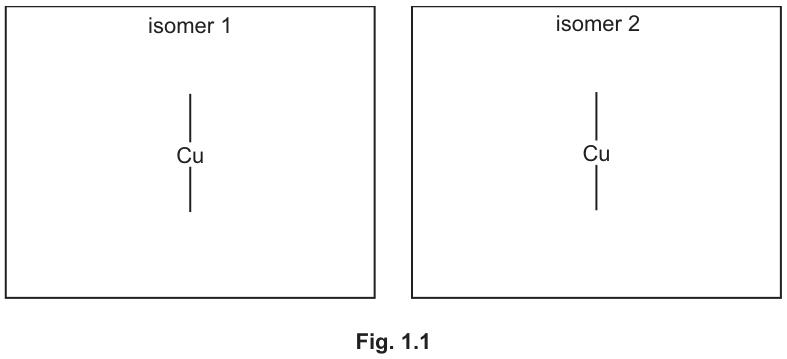
Answer
Isomer 1 (trans): H₂O ligands at top and bottom (axial positions), NH₃ ligands in the equatorial plane.
Isomer 2 (cis): H₂O ligands adjacent to each other (one axial, one equatorial), NH₃ ligands in the remaining positions.
See diagram: trans isomer (H2O axial) and cis isomer (H2O adjacent)
Background Concept
Octahedral complexes of the type (where M is the metal, A and B are different ligands) can exhibit geometric stereoisomerism (cis-trans isomerism).
- Trans isomer: The two B ligands are opposite each other (180° apart), typically at the axial positions (top and bottom).
- Cis isomer: The two B ligands are adjacent to each other (90° apart), typically one axial and one equatorial.
Understanding the Question
Complete the 3D diagrams for the two stereoisomers of . The central atom is Cu, with 4 NH₃ and 2 H₂O ligands.
Approach
Draw two octahedral structures. Use wedges and dashes to show 3D geometry. Place the two H₂O ligands in the trans positions for one isomer, and in cis positions for the other.
Step-by-Step Reasoning
- Isomer 1 (trans): Place H₂O at the top (axial) and bottom (axial) positions. Place the four NH₃ ligands in the equatorial plane (using wedges and dashes to show they are in the plane but projecting towards/away from the viewer).
- Isomer 2 (cis): Place one H₂O at the top (axial) and one H₂O at an equatorial position (e.g., front-left). Place the four NH₃ ligands in the remaining positions (bottom axial, and three equatorial).
- The mark scheme shows:
- Left box (isomer 1): H₂O top/bottom (axial), NH₃ equatorial (wedges/dashes).
- Right box (isomer 2): H₂O top (axial) and front-left (equatorial), NH₃ bottom (axial) and remaining equatorial.
Key Takeaways
- Cis-trans isomerism in octahedral complexes requires two identical ligands.
- Trans = opposite (180°), Cis = adjacent (90°).
- Use wedges (coming out) and dashes (going in) to represent 3D structure clearly.
Common Mistakes
- Drawing a square planar complex (this is octahedral, coordination number 6).
- Placing all 4 NH₃ in axial positions (only 2 axial positions exist).
- Forgetting to use wedges/dashes to show 3D geometry.
Things to Be Careful About
- Ensure the coordination number is 6 (octahedral).
- The diagrams must clearly show the relative positions of the H₂O ligands.
Deduce which stereoisomer in (d)(ii) is polar.
Explain your answer.
polar isomer ......................................................................................................................
explanation ........................................................................................................................
Answer
polar isomer: cis isomer
explanation: The bond dipoles do not cancel out (or are not symmetrical).
cis isomer; dipoles do not cancel
Background Concept
A molecule or ion is polar if it has a permanent dipole moment. This occurs when the individual bond dipoles do not cancel each other out due to asymmetry in the molecular geometry.
Understanding the Question
Deduce which stereoisomer (cis or trans) of is polar and explain why.
Approach
- In the trans isomer, the two H₂O ligands (which have dipoles) are opposite each other (180°). Their dipoles cancel. The four NH₃ ligands are also arranged symmetrically. The trans isomer is non-polar (or has very low polarity).
- In the cis isomer, the two H₂O ligands are adjacent (90°). Their dipoles do not cancel. The overall molecule has a net dipole moment.
Step-by-Step Reasoning
- Identify the cis isomer as the polar one.
- Explain that in the cis isomer, the bond dipoles (from the different ligands, particularly the H₂O ligands which are more polar than NH₃) are not arranged symmetrically opposite to each other, so they do not cancel out.
- In the trans isomer, the identical ligands are opposite, so their dipoles cancel.
Key Takeaways
- Trans isomers of MA4B2 are generally non-polar (dipoles cancel).
- Cis isomers are polar (dipoles do not cancel).
Common Mistakes
- Saying the trans isomer is polar.
- Not explaining why (failing to mention dipoles not cancelling).
Things to Be Careful About
- Be specific: "dipoles do not cancel" is a key phrase. Don't just say "it's asymmetrical" without referencing dipoles.
The dianion can act as a tridentate ligand.
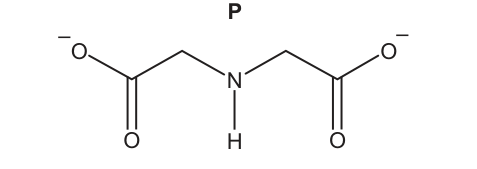
Answer
The dianion P has two oxygen atoms and one nitrogen atom, each with at least one lone pair of electrons that can be donated to the metal ion to form three dative covalent bonds.
Two oxygen and one nitrogen can donate three lone pairs of electrons to the metal ion.
Background Concept
A ligand is a molecule or ion that donates a pair of electrons to a central metal ion to form a dative (coordinate) bond. To form multiple dative bonds (acting as a multidentate ligand), the ligand must have multiple atoms with lone pairs of electrons positioned correctly to coordinate to the metal.
Understanding the Question
The dianion P (iminodiacetate, ) is a tridentate ligand. Suggest how it can form three dative covalent bonds.
Approach
Identify the atoms in P that have lone pairs available for donation. Look at the structure: it has two carboxylate groups () and one amine group ().
Step-by-Step Reasoning
- The two negatively charged oxygen atoms () each have lone pairs.
- The nitrogen atom in the amine group () has a lone pair.
- These three atoms (2 O, 1 N) can each donate a lone pair to the central metal ion, forming three dative bonds.
- This makes it a tridentate (three-toothed) ligand.
Key Takeaways
- Tridentate ligands have three donor atoms with lone pairs.
- Common donor atoms: O (in carboxylates, water), N (in amines, ammonia).
Common Mistakes
- Saying "the carbon atoms donate electrons" (carbon doesn't have lone pairs in this structure).
- Forgetting the nitrogen lone pair.
Things to Be Careful About
- Be specific: mention the specific atoms (oxygen and nitrogen) and that they donate lone pairs.
moles of dianion , , react with mole of aqueous cobalt(III) ions, to form mole of complex ion .
Deduce the formula and charge of .
Answer
[Co(C4H5NO4)2]-
Background Concept
When ligands coordinate to a central metal ion, the resulting complex ion has a formula that combines the metal and ligands, with an overall charge equal to the sum of the metal ion charge and the ligand charges.
Understanding the Question
2 moles of dianion P () react with 1 mole of to form complex Q. Deduce the formula and charge of Q.
Approach
- The ligand P replaces the water ligands. Since P is tridentate and Co(III) has a coordination number of 6, 2 moles of P (each providing 3 bonds) will replace all 6 water ligands.
- Calculate the overall charge: Co is +3, each P is -2. Total charge = +3 + 2(-2) = -1.
- Write the formula with the ligands in brackets.
Step-by-Step Reasoning
- Metal ion: (from , waters are displaced).
- Ligands: 2 moles of .
- Formula: .
- Charge calculation: +3 (from Co) + 2 × (-2) (from two P dianions) = +3 - 4 = -1.
- Final formula: .
Key Takeaways
- Charge of complex = charge of metal ion + sum of charges of ligands.
- Coordination number determines how many ligands fit (Co(III) is typically octahedral, CN=6; tridentate ligand P needs 2 to fill CN=6).
Common Mistakes
- Forgetting to calculate the charge correctly (e.g., +3 - 2 = +1, forgetting there are 2 ligands).
- Including the water ligands in the final formula (they are displaced).
Things to Be Careful About
- Ensure the charge is correct: -1, not -2 or +1.
- Use the molecular formula of the ligand as given: .
Table 1.1 shows values for the stability constants, , of some silver(I) complexes.
Table 1.1
| complex | value of |
|---|---|
Answer
The stability constant () is the equilibrium constant for the formation of the complex ion from its constituent metal ion and ligands in solution (usually water).
Equilibrium constant for the formation of the complex ion in solution from its constituent ions or molecules.
Background Concept
The stability constant ( or ) quantifies the stability of a complex ion in solution. It is the equilibrium constant for the reaction where the complex ion is formed from the central metal ion and the ligands.
A large value indicates a very stable complex (the equilibrium lies far to the right, towards the complex ion).
Understanding the Question
Define the stability constant of a complex.
Approach
State that it is an equilibrium constant for the formation reaction of the complex from its components in solution.
Step-by-Step Reasoning
- It is an equilibrium constant ().
- The reaction is the formation of the complex ion.
- The reactants are the constituent ions or molecules (metal ion + ligands).
- The solvent is typically water/solution.
- Combined: "equilibrium constant for the formation of the complex ion in a solvent/solution from its constituent ions or molecules."
Key Takeaways
- measures complex stability.
- Large = stable complex.
- It's an equilibrium constant for formation.
Common Mistakes
- Calling it a "rate constant" (it's an equilibrium constant).
- Forgetting to mention "in solution" or "from constituent ions".
Things to Be Careful About
- Use the word "equilibrium". Don't just say "constant for formation".
Use the information in Table 1.1 to identify the most stable silver(I) complex.
Explain your answer.
most stable ........................................................................................................................
explanation ........................................................................................................................
Answer
most stable:
explanation: It has the largest value of (), indicating the greatest extent of complex formation.
[Ag(CN)2]-(aq); largest Kstab value
Background Concept
The stability constant () is a measure of how strongly the ligands bind to the metal ion. A larger value means the equilibrium lies further to the right (towards the complex ion), indicating a more stable complex.
Understanding the Question
Use Table 1.1 to identify the most stable silver(I) complex and explain why.
Approach
- Look at the values in the table.
- Identify the largest value.
- State that the complex with the largest is the most stable.
Step-by-Step Reasoning
- :
- :
- :
- The largest value is , which corresponds to .
- Explanation: It has the largest stability constant (), meaning the equilibrium for its formation lies furthest to the right, so it is the most stable.
Key Takeaways
- Higher = more stable complex.
- Compare the powers of 10 first, then the coefficients.
Common Mistakes
- Choosing the complex with the most negative charge (irrelevant).
- Not explaining why (just naming the complex).
Things to Be Careful About
- Ensure the explanation explicitly mentions "largest " or "largest equilibrium constant".
Sodium sulfite, , is used as a food preservative.
A sample of impure is dissolved in distilled water and made up to in a volumetric flask.
of this solution requires of acidified to reach the end-point.
The equation for the reaction is shown.
Calculate the percentage by mass of in the sample.
Working
- Moles of used:
- Moles of in :
From the equation,
- Moles of in :
- Mass of :
- Percentage by mass:
Answer
59.0%
Background Concept
This is a redox titration calculation. Permanganate(VII) () is a strong oxidizing agent in acidic solution, and sulfite () is a reducing agent. The balanced equation gives the stoichiometric ratio between the two reactants.
Understanding the Question
Calculate the percentage by mass of pure in an impure sample, given titration data with acidified .
Approach
- Calculate moles of used from concentration and volume.
- Use the stoichiometric ratio (2:5) to find moles of in the aliquot.
- Scale up to find moles of in the total solution.
- Convert moles to mass using of .
- Calculate percentage purity: .
Step-by-Step Reasoning
- Moles of : .
- Stoichiometry: The equation is . Ratio is 2:5.
- Moles of in 10 cm³: .
- Moles in 250 cm³: The 10 cm³ is a fraction of the total 250 cm³. Scale factor = .
. - Mass of : .
. - Percentage purity: .
- Rounding to 3 significant figures (consistent with data like 3.75, 10.0, 18.70, 0.0150): .
Key Takeaways
- Always use the balanced equation for the mole ratio.
- Remember to scale up from the aliquot volume to the total volume.
- Calculate correctly.
Common Mistakes
- Forgetting to divide volume by 1000 to convert cm³ to dm³.
- Using the wrong mole ratio (e.g., 1:1 instead of 2:5).
- Forgetting to scale up from 10 cm³ to 250 cm³.
- Incorrect calculation (e.g., using atomic mass of S as 32 instead of 32.1, though 32.1 is standard).
Things to Be Careful About
- Significant figures: The final answer should be to 3 sf (59.0%), as the data (3.75 g, 0.0150 M) is given to 3 sf.
- Ensure the equation is balanced correctly before using the ratio.
The Group 2 sulfates and the Group 2 chromates show similar trends in solubility.
Suggest the trend in the solubility of the Group 2 chromates down the group.
Explain your answer.
Answer
The solubility of the Group 2 chromates decreases down the group.
Down the group, the cation radius increases, so both the lattice enthalpy and the hydration enthalpy become less exothermic (less negative). The hydration enthalpy decreases by a larger amount than the lattice enthalpy, so the enthalpy change of solution becomes less exothermic / more endothermic. Therefore solubility decreases.
Solubility decreases down the group.
Background Concept
Solubility of an ionic solid is governed by the enthalpy change of solution, , which is the sum of the lattice enthalpy and the hydration enthalpy:
Lattice enthalpy is the enthalpy change when one mole of a solid ionic compound forms from its gaseous ions. Hydration enthalpy is the enthalpy change when one mole of gaseous ions becomes hydrated in water. Both terms are exothermic for small, highly charged ions and become less exothermic as ionic radius increases and charge density falls. A compound tends to be more soluble when is more exothermic (or less endothermic).
Understanding the Question
The question tells us that Group 2 sulfates and Group 2 chromates show similar trends in solubility. We need to predict the trend in solubility of the Group 2 chromates down the group and explain it in terms of lattice and hydration enthalpies. The command words "Suggest" and "Explain" require a trend statement plus a reason.
Approach
Identify how ionic radius changes down Group 2. Then state the effect on lattice enthalpy and on hydration enthalpy. Finally, compare the magnitudes of these changes to decide which effect dominates and hence whether becomes more or less favourable.
Step-by-Step Reasoning
- Down Group 2, the cation radius increases.
- Lattice enthalpy becomes less exothermic because larger ions are held less tightly in the lattice.
- Hydration enthalpy also becomes less exothermic because larger ions attract water molecules less strongly.
- The change in hydration enthalpy is greater than the change in lattice enthalpy, so the net becomes less exothermic / more endothermic.
- Therefore solubility decreases down the group.
Key Takeaways
Solubility trends are rationalised by comparing lattice and hydration enthalpies. The dominant change decides the trend.
Common Mistakes
- Stating that solubility increases down the group.
- Saying both lattice and hydration enthalpies become more exothermic.
- Failing to identify which enthalpy change is greater.
Things to Be Careful About
Use "less exothermic / less negative" rather than "smaller" without a sign. The mark scheme accepts either "hydration enthalpy decreases more" or "lattice enthalpy decreases less".
Silver(I) chromate, , is sparingly soluble in water.
Write an ionic equation to show the equilibrium between solid and its aqueous solution.
Include state symbols.
Answer
Ag2CrO4(s) ⇌ 2Ag+(aq) + CrO4^2-(aq)
Background Concept
A sparingly soluble salt establishes a dynamic equilibrium between the solid and its ions in a saturated solution. The solubility product, , is the equilibrium constant for this dissolution.
Understanding the Question
We need to write the ionic equation for the equilibrium between solid and its aqueous ions, including state symbols. The stoichiometry is important: each formula unit contains two ions and one ion.
Approach
Write the solid on the left and the separated aqueous ions on the right, with correct coefficients and charges. Use because it is an equilibrium.
Step-by-Step Reasoning
contains two and one . Dissolving gives:
The coefficient 2 on is essential.
Key Takeaways
The equation for a solubility equilibrium must be balanced and must include state symbols.
Common Mistakes
- Forgetting the coefficient 2 on .
- Missing state symbols.
- Using instead of .
Things to Be Careful About
State symbols and are required.
The value of the solubility product, , of is at .
Calculate the equilibrium concentration of , in , in a saturated solution of at .
Working
Let the solubility of be .
Answer
1.31 × 10^-4 mol dm^-3
Background Concept
For , the solubility product expression is:
If the molar solubility of the salt is , then each mole of dissolved salt gives moles of and mole of .
Understanding the Question
We are given and asked for the equilibrium concentration of in a saturated solution. The stoichiometry of the salt must be used to connect and .
Approach
Set up in terms of the solubility , solve for , then multiply by 2 to obtain .
Step-by-Step Reasoning
- Let .
- Then .
- Substitute into :
- Solve for :
- Therefore:
The answer is given to 3 significant figures, which is more than the minimum 2 significant figures required.
Key Takeaways
Stoichiometric coefficients appear both as powers in the expression and as multipliers when converting solubility to ion concentration.
Common Mistakes
- Using instead of .
- Forgetting to take the cube root.
- Forgetting to multiply by 2 at the end.
- Giving the solubility instead of .
Things to Be Careful About
The value has units, but concentrations are quoted in . Give the final answer to at least 2 significant figures.
The hydrogenchromate ion, , is a weak acid. The of is .
Working
For a weak acid:
Answer
pH = 4.05
4.05
Background Concept
A weak acid only partially dissociates in water. For a weak acid HA:
If dissociation is small, , the initial concentration, and , so:
Hence . Also, .
Understanding the Question
We are given the concentration of and its . We need to calculate the pH of the solution.
Approach
First convert to . Then use the weak acid approximation to find . Finally calculate pH.
Step-by-Step Reasoning
- Convert to :
- Use :
- Calculate pH:
Key Takeaways
The weak acid approximation is valid when the acid is weak and the concentration is not extremely dilute.
Common Mistakes
- Using instead of .
- Forgetting to convert to .
- Calculating directly.
Things to Be Careful About
Give the pH to at least 2 significant figures. pH has no units.
can show amphoteric behaviour.
State the formula of:
- the conjugate acid of ....................................................................................
- the conjugate base of ..................................................................................
Answer
Conjugate acid:
Conjugate base:
H2CrO4 and CrO4^2-
Background Concept
A conjugate acid is formed when a base gains a proton, . A conjugate base is formed when an acid loses a proton. An amphoteric species can act as both an acid and a base.
Understanding the Question
can behave amphoterically. We need to state the formula of its conjugate acid and its conjugate base.
Approach
Add to to get the conjugate acid. Remove from to get the conjugate base.
Step-by-Step Reasoning
- Conjugate acid:
- Conjugate base:
So the conjugate acid is and the conjugate base is .
Key Takeaways
To find a conjugate acid, add a proton; to find a conjugate base, remove a proton. Charge must be adjusted accordingly.
Common Mistakes
- Swapping the conjugate acid and conjugate base.
- Forgetting to adjust the charge after adding or removing .
Things to Be Careful About
is neutral; carries a 2− charge.
Table 2.1 shows some energy changes.
Table 2.1
| energy change | value / |
|---|---|
| first ionisation energy of silver | |
| second ionisation energy of silver | |
| first ionisation energy of sulfur | |
| second ionisation energy of sulfur | |
| first electron affinity of sulfur | |
| second electron affinity of sulfur | |
| enthalpy change of atomisation of sulfur | |
| enthalpy change of formation of silver(I) sulfide, | |
| lattice energy of silver(I) sulfide, |
Answer
The energy change when one mole of gaseous atoms each gains one electron to form one mole of gaseous 1− ions.
Energy change when one mole of gaseous atoms gains one electron to form one mole of gaseous 1− ions.
Background Concept
Electron affinity is an enthalpy change associated with adding an electron to a gaseous atom. The first electron affinity is usually exothermic because the added electron is attracted to the nucleus.
Understanding the Question
The question asks for a precise definition of the first electron affinity. The definition must include the amount of substance, the physical states, and the nature of the particle formed.
Approach
Use the standard definition: one mole of gaseous atoms, each gaining one electron, to form one mole of gaseous 1− ions.
Step-by-Step Reasoning
The first electron affinity is:
For one mole of atoms, this is the energy change when one mole of gaseous atoms becomes one mole of gaseous 1− ions.
Key Takeaways
Definitions in energetics must be precise about "one mole", "gaseous", and the species formed.
Common Mistakes
- Saying "an atom" instead of "one mole of gaseous atoms".
- Missing the gaseous state.
- Saying energy is required rather than released.
Things to Be Careful About
The first electron affinity is normally negative (exothermic), but the definition itself does not require stating the sign.
Answer
The second electron is added to an already negatively charged ion. The repulsion between the negative ion and the incoming electron makes the process endothermic (positive).
Due to repulsion between the negative ion and the incoming electron.
Background Concept
The second electron affinity is the enthalpy change when one mole of gaseous 1− ions each gains one electron to form 2− ions. Adding an electron to a negative ion requires overcoming electrostatic repulsion.
Understanding the Question
We need to explain why the second electron affinity of sulfur is positive. The key is the repulsion experienced by the incoming electron.
Approach
Focus on the fact that the target species is already negatively charged.
Step-by-Step Reasoning
For sulfur:
The incoming electron is repelled by the negative ion. Energy must be supplied to force the electron onto the ion, so the process is endothermic and is positive.
Key Takeaways
Second electron affinities are often positive because of electron-electron repulsion.
Common Mistakes
- Giving a vague answer such as "it already has a full shell".
- Saying the process is exothermic.
Things to Be Careful About
A positive value means energy is absorbed.
Answer
2Ag+(g) + S2-(g) -> Ag2S(s)
Background Concept
Lattice energy is defined as the enthalpy change when one mole of a solid ionic compound is formed from its gaseous ions. The equation must show gaseous ions on the left and the solid on the right.
Understanding the Question
We need to construct the equation for the lattice energy of , including state symbols.
Approach
Identify the ions in : two ions and one ion. Write them as gaseous ions forming one mole of solid.
Step-by-Step Reasoning
The lattice energy equation is:
The coefficient 2 on is essential because there are two silver ions per formula unit.
Key Takeaways
Lattice energy equations always start from gaseous ions and form one mole of solid.
Common Mistakes
- Using atoms instead of ions.
- Wrong stoichiometry.
- Missing state symbols.
Things to Be Careful About
State symbols and are required.
Calculate the enthalpy change of atomisation, , in , of silver using relevant data from Table 2.1.
It may be helpful to draw a labelled Born–Haber cycle.
Show your working.
Working
Born–Haber cycle for :
Answer
+285.5 kJ mol^-1
Background Concept
A Born–Haber cycle applies Hess's law to ionic compound formation. For , the formation enthalpy can be broken into:
- atomisation of 2 mol Ag atoms:
- first ionisation of 2 mol Ag atoms:
- atomisation of sulfur:
- first and second electron affinities of sulfur:
- lattice energy:
Only the first ionisation energy of silver is used because silver forms , not . Only the first and second electron affinities of sulfur are used because sulfur forms .
Understanding the Question
We need to calculate of silver using the relevant data from Table 2.1. The question suggests drawing a labelled Born–Haber cycle, but the calculation can be done algebraically.
Approach
Write the overall energy cycle equation, substitute the correct values, and solve for the unknown .
Step-by-Step Reasoning
- The formation of from its elements is:
- The cycle gives:
- Substitute the values:
- Simplify:
- Solve:
Key Takeaways
Born–Haber cycles require careful selection of data and correct stoichiometry. The charge on the ion determines which ionisation energies and electron affinities are included.
Common Mistakes
- Including the second ionisation energy of silver.
- Including the first ionisation energy of sulfur.
- Forgetting to multiply the silver terms by 2.
- Sign errors with electron affinities or lattice energy.
Things to Be Careful About
Lattice energy is negative. The second electron affinity of sulfur is positive. The final answer must be in .
Suggest how the magnitude for the lattice energy of differs from the lattice energy of .
Explain your answer.
Answer
The lattice energy of is smaller in magnitude (less exothermic / less negative) than that of , because has a larger ionic radius than , so the electrostatic attraction between the ions is weaker.
Ag2S lattice energy is less exothermic (smaller magnitude) than Cu2S; Ag+ has a larger ionic radius than Cu+.
Background Concept
The magnitude of lattice energy depends on ionic charge and ionic radius. For ions of the same charge, a smaller ionic radius gives a stronger electrostatic attraction and therefore a more exothermic (more negative) lattice energy.
Understanding the Question
We need to compare the lattice energy of with that of and explain the difference.
Approach
Compare the radii of and . Both cations have the same charge and the anion is the same, so the difference is due to ionic radius.
Step-by-Step Reasoning
- is below in the periodic table, so it has a larger ionic radius.
- A larger cation means the ions in the lattice are farther apart.
- The electrostatic attraction between and is weaker than between and .
- Therefore the lattice energy of is less exothermic / less negative / smaller in magnitude than that of .
Key Takeaways
For compounds with the same ionic charges, lattice energy becomes less exothermic as ionic radius increases.
Common Mistakes
- Saying has a more exothermic lattice energy.
- Confusing the trend in ionic radius.
- Not mentioning that the ionic charges are the same.
Things to Be Careful About
Use "less exothermic / less negative" or "smaller magnitude" rather than simply "smaller".
Answer
The number of possible arrangements of particles and energy in a system.
The number of possible arrangements of particles and energy in a system.
Background Concept
Entropy () is a thermodynamic quantity that represents the degree of disorder or randomness in a system. More precisely, it is a measure of the number of possible microscopic configurations (microstates) that correspond to a macroscopic state. When particles have more freedom to move or more ways to distribute their energy, the entropy is higher.
Understanding the Question
This part simply asks for the standard definition of entropy. No calculations or deductions are required; it is a direct recall question.
Approach
Recall the formal definition of entropy from the syllabus.
Step-by-Step Reasoning
The mark scheme awards a mark for stating that entropy relates to the "number of possible arrangements" (or microstates) of both "particles" and "energy" in a system. Simply saying "disorder" is often insufficient for full credit in modern mark schemes, as it is imprecise.
Key Takeaways
Entropy is fundamentally about the number of ways energy and particles can be arranged. Always include both particles and energy in the definition.
Common Mistakes
- Defining entropy only as "disorder" without mentioning arrangements or microstates.
- Forgetting to mention that it applies to both particles and energy.
Things to Be Careful About
Ensure the definition is complete: "arrangements of particles and energy".
Place one tick () in each row of Table 3.1 to show the sign of the entropy change, , for each process.
Table 3.1
| process | is negative | is positive |
|---|---|---|
| steam condensing into water | ||
| solid dissolving in water |
Answer
| process | is negative | is positive |
|---|---|---|
| steam condensing into water | ||
| solid dissolving in water |
steam condensing: negative; KCl dissolving: positive
Background Concept
The sign of the entropy change () depends on whether the disorder of the system increases or decreases. Gases have much higher entropy than liquids, which have higher entropy than solids. Dissolving a solid into an aqueous solution typically increases entropy because the ordered crystal lattice breaks down into freely moving hydrated ions.
Understanding the Question
We need to determine the sign of for two specific processes: condensation of steam and dissolution of solid KCl.
Approach
Compare the states of matter and the degree of disorder before and after each process.
Step-by-Step Reasoning
- Steam condensing into water: . A gas is turning into a liquid. The particles become more ordered and have fewer possible arrangements. Therefore, entropy decreases, and is negative.
- Solid KCl dissolving in water: . An ordered solid lattice breaks apart into mobile, hydrated ions in solution. The number of possible arrangements increases significantly. Therefore, entropy increases, and is positive.
Key Takeaways
- Gas liquid/solid: is negative.
- Solid aqueous/gas: is positive.
Common Mistakes
- Assuming all dissolving processes have positive entropy (some can be negative if the solvent becomes highly ordered around the ions, though this is rare for simple salts like KCl).
- Confusing the sign: negative means entropy decreases.
Things to Be Careful About
Ensure the tick is placed in the correct column. The table has columns for "negative" and "positive".
Chlorine trifluoride, , decomposes on heating into its elements, as shown.
Standard entropies are shown in Table 3.2.
Table 3.2
| substance | |||
|---|---|---|---|
Calculate the standard entropy change, , in , for reaction 1.
Working
Answer
+268.9 J K^-1 mol^-1
Background Concept
The standard entropy change of a reaction () is calculated by subtracting the sum of the standard entropies of the reactants from the sum of the standard entropies of the products. It is crucial to multiply each entropy value by the stoichiometric coefficient from the balanced chemical equation.
Understanding the Question
We are given the balanced equation and the standard entropy values for each substance. We need to calculate .
Approach
- Identify products and reactants and their coefficients.
- Sum the entropies of the products: .
- Sum the entropies of the reactants: .
- Subtract reactants from products.
Step-by-Step Reasoning
- Products: and .
Sum . - Reactants: .
Sum . - .
The positive sign is consistent with the reaction producing more moles of gas (4 moles from 2 moles), which increases disorder.
Key Takeaways
Always multiply by the stoichiometric coefficient. The unit is (per mole of reaction as written).
Common Mistakes
- Forgetting to multiply by 3 or by 2.
- Subtracting in the wrong order (reactants - products).
- Forgetting the sign.
Things to Be Careful About
Check the balancing of the equation. Ensure units are correct (, not ).
Group 2 carbonates decompose on heating. The decomposition for one of the Group 2 carbonates, , is shown in reaction 2.
Answer
Sign: positive
Explanation: a gas () is produced / the number of moles of gas increases / there are more gas molecules on the right-hand side than on the left.
Positive; gas is produced / moles of gas increase.
Background Concept
In the reaction , a solid reactant produces a solid product and a gaseous product. Gases have significantly higher entropy than solids because gas molecules have much greater freedom of motion and occupy a larger volume, leading to many more possible microstates.
Understanding the Question
Predict the sign of for the decomposition of a Group 2 carbonate and explain why.
Approach
Look at the states of matter in the balanced equation. Compare the number of moles of gas on the left and right sides.
Step-by-Step Reasoning
- Left side: 1 mole of solid (), 0 moles of gas.
- Right side: 1 mole of solid (), 1 mole of gas ().
- Since a gas is produced from a solid, the disorder of the system increases.
- Therefore, is positive.
Key Takeaways
If the number of moles of gas increases in a reaction, is positive. If it decreases, is negative.
Common Mistakes
- Saying "entropy increases" without explaining why (must mention gas production or moles of gas).
- Confusing the sign.
Things to Be Careful About
The explanation must explicitly mention the production of gas or an increase in the number of gas molecules.
The Gibbs equation is shown.
Fig. 3.1 shows values of the Gibbs free energy change, , in , at different temperatures, , in , for reaction 2.
Assume and values for this reaction remain constant over this temperature range.
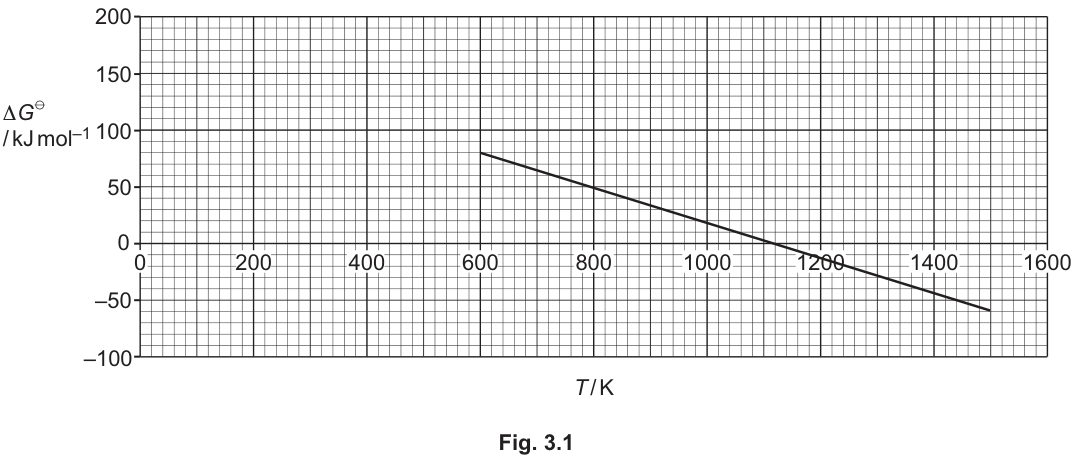
Use the gradient and intercept on the -axis in Fig. 3.1 and the Gibbs equation to determine:
- , in , for reaction 2
- the minimum temperature, , in , at which the reaction is feasible
- , in , for reaction 2.
Working
The Gibbs equation is , which is in the form , where:
- (in )
- (in )
- gradient (in )
- -intercept (in )
1. Calculate from the gradient:
Using points on the line, e.g., and :
2. Minimum temperature for feasibility:
The reaction is feasible when . From the graph, at the -intercept.
3. Calculate from the -intercept:
Using and the point :
(Alternatively, extrapolating the line to gives )
Answer
- (accept )
- Minimum (accept )
- (accept )
ΔS° = +156 J K⁻¹ mol⁻¹; T = 1120 K; ΔH° = +172 kJ mol⁻¹
Background Concept
The Gibbs free energy equation is . This is a linear equation of the form if we plot on the -axis and on the -axis.
A reaction is feasible (spontaneous) when . The minimum temperature for feasibility is where (the -intercept).
Understanding the Question
We are given a graph of vs . We must use the gradient and intercepts to find , the minimum temperature for feasibility, and .
Approach
- Identify the gradient of the line and relate it to . Remember to convert from to .
- Read the -intercept directly from the graph for the minimum temperature.
- Use the -intercept or calculate using at the -intercept to find .
Step-by-Step Reasoning
1. Finding :
- Select two clear points on the line. From the graph description: and .
- .
- Since , then .
- .
- (Allowable range from mark scheme: )
2. Minimum temperature ():
- Feasibility requires . This occurs when the line crosses the -axis ().
- Reading from the graph, the line crosses the -axis at approximately .
- (Allowable range: )
3. Finding :
- The -intercept is . Extrapolating the line to :
. Using the point :
. - Alternatively, reading the -intercept directly from an extrapolated graph gives .
- (Allowable range: )
Key Takeaways
- Plotting vs gives a straight line with gradient and intercept .
- Always check units: gradient is in , so multiply by 1000 to get in .
- Feasibility is determined by .
Common Mistakes
- Forgetting to multiply the gradient by 1000 to convert to for .
- Reading the wrong intercept (e.g., reading from the -intercept).
- Not using a large triangle for the gradient calculation, leading to inaccurate readings.
Things to Be Careful About
- The gradient is , not . The negative sign is crucial.
- Ensure the final answer for is in , not .
- When reading off the graph, use points that are far apart to minimize reading errors.
Nitrogen monoxide, , reacts with hydrogen, as shown in reaction 3.
The rate equation for reaction 3 is shown.
Complete Table 4.1.
Table 4.1
| the order of reaction with respect to | |
| the order of reaction with respect to | |
| the overall order of the reaction |
Answer
- order with respect to : 1
- order with respect to : 2
- overall order: 3
Order wrt H2: 1; order wrt NO: 2; overall: 3
Background Concept
The rate equation expresses how the rate of a reaction depends on the concentrations of the reactants. Each concentration term is raised to a power — the order with respect to that reactant — which is simply the exponent of that concentration in the rate equation. The overall order is the sum of the individual orders. Orders must be determined experimentally (or given in the question); they cannot be predicted from the stoichiometric coefficients of the balanced equation.
Understanding the Question
The question gives the rate equation rate and asks for the orders with respect to each reactant and the overall order. This is a direct read-off task — no calculation is needed.
Approach
Read the exponent of each concentration in the rate equation: has exponent 1, has exponent 2. Add them to find the overall order.
Step-by-Step Reasoning
The rate equation is rate . The exponent on is 1, so the order with respect to is 1. The exponent on is 2, so the order with respect to is 2. The overall order is the sum: .
Key Takeaways
Orders come straight from the exponents in the rate equation. The overall order is the sum of the individual orders, never the sum of the stoichiometric coefficients.
Common Mistakes
Do not use the stoichiometric coefficients (2 for NO, 2 for H) — those are unrelated to the orders. The rate equation is given, so the orders are read from it directly.
Things to Be Careful About
Make sure you sum correctly: , not (which would be the stoichiometric sum, not the kinetic order).
Predict how the initial rate for reaction 3 changes when the concentration of is halved.
Answer
rate (the initial rate is reduced to one quarter)
rate x 1/4
Background Concept
When a concentration changes, the rate changes by that factor raised to the power of the order with respect to that species. For order , rate .
Understanding the Question
is halved. The order with respect to NO is 2. We must predict how the initial rate changes.
Approach
Apply the factor . The concentration of H is unchanged, so it contributes a factor of 1.
Step-by-Step Reasoning
Since rate , halving gives of the original rate. is held constant, so the overall change is .
Key Takeaways
For a second-order species, halving the concentration quarters the rate; tripling it increases the rate ninefold.
Common Mistakes
Do not halve the rate — that would be the behaviour of a first-order species. The exponent 2 must be applied.
Things to Be Careful About
Only changes here; is held constant, so it contributes no factor.
Predict how the initial rate for reaction 3 changes when the concentrations of and are both increased three times.
Answer
rate (the initial rate increases by a factor of 27)
rate x 27
Background Concept
Each concentration change multiplies the rate by its own factor, independent of the others. The factors multiply together.
Understanding the Question
Both and are tripled. NO is second order, H is first order.
Approach
Multiply the individual factors: .
Step-by-Step Reasoning
Tripling multiplies the rate by . Tripling multiplies the rate by . The combined effect is , so the initial rate increases by a factor of 27.
Key Takeaways
Independent concentration changes multiply together: total factor .
Common Mistakes
Forgetting to square the NO factor (giving 9 instead of 27), or adding the factors instead of multiplying them.
Things to Be Careful About
Both concentrations change simultaneously, so the factors multiply; do not add them.
Suggest why reaction 3 is unlikely to proceed by a mechanism involving only a single step.
Answer
A single-step mechanism would require four molecules (2 NO and 2 H) to collide simultaneously, which is statistically very unlikely.
A four-particle simultaneous collision is very unlikely
Background Concept
An elementary step's molecularity equals the number of molecules that must collide in that step. The balanced equation involves four reactant molecules. A one-step mechanism would therefore need all four to collide at once — a four-body collision — which is extremely improbable.
Understanding the Question
Explain why reaction 3 is unlikely to proceed by a mechanism involving only a single step.
Approach
Count the reactant molecules in the balanced equation and note the improbability of a four-particle simultaneous collision.
Step-by-Step Reasoning
The stoichiometry shows two NO and two H molecules. For a single elementary step, all four must meet in one collision. Four-body collisions are vanishingly rare compared with two-body collisions, so real reactions proceed via several bimolecular steps. This is why mechanisms are proposed as sequences of two-molecule steps.
Key Takeaways
Elementary steps are usually unimolecular or bimolecular; termolecular steps are rare, and four-body collisions essentially never happen as a single step.
Common Mistakes
Saying "the reaction is slow" or "the activation energy is high" — the required point is the statistical improbability of a four-particle simultaneous collision.
Things to Be Careful About
The answer must reference the number of molecules that would have to collide (four), not just say "multi-step".
Suggest equations for the three steps of the reaction mechanism for reaction 3.
Each step involves a reaction between two molecules.
step 1 .................................................. ..................................................
step 2 ...................... ...................... .....................................
step 3 ..................................... ....................... .......................
Answer
step 1:
step 2:
step 3:
step 1: 2NO -> N2O2; step 2: N2O2 + H2 -> N2O + H2O; step 3: N2O + H2 -> N2 + H2O
Background Concept
A reaction mechanism is a series of elementary steps whose sum is the overall equation. Each step is typically bimolecular (two molecules collide). Intermediates are species formed in one step and consumed in a later step; they do not appear in the overall equation.
Understanding the Question
Provide a three-step mechanism for , with each step involving two molecules. Steps 2 and 3 are partially given, so the blanks must be filled consistently.
Approach
Combine the two NO molecules first to form a dimer (a well-known step for NO). Then let each H reduce one oxygen: , then . Verify the sum equals the overall equation.
Step-by-Step Reasoning
Step 1: (dimerisation of NO).
Step 2: .
Step 3: .
Summing: . Cancelling and gives , which matches reaction 3.
The mechanism is also consistent with the given rate equation if step 2 is rate-determining: rate , and from the fast pre-equilibrium step 1, , giving rate .
Key Takeaways
Mechanisms must sum to the overall equation; intermediates cancel out. A proposed mechanism should also be consistent with the rate equation (the slow step determines the order).
Common Mistakes
Leaving out HO, or writing a step in which three molecules collide (violates the "two molecules" instruction). Also, not checking the sum of the steps against the overall equation.
Things to Be Careful About
Each step must involve exactly two molecules. Check the overall sum balances atoms and charge.
Answer
is an intermediate: it is formed in step 2 and then consumed in step 3, so it does not appear in the overall equation.
N2O is an intermediate, formed in step 2 and used up in step 3
Background Concept
An intermediate is a species produced in one elementary step and consumed in a later step of the same mechanism. It is not a reactant or product of the overall reaction, so it cancels out when the steps are summed.
Understanding the Question
Identify the role of in the mechanism and justify it.
Approach
Trace through the steps: where is it made, and where is it used?
Step-by-Step Reasoning
is a product of step 2 () and a reactant in step 3 (). Since it is formed then destroyed within the mechanism, it is an intermediate. It does not appear in the overall equation .
Key Takeaways
Intermediates are formed and consumed within a mechanism; they cancel out of the overall equation. They are different from catalysts, which are regenerated in their original form.
Common Mistakes
Calling a catalyst — a catalyst is regenerated unchanged, whereas an intermediate is consumed in a later step.
Things to Be Careful About
The reasoning must mention both formation (step 2) and consumption (step 3) to justify the term "intermediate".
Iodine, , reacts with thiosulfate ions, , as shown in reaction 4.
Reaction 4 is carried out in the presence of a large excess of . Under these conditions, the reaction is first order with respect to and zero order with respect to .
The half-life, , for reaction 4 is under certain conditions.
Calculate the value of the rate constant, , for reaction 4. Include the units of .
Working
For a first-order reaction:
Answer
9.6 x 10^-4 s^-1
Background Concept
For a first-order reaction, the half-life is constant and related to the rate constant by . This constancy of half-life is a hallmark of first-order kinetics.
Understanding the Question
Reaction 4 is first order with respect to and zero order with respect to , so overall it is first order. Given , we must calculate and include its units.
Approach
Rearrange to , substitute the value, and derive the units from the first-order rate equation.
Step-by-Step Reasoning
(to 2 s.f.).
For the units: for a first-order reaction, rate , so . Rate has units and concentration has units , so has units . (Since is dimensionless, the units come entirely from the reciprocal of the time.)
Key Takeaways
First-order half-life: . Units of a first-order rate constant are always (or more generally time).
Common Mistakes
Using (wrong) or giving the units of a second-order rate constant (). Also forgetting to divide by 720.
Things to Be Careful About
Report to an appropriate number of significant figures (2 s.f. is fine here). The units must be — the mark scheme requires them.
The reaction between iodide ions, , and peroxydisulfate ions, , is catalysed by . The mechanism is similar to the mechanism of this reaction when is used as the catalyst.
Answer
Homogeneous catalysis — the catalyst is in the same phase (aqueous solution) as the reactants.
Homogeneous catalysis; Co3+(aq) is in the same phase as the reactants
Background Concept
Catalysis is homogeneous when the catalyst is in the same phase as the reactants, and heterogeneous when it is in a different phase (for example, a solid catalyst used with gaseous or aqueous reactants).
Understanding the Question
Classify the catalysis of the reaction between and by , and justify the classification.
Approach
Compare the phase of the catalyst with the phase of the reactants.
Step-by-Step Reasoning
All species — , , and — are in aqueous solution. Since the catalyst shares the same phase as the reactants, the catalysis is homogeneous.
Key Takeaways
Homogeneous: catalyst in the same phase as reactants. Heterogeneous: catalyst in a different phase (typically a solid catalyst).
Common Mistakes
Calling it heterogeneous because the catalyst is an ion — the phase is what matters, and is aqueous like the reactants.
Things to Be Careful About
The justification must state the phase comparison explicitly.
Write two equations to show how catalyses this reaction.
equation 1 .........................................................................................................................
equation 2 .........................................................................................................................
Answer
equation 1:
equation 2:
2Co3+ + 2I- -> 2Co2+ + I2; 2Co2+ + S2O8^2- -> 2Co3+ + 2SO4^2-
Background Concept
A homogeneous catalyst participates in the reaction by being oxidised or reduced, then regenerated. The catalyst is consumed in one step and reformed in another, so it does not appear in the overall equation.
Understanding the Question
Write two equations showing how catalyses the reaction between and . The mechanism mirrors the case, where the metal ion shuttles between two oxidation states.
Approach
oxidises to (itself being reduced to ), then is re-oxidised by back to . This regenerates the catalyst.
Step-by-Step Reasoning
Step 1: is a strong oxidising agent; it oxidises to , itself being reduced to . Balancing: (two electrons transferred, two I oxidised).
Step 2: is re-oxidised by (which is reduced to ), regenerating . Balancing: .
Summing the two equations: . This is the net catalysed reaction. is regenerated, confirming it acts as a catalyst.
Key Takeaways
Catalytic cycles: the catalyst is consumed in one step and regenerated in another. The two steps must balance atoms and charge, and their sum gives the overall (uncatalysed net) reaction.
Common Mistakes
Unbalanced equations, wrong charges on ions, or writing without the partner species (I and SO). Also forgetting the 2:1 stoichiometry.
Things to Be Careful About
Both equations must balance charge and atoms. The catalyst must be regenerated ( reformed in equation 2).
Answer
Both reactant ions ( and ) are negatively charged, so they repel each other; this makes a successful collision unlikely / raises the activation energy.
Repulsion between two negatively charged ions raises the activation energy / makes collisions unlikely
Background Concept
For a reaction to occur, particles must collide with sufficient energy (at least the activation energy) and with the correct orientation. Like charges repel, so two negative ions approach each other with difficulty, raising the energy barrier to reaction.
Understanding the Question
Explain why the reaction between and is slow in the absence of the catalyst.
Approach
Identify the charges on the two reactant species and the consequence for collisions.
Step-by-Step Reasoning
and are both anions. Electrostatic repulsion between two like-charged species makes it hard for them to come close enough to react — the activation energy is raised and successful collisions are rare, so the reaction is slow. The catalyst provides an alternative pathway (via the Co/Co couple) with a lower activation energy, speeding the reaction up.
Key Takeaways
Charge repulsion between like-charged reactants raises the activation energy and slows the reaction; a catalyst provides an alternative lower-activation-energy pathway.
Common Mistakes
Giving a vague reason such as "high concentration" or "large molecules" — the specific, creditable reason is the repulsion between two negatively charged ions.
Things to Be Careful About
Mention both ions are negative and the effect on collisions / activation energy.
Describe and explain the shape of benzene.
In your answer, include:
- the shape and bond angle in the ring
- the hybridisation of the carbon atoms
- how orbital overlap forms and bonds between the carbon atoms in the ring.
Answer
- The ring is planar (trigonal planar geometry around each carbon) with bond angles of 120°.
- Each carbon atom is sp² hybridised.
- The unhybridised p orbitals on each carbon atom overlap sideways (laterally) above and below the plane of the ring to form a delocalised pi (π) system.
- The sp² hybridised orbitals overlap end-on-end (head-on) to form sigma (σ) bonds between carbon atoms (and between C and H).
Planar ring, 120°, sp² hybridised, p orbitals overlap sideways for π bonds, sp² orbitals overlap end-on for σ bonds.
Background Concept
Benzene () is the simplest arene and its structure is a classic example of delocalisation. Each carbon atom is bonded to two other carbons and one hydrogen. To achieve this, carbon undergoes sp² hybridisation, leaving one unhybridised p orbital per carbon. The sp² orbitals form a planar hexagonal sigma framework, while the p orbitals overlap laterally to create a continuous ring of electron density above and below the plane. This delocalisation gives benzene exceptional thermodynamic stability (lower enthalpy of hydrogenation than expected for a cyclic triene).
Understanding the Question
The question asks for a description and explanation of benzene's shape. It specifically requires four elements: the overall shape and bond angle, the hybridisation of the carbons, and the orbital overlap that forms both σ and π bonds. This is a foundational organic chemistry question testing the student's understanding of benzene's molecular orbital theory.
Approach
To answer this, recall the VSEPR theory applied to sp² hybridised atoms (trigonal planar, 120°). Then, describe the hybridisation process: mixing one s and two p orbitals to form three sp² orbitals (forming σ bonds) and leaving one p orbital unhybridised (forming the π system). Finally, specify the type of overlap for each bond type: end-on for σ, sideways for π.
Step-by-Step Reasoning
- Shape and bond angle: Each carbon has 3 regions of electron density (two C-C bonds, one C-H bond). According to VSEPR, these arrange themselves at 120° to minimise repulsion, resulting in a planar, hexagonal ring with trigonal planar geometry around each carbon.
- Hybridisation: To form three σ bonds in a plane, each carbon uses sp² hybrid orbitals. This is formed from one 2s and two 2p orbitals.
- π bond formation: The remaining unhybridised 2p orbital on each carbon is perpendicular to the plane of the ring. These six p orbitals overlap sideways (laterally) with their neighbours, creating a continuous delocalised π system above and below the ring.
- σ bond formation: The sp² hybrid orbitals on adjacent carbon atoms (and between C and H) overlap end-on-end (head-on) along the internuclear axis to form strong σ bonds.
Key Takeaways
Benzene's planar structure, 120° bond angles, sp² hybridisation, and delocalised π system are fundamental concepts. Understanding the distinction between σ (end-on) and π (sideways) overlap is crucial for explaining arene reactivity.
Common Mistakes
- Stating the bond angle is 109.5° (confusing with sp³ tetrahedral geometry).
- Saying 'double bonds' instead of 'delocalised π system' or 'pi bonds'.
- Describing p orbitals overlapping 'end-on' for π bonds.
- Forgetting to specify that the ring is planar.
Things to Be Careful About
- Use precise terminology: 'planar', 'trigonal planar', 'sp²', 'sideways/lateral overlap', 'end-on/head-on overlap'.
- Ensure you address all four bullet points in the question prompt.
Fig. 5.1 shows two reactions of benzoic acid.
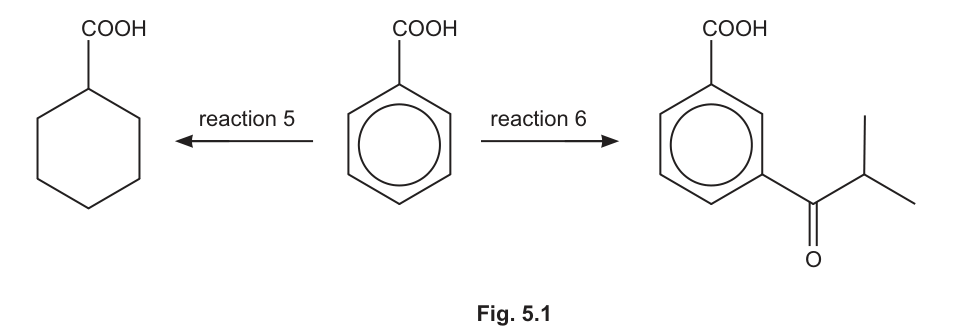
Suggest reagents and conditions for reaction 5 and for reaction 6 in Fig. 5.1.
reaction 5 ..........................................................................................................................
reaction 6 ..........................................................................................................................
Answer
Reaction 5: with or catalyst and heat.
Reaction 6: (isobutyryl chloride) with catalyst and heat.
Reaction 5: H2, Pt or Ni, heat. Reaction 6: (CH3)2CHCOCl, AlCl3, heat.
Background Concept
The benzene ring is unusually stable due to delocalisation, so it resists addition reactions that would break the π system. However, under forcing conditions, it can be hydrogenated to cyclohexane. Conversely, benzene readily undergoes electrophilic substitution reactions, such as Friedel-Crafts acylation, to attach alkyl or acyl groups to the ring without destroying the aromatic system.
Understanding the Question
Fig 5.1 shows two reactions of benzoic acid. Reaction 5 converts the benzene ring to a cyclohexane ring (ring hydrogenation). Reaction 6 adds an isobutyryl group () to the ring at the meta position (Friedel-Crafts acylation). We need to suggest the reagents and conditions for both.
Approach
For Reaction 5, recognise that converting an arene to an alicyclic ring requires catalytic hydrogenation. For Reaction 6, recognise that adding an acyl group () to an arene is a Friedel-Crafts acylation, which requires an acyl chloride and a Lewis acid catalyst.
Step-by-Step Reasoning
- Reaction 5: The product is cyclohexanecarboxylic acid. The benzene ring has been fully hydrogenated. Reagents for benzene hydrogenation are gas with a metal catalyst like or , and heat (since benzene is stable, higher temperatures/pressures are needed than for alkenes).
- Reaction 6: The product has an isobutyryl group () added to the ring. This is an acylation. The reagent for Friedel-Crafts acylation is an acyl chloride. The acyl group is , so the acyl chloride is (isobutyryl chloride or 2-methylpropanoyl chloride). The catalyst is a Lewis acid, typically (anhydrous), and heat is required.
Key Takeaways
- Benzene ring hydrogenation requires / or / heat.
- Friedel-Crafts acylation uses an acyl chloride () and catalyst.
Common Mistakes
- Using or for acylation (these are for halogenation; is standard for acylation/alkylation).
- Forgetting the catalyst or heat.
- Suggesting an alkyl halide for reaction 6 (that would give an alkyl group, not an acyl group).
Things to Be Careful About
- Ensure the acyl chloride formula matches the group added: comes from .
- State symbols are not strictly required here, but conditions (heat, catalyst) are essential marks.
Answer
Reduction (or hydrogenation).
Reduction (or hydrogenation)
Background Concept
Adding hydrogen to a molecule is a reduction reaction. In organic chemistry, hydrogenation of alkenes or arenes is a classic reduction process where the oxidation state of the carbon atoms decreases.
Understanding the Question
Reaction 5 converts benzoic acid to cyclohexanecarboxylic acid by adding across the benzene ring. We need to state the type of reaction.
Approach
The addition of to a double bond or aromatic ring is universally classified as reduction or hydrogenation.
Step-by-Step Reasoning
- The benzene ring () gains 6 hydrogen atoms to become a cyclohexane ring ().
- This is an addition of hydrogen, which is the definition of hydrogenation.
- In terms of redox, the carbon atoms gain electrons (bond to less electronegative H atoms), so it is also a reduction.
Key Takeaways
- Addition of to unsaturated systems is reduction/hydrogenation.
Common Mistakes
- Calling it an 'addition' reaction (while technically true, 'reduction' or 'hydrogenation' is the specific mark scheme term expected for arene ring saturation).
- Calling it 'oxidation'.
Things to Be Careful About
- Use the exact terms from the mark scheme: 'reduction' or 'hydrogenation'.
In the electrophilic substitution of arenes, different substituents can direct to different ring positions.
Answer
- The group directs incoming electrophiles to the 2-, 4- (and 6-) positions (ortho and para positions).
- This is because the alkyl group is an electron-donating group (by induction/hyperconjugation), which increases the electron density at the ortho and para positions of the ring, making them more attractive to electrophiles.
Directs to 2-, 4- (and 6-) positions; it is an electron-donating group.
Background Concept
Substituents already on a benzene ring influence where new substituents will attach in subsequent electrophilic substitution reactions. These are called directing groups. Electron-donating groups (EDGs) like alkyl groups activate the ring and direct ortho/para. Electron-withdrawing groups (EWGs) like or deactivate the ring and direct meta.
Understanding the Question
The question asks about the directing effect of an ethyl group () and requires an explanation based on electronic effects.
Approach
Recall that alkyl groups are activating and ortho/para-directing. Explain this by referencing their electron-donating nature via induction or hyperconjugation, which stabilises the intermediate carbocation at ortho/para positions.
Step-by-Step Reasoning
- Directing effect: Alkyl groups like are ortho/para directors. This means substitution occurs at positions 2, 4, and 6 relative to the substituent.
- Explanation: Alkyl groups push electron density into the ring through the sigma bonds (inductive effect) and through hyperconjugation. This increases the overall electron density of the ring (activating it) and specifically increases electron density at the ortho and para positions. Electrophiles are attracted to regions of high electron density, so they attack these positions.
Key Takeaways
- Alkyl groups are ortho/para directing and activating.
- The reason is electron donation (induction/hyperconjugation) increasing electron density at ortho/para positions.
Common Mistakes
- Saying alkyl groups are meta-directing (confusing with EWGs).
- Saying they are electron-withdrawing.
- Not explaining the link between electron density and electrophile attraction.
Things to Be Careful About
- The question asks to 'describe' (state the positions) and 'explain' (give the reason). Ensure both parts are answered.
- 'Electron-donating' is the key phrase required for the explanation.
The alkylation of arenes uses a mixture of and to generate the electrophile.
Write an equation for the formation of the electrophile.
Answer
CH3CH2Br + FeBr3 -> CH3CH2+ + FeBr4-
Background Concept
In Friedel-Crafts alkylation, a strong electrophile (carbocation) is needed to attack the electron-rich benzene ring. Alkyl halides are not electrophilic enough on their own, so a Lewis acid catalyst like or is used to polarise the C-Br bond and generate the carbocation.
Understanding the Question
Write the equation showing how reacts with to form the electrophile.
Approach
The Lewis acid () accepts a lone pair from the bromine in , weakening the C-Br bond and causing it to heterolytically cleave, releasing which complexes with to form , and leaving .
Step-by-Step Reasoning
- Reactants: and .
- The Br atom has lone pairs. is electron-deficient (Lewis acid).
- The Br donates a lone pair to Fe, forming a complex.
- The C-Br bond breaks heterolytically. Both electrons go to Br.
- Products: (ethyl carbocation electrophile) and (tetrabromoferrate(III) ion).
- Equation:
Key Takeaways
- Lewis acid catalysts generate electrophiles from alkyl halides.
- The byproduct is a complex halide ion like or .
Common Mistakes
- Writing on the right side of the equation (it is a catalyst, consumed in step 1 but regenerated later; in this specific equation showing electrophile formation, it is a reactant).
- Forgetting the charge on the ions.
- Writing instead of .
Things to Be Careful About
- Ensure charges are balanced: left side 0, right side (+1) + (-1) = 0.
- Use correct formulas for the complex ion: .
Complete the mechanism in Fig. 5.2.
Include all relevant curly arrows and charges. Draw the structure of the organic intermediate.
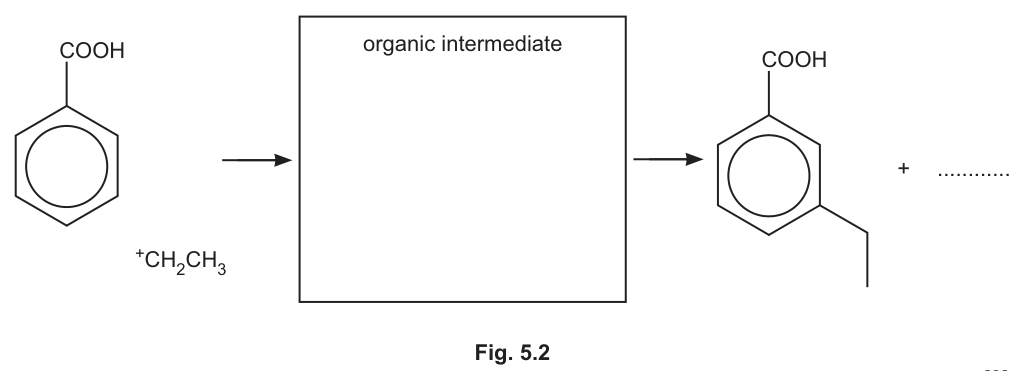
Answer
Step 1 (Electrophilic attack):
- Curly arrow from the centre of the benzene ring (or one of the double bonds) to the of the electrophile.
Intermediate (Sigma complex / Wheland intermediate):
- A cyclohexadienyl cation structure.
- The benzene ring has two double bonds and one hybridised carbon.
- The carbon is bonded to the original atom and the new group.
- The positive charge is delocalised within the ring (often shown as a '+' inside a broken circle or on one of the adjacent carbons).
Step 2 (Loss of proton / Rearomatisation):
- Curly arrow from the C-H bond (on the carbon) into the ring (to reform the double bond/delocalised system).
- The other product is (and is regenerated in the next step).
(See diagram for visual representation)
Curly arrow from ring to C+; intermediate is cyclohexadienyl cation with CH2CH3 and H on same C; curly arrow from C-H bond into ring; product is H+.
Background Concept
Electrophilic substitution in arenes occurs in two main steps:
- Electrophilic attack: The electrophile () attacks the delocalised π system, forming a sigma bond with one carbon. This breaks the aromaticity, creating a positively charged intermediate called a sigma complex or Wheland intermediate. The carbon attacked becomes hybridised.
- Loss of proton: A base (often the catalyst complex like ) removes the proton from the carbon. The electrons from the C-H bond move back into the ring to restore the delocalised π system (rearomatisation), releasing (or if the base is ).
Understanding the Question
Complete the mechanism for the electrophilic substitution of benzoic acid with the ethyl carbocation (). We need to show the attack, draw the intermediate, and show the rearomatisation step.
Approach
- Draw a curly arrow from the benzene π system to the electrophile.
- Draw the intermediate: a ring with two double bonds, an carbon bonded to H and , and a positive charge delocalised in the ring.
- Draw a curly arrow from the C-H bond to reform the π system, releasing .
Step-by-Step Reasoning
- Attack: The benzene ring is electron-rich. Draw a curly arrow starting from inside the ring (representing the π electrons) pointing to the positive carbon of . This forms a C-C bond.
- Intermediate Structure: The carbon that was attacked is now hybridised. It is bonded to the ring carbons, the original H atom, and the new group. The ring now has only two double bonds (conjugated diene system) and a positive charge. In CIE mark schemes, drawing the '+' inside a broken circle within the ring is often accepted to show delocalisation, or placing it on an adjacent carbon. The key is showing the carbon with both H and .
- Rearomatisation: To restore aromaticity, the H atom must leave as . Draw a curly arrow from the C-H bond (on the carbon) pointing into the ring (towards the adjacent double bond or into the ring system). This reforms the π bond. The product shown is 3-ethylbenzoic acid (meta product, directed by the electron-withdrawing COOH group) and .
Key Takeaways
- The intermediate in electrophilic substitution is a sigma complex (Wheland intermediate) with an carbon.
- Rearomatisation involves loss of and electrons moving back into the ring.
- Curly arrows must show the movement of electron pairs.
Common Mistakes
- Drawing the intermediate with three double bonds (wrong, aromaticity is lost).
- Forgetting the H atom on the carbon in the intermediate.
- Drawing the curly arrow for rearomatisation from the C-C bond instead of the C-H bond.
- Not showing the charge on the intermediate.
Things to Be Careful About
- The question asks for 'all relevant curly arrows and charges'.
- Ensure the intermediate structure matches the product: if the product is 3-ethylbenzoic acid (meta), the ethyl group and H must be at position 3 in the intermediate.
- The blank space after the product is for .
Answer
H+ + FeBr4- -> HBr + FeBr3
Background Concept
In electrophilic substitution using a Lewis acid catalyst (like or ), the catalyst is consumed in the first step to generate the electrophile, forming a complex ion (e.g., ). In the final step, when the proton () is lost from the intermediate to restore aromaticity, it reacts with the complex ion to release the catalyst and form the byproduct (e.g., or ).
Understanding the Question
Write the equation showing how is regenerated after the reaction in Fig 5.2. The reaction produced and (from the electrophile generation step).
Approach
The released in the rearomatisation step combines with the complex ion. The takes a from the complex, forming and leaving behind the regenerated catalyst.
Step-by-Step Reasoning
- Reactants: The proton (from the intermediate) and the tetrabromoferrate(III) ion (from step 1).
- Reaction: reacts with one of the ligands on the iron complex.
- Products: Hydrogen bromide () and the regenerated catalyst, anhydrous iron(III) bromide ().
- Equation:
Key Takeaways
- Lewis acid catalysts are regenerated in the final step of electrophilic substitution.
- The byproduct is a hydrogen halide (e.g., , ).
Common Mistakes
- Writing (forgetting that the is part of the complex in this context, though the net result is similar, the mark scheme specifically looks for the interaction with ).
- Forgetting to balance the equation (charges and atoms).
- Writing as a reactant instead of a product.
Things to Be Careful About
- Ensure charges are balanced: left side (+1) + (-1) = 0; right side 0 + 0 = 0.
- Use correct formulas: , not or similar.
- State symbols are not required here.
Compound is used in organic synthesis.
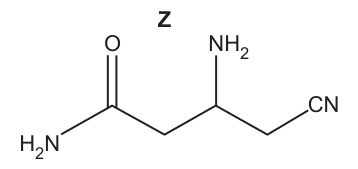
Complete Table 6.1 to show the number of , and hybridised carbon atoms present in one molecule of .
Table 6.1
| type of hybridisation | |||
|---|---|---|---|
| number of carbon atoms |
Answer
| type of hybridisation | sp | sp² | sp³ |
|---|---|---|---|
| number of carbon atoms | 1 | 1 | 3 |
sp = 1, sp² = 1, sp³ = 3
Background Concept
Carbon atoms can be hybridised as sp, sp², or sp³ depending on their bonding:
- sp³: Carbon with four single bonds (tetrahedral geometry, ~109.5°).
- sp²: Carbon with one double bond and two single bonds (trigonal planar, ~120°). This includes carbons in C=C, C=O, and aromatic rings.
- sp: Carbon with one triple bond and one single bond, or two double bonds (linear, 180°). This includes nitriles (C≡N) and alkynes (C≡C).
Understanding the Question
We are given the structure of compound Z: H₂N–CO–CH₂–CH(NH₂)–CH₂–CN. We need to count how many carbons fall into each hybridisation category.
Approach
Identify the bonding environment for each carbon atom in the chain:
- C in C=O (amide): Double bond to O, single to N, single to C. -> sp².
- CH₂ (next to C=O): Four single bonds (2 to C, 2 to H). -> sp³.
- CH (with NH₂): Four single bonds (1 to C, 1 to C, 1 to N, 1 to H). -> sp³.
- CH₂ (next to CN): Four single bonds (1 to C, 1 to C, 2 to H). -> sp³.
- C in CN (nitrile): Triple bond to N, single to C. -> sp.
Step-by-Step Reasoning
- sp carbon: The carbon in the nitrile group (–C≡N). Count = 1.
- sp² carbon: The carbonyl carbon in the amide group (H₂N–C(=O)–). Count = 1.
- sp³ carbons: The three saturated carbons in the chain (–CH₂–, –CH–, –CH₂–). Count = 3.
Key Takeaways
- Amide carbonyl carbons are sp² hybridised.
- Nitrile carbons are sp hybridised.
- Alkyl chain carbons with only single bonds are sp³ hybridised.
Common Mistakes
- Forgetting that the nitrile carbon is sp hybridised.
- Counting the nitrogen atoms or other atoms as carbons.
- Misidentifying the amide carbon as sp³ (it has a double bond to oxygen).
Things to Be Careful About
- Ensure you are only counting carbon atoms.
- Remember that the carbon in C=O is sp², not sp³.
can undergo different reactions, as shown in Fig. 6.1.
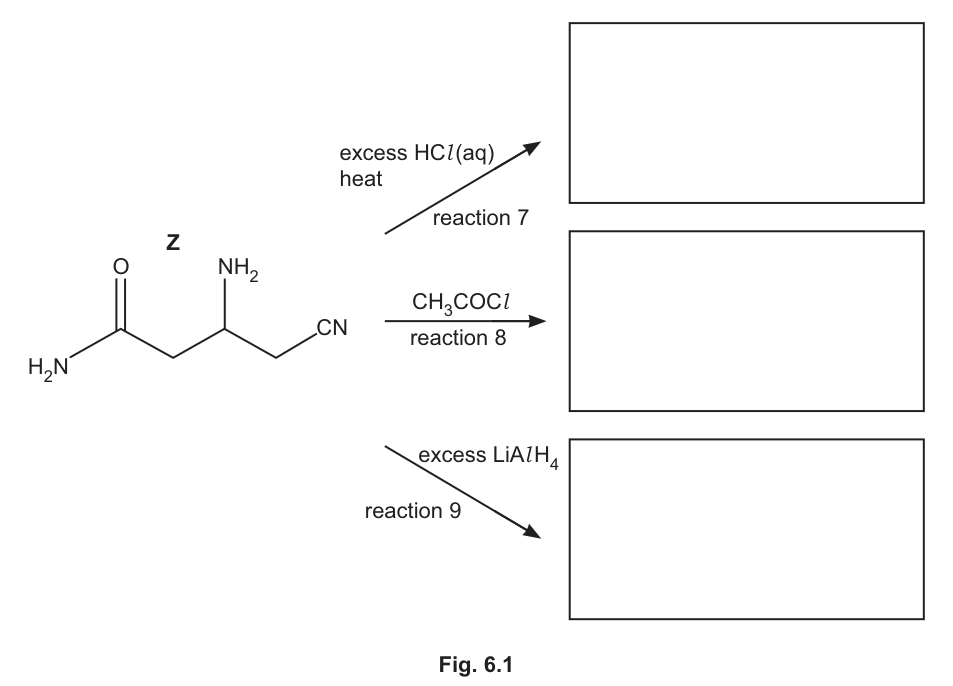
Answer
Acid-base (neutralisation) and hydrolysis.
acid-base and hydrolysis
Background Concept
- Amines are basic due to the lone pair on nitrogen. They react with acids (like HCl) to form ammonium salts. This is an acid-base reaction.
- Amides (R–CONH₂) and nitriles (R–CN) undergo hydrolysis in the presence of aqueous acid and heat.
- Amide hydrolysis: R–CONH₂ + H₂O + H⁺ → R–COOH + NH₄⁺
- Nitrile hydrolysis: R–CN + 2H₂O + H⁺ → R–COOH + NH₄⁺
Understanding the Question
Reaction 7 uses excess HCl(aq) and heat. We need to name the types of reaction occurring.
Approach
Look at the functional groups in Z:
- –NH₂ (amine): Reacts with acid HCl. -> Acid-base / neutralisation.
- –CONH₂ (amide): Hydrolyses to carboxylic acid and ammonium ion. -> Hydrolysis.
- –CN (nitrile): Hydrolyses to carboxylic acid and ammonium ion. -> Hydrolysis.
Step-by-Step Reasoning
The amine group acts as a base and accepts a proton from HCl. The amide and nitrile groups react with water (hydrolysis) catalysed by the acid heat. Thus, the two reaction types are acid-base (or neutralisation) and hydrolysis.
Key Takeaways
- Amines are basic and undergo neutralisation with acids.
- Amides and nitriles undergo acid-catalysed hydrolysis to carboxylic acids.
Common Mistakes
- Saying 'substitution' instead of 'hydrolysis'.
- Forgetting that the amine reaction is acid-base.
Things to Be Careful About
- The question asks for types of reaction, not specific mechanism names.
Answer
Reaction 7 (excess HCl, heat):
HOOC–CH₂–CH(NH₃⁺Cl⁻)–CH₂–COOH
Reaction 8 (CH₃COCl):
H₂N–CO–CH₂–CH(NHCOCH₃)–CH₂–CN
Reaction 9 (excess LiAlH₄):
H₂N–CH₂–CH₂–CH(NH₂)–CH₂–CH₂–NH₂
See working for structures
Background Concept
- Hydrolysis of amides/nitriles with acid: Produces carboxylic acid and ammonium salt.
- Acylation of amines: Amines react with acyl chlorides (CH₃COCl) to form amides. The lone pair on nitrogen attacks the carbonyl carbon.
- Reduction by LiAlH₄: A strong reducing agent.
- Reduces amides (R–CONH₂) to primary amines (R–CH₂NH₂).
- Reduces nitriles (R–CN) to primary amines (R–CH₂NH₂).
- Does not reduce isolated C=C or benzene rings, but reduces polar multiple bonds.
Understanding the Question
Draw the organic products for three reactions starting from Z (H₂N–CO–CH₂–CH(NH₂)–CH₂–CN).
Approach
Analyze each reagent's effect on the functional groups:
-
Reaction 7 (excess HCl, heat):
- Amide (H₂N–CO–) hydrolyses to carboxylic acid (HO–CO–) and NH₄⁺.
- Nitrile (–CN) hydrolyses to carboxylic acid (–COOH) and NH₄⁺.
- Amine (–NH₂) is protonated to –NH₃⁺Cl⁻.
- Product: HOOC–CH₂–CH(NH₃⁺Cl⁻)–CH₂–COOH.
-
Reaction 8 (CH₃COCl):
- Acyl chloride reacts with the most nucleophilic group: the aliphatic amine (–NH₂).
- Amide nitrogen is less nucleophilic due to resonance with C=O.
- Product: H₂N–CO–CH₂–CH(NHCOCH₃)–CH₂–CN.
-
Reaction 9 (excess LiAlH₄):
- Reduces amide (H₂N–CO–) to amine (H₂N–CH₂–).
- Reduces nitrile (–CN) to amine (–CH₂NH₂).
- Existing amine (–NH₂) is unchanged.
- Product: H₂N–CH₂–CH₂–CH(NH₂)–CH₂–CH₂–NH₂.
Step-by-Step Reasoning
- Reaction 7: The acid hydrolyses both the amide and nitrile groups to carboxylic acids. The basic amine group picks up a proton from the excess acid to form a chloride salt. Structure: HOOC–CH₂–CH(NH₃⁺Cl⁻)–CH₂–COOH.
- Reaction 8: The acyl chloride acylates the primary amine group (–NH₂) to form an amide (–NHCOCH₃). The amide and nitrile groups do not react under these conditions. Structure: H₂N–CO–CH₂–CH(NHCOCH₃)–CH₂–CN.
- Reaction 9: LiAlH₄ reduces the carbonyl of the amide to a methylene group (–CH₂–) and the nitrile to a methylene group with an amine (–CH₂NH₂). The central amine is unaffected. Structure: H₂N–CH₂–CH₂–CH(NH₂)–CH₂–CH₂–NH₂.
Key Takeaways
- Acid hydrolysis converts amides and nitriles to carboxylic acids and protonates amines.
- Acyl chlorides acylate amines to amides.
- LiAlH₄ reduces amides and nitriles to amines.
Common Mistakes
- Forgetting to protonate the amine in reaction 7 (leaving it as –NH₂ instead of –NH₃⁺Cl⁻).
- Reducing the amide incorrectly (e.g., to an alcohol instead of an amine).
- Acylating the amide nitrogen in reaction 8 instead of the amine nitrogen.
Things to Be Careful About
- Ensure structures are fully drawn with all atoms/bonds shown clearly.
- In reaction 7, the product is a salt (chloride), so include Cl⁻ or write it as a zwitterion/salt form correctly.
Compound is dissolved in and analysed by carbon-13 NMR and proton () NMR spectroscopy.
Answer
5
5
Background Concept
Carbon-13 NMR spectroscopy shows a peak for each chemically distinct carbon environment. Symmetry in a molecule can make carbons equivalent, reducing the number of peaks.
Understanding the Question
Predict the number of peaks in the ¹³C NMR spectrum of Z.
Approach
Examine the structure of Z: H₂N–CO–CH₂–CH(NH₂)–CH₂–CN.
- The molecule has a chiral centre at the carbon with the –NH₂ group (C3 if numbering from right, or C3 from left). Because it is chiral, there is no plane of symmetry.
- All 5 carbons are in different environments:
- C=O (amide)
- CH₂ (alpha to amide)
- CH (with amine)
- CH₂ (alpha to nitrile)
- C≡N (nitrile)
Step-by-Step Reasoning
Since there is no symmetry, all 5 carbon atoms are in unique environments. Therefore, there are 5 peaks.
Key Takeaways
- Chiral molecules generally lack symmetry, leading to more peaks in NMR.
- Count distinct carbon environments, not just types of functional groups.
Common Mistakes
- Assuming symmetry where there is none (e.g., thinking the two CH₂ groups are equivalent).
- Forgetting the nitrile carbon or carbonyl carbon as a distinct environment.
Things to Be Careful About
- Ensure you count every carbon, including those in functional groups like C=O and C≡N.
The proton () NMR spectrum of in gives three peaks for the proton environments, labelled , and , as shown on Fig. 6.2.
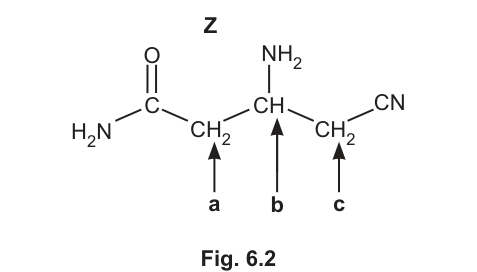
Complete Table 6.2 for the proton () NMR spectrum of in .
Table 6.2
| proton environment | |||
|---|---|---|---|
| name of splitting pattern | |||
| chemical shift range, |
Table 6.3
| environment of proton | example | chemical shift range, |
|---|---|---|
| alkane | , , | |
| alkyl next to | , , | |
| alkyl next to nitrile | ||
| alkyl next to electronegative atom | , , | |
| attached to alkene | ||
| alkyl amine | ||
| amide |
Answer
| proton environment | a | b | c |
|---|---|---|---|
| name of splitting pattern | doublet | multiplet | doublet |
| chemical shift range, / ppm | 2.2–3.0 | 3.2–4.0 | 2.0–3.0 |
See table
Background Concept
- Splitting (n+1 rule): A proton environment is split by protons on adjacent carbons. If there are adjacent protons, the peak is split into peaks.
- Chemical Shift (): Depends on the electronic environment. Electronegative atoms or pi systems deshield protons, shifting them downfield (higher ppm).
- D₂O exchange: Protons attached to heteroatoms like O or N (e.g., –NH₂, –OH) exchange with deuterium in D₂O and disappear from the ¹H NMR spectrum (or appear as broad peaks that are often ignored in simple analysis). Amide protons can also exchange, but the question specifies only environments a, b, c are labelled and considered.
Understanding the Question
Complete the table for environments a, b, c in compound Z dissolved in D₂O. Use the provided data table for shifts.
Approach
- Identify the splitting for each labelled CH group based on neighbours.
- Identify the chemical shift range using the provided table and the specific group next to the CH.
Step-by-Step Reasoning
-
Environment a (–CH₂– next to C=O):
- ** neighbours**: The adjacent carbon is b (–CH–), which has 1 proton. So , splitting = (doublet).
- Shift: Table says "alkyl next to C=O" is 2.2–3.0 ppm.
-
Environment b (–CH– next to –NH₂):
- ** neighbours**: Adjacent carbons are a (–CH₂–, 2 protons) and c (–CH₂–, 2 protons). Total . Splitting = (quintet), but often described as a multiplet in mark schemes for complex coupling or when exact splitting isn't simple. The mark scheme accepts "multiplet".
- Shift: Table says "alkyl next to electronegative atom" (N is electronegative) is 3.2–4.0 ppm.
-
Environment c (–CH₂– next to –CN):
- ** neighbours**: Adjacent carbon is b (–CH–), which has 1 proton. So , splitting = (doublet).
- Shift: Table says "alkyl next to nitrile" is 2.0–3.0 ppm.
-
Note on D₂O: The –NH₂ protons (on the amine and amide) exchange with D₂O and do not appear as the labelled peaks a, b, c. The question asks for the table for a, b, c only.
Key Takeaways
- Use the n+1 rule for splitting.
- Use the provided table to match functional groups to shift ranges.
- Remember D₂O removes exchangeable protons (NH, OH).
Common Mistakes
- Incorrectly counting neighbours for splitting (e.g., counting protons on the same carbon).
- Using the wrong shift range (e.g., using alkane range for a carbon next to C=O).
- Forgetting that the amine protons exchange and don't show up (though the question guides us to a, b, c).
Things to Be Careful About
- The shift for b is next to Nitrogen. The table gives "alkyl next to electronegative atom" as 3.2-4.0 ppm. Nitrogen is electronegative.
- Splitting for b: neighbours are 2 (from a) + 2 (from c) = 4. 4+1=5 (quintet). However, mark schemes often accept "multiplet" for complex coupling patterns involving different coupling constants. Stick to the mark scheme's accepted answer: multiplet.
Phenylmethanol and 4-methylphenol are isomers.
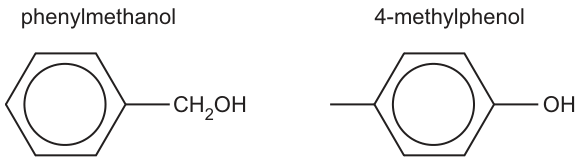
Complete Table 7.1 to show the relative acidities of benzoic acid (), phenylmethanol, 4-methylphenol and water.
Explain your answer.
Table 7.1
| name of compound | |
|---|---|
| most acidic | |
| least acidic |
Answer
Order of acidity (most to least acidic):
| Position | Compound |
|---|---|
| Most acidic | Benzoic acid |
| 2nd | 4-methylphenol |
| 3rd | Water |
| Least acidic | Phenylmethanol |
Explanation:
- Benzoic acid is most acidic because the negative charge on the carboxylate anion is delocalised (resonance) across two electronegative oxygen atoms, stabilising the conjugate base and making H⁺ more easily lost.
- 4-methylphenol is more acidic than water because the lone pair on oxygen in the phenoxide ion is delocalised into the benzene ring π system, stabilising the conjugate base.
- Phenylmethanol is the least acidic because the group (alkyl group) exerts a positive inductive effect (+I), destabilising the alkoxide conjugate base and making H⁺ less readily lost.
Most acidic: benzoic acid > 4-methylphenol > water > phenylmethanol (least acidic). Benzoic acid: –COO⁻ charge delocalised over two O atoms. 4-methylphenol: lone pair on O delocalised into ring π system. Phenylmethanol: +I effect of alkyl group destabilises conjugate base.
Background Concept
Acidity in organic chemistry is determined by the stability of the conjugate base formed when a proton (H⁺) is lost. The more stable the conjugate base (anion), the stronger the acid. Two key factors stabilise anions:
- Resonance (delocalisation): spreading the negative charge over multiple atoms, especially electronegative ones like oxygen.
- Inductive effects: electron-withdrawing groups stabilise negative charge; electron-donating groups (such as alkyl groups) destabilise it.
For compounds with an O–H bond (carboxylic acids, phenols, alcohols, water), the acid strength depends on how well the resulting oxygen-centred anion is stabilised.
Understanding the Question
The question asks you to rank four compounds by acidity and explain the ranking. The compounds are:
- Benzoic acid () — a carboxylic acid
- 4-methylphenol — a phenol (–OH directly attached to the ring)
- Water — the reference compound
- Phenylmethanol — an alcohol (–OH on a group attached to the ring, not directly on the ring)
The command word is "explain," so each ranking point must carry a structural reason.
Approach
Identify the conjugate base of each compound and assess its stability:
- Carboxylate anion: charge shared over two oxygens by resonance → very stable → strongest acid.
- Phenoxide anion: charge delocalised into the aromatic π system → moderately stable.
- Hydroxide ion: no additional stabilisation beyond oxygen's electronegativity.
- Alkoxide (from phenylmethanol): the group has a +I effect that pushes electron density toward the already negatively charged oxygen → destabilises the anion → weakest acid.
Step-by-Step Reasoning
Benzoic acid (most acidic):
When benzoic acid loses H⁺, the benzoate anion forms. The negative charge is delocalised equally over two oxygen atoms through resonance. This is the most effective stabilisation among the four conjugate bases, so benzoic acid is the strongest acid.
4-methylphenol (second):
When 4-methylphenol loses H⁺, the 4-methylphenoxide anion forms. The lone pair on oxygen can overlap with the p orbitals of the aromatic ring, delocalising electron density into the π system. This provides significant (though less than carboxylate) stabilisation. Note: the methyl group at position 4 has a slight +I effect, but the dominant factor is the resonance stabilisation of the phenoxide.
Water (third):
Water loses H⁺ to form OH⁻. The negative charge is localised on one oxygen atom with no additional delocalisation or stabilisation. This is less stable than the phenoxide ion, so water is less acidic than 4-methylphenol.
Phenylmethanol (least acidic):
Phenylmethanol loses H⁺ to form . The negative charge is on a single oxygen with no resonance stabilisation into the ring (the group acts as a spacer, preventing overlap of the oxygen lone pair with the ring π system). Additionally, the alkyl group exerts a positive inductive effect (+I), pushing electron density toward the negatively charged oxygen, further destabilising the anion. This makes phenylmethanol the weakest acid — even weaker than water.
Key Takeaways
- Carboxylic acids > phenols > water > alcohols is the general order of acidity for O–H compounds.
- The key to explaining acidity is always the stability of the conjugate base.
- Resonance delocalisation over two electronegative atoms (as in carboxylate) is the strongest stabilising factor.
- Delocalisation into an aromatic ring (as in phenoxide) provides moderate stabilisation.
- Alkyl groups destabilise anions via +I effect, making alcohols weaker acids than water.
Common Mistakes
- Confusing phenylmethanol with a phenol: the –OH is NOT directly on the ring, so there is no resonance stabilisation of the conjugate base into the ring.
- Saying the methyl group in 4-methylphenol makes it less acidic than phenol without acknowledging it is still more acidic than water — the question compares it to water, not to unsubstituted phenol.
- Failing to link the explanation to conjugate base stability (the mark scheme requires this link explicitly).
- Saying "the O–H bond is stronger" without explaining why in terms of anion stability.
Things to Be Careful About
- The mark scheme requires a general statement about conjugate base stability (M2) AND two specific structural reasons (M3, M4). Missing the general link costs a mark even if the specific reasons are correct.
- For phenylmethanol, the key point is the +I effect of the alkyl group destabilising the anion — do not say the ring stabilises it (it doesn't, because of the spacer).
- Use precise language: "delocalised across two oxygen atoms," "lone pair on oxygen overlaps with the ring π system," "positive inductive effect."
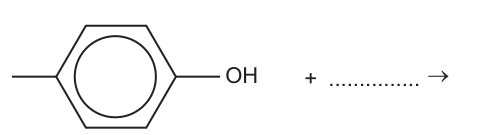
Answer
In structural form: the –OH group is replaced by –ONa, and hydrogen gas is evolved.
4-methylphenol + Na → sodium 4-methylphenoxide + 1/2 H₂
Background Concept
Phenols react with reactive metals such as sodium to produce the corresponding sodium phenoxide salt and hydrogen gas. This is analogous to the reaction of alcohols with sodium, but phenols react more readily because they are more acidic than alcohols (the phenoxide ion is resonance-stabilised).
The general reaction is:
Understanding the Question
The question provides the skeletal structure of 4-methylphenol and asks you to complete the equation by adding the missing reactant (Na) and the products. The mark scheme shows the equation written with 1/2 H₂ (i.e. using one mole of phenol and one mole of sodium), which is an acceptable way to balance it.
Approach
Identify that sodium metal reacts with the acidic O–H proton of the phenol. The products are the sodium salt (sodium 4-methylphenoxide, where –OH becomes –ONa) and hydrogen gas.
Step-by-Step Reasoning
- The O–H bond in phenol is sufficiently acidic to react with sodium metal.
- Sodium displaces hydrogen from the hydroxyl group, forming the ionic compound sodium 4-methylphenoxide ().
- The displaced hydrogen atoms combine to form gas.
- The equation can be written with fractional coefficients (1/2 H₂) or doubled to give whole numbers.
Key Takeaways
- Phenols react with sodium to give sodium phenoxide and hydrogen gas.
- This reaction demonstrates the acidic nature of phenols (they react with metals like acids do).
- The skeletal structure shows the –OH group converted to –ONa.
Common Mistakes
- Forgetting to include hydrogen gas as a product.
- Writing the product as a covalent structure rather than showing –ONa (the ionic salt).
- Using incorrect balancing (though the mark scheme accepts the 1/2 H₂ form).
Things to Be Careful About
- The mark scheme accepts the equation written with 1/2 H₂. If writing with whole numbers, use 2 phenol + 2 Na → 2 sodium phenoxide + H₂.
- Ensure the methyl group position is maintained in the product structure.
Under certain conditions, ethane-1,2-diol, , reacts with propane-1,3-dioic acid, , to form different organic products, as shown in Fig. 7.1.
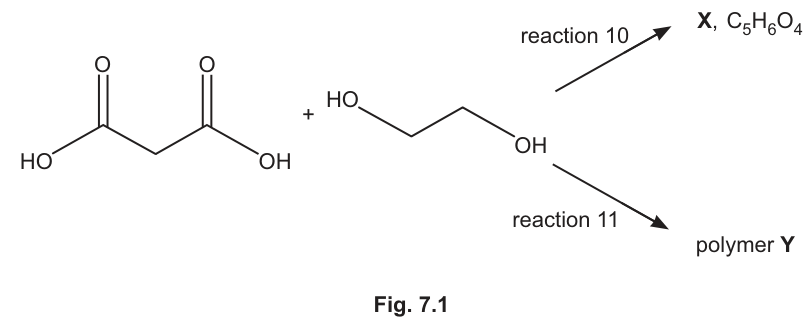
does not react with metal.
Draw the structure of the organic product , , shown in Fig. 7.1.
Answer
X is a cyclic diester (dilactone) formed by intramolecular double esterification of propane-1,3-dioic acid with ethane-1,2-diol. The structure is a nine-membered ring containing two ester linkages:
Molecular formula: ✓ (consistent with loss of 2 H₂O from ).
Cyclic diester (dilactone): a nine-membered ring with two ester groups, structure -C(=O)-CH₂-C(=O)-O-CH₂-CH₂-O- forming a closed ring. Molecular formula C₅H₆O₄.
Background Concept
When a dicarboxylic acid reacts with a diol, two types of product are possible:
- Intermolecular reaction (polymerisation): many molecules join end-to-end to form a polyester.
- Intramolecular reaction (cyclisation): one molecule of diacid reacts with one molecule of diol at both ends to form a cyclic diester (a dilactone).
The question states that X does not react with Na metal, confirming there are no free –OH or –COOH groups remaining — all four reactive groups have participated in ester formation.
Understanding the Question
Given: propane-1,3-dioic acid (HOOC–CH₂–COOH) + ethane-1,2-diol (HO–CH₂–CH₂–OH) → X, C₅H₆O₄.
The molecular formula C₅H₆O₄ tells us:
- Starting materials: C₃H₄O₄ + C₂H₆O₂ = C₅H₁₀O₆
- Product: C₅H₆O₄
- Difference: H₄O₂ = 2 H₂O lost
This confirms two ester bonds have formed (each esterification loses one H₂O), and since only one molecule of each reactant is involved, the product must be cyclic.
Approach
- Calculate the number of water molecules lost: (C₅H₁₀O₆) − (C₅H₆O₄) = 2 H₂O.
- Two ester bonds formed from one diacid + one diol → cyclic diester.
- Draw the ring: connect both –COOH groups to both –OH groups, forming a ring.
Step-by-Step Reasoning
The ring is formed as follows:
- One –COOH of the diacid reacts with one –OH of the diol → ester bond + H₂O
- The other –COOH reacts with the other –OH → second ester bond + H₂O
- The result is a closed ring: –C(=O)–CH₂–C(=O)–O–CH₂–CH₂–O– (cyclic)
Counting atoms in the ring: 5 C, 6 H, 4 O = C₅H₆O₄ ✓
The ring size: C(=O) + CH₂ + C(=O) + O + CH₂ + CH₂ + O = 7 atoms in the ring backbone (9-membered ring if counting all atoms including the carbonyl carbons and oxygens).
Key Takeaways
- A cyclic diester (dilactone) forms when a diacid and diol undergo intramolecular double esterification.
- The molecular formula allows you to determine how many water molecules are lost and hence how many bonds form.
- The absence of reaction with Na confirms no free –OH or –COOH groups remain.
Common Mistakes
- Drawing an open-chain diester instead of a cyclic structure.
- Incorrectly counting atoms and getting the wrong ring size.
- Forgetting that the –CH₂– between the two carbonyls must be included in the ring.
Things to Be Careful About
- The ring must contain BOTH ester linkages (–C(=O)–O–) and the –CH₂– spacer from the diacid.
- Ensure the molecular formula matches: C₅H₆O₄.
Reactions 10 and 11 in Fig. 7.1 are different types of reaction.
Name the type of reaction for reaction 10 and for reaction 11.
reaction 10 ........................................................................................................................
reaction 11 ........................................................................................................................
Answer
Reaction 10: Condensation (esterification) / addition–elimination
Reaction 11: Condensation polymerisation (polyesterification) / addition–elimination
Reaction 10: condensation (esterification); Reaction 11: condensation polymerisation
Background Concept
Both reactions involve the formation of ester bonds between a carboxylic acid and an alcohol, which is a condensation reaction (small molecule, H₂O, is eliminated) proceeding via an addition–elimination mechanism.
The difference lies in the product:
- Reaction 10 produces a single cyclic molecule (X) — this is a simple condensation/esterification.
- Reaction 11 produces a polymer (Y) — this is a condensation polymerisation, where many monomer units join end-to-end, each linkage formed by loss of water.
Understanding the Question
The question asks you to name the type of reaction for each. Both involve ester bond formation, but one forms a discrete cyclic product and the other forms a long-chain polymer.
Approach
Identify the common mechanism (condensation/esterification/addition-elimination) and then distinguish by whether the product is a single molecule or a polymer.
Step-by-Step Reasoning
Reaction 10: A diacid reacts with a diol to form a cyclic diester. This is a condensation reaction (esterification). The mechanism is addition–elimination at the carbonyl carbon.
Reaction 11: The same monomers react intermolecularly, with each –COOH reacting with an –OH of a different molecule, building a long chain. This is condensation polymerisation (specifically, polyesterification). The mechanism at each linkage is still addition–elimination.
Key Takeaways
- Condensation and condensation polymerisation share the same mechanism (addition–elimination) but differ in product size.
- Both are types of esterification.
- The mark scheme accepts multiple valid names for each reaction type.
Common Mistakes
- Saying reaction 10 is 'addition' (it is addition–elimination, or condensation).
- Not distinguishing between simple condensation and condensation polymerisation.
Things to Be Careful About
- The mark scheme requires BOTH names to be correct for the single mark. Acceptable answers include: condensation, esterification, addition–elimination for reaction 10; condensation polymerisation, polyesterification, addition–elimination for reaction 11.
Draw a section of polymer showing only one repeat unit.
The new functional group formed should be displayed.
Answer
The repeat unit is: with continuation bonds (dashed lines) at both ends.
Repeat unit: -C(=O)-CH₂-C(=O)-O-CH₂-CH₂-O- with continuation bonds at both ends, ester linkage displayed showing C=O and C-O-C
Background Concept
A condensation polymer forms when bifunctional monomers react repeatedly, each reaction eliminating a small molecule (water). The repeat unit of a polyester contains the ester linkage (–COO–) formed between the diacid and the diol.
For propane-1,3-dioic acid + ethane-1,2-diol:
- The diacid contributes: –C(=O)–CH₂–C(=O)–
- The diol contributes: –O–CH₂–CH₂–O–
- Together they form the repeat unit with ester links at both ends.
Understanding the Question
Draw ONE repeat unit of polymer Y. The ester functional group must be displayed (show the C=O and C–O–C bonds explicitly, not abbreviated as –COO–). Continuation bonds (short dashed lines) must appear at both ends to show the chain continues.
Approach
- Identify the ester linkage formed between –COOH and –OH.
- Build the repeat unit by connecting the diacid residue to the diol residue.
- Display the ester group fully and add continuation bonds.
Step-by-Step Reasoning
Starting from the monomers:
- HOOC–CH₂–COOH loses two H (from –OH of each COOH)
- HO–CH₂–CH₂–OH loses two OH (from each –OH)
- The remaining fragments join: –C(=O)–CH₂–C(=O)–O–CH₂–CH₂–O–
This is the repeat unit. The ester linkage is –C(=O)–O– and must be shown explicitly with the double bond on carbon and the single bond to oxygen.
Key Takeaways
- The repeat unit of a polyester shows the full ester linkage with C=O displayed.
- Continuation bonds at both ends indicate the polymer chain extends in both directions.
- The repeat unit contains contributions from BOTH monomers.
Common Mistakes
- Not showing the ester linkage explicitly (writing –COO– instead of –C(=O)–O–).
- Forgetting continuation bonds at both ends.
- Including the eliminated water molecule in the structure.
- Drawing the repeat unit with incorrect number of carbons (the diacid contributes 3 carbons, the diol contributes 2 carbons).
Things to Be Careful About
- The mark scheme awards M1 for showing the ester linkage correctly and M2 for the rest of the structure being correct with continuation bonds.
- The ester group must be 'displayed' — meaning show the C=O double bond and the C–O single bond explicitly.
- Ensure the –CH₂– from the diacid is between the two carbonyl groups.
Describe the difference in reactivity between ethanoyl chloride and chlorobenzene with water.
Explain your answer.
Answer
Chlorobenzene is less reactive than ethanoyl chloride towards water.
In chlorobenzene, the lone pair on the chlorine atom overlaps with the system of the benzene ring (delocalisation into the ring), giving the C–Cl bond partial double-bond character and strengthening it, making it harder to break.
In ethanoyl chloride, the electron-withdrawing C=O group makes the carbonyl carbon highly electron-deficient and weakens the C–Cl bond, making it more susceptible to nucleophilic attack by water.
Chlorobenzene is less reactive because delocalisation of the Cl lone pair into the ring gives partial double-bond character to C–Cl, strengthening it. Ethanoyl chloride has an electron-deficient carbonyl carbon and a weakened C–Cl bond.
Background Concept
The reactivity of a C–Cl bond towards nucleophilic substitution depends on two key factors: (1) the strength of the C–Cl bond itself, and (2) the electrophilicity of the carbon atom to which the chlorine is attached. In halogenoarenes such as chlorobenzene, the lone pair on the halogen can overlap with the -electron system of the aromatic ring through p-orbital conjugation. This delocalisation gives the C–Cl bond partial double-bond character, making it shorter and stronger than a normal C–Cl single bond. In acyl chlorides such as ethanoyl chloride, the adjacent carbonyl group is strongly electron-withdrawing due to the electronegative oxygen, which polarises the C–Cl bond and makes the carbonyl carbon highly electrophilic.
Understanding the Question
The question asks for both a description of the difference in reactivity (which compound reacts more readily with water) and an explanation of why. The command word "describe" requires the observation, while "explain" requires the underlying electronic reasoning. Two marks are available for any two of the three key points.
Approach
First, state which is more reactive. Then provide the electronic explanation for chlorobenzene's low reactivity (lone pair delocalisation into the ring → partial double bond → stronger C–Cl bond). Finally, contrast with ethanoyl chloride (electron-withdrawing C=O → electron-deficient carbon → weakened C–Cl bond → susceptible to nucleophilic attack).
Step-by-Step Reasoning
-
Observation: Chlorobenzene does not react with water under normal conditions, whereas ethanoyl chloride reacts vigorously (fuming, producing HCl and ethanoic acid). So chlorobenzene is less reactive.
-
Explanation for chlorobenzene: The chlorine atom has lone pairs in p orbitals that can overlap side-on with the system of the benzene ring. This conjugation delocalises electron density from Cl into the ring, giving the C–Cl bond partial double-bond character. A partial double bond is shorter and stronger than a pure single bond, so it is much harder to break, and nucleophilic substitution does not occur readily.
-
Explanation for ethanoyl chloride: The carbonyl group (C=O) contains a highly electronegative oxygen that withdraws electron density from the carbon. This makes the carbonyl carbon strongly (electron-deficient), attracting nucleophiles like water. Additionally, the C–Cl bond is weakened because the carbon is already electron-poor. The combination of a strong electrophilic centre and a good leaving group (Cl⁻) makes hydrolysis rapid.
Key Takeaways
- Delocalisation of a halogen lone pair into an aromatic ring strengthens the C–X bond and reduces reactivity towards nucleophilic substitution.
- The electron-withdrawing effect of a carbonyl group activates the adjacent C–Cl bond towards nucleophilic attack.
- Reactivity differences between acyl chlorides and halogenoarenes are fundamentally about bond strength and electrophilicity.
Common Mistakes
- Saying chlorobenzene is unreactive because "the C–Cl bond is in a ring" without mentioning delocalisation.
- Confusing the direction of electron flow: it is the lone pair on Cl that delocalises INTO the ring, not the ring electrons moving towards Cl.
- Failing to mention that the partial double-bond character makes the C–Cl bond stronger/harder to break.
- Not contrasting both compounds — the mark scheme requires at least two of the three points.
Things to Be Careful About
- Use precise terminology: "delocalisation," "partial double-bond character," "electron-deficient," "electron-withdrawing."
- The mark scheme accepts either "p orbital/lone pair on Cl overlaps/delocalises into the ring" OR "C of COCl is most electron deficient / has electronegative oxygen / electron-withdrawing C=O group" as the second point — you need any two of the three listed points for full marks.
The structure of compound is shown.
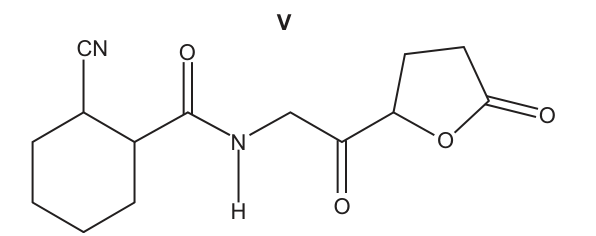
Answer
The functional groups present in compound V are:
- Nitrile ()
- Amide ()
- Ketone ()
- Ester (cyclic ester / lactone, )
Nitrile, amide, ketone, ester
Background Concept
Functional group identification from skeletal structures is a fundamental skill in organic chemistry. Each functional group has a characteristic arrangement of atoms: a nitrile is a carbon triple-bonded to nitrogen (); an amide has a carbonyl adjacent to a nitrogen (); a ketone has a carbonyl bonded to two carbon groups (); and an ester has a carbonyl bonded to an oxygen that is in turn bonded to another carbon (). When an ester is part of a ring, it is called a lactone.
Understanding the Question
The question asks you to name ALL functional groups in compound V. Looking at the skeletal structure, you must systematically identify each distinct functional group. The mark scheme requires any two for one mark and all four for two marks.
Approach
Scan the molecule from left to right: the group is a nitrile; the linkage is an amide; the between two carbons is a ketone; the five-membered ring containing is a cyclic ester (lactone).
Step-by-Step Reasoning
-
Nitrile: The group attached to the cyclohexyl ring. This is a carbon triple-bonded to nitrogen.
-
Amide: The group connecting the cyclohexyl ring to the chain. A carbonyl directly bonded to nitrogen defines an amide.
-
Ketone: The group in the middle of the chain, bonded to the on one side and the ring carbon on the other. A carbonyl flanked by two carbon groups is a ketone.
-
Ester (lactone): The five-membered ring contains , which is an ester linkage within a ring (a cyclic ester, or lactone).
Key Takeaways
- A lactone is simply a cyclic ester — the functional group is still "ester."
- Distinguishing amide from ketone: an amide has bonded to N; a ketone has bonded to two C atoms.
- Systematic scanning of the molecule prevents missing functional groups.
Common Mistakes
- Calling the cyclic ester a "cyclic ketone" — the ring oxygen makes it an ester, not a ketone.
- Confusing the amide carbonyl with a ketone carbonyl — the adjacent nitrogen distinguishes them.
- Writing "carbonyl" instead of "ketone" or "amide" — "carbonyl" is a general term, not a specific functional group name.
Things to Be Careful About
- The mark scheme accepts "carbonyl" as an alternative to "ketone," but "ester" must be specified (not just "carbonyl" for the lactone).
- Do not list "benzene ring" or "alkane" — these are not functional groups in the A-Level sense.
Answer
Compound V has 3 chiral centres (the two carbons on the cyclohexyl ring bearing the and groups, and the ring carbon of the lactone bearing the ketone group).
Number of optical isomers
Answer
8
8
Background Concept
A chiral centre (asymmetric carbon) is a carbon atom bonded to four different groups. For a molecule with chiral centres and no internal symmetry (no meso compounds), the number of optical isomers (stereoisomers) is . Each chiral centre can be or , giving combinations.
Understanding the Question
The question asks for the number of possible optical isomers of compound V. This requires identifying all chiral centres in the molecule and applying the rule. One mark is available.
Approach
Examine each carbon in the molecule and determine whether it is bonded to four different groups. Focus on the ring carbons and the lactone ring carbon, as these are the likely chiral centres.
Step-by-Step Reasoning
-
Cyclohexyl ring carbon bearing : This carbon is bonded to: (i) , (ii) H, (iii) the ring path going towards the substituent, and (iv) the ring path going the other way around. Since the two ring paths are different (one leads to the amide-substituted carbon, the other does not), this carbon has four different groups → chiral centre.
-
Cyclohexyl ring carbon bearing : This carbon is bonded to: (i) , (ii) H, (iii) the ring path towards the substituent, and (iv) the ring path going the other way. The two ring paths are different → chiral centre.
-
Lactone ring carbon bearing the ketone group: This carbon is bonded to: (i) the ketone group, (ii) H, (iii) the of the ester linkage, and (iv) the of the ring. All four groups are different → chiral centre.
-
Total: 3 chiral centres → optical isomers.
Key Takeaways
- Ring carbons can be chiral if the two paths around the ring are different (i.e., the ring is asymmetrically substituted).
- The rule applies when there is no internal plane of symmetry (no meso forms).
- Always check each potential chiral centre by listing all four groups attached.
Common Mistakes
- Missing the lactone ring carbon as a chiral centre because it is part of a ring.
- Thinking the cyclohexyl ring carbons are not chiral because "they're in a ring" — they ARE chiral if the two paths around the ring differ.
- Calculating by missing one chiral centre.
- Confusing optical isomers with geometric isomers.
Things to Be Careful About
- The question says "possible optical isomers" — this includes all stereoisomers arising from chiral centres, not just enantiomers.
- No meso compound is possible here because the three chiral centres are all in different environments.
Suggest one reason, other than better biological activity and lower dosage required, why it is beneficial to synthesise a single optical isomer of for use as a drug.
Answer
There is no need to separate the optical isomers (no resolution step required), saving time and cost in manufacture.
No need to separate optical isomers
Background Concept
When a drug is synthesised as a racemic mixture, the two enantiomers must often be separated (resolved) because they can have different biological effects. If a single optical isomer is synthesised directly (asymmetric synthesis), the separation step is eliminated.
Understanding the Question
The question asks for one benefit of synthesising a single optical isomer, explicitly excluding "better biological activity" and "lower dosage required" (which are the most commonly cited reasons). One mark is available.
Approach
Think about practical manufacturing and regulatory advantages beyond the biological ones already mentioned.
Step-by-Step Reasoning
If you synthesise only one enantiomer directly, you avoid the costly and time-consuming process of resolving a racemic mixture into its individual enantiomers. This simplifies manufacturing, reduces waste, and avoids the need to discard or recycle the unwanted enantiomer.
Key Takeaways
- Advantages of single-enantiomer drugs include: consistent biological activity, lower dose needed, no separation/resolution step, less waste, simpler regulatory approval.
- The question excludes the first two, so the answer must focus on manufacturing/practical benefits.
Common Mistakes
- Repeating "better biological activity" or "lower dosage" — these are explicitly excluded by the question.
- Saying "fewer side effects" — this is essentially the same as "better biological activity" and may not be credited.
Things to Be Careful About
- The mark scheme specifically accepts "no need to separate optical isomers" — this is the expected answer.
A sample of is hydrolysed with an excess of hot aqueous alkali.
The products are isolated from the reaction mixture at .
Draw the structures of the two organic products of the complete alkaline hydrolysis of in Fig. 8.1.

Answer
At pH 12, all acidic groups are deprotonated. Complete alkaline hydrolysis cleaves three bonds:
- The amide bond hydrolyses → (on the cyclohexyl ring) and (on the chain)
- The nitrile hydrolyses → (on the cyclohexyl ring)
- The ester (lactone) hydrolyses → ring opens to give and
Product 1 (from the cyclohexyl portion):
A cyclohexane ring with two adjacent groups (one from nitrile hydrolysis, one from amide hydrolysis).
Product 2 (from the chain + lactone portion):
(The ketone remains unchanged; the amine is free at pH 12; the lactone ring has opened to give an alcohol and a carboxylate.)
Product 1: cyclohexane-1,2-dicarboxylate (two COO⁻ groups on adjacent ring carbons). Product 2: H₂N-CH₂-C(=O)-CH(OH)-CH₂-CH₂-COO⁻
Background Concept
Complete alkaline hydrolysis (hot excess NaOH) cleaves multiple hydrolysable functional groups simultaneously. Amides hydrolyse to give a carboxylate and an amine. Nitriles hydrolyse (via an amide intermediate) to give a carboxylate. Esters hydrolyse to give a carboxylate and an alcohol. At pH 12, all carboxylic acid groups exist as carboxylate anions (), and amines remain as free bases (). Ketones are not hydrolysed under these conditions.
Understanding the Question
Compound V contains four functional groups: nitrile, amide, ketone, and ester (lactone). The question asks for the TWO organic products of COMPLETE alkaline hydrolysis at pH 12. Three marks are available: one for the amide bond cleavage, one for the nitrile hydrolysis, and one for the ester/lactone hydrolysis.
Approach
Identify each hydrolysable bond and determine where the molecule splits. The amide bond is the cleavage point that divides the molecule into two fragments. Then within each fragment, identify further hydrolysis products.
Step-by-Step Reasoning
-
Identify the amide bond cleavage: The bond breaks. On the left side, the carbonyl becomes (still attached to the cyclohexyl ring). On the right side, the nitrogen becomes (now the terminus of the chain fragment).
-
Nitrile hydrolysis (left fragment): The on the cyclohexyl ring is hydrolysed by hot alkali to . This gives a cyclohexane ring with two adjacent groups.
-
Lactone hydrolysis (right fragment): The cyclic ester opens. The bond of the lactone breaks, giving on one end and on the other. The ring carbon that bore the OH now has an group.
-
Ketone unchanged: The in the middle of the chain is a ketone and does not hydrolyse.
-
Final products:
- Product 1: Cyclohexane ring with at position 1 (from nitrile) and at position 2 (from amide).
- Product 2:
Key Takeaways
- Nitriles hydrolyse to carboxylates under hot alkaline conditions (via amide intermediate, but complete hydrolysis gives ).
- Lactones are cyclic esters and hydrolyse by ring-opening to give a hydroxy-carboxylate.
- At pH 12, always write not , and not .
- Ketones are stable to alkaline hydrolysis.
Common Mistakes
- Writing instead of at pH 12.
- Forgetting to hydrolyse the nitrile (it does hydrolyse under hot alkaline conditions).
- Drawing three products instead of two — the molecule splits into exactly two fragments at the amide bond.
- Hydrolysing the ketone — ketones do not undergo hydrolysis.
- Writing instead of at pH 12.
Things to Be Careful About
- The question specifies pH 12, so all acidic protons are removed — carboxyl groups must be drawn as .
- The amine product must be drawn as (free base), not protonated.
- The lactone ring must be shown as OPENED — draw the chain with and at the former ring positions.
- Each of the three hydrolysis events (amide, nitrile, ester) earns one mark.
A polypeptide formed from four amino acids, , , and , is completely hydrolysed and then analysed by gas–liquid chromatography.
The chromatogram produced is shown in Fig. 8.2.
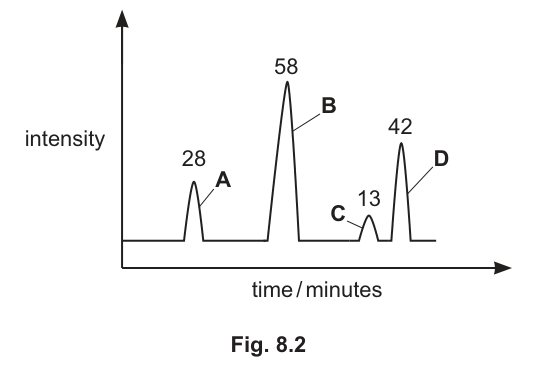
The number above each peak represents the area under the peak.
The area under each peak is proportional to the mass of the respective amino acid in the mixture.
Working
Total area
Answer
19.9%
Background Concept
In gas-liquid chromatography (GLC), the area under each peak is directly proportional to the amount (mass) of that component in the mixture. The percentage by mass of a component is calculated as its peak area divided by the sum of all peak areas, multiplied by 100.
Understanding the Question
The chromatogram shows four peaks with areas 28 (A), 58 (B), 13 (C), and 42 (D). The question asks for the percentage by mass of amino acid A. One mark is available.
Approach
Sum all peak areas to get the total, then divide A's area by the total and multiply by 100.
Step-by-Step Reasoning
- Total area = 28 + 58 + 13 + 42 = 141
- Percentage of A = (28/141) × 100 = 19.86% ≈ 19.9%
The mark scheme requires a minimum of 2 significant figures, so 20% would also be acceptable, but 19.9% is more precise.
Key Takeaways
- Peak area in GLC is proportional to mass of the component.
- Percentage composition = (individual peak area / total of all peak areas) × 100.
Common Mistakes
- Dividing by only some of the areas rather than the total.
- Forgetting to multiply by 100.
- Reporting with too few significant figures (the mark scheme requires minimum 2 s.f.).
Things to Be Careful About
- The mark scheme specifies "min 2sf" — answers like 20% are acceptable but 19.9% is preferred.
- Ensure all four peaks are included in the total.
The retention time for amino acid is the longest.
Explain why has a longer retention time than the other amino acids , and .
Answer
Amino acid D has stronger intermolecular forces (attraction) with the stationary phase than A, B, or C, so it spends more time in the stationary phase and has a longer retention time.
D is more strongly attracted to the stationary phase / forms stronger intermolecular forces with the stationary phase
Background Concept
In gas-liquid chromatography, the stationary phase is a liquid coated on a solid support inside the column. Different compounds interact with this stationary phase to different degrees through intermolecular forces (hydrogen bonding, dipole-dipole, van der Waals). A compound that interacts more strongly with the stationary phase spends more time dissolved in it and less time in the mobile gas phase, resulting in a longer retention time.
Understanding the Question
The question states that D has the longest retention time and asks why. One mark is available. The answer must relate retention time to the strength of interaction with the stationary phase.
Approach
Longer retention time → stronger attraction to stationary phase → more time spent in stationary phase → elutes later.
Step-by-Step Reasoning
Retention time depends on the balance between time spent in the mobile phase (carrying the compound through the column) and time spent in the stationary phase (held back by intermolecular forces). If D has the longest retention time, it must have the strongest intermolecular attractions to the stationary phase — whether through hydrogen bonding, dipole-dipole interactions, or van der Waals forces. This means D is retained longer and elutes last.
Key Takeaways
- Retention time increases with stronger intermolecular forces between analyte and stationary phase.
- The compound with the longest retention time has the greatest affinity for the stationary phase.
- This is the fundamental principle behind separation in chromatography.
Common Mistakes
- Saying D has a higher boiling point — while related, the mark scheme specifically wants the stationary phase interaction explanation.
- Saying D is "larger" or "heavier" — molecular size alone does not determine retention time in GLC.
- Confusing the mobile phase with the stationary phase.
Things to Be Careful About
- The key phrase is "attracted more strongly to the stationary phase" or "forms stronger intermolecular forces with the stationary phase." Simply saying "it's bigger" or "higher boiling point" without linking to stationary phase interactions may not score.