Chemistry 9701/43 — October/November 2025
Cambridge A-Level · A Level Structured Questions · worked solutions for every part, with the mark scheme
Topics Transition Elements · Electrochemistry · Carboxylic Acids and Derivatives · Hydrocarbons · Nitrogen Compounds · Group 2 · +8 more
Solutions of Group 2 hydrogencarbonates, , decompose on heating to give the corresponding metal carbonate, carbon dioxide and water.
Answer
Sr(HCO3)2(s) → SrCO3(s) + CO2(g) + H2O(g)
Background Concept
Group 2 metals form hydrogencarbonates (hydrogencarbonates) with the general formula M(HCO3)2, where M is the 2+ metal ion. On heating, these salts undergo thermal decomposition. Each hydrogencarbonate ion, HCO3⁻, contains a hydrogen that is lost during decomposition. The general reaction is:
This is a straightforward decomposition in which the hydrogencarbonate rearranges to give the carbonate, releasing carbon dioxide and water.
Understanding the Question
The stem tells you the general pattern for Group 2 hydrogencarbonates: they decompose to give the metal carbonate, carbon dioxide and water. The question asks you to write the specific equation for strontium hydrogencarbonate, Sr(HCO3)2. This is a recall-and-balance task worth 1 mark.
Approach
Identify the metal (strontium, Sr, which is in Group 2 and therefore forms a 2+ ion). The formula Sr(HCO3)2 already tells you there are two hydrogencarbonate ions per formula unit. Substitute M = Sr into the general pattern, then check the equation balances.
Step-by-Step Reasoning
- Strontium is a Group 2 element, so it forms Sr²⁺ ions. Two HCO3⁻ ions are needed to balance the charge, giving Sr(HCO3)2.
- On heating, each HCO3⁻ ion loses its proton (H⁺), which combines with the oxygen of another hydrogencarbonate to form water. The remaining carbonate portion becomes CO3²⁻.
- The products are therefore strontium carbonate, carbon dioxide and water.
- Write the equation: Sr(HCO3)2 → SrCO3 + CO2 + H2O.
- Check the balance: left side has 1 Sr, 2 C, 2 H, 6 O. Right side: SrCO3 (1 Sr, 1 C, 3 O) + CO2 (1 C, 2 O) + H2O (2 H, 1 O) gives 1 Sr, 2 C, 2 H, 6 O. Balanced.
Key Takeaways
All Group 2 hydrogencarbonates decompose on heating according to the same pattern: M(HCO3)2 → MCO3 + CO2 + H2O. Knowing the general reaction lets you write any specific example quickly.
Common Mistakes
- Writing SrHCO3 instead of Sr(HCO3)2 — forgetting that Sr²⁺ requires two hydrogencarbonate ions.
- Writing an unbalanced equation.
- Incorrect products, such as SrO + CO2 + H2O (this would be the decomposition of the carbonate itself, not the hydrogencarbonate).
Things to Be Careful About
The formula must be written with the bracket: Sr(HCO3)2. State symbols are good practice: the carbonate is a solid, CO2 is a gas, and water is a gas if the system is hot (or liquid if cooled).
The thermal stability of Group 2 carbonates increases down the group.
Explain this trend.
Answer
- Down the group, the radius of the M²⁺ cation increases, so its charge density decreases.
- A lower charge density means less polarisation (less distortion) of the carbonate ion.
- The C–O bonds in the carbonate are therefore less weakened, so more heat energy is needed to decompose it — thermal stability increases down the group.
Cation radius increases / charge density decreases down the group, so the cation polarises the carbonate ion less, making the carbonate more stable to heat.
Background Concept
Thermal stability of Group 2 carbonates is governed by the polarising power of the cation. A cation with a high charge density (high charge-to-radius ratio) strongly attracts and distorts the electron cloud of the neighbouring large anion — here the carbonate ion, CO3²⁻. This distortion (polarisation) pulls electron density away from the C–O bonds, weakening them and making the carbonate more prone to break apart (decompose, releasing CO2) when heated. The greater the polarisation, the lower the decomposition temperature.
Understanding the Question
The question states that thermal stability of Group 2 carbonates increases down the group and asks you to explain this trend. It is worth 2 marks: one for identifying the change in the cation down the group (M1), and one for the consequence for the carbonate ion (M2).
Approach
Work down the group: cation size increases → charge density decreases → polarising power decreases → less distortion of the carbonate ion → more heat needed to decompose → higher thermal stability.
Step-by-Step Reasoning
- Down Group 2 (Be to Ba), each cation M²⁺ gains an additional electron shell, so its ionic radius increases.
- With the same 2+ charge spread over a larger volume, the charge density of the cation decreases.
- A lower charge density means weaker polarising power — the cation distorts the electron cloud of the carbonate ion less.
- Less distortion means the C–O bonds within the carbonate ion are less weakened, so the carbonate is harder to decompose.
- Consequently, a higher temperature is required to decompose the carbonate, i.e. thermal stability increases down the group.
Key Takeaways
Thermal stability of Group 2 carbonates (and nitrates) increases down the group because the cation's polarising power decreases as its radius increases. The key chain is: larger cation → lower charge density → less anion polarisation → more stable.
Common Mistakes
- Saying "the cation gets bigger so it is more stable" without linking to polarisation of the anion — the mark requires the mechanism.
- Reversing the trend of polarising power (saying it increases down the group).
- Forgetting to mention the carbonate ion being distorted/polarised.
Things to Be Careful About
Use precise terminology: "charge density decreases", "less polarisation / less distortion of the carbonate ion". The mark scheme explicitly rewards both the change in the cation (M1) and the effect on the anion (M2).
The hydroxides and fluorides of Group 2 elements show similar trends in solubility.
Describe the trend in the solubility of the fluorides of calcium, strontium and barium.
Explain your answer.
explanation ...............................................................................................................................
Answer
Trend: solubility increases down the group: CaF₂ < SrF₂ < BaF₂ (least to most soluble).
Explanation:
- Down the group, both and become less exothermic (less negative).
- becomes less exothermic by a smaller extent than .
- Therefore becomes more exothermic (more negative) down the group, favouring dissolution.
- Hence solubility increases: CaF₂ < SrF₂ < BaF₂.
CaF2 < SrF2 < BaF2 (solubility increases down the group); because ΔHsol becomes more exothermic as ΔHhyd changes less than ΔHlatt.
Background Concept
The solubility of an ionic compound is related to the enthalpy change of solution, , which is the sum of the lattice energy (energy required to break the ionic lattice into gaseous ions) and the hydration enthalpies of the ions (energy released when the gaseous ions are surrounded by water molecules):
A more exothermic (more negative) makes dissolution thermodynamically more favourable, so the compound tends to be more soluble. In Group 2, both the lattice energy and the hydration enthalpy become less exothermic down the group because the ions get larger, but they do not change by the same amount — it is the relative change that determines the trend in solubility.
Understanding the Question
This question asks you to (1) state the trend in solubility of the fluorides of calcium, strontium and barium, and (2) explain it. It is worth 4 marks: 1 for the correct trend order, and 3 for the enthalpy-based explanation (both enthalpies becoming less exothermic, the relative change, and the effect on ).
Approach
First state the trend (solubility increases down the group). Then explain using the lattice/hydration comparison: identify how each enthalpy changes down the group, compare their relative changes, and link the resulting to solubility.
Step-by-Step Reasoning
- Trend (M1): CaF₂ is the least soluble, SrF₂ is intermediate, and BaF₂ is the most soluble. Solubility increases down the group.
- Both enthalpies change (M2): Down the group, the cations (Ca²⁺, Sr²⁺, Ba²⁺) get larger. Both the lattice energy () and the hydration enthalpy () become less exothermic (less negative), because the larger ions have weaker attractions.
- Relative change (M3): The key point is that changes less — it becomes less exothermic by a smaller extent — than . (Equivalently, becomes less exothermic by a larger extent.)
- Effect on (M4): Since , and becomes less negative more quickly than , the sum becomes more exothermic (more negative) down the group.
- Link to solubility: A more exothermic favours dissolution, so the fluorides become more soluble down the group.
Key Takeaways
Solubility trends in Group 2 compounds are explained by comparing how lattice and hydration enthalpies change down the group. The relative magnitude of the changes determines the direction of the trend in and hence solubility. This is the same reasoning used for hydroxides (solubility increases down the group) and is opposite to the sulfate trend (solubility decreases).
Common Mistakes
- Getting the trend backwards — thinking fluorides become less soluble down the group like sulfates. Fluorides behave like hydroxides here.
- Saying both and become more exothermic — they become less exothermic (less negative).
- Omitting the crucial comparison that changes less than .
- Not linking the enthalpy change to solubility.
Things to Be Careful About
The mark scheme requires the explicit comparison " changes less / becomes less exothermic by a smaller extent" — this is the key insight that earns M3. Use precise language: "less exothermic" or "less negative", not "smaller". State the trend order clearly as CaF₂ < SrF₂ < BaF₂.
Answer
The enthalpy change when one mole of gaseous ions dissolves in water to form an infinitely dilute solution (aqueous ions).
The enthalpy change when one mole of gaseous ions dissolves in water to form an infinitely dilute solution.
Background Concept
Enthalpy change of hydration, , is a standard quantity in energetics. It measures the energy change when gaseous ions are surrounded by (and interact with) water molecules. Water is a polar molecule, so its partially negative oxygen end is attracted to cations and its partially positive hydrogen ends are attracted to anions. These ion–dipole attractions release energy, so hydration is exothermic.
Understanding the Question
This is a one-mark definition question. The mark is awarded for precision — every part of the standard definition must be present.
Approach
Recall the exact standard definition, making sure to include "one mole", "gaseous ions", and "water".
Step-by-Step Reasoning
The standard definition is: the enthalpy change when one mole of gaseous ions is dissolved in water to form an infinitely dilute solution (or, equivalently, an aqueous solution of the ions). Each element of the definition matters: "one mole" specifies the amount, "gaseous ions" specifies the starting state, and "water" specifies the solvent.
Key Takeaways
Know the exact wording of the definition — the mark is for precision, not for a vague paraphrase.
Common Mistakes
- Omitting "gaseous" — saying just "ions" is not enough.
- Omitting "one mole".
- Saying "a solution" without specifying it is aqueous (in water).
Things to Be Careful About
The definition must include all three key elements: one mole, gaseous ions, and water/aqueous solution. The mark scheme rewards this exact phrasing.
State the main factors that affect the magnitude of enthalpy change of hydration.
Explain your answer.
Answer
Factors: ionic radius and ionic charge (charge density).
Explanation:
- As ionic radius increases / charge density decreases, there is less attraction between the water molecules and the gaseous ion, so becomes less exothermic.
- As ionic charge / charge density increases, there is more attraction between the water molecules and the gaseous ion, so becomes more exothermic.
Ionic radius and ionic charge; larger radius / lower charge density gives weaker ion–water attraction and less exothermic ΔHhyd, and vice versa.
Background Concept
The magnitude of the enthalpy change of hydration depends on the strength of the ion–dipole attraction between the ion and water molecules. Water is polar: the oxygen end carries a partial negative charge and the hydrogen ends carry partial positive charges. A cation attracts the oxygen ends of water molecules; an anion attracts the hydrogen ends. The strength of this attraction depends on the charge density of the ion — the ratio of its charge to its size (radius).
Understanding the Question
This 2-mark question asks you to (M1) state the main factors affecting the magnitude of , and (M2) explain how they affect it. The answer must link the factors to the attraction between ions and water.
Approach
State the two factors (ionic radius and ionic charge), then explain each in terms of charge density and the strength of ion–water attraction.
Step-by-Step Reasoning
- Factors (M1): The two main factors are the ionic radius and the ionic charge of the ion. Together these determine the ion's charge density.
- Effect of radius (M2): A larger ionic radius spreads the same charge over a bigger volume, lowering the charge density. This weakens the attraction between the ion and the water molecules (the ion–dipole forces), so less energy is released on hydration — becomes less exothermic (less negative).
- Effect of charge (M2): A higher ionic charge (for a similar radius) increases the charge density. The ion attracts water molecules more strongly, releasing more energy — becomes more exothermic (more negative).
Key Takeaways
The magnitude of is governed by the charge density of the ion: higher charge density means stronger ion–water attraction and a more exothermic hydration enthalpy.
Common Mistakes
- Stating only one factor — both ionic radius AND ionic charge are required for M1.
- Not explaining the mechanism (the attraction between the ion and water molecules).
- Confusing the direction of the effect (saying larger radius gives more exothermic hydration).
Things to Be Careful About
M1 requires both "ionic radii" and "ionic charge". For M2, link the factor to the strength of attraction between water molecules and the gaseous ion, and state whether becomes more or less exothermic.
Table 1.1 shows various energy changes.
Table 1.1
| energy change | value / |
|---|---|
| lattice energy of | |
| enthalpy change of hydration, , of | |
| enthalpy change of hydration, , of |
Use data from Table 1.1 to calculate the enthalpy change of solution, , for .
It may be helpful to draw a labelled energy cycle. Show your working.
Working
Using the energy cycle:
Answer
+21 kJ mol⁻¹
+21 kJ mol^-1
Background Concept
The enthalpy change of solution, , is the energy change when one mole of an ionic solid dissolves in water. It can be found from a Born-Haber-type energy cycle that connects the lattice energy and the hydration enthalpies of the ions:
Here is the number of anions per formula unit. The lattice energy given in the table is the lattice formation enthalpy (negative, energy released when gaseous ions come together to form the lattice). To break the lattice apart (the reverse process), we need to supply the positive of that value, which is why we subtract the given (negative) lattice energy.
Understanding the Question
You are given the lattice energy of MgF₂ (−2957 kJ mol⁻¹), the hydration enthalpy of Mg²⁺ (−1926 kJ mol⁻¹), and the hydration enthalpy of F⁻ (−505 kJ mol⁻¹). You must calculate for MgF₂(s). The question suggests drawing a labelled energy cycle and asks you to show your working. It is worth 2 marks: M1 for using the correct values (including multiplying the F⁻ hydration by 2), and M2 for correct signs and evaluation.
Approach
Set up the energy cycle: the solid MgF₂ can either dissolve directly (ΔHsol) or first be broken into gaseous ions (needing +2957 kJ mol⁻¹) and then hydrated (releasing −1926 and 2 × −505 kJ mol⁻¹). By Hess's law, the two routes have the same overall enthalpy change. Solve for ΔHsol.
Step-by-Step Reasoning
- There are two F⁻ ions per formula unit of MgF₂, so the hydration of the fluoride ions contributes 2 × (−505) = −1010 kJ mol⁻¹.
- The lattice energy given is −2957 kJ mol⁻¹ (lattice formation). To break the lattice into gaseous ions requires +2957 kJ mol⁻¹, so in the cycle we add +2957 (equivalently, subtract −2957).
- Sum the hydration terms and the lattice-breaking term:
ΔHsol = (−1926) + 2(−505) − (−2957)
ΔHsol = −1926 − 1010 + 2957
ΔHsol = +21 kJ mol⁻¹ - The positive value means dissolving MgF₂ is endothermic.
Key Takeaways
The energy cycle for enthalpy of solution: ΔHsol = ΔHhyd(cation) + n × ΔHhyd(anion) − ΔHlatt. Watch the sign of the lattice energy (subtract a negative = add) and remember to multiply the anion hydration by the number of anions per formula unit.
Common Mistakes
- Forgetting to multiply ΔHhyd(F⁻) by 2 — there are two fluoride ions per formula unit.
- Getting the sign of the lattice energy wrong — the given value is negative (formation), so it must be subtracted (i.e. +2957 added).
- Arithmetic errors in combining the three terms.
Things to Be Careful About
The lattice energy convention: the table gives −2957 kJ mol⁻¹ (lattice formation), so in the cycle you add +2957. Always include the unit (kJ mol⁻¹). The final answer is +21 kJ mol⁻¹ — a small positive (endothermic) value, which is consistent with MgF₂ being only sparingly soluble.
Mercury(I) fluoride, , is sparingly soluble in water.
The cation in exists as the diatomic ion with a covalent bond.
Answer
units: mol³ dm⁻⁹
Ksp = [Hg2^2+][F^-]^2; units mol^3 dm^-9
Background Concept
The solubility product, Ksp, is the equilibrium constant for the dissolution of a sparingly soluble ionic solid. For a salt that dissolves to give ions, the Ksp expression is the product of the concentrations of the ions in solution, each raised to the power of its stoichiometric coefficient in the dissolution equation. The solid itself is not included in the expression because its concentration is constant.
Understanding the Question
You are told that mercury(I) fluoride, Hg₂F₂, is sparingly soluble and that the cation is the diatomic ion Hg₂²⁺ with a covalent Hg–Hg bond. You must write the Ksp expression and give its units. This is worth 2 marks: 1 for the correct expression and 1 for the correct units.
Approach
Write the dissolution equilibrium for Hg₂F₂, then construct the Ksp expression from the ion concentrations with the correct powers. Determine the units by combining the units of each concentration term.
Step-by-Step Reasoning
- Hg₂F₂ dissolves to give one Hg₂²⁺ ion and two F⁻ ions:
Hg₂F₂(s) ⇌ Hg₂²⁺(aq) + 2F⁻(aq) - The Ksp expression excludes the solid and raises each ion concentration to its stoichiometric coefficient:
Ksp = [Hg₂²⁺][F⁻]² - Units: [Hg₂²⁺] has units mol dm⁻³, and [F⁻]² has units (mol dm⁻³)² = mol² dm⁻⁶. Multiplying gives mol³ dm⁻⁹.
Key Takeaways
Ksp = product of the ion concentrations, each raised to its stoichiometric coefficient, with the solid excluded. The units are mol^(total ions) dm^(−3 × total ions), here mol³ dm⁻⁹.
Common Mistakes
- Including the solid Hg₂F₂ in the Ksp expression.
- Using the wrong power on [F⁻] (it must be squared, not to the power 1).
- Writing the cation as Hg⁺ instead of Hg₂²⁺.
- Giving wrong units (e.g. mol dm⁻³ instead of mol³ dm⁻⁹).
Things to Be Careful About
The cation is the diatomic Hg₂²⁺ ion — do not split it into two Hg⁺ ions. The F⁻ concentration is squared because there are two fluoride ions per formula unit. The units are mol³ dm⁻⁹ (not mol⁴ dm⁻¹², which would be the case if you wrongly included the solid).
Working
Let the solubility be .
Answer
3.11 × 10⁻⁶ mol³ dm⁻⁹
3.11 x 10^-6 mol^3 dm^-9
Background Concept
When a sparingly soluble salt dissolves, the concentration of each ion in the saturated solution is related to the solubility, s (in mol dm⁻³), by the stoichiometry of the dissolution equation. For Hg₂F₂, each formula unit that dissolves produces one Hg₂²⁺ ion and two F⁻ ions, so if the solubility is s, then [Hg₂²⁺] = s and [F⁻] = 2s. Substituting these into the Ksp expression gives a direct relationship between Ksp and s.
Understanding the Question
You are given the solubility of Hg₂F₂ as 9.20 × 10⁻³ mol dm⁻³ at 298 K and asked to calculate Ksp. This is a 1-mark calculation that uses the Ksp expression from part (e)(i).
Approach
Set [Hg₂²⁺] = s and [F⁻] = 2s, substitute into Ksp = [Hg₂²⁺][F⁻]², simplify to 4s³, and evaluate with the given solubility.
Step-by-Step Reasoning
- From the dissolution equation, each mole of Hg₂F₂ that dissolves gives 1 mole of Hg₂²⁺ and 2 moles of F⁻.
- With solubility s = 9.20 × 10⁻³ mol dm⁻³: [Hg₂²⁺] = s = 9.20 × 10⁻³ mol dm⁻³ and [F⁻] = 2s = 1.84 × 10⁻² mol dm⁻³.
- Substitute into Ksp = [Hg₂²⁺][F⁻]² = s(2s)² = 4s³.
- Evaluate: 4 × (9.20 × 10⁻³)³ = 4 × 7.783 × 10⁻⁷ = 3.11 × 10⁻⁶ mol³ dm⁻⁹.
- The answer is given to 3 significant figures (the mark scheme requires a minimum of 2 significant figures).
Key Takeaways
For a salt AₓBᵧ dissolving to give x A ions and y B ions, Ksp = xˣ yʸ s^(x+y). Here that simplifies to 4s³. Always check the stoichiometry before substituting.
Common Mistakes
- Not doubling [F⁻] — using s instead of 2s for the fluoride concentration.
- Not squaring the [F⁻] term.
- Forgetting the units (mol³ dm⁻⁹).
- Giving the answer to too few significant figures (must be at least 2).
Things to Be Careful About
The factor 4 comes from (2s)² = 4s². Include the units mol³ dm⁻⁹ in the final answer. The mark scheme requires a minimum of 2 significant figures, so 3.1 × 10⁻⁶ or 3.11 × 10⁻⁶ is acceptable.
Iron can form stable ions in the and oxidation states.
Explain why transition elements have variable oxidation states.
Answer
The 3d and 4s sub-shells (orbitals/electrons) are close in energy, so transition elements can lose different numbers of electrons from these sub-shells and form ions with different oxidation states.
The 3d and 4s sub-shells are close in energy, allowing different numbers of electrons to be lost.
Background Concept
Transition elements are d-block elements that form at least one stable ion with a partially filled d sub-shell. Their chemistry is dominated by the closeness in energy of the 3d and 4s sub-shells. When a transition metal atom forms an ion, electrons are lost first from the 4s sub-shell and then from the 3d sub-shell. Because these sub-shells are close in energy, removing different numbers of 3d electrons requires only small differences in energy, so several oxidation states are accessible.
Understanding the Question
The command word is "explain". The question does not ask for examples of oxidation states; it asks for the fundamental reason transition elements can show variable oxidation states. The mark is awarded for the energy relationship between the 3d and 4s sub-shells.
Approach
State the key fact: the 3d and 4s sub-shells are very close/similar in energy. Then link that to the ability to lose variable numbers of electrons. No need to quote ionisation energies or examples.
Step-by-Step Reasoning
- In a transition metal atom, the 4s sub-shell is slightly lower in energy than the 3d, so 4s is filled first and 4s electrons are lost first when forming ions.
- However, the energy gap between 3d and 4s is very small.
- Therefore, after losing the 4s electrons, the element can lose one, two, or more 3d electrons without requiring a very large extra ionisation energy.
- This gives stable ions in several oxidation states, e.g. Fe and Fe.
Key Takeaways
The reason for variable oxidation states is the similar energies of the 3d and 4s sub-shells. This is a one-mark definition-style explanation; use the exact idea "close/similar in energy".
Common Mistakes
- Saying only "they have d electrons" or "d orbitals are partially filled" – this does not explain why different numbers of electrons can be lost.
- Referring to "shells" rather than "sub-shells" – the mark scheme specifically requires the 3d and 4s sub-shells/orbitals.
- Stating that 4s is higher in energy than 3d in all contexts; the important point is that they are close in energy.
Things to Be Careful About
Use "3d and 4s" explicitly. The mark scheme accepts "sub-shells", "orbitals" or "electrons", but the idea of closeness/similarity must be present.
Answer
A complex ion is a species/ion formed by a central metal atom/ion surrounded by (bonded to) one or more ligands.
A species/ion formed by a central metal atom/ion surrounded by one or more ligands.
Background Concept
A complex ion is a species in which a central metal atom or ion is surrounded by ligands. A ligand is a molecule or ion that donates a pair of electrons to the central metal, forming a coordinate (dative covalent) bond. Common ligands include HO, NH and Cl.
Understanding the Question
The command word is "define". The definition must contain two essential parts: the central metal atom/ion and the ligands surrounding/bonded to it.
Approach
Give a complete definition in one sentence. Include both the central metal atom/ion and the idea that it is surrounded by or bonded to one or more ligands.
Step-by-Step Reasoning
- Start with the central part: a complex ion is a species or ion formed by a central metal atom/ion.
- Add the surroundings: it is surrounded by or bonded to one or more ligands.
- This matches the mark scheme exactly: "species or ion formed by a central metal atom/ion AND surrounded by/bonded to (one or more) ligands".
Key Takeaways
A definition mark is awarded for both halves: the central metal atom/ion and the ligands. Do not omit either part.
Common Mistakes
- Missing "central metal atom/ion".
- Missing "ligands".
- Saying "molecule" instead of "species/ion" – the complex itself is often charged.
Things to Be Careful About
The mark scheme accepts "surrounded by" or "bonded to". The phrase "one or more ligands" is safer than just "ligands" because a complex may have one or several ligands.
can be converted into .
Suggest a suitable reagent for this conversion. State the type of reaction.
reagent ..............................................................................................................................
type of reaction ..................................................................................................................
Answer
reagent: NaOH(aq) / OH⁻(aq)
type of reaction: precipitation / ligand exchange / deprotonation (acid–base)
NaOH(aq) / OH⁻(aq); precipitation / ligand exchange / deprotonation (acid–base)
Background Concept
Aqua complexes such as are acidic because the water molecules coordinated to the metal ion can lose H ions. Adding hydroxide ions removes H from coordinated water molecules, forming hydroxo complexes. This can also be described as ligand exchange because OH effectively replaces HO ligands.
Understanding the Question
The conversion is . Two water ligands have lost H, so the reagent must be a base that supplies OH. The question asks for the reagent and the type of reaction.
Approach
Choose a source of hydroxide ions, usually NaOH(aq). Recognise that the reaction is a deprotonation/acid–base reaction, and also forms a precipitate and involves ligand exchange. Any of these accepted descriptions can be given as the type.
Step-by-Step Reasoning
- The reagent must provide OH; NaOH(aq) is the standard choice.
- The equation is:
- Two H ions are removed from coordinated water molecules, so the reaction is deprotonation or acid–base.
- Because OH replaces HO in the coordination sphere, it is also ligand exchange.
- The neutral hydroxo complex is insoluble, so the reaction is also a precipitation.
Key Takeaways
Adding OH to an aqua complex removes H from coordinated water, forming a hydroxo complex. The reaction can be described as deprotonation, acid–base, ligand exchange or precipitation.
Common Mistakes
- Using an acid instead of a base.
- Saying "neutralisation" when the mark scheme accepts deprotonation/acid–base.
- Forgetting to state the reagent as NaOH(aq) or OH(aq).
Things to Be Careful About
The mark scheme accepts NaOH or OH(aq). For the reaction type, any one of precipitation, ligand exchange, deprotonation or acid–base is sufficient.
is a green precipitate that turns brown on standing in air.
Table 2.1 shows electrode potentials for some electrode reactions.
Table 2.1
| electrode reaction | |
|---|---|
Use the information in Table 2.1 to explain why turns brown on standing in air.
Include an equation for this reaction.
Answer
is oxidised by oxygen in the air: Fe(II) is oxidised to Fe(III). The Fe(III)/Fe(II) couple has a more negative ( V) than the O/OH couple ( V), so V. Since is positive, the reaction is feasible and the brown Fe(III) complex forms.
Fe(II) is oxidised by O2 to Fe(III); E°cell = +0.96 V, so reaction is feasible; 4[Fe(H2O)4(OH)2] + O2 → 4[Fe(H2O)3(OH)3] + 2H2O
Background Concept
Electrode potentials measure the tendency of a half-reaction to occur as a reduction. The more positive the value, the greater the tendency for the oxidised form to be reduced, so the oxidised form is the stronger oxidising agent. For a reaction made from two half-reactions, . A positive means the reaction is feasible.
Understanding the Question
The green precipitate is the iron(II) complex . On standing in air, oxygen oxidises Fe(II) to Fe(III), giving the brown iron(III) complex . The question asks you to use the two electrode potentials to show why this happens and to write the overall equation.
Approach
Identify which species is oxidised and which is reduced. The iron couple has the more negative , so its reduced form, the Fe(II) complex, is oxidised. Oxygen has the more positive , so it is reduced. Calculate ; if positive, the reaction is feasible. Then combine the two half-equations, balancing electrons, to obtain the overall equation.
Step-by-Step Reasoning
- The iron half-equation is written as a reduction:
- The oxygen half-equation is:
- Because , the Fe(II) complex is oxidised (the reverse of the iron half-equation) and oxygen is reduced.
- , which is positive, so the reaction is feasible.
- Balance electrons: multiply the iron oxidation half-equation by 4 and add it to the oxygen reduction half-equation. Cancel the and that appear on both sides to give:
Key Takeaways
A more negative electrode potential means the reduced form is a stronger reducing agent. A positive indicates feasibility. Redox equations are balanced by making the number of electrons equal in the oxidation and reduction half-equations.
Common Mistakes
- Calculating with the wrong sign, e.g. V.
- Saying the iron complex is reduced; it is oxidised from Fe(II) to Fe(III).
- Writing an unbalanced equation or forgetting to multiply the iron half-equation by 4.
- Omitting the idea that the brown colour is due to the Fe(III) complex.
Things to Be Careful About
Use the exact values from Table 2.1. The mark scheme accepts either the statement that the iron couple is more negative than the oxygen couple, or the calculated V. The equation must balance in both atoms and charge; the correct stoichiometry is 4:1:4:2.
Working
Each loses one electron to become , and two ions react, so .
Answer
-322.3 kJ mol^-1
Background Concept
The relationship between Gibbs free energy change and cell potential is:
where is the number of moles of electrons transferred in the reaction as written, is the Faraday constant ( C mol), and is in volts. The result is in J mol; it is converted to kJ mol by dividing by 1000.
Understanding the Question
Reaction 1 is:
with V. You must calculate in kJ mol. The key first step is to find .
Approach
Use the formula . Determine from the stoichiometry: each cobalt(II) complex loses one electron to become cobalt(III), and two such complexes react, so two electrons are transferred in total. Substitute , V and C mol, then convert from J to kJ.
Step-by-Step Reasoning
- Identify the electron transfer: two ions are oxidised to two ions, so .
- Substitute into the formula:
- Calculate:
- Convert to kJ mol:
- The negative value shows the reaction is feasible under standard conditions.
Key Takeaways
For a redox reaction, is the number of electrons transferred per mole of reaction as written. The sign of is negative when is positive. Always convert from J mol to kJ mol when asked for kJ.
Common Mistakes
- Using or instead of .
- Forgetting the negative sign in .
- Leaving the answer in J mol instead of kJ mol.
- Using but not using in volts.
Things to Be Careful About
Check the stoichiometry carefully: two Co(II) ions are oxidised, so two electrons are transferred. Use C mol. Divide by 1000 to convert to kJ mol. Give the final answer to three significant figures: kJ mol.
Solid manganese(IV) oxide, , catalyses the decomposition of hydrogen peroxide.
State the type of catalysis for this reaction. Explain your answer.
Answer
Heterogeneous catalysis. The catalyst, MnO, is a solid, while the reactant, HO, is in aqueous solution; they are in different states (phases).
Heterogeneous catalysis; MnO2 is in a different phase/state to the reactants.
Background Concept
Catalysts can be classified based on their physical state relative to the reactants. In homogeneous catalysis, the catalyst is in the same phase (state) as the reactants (e.g., all in solution or all gases). In heterogeneous catalysis, the catalyst is in a different phase from the reactants (e.g., a solid catalyst with liquid or gaseous reactants). The reaction occurs on the surface of the solid catalyst.
Understanding the Question
The question asks for the type of catalysis when solid MnO decomposes aqueous hydrogen peroxide (HO(aq)). You must name the type and provide the reasoning based on the physical states of the substances involved.
Approach
Identify the physical state of the catalyst and the reactant. Compare them. If they differ, it is heterogeneous; if they are the same, it is homogeneous.
Step-by-Step Reasoning
- The catalyst is given as solid manganese(IV) oxide (MnO).
- The reactant is hydrogen peroxide in the equation given as aqueous (HO(aq)).
- Because the catalyst is a solid and the reactant is in an aqueous solution, they are in different states (phases).
- Therefore, the catalysis is heterogeneous.
Key Takeaways
Always check the state symbols in the chemical equation or the text description. Solid + aqueous/gas = heterogeneous. Aqueous + aqueous or gas + gas = homogeneous.
Common Mistakes
- Stating "heterogeneous" without the explanation (the mark scheme requires both the name and the reason: "different state/phase").
- Saying "it is a solid" without explicitly comparing it to the reactant's state.
- Confusing heterogeneous with homogeneous.
Things to Be Careful About
- Ensure you mention both the type of catalysis and the reason (different states/phases). The mark scheme explicitly requires "heterogeneous AND MnO is in a different state / phase to the reactants".
Hydrogen peroxide reacts with iodide ions in acidic conditions as shown.
The initial rate of this reaction is investigated with different concentrations of , and .
The results obtained are shown in Table 3.1.
Table 3.1
| experiment | initial rate / | |||
|---|---|---|---|---|
| 1 | ||||
| 2 | ||||
| 3 | ||||
| 4 |
Use the information in Table 3.1 to deduce the rate equation for this reaction.
Explain your reasoning.
Working
Order with respect to [I]:
Compare experiments 2 and 3: [I] doubles (), [HO] and [H] are constant. The initial rate doubles (). Therefore, the reaction is 1st order with respect to [I].
Order with respect to [H]:
Compare experiments 1 and 4: [I] quadruples (), [HO] is constant (), and [H] quadruples (). The initial rate quadruples (). Since quadrupling [I] alone would quadruple the rate, the change in [H] has no effect on the rate. Therefore, the reaction is 0 order with respect to [H].
Order with respect to [HO]:
Compare experiments 1 and 2: [I] doubles (), [HO] halves (), [H] is constant. The initial rate is unchanged (). The doubling of [I] doubles the rate, but the halving of [HO] halves the rate, resulting in no net change. Therefore, the reaction is 1st order with respect to [HO].
Answer
rate = k[H2O2][I-]
Background Concept
The rate equation (or rate law) expresses the relationship between the rate of a reaction and the concentrations of the reactants. It takes the form:
where is the rate constant, and and are the orders of reaction with respect to reactants and . These orders must be determined experimentally; they cannot be deduced from the stoichiometry of the overall balanced equation.
To find the order with respect to a specific reactant, we compare two experiments where the concentration of that reactant changes while the concentrations of all other reactants remain constant. If doubling the concentration doubles the rate, it is 1st order. If it quadruples the rate, it is 2nd order. If the rate is unchanged, it is 0 order.
Understanding the Question
You are given a table of initial concentrations and initial rates for four experiments. You need to deduce the order with respect to each of the three reactants (HO, I, H) and write the complete rate equation.
Approach
Systematically compare pairs of experiments to isolate the effect of each reactant's concentration on the initial rate.
Step-by-Step Reasoning
- For [I]: Look at experiments 2 and 3. [HO] is constant (), [H] is constant (). [I] doubles from to . The rate doubles from to . Since , . 1st order wrt [I].
- For [H]: Look at experiments 1 and 4. [HO] is constant (). [I] quadruples from to . [H] quadruples from to . The rate quadruples from to . We know [I] quadrupling causes a times increase in rate. Since the total rate increase is exactly 4 times, the change in [H] must have contributed a factor of . 0 order wrt [H].
- For [HO]: Look at experiments 1 and 2. [I] doubles (), [H] is constant. [HO] halves (). The rate is unchanged (). The doubling of [I] would double the rate (). For the net rate to be unchanged (), the halving of [HO] must halve the rate (). Since , it is 1st order wrt [HO].
- Rate equation: Combine the orders: , which simplifies to .
Key Takeaways
When multiple concentrations change between two experiments, use the known orders to 'subtract' their effects and isolate the unknown order. Always state which experiments you are comparing and the exact changes in concentration and rate to justify your deduction.
Common Mistakes
- Assuming the order is equal to the stoichiometric coefficient in the balanced equation (e.g., assuming 2nd order for HO because of the coefficient 2). Orders must be experimental.
- Failing to show the working/comparison for each reactant. The mark scheme awards method marks (M1, M2, M3) for each deduction.
- Writing the rate equation with [H] in it (e.g., is acceptable, but usually simplified to omit it).
Things to Be Careful About
- Ensure you explicitly state the comparison (e.g., "Comparing experiments 2 and 3...") and the factors (e.g., "[I] doubles, rate doubles").
- The mark scheme allows multiple valid paths to deduce the orders (e.g., using experiments 1 & 4 for [H], or 3 & 4 for [HO]). Any correct logical path earns the marks.
Use your rate equation from (b)(i) and the data from Experiment 1 to calculate the rate constant, , for this reaction. Include the units of .
Working
Using the rate equation and data from Experiment 1:
Units:
Answer
1.79 dm^3 mol^-1 s^-1
Background Concept
The rate constant, , is a proportionality constant in the rate equation that is specific to a reaction at a given temperature. Its value and units depend on the overall order of the reaction. For a reaction with overall order , the units of are generally .
Understanding the Question
You have deduced the rate equation and now need to calculate the numerical value of using data from one experiment, and then determine the correct units for .
Approach
Rearrange the rate equation to make the subject. Substitute the values from Experiment 1. Derive the units by substituting the units of rate and concentration into the rearranged equation.
Step-by-Step Reasoning
- Calculation: Rearrange to . Substitute Experiment 1 values: (to 3 significant figures).
- Units: The rate has units . Concentrations have units . Substituting these into the expression for :
This is commonly written as .
Key Takeaways
Always include units for . Derive them algebraically from the rate equation rather than memorizing the units for each overall order, to avoid errors.
Common Mistakes
- Forgetting to include units for .
- Using data from the wrong experiment (e.g., using Experiment 4 where [H] is different, though it wouldn't affect the calculation since [H] is 0 order, it's best practice to use the simplest experiment).
- Rounding errors: keep extra digits during calculation and round at the end. The mark scheme allows 2 or 3 significant figures (1.8 or 1.79).
Things to Be Careful About
- Ensure the units are written correctly: , not or other variations not standard for CIE.
- The mark scheme specifically asks for the units to be written in the blank, so do not just write them next to the number.
The rate of the thermal decomposition of azomethane, , is investigated.
Fig. 3.1 shows the results obtained. The reaction is first order with respect to .
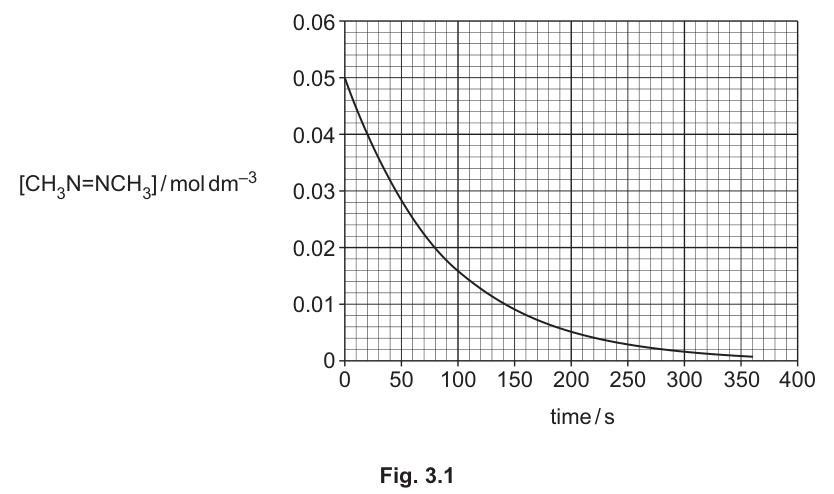
Answer
Initial concentration at is .
- First half-life (): Concentration falls to at . So .
- Second half-life: Concentration falls to at . So .
Since the two half-lives are constant (), the reaction is first order.
t_1/2 = 60 s (constant), confirming first order.
Background Concept
For a first-order reaction, the half-life () is constant. It is the time taken for the concentration of a reactant to fall to half of its initial value, and this time remains the same regardless of the starting concentration. This is a defining characteristic of first-order kinetics. The relationship is given by .
Understanding the Question
You are given a concentration-time graph for the decomposition of azomethane. You need to calculate two half-lives from the graph to demonstrate that the half-life is constant, thereby proving the reaction is first order.
Approach
Read the initial concentration. Find the time it takes to reach half that concentration. Then find the time it takes to reach half of that concentration. Subtract the initial time to get the second half-life. Compare the two.
Step-by-Step Reasoning
- Initial concentration: At , .
- First half-life: Half of is . Reading from the graph, the concentration is at . Therefore, the first .
- Second half-life: Half of is . Reading from the graph, the concentration is at . Therefore, the second .
- Conclusion: Since is constant (), the reaction is first order with respect to azomethane.
Key Takeaways
A constant half-life on a concentration-time graph is the graphical proof of first-order kinetics. Always show your working by stating the concentrations and times you read from the graph.
Common Mistakes
- Reading the wrong concentration (e.g., reading instead of ).
- Forgetting to subtract the starting time to get the second half-life (e.g., saying the second half-life is instead of ).
- Not explicitly stating that the half-lives are constant to answer the "show that" part of the question.
Things to Be Careful About
- The graph has grid lines every on the x-axis and on the y-axis. Read carefully. is exactly on a major grid line, is slightly above the line. Allow for reading errors as per the mark scheme.
Use your answer to (c)(i) to calculate the rate constant, , for the decomposition of azomethane.
Working
For a first-order reaction:
Answer
0.0116 s^-1
Background Concept
For a first-order reaction, the rate constant and the half-life are related by the equation:
This is derived from the integrated first-order rate law: . At , , so , which gives .
Understanding the Question
Using the constant half-life calculated in part (c)(i), calculate the rate constant for the decomposition.
Approach
Substitute the value of into the formula .
Step-by-Step Reasoning
- .
- .
- Rounding to 3 significant figures: .
Key Takeaways
Memorize the relationship for first-order reactions. It is frequently tested.
Common Mistakes
- Using the wrong formula (e.g., ).
- Forgetting the units: since is in seconds, must be in .
- Rounding too early or to the wrong number of significant figures. The mark scheme accepts 2 or 3 sf (0.012 or 0.0116).
Things to Be Careful About
- The question already provides the unit in the answer line, so you only need to write the number. However, in an exam, always be aware of units.
Describe the effect of increasing temperature on the rate constant and on the rate of a reaction.
Answer
Increasing the temperature increases the rate constant (), which in turn increases the rate of the reaction.
increases k and increases the rate of reaction
Background Concept
The rate constant is temperature-dependent and is described by the Arrhenius equation: . As temperature increases, the exponential term becomes less negative, so increases. Since , an increase in directly leads to an increase in the reaction rate at any given concentration.
Understanding the Question
The question asks for the effect of increasing temperature on two things: the rate constant () and the rate of the reaction.
Approach
State the effect on and then state the resulting effect on the rate.
Step-by-Step Reasoning
- Effect on : Increasing temperature increases the kinetic energy of the molecules, leading to more frequent and more energetic collisions. This increases the proportion of molecules with energy . According to the Arrhenius equation, this causes the rate constant to increase.
- Effect on rate: Since , and has increased, the rate of the reaction increases.
Key Takeaways
Temperature affects the rate constant , not the concentrations (unless it causes evaporation, which is not the primary kinetic effect). An increase in means an increase in rate.
Common Mistakes
- Saying "temperature increases the rate because collisions are more frequent" (this is true, but the question specifically asks about the effect on and rate, not the mechanism).
- Stating that temperature changes the activation energy (it does not; catalysts do that).
Things to Be Careful About
- The mark scheme is very brief: "increases and increases the rate of reaction". Keep your answer concise and direct. Do not over-explain unless asked to "explain".
Answer
The standard cell potential, , is the potential difference (or voltage or EMF) between two half-cells (or two electrodes) when all species are at standard conditions.
Standard conditions are:
- a concentration of for all aqueous ions
- a pressure of (or ) for any gases
- a temperature of (or )
Potential difference between two half-cells at standard conditions (1 mol dm^-3, 298 K, 101 kPa)
Background Concept
The standard cell potential () is a fundamental quantity in electrochemistry that allows us to compare the relative tendencies of different half-cells to undergo reduction under identical, well-defined conditions. It is measured as the potential difference (voltage or EMF) between two half-cells when they are connected in a complete circuit.
Because absolute electrode potentials cannot be measured, we use the Standard Hydrogen Electrode (SHE) as a reference, assigned a potential of exactly . The standard cell potential is the difference between the standard electrode potentials of the two half-cells: .
Understanding the Question
The question asks for a precise definition of and the specific conditions that must be met for the measurement to be considered 'standard'. The command word 'define' requires a concise, accurate statement covering both the physical quantity (potential difference between two half-cells) and the constraints (standard conditions).
Approach
Recall the formal IUPAC definition of standard cell potential. It is not just a voltage; it must be specified as being between two half-cells. Then, list the three standard conditions: temperature, pressure, and concentration. These must all be stated to gain full marks.
Step-by-Step Reasoning
- M1: Identify the physical quantity. It is the potential difference (or voltage or EMF) between two half-cells (or two electrodes) in a cell. Without mentioning 'two half-cells' or 'electrodes', the definition is incomplete.
- M2: State the standard conditions. All three are required for full credit:
- Concentration: for all aqueous species.
- Pressure: (or ) for any gaseous species.
- Temperature: (or ). Note that while temperature is technically not part of the 'standard' in (which is defined at any temperature, but conventionally reported at 298 K), CIE mark schemes typically require 298 K / 25 C to be stated for full marks in this context.
Key Takeaways
A 'define' question in chemistry requires precision. Do not just say 'voltage of a cell'; specify 'between two half-cells'. Similarly, 'standard conditions' is not a single value; it is a set of conditions (concentration, pressure, temperature) that must all be listed.
Common Mistakes
- Stating 'voltage of a battery' or 'voltage of a cell' without specifying 'between two half-cells'.
- Forgetting one of the standard conditions, particularly pressure (for gases) or temperature.
- Writing 'standard state' instead of specifying the numerical values (1 mol dm, 101 kPa, 298 K).
Things to Be Careful About
- Ensure units are correct: mol dm (not just '1 M'), kPa (not just 'atm' unless specified), and K (not just 'degrees').
- The definition must cover both the 'what' (potential difference) and the 'where/when' (between two half-cells at standard conditions).
The Daniell cell is an electrochemical cell consisting of a electrode and a electrode.
Draw a labelled diagram of this electrochemical cell.
Include all necessary substances and relevant pieces of apparatus needed to measure the .
It is not necessary to state the conditions used.
Answer
The diagram must show:
- Two beakers (half-cells) with liquid levels indicated.
- Left half-cell: Cu(s) electrode immersed in Cu(aq) solution.
- Right half-cell: Zn(s) electrode immersed in Zn(aq) solution.
- A salt bridge connecting the two solutions (labelled 'salt bridge').
- An external wire connecting the two electrodes, with a voltmeter (labelled 'V') in the circuit to measure the potential difference.
See diagram (Fig. 4.1)
Background Concept
A Daniell cell is a classic galvanic (voltaic) cell that converts chemical energy into electrical energy through spontaneous redox reactions. Zinc is more reactive than copper, so zinc is oxidised at the anode (negative electrode) and copper(II) ions are reduced at the cathode (positive electrode).
To measure the cell potential accurately without a current flowing (which would cause polarization and alter the potentials), a high-resistance voltmeter is used. The two half-cells must be physically separated but electrically connected to allow ion flow, which is achieved using a salt bridge.
Understanding the Question
The question asks for a labelled diagram of the Daniell cell apparatus. It must include all necessary substances (electrodes and their corresponding ion solutions) and relevant apparatus (salt bridge, voltmeter, wires) to form a complete circuit. The question explicitly states that standard conditions do not need to be stated in the diagram.
Approach
Draw two beakers side-by-side. In one, place a copper strip in a copper(II) sulfate solution. In the other, place a zinc strip in a zinc sulfate solution. Connect the solutions with an inverted U-tube (salt bridge). Connect the metals with wires passing through a voltmeter. Label everything clearly.
Step-by-Step Reasoning
- M1: The circuit must be complete. This requires:
- A salt bridge connecting the two solutions (labelled 'salt bridge'). It allows ions to flow to maintain electrical neutrality.
- A voltmeter (labelled 'V' or 'voltmeter') in the external wire to measure the potential difference.
- Wires connecting the voltmeter to each electrode, and the liquid levels in the beakers must be shown to indicate the solutions are present.
- M2: The copper half-cell must be correctly labelled:
- Solid copper electrode: Cu(s)
- Aqueous copper(II) ions: Cu(aq)
- M3: The zinc half-cell must be correctly labelled:
- Solid zinc electrode: Zn(s)
- Aqueous zinc(II) ions: Zn(aq)
Key Takeaways
In electrochemical cell diagrams, completeness is key. Missing the salt bridge, the voltmeter, or the labels for the electrode and solution will cost marks. The salt bridge is essential for completing the circuit and allowing ion migration.
Common Mistakes
- Forgetting to label the salt bridge or the voltmeter.
- Drawing a single beaker containing both solutions (this would result in a direct reaction, not a cell that can do electrical work).
- Omitting state symbols (s) and (aq) in the labels, though strict state symbols may not always be required if the substance is clearly identified.
- Not showing the liquid levels in the beakers, which implies no solution is present.
Things to Be Careful About
- Ensure the salt bridge is drawn as a distinct component (often an inverted U-tube) connecting the two solutions, not just a wire.
- The voltmeter must be in the external circuit, not in the solution.
- Labels should be clear and unambiguous. Use arrows if necessary to point to the correct component.
State the charge carriers that transfer current through the solutions and through the wire.
the solutions .............................. the wire ..............................
Answer
the solutions: ions
the wire: electrons
ions; electrons
Background Concept
In an electrochemical cell, current is the flow of electric charge. The nature of the charge carrier depends on the medium through which the current flows.
In metallic conductors (wires, electrodes), the charge carriers are delocalized electrons. When electrons flow through the external wire, they constitute the electric current that can do work (e.g., light a bulb, turn a voltmeter needle).
In electrolyte solutions (the half-cells), there are no free electrons. Instead, the charge is carried by the movement of ions. Cations (positive ions) move towards the cathode, and anions (negative ions) move towards the anode. The salt bridge also facilitates ion movement to maintain charge balance.
Understanding the Question
The question asks to identify the specific charge carriers in two different parts of the cell: the solutions (electrolytes) and the wire (external circuit). This is a fundamental concept in electrochemistry.
Approach
Recall the nature of conduction in metals vs. electrolytes. Metals conduct via electrons; electrolytes conduct via ions.
Step-by-Step Reasoning
- In the solutions (aqueous electrolytes like Zn(aq) and Cu(aq)), the species that are free to move and carry charge are ions (both cations and anions). Therefore, the charge carriers are ions.
- In the wire (metallic conductor), the charge carriers are electrons. Electrons flow from the anode (where they are released by oxidation) through the external circuit to the cathode (where they are consumed by reduction).
Key Takeaways
Always distinguish between conduction in metals (electrons) and conduction in electrolytes (ions). This is a common trap in electrochemistry questions.
Common Mistakes
- Stating 'electrons' for the solutions. Electrons cannot flow through aqueous solutions; they must be transferred via chemical reactions at the electrode surfaces.
- Stating 'protons' or 'hydrogen ions' for the wire. While protons are ions, the wire is a metal, so only electrons carry the current.
Things to Be Careful About
- Use the exact terms 'ions' and 'electrons'. Vague answers like 'charged particles' may not score.
The standard electrode potential, , for the electrode is .
Water is added to a standard electrode.
The new concentration of is .
Use the Nernst equation to calculate the electrode potential, , for this new electrode.
Working
The Nernst equation for the Zn(aq)/Zn(s) electrode at 298 K is:
where:
- (number of electrons transferred in the half-equation: Zn + 2e Zn)
- (activity of a pure solid is 1)
Substituting the values:
Alternatively, using the natural logarithm form:
Rounding to 2 significant figures (or 2 decimal places as appropriate for potentials):
Answer
-0.78 V
Background Concept
The Nernst equation relates the electrode potential () under non-standard conditions to the standard electrode potential (). It accounts for the effect of concentration (or activity) on the potential.
The general form of the Nernst equation is:
where is the gas constant (8.31 J K mol), is the temperature in Kelvin, is the number of moles of electrons transferred, is the Faraday constant (96500 C mol), and is the reaction quotient.
At 298 K, , so the equation is often written as:
For a reduction half-reaction: , the reaction quotient (since the activity of the solid metal is 1). Thus:
Understanding the Question
The question provides the standard electrode potential for Zn/Zn ( V) and asks for the new potential when the concentration of Zn is diluted to 0.25 mol dm. We must use the Nernst equation to calculate this.
Approach
- Write down the Nernst equation for the specific half-cell.
- Identify the values for , , and .
- Substitute and calculate.
- Pay attention to significant figures.
Step-by-Step Reasoning
-
M1: State or use the correct Nernst equation. For Zn + 2e Zn:
or equivalently . -
M2: Substitute the values:
- V
- (from the half-equation Zn + 2e Zn)
- mol dm
Rounding to an appropriate number of significant figures (the mark scheme allows min 2 sf, so -0.78 V is acceptable, though -0.778 V is more precise):
Key Takeaways
- The Nernst equation predicts that decreasing the concentration of the oxidized species (Zn) will make the reduction potential more negative (less positive), meaning the electrode is less able to undergo reduction (or more able to undergo oxidation). This matches Le Chatelier's principle: reducing [Zn] shifts the equilibrium Zn + 2e Zn to the left.
- Always check the sign of the log term. Since 0.25 < 1, is negative, so will be more negative than .
Common Mistakes
- Using the wrong value for . For Zn/Zn, , not 1.
- Forgetting that the concentration of the solid metal is 1, so it does not appear in the log term (or appears as 1 in the numerator).
- Calculation errors with the logarithm. , not positive.
- Forgetting the sign of . It is V, not V.
Things to Be Careful About
- The mark scheme accepts both the 0.059 log form and the RT/zF ln form. Ensure consistency.
- Significant figures: the given has 2 decimal places (-0.76), so the answer should ideally be given to 2 or 3 decimal places. -0.78 V is acceptable (2 sf), -0.778 V is also fine.
- The question asks for , not or cell potential. Just the electrode potential.
An electrochemical cell consists of a electrode and a electrode in an alkaline electrolyte.
The standard cell potential, , for this cell is .
The half-equation at each electrode when this cell is discharging is shown.
Use this information to determine the change in oxidation state of manganese when this cell is discharging.
from .............................. to ..............................
Answer
from +4 to +3
+4 to +3
Background Concept
Oxidation state (or oxidation number) is the charge an atom would have if all bonds to atoms of different elements were 100% ionic. Oxygen typically has an oxidation state of -2 in compounds (except in peroxides or with fluorine).
In a redox reaction, the species that is reduced gains electrons, and its oxidation state decreases. The species that is oxidised loses electrons, and its oxidation state increases.
Understanding the Question
The question gives the half-equation for the MnO/MnO electrode during discharge:
We need to find the change in oxidation state of manganese (Mn) from the reactant side (MnO) to the product side (MnO).
Approach
Calculate the oxidation state of Mn in MnO and in MnO using the rule that oxygen is -2 (and balancing the overall charge of the neutral compound).
Step-by-Step Reasoning
- In MnO: Let the oxidation state of Mn be . Oxygen is -2.
So, Mn is in the +4 oxidation state in MnO. - In MnO: Let the oxidation state of Mn be . Oxygen is -2.
So, Mn is in the +3 oxidation state in MnO. - The change is from +4 to +3. This is a reduction (gain of electrons), which is consistent with the half-equation showing electrons on the left side.
Key Takeaways
To find oxidation states in oxides, assume oxygen is -2 and solve for the metal. Remember that the sum of oxidation states in a neutral compound is zero.
Common Mistakes
- Assuming oxygen is always -2 without checking (e.g., in peroxides it is -1, but here it is a normal oxide).
- Forgetting to multiply by the number of atoms (e.g., for MnO).
- Confusing the direction of change. The question asks 'from ... to ...', so it must be '+4 to +3', not '+3 to +4'.
Things to Be Careful About
- Ensure the oxidation states are correct integers.
- The half-equation shows electrons being gained (on the left), confirming reduction and a decrease in oxidation state.
Write the equation for the overall reaction that occurs when this cell is discharging.
Answer
Zn + 2MnO2 -> ZnO + Mn2O3
Background Concept
The overall reaction in an electrochemical cell is the sum of the oxidation half-reaction (at the anode) and the reduction half-reaction (at the cathode). When adding half-equations, the electrons lost must equal the electrons gained, so they cancel out.
Understanding the Question
We are given the two half-equations for the cell discharging:
- Anode (oxidation):
- Cathode (reduction):
We need to write the overall equation by adding these two half-equations.
Approach
Add the two equations together. Cancel out species that appear on both sides (electrons, OH, HO).
Step-by-Step Reasoning
- Write the two half-equations:
- Add them:
- Cancel common terms on both sides:
- cancel out.
- cancel out.
- cancels out.
- The remaining equation is:
Key Takeaways
When combining half-equations, always check that electrons balance and cancel. Also, watch out for other species like HO, H, or OH that may appear on both sides and cancel out. The overall reaction should not contain electrons.
Common Mistakes
- Forcing electrons to remain in the final equation.
- Failing to cancel HO or OH that appear on both sides.
- Writing unbalanced equations (e.g., forgetting the coefficient 2 for MnO).
Things to Be Careful About
- Ensure the final equation is balanced in terms of atoms and charge (though charge should automatically be balanced if the half-equations are correct and electrons cancel).
- The question asks for the equation 'when this cell is discharging', which means the spontaneous reaction as written (Zn oxidised, MnO reduced). Do not reverse the equations.
The for the electrode is .
Calculate the standard electrode potential, , for the electrode.
Working
The standard cell potential is given by:
From the half-equations, Zn is oxidised (anode) and MnO is reduced (cathode).
Given:
Substitute into the equation:
Answer
+0.19 V
Background Concept
The standard cell potential () is calculated from the standard electrode potentials of the two half-cells:
or more commonly written as:
where the cathode is the electrode where reduction occurs (higher/more positive ) and the anode is where oxidation occurs (lower/more negative ).
All electrode potentials used in this formula are standard reduction potentials (as listed in data booklets).
Understanding the Question
We are given:
- (this is the anode, as Zn is oxidised in the half-equation: Zn ZnO + 2e)
- We need to find (this is the cathode, as MnO is reduced).
Approach
Use the formula and rearrange to solve for the unknown cathode potential.
Step-by-Step Reasoning
- Identify anode and cathode:
- Anode (oxidation): Zn ZnO.
- Cathode (reduction): MnO MnO.
- Apply the formula:
- Rearrange:
Key Takeaways
- Always use the formula with standard reduction potentials.
- Be careful with signs. Subtracting a negative number is adding its positive value.
- The result should be positive for a spontaneous cell (discharging), which it is (+0.19 V).
Common Mistakes
- Using the formula where is the negative of the reduction potential. This can work but is prone to sign errors. Stick to using reduction potentials.
- Forgetting the negative sign in front of (-1.28 V). , which is wrong.
- Identifying the wrong electrode as anode or cathode. Zn is clearly oxidised (loses electrons), so it is the anode.
Things to Be Careful About
- The question gives for ZnO/Zn as -1.28 V. This is a reduction potential (ZnO + HO + 2e Zn + 2OH). In the cell, the reverse reaction occurs, but we still use the reduction potential value in the formula.
- Significant figures: 1.47 and 1.28 both have 2 decimal places, so the answer 0.19 is correct to 2 decimal places.
Copper shows typical properties of transition elements, including its behaviour as a catalyst.
Complete Table 5.1 to show the total number of unpaired electrons in the 3d and 4s orbitals of an isolated gaseous Cu atom and a ion.
Table 5.1
| species | number of unpaired electrons (3d) | number of unpaired electrons (4s) |
|---|---|---|
| Cu | ||
Answer
| species | number of unpaired electrons (3d) | number of unpaired electrons (4s) |
|---|---|---|
| Cu | 0 | 1 |
| 1 | 0 |
Cu: 3d=0, 4s=1; Cu2+: 3d=1, 4s=0
Background Concept
Transition elements are defined by their ability to form stable ions with incomplete d subshells. The electron configuration of atoms and ions in the d-block follows the Aufbau principle, but there are notable exceptions in the first row (e.g., Cr and Cu) due to the extra stability of half-filled and fully-filled d subshells. When transition metals form positive ions, electrons are removed from the 4s orbital before the 3d orbitals, as the 4s electrons are at a higher energy level in the ionised atom.
Understanding the Question
The question asks for the number of unpaired electrons in the 3d and 4s orbitals for an isolated gaseous copper atom (Cu) and a copper(II) ion (). This requires writing out their electron configurations and applying Hund's rule to count unpaired electrons.
Approach
- Write the full or noble gas core electron configuration for neutral Cu, noting the exception (4s1 3d10).
- Determine the configuration for by removing two electrons (first from 4s, then from 3d).
- Count the unpaired electrons in the 3d and 4s subshells for each species.
Step-by-Step Reasoning
- Neutral Cu atom (): The expected configuration is , but a fully filled 3d subshell is more stable. Thus, one electron moves from 4s to 3d, giving .
- In the 3d subshell, all 5 orbitals are fully paired (), so there are 0 unpaired electrons.
- In the 4s subshell, there is 1 electron (), so there is 1 unpaired electron.
- ion: To form , the atom loses 2 electrons. The first electron is removed from the 4s orbital, and the second from the 3d orbital. The configuration becomes .
- In the 3d subshell, there are 9 electrons. Following Hund's rule, 4 orbitals are fully paired (8 electrons) and 1 orbital has a single electron. Thus, there is 1 unpaired electron.
- The 4s subshell is now empty, so there are 0 unpaired electrons.
Key Takeaways
- Always remove 4s electrons before 3d electrons when forming cations of transition metals.
- Remember the exceptions in the first row of the d-block: Cr is and Cu is .
Common Mistakes
- Removing electrons from 3d before 4s when forming ions. (Incorrect: for or for ).
- Forgetting the anomalous configuration of neutral Cu ( instead of ).
Things to Be Careful About
- Ensure you are counting unpaired electrons specifically in the 3d and 4s orbitals, not the total number of unpaired electrons in the entire atom/ion (though for these species, it's the same).
- State symbols are not required for this table, but the distinction between atom and ion is critical.
The 3d orbitals in an isolated ion are degenerate.
Complete the diagram to show the relative energies of the 3d orbitals in an isolated ion and in in a tetrahedral complex.
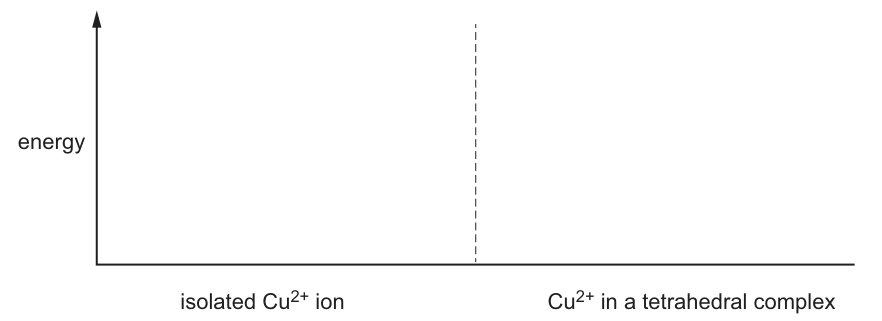
Answer
Left side (isolated ion):
- Draw 5 horizontal lines (representing the five 3d orbitals) at the same lower energy level. Label them as degenerate.
Right side ( in a tetrahedral complex):
- Draw 5 horizontal lines split into two energy levels.
- The lower level contains 2 lines (the set: and ).
- The upper level contains 3 lines (the set: , , ).
- Ensure that all 5 lines on the right are higher in energy than the 5 lines on the left.
See diagram description: 5 degenerate lines lower left; 2 lower + 3 higher lines right, all higher than left.
Background Concept
In an isolated gaseous transition metal ion, the five 3d orbitals are degenerate (have the same energy). When ligands approach the central metal ion to form a complex, the electrostatic repulsion between the lone pairs on the ligands and the electrons in the d orbitals causes the d orbitals to split into different energy levels. This is known as crystal field splitting.
For a tetrahedral complex, the ligands approach the metal ion from the corners of a tetrahedron. None of the d orbitals point directly at the ligands, so all orbitals are raised in energy compared to the isolated ion. However, the splitting is not equal:
- The set ( and ) points less directly towards the ligands and is lower in energy.
- The set (, , ) points more towards the ligands and is higher in energy.
- The splitting energy in a tetrahedral field () is smaller than in an octahedral field (), specifically .
Understanding the Question
The question asks to complete an energy level diagram comparing the 3d orbitals of an isolated ion (left side) with those in a tetrahedral complex (right side). The vertical axis is energy.
Approach
- Draw the degenerate 3d orbitals for the isolated ion at a baseline energy.
- Draw the split 3d orbitals for the tetrahedral complex, ensuring the correct number of orbitals in each set (2 lower, 3 higher) and that the entire set is higher in energy than the isolated ion.
Step-by-Step Reasoning
- Isolated ion: The five 3d orbitals are degenerate. Draw 5 horizontal lines at the same height on the left side of the dashed line. This represents the baseline energy.
- Tetrahedral complex: The symmetry of the tetrahedral ligand field causes the d orbitals to split.
- Draw 2 horizontal lines at a lower energy level (representing the orbitals: , ).
- Draw 3 horizontal lines at a higher energy level (representing the orbitals: , , ).
- Crucial point: The average energy of the d orbitals in the complex is higher than in the isolated ion due to the overall electrostatic repulsion from the ligands. Therefore, the lowest line on the right must be drawn higher than the lines on the left.
Key Takeaways
- Tetrahedral splitting results in a lower set of 2 orbitals () and an upper set of 3 orbitals ().
- All d orbitals in a complex are higher in energy than in the isolated gaseous ion due to ligand-metal repulsion.
Common Mistakes
- Drawing the tetrahedral splitting with 3 lower and 2 higher (this is the octahedral pattern).
- Placing the tetrahedral orbitals at the same energy or lower energy than the isolated ion (forgetting that ligand approach raises the overall energy).
Things to Be Careful About
- The question asks for relative energies, so exact numerical values are not needed, but the relative positions (2 lower, 3 higher, all higher than isolated) must be correct.
- Do not confuse tetrahedral ( then ) with octahedral ( then ) splitting patterns.
Answer
- Transition elements exhibit variable oxidation states (or more than one stable oxidation state).
- They have vacant (or empty) d orbitals that are energetically accessible (or can form dative bonds with ligands / adsorb reactant molecules).
These properties allow them to:
- Provide an alternative reaction pathway with a lower activation energy.
- Form intermediate complexes with reactants, facilitating electron transfer or bond breaking/forming.
Variable oxidation states; vacant d orbitals accessible for bonding/adsorption.
Background Concept
Catalysts work by providing an alternative reaction pathway with a lower activation energy. For a substance to act as a catalyst, it must be able to interact with reactants, form intermediates, and then regenerate. Transition elements are excellent catalysts (both homogeneous and heterogeneous) due to their unique electronic structure.
Understanding the Question
The question asks for an explanation of why transition elements behave as catalysts. Two distinct points are required for the full marks.
Approach
Identify the two main electronic features of transition metals that facilitate catalysis: their ability to change oxidation states easily and their ability to interact with other species via d orbitals.
Step-by-Step Reasoning
- Point 1 (Variable oxidation states): Transition metals have incompletely filled d orbitals, allowing them to lose different numbers of electrons. This means they can exist in multiple stable oxidation states (e.g., , ). In a catalytic cycle, the metal can accept electrons from a reactant (reducing itself) and then donate them to another reactant (oxidising itself back), facilitating redox reactions.
- Point 2 (Vacant d orbitals): The presence of vacant or partially filled d orbitals means the metal ion can accept lone pairs of electrons from ligands or reactant molecules. This allows it to form temporary dative bonds (coordinate bonds) with reactants, bringing them close together in the correct orientation (heterogeneous catalysis via surface adsorption or homogeneous catalysis via complex formation) and weakening their bonds.
Key Takeaways
- Catalysis by transition metals relies on variable oxidation states (for electron transfer) and vacant d orbitals (for adsorption/complex formation).
Common Mistakes
- Stating 'they have low activation energy' (catalysts lower the activation energy, they don't possess it).
- Saying 'they are not used up' (this is true for all catalysts, not specific to transition elements).
- Vague answers like 'they can form bonds' without specifying vacant d orbitals or dative bonding.
Things to Be Careful About
- Ensure both points are distinct. One must relate to oxidation states, the other to orbital availability/bonding.
is a monodentate ligand.
Table 5.2 shows information about two complex ions that contain only ions as ligands.
Complete Table 5.2.
Table 5.2
| metal ion | coordination number | formula of complex ion | charge of complex ion |
|---|---|---|---|
| 2 | |||
| 4– |
Answer
| metal ion | coordination number | formula of complex ion | charge of complex ion |
|---|---|---|---|
| 2 | |||
| 6 |
Ag+: [Ag(CN)2]-, charge 1-; Fe2+: coordination number 6, formula [Fe(CN)6]4-.
Background Concept
A complex ion consists of a central metal ion surrounded by ligands. Ligands are ions or molecules that donate a lone pair of electrons to the metal ion to form a coordinate (dative) bond. The coordination number is the number of coordinate bonds formed between the ligands and the central metal ion. Monodentate ligands (like , , ) form one bond each. Bidentate ligands (like ethane-1,2-diamine) form two bonds each.
The overall charge of the complex ion is the sum of the charge of the central metal ion and the charges of all the ligands.
Understanding the Question
The question provides information about two complex ions containing only ligands (which are monodentate and have a charge of ). We need to fill in the missing coordination numbers, formulas, and charges for silver(I) and iron(II) complexes.
Approach
- For : Given coordination number is 2. Calculate formula and charge.
- For : Given complex charge is . Determine coordination number, then formula.
Step-by-Step Reasoning
-
Row 1 ():
- Coordination number is given as 2. Since is monodentate, there are 2 ligands.
- Formula: .
- Charge: Metal ion () + 2 ligands () = . So the charge is .
- Full formula: .
-
Row 2 ():
- The complex charge is given as . Let be the coordination number (number of ligands).
- Charge equation: .
- Coordination number is 6.
- Formula: .
- Charge is given as , so .
Key Takeaways
- Coordination number = number of monodentate ligands.
- Complex charge = metal ion charge + sum of ligand charges.
- Always check charge balance to verify the formula.
Common Mistakes
- Forgetting to include the overall charge in the formula box.
- Calculating the wrong coordination number for iron by ignoring the given complex charge.
- Writing the formula without brackets, e.g., instead of .
Things to Be Careful About
- The question asks for the 'formula of complex ion', so brackets and the overall charge are essential.
- is monodentate, so coordination number equals the number of groups.
The complex ion displays geometrical (cis/trans) isomerism.
Draw the structure of trans-. State its shape and the Br-Au-Br bond angle.
Answer
Shape: square planar
Br–Au–Br bond angle =
Structure of trans-:
(Au in the centre, with Br atoms opposite each other at , and CN groups opposite each other at . All bonds in the same plane.)
Shape: square planar; Bond angle: 180°
Background Concept
Complex ions with a coordination number of 4 can have two main geometries: tetrahedral or square planar.
- Tetrahedral complexes are common for ions (e.g., , ).
- Square planar complexes are typical for metal ions, particularly in the second and third transition series (e.g., , , ) and some first series ions like with strong field ligands.
Geometrical isomerism occurs in square planar complexes when there are two different types of ligand, each appearing twice (formula type or etc., but specifically for cis/trans).
- Cis isomer: Identical ligands are adjacent to each other (bond angle ).
- Trans isomer: Identical ligands are opposite each other (bond angle ).
Understanding the Question
The complex is . Gold is in the +3 oxidation state ( configuration: is ). complexes with coordination number 4 are typically square planar. The question asks for the trans isomer, its shape, and the Br-Au-Br bond angle.
Approach
- Determine the geometry: is , coordination number 4 -> square planar.
- Draw the trans isomer: place identical ligands (Br and CN) opposite each other.
- State the bond angle for trans ligands in a square planar complex.
Step-by-Step Reasoning
- Shape: With 4 ligands and a central metal ion (), the geometry is square planar.
- Bond angle: In a square planar complex, ligands opposite each other (trans) have a bond angle of . Adjacent ligands (cis) have .
- Structure: Draw Au in the center. Draw four bonds in a cross shape (plane of paper). Place Br at top and bottom (opposite), and CN at left and right (opposite). This is the trans isomer. (Alternatively, Br top-left and bottom-right, CN top-right and bottom-left).
Key Takeaways
- square planar complexes exhibit cis-trans isomerism.
- Trans isomers have identical ligands at .
- Square planar bond angles are and .
Common Mistakes
- Drawing a tetrahedral shape (wrong for ).
- Drawing the cis isomer (identical ligands at ) when asked for trans.
- Stating the bond angle as for the trans Br-Au-Br angle.
Things to Be Careful About
- Ensure the drawing clearly shows the trans arrangement (opposite sides).
- The question asks for the shape and bond angle, so write them explicitly.
An impure sample of a vanadium(V) compound of mass is dissolved in aqueous acid. This solution contains ions.
An excess of zinc is added to this solution. All the ions are reduced to ions and Zn atoms are oxidised to ions.
The unreacted zinc is removed and the resulting solution is titrated with acidified .
The end-point is reached when of is added.
A redox reaction takes place and all the reacts forming .
Calculate the percentage by mass of vanadium in the of impure sample.
Assume the impurities do not contain any vanadium ions.
Show your working.
Working
Step 1: Calculate moles of used.
Step 2: Calculate moles of using the stoichiometric ratio.
From the equation:
Step 3: Calculate mass of vanadium.
All comes from the vanadium in the sample. Molar mass of V = .
Step 4: Calculate percentage by mass.
Answer
percentage of vanadium = 57.3 %
57.3 %
Background Concept
This is a redox titration problem involving transition metal ions. Vanadium can exist in multiple oxidation states (+2, +3, +4, +5). The problem describes a process where vanadium(V) (in ) is reduced to vanadium(II) () by zinc, and then the is titrated with acidified permanganate (), which oxidises it back to (vanadium(V)).
The balanced equation for the titration is given:
This tells us the stoichiometric ratio between the titrant () and the analyte () is 3:5.
Understanding the Question
We need to find the percentage by mass of vanadium in an impure 0.250 g sample. We are given the volume and concentration of used to titrate the produced from the sample. We assume all vanadium in the sample ends up as and is then titrated.
Approach
- Calculate moles of from titre data.
- Use the 3:5 molar ratio to find moles of (which equals moles of V in the sample).
- Convert moles of V to mass using its relative atomic mass ().
- Calculate the percentage of this mass in the original 0.250 g sample.
Step-by-Step Reasoning
-
Moles of :
Volume = . Concentration = .
-
Moles of :
Ratio .
Since all V in the sample was reduced to , moles of V = . -
Mass of V:
.
-
Percentage by mass:
Rounding to 3 significant figures (consistent with data given: 0.250, 22.5, 0.0750): 57.3 %.
Key Takeaways
- Always convert volume to (divide by 1000) before calculating moles.
- Use the stoichiometric coefficients from the balanced equation to relate moles of titrant to moles of analyte.
- Trace the element of interest (V) through the reaction steps to ensure moles are conserved.
Common Mistakes
- Forgetting to convert to (off by factor of 1000).
- Using the wrong mole ratio (e.g., 1:1 or 5:3 inverted).
- Calculating the mass of the compound instead of just the element V.
- Significant figures: the answer should be to 3 s.f. (57.3), not 2 (57).
Things to Be Careful About
- The problem states 'all the ions are reduced to ', so moles of V in sample = moles of titrated.
- Use the correct for Vanadium (50.9). Using 51 or 50.94 is acceptable but stick to standard data sheet values.
Answer
2VO3- + 3Zn + 12H+ -> 2V2+ + 3Zn2+ + 6H2O
Background Concept
Balancing redox equations in acidic solution requires ensuring both mass balance (atoms) and charge balance are satisfied. This is typically done by writing separate half-equations for oxidation and reduction, balancing atoms and charges in each, and then combining them so that the electrons cancel out.
In this reaction:
- Reduction: (V is +5) is reduced to (V is +2). Oxidation state change: +5 to +2 (gain of 3 electrons).
- Oxidation: Zn (0) is oxidised to (+2). Oxidation state change: 0 to +2 (loss of 2 electrons).
Understanding the Question
We need to complete the skeletal equation:
The reaction occurs in aqueous acid, so and will be involved.
Approach
- Write the half-equations for reduction of and oxidation of Zn.
- Balance oxygen with and hydrogen with in the reduction half-equation.
- Equalise electrons and add the half-equations.
- Verify atom and charge balance.
Step-by-Step Reasoning
-
Reduction half-equation ():
- Balance V: already balanced (1 on each side).
- Balance O: add to the right.
- Balance H: add to the left.
- Balance charge: Left side = . Right side = . Need to add to the left.
-
Oxidation half-equation (Zn ):
-
Combine half-equations:
To cancel electrons, multiply reduction by 2 and oxidation by 3 (LCM of 3 and 2 is 6).
Adding them:
Cancel electrons:
-
Check balance:
- Atoms: V (2=2), O (6=6), Zn (3=3), H (12=12). Correct.
- Charge: Left = . Right = . Correct.
Key Takeaways
- Always balance half-equations separately: atoms first (O with water, H with protons), then charge with electrons.
- Find the lowest common multiple of electrons to combine half-equations.
- Always check the final equation for mass and charge balance.
Common Mistakes
- Forgetting to add and to balance oxygen and hydrogen in oxyanions like .
- Incorrect electron count (e.g., thinking V goes from +5 to +2 is a change of 2 electrons instead of 3).
- Not multiplying the entire half-equation (including and ) when equalising electrons.
Things to Be Careful About
- The question provides the skeletal equation with blanks. Fill in the coefficients and the missing species ( and ).
- Ensure the state symbols are not required unless specified (usually not for this type of fill-in-the-blank unless asked).
- The goes on the left (reactant side) because it's an acidic medium and oxygen is being removed from as water.
Thin-layer and gas/liquid chromatography can be used to separate mixtures into their individual components.
Define the following terms used in chromatography.
value .............................................................................................................................
retention time ....................................................................................................................
Answer
value: the ratio of the distance moved by a component (solute/spot) to the distance moved by the solvent front.
Retention time: the time between injection and detection (of a component).
value = distance moved by solute / distance moved by solvent; retention time = time between injection and detection
Background Concept
Chromatography separates mixtures based on the differential partitioning of components between a stationary phase and a mobile phase. In thin-layer chromatography (TLC), the stationary phase is typically a solid adsorbent like silica gel, and the mobile phase is a liquid solvent that moves up the plate by capillary action. In gas-liquid chromatography (GLC), the mobile phase is an inert carrier gas, and the stationary phase is a non-volatile liquid coated on a solid support inside a column.
Two fundamental parameters used to characterise chromatographic separations are the value and the retention time.
Understanding the Question
The question asks for the formal definitions of two key chromatography terms: the value (specific to planar chromatographies like TLC) and the retention time (specific to column chromatographies like GLC).
Approach
Recall the standard IUPAC-style definitions for these terms. The value is a dimensionless ratio of distances measured on the chromatogram. Retention time is a temporal measurement taken from the chromatogram's x-axis.
Step-by-Step Reasoning
- value: Measure the distance from the origin (baseline) to the centre of the spot (component/solute). Measure the distance from the origin to the solvent front. The value is the ratio: . It is always between 0 and 1.
- Retention time: In GLC, components elute from the column at different times. The retention time is simply the elapsed time from the moment the sample is injected into the system to the moment the detector registers the peak for that component.
Key Takeaways
Always express as a ratio of distances, not as a percentage or a raw distance. Retention time is strictly a time interval measured from injection to detection.
Common Mistakes
- Stating is the distance moved by the solute alone (missing the denominator).
- Confusing retention time with the time taken for the solvent to travel (that is related to the mobile phase velocity, not component retention).
Things to Be Careful About
Ensure you mention both the numerator (distance moved by component) and denominator (distance moved by solvent) for . For retention time, specifying "between injection and detection" is the precise wording required to score the mark.
Each type of chromatography makes use of a stationary phase and a mobile phase.
Complete Table 6.1 with a description of each of these.
Table 6.1
| stationary phase | mobile phase | |
|---|---|---|
| thin-layer chromatography | [crossed out] | |
| gas/liquid chromatography | [crossed out] |
Answer
Thin-layer chromatography (mobile phase): polar solvent (e.g. ethyl ethanoate) or non-polar solvent.
Gas-liquid chromatography (stationary phase): non-volatile liquid or high boiling point liquid.
TLC mobile phase: polar or non-polar solvent; GLC stationary phase: non-volatile (high boiling point) liquid
Background Concept
Chromatography requires a stationary phase (which remains fixed) and a mobile phase (which moves and carries the sample). The nature of these phases determines the separation mechanism.
- In TLC, the stationary phase is a solid adsorbent (like silica gel, which is polar, or alumina). The mobile phase is a liquid solvent that travels up the plate. This solvent can be polar (e.g., water, ethanol, ethyl ethanoate) or non-polar (e.g., hexane, toluene), depending on the polarity of the analytes being separated.
- In GLC, the mobile phase is a gaseous carrier gas (like helium or nitrogen). The stationary phase must be a liquid that does not evaporate under the operating temperatures of the column; hence, it is a non-volatile liquid or a high boiling point liquid (often a polymer like polyethylene glycol) coated onto an inert solid support.
Understanding the Question
The table has the solid stationary phase for TLC and the gaseous mobile phase for GLC already crossed out. You must provide the missing mobile phase for TLC and the missing stationary phase for GLC.
Approach
Recall the physical states and typical examples of the remaining phases for each technique.
Step-by-Step Reasoning
- For TLC, the missing field is the mobile phase. This is a liquid solvent. It can be described generally as a "polar solvent" or "non-polar solvent" (or by naming a specific one like ethyl ethanoate).
- For GLC, the missing field is the stationary phase. Because the column is heated to vaporise the sample, the stationary phase cannot be a gas or a volatile liquid. It must be a "non-volatile liquid" or a "high boiling point liquid".
Key Takeaways
Match the phase description to the correct technique: TLC mobile = liquid solvent; GLC stationary = non-volatile/high boiling point liquid.
Common Mistakes
- Giving the solid adsorbent (silica gel) for the TLC mobile phase.
- Giving a carrier gas (helium) for the GLC stationary phase.
Things to Be Careful About
Read the table carefully to see which column (stationary vs. mobile) and which row (TLC vs. GLC) is blank. The mark scheme accepts general descriptions like "polar solvent" or specific named solvents for TLC, and "non-volatile liquid" for GLC.
A mixture of two substances A and B is analysed by thin-layer chromatography.
The value of substance A is larger than that of substance B.
Suggest why substance A has a larger value.
Answer
Substance A is more soluble in the mobile phase (or has less adsorption / affinity for the stationary phase).
A is more soluble in the mobile phase (or has less affinity for the stationary phase)
Background Concept
The value of a component in chromatography is a direct consequence of how it partitions between the stationary and mobile phases. A component that interacts more strongly with the mobile phase (is more soluble in it) or interacts less strongly with the stationary phase (has less adsorption) will travel further up the TLC plate, resulting in a higher value. Conversely, strong adsorption to the stationary phase or low solubility in the mobile phase causes the component to lag behind.
Understanding the Question
You are told that substance A has a larger value than substance B. You must suggest a reason for this observation based on the principles of chromatographic separation.
Approach
Relate the observed difference to the relative affinities of A and B for the two phases. A higher means A spends more time in the mobile phase or less time bound to the stationary phase compared to B.
Step-by-Step Reasoning
- Substance A travels further (higher ).
- This means A is more readily carried by the mobile phase. Therefore, A is more soluble in the mobile phase than B.
- Alternatively, this means A is less retained by the stationary phase. Therefore, A has less adsorption (or less affinity) for the stationary phase than B.
- Either statement correctly explains the observation.
Key Takeaways
Higher = greater affinity for the mobile phase (more soluble) OR lesser affinity for the stationary phase (less adsorbed).
Common Mistakes
- Stating "A is less dense" or "A is smaller" — these are not the principles governing TLC separation.
- Saying "A moves faster" without explaining why in terms of solubility or adsorption (this is circular reasoning and scores no marks).
Things to Be Careful About
Use precise terminology: "solubility in the mobile phase" or "adsorption/affinity to the stationary phase". Avoid vague terms like "interacts more" without specifying which phase.
The two isomeric compounds Y and Z are analysed by proton () NMR spectroscopy.
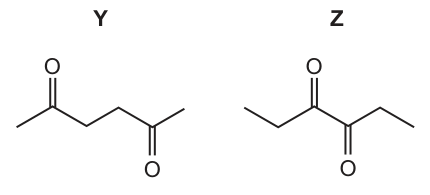
Complete Table 6.2 to predict the number of peaks observed in the proton () NMR spectra for Y and Z.
Table 6.2
| compound | number of peaks observed |
|---|---|
| Y | |
| Z |
Answer
| compound | number of peaks observed |
|---|---|
| Y | 2 |
| Z | 2 |
Y: 2; Z: 2
Background Concept
In NMR spectroscopy, the number of peaks (signals) in a spectrum corresponds to the number of chemically distinct environments for protons (hydrogen atoms) in the molecule. Protons that are chemically equivalent (due to symmetry or free rotation) produce a single signal. To determine the number of peaks, identify all sets of equivalent protons.
Understanding the Question
You are given the skeletal structures of two isomeric diketones:
- Y: hexane-2,5-dione ()
- Z: hexane-3,4-dione ()
You must predict the number of peaks in their NMR spectra.
Approach
Draw out the full structural formula for each, identify planes of symmetry, and group the protons into chemically equivalent sets.
Step-by-Step Reasoning
-
Compound Y (hexane-2,5-dione):
Structure:
The molecule has a plane of symmetry between C3 and C4. The two groups are equivalent (set a). The two groups are equivalent (set b). There are no other protons. Thus, there are 2 chemically distinct environments, giving 2 peaks. -
Compound Z (hexane-3,4-dione):
Structure:
The molecule has a plane of symmetry between C3 and C4. The two groups are equivalent (set a). The two groups are equivalent (set b). There are no other protons. Thus, there are 2 chemically distinct environments, giving 2 peaks.
Key Takeaways
Always check for molecular symmetry (planes of symmetry, rotation axes) before counting proton environments. Symmetry reduces the number of unique signals.
Common Mistakes
- Forgetting that the two halves of a symmetrical molecule are equivalent, leading to an overcount (e.g., saying Y has 4 peaks).
- Misreading the skeletal structure and missing the symmetry (e.g., treating the left and right sides of Z as different).
Things to Be Careful About
Ensure you are counting proton environments, not carbon environments (that would be NMR). Both Y and Z happen to have 2 proton signals, but their splitting patterns will differ significantly.
Name all the different splitting patterns observed in the proton () NMR spectra for Y and Z.
Y ........................................................................................................................................
Z ........................................................................................................................................
Answer
Y: singlet(s)
Z: triplet and quartet
Y: singlet; Z: triplet and quartet
Background Concept
The splitting pattern (multiplicity) of an NMR signal is determined by the number of protons on adjacent carbon atoms (typically within three bonds, coupling). The rule states that a signal will be split into peaks, where is the number of equivalent protons on the adjacent carbon(s).
- singlet (1 peak)
- doublet (2 peaks)
- triplet (3 peaks)
- quartet (4 peaks)
Protons separated by a carbonyl group () or other sp-hybridised atoms do not couple, as the coupling pathway is broken.
Understanding the Question
You must name the splitting patterns observed in the NMR spectra for Y and Z based on their structures.
Approach
For each distinct proton environment in Y and Z, count the number of adjacent protons () and apply the rule to determine the multiplicity.
Step-by-Step Reasoning
-
Compound Y (hexane-2,5-dione):
Structure:- The protons are adjacent to a carbonyl carbon (which has 0 protons). peak (singlet).
- The protons are adjacent to two carbonyl carbons (which have 0 protons). peak (singlet).
- Therefore, the only splitting pattern observed for Y is a singlet (both signals are singlets).
-
Compound Z (hexane-3,4-dione):
Structure:- The protons are adjacent to a group (2 protons). peaks (triplet).
- The protons are adjacent to a group (3 protons). peaks (quartet).
- Therefore, the splitting patterns observed for Z are a triplet and a quartet.
Key Takeaways
The rule is applied to protons on adjacent carbons. Carbonyl groups () and other heteroatoms without protons do not contribute to and break the coupling pathway.
Common Mistakes
- Assuming and in Z will couple through the carbonyl group (they don't; coupling is only through -bonds, typically ).
- Forgetting to name the patterns for both compounds (e.g., only listing triplet and quartet and forgetting that Y only has singlets).
Things to Be Careful About
The question asks to name all the different splitting patterns observed. For Y, since both environments give singlets, the only pattern is "singlet" (or "singlet(s)"). For Z, you must list both "triplet" and "quartet". Ensure exact spelling: singlet, doublet, triplet, quartet, multiplet.
State the relative acidities of bromoethanoic acid, , chloroethanoic acid, , ethanoic acid, and ethanol, .
Explain your answer.
Answer
Most acidic → least acidic:
Explanation:
- Chlorine is more electronegative than bromine, so has a stronger negative inductive effect () than , producing a more stable conjugate base and a weaker O–H bond.
- Both halogenoethanoic acids are more acidic than ethanoic acid because the electron-withdrawing halogen ( effect) stabilises the carboxylate anion, whereas the methyl group in ethanoic acid has a positive inductive effect () that destabilises it.
- Ethanoic acid is more acidic than ethanol because the group exerts a negative inductive effect that stabilises the carboxylate ion, whereas the ethyl group in ethanol has a effect that destabilises the alkoxide ion.
ClCH₂COOH > BrCH₂COOH > CH₃COOH > CH₃CH₂OH
Background Concept
Acidity in organic compounds is determined by the stability of the conjugate base (anion) formed when the proton is lost. The more stable the conjugate base, the stronger the acid. Inductive effects are the primary tool for comparing acidities among structurally similar compounds.
A negative inductive effect () is exerted by electronegative atoms or groups that pull electron density towards themselves through sigma bonds. This stabilises a nearby negative charge (the conjugate base) by dispersing it, making the acid stronger. A positive inductive effect () is exerted by alkyl groups that push electron density outward, destabilising a nearby negative charge and weakening the acid.
The strength of the inductive effect depends on electronegativity (F > Cl > Br > I) and on distance from the site of charge.
Understanding the Question
The question asks students to rank four compounds by acidity and explain the ranking. The compounds are: two halogenoethanoic acids (chloro- and bromo-), ethanoic acid, and ethanol. The command word "State" requires the order, and "Explain" requires the reasoning. The mark scheme allocates 4 marks: 1 for the correct order, 1 for the general inductive effect explanation, and 2 for specific comparisons (Cl vs Br, COOH vs OH).
Fig. 7.1 shows the reaction of methylbenzene and ethanedioic acid with .
Predict the major carbon-containing product for each of these reactions.
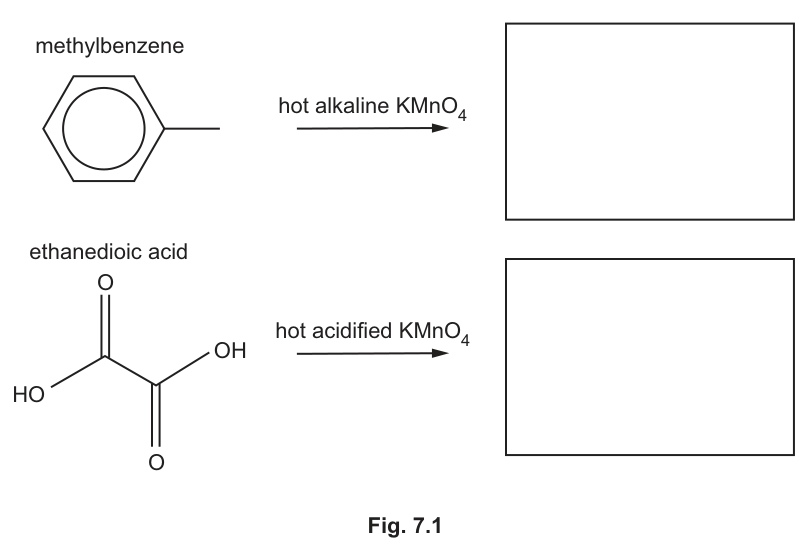
Answer
Methylbenzene + hot alkaline :
The product is benzoic acid, .
Ethanedioic acid + hot acidified :
The product is .
Benzoic acid (C₆H₅COOH) and CO₂
Background Concept
Hot alkaline potassium manganate(VII) is a strong oxidising agent that oxidises alkyl side chains on aromatic rings completely to a carboxylic acid group, regardless of the length of the side chain. This is called side-chain oxidation. The benzene ring itself is resistant to oxidation due to its delocalised system.
Ethanedioic acid (oxalic acid, HOOC–COOH) is unusual among carboxylic acids in that it can be further oxidised because it contains a C–C single bond between two carboxyl groups. Hot acidified oxidises it to carbon dioxide. The half-equation is:
This is the basis of the well-known redox titration of ethanedioic acid with .
Understanding the Question
The question shows two separate oxidation reactions and asks for the major carbon-containing product of each. For methylbenzene, the methyl group is oxidised to –COOH. For ethanedioic acid, the molecule is cleaved to give .
Approach
Identify the oxidising conditions and recall the standard products: side-chain oxidation of arenes gives benzoic acid; oxidation of ethanedioic acid gives .
Step-by-Step Reasoning
-
Methylbenzene has a methyl group attached to a benzene ring. Hot alkaline oxidises the entire side chain to a carboxylic acid group, giving benzoic acid (). The ring is unaffected.
-
Ethanedioic acid () is oxidised by hot acidified . The C–C bond is broken and both carbons are fully oxidised to . This is the only common carboxylic acid that undergoes further oxidation by .
Key Takeaways
- Hot alkaline oxidises any alkyl side chain on a benzene ring to –COOH.
- Ethanedioic acid is a reducing agent toward and is oxidised to .
Common Mistakes
- Writing phenol or cyclohexanecarboxylic acid as the product of methylbenzene oxidation.
- Forgetting that the ring is not oxidised.
- Writing CO (carbon monoxide) instead of for ethanedioic acid oxidation.
Things to Be Careful About
- The question asks for the major carbon-containing product, so for ethanedioic acid, is the answer (not water or ).
- State the product clearly as a structure or formula.
Polyamide X can be synthesised from ethanedioic acid and benzene-1,4-diamine.
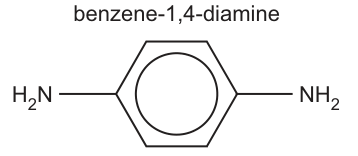
Draw the repeat unit of polyamide X in the box.
The new functional group formed should be shown displayed.
Answer
The repeat unit is:
The amide linkage () must be shown displayed with the bond and bond explicit.
Repeat unit: -NH-C₆H₄-NH-CO-CO- with displayed amide group
Background Concept
Condensation polymerisation occurs between monomers with two complementary functional groups, eliminating a small molecule (usually water) at each linkage. A diamine reacts with a dicarboxylic acid to form a polyamide, with amide () linkages formed between the and groups.
Understanding the Question
The monomers are ethanedioic acid () and benzene-1,4-diamine (). The student must draw the repeat unit showing the amide linkage displayed.
Approach
Join the two monomers by eliminating water between and , forming . The repeat unit contains the full benzene ring with both amide nitrogens attached, and the two carbonyls from ethanedioic acid.
Step-by-Step Reasoning
- Ethanedioic acid provides the portion.
- Benzene-1,4-diamine provides the portion.
- The amide bond forms between C=O and N-H, with water eliminated.
- The repeat unit has continuation bonds (dashed lines) on both sides.
Key Takeaways
- Polyamides from diamines and dicarboxylic acids have the pattern: -NH-R-NH-CO-R'-CO-
- The amide group must be shown displayed (C=O and N-H both visible).
Common Mistakes
- Drawing the amide as -NH-CO- without showing the C=O displayed.
- Forgetting the continuation bonds.
- Incorrectly placing the NH groups on the ring (they should be at 1,4-positions).
- Writing the repeat unit as if it were a polyester (with ester links instead of amide links).
Things to Be Careful About
- The mark scheme requires the amide bond to be shown displayed with C=O, N-H, and the N attached to the ring.
- Continuation bonds must be present on both ends.
Benzene-1,4-diamine can be formed by reduction of 1,4-dinitrobenzene.
Complete the equation for this reduction.
[H] represents one atom of hydrogen from a reducing agent.
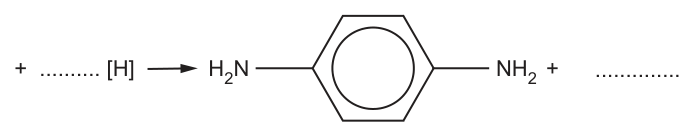
Answer
The missing reactant is 1,4-dinitrobenzene (), the coefficient of [H] is 12, and the other product is .
O₂N-C₆H₄-NO₂ + 12[H] → H₂N-C₆H₄-NH₂ + 4H₂O
Background Concept
The reduction of a nitro group () to an amino group () requires 6 hydrogen atoms per nitro group. This is because the nitro group has two oxygen atoms that must be removed as water (requiring 4H for two OH groups = 2H₂O) and the nitrogen must gain two additional H atoms to go from the oxidation state in to .
Per nitro group:
For a dinitro compound, this doubles: and .
Understanding the Question
The equation is partially given. The student must fill in the missing reactant (1,4-dinitrobenzene), the coefficient before [H], and the missing product (water with coefficient 4).
Approach
Write the reduction half-reaction for one nitro group, then double it for the dinitro compound. Balance oxygen as water and hydrogen accordingly.
Step-by-Step Reasoning
- One group requires 6[H] to become , producing 2H₂O.
- 1,4-dinitrobenzene has two groups, so it requires 12[H] and produces 4H₂O.
- The reactant is 1,4-dinitrobenzene: .
- The product is benzene-1,4-diamine: (already shown).
- The by-product is .
Key Takeaways
- Each nitro group needs 6[H] for full reduction to an amino group.
- The oxygen is removed as water.
Common Mistakes
- Writing 6[H] instead of 12[H] (forgetting there are two nitro groups).
- Writing 2H₂O instead of 4H₂O.
- Writing the wrong structure for the dinitro reactant.
Things to Be Careful About
- The question uses [H] notation, so the coefficient must be correct.
- Balance all atoms: N, O, H, and the carbon skeleton must all be accounted for.
Fig. 7.2 shows the two-step synthesis of the azo compound W.
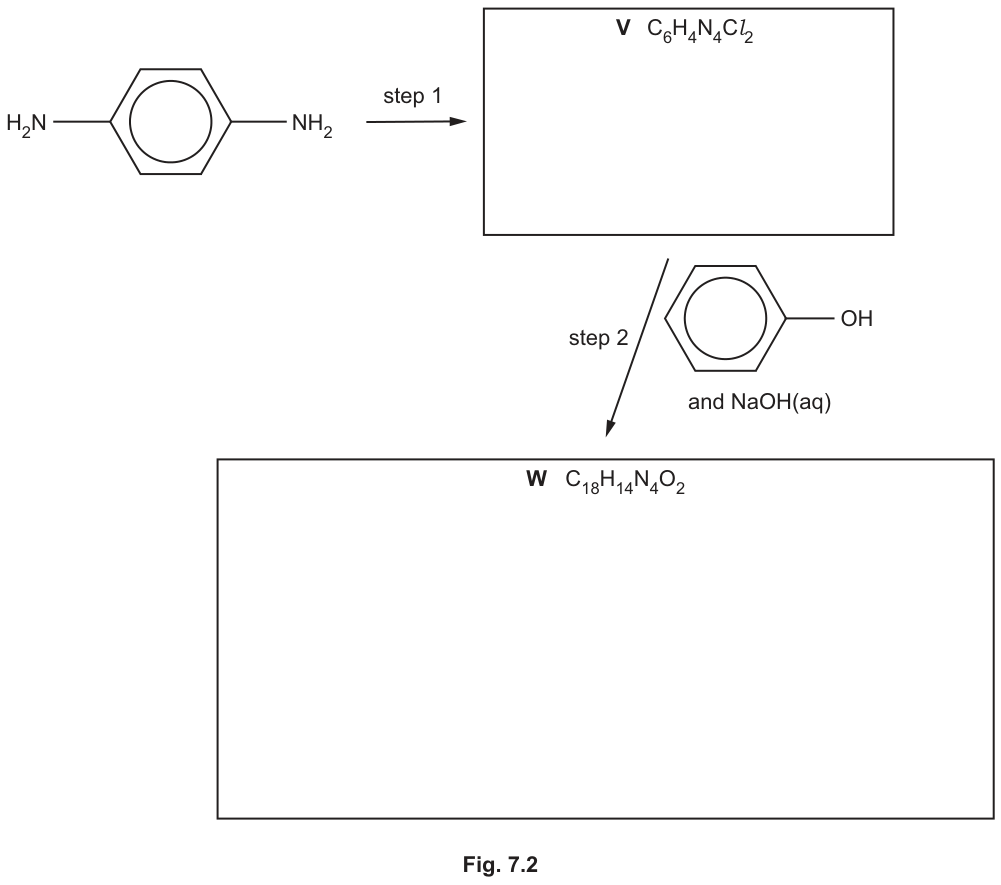
Answer
Compound V (bis-diazonium salt):
Compound W (azo coupling product with phenol):
Each diazonium group couples with phenol at the position para to the group.
V = Cl⁻⁺N≡N-C₆H₄-N⁺≡N Cl⁻; W = HO-C₆H₃-N=N-C₆H₄-N=N-C₆H₃-OH
Background Concept
Azo compounds are formed by the coupling reaction between a diazonium salt and an activated aromatic ring (such as phenol or aniline). The diazonium ion acts as a weak electrophile and attacks the position para (or ortho) to the activating group on the other ring.
When a diamine is treated with nitrous acid (generated in situ from NaNO₂ + HCl) at low temperature, both amino groups undergo diazotisation to give a bis-diazonium salt. This can then couple with two molecules of phenol to give a bis-azo compound.
Understanding the Question
Starting from benzene-1,4-diamine, step 1 produces compound V with molecular formula . Step 2 reacts V with phenol and NaOH(aq) to give W with molecular formula .
The student must deduce the structures of V and W.
Approach
-
From the formula of V (): the benzene ring contributes , the two diazonium groups contribute (two ), and two chloride ions are the counterions. So V is the bis-diazonium salt.
-
From the formula of W (): two phenol rings () plus the central benzene ring () minus the H atoms replaced by coupling. Each coupling replaces one H on the phenol ring (at the para position to OH) with the azo linkage. So W has the structure HO-C₆H₃-N=N-C₆H₄-N=N-C₆H₃-OH.
Step-by-Step Reasoning
-
Diazotisation of benzene-1,4-diamine: both groups are converted to (diazonium) groups. The counterions are (from HCl used to generate ).
-
V = — check formula: ✓
-
In step 2, NaOH(aq) is added to phenol to form the phenoxide ion (), which is more nucleophilic and activates the ring further toward electrophilic attack.
-
Each diazonium group couples with one phenol molecule at the position para to the group (the most activated position).
-
W = HO-C₆H₃-N=N-C₆H₄-N=N-C₆H₃-OH — check formula: ✓ (6+6+6=18 C; 3+4+3+1+1+1+1=14 H; 2+2=4 N; 2 O)
Key Takeaways
- Diazonium salts couple with phenols at the para position to give azo dyes.
- NaOH activates phenol by forming the phenoxide ion.
- Bis-diazonium salts can form bis-azo compounds.
Common Mistakes
- Drawing the azo linkage as without recognising it should be (linear, not bent).
- Placing the OH group on the wrong ring or the azo bond at the wrong position relative to OH.
- Forgetting the chloride counterions in V.
- Not recognising that coupling occurs para to the OH group.
Things to Be Careful About
- The molecular formula check is essential — verify C, H, N, O, and Cl counts match.
- The azo group is (double bond between the two nitrogens).
- The OH position in W must be para to the azo linkage on each terminal ring.
Answer
Reagents: and (or generated in situ)
Conditions: temperature (ice-cold / 0–5 )
NaNO₂ and HCl at ≤ 10°C
Background Concept
Diazotisation is the reaction of a primary aromatic amine with nitrous acid at low temperature to form a diazonium salt. Nitrous acid is unstable and is generated in situ by adding sodium nitrite to dilute hydrochloric acid:
The amine then reacts with the nitrous acid:
The temperature must be kept below 10°C (typically 0–5°C) because diazonium salts are thermally unstable and decompose at higher temperatures, losing nitrogen gas to form a phenol.
Understanding the Question
The question asks for the reagents and conditions used in step 1, which converts benzene-1,4-diamine to the bis-diazonium salt V. This is a standard diazotisation.
Approach
Recall the standard diazotisation conditions: sodium nitrite + dilute HCl, kept cold (below 10°C).
Step-by-Step Reasoning
- The reagent must generate nitrous acid in situ: NaNO₂ + HCl.
- Alternatively, HNO₂ itself can be stated (with HCl as the acid providing the counterion).
- The temperature must be ≤ 10°C to prevent decomposition of the diazonium salt.
Key Takeaways
- Diazotisation requires NaNO₂ + HCl at 0–10°C.
- The low temperature is critical to prevent loss of N₂ and formation of phenol.
Common Mistakes
- Writing NaNO₂ alone without HCl.
- Writing concentrated HCl (should be dilute).
- Omitting the temperature condition.
- Writing a temperature above 10°C.
Things to Be Careful About
- Both the reagent AND the temperature must be stated to gain the mark.
- The mark scheme accepts either 'HNO₂ and HCl at ≤10°C' or 'NaNO₂ and HCl at ≤10°C'.
In the electrophilic substitution of arenes, different substituents can direct to different ring positions.
Answer
The group directs incoming electrophiles to the meta position (positions 3 and 5). This is because the group is strongly electron-withdrawing (or electronegative), which deactivates the ring and makes the meta position relatively less deactivated than the ortho and para positions.
Meta position (3 and 5); electron-withdrawing group
Background Concept
In electrophilic aromatic substitution, substituents already on the benzene ring influence where the new group attaches. They are classified as ortho/para-directors or meta-directors. Electron-donating groups (like , , alkyl groups) activate the ring and direct ortho/para. Electron-withdrawing groups (like , , ) deactivate the ring and direct meta.
Understanding the Question
The question asks for the directing effect of the nitro group () in arene electrophilic substitution and the reason behind it.
Approach
Recall the rule for nitro groups: they are meta-directors. Explain this by referencing the electronic nature of the nitro group—it pulls electron density away from the ring (electron-withdrawing), destabilizing the carbocation intermediate at ortho/para positions more than at the meta position.
Step-by-Step Reasoning
- Directing effect: The group directs the incoming electrophile to the meta position, which corresponds to positions 3 and 5 on the ring relative to the nitro group at position 1.
- Explanation: The nitrogen and oxygen atoms in the nitro group are highly electronegative, and the formal positive charge on nitrogen (in one resonance structure) makes it strongly electron-withdrawing. This withdraws electron density from the delocalized pi system of the benzene ring, deactivating it towards electrophilic attack. When an electrophile attacks, the resulting carbocation intermediate is less unstable (or more stable) when the attack occurs at the meta position because the positive charge is not placed directly on the carbon bearing the electron-withdrawing group (which would create two adjacent positive charges, highly unstable).
Key Takeaways
- Nitro groups are meta-directors and deactivators.
- Electron-withdrawing groups direct meta due to the destabilization of ortho/para sigma complexes.
Common Mistakes
- Stating that is electron-donating.
- Confusing meta-directors with ortho/para-directors.
- Failing to mention that the group is electron-withdrawing or electronegative.
Things to Be Careful About
- Ensure you specify 'meta' or '3 and 5'.
- The explanation must link the directing effect to the electronic nature (electron-withdrawing/electronegative) of the group.
The nitration of arenes uses a mixture of concentrated and concentrated to generate the electrophile.
Write an equation for the formation of the electrophile.
Answer
(or )
HNO3 + 2H2SO4 -> NO2+ + 2HSO4- + H3O+
Background Concept
Nitration of arenes requires a nitrating mixture of concentrated nitric acid and concentrated sulfuric acid. The sulfuric acid acts as a catalyst and a stronger acid than nitric acid, protonating the nitric acid to generate the nitronium ion (), which is the active electrophile.
Understanding the Question
Write the balanced equation for the formation of the electrophile from and .
Approach
Recall the standard equation for nitronium ion generation. Sulfuric acid protonates nitric acid, which then loses water to form . The bisulfate ion () is formed. Depending on how many protons are transferred, water or hydronium () is formed.
Step-by-Step Reasoning
The nitric acid accepts a proton from sulfuric acid:
The protonated nitric acid loses a water molecule to form the nitronium ion:
Combining these gives:
Alternatively, the water formed can be protonated by another molecule of sulfuric acid:
Adding this to the previous equation gives:
Both equations are acceptable.
Key Takeaways
- The nitrating mixture generates the nitronium ion ().
- Sulfuric acid is a stronger acid and protonates nitric acid.
Common Mistakes
- Writing unbalanced equations.
- Forgetting state symbols (though often not strictly required for this specific equation in some mark schemes, it's good practice; here the mark scheme doesn't explicitly demand them but the ions must be correct).
- Writing as the final electrophile instead of .
Things to Be Careful About
- Ensure the equation is balanced for mass and charge.
- Both forms (with or ) are accepted.
Carbon-carbon bond formation is an important reaction in organic synthesis.
Fig. 8.1 shows the synthesis of compound Q from benzene in two reaction steps.
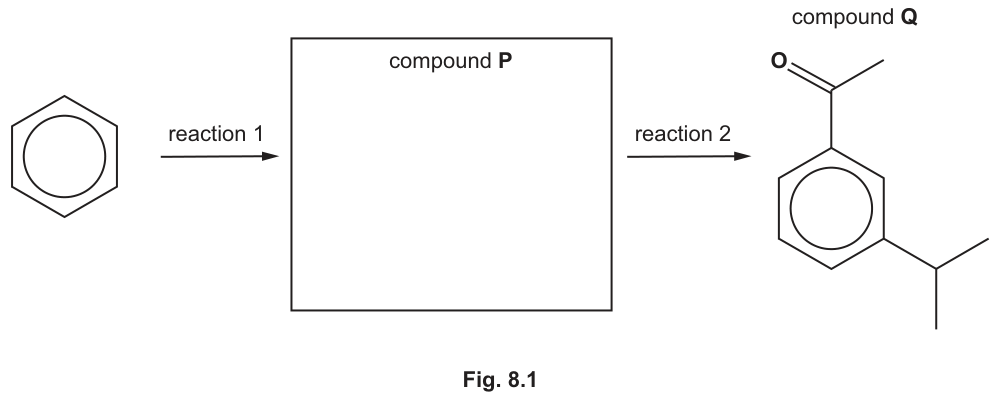
Answer
Phenylethanone (acetophenone) structure: benzene ring attached to -COCH3
Background Concept
Friedel-Crafts reactions are used to attach alkyl or acyl groups to a benzene ring. Acylation uses an acyl chloride (e.g., ) and a Lewis acid catalyst (e.g., ) to attach an acyl group (). Alkylation uses a haloalkane (e.g., ) and a Lewis acid catalyst (e.g., or ) to attach an alkyl group.
Understanding the Question
Fig 8.1 shows a two-step synthesis from benzene to compound Q (1-(3-isopropylphenyl)ethan-1-one). We need to identify compound P, the intermediate.
Approach
Compound Q has an acetyl group () and an isopropyl group () in the meta position. Reaction 1 must introduce one of these groups. Since the final product has the acetyl group at position 1 and isopropyl at position 3, and we know that acyl groups are meta-directors while alkyl groups are ortho/para-directors, we must introduce the acyl group first. If we introduced the isopropyl group first, the next group would go ortho/para, not meta. Therefore, Reaction 1 is Friedel-Crafts acylation to form phenylethanone (acetophenone), which is compound P. Reaction 2 is then Friedel-Crafts alkylation, which directs meta to the acetyl group.
Step-by-Step Reasoning
- Analyze Compound Q: It has a benzene ring with an acetyl group () and an isopropyl group () at the meta position (1,3-relationship).
- Determine Reaction 1: To get a meta-substituted product, the first substituent must be a meta-director. The acetyl group is a meta-director. The isopropyl group is an ortho/para-director. Therefore, Reaction 1 must be the introduction of the acetyl group.
- Identify Compound P: The product of Friedel-Crafts acylation of benzene with ethanoyl chloride is phenylethanone (acetophenone). Its structure is a benzene ring attached to a group.
Key Takeaways
- In multi-step aromatic synthesis, the order of reactions matters due to directing effects.
- Meta-directors must be introduced before ortho/para-directors if a meta-substituted product is desired.
Common Mistakes
- Drawing the wrong intermediate (e.g., isopropylbenzene).
- Forgetting that acyl groups are meta-directors.
Things to Be Careful About
- Ensure the structure of P is drawn correctly as a skeletal formula with the benzene ring and the acetyl group.
Suggest reagents and conditions for reactions 1 and 2 in Fig. 8.1.
reaction 1 ..........................................................................................................................
reaction 2 ..........................................................................................................................
Answer
reaction 1: ethanoyl chloride () and (anhydrous)
reaction 2: 2-bromopropane () and (or )
Reaction 1: CH3COCl and AlCl3; Reaction 2: (CH3)2CHBr and FeBr3
Background Concept
Friedel-Crafts acylation attaches an acyl group using an acyl chloride and an anhydrous aluminum chloride () catalyst. Friedel-Crafts alkylation attaches an alkyl group using a haloalkane and a Lewis acid catalyst like or .
Understanding the Question
Suggest reagents and conditions for reaction 1 (benzene to P) and reaction 2 (P to Q). P is phenylethanone and Q is 1-(3-isopropylphenyl)ethan-1-one.
Approach
Reaction 1 is the acylation of benzene to form phenylethanone. Reagents: ethanoyl chloride and .
Reaction 2 is the alkylation of phenylethanone to add an isopropyl group at the meta position. Reagents: 2-bromopropane (isopropyl bromide) and (or ).
Step-by-Step Reasoning
- Reaction 1: Benzene reacts with ethanoyl chloride () in the presence of anhydrous to form phenylethanone (compound P). The acts as a catalyst.
- Reaction 2: Phenylethanone (compound P) reacts with 2-bromopropane () in the presence of (or ) to form compound Q. The acetyl group in P is a meta-director, so the isopropyl group is added at the 3-position.
Key Takeaways
- Friedel-Crafts acylation uses acyl chloride + .
- Friedel-Crafts alkylation uses haloalkane + or .
- Directing effects determine the order of reactions.
Common Mistakes
- Using wrong reagents (e.g., using propanoyl chloride instead of ethanoyl chloride).
- Forgetting the catalyst ( or ).
- Not specifying anhydrous conditions for (though often just writing is enough for marks).
Things to Be Careful About
- Ensure the haloalkane for reaction 2 is 2-bromopropane (or 2-chloropropane), not 1-bromopropane, to get the isopropyl group.
- The catalyst for alkylation can be or .
Separate samples of and are added to warm .
State the expected observations, if any. Explain your answer.
with ................................................
with ................................................
explanation ...............................................................................................................................
Answer
with : No change / no precipitate.
with : Cream precipitate.
Explanation: In (bromobenzene), the lone pair on the bromine atom is delocalized (or overlaps with the p-orbitals of) the benzene ring -system. This gives the bond partial double-bond character, making it stronger and harder to break. In (benzyl bromide), the bond is a normal single bond and can be broken by nucleophilic substitution, releasing ions to form precipitate.
C6H5Br: no change; C6H5CH2Br: cream precipitate; explanation: delocalization of Br lone pair into ring in C6H5Br strengthens C-Br bond
Background Concept
Halogenoarenes (like bromobenzene, ) are much less reactive towards nucleophilic substitution than halogenoalkanes (like bromomethane) or benzyl halides (like ). This is because the lone pair on the halogen atom in a halogenoarene can delocalize into the pi-system of the benzene ring. This resonance gives the bond partial double-bond character, making it shorter and stronger, and harder to break.
In benzyl halides (), the halogen is attached to an hybridized carbon that is not part of the ring. The lone pair on the halogen does not delocalize into the ring (it's separated by the group). Therefore, the bond is a normal single bond and can undergo nucleophilic substitution relatively easily.
Understanding the Question
Two compounds, bromobenzene () and benzyl bromide (), are added to warm silver nitrate solution. State the observations and explain the difference.
Approach
Recall that is used to test for halide ions released from halogenoalkanes/arenes. A cream precipitate of forms if is released. Bromobenzene does not release easily due to delocalization. Benzyl bromide does release because the bond is a normal single bond.
Step-by-Step Reasoning
- Observation for : No reaction occurs, so no precipitate forms. The solution remains clear (or no change).
- Observation for : The bond breaks, releasing ions. These react with to form a cream precipitate of silver bromide ().
- Explanation: In bromobenzene, the lone pair on the bromine atom overlaps with the delocalized pi-system of the benzene ring (delocalization). This gives the bond partial double-bond character, making it stronger and harder to break. In benzyl bromide, the bromine is on a group, so there is no delocalization of the bromine lone pair into the ring. The bond is a weaker single bond and can be broken by the nucleophile ( or from the aqueous solution), releasing .
Key Takeaways
- Halogenoarenes are unreactive towards nucleophilic substitution due to delocalization.
- Benzyl halides are reactive because the halogen is not directly attached to the ring.
- Silver nitrate test distinguishes between reactive and unreactive C-Br bonds.
Common Mistakes
- Saying bromobenzene reacts slowly (it essentially doesn't react under these conditions).
- Not mentioning delocalization or partial double-bond character.
- Confusing benzyl bromide with bromobenzene.
Things to Be Careful About
- The precipitate from bromide ions is cream (not white like chloride, or yellow like iodide).
- Ensure the explanation clearly links delocalization to bond strength.
Acyl bromides, , react readily with .
The mechanism of this reaction is similar to that of the reaction of with acyl chlorides, .
Answer
(nucleophilic) addition–elimination
Nucleophilic addition-elimination
Background Concept
Acyl chlorides (and acyl bromides) react vigorously with water (hydrolysis) to form carboxylic acids and hydrogen halides. The mechanism involves two main steps: first, a nucleophile (water) adds to the carbonyl carbon, breaking the pi bond (addition). Then, a leaving group (halide ion) is expelled, reforming the carbonyl pi bond (elimination). This is called nucleophilic addition-elimination.
Understanding the Question
Name the mechanism for the reaction of acyl bromides with water.
Approach
Recall the standard mechanism name for nucleophilic attack on the carbonyl group of acyl derivatives followed by loss of a leaving group.
Step-by-Step Reasoning
The reaction proceeds via nucleophilic addition of water to the carbonyl carbon, forming a tetrahedral intermediate, followed by elimination of the bromide ion to reform the bond. This is the nucleophilic addition-elimination mechanism.
Key Takeaways
- Acyl derivatives undergo nucleophilic addition-elimination.
- This is distinct from nucleophilic substitution (/) at saturated carbons.
Common Mistakes
- Calling it 'nucleophilic substitution' (it's addition-elimination).
- Calling it 'electrophilic addition'.
Things to Be Careful About
- Use the full name 'nucleophilic addition-elimination'.
Complete the mechanism in Fig. 8.2 for the reaction of with .
Include all relevant lone pairs of electrons, curly arrows, charges and dipoles.
Draw the structure of the intermediate.
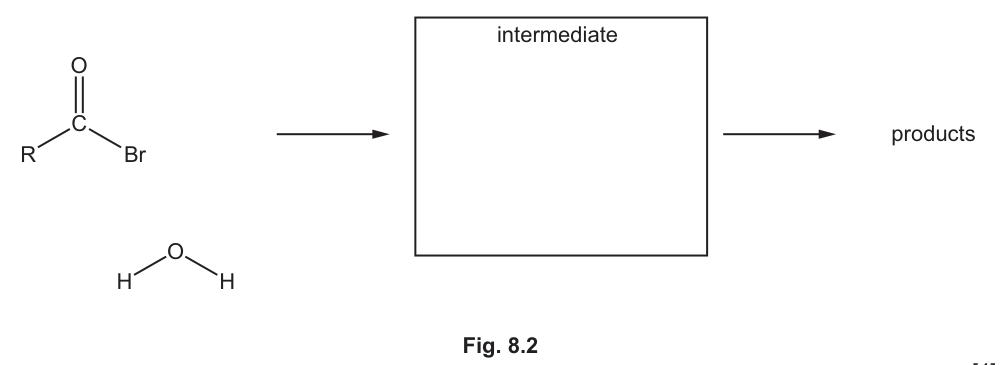
Answer
See mechanism diagram
Background Concept
The nucleophilic addition-elimination mechanism for acyl halides with water involves:
- Addition: The lone pair on the oxygen of water attacks the electrophilic carbonyl carbon. The pi electrons from the bond move onto the oxygen atom. This forms a tetrahedral intermediate with a negative charge on the carbonyl oxygen and a positive charge on the water oxygen.
- Elimination: The lone pair on the negative oxygen reforms the pi bond, and the bond breaks, with the electrons going to the bromine atom. This expels and forms a protonated carboxylic acid, which then loses a proton to form the final carboxylic acid and (or and ).
Understanding the Question
Complete the mechanism in Fig 8.2 for the reaction of with . Include lone pairs, curly arrows, charges, dipoles, and draw the intermediate.
Approach
Draw the reactants with dipoles and lone pairs. Show the nucleophilic attack with curly arrows. Draw the tetrahedral intermediate with correct charges and lone pairs. Show the elimination step with curly arrows.
Step-by-Step Reasoning
Step 1: Addition
- Draw with dipoles: is , is , is .
- Draw with a lone pair on oxygen.
- Curly arrow from the lone pair on (in ) to the carbonyl .
- Curly arrow from the pi bond to the atom.
- Intermediate: A tetrahedral carbon bonded to , , (with 3 lone pairs), and (with 1 lone pair, positive charge). The bond is a single bond.
Step 2: Elimination
- Curly arrow from a lone pair on the to reform the pi bond (to the bond).
- Curly arrow from the bond to the atom, breaking the bond and forming .
- This leads to products: (after deprotonation) and (or ).
Key Takeaways
- The mechanism is addition-elimination, not substitution.
- The intermediate is tetrahedral with charges.
- Curly arrows must show electron movement from electron-rich to electron-poor species.
Common Mistakes
- Drawing curly arrows from the wrong place (e.g., from the bond instead of the lone pair).
- Forgetting lone pairs on oxygen atoms.
- Getting the charges wrong in the intermediate (O from carbonyl is negative, O from water is positive).
- Drawing the intermediate as planar (it should be tetrahedral around the central carbon).
Things to Be Careful About
- Ensure all curly arrows start from a lone pair or a bond and end at an atom or a bond.
- Include dipoles on the and bonds in the reactants.
- The intermediate must show the correct connectivity and charges.
Answer
Basicity depends on the ability of the lone pair on nitrogen to accept (coordinate with) a proton (). In amides, the lone pair on nitrogen is delocalised into the adjacent group, making it unavailable to accept a proton, so amides are much weaker bases than amines.
The lone pair on N in amides is delocalised into the C=O group, making it unavailable to accept H+, unlike in amines where the lone pair is fully available.
Background Concept
A base, in the Brønsted-Lowry sense, is a proton acceptor. In the Lewis sense, it is an electron pair donor. Amines are basic because the nitrogen atom carries a lone pair of electrons that is available to form a dative covalent bond with a proton (), producing an ammonium ion.
Amides () also contain a nitrogen with a lone pair, yet they are essentially neutral in aqueous solution. The key difference lies in the electronic environment of that lone pair.
Understanding the Question
The question asks you to explain, in terms of structure and bonding, why amides are much weaker bases than amines. The command word is "explain", so you must give the reason, not just state the observation. You need to address two points: (1) what makes a substance basic (lone pair availability to accept ), and (2) why the amide nitrogen's lone pair is not available (delocalisation into the carbonyl group).
Approach
Start from the definition of basicity in terms of lone pair donation. Then identify the structural feature of amides that removes the lone pair from availability — the adjacent group provides a orbital into which the nitrogen lone pair can delocalise (p-π conjugation).
Step-by-Step Reasoning
M1 — Define basicity in terms of lone pair:
A substance is basic because it has a lone pair of electrons that can accept (coordinate with) a proton. This is the Lewis definition applied to Brønsted basicity. Amines have an available lone pair on nitrogen, so they readily accept .
M2 — Explain delocalisation in amides:
In an amide, the nitrogen lone pair is in a p-orbital that overlaps with the -system of the adjacent bond. This delocalisation (resonance) means the lone pair is shared with the carbonyl group and is no longer localised on nitrogen. As a result, it cannot be donated to a proton, and the amide behaves as a neutral compound rather than a base.
The resonance structure can be represented as:
This partial double-bond character between C and N also explains why amides have restricted rotation about the C-N bond.
Key Takeaways
- Basicity requires an available lone pair to accept .
- Delocalisation of a lone pair into an adjacent -system removes its availability for protonation.
- Amides are essentially neutral because the N lone pair is tied up in resonance with the carbonyl.
Common Mistakes
- Saying only "the lone pair is delocalised" without linking this to the inability to accept a proton (missing M1).
- Saying "the lone pair is involved in bonding" without specifying delocalisation into the C=O group.
- Confusing amides with amines — amines have no adjacent carbonyl, so their lone pairs remain localised and available.
Things to Be Careful About
- You must explicitly mention the lone pair accepting/being available for (M1) AND the delocalisation into C=O (M2). Both are required for full marks.
- The mark scheme accepts "p-orbital" as an alternative to "lone pair" for M1.
Fig. 9.1 shows the preparation of 2-phenylethylamine, , by three different routes.
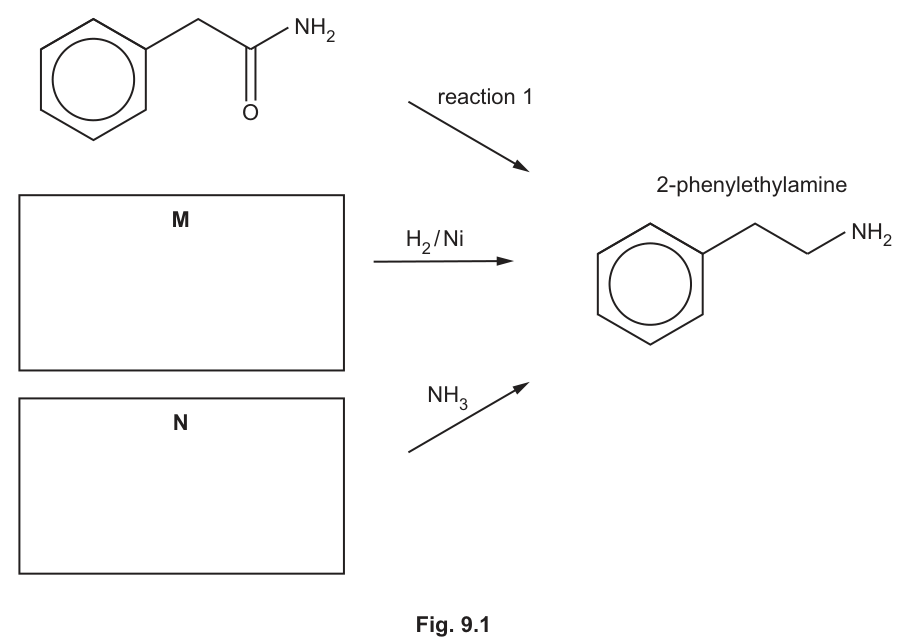
Answer
M = phenylacetonitrile (benzyl cyanide):
N = (2-bromoethyl)benzene:
M = C6H5CH2CN (phenylacetonitrile); N = C6H5CH2CH2Br ((2-bromoethyl)benzene)
Background Concept
2-Phenylethylamine () is a primary amine with a two-carbon chain between the phenyl ring and the amino group. It can be prepared by several routes:
-
Reduction of a nitrile: Nitriles () are reduced by (or ) to primary amines with one additional carbon. The C≡N triple bond is reduced to CH₂-NH₂.
-
Nucleophilic substitution with ammonia: A halogenoalkane () reacts with excess concentrated (in ethanol, heated in a sealed tube) to give a primary amine via substitution.
Understanding the Question
The question provides the product (2-phenylethylamine) and the reagents for two routes. You must deduce what starting material would give this product under those conditions.
- Route 2 uses (a reducing agent) to give the amine → the precursor must be a nitrile.
- Route 3 uses (a nucleophile) to give the amine → the precursor must be a halogenoalkane.
Approach
For M (reduction route): The product has the structure . Reduction of a nitrile converts to . So the nitrile must be (the carbon of the CN becomes the CH₂ attached to NH₂).
For N (substitution route): The product is . Nucleophilic substitution replaces the halogen with NH₂. So the halogenoalkane must be (or Cl/I).
Step-by-Step Reasoning
M — Nitrile precursor:
- is a catalytic hydrogenation reagent that reduces multiple bonds.
- Nitriles are reduced to primary amines:
- Working backwards: if , then
- Therefore M = (phenylacetonitrile)
N — Halogenoalkane precursor:
- acts as a nucleophile in substitution reactions with halogenoalkanes.
- Working backwards: if , then
- Therefore N = ((2-bromoethyl)benzene)
Key Takeaways
- Reduction of nitriles adds one carbon to the chain (the CN carbon becomes CH₂).
- Nucleophilic substitution with NH₃ preserves the carbon skeleton exactly (Br is replaced by NH₂).
- Working backwards from products is a key skill in organic synthesis questions.
Common Mistakes
- For M: drawing (wrong — this would give a three-carbon chain after reduction).
- For N: drawing (wrong position of Br — would give a different amine).
- Using for N is also acceptable, but the mark scheme specifically shows Br.
Things to Be Careful About
- The carbon count must match exactly. For the nitrile route, remember the CN carbon becomes part of the chain.
- Draw full displayed or skeletal structures clearly showing all atoms and bonds as required.
Answer
(lithium tetrahydridoaluminate(III)), followed by hydrolysis with water/dilute acid.
LiAlH4
Background Concept
Amides can be reduced to amines by strong reducing agents. The C=O bond of the amide is reduced, converting to . This is analogous to the reduction of nitriles but requires a stronger reducing agent.
The reagent of choice is lithium tetrahydridoaluminate(III) (), which is a powerful hydride donor. It cannot be used in aqueous solution (it reacts violently with water), so the reaction is carried out in dry ether, followed by hydrolysis.
Note: is not strong enough to reduce amides — it only reduces aldehydes and ketones.
Understanding the Question
Reaction 1 converts 2-phenylacetamide () to 2-phenylethylamine (). This is a reduction of the amide carbonyl to a methylene group. The question asks for reagents and conditions.
Approach
Identify the type of reaction: amide → amine is a reduction. The standard reagent for this transformation at A-Level is .
Step-by-Step Reasoning
- The amide has a carbonyl group adjacent to the nitrogen.
- Reduction removes the oxygen and adds two hydrogens:
- Product: ✓
- Reagent: in dry ether, followed by hydrolysis.
Key Takeaways
- reduces amides to amines (and nitriles to amines, and carboxylic acids to primary alcohols).
- does NOT reduce amides.
- can also reduce nitriles but is not the standard answer for amide reduction.
Common Mistakes
- Writing (not strong enough for amides).
- Writing "heat with " (this is for nitriles, not amides at standard conditions).
- Forgetting to mention that must be used in dry conditions followed by hydrolysis.
Things to Be Careful About
- The mark scheme accepts just "" as the answer. The full name or "followed by hydrolysis" adds detail but is not required for the mark.
Fig. 9.2 shows compound H which is a useful starting material in organic synthesis.
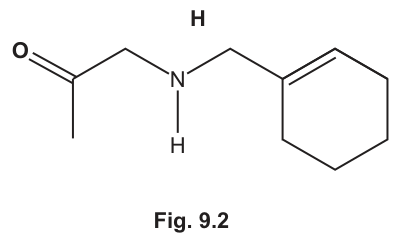
H contains an alkene and an amine functional group.
Name the other functional group and give the classification of the amine group in H.
other functional group in H ................................................
classification of amine ................................................
Answer
Other functional group: ketone (carbonyl)
Classification of amine: secondary ()
ketone (carbonyl) AND secondary (2°)
Background Concept
Functional group identification requires recognising characteristic structural features:
- Ketone (carbonyl): with the carbon bonded to two other carbon groups (not at the end of a chain, which would be an aldehyde).
- Amine classification: Primary () = N bonded to one carbon group; Secondary () = N bonded to two carbon groups; Tertiary () = N bonded to three carbon groups.
Understanding the Question
Compound H is shown with three functional groups: an alkene (cyclohexene ring), an amine, and one more. The question asks for the "other" functional group (besides alkene and amine) and the classification of the amine.
From the structure: (cyclohexenyl)
Approach
- Identify the group: this is a carbonyl with a methyl on one side and a on the other → ketone.
- Examine the nitrogen: it is bonded to two carbon groups ( and ) and one hydrogen → secondary amine.
Step-by-Step Reasoning
Other functional group:
- The structure shows
- The carbonyl carbon is bonded to two carbon atoms (methyl and methylene) → ketone (not aldehyde, not carboxylic acid).
Classification of amine:
- The nitrogen has: one H, one bond to (carbon group 1), one bond to (carbon group 2).
- Two carbon groups attached to N → secondary () amine.
Key Takeaways
- A ketone has the carbonyl carbon bonded to two carbon groups (internal position).
- Amine classification depends on how many carbon groups are attached to nitrogen, not how many carbons are in those groups.
Common Mistakes
- Calling the carbonyl an "aldehyde" (the C=O is not at the end of the chain with an H attached).
- Calling the amine "primary" because it has an N-H bond (primary/secondary/tertiary refers to carbon groups on N, not H atoms).
- Saying "amide" for the C=O group (an amide requires N directly bonded to C=O; here there is a CH₂ between them).
Things to Be Careful About
- The question asks for BOTH the functional group name AND the amine classification for one mark — both must be correct.
- "Carbonyl" is accepted as an alternative to "ketone" by the mark scheme.
Ozonolysis involves the oxidative cleavage of a C=C bond in alkenes using ozone, , as shown in Fig. 9.3.
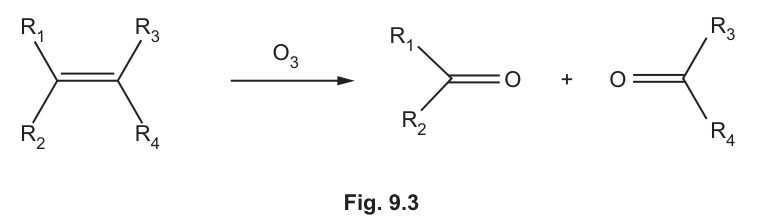
Fig. 9.4 shows the first step in this reaction which involves the formation of an ozonide intermediate.
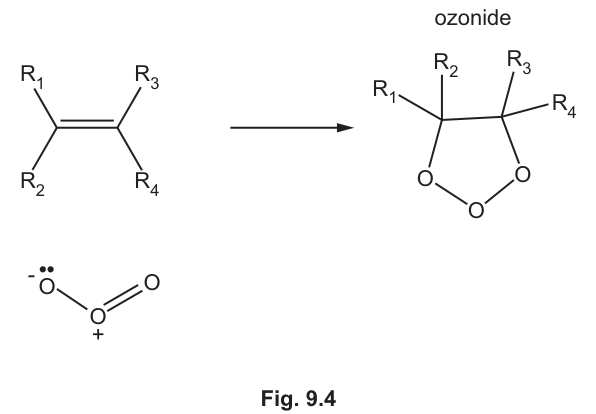
Answer
Three curly arrows:
- From the lone pair on to one carbon of the bond (forming a new C-O bond).
- From the bond to the terminal (right-hand) oxygen of ozone (forming a new C-O bond).
- From the bond to the central (neutralising the positive charge).
Three curly arrows: (1) from O- lone pair to C of C=C, (2) from C=C pi bond to terminal O, (3) from O=O pi bond to central O+
Background Concept
Ozonolysis begins with a 1,3-dipolar cycloaddition between ozone (a 1,3-dipole) and the alkene (a dipolarophile). Ozone has the structure , with formal charges that make it both a nucleophile (at ) and an electrophile (at ).
The curly arrow convention shows the movement of electron pairs:
- Arrows start at electron sources (lone pairs or bonds) and end at electron sinks (atoms or positions where new bonds form or charges are neutralised).
Understanding the Question
The question provides the structures of the alkene and ozone (with formal charges shown) and the cyclic ozonide product. You must draw three curly arrows showing how electrons move to form the two new C-O bonds and the intermediate.
Approach
Identify where new bonds form in the product:
- A new bond between and one carbon of the alkene.
- A new bond between the other carbon of the alkene and the terminal oxygen.
- The double bond breaks (electrons move to the central to neutralise it).
Step-by-Step Reasoning
Arrow 1: The negatively charged oxygen () has a lone pair that acts as a nucleophile. Draw a curly arrow from this lone pair to one carbon of the bond. This forms a new C-O single bond.
Arrow 2: The electrons of the bond move to form a new bond with the terminal (right-hand) oxygen of ozone. Draw a curly arrow from the middle of the bond to the right-hand O.
Arrow 3: As the terminal O gains a bond to carbon, the bond must break. The electrons from this bond move onto the central , neutralising its positive charge. Draw a curly arrow from the bond to the central .
Key Takeaways
- Curly arrows always start at a source of electrons (lone pair or bond) and end at a destination (atom gaining electrons or position of new bond).
- In cycloaddition mechanisms, multiple arrows work simultaneously to show concerted bond formation and breaking.
- Formal charges guide where electrons flow: negative → positive, or from bonds to electron-deficient centres.
Common Mistakes
- Drawing the arrow from the bond to the (wrong direction — electrons flow from the bond to the terminal O, not to the already-negative O).
- Omitting arrow 3 (the bond breaking is essential to neutralise the positive charge).
- Drawing arrows head-to-head or tail-to-tail (arrows must go from electron source to electron destination).
Things to Be Careful About
- Each arrow must start with a clear tail (at a lone pair or bond) and end with a clear head (at an atom or between atoms where a bond forms).
- The mark scheme awards 2 marks for 3 correct arrows (likely 1 mark for any two correct, 2 for all three, or similar distribution).
L is formed from alkene K, , by a similar reaction to that shown in Fig. 9.3.
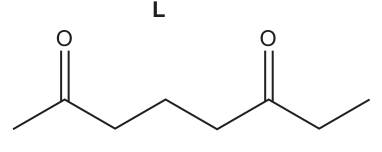
Suggest the structure of K.
Answer
Compound L is (octane-2,6-dione).
The two carbonyl carbons (C2 and C6) were joined by a bond in the alkene. Removing both oxygens and reconnecting C2 to C6 gives a cyclic alkene:
K = 1-ethyl-2-methylcyclopentene
1-ethyl-2-methylcyclopentene (C8H14)
Background Concept
Ozonolysis cleaves a double bond completely, replacing each carbon of the double bond with a group. The reaction is:
For a cyclic alkene, ozonolysis opens the ring and produces a dicarbonyl compound (dialdehyde or diketone) with the two carbonyl groups at the positions where the double bond was.
To work backwards (retro-ozonolysis): identify the two carbonyl carbons in the product, remove the oxygen atoms, and join those two carbons with a double bond. If the two carbonyls are connected by a chain, this forms a ring.
Understanding the Question
L is octane-2,6-dione: . This was formed by ozonolysis of alkene K (). We need to deduce K.
Approach
- Identify the two carbonyl carbons in L: C2 (bearing CH₃) and C6 (bearing CH₂CH₃).
- Remove both oxygens and reconnect C2 to C6 with a double bond.
- The chain between C2 and C6 is C3-C4-C5 (three CH₂ groups), so reconnecting C2 to C6 forms a five-membered ring (C2-C3-C4-C5-C6).
- C2 bears a methyl group and C6 bears an ethyl group.
Step-by-Step Reasoning
L structure:
Numbering: C1(CH₃) - C2(=O) - C3(H₂) - C4(H₂) - C5(H₂) - C6(=O) - C7(H₂) - C8(H₃)
Retro-ozonolysis:
- C2 and C6 were the double-bonded carbons in K.
- Remove O from C2 and O from C6.
- Join C2=C6.
- The ring formed: C2-C3-C4-C5-C6 = 5 carbons → cyclopentene ring.
- Substituents on the double bond: C2 has CH₃ (from C1), C6 has CH₂CH₃ (C7-C8).
K = 1-ethyl-2-methylcyclopentene
Molecular formula check: Cyclopentene ring = C₅H₆ (as base). Adding methyl (CH₃) replaces one H → +CH₂. Adding ethyl (C₂H₅) replaces one H → +C₂H₄. Total: C₅H₆ + CH₂ + C₂H₄ = C₈H₁₂...
Let me recount: 1-ethyl-2-methylcyclopentene. The ring has 5 carbons. C1 has ethyl (2C), C2 has methyl (1C). Total carbons = 5+2+1 = 8 ✓. Hydrogens: the ring carbons C3, C4, C5 each have 2H = 6H. C1 has 0H (bonded to C2, C5, and ethyl). C2 has 0H (bonded to C1, C3, and methyl). Ethyl = 5H. Methyl = 3H. Total H = 6+0+0+5+3 = 14 ✓ (C₈H₁₄).
Key Takeaways
- Retro-ozonolysis: join the carbonyl carbons with a double bond and remove the oxygens.
- If the two carbonyls are in the same molecule connected by a chain, the result is a cyclic alkene.
- Always verify the molecular formula matches the given value.
Common Mistakes
- Forgetting that the product is cyclic (drawing an open-chain alkene instead).
- Placing the substituents on the wrong carbons of the ring.
- Miscounting hydrogens and getting the wrong molecular formula.
Things to Be Careful About
- The question gives the molecular formula , so your answer must have exactly this formula.
- Draw the structure clearly showing the ring, the double bond position, and the correct substituents on the correct carbons.