Chemistry 9701/42 — October/November 2025
Cambridge A-Level · A Level Structured Questions · worked solutions for every part, with the mark scheme
Topics Nitrogen Compounds · Introduction to A Level Organic Chemistry · Hydrocarbons · Carboxylic Acids and Derivatives · Transition Elements · Group 2 · +7 more
Magnesium nitrate, , and strontium nitrate, , both decompose when heated to form the metal oxide and a mixture of gases.
Answer
(or the doubled version: )
Mg(NO3)2 → MgO + 2NO2 + ½O2
Background Concept
Group 2 nitrates decompose on heating to give the metal oxide, nitrogen dioxide, and oxygen. The general equation is:
The nitrate ion is decomposed by the polarising effect of the metal cation, which distorts the electron cloud of the nitrate ion, weakening the N–O bonds.
Understanding the Question
The question asks for a balanced equation for the thermal decomposition of magnesium nitrate. This is a recall task—you need to know the general form of the decomposition of a Group 2 nitrate and apply it to magnesium.
Approach
Write the general decomposition equation for a Group 2 nitrate and substitute Mg for M. Balance the equation by counting atoms on both sides.
Step-by-Step Reasoning
The general equation for the thermal decomposition of a Group 2 nitrate is:
Substituting M = Mg:
Check the balance:
- Mg: 1 on each side ✓
- N: 2 on each side (2 in the nitrate, 2 in 2NO₂) ✓
- O: 6 on the left (2 × 3), 1 + 4 + 1 = 6 on the right ✓
Alternatively, multiply the whole equation by 2 to avoid the fraction:
Key Takeaways
- Group 2 nitrates decompose to oxide + NO₂ + O₂.
- Both the fractional and doubled equations are acceptable.
- State symbols are not required here but would be (s), (g), (g) respectively.
Common Mistakes
- Writing NO instead of NO₂ (NO₂ is brown, NO is colourless).
- Forgetting to balance oxygen.
- Writing Mg(NO₃)₂ → MgO + N₂ + O₂ (wrong—nitrogen is released as NO₂).
Things to Be Careful About
- The equation must be balanced.
- Either the fractional or whole-number version is accepted.
- If state symbols are included, they must be correct: Mg(NO₃)₂(s) → MgO(s) + 2NO₂(g) + ½O₂(g).
State which of or decomposes at a lower temperature.
Explain your answer.
compound that decomposes at a lower temperature ...............................................................
explanation ...............................................................................................................................
Answer
Compound that decomposes at a lower temperature:
Explanation:
- is smaller than and has a higher charge density.
- The ion distorts/polarises the nitrate ion more strongly, weakening the N–O bonds, so decomposes at a lower temperature.
Mg(NO3)2; Mg2+ is smaller / higher charge density, polarises nitrate more
Background Concept
Thermal stability of Group 2 nitrates decreases as you go down the group. This is due to the polarising power of the metal cation. A small, highly charged cation (high charge density) distorts the electron cloud of the nitrate ion more strongly, weakening the N–O bonds and making the nitrate easier to decompose. As you go down Group 2, the cation becomes larger with a lower charge density, so it polarises the nitrate less, making the nitrate more stable and requiring a higher temperature to decompose.
Understanding the Question
The question asks which nitrate—magnesium nitrate or strontium nitrate—decomposes at a lower temperature, and to explain why. This is a "state and explain" question: you must name the compound AND give the reason based on polarisation.
Approach
Recall the trend in thermal stability of Group 2 nitrates: it increases down the group. Therefore, the nitrate with the smaller cation (Mg) decomposes at a lower temperature. Explain using charge density and polarisation of the nitrate ion.
Step-by-Step Reasoning
- Mg²⁺ is smaller than Sr²⁺ (Mg is above Sr in Group 2).
- Mg²⁺ therefore has a higher charge density (charge per unit volume).
- The higher charge density of Mg²⁺ means it polarises (distorts) the electron cloud of the nitrate ion more strongly.
- This weakens the N–O bonds in the nitrate ion, making it less thermally stable.
- Therefore, Mg(NO₃)₂ decomposes at a lower temperature than Sr(NO₃)₂.
Key Takeaways
- Thermal stability of Group 2 nitrates increases down the group.
- The explanation is based on charge density and polarisation of the anion.
- The same argument applies to Group 2 carbonates.
Common Mistakes
- Saying Sr(NO₃)₂ decomposes at a lower temperature (wrong—it's the opposite).
- Giving only "Mg is smaller" without mentioning charge density or polarisation.
- Confusing this with the trend for hydroxides (which become MORE soluble down the group).
Things to Be Careful About
- The mark scheme requires both M1 (smaller/higher charge density) and M2 (nitrate ion more distorted/polarised).
- "Charge density" is the key term—don't just say "smaller".
- The polarisation weakens the N–O bond—this is the mechanism for the lower decomposition temperature.
Magnesium oxide, , and strontium oxide, , both react with dilute sulfuric acid.
forms a soluble salt, A.
forms an insoluble salt, B.
Answer
Magnesium sulfate and water: and
MgSO4 and H2O
Background Concept
Metal oxides are basic oxides. They react with acids to form a salt and water. The general equation is:
This is a neutralisation reaction.
Understanding the Question
The question asks for the products when magnesium oxide reacts with dilute sulfuric acid. This is a simple acid-base reaction.
Approach
Identify the salt formed (magnesium sulfate) and the other product (water). Write the balanced equation.
Step-by-Step Reasoning
- MgO is a basic oxide.
- H₂SO₄ is the acid.
- The salt formed is magnesium sulfate (MgSO₄).
- The other product is water.
Key Takeaways
- Metal oxide + acid → salt + water.
- The salt name is derived from the metal and the acid: magnesium + sulfate = magnesium sulfate.
Common Mistakes
- Writing MgSO₃ instead of MgSO₄ (sulfate is SO₄²⁻, sulfite is SO₃²⁻).
- Forgetting the water product.
Things to Be Careful About
- The salt is magnesium sulfate, not magnesium sulfide or sulfite.
- The equation must be balanced.
Answer
- (A) has a more exothermic and a more exothermic than (B).
- The difference in is greater than the difference in .
- Therefore (A) has a more exothermic , so it is more soluble.
A (MgSO4) is more soluble because the difference in hydration enthalpy outweighs the difference in lattice enthalpy, giving a more exothermic ΔH_sol.
Background Concept
The solubility of an ionic compound depends on the balance between lattice enthalpy (energy required to separate the ions in the solid) and hydration enthalpy (energy released when the ions are hydrated by water). The enthalpy of solution, ΔH_sol, is given by:
For a salt to dissolve, ΔH_sol should be exothermic (or at least not too endothermic). The more exothermic the ΔH_sol, the more soluble the salt tends to be.
As you go down Group 2, the sulfates become LESS soluble. This is because the hydration enthalpy decreases (becomes less exothermic) more rapidly than the lattice enthalpy decreases. For MgSO₄, the small Mg²⁺ ion has a very high hydration enthalpy, which makes ΔH_sol exothermic and the salt soluble. For SrSO₄, the larger Sr²⁺ ion has a lower hydration enthalpy, so the difference between ΔH_latt and ΔH_hyd is smaller, making ΔH_sol less exothermic (or even endothermic), so the salt is insoluble.
Understanding the Question
The question states that MgO reacts with dilute sulfuric acid to form a soluble salt A (MgSO₄), while SrO forms an insoluble salt B (SrSO₄). The question asks why A is more soluble than B. This requires comparing the lattice and hydration enthalpies of the two sulfates.
Approach
- Recognise that solubility depends on ΔH_sol = ΔH_latt + ΔH_hyd.
- For MgSO₄ (A), both ΔH_latt and ΔH_hyd are more exothermic than for SrSO₄ (B).
- The key point is that the difference in ΔH_hyd is GREATER than the difference in ΔH_latt.
- Therefore, ΔH_sol for MgSO₄ is more exothermic, making it more soluble.
Step-by-Step Reasoning
- Mg²⁺ is smaller than Sr²⁺, so it has a higher charge density.
- This means MgSO₄ has a more exothermic ΔH_latt than SrSO₄ (more energy released when the lattice forms).
- Similarly, Mg²⁺ has a more exothermic ΔH_hyd than Sr²⁺ (more energy released when the ions are hydrated).
- The difference in ΔH_hyd is greater than the difference in ΔH_latt.
- Therefore, ΔH_sol = ΔH_latt + ΔH_hyd is more exothermic for MgSO₄ than for SrSO₄.
- A more exothermic ΔH_sol means MgSO₄ is more soluble.
Key Takeaways
- Solubility of Group 2 sulfates decreases down the group.
- This is explained by the balance between lattice and hydration enthalpies.
- The hydration enthalpy difference dominates, making the smaller cation's salt more soluble.
Common Mistakes
- Saying "MgSO₄ has a more exothermic ΔH_latt" alone is not enough—you must mention the ΔH_hyd difference being greater.
- Confusing the trend for sulfates (decreasing solubility down the group) with the trend for hydroxides (increasing solubility down the group).
- Forgetting that ΔH_sol = ΔH_latt + ΔH_hyd.
Things to Be Careful About
- The mark scheme requires all three points: more exothermic ΔH_latt and ΔH_hyd, the difference in ΔH_hyd is greater, and therefore more exothermic ΔH_sol.
- "Exothermic" is the key term—use it precisely.
- The explanation must link the enthalpy terms to solubility.
Ethanal, , reacts with nitrogen dioxide, . The products of the first step of this reaction are a radical and a molecule of nitrous acid, .
Use two words to complete the sentence.
This reaction involves ........................................ ........................................ of the single covalent bond between a hydrogen atom and a carbon atom in .
Answer
homolytic fission
homolytic fission
Background Concept
In organic chemistry, covalent bonds can break in two ways: homolytically or heterolytically. Homolytic fission occurs when the shared pair of electrons in a covalent bond is split equally between the two atoms, with each atom taking one electron. This process produces radicals (species with an unpaired electron). Homolytic fission is typically initiated by UV light or high temperatures and is the defining bond-breaking step in radical substitution mechanisms, such as the side-chain halogenation of alkanes or arenes.
Heterolytic fission, by contrast, involves the bond breaking unequally, with both electrons going to one atom to form ions (a cation and an anion). This is characteristic of polar reactions like nucleophilic substitution or electrophilic addition.
Understanding the Question
The question describes the first step of a reaction between ethanal () and nitrogen dioxide (). The products are a radical and . We are asked to identify the specific term for the breaking of the C–H bond in ethanal that leads to these products.
Approach
Look at the products: one is a radical (indicated by the single dot ). Since a radical is formed, the bond must have broken by sharing one electron with each fragment. This is the definition of homolytic fission.
Step-by-Step Reasoning
- The reactant is . The bond broken is the single covalent bond between the hydrogen atom and the carbon atom (the C–H bond on the carbonyl carbon).
- The products are (an acetyl radical) and .
- In , the carbon atom has an unpaired electron. This means the hydrogen atom took one electron from the C–H bond, and the carbon atom took the other.
- Equal splitting of a bonding pair to form radicals is called homolytic fission.
Key Takeaways
- Radicals are formed by homolytic fission.
- Ions are formed by heterolytic fission.
- Always look at the products to determine the type of bond breaking: if radicals are produced, it is homolytic.
Common Mistakes
- Writing "homolytic cleavage" instead of "homolytic fission" (both are acceptable, but "fission" is the standard mark scheme term).
- Confusing it with "heterolytic fission" or "ionic bond breaking".
- Writing "breakage" or "splitting" without the specific chemical terminology "homolytic fission".
Things to Be Careful About
- The question asks for two words. "Homolytic fission" is exactly two words. "Homolysis" is one word and would not score.
- Ensure spelling is correct: homolytic (not homolytical or homolyticly).
The hydrogen atom mentioned in (a)(i) forms a covalent bond with one of the oxygen atoms of an molecule. An molecule has a single, unpaired electron on the nitrogen atom. All electrons are paired in an molecule.
Draw dot-and-cross diagrams of and in the boxes. Show outer shell electrons only.
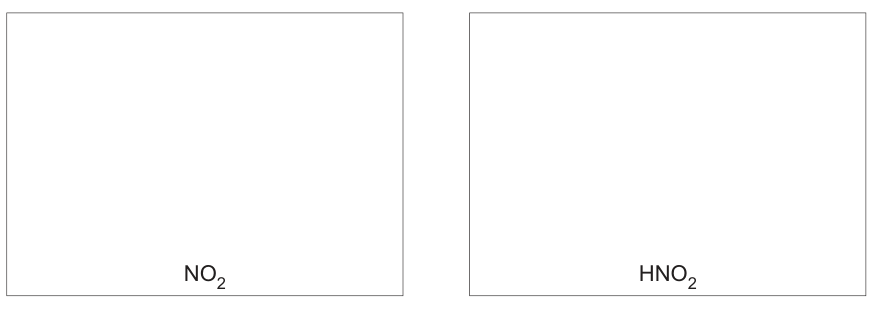
Answer
NO₂:
- Nitrogen atom (N) in the center.
- One oxygen atom (O) double-bonded to N (sharing 4 electrons: 2 dots and 2 crosses).
- The other oxygen atom (O) single-bonded to N (sharing 2 electrons: 1 dot and 1 cross, representing a coordinate bond from O to N).
- N has one unpaired electron (a single dot or cross).
- Each O has 3 lone pairs (6 non-bonding electrons).
HNO₂:
- H atom single-bonded to an O atom (sharing 2 electrons).
- This O atom is single-bonded to the N atom (sharing 2 electrons).
- The N atom is double-bonded to the other O atom (sharing 4 electrons).
- All electrons are paired; no unpaired electrons.
- Each O has appropriate lone pairs to complete its octet (2 lone pairs on the O bonded to H, 2 lone pairs on the O double-bonded to N, 1 lone pair on N if considering formal charges, but typically N has 1 lone pair in HNO₂ structure: H–O–N=O with a lone pair on N).
(See diagram below for the exact dot-and-cross representation)
See diagram description: NO₂ has N with one unpaired electron, double bond to one O, single coordinate bond to other O. HNO₂ has H-O-N=O structure with all electrons paired.
Background Concept
Dot-and-cross diagrams (Lewis structures) show the arrangement of valence (outer shell) electrons in a molecule. Dots (•) and crosses (×) are used to distinguish which atom contributed each electron, though in modern conventions, either symbol can be used as long as bonding pairs are clearly shown.
- Covalent bond: A shared pair of electrons (one from each atom, or two from one atom in a coordinate/dative bond).
- Radical: A species with an unpaired electron. In dot-and-cross diagrams, this is shown as a single dot or cross not paired with another.
- Octet rule: Main group elements (like N and O) tend to form bonds to achieve 8 electrons in their outer shell (except H, which needs 2).
Understanding the Question
We need to draw dot-and-cross diagrams for (nitrogen dioxide) and (nitrous acid), showing outer shell electrons only.
Key information given:
- : Single unpaired electron on the nitrogen atom.
- : All electrons are paired. The H atom forms a covalent bond with one of the oxygen atoms.
Approach
- Count the total outer shell electrons for each molecule.
- Determine the connectivity (which atoms are bonded to which).
- Distribute electrons to satisfy the octet rule (or duet for H), placing any remaining electrons as lone pairs or unpaired electrons.
- Use dots for one atom's electrons and crosses for another's to show the bonding clearly.
Step-by-Step Reasoning
For :
- N has 5 outer shell electrons. Each O has 6. Total = electrons.
- Since 17 is odd, there must be one unpaired electron (a radical).
- Connectivity: O–N–O.
- Draw a double bond between N and one O (4 electrons shared). Draw a single coordinate bond (or single covalent bond) between N and the other O (2 electrons shared).
- N has the unpaired electron.
- Distribute remaining electrons as lone pairs: each O gets 3 lone pairs (6 electrons). N has no lone pairs (5 valence - 4 in bonds - 1 unpaired = 0).
- Diagram description: N in center. Left O: 3 lone pairs, double bond to N (2 dots, 2 crosses). Right O: 3 lone pairs, single bond to N (1 dot, 1 cross, coordinate from O). N: 1 unpaired electron.
For :
- H has 1, N has 5, two O's have 12. Total = electrons.
- All electrons paired (even number).
- Connectivity given: H is bonded to an O. So we have H–O–N=O.
- H–O bond: 2 electrons (1 from H, 1 from O).
- O–N bond: 2 electrons (both from O, coordinate bond, or 1 from each).
- N=O bond: 4 electrons (2 from N, 2 from O).
- Lone pairs: O (bonded to H) has 2 lone pairs. N has 1 lone pair. O (double bonded to N) has 2 lone pairs.
- Total electrons: 2 (H-O) + 4 (O lone pairs) + 2 (O-N) + 2 (N lone pair) + 4 (N=O) + 4 (O lone pairs) = 18. Correct.
- Diagram description: H sharing a pair with O. That O sharing a pair with N. N sharing a double bond (two pairs) with the other O. Lone pairs placed to complete octets.
Key Takeaways
- Odd number of outer shell electrons = radical (unpaired electron).
- Coordinate bonds can be shown as both electrons coming from one atom (e.g., O to N in ).
- Always check the total electron count to ensure the diagram is correct.
Common Mistakes
- Forgetting the unpaired electron on N in .
- Drawing with a double bond to both oxygens and no unpaired electron (this would be 18 electrons, which is incorrect for ; that's or ).
- Drawing H bonded to N in instead of O. The question states H bonds to an oxygen atom.
- Including inner shell electrons (the question specifies "outer shell electrons only").
Things to Be Careful About
- The mark scheme allows either dots or crosses for bonding pairs, but consistency is key.
- For , the single bond to the second oxygen is often represented as a coordinate bond (both electrons from O), but a standard covalent bond (one from each) is also acceptable as long as the electron count and unpaired electron are correct.
- In , ensure N has a lone pair to complete its octet (5 valence - 3 bonds - 0 unpaired = 1 lone pair).
Use VSEPR theory to predict the bond angle at the nitrogen atom in an molecule.
bond angle = ..............................
Answer
115-120 degrees
Background Concept
VSEPR (Valence Shell Electron Pair Repulsion) theory predicts the geometry of molecules based on the repulsion between electron domains (bonding pairs, lone pairs, and sometimes single electrons in radicals) around a central atom. Electron domains arrange themselves as far apart as possible to minimize repulsion.
- 2 domains: Linear, .
- 3 domains: Trigonal planar, .
- 4 domains: Tetrahedral, .
Effect of lone pairs and multiple bonds: Lone pairs occupy more space than bonding pairs, so they compress bond angles. For example, in (4 domains, 1 lone pair), the angle is instead of . In (4 domains, 2 lone pairs), the angle is . Double bonds also exert slightly more repulsion than single bonds.
Understanding the Question
We need to predict the bond angle at the nitrogen atom in (nitrous acid) using VSEPR theory.
Approach
- Determine the Lewis structure of to identify the electron domains around the central nitrogen atom.
- Count the number of bonding domains (single, double, or triple bonds each count as one domain) and lone pairs.
- Determine the electron geometry and then the molecular geometry.
- Predict the bond angle, accounting for the compression caused by the lone pair.
Step-by-Step Reasoning
- Lewis structure of : As established in part (a)(ii), the structure is H–O–N=O, with a lone pair on nitrogen.
- Electron domains around N:
- One single bond to O (H–O–N): 1 domain.
- One double bond to O (N=O): 1 domain.
- One lone pair on N: 1 domain.
- Total domains = 3.
- Electron geometry: 3 domains arrange in a trigonal planar geometry with an ideal angle of .
- Molecular geometry: With 2 bonding domains and 1 lone pair, the shape is bent (or angular).
- Bond angle prediction: The lone pair repels the bonding pairs more strongly than they repel each other, compressing the O–N–O bond angle to less than . Typically, for a trigonal planar electron geometry with one lone pair (like in or ozone ), the angle is around . (In , it is ; in , it is ). For , the accepted range is .
Key Takeaways
- Count electron domains (bonds + lone pairs) around the central atom.
- A double bond counts as ONE domain in VSEPR theory.
- Lone pairs compress bond angles below the ideal value for that electron geometry.
- For 3 domains (trigonal planar electron geometry) with 1 lone pair, the angle is slightly less than (typically ).
Common Mistakes
- Counting the double bond as two domains (this would give 4 domains and a tetrahedral angle, which is wrong).
- Forgetting the lone pair on nitrogen in .
- Stating the angle is exactly without acknowledging the compression from the lone pair.
- Confusing the electron geometry (trigonal planar) with the molecular shape (bent) and giving the wrong angle.
Things to Be Careful About
- The question asks for the bond angle at the nitrogen atom, not the oxygen atom. The angle at the oxygen (H–O–N) would be different (around due to 2 lone pairs on O).
- Give a range or a value within the accepted range (). Giving exactly may not score if the mark scheme requires recognition of lone pair compression.
- Use the degree symbol () in the final answer.
The rate equation for the reaction between and is shown.
Under certain conditions, when the concentrations of both and are , the rate of the reaction is .
Calculate the value of the rate constant, , under these conditions. Give the units of .
= .............................. units ..............................
Working
Rate equation:
Rearrange for :
Substitute the given values:
Units of :
Answer
(or )
units =
3.825e-3 mol^-1 dm^3 s^-1
Background Concept
The rate equation (or rate law) expresses the relationship between the rate of a reaction and the concentrations of the reactants. For a general reaction , the rate equation is:
where:
- is the rate constant (specific to a given temperature).
- and are the orders of reaction with respect to A and B, respectively.
- The overall order is .
The units of depend on the overall order of the reaction. They can be derived by rearranging the rate equation and substituting the units of rate () and concentration ().
Understanding the Question
We are given:
- Rate equation:
We need to calculate the value of and its units.
Approach
- Rearrange the rate equation to solve for .
- Substitute the numerical values and calculate .
- Derive the units of by substituting the units into the rearranged equation.
Step-by-Step Reasoning
Calculating the value of :
- Rearrange:
- Substitute:
- Calculate the denominator:
- Calculate :
Deriving the units of :
- Units of rate =
- Units of concentration =
- Substitute into the rearranged equation:
- Simplify: Alternatively, this can be written as .
Key Takeaways
- Always rearrange the rate equation before substituting values.
- The units of can be found by dimensional analysis: .
- For a second-order reaction (overall order = 2), the units of are always (e.g., or ).
Common Mistakes
- Forgetting to square the concentration in the denominator (i.e., calculating instead of ).
- Writing the wrong units for . A common error is writing (missing the ) or (wrong sign on the mol exponent).
- Using the wrong order of operations in the calculation.
- Not giving the answer to an appropriate number of significant figures (3 s.f. is appropriate here, so is acceptable, but is also fine).
Things to Be Careful About
- The mark scheme accepts , , , , or . Any of these is correct.
- Units must be exactly . Writing is not accepted in Cambridge exams unless specified; always use based units.
- Ensure the rate constant value is positive.
The reaction mixture described in (b) is monitored over a period of time.
Predict whether the graph of against time shows a constant half-life.
Explain your answer.
prediction ..................................................................................................................................
explanation ...............................................................................................................................
Answer
prediction: not constant half-life
explanation: because the overall order of the reaction is second order (or because the rate depends on the concentration of two reactants, so as concentration decreases, the rate decreases more rapidly than in a first-order reaction).
not constant half-life because overall second order
Background Concept
The half-life () of a reaction is the time taken for the concentration of a reactant to fall to half of its initial value.
- For a first-order reaction, the half-life is constant. It is independent of the initial concentration: .
- For a second-order reaction (or any reaction with overall order > 1), the half-life is not constant. As the reaction proceeds and the concentration of reactants decreases, the rate of reaction decreases, so it takes longer and longer for the concentration to halve. For a second-order reaction with rate equation , , which is inversely proportional to the initial concentration.
Understanding the Question
We are asked to predict whether the graph of against time for the reaction in part (b) shows a constant half-life, and to explain the answer.
From part (b), the rate equation is . This means the reaction is first order with respect to and first order with respect to , giving an overall order of 2 (second order).
Approach
- Identify the overall order of the reaction from the rate equation.
- Recall the relationship between reaction order and half-life constancy.
- State the prediction and provide the explanation.
Step-by-Step Reasoning
- The rate equation is .
- The overall order is (second order).
- Only first-order reactions have a constant half-life. For second-order reactions, the half-life increases as the concentration decreases.
- Therefore, the graph of against time will not show a constant half-life.
- Explanation: The reaction is overall second order (or the rate depends on the concentration of reactants, which decrease over time, causing the rate to decrease and the half-life to increase).
Key Takeaways
- Constant half-life is a unique characteristic of first-order reactions.
- For any reaction with overall order > 1, the half-life is not constant (it increases as concentration decreases).
- Always determine the overall order from the rate equation before making predictions about half-life.
Common Mistakes
- Assuming all reactions have a constant half-life.
- Saying "the concentration decreases, so the rate decreases" without explicitly linking this to the overall order or the definition of half-life.
- Confusing the half-life of a reactant with the half-life of a product.
Things to Be Careful About
- The prediction must be clear: "not constant half-life" or "the half-life is not constant".
- The explanation must mention the overall order (second order) or the fact that the rate depends on concentration (which is implied by the order). Simply saying "because the concentration decreases" is not sufficient; you must link it to the order of reaction.
- Do not say "the half-life increases" without being asked; just predict whether it is constant or not.
also reacts with ozone, .
The rate equation is shown.
Under certain conditions, the value of is .
The reaction has a constant half-life under these conditions.
Calculate the half-life in seconds.
half-life = .............................. s
Working
The rate equation is , which is first order with respect to .
For a first-order reaction, the half-life is given by:
Given :
Rounding to 3 significant figures:
Answer
half-life = 8.17 s
8.17
Background Concept
For a first-order reaction, the rate is directly proportional to the concentration of one reactant: .
The half-life () of a first-order reaction is constant and is related to the rate constant by the equation:
This formula is derived from the integrated rate law for first-order reactions: . Setting and solving for gives .
Understanding the Question
We are given:
- Rate equation:
- The reaction has a constant half-life (confirming it is first order).
We need to calculate the half-life in seconds.
Approach
- Recognize that the rate equation indicates a first-order reaction.
- Use the first-order half-life formula: .
- Substitute the given value of and calculate.
Step-by-Step Reasoning
- The rate equation shows that the reaction is first order with respect to (overall order = 1).
- For a first-order reaction, .
- .
- Substitute :
- Calculate:
- Round to 3 significant figures (matching the precision of ): .
Key Takeaways
- The formula applies only to first-order reactions.
- Always check the units of : for a first-order reaction, has units of (e.g., ), which is consistent with the half-life having units of time.
- Use (not ) in the calculation.
Common Mistakes
- Using the wrong formula for half-life (e.g., or ).
- Forgetting to use the natural logarithm () instead of the common logarithm ().
- Not rounding to the correct number of significant figures.
- Confusing with the rate constant from part (b) (which had different units and value).
Things to Be Careful About
- The mark scheme accepts or . Giving is more precise and preferred.
- Ensure the unit is seconds (s), as is given in .
- Do not include units in the final answer box if the unit is already provided outside the box (as in this case, "half-life = .............................. s"). Just write the number.
is present in the exhaust gases of cars. It can react with carbon monoxide, , on the surface of a heterogeneous catalyst in the car’s catalytic converter.
Describe the mode of action of this heterogeneous catalyst.
Answer
- The reactant molecules ( and ) are adsorbed onto the surface of the catalyst.
- This adsorption weakens the bonds within the reactant molecules, lowering the activation energy.
- The reaction occurs on the surface, and the product molecules are then desorbed from the catalyst surface.
(Any two of these points earn full marks)
reactants adsorbed onto catalyst surface; bonds weakened; products desorbed
Background Concept
Heterogeneous catalysis occurs when the catalyst is in a different phase from the reactants (e.g., a solid catalyst with gaseous reactants). The most common example is the use of metal catalysts (like platinum, palladium, or rhodium) in a car's catalytic converter to convert toxic gases (, ) into less harmful ones (, ).
The mechanism of heterogeneous catalysis involves three main steps:
- Adsorption: Reactant molecules bind to the surface of the catalyst. This can be physical (weak van der Waals forces) or chemical (formation of new bonds between the reactant and the catalyst surface atoms). Chemical adsorption is the key step.
- Reaction: The adsorption process weakens or breaks the bonds within the reactant molecules, lowering the activation energy for the reaction. The reactants are held in the correct orientation for the reaction to occur.
- Desorption: The product molecules, which have a weaker attraction to the catalyst surface than the reactants, detach (desorb) from the surface, freeing up active sites for new reactant molecules.
Understanding the Question
We are asked to describe the mode of action of a heterogeneous catalyst in a car's catalytic converter, specifically for the reaction between and .
Approach
Recall the standard three-step mechanism for heterogeneous catalysis and apply it to the given context. The mark scheme rewards three key points: adsorption, bond weakening, and desorption.
Step-by-Step Reasoning
- Adsorption: The reactant gases ( and ) come into contact with the solid catalyst surface (e.g., platinum or rhodium). They are adsorbed onto the surface. This is a crucial first step; without adsorption, the reaction cannot occur on the surface.
- Bond weakening: When the molecules are adsorbed, they interact with the metal atoms on the catalyst surface. This interaction weakens the bonds within the reactant molecules (e.g., the N–O bonds in or the C–O bond in ). Weakening the bonds lowers the activation energy required for the reaction to proceed, allowing the reaction to occur at a lower temperature than it would without the catalyst.
- Desorption: After the reaction occurs on the surface (forming and or ), the product molecules are desorbed (detached) from the catalyst surface. This frees up the active sites on the catalyst for new reactant molecules to adsorb, allowing the catalytic cycle to continue.
Any two of these three points are sufficient to earn the 2 marks.
Key Takeaways
- Heterogeneous catalysis involves adsorption, reaction (with bond weakening), and desorption.
- The catalyst provides an alternative reaction pathway with a lower activation energy.
- The catalyst surface must have active sites where reactants can adsorb.
Common Mistakes
- Saying the reactants are "absorbed" instead of "adsorbed". Absorption means taking in into the bulk of a material (like a sponge), while adsorption means sticking to the surface. This is a common and costly error.
- Saying the catalyst "provides a surface for the reaction" without mentioning adsorption or bond weakening. This is too vague and may not score.
- Forgetting to mention desorption. If products don't desorb, the catalyst becomes poisoned and the reaction stops.
- Confusing heterogeneous catalysis with homogeneous catalysis (where the catalyst is in the same phase as the reactants).
Things to Be Careful About
- Use precise terminology: adsorption (not absorption), desorption (not desorbing or leaving), weaken bonds (not break bonds completely, though bond breaking can occur, weakening is the key effect that lowers ).
- The question asks for the "mode of action", so describe the process, not just list keywords. However, concise bullet points covering the three steps are acceptable.
- Ensure you mention the reactants being adsorbed and the products being desorbed. Just saying "molecules are adsorbed" is slightly vague.
Answer
A conjugate acid–base pair is two species that differ from each other by one proton, .
Two species that differ by one proton (H+).
Background Concept
In Brønsted–Lowry theory, an acid is a proton donor and a base is a proton acceptor. When an acid donates a proton, the species left behind is its conjugate base; when a base accepts a proton, the species formed is its conjugate acid. The two members of the pair are identical except for one (and the corresponding charge).
Understanding the Question
The command word is 'define' — a precise, one-line statement is required, worth 1 mark.
Approach
State the defining feature: the two species differ by exactly one proton.
Step-by-Step Reasoning
The mark scheme credits 'two species that differ by one proton / '. Any wording conveying this idea scores, e.g. 'a pair of species related by the transfer of a single proton'.
Key Takeaways
The conjugate pair relationship is always 'acid ⇌ base + '; the difference is exactly one H and one unit of charge.
Common Mistakes
Saying the species 'differ by a hydrogen atom' (it is the ion , not H), or describing only an acid or only a base without linking the pair.
Things to Be Careful About
Use the word 'proton' or explicitly — vague answers like 'related species' do not score.
Give the formulas of the conjugate acid and the conjugate base of the hydrogen phosphate ion, .
conjugate acid of ..............................
conjugate base of ..............................
Answer
Conjugate acid of :
Conjugate base of :
H2PO4− and PO4^3−
Background Concept
The conjugate acid of a species is formed by adding one ; the conjugate base is formed by removing one . Adding increases the charge by +1; removing it decreases the charge by 1.
Understanding the Question
is amphoteric — it can act as both an acid and a base, so it has both a conjugate acid and a conjugate base.
Approach
Add one H (charge −2 → −1) for the conjugate acid; remove one H (charge −2 → −3) for the conjugate base.
Step-by-Step Reasoning
- Conjugate acid: .
- Conjugate base: .
Key Takeaways
Each proton gained/lost changes the charge by ±1; count both H atoms and charge carefully.
Common Mistakes
Writing or — miscounting the charge change when the proton is added or removed.
Things to Be Careful About
Both formulas (AND condition) are needed for the single mark; one wrong answer scores zero.
The of propanoic acid, , is at .
Solution C is a solution of with a pH of at .
Working
For :
Answer
4.67 × 10^-3 mol dm^-3
Background Concept
A weak acid only partially dissociates, so at equilibrium and the undissociated acid concentration is approximately its initial concentration. .
Understanding the Question
Given pH = 3.60 and , find the acid concentration in solution C.
Approach
Convert pH to (M1), assume , then rearrange for (M2).
Step-by-Step Reasoning
. Since dissociation is small, . Rearranging: .
Key Takeaways
The 'weak acid approximation' and initial concentration underpins all such calculations.
Common Mistakes
Using pH directly instead of ; forgetting to square ; subtracting from unnecessarily (the approximation is expected at this level).
Things to Be Careful About
Give the answer to 3 significant figures with units; an arithmetic slip in the square still earns M1 (ecf).
Calculate the concentration of hydroxide ions in solution C.
= ..............................
Working
Answer
3.98 × 10^-11 mol dm^-3
Background Concept
Even in an acidic solution, water's auto-ionisation means at 298 K applies, so a small but non-zero always exists.
Understanding the Question
Find in solution C, whose pH (hence ) is known.
Approach
Divide by the found in (b)(i).
Step-by-Step Reasoning
. The value is tiny because the solution is acidic.
Key Takeaways
applies to all aqueous solutions, not just pure water or alkaline ones.
Common Mistakes
Assuming in an acid; using pH = 14 − 3.60 = pOH then mis-converting.
Things to Be Careful About
Use at 298 K; keep 3 s.f.
Calculate the concentration of a solution of hydrochloric acid with the same pH as solution C.
concentration = ..............................
Answer
HCl is a strong acid and dissociates completely, so
2.51 × 10^-4 mol dm^-3
Background Concept
A strong acid dissociates completely in water, so its concentration equals . A weak acid of the same pH must be far more concentrated because only a small fraction dissociates.
Understanding the Question
Find the HCl concentration giving pH 3.60 — the same as solution C.
Approach
; for HCl this equals the acid concentration directly.
Step-by-Step Reasoning
Since HCl → H⁺ + Cl⁻ completely, — about 18 times less concentrated than the propanoic acid in (b)(i).
Key Takeaways
Same pH does not mean same concentration; the strength of the acid determines the ratio.
Common Mistakes
Reusing (the weak acid value) instead of .
Things to Be Careful About
The mark is cao on the value .
Table 3.1 shows three possible values of the of dimethylpropanoic acid, .
Place a tick in Table 3.1 to show the correct value. Explain your answer.
Table 3.1
| value of / | place one tick (✓) in this column |
|---|---|
explanation ........................................................................................................................
...........................................................................................................................................
Answer
Tick: (top box).
Explanation: is a weaker acid than , so its is smaller. The extra alkyl groups are electron donating (positive inductive effect), which strengthens the O–H bond and destabilises the carboxylate anion, so dissociation is less favourable.
9.33 × 10^-6 mol dm^-3; weaker acid due to electron-donating alkyl groups
Background Concept
measures acid strength: larger = stronger acid = more dissociation. Carboxylic acid strength depends on how stable the carboxylate anion is — the negative charge is shared between the two oxygens, and electron-withdrawing substituents stabilise it (raising ), while electron-donating alkyl groups destabilise it (lowering ).
Understanding the Question
Dimethylpropanoic acid, , has more alkyl groups attached near the COOH than propanoic acid. Choose the correct from three options and explain.
Approach
Decide whether the extra alkyl groups strengthen or weaken the acid, then pick the accordingly and justify with the inductive effect.
Step-by-Step Reasoning
- M1: The three methyl groups push electron density towards the COOH group, so the acid is weaker than propanoic acid → must be smaller than → tick .
- M2: The alkyl groups are electron donating (+I effect).
- M3: This either strengthens the O–H bond (harder to break) or destabilises the carboxylate anion formed — either wording earns the mark. Less dissociation → smaller .
Key Takeaways
Electron-withdrawing groups increase acidity of carboxylic acids; electron-donating groups decrease it. The same logic explains why chloroethanoic acid is stronger than ethanoic acid.
Common Mistakes
Assuming more alkyl groups = stronger acid; ticking ; saying 'more alkyl groups make the anion more stable' — the opposite is true for electron donation.
Things to Be Careful About
All three marks are needed: correct tick, 'weaker acid' statement, and the electronic explanation including its consequence (stronger O–H bond or destabilised anion).
Solution D is made by mixing of and of .
The pH of solution D is measured as small amounts of are added to it, and when small amounts of are added to it.
Solution D only acts as a buffer solution when one of these solutions is added to it.
Complete the sentence and write an equation for the reaction that occurs.
Solution D acts as a buffer when ................................................................ is added to it.
equation ............................................................................................................................
Answer
Solution D acts as a buffer when NaOH is added to it.
NaOH; CH3CH2COOH + OH− -> CH3CH2COO− + H2O
Background Concept
A buffer needs a weak acid and its conjugate base together. Solution D initially contains only the weak acid (NaCl is a spectator). Adding limited NaOH neutralises some acid, producing its conjugate base ; the mixture then contains both HA and A⁻ — a buffer.
Understanding the Question
Small amounts of or NaOH are added to a propanoic acid/NaCl mixture; only one addition produces a buffer.
Approach
Adding base converts HA → A⁻, creating the pair. Adding acid adds no conjugate base, so no buffer.
Step-by-Step Reasoning
NaOH reacts with the acid: . Now both (excess) and are present — a buffer. The equation must show and the carboxylate ion (ionic form accepted).
Key Takeaways
Partial neutralisation of a weak acid with a strong base is a standard way to make a buffer.
Common Mistakes
Writing the molecular equation with NaOH/NaCH₃CH₂COO when the ionic equation is expected; choosing .
Things to Be Careful About
Both the word 'NaOH' and a correctly balanced equation are required for the single mark.
Complete the sentence and explain why solution D does not act as a buffer when the other solution is added.
Solution D does not act as a buffer when .................................................. is added to it.
explanation ........................................................................................................................
Answer
Solution D does not act as a buffer when is added to it.
Explanation: a buffer requires both the weak acid and its conjugate base; when is added, the conjugate base of , , is not present in the mixture, so there is nothing to remove the added and resist the pH change.
H2SO4; the conjugate base CH3CH2COO− is not present
Background Concept
A buffer resists pH change because it contains both a weak acid (to neutralise added base) and its conjugate base (to neutralise added acid). Remove either component and the mixture is no longer a buffer.
Understanding the Question
Explain why adding sulfuric acid to the propanoic acid/NaCl solution fails to create a buffer.
Approach
Check which buffer component would be present after each addition; adding acid supplies only , no conjugate base.
Step-by-Step Reasoning
Adding adds to a solution containing only and spectator ions. No is generated, so the added is not removed by any conjugate base and the pH falls sharply — not buffer behaviour. The mark scheme requires the key point: the conjugate base of the acid is not present.
Key Takeaways
Buffer action depends on the presence of both members of the conjugate pair.
Common Mistakes
Saying 'strong acid' alone without explaining that the conjugate base is absent; naming NaOH instead of .
Things to Be Careful About
The explanation must mention the missing conjugate base, not merely that the pH changes.
Manganese(II) hydroxide, , is only slightly soluble in water.
The solubility of in water is at .
Calculate the concentration of a saturated solution of at .
= ..............................
Working
Answer
3.69 × 10^-5 mol dm^-3
Background Concept
Solubility in g dm⁻³ converts to molar solubility by dividing by the molar mass: moles = mass/Mr.
Understanding the Question
Convert of into mol dm⁻³.
Approach
Compute = 55 (Mn) + 2 × 17 (OH) = 89, then divide.
Step-by-Step Reasoning
.
Key Takeaways
Always convert mass-based solubility to molar solubility before using .
Common Mistakes
Using = 88 or 90 from wrong atomic masses; forgetting the ×10⁻³.
Things to Be Careful About
Write an expression for the of . Give the units of .
=
units = ..............................
Answer
Units:
Ksp = [Mn2+][OH−]^2; units mol^3 dm^-9
Background Concept
For a sparingly soluble salt , the solubility product is — the ion concentrations raised to the powers of their stoichiometric coefficients. The solid does not appear in the expression.
Understanding the Question
Write the expression for and its units.
Approach
Dissociation: , so the hydroxide term is squared. Units follow from the powers: .
Step-by-Step Reasoning
. Units: .
Key Takeaways
Powers in come from the formula's ion ratio; units are derived, not memorised.
Common Mistakes
Omitting the square on ; writing units as mol² dm⁻⁶ (as for a 1:1 salt).
Things to Be Careful About
Both the expression and the units are separately marked — get both right.
Use your answers to (d)(i) and (d)(ii) to calculate the value of of at .
= ..............................
Working
and
Answer
2.0 × 10^-13
Background Concept
Each mole of dissolved produces 1 mol and 2 mol , so and where is the molar solubility.
Understanding the Question
Use from (d)(i) and the expression from (d)(ii) to compute .
Approach
Substitute , into .
Step-by-Step Reasoning
.
Key Takeaways
For MX₂ salts, ; the factor of 2 on the hydroxide concentration is essential.
Common Mistakes
Using instead of ; forgetting to square; arithmetic errors in cubing small numbers.
Things to Be Careful About
The answer is cao; a wrong value from (d)(i) can still earn the method mark via ecf.
Answer
The enthalpy change of atomisation is the energy required to form one mole of gaseous atoms from the element in its standard state.
Energy required to form one mole of gaseous atoms from the element in its standard state.
Background Concept
Enthalpy change of atomisation, , is a standard enthalpy change describing the conversion of an element in its standard state into its gaseous atoms. For a diatomic element such as chlorine, the standard state is , so atomisation corresponds to . Breaking a covalent bond requires energy, so is always positive (endothermic). The definition is per mole of gaseous atoms formed, not per mole of bonds broken.
Understanding the Question
The command word "Define" requires the precise textbook definition. The mark is awarded for the exact conditions: one mole of gaseous atoms, formed from the element (in its standard state).
Approach
State the definition exactly, ensuring all three conditions are present: "one mole", "gaseous atoms", "from the element".
Step-by-Step Reasoning
The definition: the energy required when one mole of gaseous atoms is formed from the element in its standard state. For chlorine, this is the energy for . Each condition matters: "one mole of gaseous atoms" fixes the quantity; "gaseous" fixes the state of the product; "from the element" fixes the starting material. The value is positive because energy must be supplied to break the Cl–Cl bond.
Key Takeaways
is endothermic, defined per mole of gaseous atoms, and is the first step in Born-Haber cycles for ionic compounds.
Common Mistakes
- Writing "per mole of element" instead of "per mole of gaseous atoms".
- Omitting "gaseous" for the atoms.
- Confusing with bond dissociation enthalpy (which is per mole of bonds, e.g. , double the value per mole of Cl atoms).
Things to Be Careful About
The mark scheme rewards the phrase "one mole of gaseous atoms" and "from the element". State symbols matter: the product must be gaseous atoms.
Answer
The first electron affinity is the energy released when one mole of gaseous atoms each gains one electron to form one mole of gaseous singly-charged negative ions.
Energy released when one mole of gaseous atoms gains one mole of electrons to form one mole of gaseous 1- ions.
Background Concept
First electron affinity is the energy change when one mole of gaseous atoms each gains one electron to form one mole of gaseous singly-charged negative ions. For chlorine: . The incoming electron is attracted to the nucleus, so energy is released — the process is exothermic and is negative. "First" means one electron per atom.
Understanding the Question
"Define first electron affinity" — give the precise definition. The mark requires all the conditions: gaseous atoms, one mole of electrons, gaseous 1⁻ ions.
Approach
Recall the standard definition and state it precisely, including the gaseous states of both the atom and the ion.
Step-by-Step Reasoning
The definition: the energy released when one mole of gaseous atoms gains one mole of electrons to form one mole of gaseous singly-charged negative ions. For chlorine this is . Each part is essential: "one mole of gaseous atoms" (quantity and state), "one mole of electrons" (one electron per atom), "one mole of gaseous 1⁻ ions" (product state and charge).
Key Takeaways
First EA is exothermic for most atoms (negative ). It is a key quantity in Born-Haber cycles.
Common Mistakes
- Forgetting "gaseous" for the atom or the ion.
- Saying "an atom gains an electron" without specifying one mole.
- Confusing first EA with second EA (which is endothermic because energy is needed to add an electron to a negative ion).
Things to Be Careful About
The mark scheme wording: "one mole of gaseous atoms gains one mole of electrons and becomes one mole of gaseous 1⁻ ions". Use "released" (exothermic) for the first EA.
Explain why the first electron affinity of chlorine is more exothermic than the first electron affinity of iodine.
Answer
- The iodine atom has a greater atomic radius than the chlorine atom.
- The incoming electron experiences less attraction to the iodine nucleus (the outer electrons are further from the nucleus and more shielded), so less energy is released when the electron is added.
Iodine has a greater atomic radius, so there is less attraction between the nucleus and the incoming electron.
Background Concept
The first electron affinity is exothermic because the incoming electron is attracted to the positively charged nucleus. The magnitude of the energy released depends on how strongly the nucleus attracts the incoming electron. Down Group 7 (Cl → I), each successive element has an additional electron shell, so atomic radius increases and the outer electrons are further from the nucleus and more strongly shielded by inner electrons. The effective nuclear charge felt by an incoming electron therefore decreases down the group.
Understanding the Question
Explain why the first EA of chlorine (−364 kJ mol⁻¹) is more exothermic than the first EA of iodine. Two marks: M1 greater atomic radius of iodine; M2 less attraction between the nucleus and the incoming electron in iodine.
Approach
Compare the atomic radii of Cl and I, then link the larger radius to weaker attraction for the incoming electron.
Step-by-Step Reasoning
M1: Iodine is below chlorine in Group 7, so it has more electron shells and a greater atomic radius. M2: Because the incoming electron is added at a greater distance from the nucleus and experiences more shielding from inner electrons, the attraction between the iodine nucleus and the incoming electron is weaker. Less energy is therefore released when the electron is added, so the first EA of iodine is less exothermic (less negative) than that of chlorine.
Key Takeaways
Down Group 7, first EA becomes less exothermic due to increasing atomic radius and shielding. The trend is the opposite of what a naive "more protons = more attraction" argument would predict.
Common Mistakes
- Arguing "iodine has more protons, so it attracts the electron more strongly" — wrong, because the extra shielding outweighs the extra nuclear charge.
- Not explicitly stating that the electron is added at a greater distance from the nucleus.
- Confusing "more exothermic" with "more positive".
Things to Be Careful About
Both marking points are needed: greater radius of iodine AND less attraction/less energy released. Use the phrase "less attraction between the nucleus and the incoming electron".
The enthalpy change for the reaction is .
The first electron affinity of chlorine is .
Calculate the enthalpy change of atomisation of chlorine.
of chlorine = ..............................
Working
The reaction can be split into two steps.
Step 1 — atomisation:
Step 2 — electron gain:
By Hess's law:
Answer
+121 kJ mol⁻¹
+121 kJ mol^-1
Background Concept
This is a Hess's law calculation in the style of a Born-Haber cycle. The overall reaction can be achieved in two steps: first atomise the chlorine (), then add electrons (). Hess's law states that the enthalpy change of the overall reaction equals the sum of the enthalpy changes of the individual steps, regardless of the route.
Understanding the Question
Given the overall enthalpy change for is −486 kJ mol⁻¹, and the first EA of chlorine is −364 kJ mol⁻¹, find of chlorine. The key subtlety is the factor of 2: two moles of Cl atoms are formed and two moles of Cl⁻ ions are formed.
Approach
Write the two-step pathway, apply Hess's law, and solve for . Be careful with the factor of 2 on both the atomisation and the electron affinity terms.
Step-by-Step Reasoning
Step 1 (atomisation): , . Two moles of Cl atoms are formed, so the atomisation enthalpy is doubled.
Step 2 (electron gain): , kJ mol⁻¹. Two moles of Cl⁻ ions are formed, each with first EA −364 kJ mol⁻¹.
By Hess's law:
The mark scheme expresses this as .
Key Takeaways
Hess's law allows enthalpy changes to be combined along a chosen pathway. Atomisation is endothermic (positive), electron affinity is exothermic (negative). Always account for the number of moles in each step.
Common Mistakes
- Forgetting the factor of 2 on (two Cl atoms).
- Forgetting the factor of 2 on the EA (two Cl⁻ ions).
- Sign errors: EA is −364, so ; subtracting a negative is adding.
- Reporting −121 instead of +121.
Things to Be Careful About
Units: kJ mol⁻¹. The answer is +121 kJ mol⁻¹. The mark scheme: M1 for the correct expression , M2 for +121.
Cobalt is a transition element which forms compounds containing and ions. Cobalt(II) sulfate dissolves in water to form a solution containing the complex ion.
Complete the electronic configurations of a ion and a ion.
..............................
..............................
Answer
Co2+ = [Ar] 3d7; Co3+ = [Ar] 3d6
Background Concept
Cobalt has electron configuration . When transition metals form ions, the 4s electrons are removed first, before the 3d electrons, even though 4s fills before 3d. This is because once occupied, the 4s orbital lies at a higher energy than 3d.
Understanding the Question
You must write the configurations of the 2+ and 3+ ions of cobalt, starting from the core.
Approach
Remove two electrons (from 4s) for , then one more (from 3d) for .
Step-by-Step Reasoning
- Co atom: . Remove first: .
- Remove one 3d electron: .
Key Takeaways
For any transition metal ion, always strip 4s electrons before 3d electrons.
Common Mistakes
Writing as (removing 3d first) — this loses the mark.
Things to Be Careful About
Count the d electrons carefully: Co is group 9, so for the atom.
Answer
Transition elements have vacant (empty) 3d orbitals that are energetically accessible, so they can accept lone pairs from ligands to form coordinate (dative covalent) bonds.
They have vacant d orbitals that are energetically accessible (so lone pairs from ligands can be accepted).
Background Concept
A complex ion forms when ligands (species with lone pairs) donate lone pairs to a central metal ion via coordinate bonds. For this to happen the metal ion must have empty orbitals of suitable energy to accept the lone pairs.
Understanding the Question
'Explain why' demands a reason, not just a description: the key is the availability of empty d orbitals.
Approach
State the presence of vacant d orbitals AND that they are energetically accessible (low enough in energy to accept lone pairs).
Step-by-Step Reasoning
Transition metal ions have partially filled d subshells, so some 3d orbitals remain empty. These empty orbitals are close in energy to the valence shell, so ligand lone pairs can be donated into them, forming dative covalent bonds and hence complex ions.
Key Takeaways
The phrase 'vacant d orbitals that are energetically accessible' is the examinable wording.
Common Mistakes
Saying only 'they have d orbitals' — they must be vacant and accessible; filled d orbitals cannot accept lone pairs.
Things to Be Careful About
Do not say the metal 'shares' electrons — the ligand donates both electrons in a coordinate bond.
An excess of concentrated is added to a solution containing .
Describe the colour change observed and the state of the cobalt-containing product.
The colour changes from .............................. to .............................. .
The state of the cobalt-containing product is .............................. .
Answer
The colour changes from pink to blue.
The state of the cobalt-containing product is aqueous (in solution).
pink to blue; product is aqueous
Background Concept
is pink. In concentrated HCl, chloride ligands replace the water ligands to give , which is blue. This is a ligand exchange (substitution) reaction. Because concentrated hydrochloric acid contains plenty of water, the tetrachlorocobaltate(II) ion remains dissolved — it is aqueous, not a solid precipitate.
Understanding the Question
Three things are creditable: the initial colour (pink), the final colour (blue), and the state of the product (aqueous). Any two earn 1 mark, all three earn 2.
Approach
Recall the standard cobalt(II) ligand exchange: pink aqueous hexaaqua ion → blue aqueous tetrachlorocobaltate(II) ion.
Step-by-Step Reasoning
- (aq) is pink.
- Excess Cl⁻ from concentrated HCl exchanges with H₂O ligands, forming (aq), which is blue.
- The product is an ion in solution, so its state is aqueous.
Key Takeaways
Cobalt(II): pink hexaaqua, blue tetrachloro. Copper(II): blue hexaaqua, yellow-green tetrachloro — don't mix them up.
Common Mistakes
Writing 'solid' or 'precipitate' for the product state — stays in solution.
Things to Be Careful About
All three items (pink, blue, aqueous) are needed for full marks; two only get half the marks.
Answer
[Co(H2O)6]2+ + 4Cl- -> [CoCl4]2- + 6H2O
Background Concept
Ligand exchange: chloride ions (monodentate ligands) replace water ligands around Co²⁺. Coordination number changes from 6 to 4 because Cl⁻ is larger than H₂O, so only four fit around the metal ion.
Understanding the Question
Write the balanced equation for the reaction described in (a)(iii).
Approach
Use the ionic form with Cl⁻ as the ligand; check atoms and charges balance.
Step-by-Step Reasoning
- Left: one Co, six H₂O ligands, four Cl⁻; charge .
- Right: (charge −2) plus six waters; charge −2. Balanced.
- (The mark scheme also accepts the HCl form: .)
Key Takeaways
Coordination number drops 6 → 4 with chloride ligands; four Cl⁻ are needed, not six.
Common Mistakes
Writing or forgetting the 2− charge on ; not balancing the waters released.
Things to Be Careful About
Check the charge balance: on both sides.
Answer
Ligand exchange (ligand substitution).
ligand exchange
Background Concept
When one ligand replaces another around a central metal ion without changing the oxidation state of the metal, the reaction is called ligand exchange (or ligand substitution).
Understanding the Question
Name the type of reaction in which Cl⁻ replaces H₂O around Co²⁺.
Approach
Recognise that only the ligands change; Co remains +2.
Step-by-Step Reasoning
Water ligands are swapped for chloride ligands; the oxidation state of cobalt stays +2, so this is ligand exchange, not redox.
Key Takeaways
Ligand exchange ≠ redox; the metal's oxidation state is unchanged.
Common Mistakes
Calling it 'redox' or 'neutralisation' — no electron transfer occurs.
Things to Be Careful About
Use the term 'ligand exchange' or 'ligand substitution' precisely.
Write an equation for the reaction that occurs when an excess of is added to a solution containing .
Answer
[Co(H2O)6]2+ + 2OH- -> Co(OH)2(H2O)4 + 2H2O
Background Concept
Adding NaOH(aq) to a hexaaqua transition metal ion removes two protons from coordinated water molecules (an acid–base deprotonation), giving a neutral hydroxide precipitate. For cobalt(II) the precipitate is , often simplified to .
Understanding the Question
Write the equation for the reaction with excess NaOH(aq).
Approach
Two OH⁻ ions deprotonate two coordinated waters; the two protons combine with the OH⁻ to form two free water molecules.
Step-by-Step Reasoning
- : charges on both sides; atoms balance.
- Simpler accepted form: .
Key Takeaways
The precipitate is neutral because two negative OH⁻ balance the 2+ charge.
Common Mistakes
Writing (wrong oxidation state) or an unbalanced equation; forgetting the waters released.
Things to Be Careful About
Both forms in the mark scheme are acceptable; keep charges balanced either way.
Cobalt metal can be oxidised by acidified . The relevant half-equations, and their values, are shown.
A electrode is constructed in which is at .
Use the Nernst equation to show that the value for this electrode is .
Working
For , , , (pure solid):
Answer
(as required)
E = -0.33 V
Background Concept
The Nernst equation adjusts a standard electrode potential for non-standard concentrations:
where is the number of electrons in the half-equation. Pure solids and pure liquids have unit 'concentration' (they don't appear in the ratio).
Understanding the Question
Show that with , the electrode potential is −0.33 V. The command 'show that' means full substitution must be visible.
Approach
Identify from the half-equation, set the ratio to , and evaluate.
Step-by-Step Reasoning
- .
- V.
- V.
- Lower than 1 mol dm⁻³ shifts the equilibrium left (less reduction), making more negative — consistent with the result.
Key Takeaways
The reduced form is a solid, so it contributes nothing to the log ratio; only appears.
Common Mistakes
Using instead of 2; using or inverting the ratio; forgetting the log of 0.020 is negative.
Things to Be Careful About
The 0.059 form already includes the factor at 298 K; don't double-count.
An electrochemical cell is constructed using the electrode described in (b)(i) and a electrode in which all conditions are standard.
Calculate the value of .
= ..............................
Working
The dichromate electrode ( V) is the more positive, so it is the cathode:
Answer
1.66 V
Background Concept
(right-hand minus left-hand). The more positive electrode undergoes reduction; the less positive undergoes oxidation.
Understanding the Question
Combine the non-standard Co electrode from (b)(i) with the standard dichromate electrode.
Approach
Subtract the cobalt (−0.33 V) from the dichromate (+1.33 V).
Step-by-Step Reasoning
V. The positive value confirms the cell reaction is feasible.
Key Takeaways
Never multiply electrode potentials by balancing coefficients — potentials are intensive.
Common Mistakes
Adding the values ( happens to give the same number here, but the method is wrong and fails with other signs); using −0.28 instead of the Nernst-corrected −0.33.
Things to Be Careful About
Use the non-standard Co value (−0.33 V), not the standard −0.28 V.
A current is drawn from the electrochemical cell described in (b)(ii).
Write an equation for the reaction taking place in the cell.
Answer
3Co + Cr2O7^2- + 14H+ -> 3Co2+ + 2Cr3+ + 7H2O
Background Concept
To combine half-equations, the electrons lost must equal electrons gained. Co loses 2 electrons per atom; dichromate gains 6. Multiply the cobalt half-equation by 3.
Understanding the Question
Write the spontaneous cell reaction (cobalt is oxidised, dichromate reduced, since ).
Approach
Reverse the cobalt half-equation (oxidation), multiply by 3, add to the dichromate reduction; cancel electrons.
Step-by-Step Reasoning
- Oxidation:
- Reduction:
- Adding and cancelling 6e⁻ gives the overall equation.
Key Takeaways
The species with the more negative is oxidised; the more positive is reduced.
Common Mistakes
Forgetting to multiply the cobalt half-equation by 3; omitting the ; writing Co²⁺/Co in the wrong direction.
Things to Be Careful About
Check the atoms and charges balance fully before moving on.
Complete the sentences to identify the negative electrode and the direction of electron flow when a current is drawn from the cell described in (b)(ii).
The .............................. electrode is the negative electrode.
Electrons flow from the .............................. electrode to the .............................. electrode.
Answer
The electrode is the negative electrode.
Electrons flow from the electrode to the electrode.
Co2+/Co is negative; electrons flow from Co2+/Co to Cr2O7^2-/Cr3+
Background Concept
In a galvanic cell, oxidation occurs at the negative electrode (anode); electrons released there travel through the external circuit to the positive electrode (cathode) where reduction occurs.
Understanding the Question
Identify which electrode is negative and the electron flow direction.
Approach
The cobalt electrode has the more negative and is oxidised, so it is negative; electrons flow from it to the dichromate electrode.
Step-by-Step Reasoning
Co is oxidised (), releasing electrons at the Co electrode — so it is the negative electrode. Electrons flow through the wire to the dichromate electrode where reduction occurs.
Key Takeaways
Negative electrode = oxidation = source of electrons.
Common Mistakes
Saying electrons flow from positive to negative (that's conventional current, not electrons).
Things to Be Careful About
Electron flow is opposite to conventional current direction.
A molten salt is electrolysed using a current of .
of cobalt metal forms at the cathode. Under the conditions used no other reduction reaction occurs at the cathode.
Calculate the time in minutes for which the current flows to produce this mass of cobalt.
Give your answer to three significant figures.
time = .............................. min
Working
Each needs 2 electrons:
Answer
time = 59.7 min (3 s.f.)
59.7 min
Background Concept
Faraday's laws: the charge (in coulombs) passed is . One mole of electrons carries 96 500 C (the Faraday constant). To deposit 1 mol of Co from , 2 mol of electrons (2 × 96 500 C) are required.
Understanding the Question
Find the electrolysis time for 0.547 g of cobalt at 0.500 A, to 3 significant figures, in minutes.
Approach
mass → moles → moles of electrons → charge → time (s) → time (min).
Step-by-Step Reasoning
- mol.
- , so electrons needed = mol; C.
- s = min (3 s.f.).
Key Takeaways
Always multiply by the number of electrons in the cathode half-equation — here 2, not 1.
Common Mistakes
Forgetting the factor of 2 (giving ~29.9 min); giving the answer in seconds; rounding to 2 s.f. or 4 s.f.
Things to Be Careful About
The question asks for minutes and 3 significant figures — convert and round correctly.
Nickel forms complexes.
Give the formula and charge of the tetrahedral complex formed by atoms with carbon monoxide molecules. Carbon monoxide is a monodentate ligand. This is complex E.
E = ...............................................................................................................................
Answer
E is , charge 0.
Ni(CO)4, charge 0
Background Concept
A complex consists of a central metal atom or ion surrounded by ligands, each ligand donating at least one lone pair of electrons to form a coordinate (dative covalent) bond. A monodentate ligand has one donor atom, so it occupies one coordination site. A tetrahedral complex has four coordination sites arranged around the metal at approximately 109.5°. The overall charge of a complex is the sum of the charge on the metal and the charges on all ligands.
Understanding the Question
The stem specifies that neutral nickel atoms, not ions, combine with carbon monoxide. Complex E is tetrahedral, so the coordination number is 4, and CO is described as monodentate. We need to state the formula and charge of E.
Approach
Because the geometry is tetrahedral, four monodentate ligands must bind. CO is a neutral ligand and Ni is present as the atom, so both contribute no charge. Therefore the formula is Ni with four CO groups and the charge is zero.
Step-by-Step Reasoning
Each CO ligand donates one lone pair. Tetrahedral geometry requires four coordinate bonds, so four CO molecules attach to one Ni atom. The oxidation state of Ni in an elemental atom is 0, and each CO ligand is neutral. Total charge = . The formula is .
Key Takeaways
- The coordination number equals the number of donor atoms, not the number of atoms in the ligand.
- A neutral complex has total charge 0.
- Tetrahedral geometry fixes the number of monodentate ligands at four.
Common Mistakes
- Writing the formula as instead of .
- Assuming nickel contributes a positive charge because transition metals often form ions; here nickel is present as the neutral atom.
- Treating CO as a charged ligand.
Things to Be Careful About
The parentheses in show that CO is a ligand unit. The charge is zero, not 4+, because both Ni and CO are neutral.
Give the formula and charge of the octahedral complex formed by ions with ethanedioate ions. This is complex F.
F = ...............................................................................................................................
Answer
F is , charge 4−.
[Ni(C2O4)3]^4-, charge 4-
Background Concept
The ethanedioate ion, (oxalate), is a bidentate ligand: each ion contains two oxygen atoms that each have a lone pair and can form a coordinate bond to the metal. A bidentate ligand therefore occupies two coordination sites. An octahedral complex has six coordination sites arranged around the central metal, so six donor atoms are required. The charge on a complex ion is the algebraic sum of the metal ion charge and the charges on all the ligands.
Understanding the Question
Nickel is present as , and the ligand is the ethanedioate ion, . The complex F is octahedral, so we must use enough ethanedioate ions to provide six donor atoms, then work out the overall charge.
Approach
Since each ethanedioate is bidentate, only three ligands are needed to give a coordination number of 6. Combine one with three ions and add the charges: . The formula is therefore .
Step-by-Step Reasoning
The ion is octahedral, so there are six ligand donor atoms around nickel. Each ethanedioate ion donates two lone pairs (from two O atoms), so three ions supply the six coordination sites. Ligand charge: three ions contribute a total charge of . Add the charge: . Put the three ligands in square brackets: .
Key Takeaways
Bidentate ligands count twice when filling the coordination sphere. Always calculate the net charge from both the metal and the ligands.
Common Mistakes
- Writing six ethanedioate ions because octahedral means six; it means six donor atoms.
- Forgetting the negative charge on ethanedioate and writing a neutral or positive complex.
- Writing the charge as instead of .
Things to Be Careful About
The final answer must show one Ni and three ethanedioate ligands, and a charge of : .
Identify which complex, E or F, exists as a mixture of two stereoisomers and the type of stereoisomerism involved.
The complex which exists as a mixture of two stereoisomers is .............................. .
The type of stereoisomerism involved is .............................. .
Answer
The complex that exists as a mixture of two stereoisomers is F. The type of stereoisomerism involved is optical.
F; optical
Background Concept
Stereoisomers have the same formula and same connectivity but differ in the spatial arrangement of atoms. In coordination chemistry the common types are geometric (cis/trans) and optical. An optical isomer is a molecule whose mirror image cannot be superimposed on itself; the molecule is chiral. Optical isomers are non-superimposable mirror images.
Understanding the Question
We must decide which of E and F can exist as two stereoisomers and name the type. E is tetrahedral and contains four identical CO ligands. F is octahedral and contains three identical bidentate ethanedioate ligands.
Approach
Check whether the molecular symmetry of each complex allows non-superimposable mirror images. A tetrahedron with four identical substituents is highly symmetric and is identical to its mirror image. An octahedron with three identical bidentate chelate rings can twist into a left-handed and a right-handed propeller, making the two mirror images non-identical.
Step-by-Step Reasoning
- E: has four identical CO ligands at the corners of a tetrahedron. Any rotation or mirror operation maps the structure onto itself; no pair of stereoisomers exists.
- F: is octahedral. The three bidentate oxalate ligands wrap around the metal in a helical arrangement. The complex and its mirror image are not superimposable, so F exists as optical isomers.
- Therefore the complex with two stereoisomers is F, and the stereoisomerism is optical.
Key Takeaways
All identical tetrahedral complexes usually show no stereoisomerism, while tris(bidentate) octahedral complexes are classic examples of optical isomerism.
Common Mistakes
- Choosing E because it is tetrahedral.
- Saying 'geometric' instead of 'optical'. There is no cis/trans possibility in the structures described.
Things to Be Careful About
Write 'optical' exactly, not just 'stereoisomerism'.
Cadmium forms complexes with methylamine, , and 1,2-diaminoethane, en. The values of the stability constants, , of these complex ions are given in Table 6.1.
Table 6.1
| complex | |
|---|---|
Answer
is monodentate because only the N atom has a lone pair of electrons available to donate; it can form only one coordinate bond to the metal.
Only the N atom has a lone pair to donate, so it can form only one coordinate bond
Background Concept
Denticity describes how many coordinate bonds a single ligand can form to a metal. A monodentate ligand has only one donor atom and forms one coordinate bond. A donor atom must have a lone pair of electrons that it can share with the metal.
Understanding the Question
Methylamine, , acts as a monodentate ligand. We must explain, using its structure, why it can form only one coordinate bond.
Approach
Look at each atom in the molecule for an available lone pair. Only nitrogen has a lone pair; the carbon atom and hydrogen atoms do not have lone pairs available, so there is only one donor atom.
Step-by-Step Reasoning
The nitrogen atom in has one lone pair of electrons. It is the only atom in the molecule that can donate a lone pair to the metal. Since the ligand has only one donor atom, it can form only one coordinate bond, which is the definition of a monodentate ligand.
Key Takeaways
A monodentate ligand is defined by one donor atom/one lone pair, not by molecular size.
Common Mistakes
- Saying methylamine 'has one NH group' without referring to the lone pair.
- Suggesting carbon or hydrogen can donate electrons.
Things to Be Careful About
The mark requires the idea that the N atom donates one lone pair. Use the phrase 'lone pair'.
Some is added to a solution containing equal concentrations of and en.
Predict which of the two complexes in Table 6.1 forms at the higher concentration.
Explain your answer.
complex that forms at the higher concentration ................................................................
explanation ........................................................................................................................
Answer
The complex that forms at the higher concentration is because it has the larger and is therefore more stable.
[Cd(en)2]^2+; larger Kstab / more stable
Background Concept
is an equilibrium constant for formation of a complex ion. For , . The larger the value, the more the equilibrium lies to the right (towards the complex). A larger means a more stable complex and a higher concentration at equilibrium under otherwise comparable conditions.
Understanding the Question
Equal concentrations of methylamine and en are present. We are asked to predict which complex forms at higher concentration and to explain. The key data are the two stability constants in Table 6.1.
Approach
Compare the numerical values of . The complex with the larger stability constant is the more stable one and will be present in higher concentration at equilibrium.
Step-by-Step Reasoning
From Table 6.1:
- :
- :
The value for the en complex is much larger. A larger stability constant means that the formation equilibrium lies further to the right, so the concentration of that complex is higher. Hence forms at the higher concentration.
Key Takeaways
Higher → more stable complex → higher concentration at equilibrium.
Common Mistakes
- Choosing the methylamine complex because it is listed first.
- Saying 'smaller Kstab means more complex forms'.
Things to Be Careful About
Do not compare the two complexes solely on formula size; the stability constant is the deciding factor. The bidentate en ligand gives the chelate effect, but the mark is awarded for the larger .
Answer
Kstab = [[Cd(CH3NH2)4]^2+] / ([Cd2+][CH3NH2]^4)
Background Concept
The stability constant, , is the equilibrium constant for the formation of a complex ion from the metal ion and its ligands. For a general reaction
the expression is written as concentration of the complex divided by the product of the concentrations of the reactants, each raised to the power of its stoichiometric coefficient.
Understanding the Question
The question gives the complex ion and asks us to complete the expression. We need to include the complex ion as the numerator and and four methylamine molecules as the denominator terms.
Approach
Write the formation equilibrium in words, then convert it into an equilibrium expression. The coefficient 4 in front of becomes the power 4 in the denominator.
Step-by-Step Reasoning
The formation equilibrium is:
So:
Concentration terms are shown in square brackets. The ligand appears to the fourth power because four methylamine molecules are involved in the formation of the complex.
Key Takeaways
- always has the complex ion on top.
- Each ligand concentration is raised to the power equal to the number of ligands in the formula.
- Neutral ligands such as methylamine are included in the expression because they are present in aqueous solution.
Common Mistakes
- Putting the ligand in the numerator.
- Forgetting the power 4 on .
- Omitting square-bracket concentration notation.
Things to Be Careful About
The expression must include the four methylamine molecules to the power 4. There are no state symbols needed, but square brackets around every concentration term are essential.
P, Q, R, S, T, U, and V are the seven structural isomers with molecular formula that have a carbonyl group.
- P
- Q
- R
- S
- T
- U
- V
Only one of these seven compounds has stereoisomers.
Draw three-dimensional diagrams of the two stereoisomers of this compound.
Answer
The compound with stereoisomers is Q: (2-methylbutanal).
The carbon atom bonded to , , and is a chiral centre (four different groups).
The two stereoisomers are non-superimposable mirror images (enantiomers).
Q (2-methylbutanal); two enantiomers drawn with wedge/dash bonds showing the chiral carbon bonded to -H, -CH3, -C2H5 and -CHO
Background Concept
A carbon atom is a chiral centre (stereocentre) when it is bonded to four different groups. Such a carbon is -hybridised and tetrahedral. A molecule with one chiral centre exists as a pair of enantiomers — non-superimposable mirror images. Enantiomers have identical physical properties except for the direction in which they rotate plane-polarised light.
In organic chemistry, the only carbonyl compounds among the isomers that can have a chiral centre are the aldehydes (since the carbonyl carbon in an aldehyde is bonded to H and cannot be chiral). The chiral centre must be elsewhere in the chain.
Understanding the Question
We are given seven structural isomers of containing a carbonyl group: four aldehydes (P, Q, R, S) and three ketones (T, U, V). We must identify which one has stereoisomers and draw both stereoisomers in three dimensions.
Approach
Examine each compound for a carbon atom bonded to four different substituents. For aldehydes, the carbon is bonded to H, =O and the rest of the chain — only three groups, so it cannot be chiral. Check the other carbons.
Step-by-Step Reasoning
Checking each compound:
- P : no carbon has four different groups.
- Q : the carbon bearing the methyl group is bonded to , , and — four different groups. This is a chiral centre. ✓
- R : the CH carbon is bonded to two identical groups — not chiral.
- S : the quaternary carbon has three identical groups — not chiral.
- T, U, V: ketones; none have a carbon with four different groups.
Drawing the enantiomers of Q:
The chiral carbon is drawn in the centre with four bonds in a tetrahedral arrangement. One enantiomer has on a wedge (coming out) and on a dash (going in); the other has them swapped. The and groups occupy the remaining two positions.
Key Takeaways
- A chiral centre requires four different groups on one carbon.
- Enantiomers are drawn using wedge-and-dash notation to show 3D geometry.
- Aldehydes with a branched alkyl chain can be chiral; ketones with a methyl group on each side of the carbonyl often have symmetry.
Common Mistakes
- Drawing the carbonyl carbon as chiral — it only has three groups (H, =O, R), not four.
- Forgetting that two identical groups (e.g. two on R or S) destroy chirality.
- Drawing flat 2D structures without wedge/dash bonds to show 3D arrangement.
Things to Be Careful About
- The drawing must show four different groups on the central carbon with correct 3D representation (wedge = towards viewer, dash = away).
- Both enantiomers must be drawn; they are mirror images, not the same molecule.
- Do not confuse structural isomerism with stereoisomerism — only Q has a chiral centre among these seven.
P, Q, R, S, T, U, and V are treated separately with alkaline and the product mixture is acidified.
Identify the two compounds that give a positive result with alkaline .
............................................................... and ...............................................................
Answer
T and V
and
Both contain the (methyl ketone) group required for a positive iodoform test.
T and V
Background Concept
The iodoform test uses alkaline iodine ( in /) to detect compounds containing a methyl ketone group () or a methyl carbinol group (). The reaction replaces all three hydrogens of the group with iodine, forming , which then undergoes cleavage in base to give a carboxylate ion and iodoform (), a pale yellow precipitate.
After acidification, the carboxylate is converted to the carboxylic acid.
Understanding the Question
Seven carbonyl isomers of are treated with alkaline . We must identify which two give a positive result.
Approach
A positive iodoform test requires a group. Scan the seven compounds for this structural feature.
Step-by-Step Reasoning
- P : aldehyde, no → negative.
- Q : aldehyde, no → negative.
- R : aldehyde, no → negative.
- S : aldehyde, no → negative.
- T : methyl ketone ✓ → positive.
- U : ethyl ketone, no → negative.
- V : methyl ketone ✓ → positive.
The two compounds are T (pentan-2-one) and V (3-methylbutan-2-one).
Key Takeaways
- The iodoform test is positive for (methyl ketones) and (secondary alcohols with a methyl group).
- Aldehydes (except ethanal) and ketones without a methyl group on the carbonyl side give negative results.
Common Mistakes
- Selecting U () — it has methyl groups but neither is directly attached to the carbonyl as .
- Selecting any aldehyde — aldehydes other than ethanal do not give the iodoform test.
Things to Be Careful About
- The must be directly bonded to the carbonyl carbon (), not just present somewhere in the molecule.
- After acidification, the product is the carboxylic acid, not the carboxylate salt.
Describe the observations when one of the compounds you have identified in (b)(i) is treated with alkaline and give the structural formulae of the two carbon-containing products of this reaction.
observations ......................................................................................................................
two carbon-containing products ........................................................................................
and ........................................................................................
Answer
Observations: A pale yellow precipitate (solid) forms.
Two carbon-containing products (using T as the example):
(butanoic acid) and (iodoform)
(Using V: (2-methylpropanoic acid) and )
Yellow precipitate; CH3CH2CH2COOH and CHI3 (or (CH3)2CHCOOH and CHI3)
Background Concept
In the iodoform reaction, a methyl ketone is treated with /. The three hydrogens of the methyl group are successively replaced by iodine to give . The group is then a good leaving group and is expelled by hydroxide attack on the carbonyl carbon, producing (carboxylate) and (iodoform).
Upon acidification, the carboxylate is protonated to give the carboxylic acid .
Iodoform () is a pale yellow solid — this is the characteristic positive observation.
Understanding the Question
We need to describe the visual observation and write the structural formulae of the two carbon-containing products after acidification, using one of the compounds identified in (b)(i).
Approach
State the observation (yellow precipitate). For the products, identify R in and write R-COOH and CHI3.
Step-by-Step Reasoning
Observation: The formation of a yellow precipitate of iodoform () is the positive result.
Products from T ():
- R =
- Carboxylic acid: (butanoic acid)
- Iodoform:
Products from V ():
- R =
- Carboxylic acid: (2-methylpropanoic acid)
- Iodoform:
Either pair is acceptable.
Key Takeaways
- The iodoform test gives a yellow precipitate of .
- The organic product is a carboxylic acid with one fewer carbon than the original methyl ketone (the becomes ).
- Acidification converts the carboxylate to the carboxylic acid.
Common Mistakes
- Writing the carboxylate salt () instead of the carboxylic acid — the question says the mixture is acidified.
- Forgetting as one of the products.
- Writing incorrect structural formulae for the carboxylic acid.
Things to Be Careful About
- The question asks for structural formulae, not names.
- Both carbon-containing products must be given; counts as a carbon-containing product.
The proton () NMR spectra of P, Q, R, S, T, U, and V are compared.
Answer
S
The nine protons are all equivalent (one singlet) and the proton has no neighbouring protons (another singlet). Two singlets, no other peaks.
S
Background Concept
In NMR spectroscopy, each set of chemically equivalent protons gives one peak. The number of peaks equals the number of different proton environments. The splitting pattern follows the rule: a proton signal is split into peaks by equivalent protons on adjacent carbons. A singlet means no neighbouring protons ().
Understanding the Question
Among the seven isomers, find the one whose NMR spectrum shows exactly two singlets and nothing else.
Approach
For each compound, count the number of proton environments and check whether each environment has neighbouring protons. We need exactly two environments, both with zero neighbouring protons.
Step-by-Step Reasoning
Checking S (2,2-dimethylpropanal / pivaldehyde):
- The three groups are all equivalent (attached to the same quaternary carbon) → one environment, 9H. The quaternary carbon has no H, and the H is too far to couple effectively → singlet.
- The proton → one environment, 1H. No adjacent H (the quaternary C has no H) → singlet.
- Total: two singlets, no other peaks. ✓
Other compounds have more than two environments or have neighbouring protons causing splitting.
Key Takeaways
- Symmetrical molecules can have very few NMR peaks.
- A quaternary carbon between proton groups eliminates coupling, giving singlets.
- The aldehyde proton () typically appears at 9–10 ppm as a singlet if there are no adjacent protons.
Common Mistakes
- Choosing P () — it has multiple environments with splitting.
- Forgetting that the proton is a separate peak.
Things to Be Careful About
- "Two singlets and no other peaks" means exactly two peaks total, both singlets.
Fig. 7.1 shows the spectrum obtained from one of the compounds.
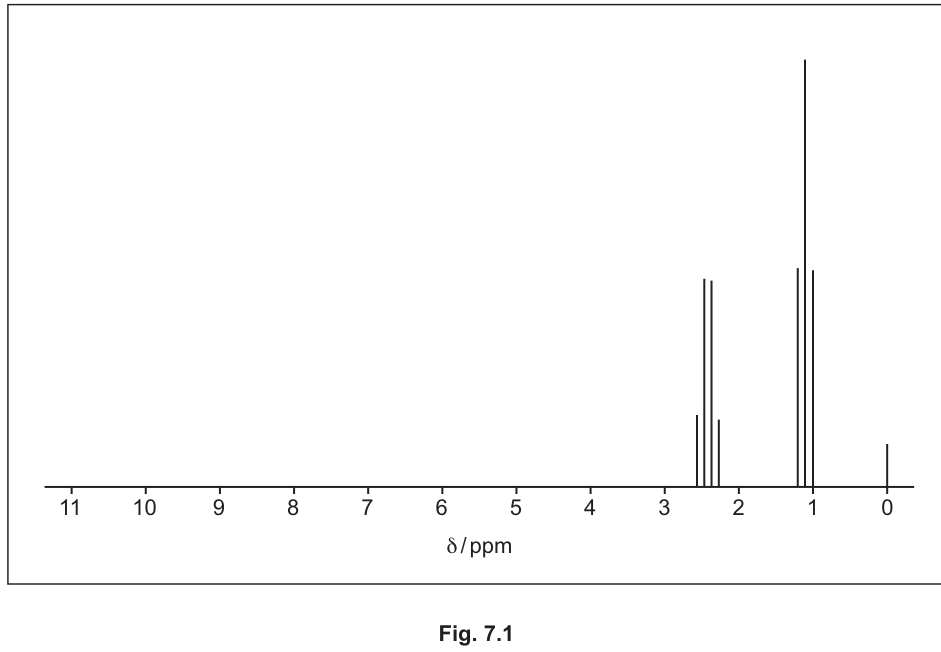
Identify the compound that gives this spectrum.
Answer
U
(pentan-3-one)
The spectrum shows two peaks: a triplet at ppm (6H, two equivalent groups) and a quartet at ppm (4H, two equivalent groups adjacent to the carbonyl). This matches the symmetric structure of U.
U
Background Concept
In NMR:
- Chemical shift () indicates the electronic environment: groups appear at 0.8–1.2 ppm; adjacent to a carbonyl appears at 2.0–2.5 ppm.
- Splitting follows : a next to a () gives a triplet; a next to a () gives a quartet.
- Integration (peak area) is proportional to the number of protons.
Understanding the Question
Fig. 7.1 shows an NMR spectrum with two main peaks (plus the TMS reference at 0 ppm): a tall peak at ppm and a shorter peak at ppm. Identify which compound produces this spectrum.
Approach
Two peaks means only two proton environments. The chemical shifts suggest (1.0 ppm) and next to C=O (2.4 ppm). The splitting (triplet/quartet) indicates - coupling. Look for a symmetric molecule with this pattern.
Step-by-Step Reasoning
U (pentan-3-one):
- The molecule is symmetric about the carbonyl.
- Two equivalent groups → 6H, coupled to adjacent () → triplet at ppm.
- Two equivalent groups → 4H, coupled to adjacent () → quartet at ppm (deshielded by carbonyl).
- Total: two peaks (triplet + quartet). ✓
Other candidates:
- T : four different environments → more than two peaks.
- V : three environments (isopropyl CH, isopropyl , acetyl ) → three peaks.
- R, Q, P, S: aldehydes with more complex patterns or the aldehyde peak at 9–10.
Key Takeaways
- Symmetric molecules give fewer NMR peaks.
- A triplet at ~1 ppm and quartet at ~2.4 ppm is characteristic of an ethyl group next to a carbonyl.
- Two equivalent ethyl groups on either side of a carbonyl give exactly two peaks.
Common Mistakes
- Choosing T — it has four proton environments, not two.
- Misreading the splitting pattern (triplet vs doublet, quartet vs septet).
Things to Be Careful About
- The integration ratio (6H:4H = 3:2) confirms two equivalent and two equivalent groups.
- The carbonyl carbon has no protons, so it doesn't appear in NMR.
Name the splitting pattern of the peak at in Fig. 7.1.
Give the reason for this splitting.
name ..............................
reason ...............................................................................................................................
Answer
Name: triplet
Reason: The protons are coupled to two hydrogen atoms on the neighbouring carbon atom (, so peaks).
triplet; two hydrogen atoms on neighbouring carbon atoms
Background Concept
The rule in NMR: a proton signal is split into peaks by equivalent protons on adjacent (neighbouring) carbon atoms. Protons on the same carbon do not split each other (in simple spectra). Protons separated by more than three bonds generally do not couple.
- : singlet
- : doublet
- : triplet
- : quartet
Understanding the Question
In Fig. 7.1, the peak at ppm is the signal of compound U (). Name the splitting and explain why.
Approach
The group is adjacent to a group (2 H atoms). Apply → triplet.
Step-by-Step Reasoning
The peak at ppm corresponds to the protons in U. These protons are on a carbon adjacent to a group. The has 2 hydrogen atoms (). By the rule, the signal is split into peaks → a triplet.
Key Takeaways
- Triplet = coupled to 2 neighbouring H atoms.
- The rule is the fundamental principle behind splitting patterns.
Common Mistakes
- Saying "because there are 3 peaks" without explaining the cause (neighbouring protons).
- Confusing which protons are causing the splitting (it's the neighbours, not the protons giving the signal).
Things to Be Careful About
- The reason must mention the number of neighbouring hydrogen atoms (two), not just "coupling".
- Use precise language: "two hydrogen atoms on the neighbouring carbon atom".
Answer
TMS (tetramethylsilane),
TMS (tetramethylsilane)
Background Concept
In and NMR spectroscopy, tetramethylsilane (TMS), , is used as the internal reference standard. It is added in small amounts to the sample. All 12 protons (and 4 carbons) in TMS are chemically equivalent and highly shielded by the silicon atom, so the signal appears at ppm. All other chemical shifts are reported relative to TMS.
Understanding the Question
The small peak at ppm in Fig. 7.1 is the reference signal. Identify the substance.
Approach
Recall the NMR reference standard.
Step-by-Step Reasoning
The peak at ppm is always TMS (tetramethylsilane), . It is added as an internal reference and defines the zero point of the chemical shift scale.
Key Takeaways
- TMS is the universal NMR reference at ppm.
- It is chemically inert, volatile (easily removed), and gives a single sharp peak.
Common Mistakes
- Writing "solvent" — the deuterated solvent (e.g. ) does not give a peak at 0 ppm in NMR (the residual peak is at 7.26).
- Not knowing the full name or formula.
Things to Be Careful About
- Acceptable answers: TMS, tetramethylsilane, or .
The carbon-13 NMR spectra of R, S, T and U are compared.
Complete Table 7.1 to state the number of peaks in the spectrum of each compound.
Table 7.1
| compound | number of peaks |
|---|---|
| R | |
| S | |
| T | |
| U |
Answer
| compound | number of peaks |
|---|---|
| R | 4 |
| S | 3 |
| T | 5 |
| U | 3 |
Reasoning:
- R: (1), CH (1), (1), CHO (1) = 4 unique carbons.
- S: (1), C (quaternary, 1), CHO (1) = 3 unique carbons.
- T: (1), (1), (1), CO (1), (1) = 5 unique carbons (no symmetry).
- U: (1, symmetric), (1, symmetric), CO (1) = 3 unique carbons.
R: 4, S: 3, T: 5, U: 3
Background Concept
In NMR spectroscopy, each chemically unique carbon atom gives one peak. The number of peaks equals the number of different carbon environments. Molecular symmetry can make carbons equivalent, reducing the number of peaks. For example, two groups on the same carbon are equivalent and give one peak.
Understanding the Question
Complete a table giving the number of peaks in the NMR spectrum of four compounds: R, S, T, U.
Approach
For each compound, identify all carbon atoms and determine which are chemically equivalent (related by symmetry or identical bonding environments). Count the unique environments.
Step-by-Step Reasoning
R (3-methylbutanal):
- : two equivalent methyl carbons → 1 peak
- CH (methine): → 1 peak
- : → 1 peak
- CHO (carbonyl): → 1 peak
- Total: 4 peaks
S (2,2-dimethylpropanal):
- : three equivalent methyl carbons → 1 peak
- C (quaternary, bonded to 3 and CHO): → 1 peak
- CHO (carbonyl): → 1 peak
- Total: 3 peaks
T (pentan-2-one):
- (C1, attached to CO): → 1 peak
- (C3, attached to CO): → 1 peak
- (C4): → 1 peak
- (C3... wait, let me re-number):
- -C1, -C2, -C3, CO-C4, -C5
- C1 ( next to ): 1 peak
- C2 ( next to C1 and C3): 1 peak
- C3 ( next to C2 and C=O): 1 peak
- C4 (C=O): 1 peak
- C5 ( next to C=O): 1 peak
- No symmetry → 5 peaks
U (pentan-3-one):
- Symmetric about the carbonyl.
- Two equivalent groups → 1 peak
- Two equivalent groups → 1 peak
- C=O → 1 peak
- Total: 3 peaks
Key Takeaways
- NMR peak count = number of unique carbon environments.
- Symmetry reduces the number of peaks (U has 3 peaks despite having 5 carbons).
- Quaternary carbons (like the C in S) still give peaks.
Common Mistakes
- Counting total carbons instead of unique environments (e.g. saying U has 5 peaks).
- Forgetting that equivalent methyl groups give only one peak.
- Missing the carbonyl carbon as a peak.
Things to Be Careful About
- In T, the two groups are in different environments (one next to C=O, one at the end of a propyl chain), so they give separate peaks.
- In U, the two ethyl groups are mirror images, making the corresponding carbons equivalent.
Asparagine and aspartic acid are two naturally occurring amino acids. Their structures and isoelectric points are shown in Table 8.1.
Table 8.1
| amino acid | structure | isoelectric point |
|---|---|---|
| asparagine | 5.41 | |
| aspartic acid | 2.77 |
Answer
The pH at which an amino acid exists as a zwitterion (has no net charge).
The pH at which an amino acid exists as a zwitterion
Background Concept
Amino acids contain both a basic amine group () and an acidic carboxylic acid group (). In aqueous solution, the amine group can accept a proton to form , and the carboxylic acid group can donate a proton to form . When both of these processes occur simultaneously within the same molecule, the result is a zwitterion (from the German for "hybrid ion"), which carries both a positive and a negative charge but has a net charge of zero.
Understanding the Question
The question asks for the definition of the isoelectric point (pI). This is a fundamental concept in the chemistry of amino acids and proteins, relating directly to the pH at which the molecule's ionization state changes.
Approach
Recall the definition of the isoelectric point in terms of the net charge or the specific structural form (zwitterion) of the amino acid.
Step-by-Step Reasoning
At very low pH (acidic conditions), the amino acid exists as a cation (e.g., ). As the pH increases, the carboxylic acid group loses a proton to form the zwitterion (). As the pH increases further, the ammonium group loses a proton to form the anion (). The isoelectric point is the specific pH value where the concentration of the neutral zwitterion is at its maximum, and the average net charge of the population of molecules is zero.
Key Takeaways
- The isoelectric point (pI) is the pH at which an amino acid is a zwitterion.
- At the pI, the amino acid has no net electrical charge and will not migrate in an electric field.
Common Mistakes
- Defining it as the pH where the solution is neutral (pH 7). The pI depends on the side chain and is rarely exactly 7.
- Confusing the isoelectric point with the values. The pI is often the average of the two values flanking the zwitterion form.
Things to Be Careful About
- Ensure the term "zwitterion" is used or clearly described (net charge of zero).
Answer
At pH 2 (which is below the pI of both amino acids), both the amine and carboxyl groups are fully protonated, forming cations.
Asparagine:
Aspartic acid:
Asparagine: HOOCCH(NH3+)CH2CONH2; Aspartic acid: HOOCCH(NH3+)CH2COOH
Background Concept
The ionization state of an amino acid depends on the pH of the solution relative to its values.
- If , the group is protonated.
- If , the group is deprotonated.
For amino acids, the of the group is typically around 2-4, and the of the group is around 9-10. At pH 2, the solution is very acidic. The amine group will definitely be protonated (). The carboxylic acid group will also be protonated () because the pH is at or below its . Thus, the molecule exists as a positive ion (cation).
Understanding the Question
We need to draw the structures of asparagine and aspartic acid at pH 2.
- Asparagine has a side chain with an amide group (). Amides are not significantly basic or acidic in this pH range, so it remains unchanged.
- Aspartic acid has a side chain with a second carboxylic acid group (). Like the alpha-carboxyl group, this will be protonated at pH 2.
Approach
- Start with the neutral structure.
- Add a proton to the amine group to make .
- Ensure all carboxylic acid groups are in the form (not ).
Step-by-Step Reasoning
Asparagine:
- Structure:
- At pH 2, becomes .
- remains .
- remains .
- Result:
Aspartic Acid:
- Structure:
- At pH 2, becomes .
- Both groups remain .
- Result:
Key Takeaways
- At low pH, amino acids exist as cations with protonated amines and protonated carboxyls.
- Side chains containing amides do not ionize in the same way as carboxylic acids or amines.
Common Mistakes
- Leaving the carboxyl group as (zwitterion form) instead of (cation form).
- Forgetting to protonate the amine group.
- Incorrectly ionizing the amide side chain of asparagine.
Things to Be Careful About
- Include the positive charge on the nitrogen atom.
- Ensure the correct number of hydrogens on the nitrogen ().
Asparagine and aspartic acid are treated separately with an excess of .
Draw the structures of the organic products of these reactions.
Answer
reduces carboxylic acids to primary alcohols and amides to amines.
Asparagine product:
Aspartic acid product:
Asparagine: HOCH2CH(NH2)CH2CH2NH2; Aspartic acid: HOCH2CH(NH2)CH2CH2OH
Background Concept
Lithium aluminium hydride () is a powerful reducing agent. It acts as a source of hydride ions ().
- Carboxylic acids () are reduced to primary alcohols ().
- Amides () are reduced to primary amines (). The carbonyl oxygen is removed completely.
- Amines () are generally not reduced by .
Understanding the Question
We are treating asparagine and aspartic acid with excess . We must identify the functional groups in each and apply the reduction rules.
- Asparagine: . Contains a carboxylic acid, an amine, and an amide.
- Aspartic acid: . Contains two carboxylic acids and an amine.
Approach
Apply the reduction transformation to each reducible group independently.
Step-by-Step Reasoning
Asparagine:
- The alpha-carboxyl group () reduces to a primary alcohol ().
- The alpha-amino group () is unaffected.
- The side-chain amide group () reduces to a primary amine ().
- Result: .
Aspartic acid:
- The alpha-carboxyl group () reduces to a primary alcohol ().
- The alpha-amino group () is unaffected.
- The side-chain carboxyl group () reduces to a primary alcohol ().
- Result: .
Key Takeaways
- converts to .
- converts to .
Common Mistakes
- Confusing amide reduction (to amine) with carboxylic acid reduction (to alcohol).
- Thinking the existing amine group is reduced or removed.
- Forgetting to reduce the side chain functional group.
Things to Be Careful About
- Ensure the carbon count remains the same (the carbonyl carbon becomes a methylene carbon).
- Draw the full displayed structure or correct semi-structure.
Propanedioic acid, , is treated with an excess of thionyl chloride, . Propanedioyl chloride, , is formed.
Answer
HOOCCH2COOH + 2SOCl2 -> ClOCCH2COCl + 2SO2 + 2HCl
Background Concept
Thionyl chloride () is a reagent used to convert carboxylic acids into acyl chlorides (acid chlorides). The reaction typically produces sulfur dioxide () and hydrogen chloride () as gaseous by-products, which helps drive the reaction to completion.
Understanding the Question
Propanedioic acid (malonic acid) has two carboxylic acid groups. It reacts with an excess of thionyl chloride to form propanedioyl chloride (malonyl chloride). We need to write the balanced equation.
Approach
- Write the reactants: and .
- Write the main organic product: .
- Determine the stoichiometry: Since there are two groups, two molecules are needed.
- Balance the by-products: Each substitution of by releases one and the sulfur part forms . So, 2 and 2 .
Step-by-Step Reasoning
Reactants:
Products:
Check atoms:
- C: 3 on both sides.
- H: 4 on left, 2 (in organic) + 2 (in HCl) = 4 on right.
- O: 4 on left, 2 (in organic) + 4 (in SO2) = 6? Wait. has 1 O. Left: 4 (acid) + 2 (thionyl) = 6. Right: 2 (acid chloride) + 4 (SO2) = 6. Correct.
- S: 2 on left, 2 on right.
- Cl: 4 on left, 2 (in organic) + 2 (in HCl) = 4 on right.
Key Takeaways
- Dicarboxylic acids react with 2 equivalents of .
- The by-products are and .
Common Mistakes
- Forgetting to double the coefficients for the dicarboxylic acid reaction.
- Writing incorrect by-products (e.g., ).
Things to Be Careful About
- Ensure the equation is balanced.
Propanedioyl chloride reacts with an excess of asparagine to form compound G with molecular formula .
Each molecule of compound G has four amide groups.
Draw the structure of compound G.
Answer
Asparagine has two nucleophilic groups: the amine () and the amide nitrogen (). Propanedioyl chloride has two electrophilic acyl chloride groups. The reaction forms amide linkages.
Structure of Compound G:
Actually, the formula suggests a 1:1 adduct where both the amine and the amide side chain of asparagine react with the diacid chloride? No, let's check the formula.
Asparagine: . Propanedioyl chloride: .
If 1 asparagine reacts with 1 propanedioyl chloride:
. This is not .
If 2 asparagine molecules react with 1 propanedioyl chloride molecule:
.
This matches the molecular formula exactly.
So, one molecule of propanedioyl chloride bridges two molecules of asparagine. The reaction occurs at the amine group of asparagine (primary amine is a better nucleophile than amide nitrogen).
Structure:
HOOCCH(CH2CONH2)NHCOCH2CONHCH(CH2CONH2)COOH
Background Concept
Amino acids react with acyl chlorides via nucleophilic addition-elimination. The primary amine group () is a strong nucleophile and reacts readily with acyl chlorides to form amide (peptide) bonds. The amide group in the side chain of asparagine is much less nucleophilic and typically does not react under these conditions compared to the amine.
Understanding the Question
We are given the molecular formula of product G: . We know the reactants are asparagine () and propanedioyl chloride (). We need to determine the stoichiometry and connectivity.
Approach
- Calculate the formula of a potential adduct.
- Compare with the given formula to find the ratio of reactants.
- Draw the structure based on the reactivity of the amine group with the acyl chloride groups.
Step-by-Step Reasoning
-
Stoichiometry Check:
- 1 Asparagine + 1 Propanedioyl chloride Loss of 1 HCl.
Formula: . (Does not match given formula, and contains Cl). - 2 Asparagine + 1 Propanedioyl chloride Loss of 2 HCl.
Formula:
. Matches.
- 1 Asparagine + 1 Propanedioyl chloride Loss of 1 HCl.
-
Connectivity:
- Propanedioyl chloride is a di-acid chloride: .
- It reacts with two molecules of asparagine.
- The nucleophilic site on asparagine is the -amino group ().
- Two amide bonds are formed: .
- The rest of the asparagine molecule (the part) remains unchanged.
-
Structure Assembly:
- Left Asparagine residue:
- Central linker:
- Right Asparagine residue:
Key Takeaways
- Molecular formulas can be used to deduce the number of reactant molecules involved.
- Acyl chlorides react with amines to form amides.
- In amino acids, the amine group is the primary site of reaction with acylating agents.
Common Mistakes
- Assuming the side-chain amide reacts.
- Incorrect stoichiometry (1:1 instead of 2:1).
- Forgetting that the carboxylic acid groups of asparagine remain as (they do not react with the amine of another asparagine in this specific reaction context with the diacid chloride).
Things to Be Careful About
- Ensure the final structure accounts for all atoms in the formula.
- Draw the amide linkages correctly ().
Asparagine is hydrolysed with an excess of hot .
Draw the structure of the organic product of this reaction.
Answer
Hot excess hydrolyses the amide side chain to a carboxylate ion and neutralises the carboxylic acid group to a carboxylate ion.
Structure:
(Or drawn as the dianion with group intact)
-OOCCH(NH2)CH2COO-
Background Concept
- Amide Hydrolysis: Amides are hydrolysed by hot aqueous alkali () to form a carboxylate salt and ammonia (or an amine). The group becomes .
- Acid-Base Neutralization: Carboxylic acids react with bases like to form carboxylate salts ().
- Stability of Amines: The amine group () is stable in basic conditions and does not react further (it remains neutral, not protonated).
Understanding the Question
Asparagine () is treated with excess hot . We need to determine the final organic product.
Approach
Identify the functional groups and their fate in hot excess alkali.
- (alpha): Neutralized to .
- (alpha): Unchanged.
- (side chain): Hydrolyzed to .
Step-by-Step Reasoning
- The alpha-carboxylic acid group loses a proton to the base: .
- The side-chain amide group undergoes hydrolysis. The bond breaks. The carbonyl carbon becomes a carboxylate ion () in the alkaline medium, and the nitrogen leaves as ammonia ().
Reaction: . - The alpha-amine group remains as .
- Combine these parts: The central is bonded to , , and .
Key Takeaways
- Amides hydrolyse to carboxylates in base.
- Carboxylic acids form carboxylates in base.
- Amines are stable in base.
Common Mistakes
- Leaving the carboxylic acid as (forgetting neutralization).
- Leaving the amide as (forgetting hydrolysis).
- Protonating the amine to (this happens in acid, not base).
Things to Be Careful About
- The product is a dianion (charge of -2). Ensure both negative charges are shown.
A polymer can form from asparagine, , as the only monomer.
Draw a length of the polymer chain containing three monomer residues.
Clearly label the repeat unit of the polymer on your diagram.
Answer
Asparagine has both amine () and carboxylic acid () groups, allowing it to form a polyamide (polypeptide) via condensation polymerisation.
Structure of a length containing three residues:
Polymer chain: -[NH-CH(CH2CONH2)-CO]-[NH-CH(CH2CONH2)-CO]-[NH-CH(CH2CONH2)-CO]-
Background Concept
Amino acids can undergo condensation polymerisation to form polyamides (proteins/polypeptides). This occurs between the amine group of one molecule and the carboxylic acid group of another, eliminating a water molecule and forming an amide (peptide) linkage (). The side chain (R group) remains unchanged.
Understanding the Question
We need to draw a polymer chain formed from asparagine (). The chain must contain three monomer residues, and the repeat unit must be clearly labelled.
Approach
- Draw the backbone: .
- Add the peptide linkages between residues.
- Add the side chain of asparagine to each alpha-carbon.
- Bracket the repeat unit.
Step-by-Step Reasoning
- Monomer: Asparagine is .
- Linkage: .
- Side Chain (R): .
- Drawing the Chain:
- Start with an open bond (or H) at the N-terminus.
- Unit 1:
- Unit 2:
- Unit 3:
- End with an open bond (or OH) at the C-terminus.
- Repeat Unit: The segment is the repeat unit.
Key Takeaways
- Polyamides from amino acids have the backbone .
- The side chain must be correctly attached to the alpha-carbon.
- Condensation polymerisation eliminates small molecules (water).
Common Mistakes
- Drawing the side chain incorrectly (e.g., forgetting the amide in the side chain).
- Incorrect linkage orientation (e.g., or ).
- Failing to label the repeat unit with brackets.
- Drawing only two residues instead of three.
Things to Be Careful About
- Ensure the bonds extending from the ends of the chain are shown (dangling bonds) to indicate the polymer continues.
- The side chain amide group () is distinct from the backbone amide linkages.
Aspartic acid exists in two optically active forms.
Plane polarised light is passed through pure samples of these two optically active forms in solutions of the same concentration.
Describe two similarities and one difference in their effect on the plane polarised light.
similarities .........................................................................................................................
...........................................................................................................................................
difference ...........................................................................................................................
...........................................................................................................................................
Answer
Similarities:
- Both rotate the plane of plane polarised light.
- The magnitude (angle) of rotation is the same for both.
Difference:
- They rotate the plane in opposite directions (one clockwise/dextrorotatory, the other anticlockwise/levorotatory).
Similarities: Rotate light, same angle. Difference: Opposite directions.
Background Concept
Optical isomers (enantiomers) are non-superimposable mirror images. They have identical physical properties (boiling point, density) except for their interaction with plane polarised light and other chiral environments. A chiral molecule rotates the plane of polarisation of light. One enantiomer rotates it to the right (+/dextro), and the other rotates it to the left (-/levo) by exactly the same amount.
Understanding the Question
We have two optically active forms of aspartic acid (enantiomers). We need to describe how they affect plane polarised light, giving two similarities and one difference.
Approach
Recall the definition of optical activity for a pair of enantiomers.
Step-by-Step Reasoning
- Effect: Both isomers are optically active, meaning they will both cause rotation of the plane of polarised light. (Similarity 1)
- Magnitude: The specific rotation is a physical constant for a given compound. For enantiomers, the absolute value is identical. (Similarity 2)
- Direction: The sign of the rotation is opposite. One is , the other is . (Difference)
Key Takeaways
- Enantiomers rotate light by the same angle but in opposite directions.
- Optical activity is a key distinguishing property of chiral molecules.
Common Mistakes
- Saying one rotates light and the other doesn't (that would be a meso compound or achiral molecule, but the question states they are optically active).
- Confusing optical activity with the effect on other physical properties.
Things to Be Careful About
- Be precise with terms: "rotate the plane of polarised light", "same angle", "opposite directions".
Give the term used to describe a mixture of equal amounts of the two optically active forms.
Answer
Racemic mixture (or racemate).
Racemic mixture
Background Concept
A mixture containing equal amounts (50:50) of two enantiomers is called a racemic mixture. Because the rotations caused by the two isomers are equal in magnitude but opposite in direction, they cancel out, and the mixture is optically inactive.
Understanding the Question
Identify the term for a mixture of equal amounts of the two optically active forms.
Approach
Recall the definition of a racemic mixture.
Step-by-Step Reasoning
- Equal amounts of (+) and (-) isomers net rotation is zero Racemic mixture.
Key Takeaways
- Racemic mixture = 50:50 mixture of enantiomers.
- Racemic mixtures are optically inactive.
Common Mistakes
- Calling it a "meso compound" (meso compounds are single molecules with internal symmetry).
- Calling it a "conformational isomer".
Things to Be Careful About
- Spelling: "Racemic".
Compound X is made from benzene by the route shown in Fig. 9.1.
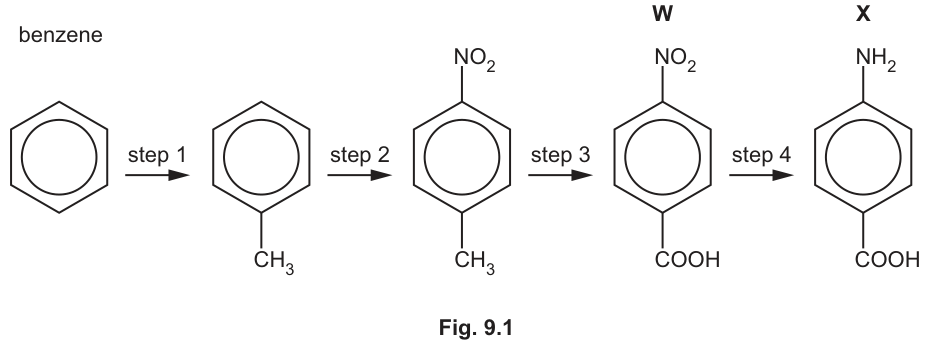
Describe the bonding in benzene, .
Your answer should include:
- the hybridisation of the six carbon atoms
- the types of bond between the carbon atoms
- the orbitals that overlap to produce the bonds between the carbon atoms
- the type of bond between the carbon atoms and the hydrogen atoms
- the orbitals that overlap to produce the bonds between the carbon atoms and the hydrogen atoms.
Answer
All carbon atoms are sp² hybridised. Bonds between carbon atoms are σ and π bonds. C–C σ bonds are formed by overlap of sp² hybrid orbitals. C–C π bonds are formed by overlap of p orbitals. Bonds between C and H atoms are σ bonds formed by overlap of sp² hybrid orbitals and s orbitals.
All C atoms are sp² hybridised; C-C bonds are σ (sp²-sp² overlap) and π (p-p overlap); C-H bonds are σ (sp²-s overlap).
Background Concept
Benzene () is a planar, hexagonal molecule. Each carbon atom is bonded to two other carbon atoms and one hydrogen atom, using three electron pairs for σ bonding. This requires three hybrid orbitals, so the carbon atoms are sp² hybridised. The remaining unhybridised p orbital on each carbon is perpendicular to the plane of the ring. These six p orbitals overlap sideways to form a delocalised π system above and below the ring, which is often represented by a circle inside the hexagon. This delocalisation gives benzene exceptional stability (resonance energy).
Understanding the Question
The question asks for a description of the bonding in benzene, specifically requiring details on hybridisation, bond types (σ/π), and the orbitals involved in overlap for both C–C and C–H bonds. This is a standard recall question testing the structural model of benzene.
Approach
List the six key facts about benzene's bonding as outlined in the mark scheme: hybridisation, bond types, and orbital overlaps for both C–C and C–H connections.
Step-by-Step Reasoning
- Hybridisation: Each carbon forms 3 σ bonds (2 to C, 1 to H), so it uses sp² hybrid orbitals. All six carbon atoms are sp² hybridised.
- C–C bonds: Between carbons, there is a σ bond and a π bond. The σ bond comes from head-on overlap of sp² orbitals. The π bond comes from sideways overlap of the unhybridised p orbitals.
- C–H bonds: These are σ bonds formed by the overlap of a carbon sp² hybrid orbital and a hydrogen 1s orbital.
Key Takeaways
Benzene bonding involves sp² hybridised carbons forming a σ framework (sp²-sp² for C–C, sp²-s for C–H) and a delocalised π system from p-orbital overlap.
Common Mistakes
- Stating that benzene has alternating single and double bonds (Kekulé structure) without mentioning delocalisation.
- Saying p orbitals form σ bonds.
- Forgetting that C–H bonds are σ bonds formed by sp² and s orbitals.
Things to Be Careful About
Ensure you distinguish between the σ framework and the π system. Specify which orbitals overlap for each bond type. The mark scheme awards marks for any combination of the key points, but providing all ensures full credit.
Answer
and
CH3Cl and AlCl3
Background Concept
Step 1 converts benzene to methylbenzene (toluene). This is a Friedel-Crafts alkylation, an electrophilic substitution reaction where an alkyl group is added to the benzene ring. The electrophile is the methyl carbocation (), generated in situ.
Understanding the Question
Identify the reagents needed to convert benzene to methylbenzene via electrophilic substitution with a methyl group.
Approach
Recall the standard reagents for Friedel-Crafts alkylation: an alkyl halide (methyl chloride) and a Lewis acid catalyst (aluminium chloride).
Step-by-Step Reasoning
To introduce a methyl group, we use chloromethane () and an anhydrous aluminium chloride () catalyst. The reacts with to generate the electrophile .
Key Takeaways
Friedel-Crafts alkylation of benzene requires an alkyl halide and catalyst.
Common Mistakes
- Using (acceptable but is standard).
- Forgetting the catalyst .
- Writing conditions like UV light (this is for free-radical substitution, not electrophilic).
Things to Be Careful About
The catalyst must be anhydrous . Water would hydrolyse the catalyst and stop the reaction.
In step 1 of Fig. 9.1 benzene reacts with .
Complete Fig. 9.2 to show the mechanism for this reaction, including:
- the movement of electron pairs using curly arrows
- the structure of the intermediate involved.
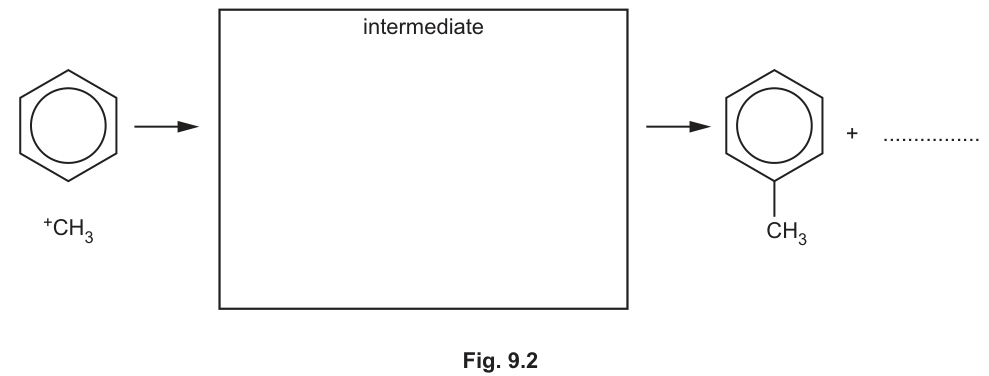
Answer
See diagram
Background Concept
Electrophilic substitution in benzene involves two main stages: attack by the electrophile to form a carbocation intermediate (arenium ion), and loss of a proton to restore aromaticity. The curly arrows show the movement of electron pairs.
Understanding the Question
Complete the mechanism for the reaction of benzene with . This involves drawing the initial attack, the intermediate structure, and the restoration of the ring.
Approach
- Draw a curly arrow from the delocalised π system (or a double bond) of benzene to the positive carbon of .
- Draw the intermediate: a cyclohexadienyl cation with the methyl group and a hydrogen atom on the same carbon (tetrahedral, sp³). The positive charge is delocalised over the ring (horseshoe arrow).
- Draw a curly arrow from the C–H bond (on the sp³ carbon) back into the ring to restore the π system, producing .
Step-by-Step Reasoning
- M1: Curly arrow from the benzene ring (π electrons) to the of . This forms a new C–C bond.
- M2: The intermediate is a carbocation. Draw a hexagon with a circle (or alternating double bonds, but circle is better for benzene derivatives) and a + charge. The carbon bonded to is also bonded to H. Use a horseshoe arrow to show delocalisation of the positive charge around the ring (positions 2, 4, 6 relative to the sp³ carbon).
- M3: Curly arrow from the C–H bond on the sp³ carbon into the ring (to reform the π bond). The product is methylbenzene + .
Key Takeaways
In electrophilic aromatic substitution, the intermediate is a sigma complex (arenium ion) where aromaticity is temporarily lost. The base (or the conjugate base of the catalyst) removes a proton to restore aromaticity.
Common Mistakes
- Drawing the arrow from a specific double bond instead of the delocalised system (though drawing from a double bond is often accepted, the circle is preferred).
- Forgetting the positive charge on the intermediate.
- Drawing the wrong intermediate (e.g., addition product without loss of H⁺).
- Forgetting the product in the final step.
Things to Be Careful About
The intermediate must show the tetrahedral carbon with both H and . The charge must be delocalised (horseshoe arrow). The final arrow must go from the C–H bond to the ring, not from the ring to H.
Answer
Concentrated and concentrated at to .
Concentrated HNO3 and concentrated H2SO4, 25-60 C
Background Concept
Step 2 converts methylbenzene to 1-methyl-4-nitrobenzene. This is an electrophilic substitution (nitration) where a nitro group () replaces a hydrogen on the ring. The methyl group is an ortho/para director, so the major product is para (1-methyl-4-nitrobenzene).
Understanding the Question
Identify the reagents and conditions for nitration of an arene.
Approach
Recall the standard nitrating mixture: concentrated nitric acid and concentrated sulphuric acid. The temperature must be controlled (usually 25-60 °C) to prevent poly-nitration or oxidation.
Step-by-Step Reasoning
- Reagents: Concentrated and concentrated . The sulphuric acid acts as a catalyst to generate the nitronium ion ().
- Conditions: Temperature between and . Higher temperatures can lead to multiple substitutions or side reactions.
Key Takeaways
Nitration of benzene derivatives requires concentrated /concentrated at moderate temperatures (25-60 °C).
Common Mistakes
- Using dilute acids.
- Forgetting the temperature range or stating room temperature only (60 °C is needed for less reactive arenes, though methylbenzene nitrates easily, the mark scheme accepts 25-60 °C).
- Writing as a reactant instead of a catalyst (though it's part of the mixture).
Things to Be Careful About
Both acids must be concentrated. The temperature range is important; too high leads to di-nitration.
Identify the reagents required for step 3 of Fig. 9.1. Compound W is the product of this step.
Answer
Alkaline (heat)
Alkaline KMnO4
Background Concept
Step 3 converts 1-methyl-4-nitrobenzene to 4-nitrobenzoic acid (compound W). This is an oxidation of the alkyl side chain (methyl group) to a carboxylic acid group (). The nitro group is unaffected by these conditions.
Understanding the Question
Identify the reagent that oxidises an alkyl side chain on a benzene ring to a carboxylic acid.
Approach
The standard reagent for side-chain oxidation is alkaline potassium manganate(VII) (), followed by acidification. The mark scheme accepts "alkaline ".
Step-by-Step Reasoning
- The methyl group () is oxidised to .
- Reagent: Alkaline (often with heat). The solution turns from purple to brown precipitate () or colourless ( in acid, but here it's alkaline so brown ppt).
- Note: The ring is not oxidised, only the side chain with at least one hydrogen on the benzylic carbon.
Key Takeaways
Alkyl groups attached to benzene rings with at least one benzylic hydrogen are oxidised to carboxylic acids by hot alkaline .
Common Mistakes
- Using acidified (this works for alcohols/aldehydes but not typically for direct side-chain oxidation of arenes in this context, though it can work, is the standard answer).
- Forgetting that the side chain must have a benzylic hydrogen (tert-butylbenzene cannot be oxidised).
Things to Be Careful About
The mark scheme specifically says "alkaline ". Acidification is usually implied or required to get the free acid, but the oxidising agent is the key point.
Answer
4-nitrobenzoic acid
4-nitrobenzoic acid
Background Concept
Compound W has a benzene ring with a nitro group () at position 4 and a carboxylic acid group () at position 1. The principal functional group is the carboxylic acid, so the parent name is benzoic acid. The nitro group is at the para position (position 4).
Understanding the Question
Name compound W based on its structure.
Approach
Identify the parent chain/ring: benzoic acid. Identify substituents: nitro at position 4. Combine: 4-nitrobenzoic acid.
Step-by-Step Reasoning
- Parent: Benzoic acid (C6H5COOH).
- Substituent: Nitro group () opposite to the carboxylic acid group.
- Numbering: Carboxylic acid carbon is attached to C1. The nitro group is at C4.
- Name: 4-nitrobenzoic acid (or p-nitrobenzoic acid, but IUPAC prefers numbers).
Key Takeaways
When naming disubstituted benzenes, identify the principal functional group for the parent name and number the ring to give the lowest locants.
Common Mistakes
- Naming it as a nitrobenzene derivative (e.g., 4-carboxy-1-nitrobenzene) - incorrect priority.
- Forgetting the number 4 (though para is acceptable, 4 is preferred in IUPAC).
Things to Be Careful About
Ensure the name matches the structure: COOH at bottom, NO2 at top (para position).
The reagents commonly used for step 4 will not reduce the group.
Identify the reagents and conditions required for step 4 of Fig. 9.1.
Answer
(T hot concentrated) HCl and Sn
Hot concentrated HCl and Sn
Background Concept
Step 4 converts 4-nitrobenzoic acid (W) to 4-aminobenzoic acid (X). This is the reduction of the nitro group () to an amino group (). The carboxylic acid group is not reduced under these conditions.
Understanding the Question
Identify reagents that reduce to without affecting .
Approach
Standard reduction of aromatic nitro compounds uses tin () and concentrated hydrochloric acid () with heat. Alternatively, /Ni or /HCl can be used, but Sn/HCl is the classic answer.
Step-by-Step Reasoning
- Reagent: Tin () and concentrated .
- Condition: Heat (reflux).
- The nitro group is reduced to an amino group. Initially, the amino group is protonated to form an ammonium salt (), so excess alkali (NaOH) is needed afterwards to free the amine, but the question asks for reagents for the step, and Sn/HCl is the standard reduction mixture.
- Note: The mark scheme accepts "(hot) concentrated HCl and Sn".
Key Takeaways
Nitroarenes are reduced to arylamines using Sn/concentrated HCl (or Fe/HCl) followed by alkali.
Common Mistakes
- Using (this might reduce the carboxylic acid or is too harsh).
- Forgetting the acid catalyst.
- Writing /Pd (this works but Sn/HCl is the specific textbook answer for this context).
Things to Be Careful About
The question states the reagents will not reduce the group. Sn/HCl is selective for nitro reduction in this context. Ensure "concentrated" is mentioned for HCl.
Benzene can also be used as a starting material to make compound Y.
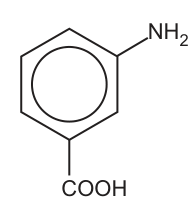
Describe how the route described in Fig. 9.1 (repeated below) can be changed to give compound Y instead of compound X.
Explain your answer.
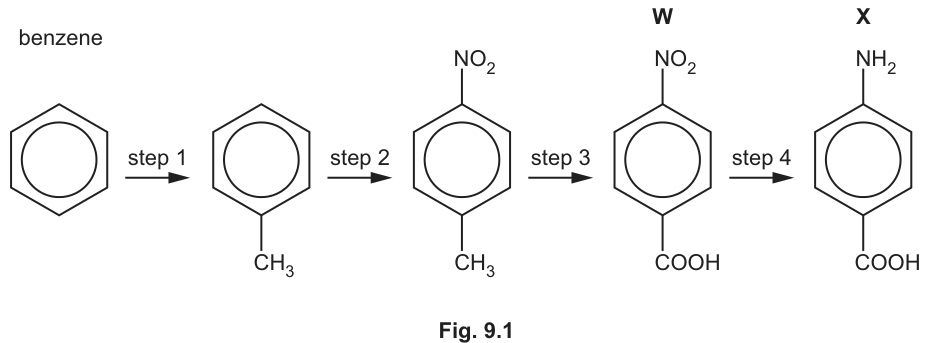
Answer
Perform step 3 before step 2 (or perform step 2 before step 1).
Explanation: The group (or group) is meta-directing (3-directing), so nitration occurs at the 3-position relative to the carboxylic acid/nitro group, giving 3-aminobenzoic acid.
Working
Original route: Benzene Methylbenzene 1-methyl-4-nitrobenzene ( is ortho/para directing).
New route: Benzene Methylbenzene Benzoic acid 3-nitrobenzoic acid ( is meta directing) 3-aminobenzoic acid (Compound Y).
Answer
Rearrange steps: perform step 3 before step 2. Explanation: is a meta-directing group (3-directing), so nitration of benzoic acid gives 3-nitrobenzoic acid, which reduces to 3-aminobenzoic acid (compound Y).
Perform step 3 before step 2; COOH is meta-directing (3-directing).
Background Concept
Directing effects in electrophilic aromatic substitution determine the position of the second substituent. Alkyl groups (like ) are ortho/para directors (2,4-directing). Electron-withdrawing groups (like and ) are meta directors (3-directing).
Understanding the Question
Compound Y is 3-aminobenzoic acid (meta-aminobenzoic acid). The original route produces 4-aminobenzoic acid (para). We need to change the sequence to get the meta isomer.
Approach
To get a meta-substituted product, we need a meta-directing group on the ring when the nitration (step 2) occurs. is ortho/para directing, so we cannot nitrate methylbenzene to get the meta product. We must convert to (step 3) first, as is meta-directing. Alternatively, nitrate benzene first (step 2) to get nitrobenzene ( is meta-directing), then try to add the carbon group (but Friedel-Crafts doesn't work well on nitrobenzene, so the mark scheme accepts "perform step 2 before step 1" theoretically, though practically step 3 before step 2 is the viable route). The mark scheme says: "perform step 3 before step 2 OR perform step 2 before step 1".
Step-by-Step Reasoning
- Option 1 (Viable): Benzene Methylbenzene Benzoic acid. Now, perform step 2 (nitration). Since is meta-directing, nitration gives 3-nitrobenzoic acid. Then step 4 (reduction) gives 3-aminobenzoic acid (Compound Y).
- Explanation: The group directs the incoming nitro group to the 3-position (meta).
- Option 2 (Theoretical): Benzene Nitrobenzene. is meta-directing. Then perform step 1 (Friedel-Crafts). However, nitrobenzene is strongly deactivated, so Friedel-Crafts alkylation fails or is very slow. Despite this, the mark scheme accepts the logic: if you nitrate first, the group is meta-directing. (Note: In practice, you can't do FC alkylation on nitrobenzene, but for exam purposes, the directing effect logic is what's tested). The mark scheme explicitly allows "perform step 2 before step 1" with the explanation that is 3-directing.
Key Takeaways
The order of steps in aromatic synthesis is crucial. To get meta-substitution, ensure a meta-directing group is present before the electrophilic substitution step.
Common Mistakes
- Trying to nitrate methylbenzene and expecting meta product (methyl is ortho/para directing).
- Forgetting to explain why the order changes (directing effects).
- Suggesting impossible reactions (like FC alkylation on nitrobenzene) without acknowledging the directing effect logic.
Things to Be Careful About
The mark scheme gives two acceptable answers for the rearrangement. Ensure the explanation links the reordering to the directing effect of the relevant group ( or ).