Chemistry 9701/42 — May/June 2025
Cambridge A-Level · A Level Structured Questions · worked solutions for every part, with the mark scheme
Topics Nitrogen Compounds · Equilibria · Electrochemistry · Carboxylic Acids and Derivatives · Introduction to A Level Organic Chemistry · Group 2 · +7 more
Calcium nitrate, , decomposes on heating.
Write an equation for the decomposition of calcium nitrate.
Answer
Background Concept
Group 2 nitrates decompose on heating to form the metal oxide, nitrogen dioxide, and oxygen. This is a thermal decomposition reaction that follows a general pattern for all Group 2 nitrates.
Understanding the Question
The question asks for the balanced equation for the thermal decomposition of calcium nitrate. This is a recall question testing knowledge of the general decomposition pattern.
Approach
Recall the general equation for Group 2 nitrate decomposition and substitute calcium as the metal.
Step-by-Step Reasoning
- The general equation for Group 2 nitrate decomposition is: M(NO₃)₂ → MO + 2NO₂ + ½O₂
- For calcium (M = Ca): Ca(NO₃)₂ → CaO + 2NO₂ + ½O₂
- Check the balance: Ca: 1 = 1; N: 2 = 2; O: 6 = 1 + 4 + 1 = 6 ✓
Key Takeaways
The thermal decomposition of Group 2 nitrates follows the pattern: M(NO₃)₂ → MO + 2NO₂ + ½O₂.
Common Mistakes
Forgetting the oxygen gas product, or using incorrect coefficients.
Things to Be Careful About
The equation can also be written with whole-number coefficients: 2Ca(NO₃)₂ → 2CaO + 4NO₂ + O₂.
Describe the trend in the decomposition temperature of the Group 2 nitrates.
Explain your answer.
Answer
Trend: Decomposition temperature increases down the group.
Explanation:
- Down the group, the ionic radius (size) of the cation increases.
- The larger cation has less polarising power.
- It polarises/distorts the nitrate ion less.
- The N-O bond is less weakened / harder to break.
- Therefore a higher temperature is needed to decompose the nitrate.
Decomposition temperature increases down the group.
Background Concept
The thermal stability of Group 2 nitrates increases down the group. This is explained by the polarising power of the cation.
Understanding the Question
This is a two-part question: first describe the trend in decomposition temperature, then explain it using the concept of polarisation.
Approach
State the trend, then explain using ionic radius and polarising power.
Step-by-Step Reasoning
- Trend: decomposition temperature increases down the group.
- Down the group, the cation M²⁺ increases in ionic radius (size).
- A larger cation has less polarising power (lower charge density).
- Less polarisation of the nitrate ion means the N-O bond is less weakened.
- Therefore more energy (higher temperature) is needed to break the N-O bond and decompose the nitrate.
Key Takeaways
Thermal stability of Group 2 nitrates increases down the group due to decreasing polarising power of the cation.
Common Mistakes
Saying the trend is decreasing, or explaining with the wrong reason (e.g., lattice enthalpy instead of polarisation).
Things to Be Careful About
The explanation must mention polarisation of the nitrate ion and weakening of the N-O bond.
A sample of of strontium oxide, , is completely dissolved in distilled water to form a solution of strontium hydroxide, .
The resulting solution is added to a volumetric flask and made up to with distilled water.
Calculate the pH of this solution at . Give your answer to two decimal places.
Working
Moles of SrO = mol
Moles of Sr(OH)₂ = mol (from SrO + H₂O Sr(OH)₂)
Moles of OH⁻ in 250 cm³ = mol
[OH⁻] = mol dm⁻³
pOH =
pH =
Answer
pH = 12.41
pH = 12.41
Background Concept
Strontium oxide reacts with water to form strontium hydroxide, a strong base. The pH of a strong base solution can be calculated from the concentration of OH⁻ ions and the ionic product of water, Kw.
Understanding the Question
We need to find the pH of a solution made by dissolving 0.333 g of SrO in water and making up to 250 cm³.
Approach
- Calculate moles of SrO.
- Convert to moles of Sr(OH)₂ (1:1 from the reaction SrO + H₂O → Sr(OH)₂).
- Find [OH⁻] in the 250 cm³ solution (each Sr(OH)₂ gives 2 OH⁻).
- Convert to concentration in mol dm⁻³.
- Calculate pOH = -log[OH⁻], then pH = 14 - pOH.
Step-by-Step Reasoning
- Moles of SrO = 0.333 / 103.6 = 3.214 × 10⁻³ mol
- SrO + H₂O → Sr(OH)₂, so moles of Sr(OH)₂ = 3.214 × 10⁻³ mol
- Each Sr(OH)₂ produces 2 OH⁻, so moles of OH⁻ in 250 cm³ = 3.214 × 10⁻³ × 2 = 6.429 × 10⁻³ mol
- Concentration of OH⁻ = (6.429 × 10⁻³) × (1000 / 250) = 6.429 × 10⁻³ × 4 = 0.0257 mol dm⁻³
- pOH = -log(0.0257) = 1.59
- pH = 14 - 1.59 = 12.41
Key Takeaways
pH of a strong base: find [OH⁻], then pH = 14 - pOH. Remember to account for the stoichiometry (2 OH⁻ per Sr(OH)₂) and the dilution to 250 cm³.
Common Mistakes
Forgetting to multiply by 2 for the two OH⁻ ions. Forgetting to convert cm³ to dm³. Using pH = -log[OH⁻] instead of pOH.
Things to Be Careful About
The answer must be given to two decimal places. The molar mass of SrO must be calculated correctly (87.6 + 16.0 = 103.6).
When cobalt(II) sulfate, , is dissolved in distilled water, solution A is formed.
The reaction scheme in Fig. 2.1 shows some reactions of solution A.
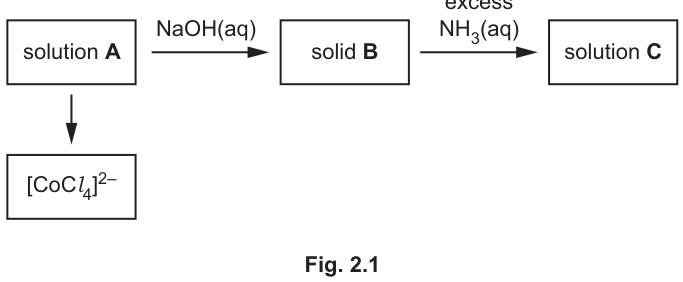
Complete Table 2.1 to show the formula and colour of each of the cobalt-containing species present in A, B and C. Identify the type of reaction forming each of B and C.
Table 2.1
| formula of cobalt-containing species | colour of cobalt-containing species | type of reaction | |
|---|---|---|---|
| A | — | ||
| B | |||
| C |
Answer
| formula of cobalt-containing species | colour of cobalt-containing species | type of reaction | |
|---|---|---|---|
| A | pink | — | |
| B | or | blue | precipitation (deprotonation / acid-base) |
| C | straw / yellow-brown | ligand exchange |
A: [Co(H₂O)₆]²⁺, pink; B: Co(OH)₂, blue, precipitation; C: [Co(NH₃)₆]², straw/yellow-brown, ligand exchange
Background Concept
When a transition metal salt such as CoSO₄ dissolves in water, the metal ion is surrounded by six water molecules acting as ligands, forming the hexaaqua complex . This is the species present in solution A.
Adding NaOH(aq) provides OH⁻ ions which deprotonate two of the coordinated water molecules (each H₂O ligand can lose H⁺ to become OH⁻), forming a neutral precipitate (often written simply as Co(OH)₂). This is a precipitation / acid-base reaction.
Adding excess NH₃(aq) to the precipitate causes ligand exchange: the smaller NH₃ molecules replace the H₂O ligands to form the hexaammine complex , which is soluble and has a straw/yellow-brown colour.
Understanding the Question
The question asks you to complete a table giving the formula, colour, and reaction type for three cobalt-containing species (A, B, C) formed from the reaction scheme in Fig. 2.1. The reaction types are only required for B and C (the reactions that form them).
Approach
- A: CoSO₄ dissolves in water → hexaaqua cobalt(II) ion.
- B: NaOH deprotonates water ligands → neutral hydroxo-aqua complex precipitates.
- C: Excess NH₃ replaces all six H₂O ligands → hexaammine complex.
Step-by-Step Reasoning
Species A: CoSO₄ dissociates to give Co²⁺(aq), which in water exists as . This is pink.
Species B: NaOH provides OH⁻ which removes H⁺ from two coordinated water molecules. The resulting complex has formula — overall charge is 2+ + 4(0) + 2(−1) = 0, so it is neutral and precipitates. The colour is blue. The reaction type is precipitation (also acceptable: deprotonation or acid-base reaction).
Species C: Excess NH₃(aq) acts as a stronger ligand than H₂O for Co²⁺ in this context and replaces all six water ligands to give . The colour is straw or yellow-brown. The reaction type is ligand exchange.
Key Takeaways
- Co²⁺ in aqueous solution always exists as the hexaaqua complex.
- NaOH causes deprotonation of coordinated water (precipitation), not ligand substitution.
- Excess NH₃ causes full ligand exchange to give the hexaammine complex.
- Co²⁺ complexes are characteristically pink (hexaaqua), blue (hydroxo), and straw/yellow-brown (hexaammine).
Common Mistakes
- Writing Co²⁺ instead of for species A — the mark scheme requires the complex formula.
- Calling the formation of B a 'ligand exchange' — it is a deprotonation/precipitation.
- Giving the colour of C as 'brown' without specifying 'straw' or 'yellow-brown'.
- Writing the formula of B as (this would be amphoteric behaviour, which Co(OH)₂ does not show with NaOH).
Things to Be Careful About
- The mark scheme accepts either or Co(OH)₂ for B.
- 'Any two' gives 1 mark, 'any four' gives 2 marks, 'any six' gives 3 marks, 'all eight' gives 4 marks — so you need to get the formulas, colours, AND reaction types correct.
- The reaction type for C must be 'ligand exchange' (not 'substitution' alone, though that may be accepted).
Answer
Concentrated HCl
Concentrated HCl
Background Concept
The complex forms when chloride ions replace the water ligands in . This is a ligand exchange reaction. Because Cl⁻ is a weaker ligand than H₂O for cobalt(II) in aqueous solution, a high concentration of Cl⁻ is needed to drive the equilibrium towards the tetrachlorocobaltate(II) ion.
Understanding the Question
You need to suggest a reagent that will convert solution A () into .
Approach
To replace H₂O ligands with Cl⁻ ligands, you need a source of concentrated chloride ions. Concentrated hydrochloric acid provides both a high [Cl⁻] and the acidic conditions that favour the tetrahedral chloro complex.
Step-by-Step Reasoning
The reaction is:
This equilibrium is only driven to the right with a large excess of Cl⁻, hence concentrated HCl is required. The product is blue.
Key Takeaways
- Ligand exchange with Cl⁻ requires concentrated HCl (not dilute) because Cl⁻ is a weaker ligand than H₂O.
- The tetrahedral is blue, contrasting with the pink octahedral .
Common Mistakes
- Writing 'HCl' without specifying 'concentrated' — dilute HCl will not shift the equilibrium sufficiently.
- Suggesting NaCl(aq) — while it provides Cl⁻, the concentration achievable is too low.
Things to Be Careful About
- The mark scheme specifically requires 'concentrated HCl'. Simply writing 'HCl' may not earn the mark.
The complex ion has tetrahedral geometry.
The 3d orbitals in an isolated ion are degenerate.
Complete Fig. 2.2 to show the relative energies of the 3d orbitals in an isolated ion and in in a tetrahedral complex.
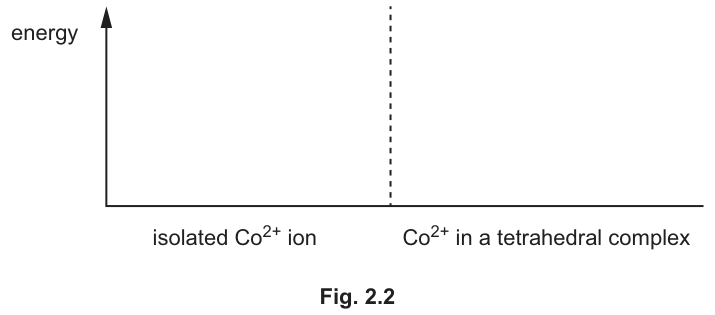
Answer
The isolated Co²⁺ ion has five degenerate 3d orbitals shown as five lines (or boxes) at the same energy level.
In the tetrahedral complex, these split into two groups: two lower-energy orbitals (e set) and three higher-energy orbitals (t₂ set). The centre of gravity of the split orbitals is at a higher energy than the isolated ion (all five orbitals in the complex are above the isolated ion level).
Five degenerate orbitals for isolated Co²⁺; split into 2 lower and 3 higher for tetrahedral complex; all complex orbitals above isolated ion energy
Background Concept
In an isolated transition metal ion, all five 3d orbitals are degenerate (same energy). When ligands approach to form a complex, the electrostatic repulsion between the ligand electron pairs and the d electrons raises the energy of the d orbitals. However, the five orbitals are not all raised equally — those pointing more directly at ligands are raised more than those pointing between ligands. This is crystal field splitting.
In an octahedral complex (six ligands along the x, y, z axes), the d_z² and d_x²−y² orbitals point directly at ligands and are raised more (e_g set, 2 orbitals), while d_xy, d_xz, d_yz point between ligands and are raised less (t_2g set, 3 orbitals).
In a tetrahedral complex (four ligands approaching between the axes), the situation is reversed: the d_xy, d_xz, d_yz orbitals point more directly at the ligands and are raised more (t₂ set, 3 orbitals), while d_z² and d_x²−y² point between ligands and are raised less (e set, 2 orbitals). The splitting is also smaller than in octahedral complexes.
Importantly, the average energy of all five d orbitals in the complex is HIGHER than in the isolated ion, because the ligands repel the d electrons.
Understanding the Question
You must complete Fig. 2.2 showing:
- Five degenerate 3d orbitals for the isolated Co²⁺ ion.
- The splitting pattern for a tetrahedral complex (3 higher, 2 lower).
- The overall energy of the complex orbitals must be clearly higher than the isolated ion.
Approach
Draw five horizontal lines at the same height for the isolated ion. For the tetrahedral complex, draw two lines at a lower position and three lines at a higher position, with the centre of gravity of all five above the isolated ion level.
Step-by-Step Reasoning
Isolated Co²⁺: Co²⁺ has electron configuration [Ar]3d⁷. The five 3d orbitals (d_xy, d_xz, d_yz, d_x²−y², d_z²) are all degenerate — draw five lines at the same energy.
Tetrahedral complex: The ligand field splits the d orbitals into:
- Lower set (e): 2 orbitals — d_z² and d_x²−y²
- Higher set (t₂): 3 orbitals — d_xy, d_xz, d_yz
Note this is the OPPOSITE of octahedral splitting (where 3 are lower and 2 are higher).
Energy comparison: The barycentre (weighted average energy) of the split orbitals must be ABOVE the isolated ion energy level, because ligand-electron repulsion raises all d orbital energies. This is a key mark — many students draw the splitting centred on the same level.
Key Takeaways
- Tetrahedral splitting is 3 higher, 2 lower (opposite of octahedral).
- The splitting energy Δ_t is smaller than Δ_o (roughly 4/9 of it).
- All d orbitals in a complex are raised in energy relative to the free ion.
- Co²⁺ is d⁷, so in the tetrahedral complex: e⁴ t₂³ (all five orbitals have at least one electron, with the lower e set having two pairs).
Common Mistakes
- Drawing the octahedral pattern (3 lower, 2 higher) instead of tetrahedral (2 lower, 3 higher).
- Not showing that the complex orbitals are at a higher energy than the isolated ion.
- Drawing only the split levels without showing the five degenerate orbitals for the isolated ion.
- Forgetting to show that the energy of ALL d orbitals in the complex is higher than the isolated ion.
Things to Be Careful About
- The mark scheme requires 'any two' of the three points for 1 mark, 'all three' for 2 marks.
- The three creditable points are: (1) five degenerate orbitals for isolated ion, (2) splitting into 3 higher and 2 lower, (3) all d orbitals in complex clearly higher than isolated ion.
- The diagram must clearly show the energy axis and the relative positions.
Answer
A central Co atom with four Cl ligands arranged tetrahedrally. Two bonds are drawn as plain lines (in the plane), one as a solid wedge (coming towards the viewer), and one as a dashed/hashed wedge (going away from the viewer). The overall charge is 2−.
Tetrahedral structure of [CoCl₄]² with two plain bonds, one wedged bond, and one dashed bond from central Co to four Cl atoms, charge 2−
Background Concept
The ion has coordination number 4 with tetrahedral geometry. In a tetrahedral arrangement, the four ligands are positioned at the corners of a regular tetrahedron around the central metal ion, with bond angles of 109.5°. This is the most common geometry for 4-coordinate complexes with large ligands like Cl⁻, as it minimises ligand-ligand repulsion.
Understanding the Question
Draw a three-dimensional representation of showing the tetrahedral geometry.
Approach
Use the standard 3D drawing convention: two bonds in the plane of the paper (plain lines), one bond coming towards the viewer (solid wedge), and one bond going away from the viewer (dashed/hashed wedge). Label all four Cl atoms and show the 2− charge.
Step-by-Step Reasoning
Place Co at the centre. Draw:
- One Cl going upward (plain line, in plane)
- One Cl going to the lower-left (plain line, in plane)
- One Cl going to the lower-right (solid wedge, towards viewer)
- One Cl going to the upper-right (dashed/hashed wedge, away from viewer)
The bond angles should all be approximately 109.5°. The overall ion carries a 2− charge (Co²⁺ + 4Cl⁻ = 2−).
Key Takeaways
- Tetrahedral geometry uses wedged and dashed bonds to show 3D arrangement.
- Co²⁺ with Cl⁻ ligands forms tetrahedral (not square planar) because Cl⁻ is a weak field ligand.
- The charge on the complex is: oxidation state of metal + sum of ligand charges = +2 + 4(−1) = −2.
Common Mistakes
- Drawing a square planar arrangement instead of tetrahedral.
- Forgetting the 2− charge on the complex.
- Using all plain lines (not showing 3D geometry).
- Drawing the wrong bond angles (e.g. 90° instead of 109.5°).
Things to Be Careful About
- The diagram must clearly show tetrahedral geometry using at least one wedged bond and one dashed bond.
- The 2− charge must be indicated.
can act as an oxidising agent or a reducing agent when reacting with species that contain manganese.
Table 2.2 shows electrode potentials, , for some electrode reactions.
Table 2.2
| electrode reaction | |
|---|---|
Use only the species listed in Table 2.2 to suggest:
- one reaction in which acts as an oxidising agent and
- one reaction in which acts as a reducing agent.
Include the value of the standard cell potential, , and an overall equation for each reaction.
acting as an oxidising agent
acting as a reducing agent
Answer
H₂O₂ acting as an oxidising agent:
is reduced (cathode, higher ); is oxidised (anode, lower ).
Oxidation (reversed):
Reduction:
Overall:
H₂O₂ acting as a reducing agent:
is oxidised (anode, lower ); is reduced (cathode, higher ).
Oxidation (reversed):
Reduction:
Overall:
Oxidising agent: Mn²⁺ + H₂O₂ → MnO₂ + 2H⁺, E°cell = +0.56 V. Reducing agent: MnO₂ + 2H⁺ + H₂O₂ → Mn²⁺ + 2H₂O + O₂, E°cell = +0.54 V.
Background Concept
A species acts as an oxidising agent when it is itself reduced (gains electrons). For a reaction to be feasible, the oxidising agent must have the HIGHER (more positive) value, and the species being oxidised must have the LOWER value (its half-equation is reversed).
A species acts as a reducing agent when it is itself oxidised (loses electrons). Here, the reducing agent's half-equation is reversed (it becomes the anode), and the species being reduced has the higher .
(where cathode is the reduction half-equation and anode is the oxidation half-equation).
For a feasible reaction, must be positive.
Understanding the Question
Using ONLY the species in Table 2.2, find:
- A reaction where H₂O₂ is the oxidising agent (H₂O₂ is reduced — it must be the cathode with higher E° than the anode).
- A reaction where H₂O₂ is the reducing agent (H₂O₂ is oxidised — its half-equation is reversed, and the Mn species is reduced at the cathode).
Approach
H₂O₂ as oxidising agent: H₂O₂ must be reduced. Look at the half-equations where H₂O₂ appears on the LEFT (being reduced):
- ()
- ()
The species being oxidised must have a LOWER . The Mn half-equations are:
- () — reversing gives oxidation of Mn²⁺ to MnO₂
- () — reversing gives oxidation of Mn(OH)₂ to MnO₂
Pair with : V ✓
H₂O₂ as reducing agent: H₂O₂ must be oxidised. The half-equation where H₂O₂ appears on the RIGHT is:
- () — reversing gives oxidation of H₂O₂ to O₂
The species being reduced must have a HIGHER than +0.68. The MnO₂/Mn²⁺ half-equation has .
Pair with : V ✓
Step-by-Step Reasoning
Oxidising agent reaction:
- Cathode (reduction): ()
- Anode (oxidation, reversed): ()
- Adding: (the 2H₂O cancels, and 4H⁺ − 2H⁺ = 2H⁺ on the right)
- V
Alternatively, using the alkaline equation: with V.
Reducing agent reaction:
- Cathode (reduction): ()
- Anode (oxidation, reversed): ()
- Adding: (4H⁺ − 2H⁺ = 2H⁺ on the left)
- V
Key Takeaways
- To identify whether H₂O₂ acts as oxidising or reducing agent, look at which half-equation it appears in and whether it is being reduced (on the left) or oxidised (on the right, equation reversed).
- The feasibility criterion is .
- When combining half-equations, electrons must cancel and the overall equation must be balanced in atoms and charge.
Common Mistakes
- Confusing which species is the oxidising agent vs reducing agent. The oxidising agent is REDUCED (gains electrons, appears on the left of its half-equation).
- Not reversing the correct half-equation when combining.
- Arithmetic errors in E°cell calculation (subtracting in the wrong order).
- Writing an unbalanced overall equation (e.g. forgetting to cancel H⁺ or H₂O correctly).
- Using the half-equation as a reduction when H₂O₂ is the oxidising agent — this would make H₂O₂ the product, not the reactant being reduced.
Things to Be Careful About
- The mark scheme requires BOTH the overall equation AND the E°cell value for each reaction.
- The question says 'use only the species listed in Table 2.2' — do not introduce other species.
- For the oxidising agent reaction, the mark scheme accepts either the acidic version (with Mn²⁺, E°cell = +0.56) or the alkaline version (with Mn(OH)₂, E°cell = +0.92).
- Ensure the overall equation is balanced: check atoms and charge on both sides.
Acidified manganate(VII) ions, , can be used to analyse the content of iron tablets by titration.
Two identical iron tablets are crushed and dissolved in distilled water.
The resulting solution is made up to with distilled water.
of this solution requires of acidified to reach the end-point. All the ions are oxidised.
The relevant half-equations are shown.
Describe the colour change observed at the end-point of this titration.
from ................................................ to ................................................
Answer
From colourless to pale pink
colourless to pale pink
Background Concept
In a titration of Fe²⁺ with acidified MnO₄⁻, the MnO₄⁻ ion is intensely purple (violet). As it is added, it reacts immediately with Fe²⁺ and is reduced to Mn²⁺, which is very pale pink (essentially colourless at low concentration). The Fe²⁺ solution itself is pale green, but at the dilute concentrations used in these titrations it appears colourless.
At the end-point, all the Fe²⁺ has been consumed. The next drop of MnO₄⁻ is no longer reduced and persists in solution, imparting a faint pink/purple colour that signals the end-point. No indicator is needed — MnO₄⁻ is self-indicating.
Understanding the Question
State the colour change observed at the end-point of the titration of Fe²⁺ with acidified MnO₄⁻.
Approach
Before the end-point: the solution contains Fe²⁺ (appears colourless when dilute) and the MnO₄⁻ added is immediately reduced to nearly colourless Mn²⁺. So the solution appears colourless.
At the end-point: one excess drop of MnO₄⁻ turns the solution a permanent pale pink.
Step-by-Step Reasoning
- Initial solution: Fe²⁺ is pale green but appears colourless at the dilute concentrations used.
- During titration: MnO₄⁻ (purple) is added and immediately decolourised as it reacts with Fe²⁺ to form Mn²⁺ (very pale pink, effectively colourless).
- End-point: all Fe²⁺ consumed; the next drop of MnO₄⁻ is not reduced and gives a permanent pale pink colour.
Therefore: colourless → pale pink.
Key Takeaways
- Acidified KMnO₄ is self-indicating — no separate indicator is needed.
- The end-point colour is pale pink (not purple — only a tiny excess of MnO₄⁻ is present).
- Mn²⁺ is so pale it is effectively colourless in dilute solution.
Common Mistakes
- Writing 'colourless to purple' — the end-point is PALE pink, not deep purple.
- Writing 'pale green to colourless' — this describes the reverse (if MnO₄⁻ were in the flask and Fe²⁺ in the burette).
- Saying 'colourless to pink' without 'pale' — though this may be accepted, 'pale pink' is more precise.
Things to Be Careful About
- The mark scheme specifically states 'colourless to pale pink'. Using 'purple' instead of 'pale pink' would not earn the mark.
Calculate the mass, in mg, of iron in one tablet.
Assume that all the iron in the tablets is .
Show your working.
Working
From the half-equations, the ratio is
Answer
778 mg
778 mg
Background Concept
In redox titrations, the stoichiometric ratio between the two reactants is determined by balancing the electrons transferred. From the half-equations:
- (Mn gains 5 electrons)
- (Fe loses 1 electron)
To balance electrons, multiply the iron half-equation by 5, giving a ratio of 1 MnO₄⁻ : 5 Fe²⁺.
Understanding the Question
Two identical tablets are dissolved and made up to 150.0 cm³. A 25.0 cm³ aliquot requires 18.60 cm³ of 0.0500 mol dm⁻³ MnO₄⁻. Find the mass of iron in ONE tablet, in mg.
Approach
- Calculate moles of MnO₄⁻ used in the titration.
- Use the 1:5 ratio to find moles of Fe²⁺ in the 25.0 cm³ aliquot.
- Scale up to find moles of Fe²⁺ in the full 150.0 cm³ (factor of 6).
- Convert to mass of Fe (using Ar = 55.8).
- Divide by 2 (since two tablets were dissolved).
- Convert g to mg.
Step-by-Step Reasoning
Step 1: Moles of MnO₄⁻ = concentration × volume (in dm³)
Step 2: From the balanced equation, 1 mol MnO₄⁻ reacts with 5 mol Fe²⁺.
Step 3: Scale from 25.0 cm³ to 150.0 cm³ (×6):
Step 4: Mass of Fe in two tablets:
Step 5: Mass in one tablet:
Step 6: Convert to mg:
Key Takeaways
- Always identify the correct stoichiometric ratio from the half-equations (here 1:5, not 1:1).
- When an aliquot is taken, multiply by the ratio of total volume to aliquot volume.
- If multiple tablets are dissolved, divide the final mass by the number of tablets.
- The mark scheme allows an alternative route: scale MnO₄⁻ to the full 150 cm³ first, then apply the 1:5 ratio.
Common Mistakes
- Using a 1:1 ratio instead of 1:5 (forgetting that MnO₄⁻ accepts 5 electrons while Fe²⁺ donates only 1).
- Forgetting to scale from 25.0 cm³ to 150.0 cm³ (factor of 6).
- Forgetting to divide by 2 for the number of tablets.
- Giving the answer in g instead of mg (the question asks for mg).
- Using Ar = 56 instead of 55.8 (though 56 is sometimes accepted, the mark scheme uses 55.8).
Things to Be Careful About
- The mark scheme awards M1/M2 for any two of the three calculation steps (moles MnO₄⁻, moles Fe²⁺ in aliquot, moles Fe²⁺ in total volume), and all three for 2 marks. M3 is mass in two tablets, M4 is mass in one tablet in mg.
- Significant figures: the titre is given to 4 s.f. (18.60), so the answer should be given to 3 s.f. (778 mg).
- The alternative route (scaling MnO₄⁻ first) is equally valid and earns the same marks.
Answer
Entropy is the number of possible arrangements of particles (or molecules) and energy in a system.
Entropy is the number of possible arrangements of particles and energy in a system.
Background Concept
Entropy () is a thermodynamic quantity that measures the degree of disorder or randomness in a system. More rigorously, it is related to the number of microscopic configurations (microstates) that correspond to a macroscopic state. The Boltzmann equation defines this, where is the number of microstates. In chemistry, we often describe entropy qualitatively as the number of ways energy and particles can be distributed.
Understanding the Question
The question asks for a standard definition of entropy. It requires stating the two key components: the arrangements of particles (or molecules) and the arrangements of energy within those particles.
Approach
Recall the formal thermodynamic definition of entropy and ensure both 'particles/molecules' and 'energy' are mentioned, as both are required for full marks.
Step-by-Step Reasoning
- State that entropy relates to the number of possible arrangements.
- Specify that these arrangements apply to both the particles (molecules/atoms) and the energy within the system.
- Combining these gives the mark-scheme answer: 'number of possible arrangements of particles/molecules AND energy in a system'.
Key Takeaways
Entropy is fundamentally about the number of microstates. When defining it, always mention both the spatial/positional arrangements of particles and the distribution of energy among them.
Common Mistakes
- Stating only 'disorder' without mentioning arrangements or microstates. While 'disorder' is a common shorthand, examiners look for 'arrangements' or 'ways of distributing'.
- Forgetting to include 'energy' in the definition. Energy distribution is just as important as particle position.
Things to Be Careful About
- Use precise terminology: 'arrangements' or 'distributions' rather than just 'messiness'.
- Ensure both particles and energy are covered in the definition.
Fig. 3.1 shows how the entropy, , of a pure substance changes with temperature, .
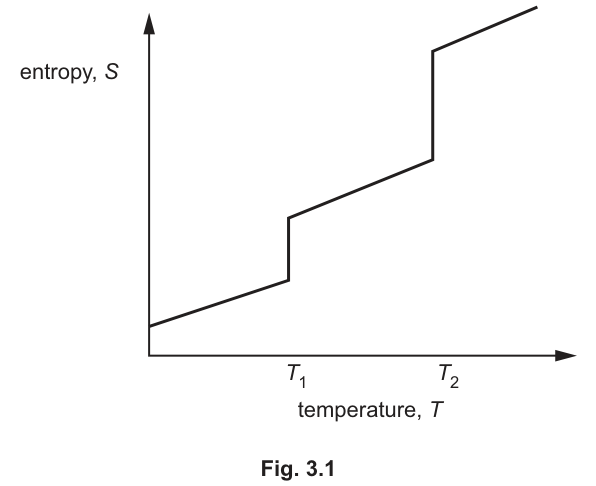
Identify the process occurring at each of the temperatures and .
.................................................. ..................................................
Answer
: melting (or solid to liquid)
: boiling (or liquid to gas)
T1: melting; T2: boiling
Background Concept
When a pure substance is heated, its entropy increases gradually as kinetic energy increases within a single phase. At phase transition temperatures (melting point and boiling point), the temperature remains constant while the substance changes phase. During these transitions, entropy increases sharply (a vertical step on an vs graph) because the particles gain significant freedom of movement and the volume expands dramatically.
Understanding the Question
Fig. 3.1 shows entropy () versus temperature () for a pure substance. There are two vertical steps at and . The question asks to identify the physical processes occurring at these temperatures.
Approach
A heating curve for a pure substance shows gradual entropy increase within phases and sharp vertical jumps at phase transitions. The first transition (at a lower temperature) is melting (solid liquid), and the second (at a higher temperature) is boiling/vaporisation (liquid gas).
Step-by-Step Reasoning
- The graph starts at low with low (solid phase).
- At , there is a vertical step in entropy at constant temperature. This is the first phase change, which is melting (solid to liquid).
- The curve continues to rise (liquid phase heating).
- At , there is a second, larger vertical step. This is the second phase change, which is boiling (liquid to gas).
Key Takeaways
On an entropy-temperature graph, vertical steps represent phase changes. The first step is always melting, and the second is boiling.
Common Mistakes
- Confusing the order of phase changes. Melting always occurs at a lower temperature than boiling for a given substance.
- Using incorrect terminology, e.g., 'evaporation' instead of 'boiling' or 'vaporisation'.
Things to Be Careful About
- Ensure the answer matches the labels and correctly. is the lower temperature (melting), is the higher temperature (boiling).
Answer
The change in disorder (or the change in intermolecular distance) from a liquid to a gas is much bigger than from a solid to a liquid.
The change in disorder from liquid to gas is much bigger than solid to liquid.
Background Concept
Entropy change () during a phase transition depends on how much the freedom of the particles increases. In melting (solid liquid), particles break out of a rigid lattice but remain close together, interacting strongly. In boiling (liquid gas), particles separate completely, moving freely in a much larger volume.
Understanding the Question
The graph shows a larger vertical step (greater ) at (boiling) than at (melting). The question asks to explain why is bigger for boiling than for melting.
Approach
Compare the structural changes in the two phase transitions. Boiling involves a much larger increase in the volume occupied by the substance and a much greater increase in the number of possible arrangements (disorder) of the molecules compared to melting.
Step-by-Step Reasoning
- At (melting), the solid lattice breaks down into a liquid. Particles are still close together, so the increase in disorder is moderate.
- At (boiling), the liquid turns into a gas. The molecules move far apart, and the volume increases dramatically (typically by a factor of ~1000).
- This massive increase in intermolecular distance and freedom of movement leads to a much larger increase in the number of microstates (disorder).
- Therefore, .
Key Takeaways
Boiling causes a much larger entropy increase than melting because gas molecules are much further apart and have vastly more possible arrangements than liquid molecules.
Common Mistakes
- Saying 'gas has more entropy than liquid' without explaining why (i.e., greater distance/disorder).
- Failing to compare the two transitions explicitly.
Things to Be Careful About
- Use terms like 'disorder', 'arrangements', or 'intermolecular distance'. Avoid vague statements like 'gas is more random' without context.
The equation for the reduction of iron(III) oxide by carbon monoxide at is shown.
Table 3.1 shows the enthalpy of formation, , and the entropy, , for some substances.
Table 3.1
| to be calculated |
Use the data in Table 3.1 to calculate the entropy, , of carbon monoxide at .
Show your working.
Working
Step 1: Calculate
Step 2: Calculate using
Temperature
Step 3: Calculate of CO
Answer
(to 3 s.f.)
198 J K^-1 mol^-1
Background Concept
The Gibbs free energy equation relates the feasibility of a reaction to its enthalpy change, entropy change, and temperature. To find an unknown standard entropy value, we can work backwards: calculate from formation data, use the given and temperature to find , and then use the standard entropy summation equation () to solve for the unknown.
Understanding the Question
We are given the reaction, at , and standard enthalpies of formation and entropies for all substances except CO. We need to find . The temperature must be converted to Kelvin.
Approach
- Convert to Kelvin: .
- Calculate using data.
- Rearrange to find . Ensure units are consistent (kJ to J).
- Set up the entropy summation equation and solve for .
Step-by-Step Reasoning
Step 1: Enthalpy of reaction
Convert to J: .
Step 2: Entropy of reaction
Step 3: Entropy of CO
Let .
Rounding to 3 significant figures: .
Key Takeaways
When using , always ensure and are in the same units (usually J) before calculating , because is typically in J K mol.
Common Mistakes
- Forgetting to convert from kJ to J (or from J to kJ), leading to a wildly incorrect value.
- Forgetting to convert temperature to Kelvin ().
- Sign errors when rearranging the Gibbs equation or when calculating (products minus reactants).
Things to Be Careful About
- Significant figures: The final answer should be given to at least 3 s.f. as per the mark scheme.
- State symbols in the equation help keep track of which substances are products and reactants.
Iron(II) oxide can also be reduced to iron by carbon monoxide, as shown.
State the effect of increasing temperature on the feasibility of this reaction.
Explain your answer.
Answer
As temperature increases, the reaction becomes less feasible.
Explanation:
The reaction has a negative . As increases, the term becomes more negative, making more positive. This causes to become less negative (or more positive), reducing the feasibility of the reaction.
Reaction becomes less feasible as temperature increases because becomes less negative / more positive.
Background Concept
The feasibility of a reaction is determined by the sign of . A reaction is feasible (spontaneous) when . The equation is . If is negative, then is positive. As increases, this positive term becomes larger, making less negative (or eventually positive), which decreases feasibility.
Understanding the Question
Given and , we must state and explain the effect of increasing temperature on feasibility.
Approach
Analyze the signs of and in the Gibbs equation. Since is negative, the term is positive and grows with temperature. This opposes the negative , making less negative at higher .
Step-by-Step Reasoning
- Statement: The reaction is less feasible at higher temperatures.
- Explanation: is negative ().
- In , the term is positive.
- As increases, becomes more negative, so becomes more positive.
- This makes less negative (or more positive).
- A less negative (or positive) means the reaction is less feasible.
Key Takeaways
When , increasing temperature decreases feasibility because the entropy term opposes spontaneity more strongly at higher .
Common Mistakes
- Stating 'the reaction is more feasible' without checking the sign of .
- Failing to link the change in to the term explicitly.
- Saying ' becomes positive' without acknowledging it might just become 'less negative' at moderate temperature increases.
Things to Be Careful About
- Use precise language: 'less feasible' or ' becomes less negative/more positive'.
- Ensure the explanation directly references the Gibbs equation and the signs of the terms.
In aqueous solution, iodide ions react with acidified hydrogen peroxide, as shown in reaction 1.
The rate equation for reaction 1 is shown.
Answer
The power (or exponent) to which the concentration of a reactant is raised in the rate equation.
The power (or exponent) to which the concentration of a reactant is raised in the rate equation.
Background Concept
The rate equation (or rate law) expresses the relationship between the rate of a reaction and the concentrations of the reactants. It generally takes the form , where is the rate constant and and are the orders of reaction with respect to reactants A and B respectively.
Understanding the Question
The question asks for a definition of 'order of reaction'. This is a fundamental concept in kinetics that describes how sensitive the reaction rate is to changes in the concentration of a specific reactant.
Approach
Recall the standard IUPAC definition of order of reaction. It is a mathematical exponent in the rate law.
Step-by-Step Reasoning
The order of reaction with respect to a specific reactant is defined as the power to which its concentration term is raised in the experimentally determined rate equation. For example, if rate , the reaction is second order with respect to A. The overall order is the sum of these powers.
Key Takeaways
Order of reaction is an experimental quantity derived from the rate equation, not necessarily related to the stoichiometric coefficients in the balanced chemical equation.
Common Mistakes
Students often confuse order of reaction with stoichiometric coefficients. For example, in the reaction , the coefficient of is 2, but if does not appear in the rate equation, the order with respect to is 0, not 2.
Things to Be Careful About
Ensure the definition mentions 'concentration of a reactant' (singular or general) and 'rate equation'. Mentioning 'power' or 'exponent' is crucial.
Complete Table 4.1.
Table 4.1
| the order of reaction with respect to | |
| the order of reaction with respect to | |
| the order of reaction with respect to | |
| overall order of the reaction |
Answer
| the order of reaction with respect to | 0 |
| the order of reaction with respect to | 1 |
| the order of reaction with respect to | 1 |
| overall order of the reaction | 2 |
Working
The rate equation is .
- does not appear in the rate equation, so the order is 0.
- has an implicit power of 1, so the order is 1.
- has an implicit power of 1, so the order is 1.
- Overall order .
Answer
See table above.
0, 1, 1, 2
Background Concept
The order of reaction with respect to a reactant is the exponent of its concentration term in the rate equation. The overall order of reaction is the sum of the orders with respect to all reactants.
Understanding the Question
We are given the rate equation: . We need to determine the order with respect to each reactant (, , ) and the overall order.
Approach
Identify the concentration terms in the rate equation and their exponents. If a reactant is not in the rate equation, its order is 0. Sum the exponents to find the overall order.
Step-by-Step Reasoning
- Order with respect to : The hydrogen ion concentration does not appear in the rate equation . Therefore, the reaction is zero order with respect to . Value: 0.
- Order with respect to : The term is present with an implicit exponent of 1 (i.e., ). Therefore, the order is 1.
- Order with respect to : The term is present with an implicit exponent of 1. Therefore, the order is 1.
- Overall order: Sum of individual orders . The reaction is second order overall.
Key Takeaways
- Reactants not in the rate equation have an order of 0.
- Implicit exponents in rate equations are 1.
- Overall order is the sum of all individual orders.
Common Mistakes
- Assuming the order is related to the stoichiometric coefficient in the balanced equation (e.g., thinking order for is 2 because of in the equation).
- Forgetting to include the zero order reactant when calculating the overall order (though here it doesn't change the sum, it's a good habit).
Things to Be Careful About
Ensure you check all reactants in the balanced equation against the rate equation. is a reactant in the overall equation but not in the rate law.
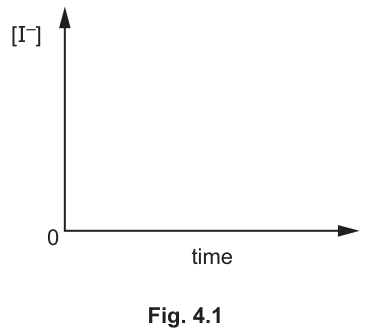
Answer
Working
The reaction is first order with respect to (order = 1). For a first-order reactant, the concentration decreases exponentially over time. The graph of concentration vs time is a curve with a negative gradient that becomes less steep as time progresses (concave up), approaching the x-axis asymptotically.
Answer
See diagram below.
A curve starting at an initial positive value, decreasing with a negative gradient that becomes less steep (concave up) as time increases.
Background Concept
The shape of a concentration-time graph depends on the order of reaction with respect to that reactant.
- Zero order: Linear decrease with constant negative gradient ().
- First order: Exponential decay curve (). The gradient (rate) is proportional to concentration, so as concentration drops, the rate drops, and the curve flattens out.
- Second order: Curve that is steeper initially than first order but decays faster initially then slower? Actually, for second order , so vs is a curve that drops faster than first order initially.
Understanding the Question
We need to sketch against time. From part (a)(ii), the reaction is first order with respect to .
Approach
Recall the graph shape for a first-order reactant. It starts at the initial concentration and decreases exponentially.
Step-by-Step Reasoning
- The y-axis is and x-axis is time.
- At , is at its maximum initial value.
- Since the order is 1, the rate is proportional to . As decreases, the rate (gradient of the graph) decreases.
- This results in a curve that starts steep and becomes less steep (concave up), approaching zero but theoretically never reaching it (asymptotic to the time axis).
- The mark scheme accepts a 'negative gradient curve'.
Key Takeaways
First-order reactant concentration-time graphs are exponential decay curves.
Common Mistakes
- Drawing a straight line (this would be zero order).
- Drawing a curve that is concave down (this is incorrect for decay).
- Not starting at a positive y-intercept.
Things to Be Careful About
The gradient represents the rate of reaction. Since rate decreases as concentration decreases, the slope must get flatter.
Nitrogen dioxide, , reacts with ozone, , as shown in reaction 2.
The rate equation for reaction 2 is shown.
Two experiments are carried out to measure the rate of reaction 2.
In the first experiment, the initial rate is measured starting with known concentrations of and . In the second experiment, the concentrations of and are both increased by a factor of four.
Predict how the initial rate for reaction 2 would change.
Answer
16 times
Working
Rate equation: . Both orders are 1.
If is multiplied by 4 and is multiplied by 4:
.
Answer
The initial rate would increase by a factor of 16.
16 times
Background Concept
The rate equation allows us to predict how the rate changes when concentrations change. If rate , changing by a factor changes the rate by , and changing by a factor changes the rate by .
Understanding the Question
Reaction: . Rate equation: . Both concentrations are increased by a factor of 4.
Approach
Substitute the new concentrations ( and ) into the rate equation and compare to the original rate.
Step-by-Step Reasoning
- Original rate .
- New concentrations: , .
- New rate .
- Ratio . The rate increases 16 times.
Key Takeaways
Changes in rate are multiplicative. If two first-order reactants are both quadrupled, the rate increases by .
Common Mistakes
- Adding the factors () instead of multiplying ().
- Assuming the overall order is 1 and just multiplying by 4.
Things to Be Careful About
Read carefully: 'both increased by a factor of four'.
Answer
The slowest step in a reaction mechanism (or the step with the highest activation energy).
The slowest step in the mechanism.
Background Concept
Many reactions occur via a series of elementary steps (a mechanism). The overall rate of the reaction is determined by the slowest step in this sequence, often called the rate-determining step (RDS) or rate-limiting step. It acts like a bottleneck.
Understanding the Question
Define 'rate-determining step'.
Approach
Recall the standard definition.
Step-by-Step Reasoning
The rate-determining step is the slowest individual step in a multi-step reaction mechanism. Because it is the slowest, it limits the overall rate at which products can be formed.
Key Takeaways
The rate equation is determined by the stoichiometry of the rate-determining step (and any steps prior to it that involve equilibria).
Common Mistakes
- Calling it the 'fastest' step.
- Saying it has the lowest activation energy (it actually has the highest ).
Things to Be Careful About
Use the word 'slowest'.
Suggest equations for the two steps of the reaction mechanism for reaction 2.
step 1 ................................................................................................................................
step 2 ................................................................................................................................
Answer
step 1:
step 2:
Working
Overall: .
Rate equation: . This implies the rate-determining step (step 1) involves one and one .
Step 1 must produce an intermediate () and one product ().
Step 2 must consume the intermediate () and the remaining to form the final product ().
Sum: . Canceling gives .
Answer
See equations above.
step 1: O3 + NO2 -> NO3 + O2; step 2: NO3 + NO2 -> N2O5
Background Concept
A reaction mechanism consists of elementary steps. The sum of these steps must equal the overall balanced equation. The rate equation is determined by the slowest step (RDS). If the RDS is the first step, the reactants in the RDS appear in the rate equation.
Understanding the Question
Overall: . Rate: . We need two steps.
Approach
The rate law suggests the RDS involves one molecule of each. Since there are two in the overall equation, one must react in the slow step and the other in a fast step. The product contains two nitrogens, suggesting the combination of two nitrogen-containing species.
Step-by-Step Reasoning
- Identify RDS reactants: Rate . So step 1 (slow) involves .
- Determine step 1 products: Reactants are . Products must include (since it's a product in the overall equation and has 3 oxygens while has 2, leaving 1 oxygen for the nitrogen species). So . This creates the intermediate .
- Determine step 2: We have used one and one . We need to use the second and convert the intermediate into the final product . Reaction: .
- Check sum: . Cancel : . Matches overall equation.
Key Takeaways
- The rate equation hints at the reactants in the slow step.
- Intermediates produced in early steps must be consumed in later steps.
- The sum of steps must equal the overall stoichiometry.
Common Mistakes
- Writing steps that don't sum to the overall equation.
- Including species that aren't in the overall equation as final products (unless they are intermediates).
- Forgetting to balance the steps.
Things to Be Careful About
Ensure the intermediate () cancels out when adding the steps.
Dinitrogen pentoxide, , can decompose to and .
The rate equation for this decomposition is shown.
Fig. 4.2 shows the graph of rate against for this decomposition.
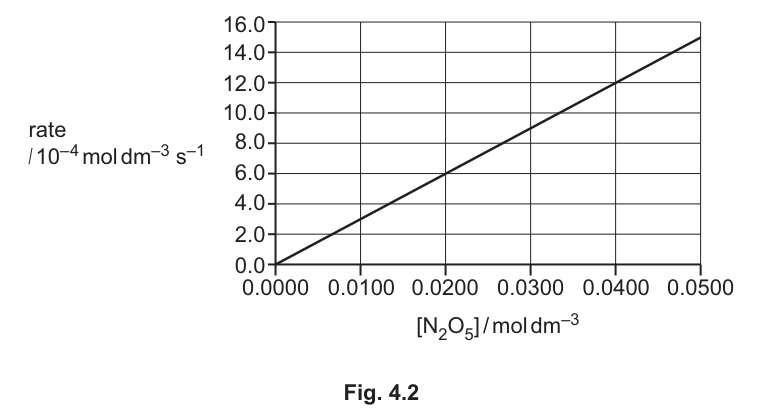
Working
Rate equation: . This is a first-order reaction.
From Fig 4.2, the graph of rate vs is a straight line through the origin. The gradient is equal to .
Pick a point on the line, e.g., , rate .
Answer
(or )
0.030 s^-1
Background Concept
For a first-order reaction, rate . A plot of rate vs is a straight line through the origin with gradient . The units of for first order are (e.g., ).
Understanding the Question
Calculate from the graph of rate against . Note the y-axis is scaled by .
Approach
Calculate the gradient of the line. Ensure correct units and scaling from the graph axes.
Step-by-Step Reasoning
- Identify coordinates: . Note y-axis is , so actual rate is .
- Calculate gradient: .
- Units: .
- Value: .
Key Takeaways
Always check axis labels for multipliers (like ).
Gradient of rate vs concentration graph for first order is .
Common Mistakes
- Forgetting the factor on the y-axis.
- Calculating units incorrectly (e.g., which is for second order).
Things to Be Careful About
The graph shows rate , so a value of 12.0 means .
Use your answer to (c)(i) to calculate the half-life, , in seconds, for this decomposition.
Working
For a first-order reaction:
Using :
Answer
(to 2 s.f.)
23 s
Background Concept
For a first-order reaction, the half-life is constant and independent of concentration. The formula is .
Understanding the Question
Calculate half-life using the value from part (c)(i). The reaction is first order (rate ).
Approach
Substitute into the half-life equation.
Step-by-Step Reasoning
- Formula: .
- Substitute :
- Significant figures: was given/calculated to 2 s.f. (0.030), so answer should be 23 s.
Key Takeaways
Half-life is constant for first-order reactions. Use .
Common Mistakes
- Using the wrong formula (e.g., for second order ).
- Significant figure errors.
Things to Be Careful About
The question asks for the answer in seconds. The unit of is , so the result is in seconds.
Chloric(I) acid, , is a weak Brønsted–Lowry acid.
When chloric(I) acid is added to aqueous sodium hydroxide, an acid–base reaction takes place, as shown.
Identify the two conjugate acid–base pairs in this reaction.
acid I: conjugate base of acid I: ................
acid II: ................ conjugate base of acid II: ................
Answer
acid I: ; conjugate base of acid I:
acid II: ; conjugate base of acid II:
acid I: HClO, conjugate base: ClO-; acid II: H2O, conjugate base: OH-
Background Concept
A Brønsted–Lowry acid is a proton () donor, and a Brønsted–Lowry base is a proton acceptor. When an acid donates a proton, the species left behind is its conjugate base. When a base accepts a proton, the species formed is its conjugate acid. An acid–base reaction always involves two conjugate acid–base pairs: the acid donates to become its conjugate base, while the base accepts to become its conjugate acid.
Understanding the Question
The reaction is . We need to identify the two conjugate acid–base pairs. The question already tells us acid I is , so we need its conjugate base. We also need to identify acid II and its conjugate base. Note that is a strong base — in aqueous solution it exists as and . The actual proton transfer is between and .
Approach
Identify which species donates a proton (the acid) and which accepts it (the base). Then, for each, write the species formed after donation (conjugate base) or after acceptance (conjugate acid). The two pairs are (acid, conjugate base) for each side of the reaction.
Step-by-Step Reasoning
donates to form . So is acid I and is its conjugate base.
The proton acceptor is (from ). When accepts , it forms . So is the base, and is its conjugate acid. The question asks for acid II, which is , and its conjugate base, which is .
Note: The ion is a spectator and plays no role in the acid–base chemistry.
So the two conjugate acid–base pairs are:
- /
- /
Key Takeaways
- In any acid–base reaction, identify the proton donor and proton acceptor.
- The conjugate base is what remains after the acid loses ; the conjugate acid is what forms when the base gains .
- Spectator ions (like ) should be ignored.
Common Mistakes
- Writing as the conjugate base of — this is backwards. accepts to become , so is the conjugate ACID of .
- Including in the conjugate pairs — is a spectator ion.
- Confusing which species is acid and which is base in each pair.
Things to Be Careful About
- The conjugate base of an acid has one fewer and one more negative charge (or one less positive charge).
- The conjugate acid of a base has one more and one more positive charge (or one less negative charge).
- The question explicitly labels acid I as — use that as your anchor.
The value for the acid dissociation constant, , of is .
Calculate the concentration, in , of at a pH of .
Working
For a weak acid,
Answer
0.0258 mol dm^-3
Background Concept
For a weak acid HA, the acid dissociation constant is:
For a weak acid where dissociation is small, , so . This is the weak-acid approximation. Also, , so .
Understanding the Question
We are given for and . We need to find the concentration of . The key is to use the relationship between pH, , and .
Approach
- Convert pH to using .
- Use the weak-acid approximation and rearrange to find .
Step-by-Step Reasoning
Step 1: .
Step 2: For the weak acid , the dissociation is:
Since (from the stoichiometry of dissociation), .
Rearranging: .
The answer should be given to at least 2 significant figures — 0.0258 mol dm⁻³ (3 sf) is appropriate.
Key Takeaways
- pH is a logarithmic scale; .
- For a weak acid, if dissociation is small, .
- Always keep units — mol dm⁻³ here.
Common Mistakes
- Forgetting to take — writing or .
- Using instead of .
- Mixing up the rearrangement: (not ).
- Giving the answer without units or in the wrong units.
Things to Be Careful About
- The weak-acid approximation assumes is small compared to ; here is indeed much smaller than , so the approximation is valid.
- The pH was given to 3 significant figures, so the answer should have at least 2–3 sf. The mark scheme says "min 2sf".
When a solution of is heated, chloric(V) acid and a strong acid not containing oxygen are formed as the only products.
Write an equation for this reaction.
Answer
3HClO -> HClO3 + 2HCl
Background Concept
Disproportionation is a redox reaction in which the same element in a single species is simultaneously oxidised and reduced. Here, chlorine in (oxidation state +1) is both oxidised to +5 (in , chloric(V) acid) and reduced to −1 (in , a strong acid not containing oxygen).
Understanding the Question
When is heated, it forms chloric(V) acid () and a strong acid not containing oxygen. The only strong acid without oxygen formed from chlorine is . We need to write and balance the equation.
Approach
- Identify the products: and .
- Write the unbalanced equation: .
- Balance by considering the oxidation states of chlorine and the conservation of atoms.
Step-by-Step Reasoning
Cl in has oxidation state +1 (since H is +1 and O is −2, so , giving ).
In , Cl has oxidation state +5: , so . This is oxidation (loss of electrons).
In , Cl has oxidation state −1. This is reduction (gain of electrons).
To balance the electron transfer: going from +1 to +5 loses 4 electrons per Cl. Going from +1 to −1 gains 2 electrons per Cl. To balance, we need 1 Cl oxidised (loses 4 e⁻) and 2 Cl reduced (gain 2 × 2 = 4 e⁻). So the ratio of oxidised to reduced Cl is 1:2.
This gives:
Check atom balance: Left: 3 H, 3 Cl, 3 O. Right: 1 H + 2 H = 3 H; 1 Cl + 2 Cl = 3 Cl; 3 O. Balanced.
Key Takeaways
- Disproportionation: same element oxidised and reduced in one reaction.
- Balance redox equations by tracking electron transfer (oxidation state changes).
- The strong acid without oxygen from chlorine chemistry is .
Common Mistakes
- Writing or instead of — the question specifies chloric(V) acid, which is .
- Unbalanced equation, e.g. (not balanced in Cl or H).
- Not recognising that is the "strong acid not containing oxygen".
Things to Be Careful About
- Chloric(V) acid is — the (V) refers to the oxidation state of chlorine.
- The equation must be balanced in all atoms: H, Cl, and O.
- State symbols are not required here (the mark scheme gives the equation without them), but would be (aq) for all species.
Answer
A buffer solution is a solution that resists (or minimises) changes in pH when small amounts of acid () and base () are added to it.
A solution that resists/minimises changes in pH when small amounts of acid and base are added.
Background Concept
A buffer solution is a solution that resists changes in pH when small amounts of acid or base are added. It typically consists of a weak acid and its conjugate base (or a weak base and its conjugate acid) in roughly comparable concentrations. The weak acid neutralises added , and the conjugate base neutralises added .
Understanding the Question
The question asks for a definition. This is a recall question — the mark scheme wants two components: (1) resists/minimises pH change, AND (2) when small amounts of acid and base are added.
Approach
State the definition directly, covering both required elements.
Step-by-Step Reasoning
The definition must include:
- The solution resists (or minimises) changes in pH.
- This happens when small amounts of acid () and base () are added.
A complete answer: "A buffer solution is a solution that resists changes in pH when small amounts of acid or base are added to it."
Key Takeaways
- Buffers resist pH change, they don't prevent it entirely.
- The definition requires both the "resists pH change" part and the "when small amounts of acid/base are added" part.
Common Mistakes
- Saying a buffer "keeps the pH constant" — this is too strong; it resists/minimises change.
- Omitting the condition "when small amounts of acid or base are added" — this is a required part of the mark.
- Confusing a buffer with a neutral solution.
Things to Be Careful About
The mark scheme says "resists / minimises changes pH AND when small amounts of acid / and base / are added to it" — both parts are needed for the mark.
Suggest a substance that could be added to aqueous ethanoic acid to form a buffer solution.
Explain your answer.
Answer
Add hydroxide ions (e.g. ). The reacts with ethanoic acid to form the conjugate base (ethanoate ions, ), giving a mixture of the weak acid and its conjugate base.
(OR: Add sodium ethanoate, which provides ethanoate ions — the conjugate base of ethanoic acid.)
Add NaOH (or sodium ethanoate) — provides the conjugate base, ethanoate ions.
Background Concept
An acidic buffer is made from a weak acid and its conjugate base. Ethanoic acid () is a weak acid; its conjugate base is the ethanoate ion (). A buffer can be made by mixing the weak acid with a salt of the conjugate base (e.g. sodium ethanoate) or by partially neutralising the weak acid with a strong base (e.g. ).
Understanding the Question
We have aqueous ethanoic acid and need to suggest a substance to add to make a buffer, and explain why.
Approach
Identify what's missing: the conjugate base (ethanoate ions). Suggest either a salt of ethanoate (sodium ethanoate) or a strong base () that will partially neutralise the ethanoic acid to form ethanoate ions.
Step-by-Step Reasoning
Option 1: Add sodium ethanoate (). This dissociates to give ethanoate ions (), which are the conjugate base of ethanoic acid. The solution then contains both the weak acid () and its conjugate base () — an acidic buffer.
Option 2: Add . The reacts with some of the ethanoic acid:
This forms ethanoate ions, so the remaining mixture contains both and .
The mark scheme accepts either: "hydroxide ions / / AND it reacts with the acid to form the conjugate base / ethanoate ions" OR "ethanoate ions / sodium ethanoate AND as it is the conjugate base (of ethanoic acid)".
Key Takeaways
- An acidic buffer = weak acid + its conjugate base.
- The conjugate base can be added directly (as a salt) or generated by partial neutralisation with a strong base.
Common Mistakes
- Suggesting adding a strong acid (like ) — this would not form a buffer; it would just lower the pH.
- Suggesting adding more ethanoic acid — this doesn't add the conjugate base.
- Not explaining WHY the substance works — the explanation is required for the mark.
Things to Be Careful About
The mark requires both the substance AND the explanation. Just naming sodium ethanoate without explaining that it provides the conjugate base may not score. "Sodium ethanoate" and "ethanoate ions" are both acceptable.
Some fertilisers contain calcium dihydrogenphosphate, .
An aqueous solution containing dihydrogenphosphate ions, , can act as a buffer solution.
Write two equations to show how ions can act as a buffer.
equation 1 .................................................................................................................................
equation 2 .................................................................................................................................
Answer
equation 1:
equation 2:
H2PO4- + H+ -> H3PO4; H2PO4- + OH- -> HPO4(2-) + H2O
Background Concept
A buffer works by having a weak acid (or weak base) that can neutralise added (or ) and a conjugate species that can neutralise added (or ). is amphiprotic — it can act as both an acid (donating to become ) and a base (accepting to become ). This makes it able to act as a buffer on its own.
Understanding the Question
We need to write two equations showing how acts as a buffer: one showing how it neutralises added acid (), and one showing how it neutralises added base ().
Approach
- To neutralise added : accepts the proton, becoming .
- To neutralise added : donates a proton to , forming and .
Step-by-Step Reasoning
Equation 1 (neutralising added acid):
The acts as a base, accepting to form phosphoric acid.
Equation 2 (neutralising added base):
The acts as an acid, donating to , forming and water.
Together, these two reactions show that can resist pH change in both directions — it can mop up excess and excess .
Key Takeaways
- An amphiprotic species (like ) can act as both acid and base, making it a single-component buffer.
- Buffer equations should show the species neutralising (for added acid) and neutralising (for added base).
Common Mistakes
- Writing — this is wrong because accepting should form (adding a proton), not (removing one).
- Writing — this loses two protons at once; the correct product is .
- Forgetting the in the second equation.
- Not balancing charges: has charges −1 + 1 = 0 on the left, and 0 on the right. Balanced.
Things to Be Careful About
- Check charge balance in every equation.
- (no water formed here).
- (water IS formed here).
The solubility of calcium phosphate, , is at .
The expression for the solubility product, , of is shown.
Calculate the value of for . Include units.
Working
Answer
2.08 × 10^-33 mol^5 dm^-15
Background Concept
The solubility product, , is the equilibrium constant for the dissolution of a sparingly soluble salt. For , . The solubility () is the concentration of the salt that dissolves, and the ion concentrations are related to by the stoichiometry of the dissolution.
Understanding the Question
We are given the solubility of as . We need to calculate , including units. The expression is already given.
Approach
- Write the dissolution equilibrium: .
- From solubility , and .
- Substitute into .
- Determine the units from the powers of concentration.
Step-by-Step Reasoning
Step 1: The dissolution equilibrium:
Step 2: If solubility , then:
Step 3: Substitute:
Step 4: Units: .
So .
Key Takeaways
- The stoichiometric coefficients in the dissolution equation become powers in the expression.
- The ion concentrations are NOT equal to the solubility — they are multiplied by the stoichiometric coefficient.
- Units of depend on the stoichiometry: for a salt giving cations and anions.
Common Mistakes
- Using (forgetting the 3 and 2 factors) — this gives the wrong .
- Using the solubility directly in the expression without the stoichiometric factors.
- Forgetting the units or giving the wrong units.
- Writing the expression as instead of .
Things to Be Careful About
The mark scheme shows two equivalent methods: either compute and first, or substitute directly as . The answer must be to at least 2 significant figures: or both accepted. Units are — this is a required mark (M3).
Some solid sodium phosphate is added to a saturated solution of .
Predict the effect, if any, on the solubility of .
Explain your answer.
Answer
The solubility of decreases.
Adding ions (the common ion) shifts the equilibrium to the left (common ion effect), so less solid dissolves.
Solubility decreases — common ion effect.
Background Concept
The common ion effect: when a salt is dissolved in a solution already containing one of its ions, the solubility of the salt decreases. This is a direct application of Le Chatelier's principle to the dissolution equilibrium. Adding a common ion (here from sodium phosphate) shifts the equilibrium to the left, favouring the solid, so less dissolves.
Understanding the Question
Sodium phosphate () is added to a saturated solution of . We need to predict the effect on solubility and explain. The common ion is .
Approach
Identify the common ion (), apply Le Chatelier's principle to the dissolution equilibrium, and state that solubility decreases.
Step-by-Step Reasoning
The dissolution equilibrium is:
Adding increases . By Le Chatelier's principle, the equilibrium shifts to the left (towards the solid) to reduce the concentration. This means less dissolves — the solubility decreases. This is the common ion effect.
Key Takeaways
- Adding a common ion decreases the solubility of a sparingly soluble salt.
- Le Chatelier's principle applies to solubility equilibria like any other equilibrium.
- The common ion here is (from ).
Common Mistakes
- Saying solubility increases — adding a common ion always decreases solubility (for a sparingly soluble salt).
- Saying "no effect" — the common ion definitely affects the equilibrium.
- Not mentioning the common ion effect or Le Chatelier's principle in the explanation.
- Confusing which ion is the common one (it's , not ).
Things to Be Careful About
The mark scheme wants "solubility decreases AND due to the common ion effect" — both parts needed. The explanation should mention that the equilibrium shifts to the left / towards the solid.
Methylbenzene reacts readily with nitronium ions, .
ions are generated by the reaction between concentrated nitric acid and concentrated sulfuric acid.
Answer
HNO3 + H2SO4 -> NO2+ + HSO4- + H2O
Background Concept
In electrophilic aromatic substitution, the electrophile must be generated first. For nitration, the electrophile is the nitronium ion (). Concentrated sulfuric acid acts as a stronger acid than nitric acid, protonating nitric acid on its group. The protonated nitric acid then loses water to form the nitronium ion.
Understanding the Question
The question asks for the equation showing how is generated from the reaction between concentrated nitric acid and concentrated sulfuric acid. This is a standard equation that must be recalled.
Approach
Write the acid-base reaction: donates a proton to , which then loses water to form . The products are , , and .
Step-by-Step Reasoning
- Sulfuric acid is the stronger acid and protonates nitric acid:
- The protonated nitric acid loses water:
- Combining:
An alternative form using is also accepted:
Key Takeaways
- The nitronium ion is generated by acid-catalysed dehydration of nitric acid.
- Sulfuric acid acts as a proton donor (stronger acid than nitric acid).
Common Mistakes
- Writing instead of (missing the charge).
- Forgetting the product.
- Writing instead of .
Things to Be Careful About
- The equation must be balanced (check atoms and charges on both sides).
- State symbols are not required for this mark but the charges on and must be shown.
Complete the mechanism in Fig. 6.1 for the nitration of methylbenzene to form 1-methyl-2-nitrobenzene.
Include all relevant curly arrows and charges.
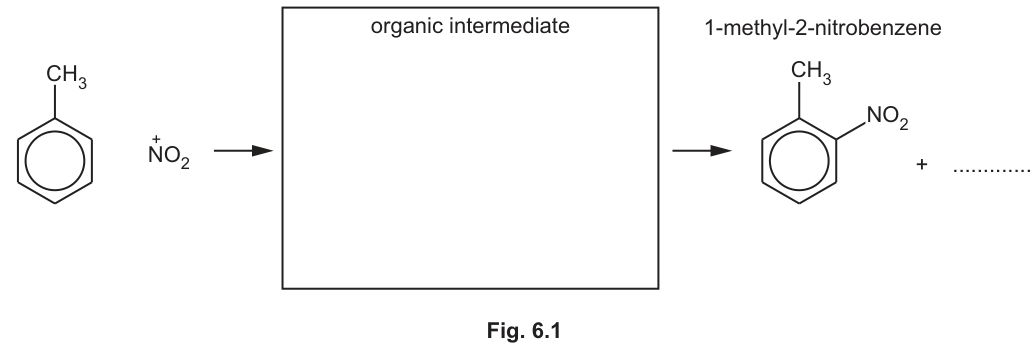
Answer
Step 1: Curly arrow from the delocalised system (inside the hexagon) of methylbenzene to the nitrogen atom of .
Step 2 (Organic intermediate): A cyclohexadienyl cation with a broken horseshoe (delocalised positive charge over 3 carbons), with and on one carbon and on the adjacent carbon. The charge is shown in the centre of the ring.
Step 3: Curly arrow from the C–H bond on the carbon into the ring to restore aromaticity, giving 1-methyl-2-nitrobenzene + .
See diagram: curly arrow from ring to NO2+, charged cyclohexadienyl intermediate, curly arrow from C-H into ring giving 1-methyl-2-nitrobenzene + H+
Background Concept
Electrophilic aromatic substitution proceeds through a two-stage mechanism. First, the electrophile attacks the aromatic system, forming a positively charged sigma complex (also called an arenium ion or Wheland intermediate). This intermediate has lost aromaticity — one carbon becomes hybridised, and the positive charge is delocalised over three remaining carbons (shown by a broken horseshoe). In the second stage, a proton is lost from the carbon, with the C–H bond electrons returning to the ring to restore aromaticity.
Understanding the Question
The question provides the overall scheme: methylbenzene + → organic intermediate → 1-methyl-2-nitrobenzene + (something). The student must complete the mechanism by drawing curly arrows and the intermediate structure. The product is the ortho-substituted isomer (1-methyl-2-nitrobenzene), so the group is adjacent to the group.
Approach
- Draw a curly arrow from the ring's delocalised electrons to the N of (showing the electrophile being attacked).
- Draw the intermediate: a hexagon with a broken horseshoe (indicating delocalised + charge over 3 carbons), with and on the carbon and on the adjacent carbon.
- Draw a curly arrow from the C–H bond into the ring (restoring the delocalised system) and write as the co-product.
Step-by-Step Reasoning
M1 (first curly arrow): The electrons of the aromatic ring attack the electrophilic nitrogen of . The curly arrow starts from inside the hexagon (representing the delocalised system) and points to the N atom. This forms a new C–N bond.
M2 (intermediate): The carbon that was attacked becomes (it now bears both H and ). The adjacent carbon bears the group. The positive charge is delocalised over the remaining three carbons, shown by a broken horseshoe with a + sign inside. The horseshoe must be broken (not a complete circle) to indicate loss of aromaticity.
M3 (second curly arrow and H+): The C–H bond on the carbon breaks heterolytically — the electron pair returns to the ring to restore the aromatic sextet. This is shown by a curly arrow from the C–H bond into the ring. The product is 1-methyl-2-nitrobenzene and .
Key Takeaways
- The curly arrow always starts from an electron pair (bond or lone pair) and ends at the species receiving the electrons.
- The intermediate must show a broken horseshoe (not complete) because aromaticity is lost.
- The is regenerated, making a catalyst overall.
Common Mistakes
- Drawing a complete circle inside the intermediate (this implies aromaticity is retained — incorrect).
- Placing the + charge on a single carbon rather than delocalised.
- Drawing the curly arrow from to the ring (wrong direction — arrows go from electrons to the electron-deficient species).
- Forgetting to show as the other product.
- Placing the group on the wrong carbon (must be ortho to for 1-methyl-2-nitrobenzene).
Things to Be Careful About
- The horseshoe must be broken (open at one end) to show the positive charge is delocalised over only 3 carbons.
- Charges must be shown on the intermediate and on .
- The curly arrow for the second step must go from the C–H bond into the ring, not from the ring to H.
Phenol can be nitrated with dilute nitric acid.
Explain why the nitration of phenol occurs under milder conditions than the nitration of benzene.
Answer
- The lone pair on the oxygen atom of the group is delocalised (overlaps) into the system of the ring.
- This increases the electron density of the ring, making it more susceptible to attack by the electrophile , so milder conditions (dilute ) are needed.
Lone pair on O delocalises into the ring pi system, increasing electron density of the ring, making it more reactive towards electrophiles so milder conditions suffice.
Background Concept
The group attached directly to a benzene ring (as in phenol) is a powerful activating group. The oxygen atom has two lone pairs in p-orbitals that can overlap with the system of the ring. This - overlap donates electron density into the ring, particularly at the ortho and para positions. The increased electron density means the ring is more nucleophilic and can react with weaker electrophiles or under milder conditions than benzene itself.
Understanding the Question
The question asks why phenol can be nitrated with dilute nitric acid (milder conditions) whereas benzene requires concentrated nitric acid and concentrated sulfuric acid. The key is the activating effect of the group.
Approach
Identify the structural feature of phenol that differs from benzene (the group with lone pairs on oxygen), explain how this affects the ring electron density, and connect this to the ease of electrophilic attack.
Step-by-Step Reasoning
M1: The oxygen atom of the group has lone pairs in p-orbitals that overlap with the delocalised system of the benzene ring. This is - conjugation (or resonance donation).
M2: As a result, electron density in the ring is increased (the ring becomes more electron-rich / more nucleophilic). This means the electrophile is more readily attracted and attacked, so a weaker nitrating agent (dilute without ) is sufficient.
The mark scheme also accepts: 'polarises electrophiles / better' as an alternative for M2.
Key Takeaways
- The group is an activating group in electrophilic aromatic substitution due to lone pair donation into the ring.
- Increased ring electron density = easier electrophilic attack = milder conditions.
- This is the same principle that makes phenol react with bromine water at room temperature while benzene requires a halogen carrier catalyst.
Common Mistakes
- Saying the group 'pushes electrons' without specifying that it is the lone pair on oxygen that is delocalised into the system.
- Confusing this with the inductive effect (the group is actually electron-withdrawing by induction; it is the resonance/lone pair donation that activates the ring).
- Not mentioning the connection between increased electron density and easier electrophilic attack.
Things to Be Careful About
- Must mention both the mechanism of activation (lone pair delocalisation into ring) AND the consequence (increased electron density / more reactive towards electrophiles).
- The term 'delocalised' or 'overlaps into the system' is required — just saying 'donates electrons' may not earn M1.
A sample of 2-nitrophenol is reacted with sodium.
Complete the equation in Fig. 6.2 for the reaction of 2-nitrophenol with sodium.
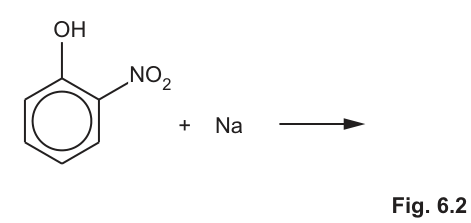
Answer
The organic product is sodium 2-nitrophenolate (benzene ring with at position 1 and at position 2).
2-nitrophenol + Na -> sodium 2-nitrophenolate + 1/2 H2
Background Concept
Phenol is weakly acidic (stronger than alcohols but weaker than carboxylic acids). Like all acids, it reacts with reactive metals such as sodium to form a salt and hydrogen gas. The proton is replaced by sodium to give the phenolate (phenoxide) salt.
Understanding the Question
The question shows 2-nitrophenol reacting with sodium metal and asks for the products to be completed. The group is unaffected; only the phenolic reacts.
Approach
Apply the general reaction: acid + metal → salt + hydrogen. For phenol: . The nitro group remains unchanged.
Step-by-Step Reasoning
- The acidic proton on the group of 2-nitrophenol is displaced by sodium.
- The product is sodium 2-nitrophenolate: the ring retains at position 2, and replaces at position 1.
- Hydrogen gas is evolved: per mole of phenol reacting with one mole of Na.
Key Takeaways
- Phenol reacts with sodium because it is acidic enough to donate a proton to the metal.
- The nitro group is unaffected by this reaction.
- The phenolate ion is stabilised by delocalisation of the negative charge into the ring.
Common Mistakes
- Writing instead of (the equation is not balanced with 1:1 Na to H2).
- Replacing the group instead of the group.
- Writing as a product instead of the sodium phenolate salt.
Things to Be Careful About
- The coefficient of must be if using 1 mole of Na, or the equation can be doubled: .
2-nitrophenol can undergo different reactions as shown in Fig. 6.3.
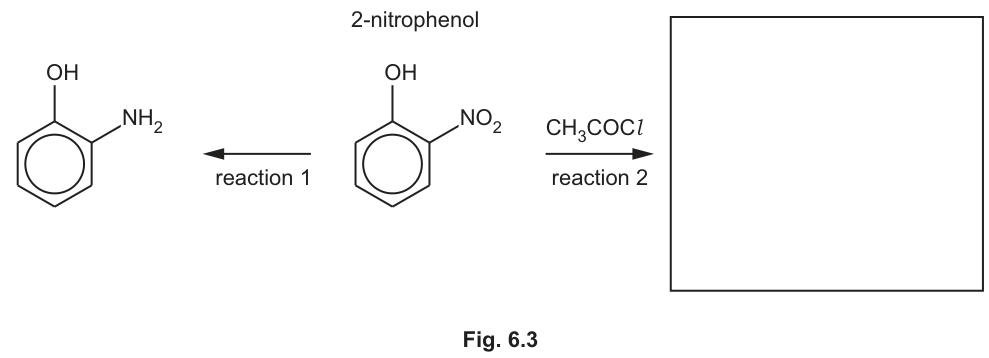
Answer
Tin (Sn) and concentrated , with heat (reflux).
Sn and concentrated HCl, heat
Background Concept
The reduction of a nitro group () to an amino group () on an aromatic ring is a classic reaction in A-Level chemistry. The standard method uses a metal (tin or iron) with concentrated hydrochloric acid under reflux. The initially formed product is the ammonium salt (), which must be treated with alkali (e.g. NaOH) to liberate the free amine. Alternatively, catalytic hydrogenation with /Ni can be used.
Understanding the Question
Reaction 1 converts 2-nitrophenol to 2-aminophenol — the group is reduced to while the group is unaffected. The question asks for reagents and conditions.
Approach
Recall the standard reducing conditions for aromatic nitro compounds: Sn (or Fe) + concentrated HCl + heat.
Step-by-Step Reasoning
The conversion requires a reducing agent. The standard A-Level answer is tin + concentrated HCl under reflux. The group is unaffected by these conditions.
Key Takeaways
- Reduction of to uses Sn/conc. HCl/heat or Fe/conc. HCl/heat.
- The group survives these conditions.
Common Mistakes
- Writing dilute HCl instead of concentrated HCl.
- Omitting the heat/reflux condition.
- Suggesting a reducing agent that would also reduce other groups (e.g. LiAlH4 would be inappropriate here).
Things to Be Careful About
- Must specify 'concentrated' HCl, not just 'HCl'.
- Heat (reflux) must be mentioned as a condition.
Answer
Reduction
Reduction
Background Concept
When a functional group gains hydrogen (or loses oxygen), the reaction is classified as reduction. The conversion involves loss of two oxygen atoms and gain of two hydrogen atoms, which is clearly reduction.
Understanding the Question
The question asks to name the type of reaction that converts the nitro group to an amino group.
Approach
Compare the starting material and product: has lost oxygen and gained hydrogen → reduction.
Step-by-Step Reasoning
The nitrogen goes from oxidation state +3 in to in (considering the bonds to carbon and oxygen/hydrogen). This decrease in oxidation state confirms reduction.
Key Takeaways
- Loss of oxygen / gain of hydrogen = reduction.
- The to conversion is a standard example of reduction in organic chemistry.
Common Mistakes
- Writing 'substitution' (the reaction involves the whole group being changed, not a single atom being swapped).
- Writing 'hydrogenation' (while technically correct in a broad sense, 'reduction' is the expected answer).
Things to Be Careful About
- 'Reduction' is the expected term. 'Hydrogenation' would likely not be accepted as the mechanism involves electron transfer from the metal, not addition of H2 across a bond.
Reaction 2 is carried out at room temperature.
Draw the structure of the organic product from reaction 2 in Fig. 6.3.
Answer
The product is 2-nitrophenyl ethanoate: a benzene ring with at position 1 and at position 2.
2-nitrophenyl ethanoate: benzene ring with -O-C(=O)CH3 at position 1 and -NO2 at position 2
Background Concept
Phenols react with acyl chlorides to form esters. The group of the phenol acts as a nucleophile, attacking the electrophilic carbonyl carbon of the acyl chloride. is eliminated. This is an addition-elimination (nucleophilic acyl substitution) reaction. Unlike alcohols, phenols do not react with carboxylic acids to form esters, but they do react with acyl chlorides.
Understanding the Question
2-nitrophenol reacts with (ethanoyl chloride) at room temperature. The group is converted to an ester group . The group is unaffected.
Approach
Replace the H of the group with the group from the acyl chloride. The oxygen remains attached to the ring.
Step-by-Step Reasoning
- The phenolic oxygen attacks the carbonyl carbon of .
- Chloride leaves, and is eliminated.
- The product is 2-nitrophenyl ethanoate: .
Key Takeaways
- Phenol + acyl chloride → aryl ester + HCl.
- The oxygen of the phenol becomes the bridging oxygen in the ester.
- Reaction occurs at room temperature (acyl chlorides are very reactive).
Common Mistakes
- Drawing the ester with the carbonyl attached to the ring (i.e. ) instead of .
- Forgetting the group.
- Drawing a carboxylic acid instead of an ester.
Things to Be Careful About
- The ester linkage is (the ring oxygen is bonded to the carbonyl carbon). Do not reverse the ester direction.
Answer
Nucleophilic addition–elimination
Nucleophilic addition-elimination
Background Concept
Reactions of acyl chlorides (and other carboxylic acid derivatives) proceed by nucleophilic addition-elimination. A nucleophile attacks the electrophilic carbonyl carbon (addition step), forming a tetrahedral intermediate. Then a leaving group (Cl⁻ in this case) is expelled (elimination step), regenerating the carbonyl group.
Understanding the Question
The reaction of 2-nitrophenol with is an acyl chloride reacting with a nucleophile (the phenolic oxygen). The question asks for the mechanism name.
Approach
Identify that the reaction involves a nucleophile attacking a carbonyl carbon followed by loss of a leaving group — this is nucleophilic addition-elimination.
Step-by-Step Reasoning
- The lone pair on the phenolic oxygen acts as a nucleophile and attacks the carbonyl carbon of (addition).
- The tetrahedral intermediate collapses, expelling as the leaving group (elimination).
- The product is an ester.
Key Takeaways
- All reactions of acyl chlorides with nucleophiles (water, alcohols, phenols, ammonia, amines) proceed by nucleophilic addition-elimination.
- This mechanism is distinct from nucleophilic substitution (which occurs at saturated carbon).
Common Mistakes
- Writing 'nucleophilic substitution' (this is the mechanism for halogenoalkanes, not acyl chlorides).
- Writing just 'addition' without 'elimination'.
Things to Be Careful About
- The full name 'nucleophilic addition-elimination' is required. 'Addition-elimination' alone may also be accepted.
The group in 2-nitrophenol is electron withdrawing.
Suggest the relative acidities of ethanol, 2-nitrophenol, phenol and water.
Explain your answer.
.................................. .................................. .................................. ..................................
(most acidic) (least acidic)
Answer
Order (most acidic → least acidic): 2-nitrophenol > phenol > water > ethanol
Explanation:
- 2-nitrophenol and phenol are more acidic than water and ethanol because the negative charge on the phenoxide ion is delocalised into the ring (the lone pair on oxygen overlaps with the system of the ring), stabilising the conjugate base and making the O–H bond easier to break / proton more easily donated.
- 2-nitrophenol is more acidic than phenol because the electron-withdrawing group further stabilises the negative charge on the phenoxide ion.
- Ethanol is the least acidic because the ethyl group has a positive inductive effect (electron-donating), which destabilises the alkoxide ion (), making the O–H bond harder to break.
2-nitrophenol > phenol > water > ethanol. Phenol/2-nitrophenol: charge delocalised into ring stabilises anion. Ethanol: positive inductive effect of alkyl group destabilises anion.
Background Concept
Acidity depends on the stability of the conjugate base. A more stable conjugate base means the acid more readily donates a proton. For compounds with an O–H bond, the conjugate base is an anion ( or ). Factors that stabilise this anion (resonance delocalisation, electron-withdrawing groups) increase acidity, while factors that destabilise it (electron-donating groups) decrease acidity.
Understanding the Question
The question asks to rank four compounds (ethanol, 2-nitrophenol, phenol, water) by acidity and explain the order. The group in 2-nitrophenol is stated to be electron-withdrawing.
Approach
- Group the compounds: phenol and 2-nitrophenol form phenoxide ions (charge delocalised into ring); water and ethanol form hydroxide and ethoxide ions (charge localised on oxygen).
- Within the delocalised group: 2-nitrophenol has an additional electron-withdrawing group that further stabilises the anion.
- Within the localised group: ethanol's alkyl group destabilises the anion relative to water.
Step-by-Step Reasoning
M1 (Order): 2-nitrophenol > phenol > water > ethanol. This order must be stated correctly.
M2 (General explanation for acidity): The O–H bond is weakened / the conjugate base (anion) is stabilised, so the proton is more easily lost/donated. This is the general principle linking anion stability to acid strength.
M3 (Why phenol and 2-nitrophenol are more acidic than water/ethanol): In the phenoxide ion, a lone pair on the oxygen is delocalised into the system of the benzene ring (p-orbital overlap). This spreads the negative charge over the ring, stabilising the anion and making the O–H bond easier to break.
M4 (Why ethanol is least acidic): The ethyl group has a positive inductive effect (+I), meaning it pushes electron density towards the oxygen. This destabilises the alkoxide ion () by concentrating negative charge on an already negatively charged oxygen, making it harder to lose the proton.
The electron-withdrawing group in 2-nitrophenol further stabilises the phenoxide ion by delocalising/withdrawing electron density, making 2-nitrophenol more acidic than phenol.
Key Takeaways
- Acidity increases with conjugate base stability.
- Resonance delocalisation into an aromatic ring greatly stabilises phenoxide ions.
- Electron-withdrawing groups (like ) further increase acidity by additional stabilisation.
- Electron-donating groups (like alkyl groups) decrease acidity by destabilising the anion.
Common Mistakes
- Getting the order wrong (e.g. placing water above phenol).
- Saying 'phenol is acidic because of the ring' without specifying that it is the delocalisation of the lone pair/charge into the system.
- Confusing the inductive effect of the alkyl group (electron-donating, destabilises anion) with resonance effects.
- Not explaining why 2-nitrophenol > phenol (the additional stabilisation from the electron-withdrawing group).
Things to Be Careful About
- All four marks must be addressed: the correct order, the general principle (anion stabilisation → easier proton loss), the specific mechanism for phenol (delocalisation into ring), and the specific mechanism for ethanol (positive inductive effect).
- Use precise language: 'delocalised into the system of the ring', 'positive inductive effect', 'stabilises the conjugate base/anion'.
Salbutamol is a pharmaceutical drug that contains a phenol functional group.
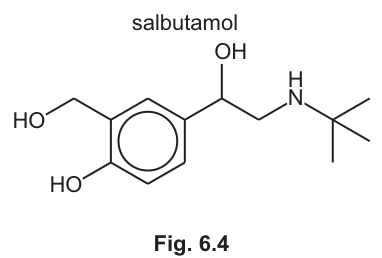
Name and classify the three other functional groups in salbutamol in Table 6.1.
Table 6.1
| name of functional group | classification of functional group |
|---|---|
Answer
| Name of functional group | Classification |
|---|---|
| Alcohol (hydroxyl) | Primary |
| Alcohol (hydroxyl) | Secondary |
| Amine | Secondary |
Primary alcohol, secondary alcohol, secondary amine
Background Concept
Functional groups can be classified by their degree. Alcohols are primary (OH on a carbon bonded to one other carbon), secondary (OH on a carbon bonded to two other carbons), or tertiary (OH on a carbon bonded to three other carbons). Amines are primary (), secondary (), or tertiary (), classified by the number of carbon groups attached to nitrogen.
Understanding the Question
Salbutamol has a phenol group (already identified in the question stem). The student must identify and classify the three OTHER functional groups. Looking at the displayed formula:
- A group (carbon attached to one other carbon → primary alcohol)
- A group in the side chain (carbon attached to two other carbons → secondary alcohol)
- A group (nitrogen attached to two carbon groups → secondary amine)
Approach
Examine each functional group in the structure, determine its type, then classify by degree.
Step-by-Step Reasoning
- on the ring: The carbon bearing the OH is bonded to only one other carbon (the ring carbon) → primary alcohol.
- in the side chain: The carbon bearing the OH is bonded to two other carbons (the ring-attached carbon and the next to N) → secondary alcohol.
- in the side chain: The nitrogen is bonded to two carbon groups (the from the side chain and the tert-butyl group) → secondary amine.
Key Takeaways
- Classification of alcohols depends on the number of carbons attached to the carbon bearing the OH.
- Classification of amines depends on the number of carbon groups attached to nitrogen.
- The phenol group is distinct from alcohols (OH directly on ring).
Common Mistakes
- Classifying the as secondary (it is primary — the carbon is only bonded to one other carbon).
- Calling the amine 'primary' (it has two carbon groups on nitrogen → secondary).
- Confusing phenol with an alcohol (the question already identifies the phenol; the other OH groups are alcohols).
Things to Be Careful About
- The mark scheme awards 1 mark for any three correct pairs and 2 marks for all six correct. Both name and classification must be correct for each entry.
Answer
Bromine is added at the position ortho to the phenolic group (position 5 relative to the side chain). The product is a tribromo-substituted ring: the ring retains , , and , with added ortho to the phenolic .
Bromine added ortho to the phenolic OH group on the ring; all other substituents unchanged
Background Concept
Phenol reacts readily with bromine water () at room temperature without a catalyst. The group is strongly activating and directs electrophilic substitution to the ortho and para positions. In salbutamol, the phenolic is at one position on the ring, with at the meta position (relative to OH) and the side chain at the para position (relative to OH). The ortho positions to the are: one is occupied by (meta to OH, so actually the positions need careful analysis).
Looking at the structure: the ring has substituents at positions 1 (side chain), 3 (), and 4 (). The at position 4 directs to positions 3 and 5 (ortho) and position 1 (para). Position 3 is occupied by , position 1 is occupied by the side chain. So the available activated position is position 5 (ortho to OH, meta to side chain, para to ).
Understanding the Question
Salbutamol reacts with — this is the standard phenol bromination reaction. The question asks for the structure of the monobrominated product X.
Approach
Identify the most activated available position on the ring (ortho to the group that is not already substituted) and place Br there.
Step-by-Step Reasoning
The group activates ortho and para positions. In salbutamol's ring:
- Para to OH = position 1 (occupied by side chain)
- Ortho to OH = positions 3 (occupied by ) and 5 (free)
Therefore Br substitutes at position 5, which is ortho to the phenolic .
Key Takeaways
- Phenol + → bromophenol (no catalyst needed, unlike benzene).
- The group directs to ortho and para positions.
- Only available activated positions can be substituted.
Common Mistakes
- Placing Br at the wrong position (not ortho to OH).
- Substituting more than one Br (the question says 'organic product X', implying monobromination at the most activated available site).
- Forgetting that the and side chain are unaffected.
Things to Be Careful About
- The group is also activating (alkyl-type), but the phenolic is the dominant director.
- The structure must show all original substituents intact plus the new Br.
Salbutamol reacts with an excess of to form organic product Y.
The molecular formula of Y is .
Draw the structure of Y.
Answer
reacts with the two aliphatic alcohol groups ( and ) to give chloroalkanes, but does NOT react with the phenolic . The product Y has , confirming two Cl atoms replace the two aliphatic OH groups while the phenol remains.
Structure: benzene ring with (phenol, unchanged), (from primary alcohol), and (from secondary alcohol).
Salbutamol with both aliphatic OH groups replaced by Cl; phenolic OH unchanged. Formula C13H19Cl2NO.
Background Concept
Thionyl chloride () converts alcohols to chloroalkanes: . However, phenols do NOT react with because the C–O bond in phenol has partial double-bond character (due to overlap of the oxygen lone pair with the ring system), making it much harder to break. Therefore, in a molecule containing both aliphatic alcohols and a phenol, selectively replaces only the aliphatic OH groups.
Understanding the Question
Salbutamol has three OH groups: one phenolic and two aliphatic (primary and secondary). The molecular formula of Y is . Salbutamol's formula is . The change from to and from to with the addition of two Cl atoms confirms that two OH groups have been replaced by Cl (loss of 2 O and 2 H, gain of 2 Cl), while one oxygen (the phenolic OH) remains.
Approach
- Compare molecular formulas to determine how many OH groups reacted.
- Apply selectivity: reacts with alcohols but not phenols.
- Draw the product with the two aliphatic OH groups replaced by Cl.
Step-by-Step Reasoning
- Salbutamol: (three OH groups)
- Product Y: (one O remaining, two Cl added)
- Change: lost , gained → two OH replaced by Cl
- The remaining O must be the phenolic OH (which does not react with )
- The becomes (primary alcohol → primary chloroalkane)
- The becomes (secondary alcohol → secondary chloroalkane)
Key Takeaways
- reacts with aliphatic alcohols but NOT with phenols.
- Molecular formula comparison can confirm the number and type of reactions that occurred.
- The phenolic C–O bond is strengthened by partial double-bond character from resonance.
Common Mistakes
- Replacing the phenolic OH with Cl (phenols do not react with ).
- Replacing all three OH groups (the formula shows only one O remains).
- Forgetting that the amine group () is unaffected by .
Things to Be Careful About
- The molecular formula is the key evidence: it shows exactly two Cl atoms and one remaining O, confirming selective reaction with the two aliphatic alcohols only.
- The phenolic OH must be retained in the drawing.
Answer
Enantiomers are non-superimposable mirror-image isomers that rotate the plane of plane-polarised light equally but in opposite directions.
Enantiomers rotate the plane of plane-polarised light equally in opposite directions.
Background Concept
Enantiomers are a type of stereoisomerism arising from chirality — a molecule with a carbon atom bonded to four different groups (a chiral centre) exists in two mirror-image forms that cannot be superimposed. These two forms are identical in all physical properties (melting point, boiling point, density) except for their interaction with plane-polarised light and with other chiral species.
Understanding the Question
The command word is "define". The question asks for the precise definition of enantiomers. The mark scheme specifically requires the reference to rotation of plane-polarised light in opposite directions, which is the distinguishing experimental property.
Approach
Recall the full definition: non-superimposable mirror images + the optical rotation property. The mark scheme focuses on the optical rotation aspect for the mark.
Step-by-Step Reasoning
The definition of enantiomers has two key components:
- They are non-superimposable mirror images of each other (structural relationship).
- They rotate the plane of plane-polarised light by equal magnitudes but in opposite directions (experimental property).
The mark scheme awards the mark for stating that they rotate plane-polarised light equally in opposite directions. A complete answer should also mention the mirror-image relationship.
Key Takeaways
- Enantiomers are defined by both their structural relationship (non-superimposable mirror images) and their optical property (equal and opposite rotation of plane-polarised light).
- A racemic mixture (equal amounts of both enantiomers) shows no net rotation.
Common Mistakes
- Saying only "mirror images" without specifying non-superimposable — this would also describe identical molecules.
- Confusing enantiomers with diastereomers (which have different physical properties and unequal rotations).
- Omitting the optical rotation property when the mark scheme specifically requires it.
Things to Be Careful About
- The mark scheme requires the phrase "rotate the plane of polarised light" — simply saying "rotate light" may not be sufficient. Include "plane-polarised" or "plane of polarised light" for full credit.
Explain why an aqueous solution of 2-aminobutane has a pH greater than 7.
Include an equation in your answer.
Answer
The nitrogen atom in 2-aminobutane has a lone pair of electrons that can accept a proton () from water, acting as a Brønsted-Lowry base.
The production of ions makes the solution alkaline, so pH > 7.
The lone pair on N accepts a proton from water, producing OH⁻ ions. Equation: CH₃CH(NH₂)CH₂CH₃ + H₂O → CH₃CH(NH₃⁺)CH₂CH₃ + OH⁻
Background Concept
Amines are organic bases. The nitrogen atom in an amine has a lone pair of electrons in an sp³ hybrid orbital. This lone pair can be donated to a proton (), making the amine a Brønsted-Lowry base (proton acceptor) and a Lewis base (electron pair donor). When an amine dissolves in water, it establishes an equilibrium with water, accepting a proton from and generating ions, which raises the pH above 7.
Understanding the Question
The command word is "explain" and the question requires an equation. The explanation must identify why the solution is alkaline (lone pair on N accepts ) and the equation must show the specific reaction of 2-aminobutane with water producing hydroxide ions.
Approach
Two marks are available: M1 for the explanation (lone pair accepts proton) and M2 for the correct equation. State the role of the lone pair, then write the balanced equation showing the protonated amine cation and hydroxide ion as products.
Step-by-Step Reasoning
M1 — Explanation: The nitrogen atom in the group possesses a lone pair of electrons. This lone pair can form a dative covalent bond with a proton () donated by a water molecule. This makes 2-aminobutane a Brønsted-Lowry base.
M2 — Equation: When 2-aminobutane accepts a proton from water:
The ions produced increase the hydroxide concentration above mol dm, so pH > 7.
Key Takeaways
- Amines act as bases because of the lone pair on nitrogen.
- The equation must show the protonated amine (with a positive charge on N) and as products.
- This is analogous to the reaction of ammonia with water.
Common Mistakes
- Writing the equation with as a product instead of — this would show acidic behaviour.
- Forgetting the positive charge on the protonated amine nitrogen.
- Saying "the amine releases " without explaining the mechanism (proton acceptance from water).
Things to Be Careful About
- The equation must use the correct structure of 2-aminobutane (the is on carbon 2, not carbon 1).
- The product must show (protonated amine), not .
- State symbols are not required by the mark scheme but the equation must be balanced.
A solution of diethylamine, , has a higher pH than a solution of 2-aminobutane, .
Suggest why.
Answer
Diethylamine has two electron-donating ethyl groups attached to the nitrogen, compared with only one alkyl group (the butyl chain) in 2-aminobutane. The two ethyl groups increase the electron density on the nitrogen atom more effectively, making the lone pair more available to accept a proton, so diethylamine is a stronger base and produces a higher pH.
Diethylamine has two electron-donating alkyl groups on N, increasing electron density on N and making the lone pair more available to accept H⁺, so it is a stronger base.
Background Concept
The basicity of an amine depends on how available the lone pair on nitrogen is for donation to a proton. Alkyl groups are electron-donating through the positive inductive effect ( effect): they push electron density towards the nitrogen atom through sigma bonds. More alkyl groups (and larger/more electron-donating alkyl groups) increase electron density on N, making the lone pair more available and the amine a stronger base.
Primary amines (one alkyl group) are weaker bases than secondary amines (two alkyl groups), which are generally weaker than tertiary amines (three alkyl groups), though steric and solvation effects complicate the tertiary case in aqueous solution.
Understanding the Question
We are comparing diethylamine, (a secondary amine with two ethyl groups), with 2-aminobutane, (a primary amine with one alkyl group attached to N). Both are at the same concentration (0.10 mol dm), so the difference in pH must arise from a difference in base strength.
Approach
Identify the structural difference (number of alkyl groups on N), explain the electronic consequence (inductive effect increases electron density on N), and link this to the chemical consequence (lone pair more available, stronger base, more produced, higher pH).
Step-by-Step Reasoning
M1 — Structural difference: Diethylamine has two electron-donating ethyl groups bonded to the nitrogen atom. 2-Aminobutane has only one alkyl group (the sec-butyl group) bonded to nitrogen — it is a primary amine.
M2 — Electronic consequence: The two ethyl groups in diethylamine exert a stronger combined effect than the single alkyl group in 2-aminobutane. This pushes more electron density onto the nitrogen atom, making the lone pair more available for donation to a proton. The amine is therefore a stronger base, ionises to a greater extent in water, produces a higher concentration of , and has a higher pH.
Key Takeaways
- More alkyl groups on nitrogen → greater effect → more electron density on N → stronger base.
- Secondary amines are generally stronger bases than primary amines in aqueous solution.
- The comparison must be made at the same concentration for pH to reflect base strength directly.
Common Mistakes
- Saying "diethylamine is bigger" or "has more carbons" without linking to the inductive effect on nitrogen.
- Confusing the number of carbons in the molecule with the number of alkyl groups directly attached to nitrogen.
- Attributing the difference to steric effects (which would actually reduce basicity) rather than electronic effects.
Things to Be Careful About
- The key phrase is "electron-donating alkyl groups" or "inductive effect" — vague statements about "size" do not score.
- Must link electron density to lone pair availability to proton acceptance to explain the pH difference.
Answer
(CH₃CH₂)₂NH₂⁺ CH₃COO⁻
Background Concept
Amines react with carboxylic acids in a simple acid-base neutralisation. The amine (base) accepts a proton from the carboxylic acid (acid), forming an ammonium carboxylate salt. No covalent bond formation or elimination occurs — it is purely a proton transfer.
Understanding the Question
The command word is "complete the equation". We need to write the product of the reaction between diethylamine and ethanoic acid. This is a straightforward acid-base reaction.
Approach
The amine nitrogen accepts a proton from the carboxylic acid. The nitrogen gains a positive charge (becoming ), and the carboxylic acid loses a proton (becoming the carboxylate anion ). The product is an ionic salt.
Step-by-Step Reasoning
Diethylamine, , acts as a base. Ethanoic acid, , acts as an acid. A proton transfers from the group to the nitrogen lone pair:
The product is diethylammonium ethanoate (an ammonium carboxylate salt).
Key Takeaways
- Amine + carboxylic acid → ammonium carboxylate salt (simple proton transfer).
- The nitrogen gains a proton and a positive charge; the acid loses a proton and becomes the carboxylate anion.
- No water is eliminated (unlike the reaction with acyl chlorides or acid anhydrides).
Common Mistakes
- Writing the product as an amide (that would require an acyl chloride or acid anhydride, or heating with the acid).
- Forgetting the charges on both the ammonium cation and the carboxylate anion.
- Writing as a product (no condensation occurs in a simple acid-base reaction).
Things to Be Careful About
- The nitrogen must show (gained one proton from ), not .
- The carboxylate must be written as with the negative charge.
Answer
CH₃CON(CH₂CH₃)₂ + HCl
Background Concept
Acyl chlorides are highly reactive carboxylic acid derivatives. The carbonyl carbon is strongly electrophilic due to the electron-withdrawing chlorine. Amines act as nucleophiles (the lone pair on nitrogen attacks the carbonyl carbon), and the reaction proceeds by nucleophilic addition-elimination: the amine attacks, a tetrahedral intermediate forms, chloride is eliminated, and the proton on nitrogen is lost to give the amide. is produced as a by-product.
Understanding the Question
Complete the equation for the reaction between diethylamine and ethanoyl chloride. This is an acylation reaction forming an amide.
Approach
The nitrogen lone pair attacks the carbonyl carbon of ethanoyl chloride. Chloride is eliminated as a leaving group, and the N-H proton is lost, giving and an -diethyl amide.
Step-by-Step Reasoning
Diethylamine is a secondary amine (one N-H bond). It reacts with ethanoyl chloride via nucleophilic addition-elimination:
- The lone pair on N attacks the carbonyl carbon.
- is eliminated from the tetrahedral intermediate.
- The proton on nitrogen is lost (to the departing chloride, forming ).
Product: -diethylacetamide, , plus .
Key Takeaways
- Amine + acyl chloride → amide + (irreversible, vigorous reaction).
- Compare with amine + carboxylic acid → ammonium carboxylate salt (reversible, mild).
- The acyl chloride route is preferred for amide synthesis because the reaction is essentially complete.
Common Mistakes
- Writing the product as a salt (confusing with the carboxylic acid reaction in part (iii)).
- Forgetting as a co-product.
- Writing the amide incorrectly, e.g. — diethylamine has TWO ethyl groups on nitrogen, so the product is a tertiary amide with no N-H bond.
Things to Be Careful About
- The product is — both ethyl groups remain on nitrogen (it is an -disubstituted amide).
- must appear as a separate product.
Table 7.1 shows monomers that can undergo polymerisation.
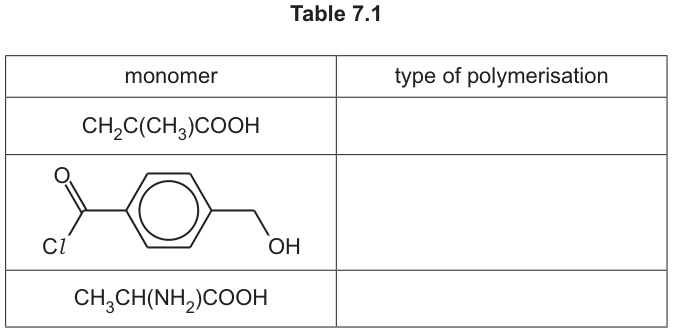
Answer
| Monomer | Type of polymerisation |
|---|---|
| Addition | |
| 4-(chlorocarbonyl)phenylmethanol (benzene ring with and ) | Condensation |
| Condensation |
CH₂C(CH₃)COOH: addition; COCl/CH₂OH benzene: condensation; CH₃CH(NH₂)COOH: condensation
Background Concept
There are two main types of polymerisation:
- Addition polymerisation: monomers with a C=C double bond open up and link together without loss of any small molecule. The repeat unit has the same atoms as the monomer.
- Condensation polymerisation: monomers with two different reactive functional groups (e.g. and , or and , or and ) react together, eliminating a small molecule (usually or ) at each linkage.
Understanding the Question
We must examine each monomer's structure and determine which type of polymerisation it undergoes.
Approach
- Look for a C=C double bond → addition polymerisation.
- Look for two complementary functional groups that can react with elimination of a small molecule → condensation polymerisation.
Step-by-Step Reasoning
Monomer 1:
This molecule contains a C=C double bond (between the and the C). The group is a spectator — it does not participate in the polymerisation. The double bond opens to form the polymer chain. This is addition polymerisation (the monomer is 2-methylpropenoic acid / methacrylic acid).
Monomer 2: Benzene ring with at position 1 and at position 4
This molecule has two different functional groups: an acyl chloride () and a primary alcohol (). These can react with each other (esterification with elimination of ) to form a polyester. Since a small molecule () is eliminated at each linkage, this is condensation polymerisation.
Monomer 3:
This is an amino acid (2-aminopropanoic acid / alanine). It has both an group and a group. These react to form amide (peptide) linkages with elimination of . This is condensation polymerisation (forming a polyamide).
Key Takeaways
- C=C double bond → addition polymerisation (regardless of other groups present).
- Two complementary functional groups (acid + alcohol, acid + amine, acyl chloride + alcohol) → condensation polymerisation.
- A molecule can have a functional group that is NOT involved in the polymerisation (e.g. the in methacrylic acid).
Common Mistakes
- Saying monomer 1 undergoes condensation because it has a group — the C=C double bond is the polymerising feature.
- Saying monomer 2 undergoes addition because it has a benzene ring — the ring is not a C=C that opens; the functional groups react.
- Confusing the presence of any functional group with the ability to condense.
Things to Be Careful About
- The benzene ring is NOT a site for addition polymerisation — it is aromatic and stable.
- For monomer 2, the reacts with (not with the ring), eliminating to form ester links.
Ethanedioic acid, , can react with propane-1,3-diamine, , to form polymer W.
Draw a section of polymer W showing only one repeat unit.
The new functional group formed should be displayed.
Answer
Repeat unit: -CO-CO-NH-CH₂-CH₂-CH₂-NH- with displayed amide linkage and continuation bonds at both ends
Background Concept
Condensation polymerisation between a dicarboxylic acid and a diamine produces a polyamide (nylon-type polymer). At each junction, an group reacts with an group, eliminating and forming an amide linkage . The repeat unit contains the full residue of both monomers minus the eliminated water.
Understanding the Question
Ethanedioic acid () reacts with propane-1,3-diamine (). We must draw ONE repeat unit of the resulting polyamide, with the amide linkage displayed (showing all atoms including the H on N and the =O on C).
Approach
- Identify the two monomers and their reactive groups.
- Determine the linkage: (amide).
- Build the repeat unit by joining the monomer residues through the amide linkage.
- Add continuation bonds (dashed lines) at both ends to show the chain continues.
Step-by-Step Reasoning
M1 — Amide linkage displayed correctly:
The amide group is . The carbonyl carbon must show the double bond to oxygen, and the nitrogen must show its hydrogen. This is the "new functional group" that must be displayed.
M2 — Rest of structure correct with continuation bonds:
- From ethanedioic acid: (two carbonyl carbons remain in the chain).
- From propane-1,3-diamine: (three methylene groups between the two nitrogens).
The repeat unit is:
With continuation bonds (dashed lines) at both ends indicating the polymer chain extends in both directions.
Key Takeaways
- The repeat unit of a polyamide from a diacid + diamine contains: diacid residue + amide link + diamine residue + amide link.
- "Displayed" means showing all atoms explicitly (the H on N, the =O on C).
- Continuation bonds (dashed lines) at both ends are essential to show it is a repeat unit, not a complete molecule.
Common Mistakes
- Drawing the amide as without showing the =O and the H on N (not "displayed").
- Forgetting that ethanedioic acid contributes TWO carbonyl groups to the repeat unit (not just one).
- Drawing two repeat units instead of one.
- Omitting continuation bonds at the ends.
- Using propane-1,2-diamine (wrong isomer) or butane-1,4-diamine (wrong chain length).
Things to Be Careful About
- The question says "only one repeat unit" — do not draw two.
- The amide linkage must be fully displayed (show C=O and N-H).
- Continuation bonds must be present at both ends (dashed lines or open bonds).
- The chain between the two NH groups must have exactly 3 carbons (from propane-1,3-diamine).
Answer
Poly(alkenes) have a backbone of non-polar C-C single bonds, which are chemically inert and very difficult to hydrolyse, so microorganisms cannot break them down.
They have a non-polar C-C backbone that is chemically inert and difficult to hydrolyse.
Background Concept
Biodegradation requires enzymes (produced by microorganisms) to break chemical bonds in the polymer. Enzymes typically catalyse hydrolysis of polar bonds (esters, amides) or oxidation. Poly(alkenes) such as polyethylene and polypropylene have a backbone consisting entirely of C-C single bonds and C-H bonds, which are non-polar and very strong. There is no functional group susceptible to nucleophilic attack or hydrolysis.
Understanding the Question
The command word is "explain" — we need to give the chemical reason for the slow biodegradation, not just state that it is slow.
Approach
Identify the structural feature of poly(alkenes) (non-polar C-C backbone) and explain why this makes them resistant to enzymatic/biological degradation.
Step-by-Step Reasoning
The mark scheme accepts: "chemically inert", "difficult to hydrolyse", or "C-C bonds are non-polar". Any of these captures the key idea.
The C-C backbone bonds are:
- Non-polar → not susceptible to nucleophilic or electrophilic attack.
- Strong (bond enthalpy ~348 kJ mol) → require significant energy to break.
- Not hydrolysable → no functional group (ester, amide) that enzymes can target.
Therefore, microorganisms lack the enzymes to break down poly(alkenes), and they persist in the environment for hundreds of years.
Key Takeaways
- Biodegradability depends on the presence of hydrolysable functional groups (esters, amides) in the polymer backbone.
- Poly(alkenes) lack such groups — their C-C backbone is inert.
- This is why polyesters and polyamides can be designed to be biodegradable, but poly(alkenes) cannot.
Common Mistakes
- Saying "they are too strong" or "too big" without specifying the chemical reason (non-polar C-C bonds, no hydrolysable group).
- Confusing this with the reason for their mechanical strength (which is also C-C bonds but a different context).
Things to Be Careful About
- The answer must reference the chemical nature of the bonds (non-polar, inert, not hydrolysable), not just physical properties.
Compound A is analysed by carbon-13 NMR and proton () NMR spectroscopy.
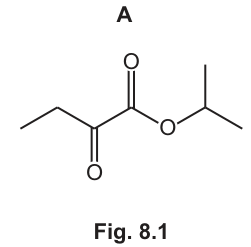
State the reference substance and a solvent that can be used in NMR spectroscopy.
reference ..................................................................................................................................
solvent ......................................................................................................................................
Answer
reference: TMS (tetramethylsilane), (CH_3)_4Si
solvent: CDCl_3 (or D_2O)
Reference: TMS (CH3)4Si; Solvent: CDCl3 (or D2O)
Background Concept
NMR spectroscopy requires a reference compound against which all chemical shifts are measured. Tetramethylsilane (TMS), (CH_3)_4Si, is used as the universal reference because all twelve of its protons (and all four of its carbons) are in identical chemical environments, giving a single sharp peak. Silicon is less electronegative than carbon, so the TMS protons are highly shielded and its signal appears upfield (at δ = 0 ppm). A deuterated solvent must be used because ordinary solvents containing C-H bonds would produce huge solvent peaks that would obscure the sample signals. Deuterium (^2H) is NMR-active at a very different frequency from ^1H and ^13C, so it does not interfere.
Understanding the Question
The question asks for two pieces of standard NMR knowledge: the reference compound and a suitable solvent. No calculation or analysis of compound A is needed here — it is pure recall.
Approach
Recall the two standard pieces of equipment/chemicals used in every NMR experiment: TMS as the external reference and a deuterated solvent such as CDCl_3 or D_2O.
Step-by-Step Reasoning
- Reference: TMS, tetramethylsilane, (CH_3)_4Si. All methyl groups are equivalent, giving one sharp peak at δ = 0 ppm. Any equivalent naming (TMS, tetramethylsilane, (CH_3)_4Si) scores.
- Solvent: Must be deuterated so it does not produce ^1H signals. CDCl_3 (deuteriochloroform) is the most common NMR solvent; D_2O is also acceptable for water-soluble samples.
Key Takeaways
Every NMR spectrum is calibrated against TMS at δ = 0 ppm, and deuterated solvents (CDCl_3, D_2O, etc.) are used to avoid solvent proton interference.
Common Mistakes
- Writing H_2O or CHCl_3 as the solvent — these contain ^1H and would produce large peaks that obscure the sample.
- Naming an organic compound (e.g. ethanol) as the reference — only TMS is accepted.
- Forgetting the state or formula: (CH_3)_4Si is acceptable; writing just "silane" is not.
Things to Be Careful About
- The mark scheme accepts any of: TMS, tetramethylsilane, (CH_3)_4Si. Use one of these exact forms.
- CDCl_3 and D_2O are both acceptable; do not write a non-deuterated solvent.
Answer
6 peaks
6
Background Concept
In ^13C NMR spectroscopy, each chemically distinct carbon environment in a molecule gives rise to one peak. Carbons that are related by symmetry (e.g. the two methyl groups in an isopropyl group) are equivalent and produce a single peak. The number of peaks therefore equals the number of non-equivalent carbon atoms.
Understanding the Question
Compound A is isopropyl 2-oxobutanoate. The skeletal structure is shown in Fig. 8.1. We need to count the number of chemically distinct carbon environments.
Approach
Draw out the full structure, label every carbon, and determine which carbons are in identical environments by considering symmetry and bonding.
Step-by-Step Reasoning
The structure of isopropyl 2-oxobutanoate is:
Labeling the carbons:
- C-4: CH_3 at the end of the ethyl group — bonded to CH_2, then to C=O.
- C-3: CH_2 of the ethyl group — bonded to CH_3 and C=O (ketone).
- C-2: C=O ketone carbonyl — bonded to CH_2 and C=O (ester).
- C-1: C=O ester carbonyl — bonded to C=O (ketone) and O-CH.
- C-5: CH (methine) of the isopropyl group — bonded to O and two CH_3 groups.
- C-6 and C-7: The two CH_3 groups of the isopropyl moiety — these are equivalent by symmetry (both bonded to the same CH, which is bonded to O).
That gives 6 chemically distinct carbon environments, so the ^13C NMR spectrum shows 6 peaks.
Key Takeaways
The number of ^13C NMR peaks equals the number of non-equivalent carbon atoms. Always check for symmetry — equivalent groups (like the two methyls in an isopropyl group) count as one environment.
Common Mistakes
- Counting the two isopropyl methyl carbons as two separate peaks — they are equivalent and give one peak.
- Forgetting that the two carbonyl carbons (ketone and ester) are in different environments and give two separate peaks.
- Saying 7 peaks by treating the two isopropyl methyls as non-equivalent.
Things to Be Careful About
- The two C=O carbons are different: one is a ketone (bonded to C and C), the other is an ester (bonded to C and O). They appear at different chemical shifts.
- Symmetry in the isopropyl group makes the two methyl carbons equivalent.
The proton () NMR spectrum of A shows peaks in four different chemical environments.
Complete Table 8.1 for the proton () NMR spectrum of A.
Table 8.1
| chemical shift / ppm | splitting pattern | number of protons on adjacent carbon atoms | number of atoms responsible for the peak |
|---|---|---|---|
| 1.10 | |||
| 1.50 | 6 | ||
| 2.85 | |||
| 3.75 |
Answer
| chemical shift δ / ppm | splitting pattern | number of protons on adjacent carbon atoms | number of ^1H atoms responsible for the peak |
|---|---|---|---|
| 1.10 | triplet | 2 | 3 |
| 1.50 | doublet | 1 | 6 |
| 2.45 | quartet | 3 | 2 |
| 3.75 | multiplet | 6 | 1 |
(Note: the value 2.45 ppm in the mark scheme corresponds to the CH_2 group; the table in the question shows 2.85, which appears to be a typo.)
See table above
Background Concept
In ^1H NMR spectroscopy, each set of chemically equivalent protons gives a peak. The position of the peak (chemical shift, δ) depends on the electronic environment — protons near electronegative atoms or electron-withdrawing groups are deshielded and appear downfield (higher δ). The splitting pattern follows the n+1 rule: if a proton has n equivalent protons on adjacent carbon atoms, its peak is split into n+1 lines. The area under each peak is proportional to the number of protons in that environment.
Typical chemical shift ranges:
- Alkyl CH_3 / CH_2 (no nearby electronegative atom): δ ≈ 0.8–1.5 ppm
- CH_2 or CH alpha to a carbonyl (C=O): δ ≈ 2.0–2.5 ppm
- CH alpha to an ester oxygen (O-CH): δ ≈ 3.5–4.5 ppm
- CH_3 on an isopropyl group (O-CH(CH_3)_2): δ ≈ 1.2–1.5 ppm
Understanding the Question
Compound A is isopropyl 2-oxobutanoate: CH_3-CH_2-C(=O)-C(=O)-O-CH(CH_3)_2. The ^1H NMR spectrum shows four peaks at δ = 1.10, 1.50, 2.45 (question shows 2.85, mark scheme uses 2.45), and 3.75 ppm. We must fill in the splitting pattern, the number of adjacent protons, and the number of protons giving rise to each peak.
Approach
- Draw the full structure and label all proton environments.
- Match each chemical shift to the appropriate environment based on deshielding effects.
- For each environment, count the protons in that group and the protons on adjacent carbons to determine the splitting pattern using the n+1 rule.
Step-by-Step Reasoning
Step 1: Identify the four proton environments.
- (a) CH_3 of the ethyl group: 3 protons, adjacent to CH_2 (2 protons)
- (b) CH_2 of the ethyl group: 2 protons, adjacent to CH_3 (3 protons), alpha to C=O
- (c) CH of the isopropyl group: 1 proton, adjacent to 2 × CH_3 (6 protons), alpha to O
- (d) 2 × CH_3 of the isopropyl group: 6 protons (equivalent), adjacent to CH (1 proton)
Step 2: Assign chemical shifts.
- δ = 1.10 ppm: The CH_3 of the ethyl group (a). This is a simple alkyl methyl with no strong deshielding. → 3H, adjacent to 2H → triplet (2+1=3)
- δ = 1.50 ppm: The two equivalent CH_3 groups of the isopropyl moiety (d). Slightly deshielded by the nearby oxygen through the CH. → 6H, adjacent to 1H → doublet (1+1=2)
- δ = 2.45 ppm: The CH_2 group (b). Alpha to a carbonyl group (C=O), which deshields these protons. → 2H, adjacent to 3H → quartet (3+1=4)
- δ = 3.75 ppm: The CH group (c) of the isopropyl ester. Directly bonded to oxygen through the ester linkage, causing significant deshielding. → 1H, adjacent to 6H → multiplet (6+1=7, a septet, but often described as a multiplet at this level)
Step 3: Fill in the table.
| δ / ppm | splitting | adjacent H | number of H |
|---|---|---|---|
| 1.10 | triplet | 2 | 3 |
| 1.50 | doublet | 1 | 6 |
| 2.45 | quartet | 3 | 2 |
| 3.75 | multiplet | 6 | 1 |
Verification: Total protons = 3 + 6 + 2 + 1 = 12. The molecular formula of isopropyl 2-oxobutanoate is C_7H_12O_3, which has 12 hydrogen atoms. ✓
Key Takeaways
- Match chemical shifts to environments using deshielding trends: O-CH > CH_2-C=O > alkyl CH_3/CH_2.
- Apply the n+1 rule: count protons on adjacent carbons only (not on the same carbon).
- The total number of protons across all peaks must equal the molecular formula count.
- A septet (7 peaks) from 6 adjacent equivalent protons is often accepted as "multiplet" at A-Level.
Common Mistakes
- Assigning the CH_2 (2H) to δ = 1.50 ppm — the CH_2 is alpha to a carbonyl and should appear further downfield (~2.45 ppm), not at 1.50.
- Saying the isopropyl CH gives a triplet — it has 6 adjacent protons, so it is a septet/multiplet.
- Counting the two isopropyl methyl groups as separate environments — they are equivalent and give one peak of 6H.
- Forgetting that the ester oxygen deshields the CH proton significantly (δ ≈ 3.75 ppm), placing it furthest downfield.
- Writing "septet" instead of "multiplet" for the isopropyl CH — both are acceptable, but the mark scheme accepts multiplet.
Things to Be Careful About
- The question table shows 2.85 ppm for the CH_2 peak, but the mark scheme uses 2.45 ppm. This is a known typo in this paper. Use 2.45 as per the mark scheme.
- The splitting for the isopropyl CH (6 adjacent H) is technically a septet, but "multiplet" is the accepted answer at this level.
- Always verify that the total number of protons sums to the correct molecular formula count (12 for C_7H_12O_3).
The structures of the amino acids serine and lysine are shown in Fig. 9.1.
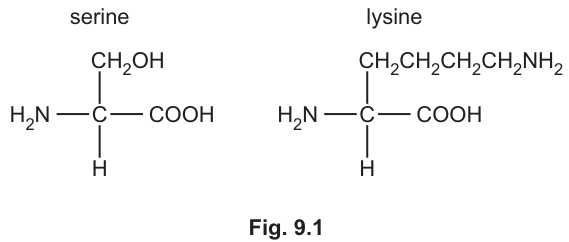
Draw the structure for the dipeptide, ser–lys, with molecular formula .
The peptide functional group formed should be displayed.
Answer
The peptide bond forms between the carboxyl group of serine and the amino group of lysine:
Structure:
Molecular formula: ✓
See diagram: H₂N-CH(CH₂OH)-CO-NH-CH(CH₂CH₂CH₂CH₂NH₂)-COOH with displayed peptide bond
Background Concept
Amino acids contain both an amino group () and a carboxyl group () attached to the same -carbon. When two amino acids join, a condensation reaction occurs between the carboxyl group of one and the amino group of the other, eliminating water and forming a peptide (amide) bond: . In a dipeptide written as 'ser–lys', serine is the N-terminal residue (its carboxyl reacts) and lysine is the C-terminal residue (its amino reacts). The remaining free amino group (on serine) and free carboxyl group (on lysine) define the termini.
Understanding the Question
The question gives the structures of serine and lysine and asks for the dipeptide ser–lys. The molecular formula confirms one water molecule has been lost (serine + lysine − = ). The peptide functional group must be displayed (showing the C=O and N-H explicitly).
Approach
- Identify which groups react: serine's COOH + lysine's α-NH₂.
- Draw the backbone: serine residue on the left (with free NH₂), peptide bond in the middle, lysine residue on the right (with free COOH).
- Include the side chains: serine has ; lysine has .
- Display the peptide bond fully (C=O and N-H shown).
Step-by-Step Reasoning
- Serine:
- Lysine:
- The COOH of serine loses and the α-NH₂ of lysine loses , forming .
- The resulting bond is (the peptide/amide link).
- The full structure is:
The mark scheme also accepts lys–ser (the reverse orientation), as long as the peptide bond is correctly displayed between the α-carboxyl of one and the α-amino of the other.
Key Takeaways
- In a dipeptide 'X–Y', X is the N-terminal residue and Y is the C-terminal residue.
- The peptide bond must be drawn as a displayed amide group (C=O and N-H shown explicitly).
- The side chains of both amino acids remain unchanged.
Common Mistakes
- Reacting the wrong amino group: lysine has two groups (α-amino and ε-amino on the side chain). The peptide bond forms with the α-amino group, not the side-chain amino.
- Not displaying the peptide bond (writing it as in condensed form without showing the C=O and N-H).
- Forgetting the free COOH on the C-terminal residue or the free NH₂ on the N-terminal residue.
Things to Be Careful About
- The molecular formula given () serves as a check: count all atoms in your drawn structure to confirm.
- Ensure the side chain of serine and the side chain of lysine are both present and correctly positioned.
The isoelectric point of serine is 5.7 and of lysine is 9.7.
Answer
The isoelectric point is the pH at which a molecule has no overall (net) charge.
The pH at which a molecule has no overall/net charge
Background Concept
Amino acids are amphoteric: they contain both a basic amino group and an acidic carboxyl group. In aqueous solution, they exist as zwitterions (dipolar ions) with a protonated and a deprotonated . The isoelectric point (pI) is the specific pH at which the molecule carries no net electrical charge — the positive and negative charges balance exactly. At pH values below the pI, the molecule has a net positive charge (more groups protonated); at pH values above the pI, it has a net negative charge.
Understanding the Question
The command word is 'state', so a concise definition is required. The question gives the pI values of serine (5.7) and lysine (9.7) as context for the subsequent electrophoresis part.
Approach
Provide the standard definition: the pH at which the molecule has no net/overall charge.
Step-by-Step Reasoning
The mark scheme requires: 'pH at which a molecule has no overall charge / no net charge'. This is a direct definition — no calculation or reasoning needed. The key phrase is 'no overall charge' or 'no net charge'. Simply saying 'the pH where it is neutral' may be accepted but 'no overall/net charge' is the precise wording.
Key Takeaways
- The isoelectric point is defined by the absence of net charge, not by the absence of any charge (the molecule may still be a zwitterion with equal positive and negative charges).
- At the pI, the molecule does not migrate in an electric field.
Common Mistakes
- Saying 'the pH at which the amino acid is neutral' without specifying 'net' or 'overall' charge — this is ambiguous because a zwitterion has charges but no net charge.
- Confusing pI with the pH of a neutral solution (pH 7).
Things to Be Careful About
- Use the word 'overall' or 'net' to indicate that individual charges may exist but they sum to zero.
A mixture of serine, lysine and ser–lys is analysed by electrophoresis using a buffer at pH 5.7.
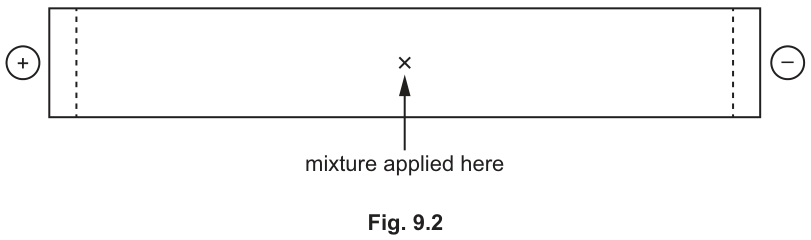
Draw and label three spots on Fig. 9.2 to indicate the predicted position of each of these three species, serine, lysine and ser–lys, after electrophoresis.
Explain your answer.
Answer
- Serine: remains at the origin (x mark). At pH 5.7 = its pI, serine is a zwitterion with no net charge, so it does not migrate.
- Lysine: moves furthest toward the negative electrode. At pH 5.7 (below its pI of 9.7), lysine is positively charged and migrates to the cathode. It moves the fastest/furthest because it has a lower (smaller size) than ser–lys.
- Ser–lys: moves toward the negative electrode but less than lysine. The dipeptide has a net positive charge at pH 5.7 (the free amino groups are protonated while the carboxyl is deprotonated, giving overall positive charge), but it is larger (higher ) so it migrates more slowly.
Ser at origin (no net charge at pI); lys moves furthest toward negative electrode (positive charge, smaller Mr); ser-lys moves moderately toward negative electrode (positive charge, larger Mr)
Background Concept
Electrophoresis separates charged species based on their migration in an electric field. The direction of migration depends on the net charge of the species: positively charged species move toward the cathode (negative electrode), negatively charged species move toward the anode (positive electrode), and species with no net charge remain at the origin. The distance migrated depends on both the magnitude of the charge and the size/mass of the molecule — smaller molecules with the same charge migrate faster and further.
The isoelectric point (pI) is the pH at which a molecule has zero net charge. When the buffer pH equals the pI, the molecule is a zwitterion with no net charge and does not migrate. When the buffer pH is below the pI, the molecule is protonated and carries a net positive charge. When the buffer pH is above the pI, the molecule is deprotonated and carries a net negative charge.
Understanding the Question
The buffer is at pH 5.7. We must determine the charge on each species (serine, lysine, ser–lys) at this pH and predict their positions after electrophoresis. Fig. 9.2 shows the electrophoresis strip with the positive electrode on the left and the negative electrode on the right, with the mixture applied at the central mark 'x'.
Approach
- Compare each species' pI to the buffer pH to determine its net charge.
- Predict migration direction based on charge.
- For species migrating in the same direction, compare distances based on molecular size.
Step-by-Step Reasoning
Serine (pI = 5.7): The buffer pH (5.7) equals the pI of serine. At this pH, serine exists as a zwitterion with no net charge. It will not migrate and remains at the origin (the 'x' mark).
Lysine (pI = 9.7): The buffer pH (5.7) is well below the pI (9.7). At pH 5.7, the amino groups of lysine (both α-NH₂ and ε-NH₂) are protonated to NH₃⁺, while the carboxyl group is COO⁻. The net charge is positive. Lysine migrates toward the negative electrode (right side of the diagram).
Ser–lys dipeptide: The dipeptide has a free α-NH₂ (from serine, N-terminus), a free COOH (from lysine, C-terminus), and a side-chain NH₂ (from lysine). At pH 5.7, both amino groups are protonated (+1 each = +2) and the carboxyl is deprotonated (−1), giving a net charge of +1. The dipeptide is positively charged and migrates toward the negative electrode.
Relative distances: Both lysine and ser–lys are positively charged and move toward the negative electrode. However, lysine has a lower (146) than ser–lys (233), so lysine migrates faster and further. The order from origin toward the negative electrode is: ser (at origin) < ser–lys (moderate migration) < lys (furthest migration).
Key Takeaways
- At pH = pI, a molecule has no net charge and does not migrate in electrophoresis.
- At pH < pI, the molecule is positively charged and moves toward the cathode.
- At pH > pI, the molecule is negatively charged and moves toward the anode.
- Among species with the same charge sign, smaller molecules (lower ) migrate further in a given time.
Common Mistakes
- Placing serine at the wrong position — it must stay at the origin because pH = pI.
- Forgetting that ser–lys also has a net positive charge (due to the extra side-chain NH₂ of lysine) and placing it at the origin or toward the positive electrode.
- Not explaining WHY lysine moves further than ser–lys (the size/ argument is required for M3).
- Drawing spots on the positive side — both lysine and ser–lys are positive at pH 5.7.
Things to Be Careful About
- The explanation must include both the charge reasoning AND the size reasoning for the relative positions of lys and ser–lys.
- The mark scheme requires three separate points: correct positions (M1), ser not moving as zwitterion OR lys/ser-lys moving to negative as positive (M2), and lys moving furthest due to lower Mr (M3).
Fig. 9.3 shows the synthesis of compound R from compound P.
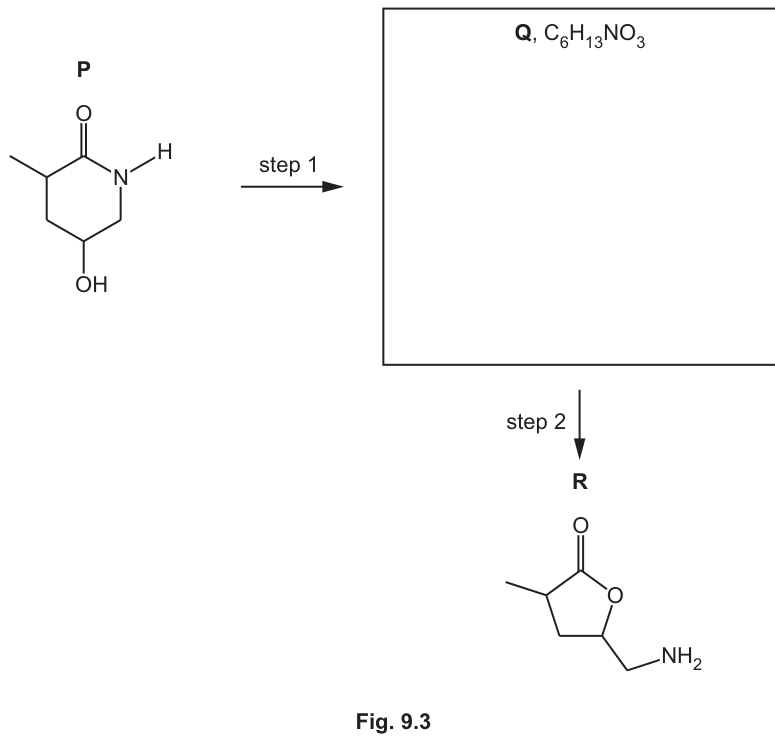
Answer
Step 1 hydrolyses the lactam (cyclic amide) bond, opening the ring to give the amino acid:
Structure:
Molecular formula: ✓
HOOC-CH(CH₃)-CH₂-CH(OH)-CH₂-NH₂ (C₆H₁₃NO₃)
Background Concept
Lactams are cyclic amides. Hydrolysis of a lactam (under acidic conditions with heating) cleaves the C–N amide bond, opening the ring to give an amino acid — a molecule containing both a free carboxylic acid group and a free amino group. The amide bond is between the carbonyl carbon and the nitrogen; hydrolysis adds water across this bond, regenerating the COOH and NH₂ groups.
Understanding the Question
Compound P is a six-membered ring lactam (a piperidin-2-one derivative) with a methyl group on the carbon adjacent to the carbonyl, a hydroxyl group on another ring carbon, and an NH in the ring. Step 1 converts P to Q (C₆H₁₃NO₃), which must be the ring-opened hydrolysis product. The molecular formula of Q has 6 carbons (same as the ring) and 3 oxygens (the original C=O becomes COOH, plus the existing OH), confirming hydrolysis of the amide bond.
Approach
- Identify the amide bond in P: the C=O bonded to N-H in the ring.
- Cleave this bond by adding H₂O: the carbonyl carbon becomes COOH, the nitrogen becomes NH₂.
- Draw the resulting open-chain structure, keeping the methyl and hydroxyl substituents in their correct positions.
- Verify the molecular formula matches C₆H₁₃NO₃.
Step-by-Step Reasoning
Starting from P (reading the ring): the carbonyl carbon is bonded to CH(CH₃), which is bonded to CH₂, which is bonded to CH(OH), which is bonded to CH₂, which is bonded to NH (closing the ring back to the carbonyl).
On hydrolysis, the C(=O)–NH bond breaks:
- The carbonyl carbon gains –OH to become COOH.
- The nitrogen gains an H to become NH₂.
The open-chain product is: HOOC–CH(CH₃)–CH₂–CH(OH)–CH₂–NH₂
Verification: C = 1+1+1+1+1+1 = 6 ✓; H = 1+1+3+2+1+1+2+2 = 13 ✓; N = 1 ✓; O = 2+1 = 3 ✓
Key Takeaways
- Lactam hydrolysis opens the ring to give an amino acid.
- The positions of substituents (methyl, hydroxyl) on the carbon chain are preserved from the ring structure.
- Always verify the molecular formula of the drawn product against the given value.
Common Mistakes
- Drawing the wrong connectivity — placing the NH₂ on the wrong carbon or the OH in the wrong position.
- Forgetting that the carbonyl becomes a carboxylic acid (COOH) rather than remaining as an aldehyde or ketone.
- Not including the hydrogen on the nitrogen (writing –NH₂ rather than –NH– or leaving it as part of a ring).
Things to Be Careful About
- The ring numbering must be followed carefully to place the methyl and hydroxyl groups on the correct carbons in the open-chain structure.
- The molecular formula C₆H₁NO₃ is a useful check — if your structure doesn't match, you have an error.
State the reagents and conditions for steps 1 and 2 in Fig. 9.3.
step 1 ................................................................................................................................
step 2 ................................................................................................................................
Answer
Step 1: Aqueous (or ) and heat/reflux.
Step 2: Concentrated (catalyst) and heat.
Step 1: aqueous HCl (or H₂SO₄) and heat/reflux; Step 2: concentrated H₂SO₄ catalyst and heat
Background Concept
Amide hydrolysis requires vigorous conditions because the amide bond is relatively stable. Under acidic conditions (aqueous HCl or H₂SO₄ with heating/reflux), the amide is protonated and water attacks the carbonyl carbon, ultimately giving a carboxylic acid and an ammonium ion (which on workup gives the free amine). This is the standard method for hydrolysing lactams to amino acids.
Esterification (formation of an ester from a carboxylic acid and an alcohol) is catalysed by concentrated sulfuric acid and requires heating. In this case, the reaction is intramolecular — the –OH group and the –COOH group within the same molecule (compound Q) react to form a cyclic ester (lactone, compound R). Concentrated H₂SO₄ acts as an acid catalyst and also as a dehydrating agent, removing the water produced and driving the equilibrium toward the ester.
Understanding the Question
Step 1 converts the cyclic amide (lactam) P to the open-chain amino acid Q — this is amide hydrolysis. Step 2 converts Q (which contains both –COOH and –OH groups) to the cyclic ester (lactone) R — this is intramolecular esterification.
Approach
For step 1: recall the conditions for acidic hydrolysis of an amide.
For step 2: recall the conditions for Fischer esterification (acid + alcohol → ester + water).
Step-by-Step Reasoning
Step 1 (lactam → amino acid): This is hydrolysis of an amide bond. The required conditions are aqueous acid (HCl or H₂SO₄) with heating under reflux. The water adds across the C–N bond, breaking the ring and giving the open-chain amino acid Q.
Step 2 (amino acid → lactone): This is an intramolecular esterification between the –COOH and –OH groups of Q. The conditions are concentrated H₂SO₄ as an acid catalyst with heating. The –OH of the hydroxyl group attacks the protonated carbonyl of the carboxyl group, water is eliminated, and a five-membered ring lactone (R) is formed.
Key Takeaways
- Amide hydrolysis requires aqueous acid (or base) and heat/reflux — it does not occur under mild conditions.
- Esterification requires an acid catalyst (concentrated H₂SO₄) and heat.
- Intramolecular esterification forms lactones (cyclic esters).
Common Mistakes
- For step 1, writing just 'HCl' without specifying aqueous and heat/reflux — both the aqueous medium and the heating are required for the mark.
- For step 2, writing dilute H₂SO₄ instead of concentrated — the concentrated acid is needed both as catalyst and to remove water.
- Confusing step 1 with reduction (which would give an amine, not a hydrolysis product).
Things to Be Careful About
- Step 1 requires BOTH 'aqueous' AND an acid AND 'heat/reflux' — all three elements are needed for the mark.
- Step 2 requires BOTH 'concentrated H₂SO₄' AND 'heat' — the catalyst alone or heat alone is insufficient.