Chemistry 9701/41 — May/June 2025
Cambridge A-Level · A Level Structured Questions · worked solutions for every part, with the mark scheme
Topics Transition Elements · Hydrocarbons · Carboxylic Acids and Derivatives · Group 2 · Reaction Kinetics · Equilibria · +6 more
Both calcium carbonate, , and barium carbonate, , decompose when heated to form the metal oxide and a gas.
Answer
CaCO3(s) -> CaO(s) + CO2(g)
Background Concept
Calcium carbonate is a Group 2 carbonate. When heated, Group 2 carbonates decompose thermally to give the metal oxide and carbon dioxide gas. The general equation is . This is a thermal decomposition reaction.
Understanding the Question
This part asks for the balanced symbol equation for the decomposition of calcium carbonate. The reactants and products are given in the stem: calcium carbonate decomposes to the metal oxide and a gas. The metal oxide is CaO and the gas is CO2.
Approach
Write the formula of calcium carbonate, then replace the carbonate group with oxide, and add carbon dioxide. Balance if necessary. Include state symbols.
Step-by-Step Reasoning
- Calcium carbonate has the formula .
- On heating, it loses carbon dioxide to form calcium oxide.
- The equation is .
- The equation is already balanced: one Ca, one C, three O on each side.
- State symbols: CaCO3 and CaO are solids; CO2 is a gas.
Key Takeaways
- All Group 2 carbonates decompose on heating to the oxide and CO2.
- The balanced equation must show correct formulae and state symbols.
Common Mistakes
- Forgetting state symbols: the mark scheme often accepts without, but including them is good practice.
- Writing CaO2 instead of CaO.
- Unbalanced equation.
Things to Be Careful About
- Use correct formulae: CaCO3, CaO, CO2.
- Include state symbols if asked or for good practice.
- The gas is CO2, not CO or O2.
State which of and decomposes at a lower temperature.
Explain your answer.
The compound that decomposes at a lower temperature is ...................................................
explanation ...............................................................................................................................
Answer
Calcium carbonate decomposes at a lower temperature.
The ion is smaller than (ionic radius increases down Group 2), so has a higher charge density and polarises the carbonate ion, , more strongly. This distorts the carbonate ion and weakens its C–O bonds, making thermally less stable, so it decomposes at a lower temperature.
Calcium carbonate decomposes at a lower temperature; Ca2+ is smaller and polarises CO3^2- more strongly.
Background Concept
The thermal stability of Group 2 carbonates depends on the polarising power of the metal cation. A cation with a high charge density (small radius, high charge) can distort the electron cloud of the large carbonate anion, . This distortion weakens the C–O bonds, making it easier for the carbonate to decompose on heating to the oxide and .
Understanding the Question
This part asks you to state which of calcium carbonate and barium carbonate decomposes at a lower temperature, and to explain why. The explanation must compare the sizes of the cations and relate this to polarisation of the carbonate ion.
Approach
Recall that down Group 2, the ionic radius increases, so the charge density of the cation decreases. A lower charge density means less polarisation of the carbonate ion, so the carbonate is more thermally stable and decomposes at a higher temperature. Therefore, the smaller cation (Ca2+) gives a less stable carbonate that decomposes at a lower temperature.
Step-by-Step Reasoning
- Ca is above Ba in Group 2, so Ca2+ is smaller than Ba2+.
- Ionic radius increases down the group: .
- Since Ca2+ is smaller, it has a higher charge density and is a stronger polarising agent.
- The carbonate ion is large and polarisable; the Ca2+ ion distorts the electron cloud of more than Ba2+ does.
- This distortion weakens the C–O bonds, so less thermal energy is needed to break them and release .
- Hence CaCO3 decomposes at a lower temperature than BaCO3.
Key Takeaways
- Down Group 2, thermal stability of carbonates increases because cation polarising power decreases.
- The explanation must mention both the smaller cation and the greater polarisation/distortion of the carbonate ion.
Common Mistakes
- Saying that CaCO3 is less stable because Ca is more reactive – this is not the reason.
- Confusing ionic radius trend: it increases down the group, not decreases.
- Omitting the effect on the carbonate ion (distortion/polarisation).
Things to Be Careful About
- Use precise terms: 'polarise', 'distort', 'charge density'.
- The mark scheme requires both the comparison of cation size and the effect on the carbonate ion.
- Do not say 'Ca2+ is bigger' – it is smaller.
Calcium oxide, , reacts with water to form compound A.
Barium oxide, , reacts with water to form compound B.
Answer
A is calcium hydroxide, .
Ca(OH)2 (calcium hydroxide)
Background Concept
Group 2 metal oxides are basic oxides. They react with water to form the corresponding metal hydroxide. For example, calcium oxide (quicklime) reacts with water to form calcium hydroxide (slaked lime).
Understanding the Question
The stem states that CaO reacts with water to form compound A, and BaO reacts with water to form compound B. This part asks you to identify A, the product from calcium oxide.
Approach
Recall the reaction of a Group 2 oxide with water: . For calcium, A is calcium hydroxide.
Step-by-Step Reasoning
- Calcium oxide is CaO.
- It reacts with water: .
- The product is calcium hydroxide, .
- Similarly, barium oxide would give barium hydroxide, , which is compound B.
Key Takeaways
- Group 2 oxides are basic and form hydroxides with water.
- The formula of the hydroxide reflects the +2 charge of the metal ion: .
Common Mistakes
- Writing CaOH instead of Ca(OH)2.
- Confusing oxide with hydroxide.
Things to Be Careful About
- The formula must include the bracket: Ca(OH)2, not CaOH2.
- State symbols are not required but can be included.
Answer
A (calcium hydroxide) is less soluble than B (barium hydroxide) because is smaller than , so both the lattice enthalpy and the hydration enthalpy of are more exothermic than those of . However, the difference in lattice enthalpy is greater than the difference in hydration enthalpy, so the overall enthalpy change of solution, , is less exothermic for than for . A less exothermic makes dissolving less favourable, so is less soluble.
A is Ca(OH)2; less soluble because its ΔH_sol is less exothermic than Ba(OH)2 due to greater difference in lattice enthalpy than hydration enthalpy.
Background Concept
The solubility of an ionic compound in water depends on the enthalpy change of solution, . This is the enthalpy change when one mole of the compound dissolves in water. It can be considered as the sum of two contributions:
- Lattice enthalpy, : the enthalpy change when one mole of the solid lattice forms from its gaseous ions. This is exothermic (negative) for the formation of the lattice.
- Hydration enthalpy, : the enthalpy change when gaseous ions are hydrated (surrounded by water molecules). This is also exothermic (negative).
Thus (using the convention that lattice enthalpy is exothermic). A more exothermic (more negative) makes dissolving more energetically favourable and generally leads to greater solubility.
Understanding the Question
This part asks why calcium hydroxide (A) is less soluble than barium hydroxide (B). You need to compare the lattice and hydration enthalpies of the two compounds and explain how the difference affects the enthalpy of solution.
Approach
Use the relationship . Compare the ionic radii of Ca2+ and Ba2+. Since Ca2+ is smaller, both lattice and hydration enthalpies are more exothermic for Ca(OH)2. However, the key is that the lattice enthalpy difference is larger than the hydration enthalpy difference, so the net is less exothermic for Ca(OH)2, making it less soluble.
Step-by-Step Reasoning
- Ca2+ is smaller than Ba2+ (ionic radius increases down Group 2).
- A smaller cation has a higher charge density, so it attracts the anion more strongly in the lattice and attracts water molecules more strongly during hydration.
- Therefore, both and are more exothermic (more negative) for Ca(OH)2 than for Ba(OH)2.
- However, the magnitude of the difference in lattice enthalpy is greater than the magnitude of the difference in hydration enthalpy. This is because lattice enthalpy depends on the close approach of cation and anion in the solid, while hydration enthalpy involves the interaction of the cation with water molecules and is somewhat less sensitive to the cation size.
- As a result, when you add and to get , the less exothermic lattice term dominates, so for Ca(OH)2 is less exothermic (more positive) than for Ba(OH)2.
- A less exothermic means the dissolving process is less energetically favourable, so Ca(OH)2 is less soluble.
Key Takeaways
- Down Group 2, the solubility of hydroxides increases (e.g. Mg(OH)2 is sparingly soluble, Ba(OH)2 is more soluble).
- The trend is explained by the balance between lattice and hydration enthalpies.
- Always compare the differences in lattice and hydration enthalpies, not just their individual signs.
Common Mistakes
- Saying that Ca(OH)2 is less soluble because its lattice enthalpy is more exothermic – this would suggest it is more soluble; you must consider the difference.
- Forgetting that hydration enthalpy is also more exothermic for the smaller ion.
- Confusing the sign convention: in some contexts lattice enthalpy is endothermic (breaking the lattice). Here the mark scheme uses the exothermic convention (formation of lattice).
- Not mentioning that the lattice enthalpy difference is greater than the hydration enthalpy difference.
Things to Be Careful About
- Use the correct sign convention: more exothermic means more negative.
- The mark scheme awards separate marks for (i) both enthalpies more exothermic, (ii) lattice difference greater, (iii) enthalpy of solution less exothermic.
- Ensure you state that A is calcium hydroxide and B is barium hydroxide if you refer to them.
- No need to calculate numerical values; a qualitative explanation is sufficient.
Three experiments are carried out to investigate the reaction of nitrogen oxide, , with chlorine.
The rate equation for this reaction is shown.
Under the conditions used in experiments 1 and 2, the value of is 26.4.
Answer
The overall order is 3, so the units of are .
mol^-2 dm^6 s^-1
Background Concept
A rate equation shows how the rate of a reaction depends on the concentrations of the reactants. The rate constant, , is the proportionality constant, and its units must make the two sides of the equation dimensionally consistent. Since rate is measured in and each concentration term has units , the units of depend on the overall order of the reaction.
Understanding the Question
The rate equation is . The overall order is . The question asks for the units of when rate is expressed in .
Approach
Use the general relationship: units of . Substitute the overall order 3.
Step-by-Step Reasoning
From the rate equation, . Therefore the units are:
Equivalently, the general formula with gives .
Key Takeaways
The units of are determined by the overall order of the reaction. For overall order 3, the units are . Always check dimensional consistency.
Common Mistakes
A common error is to give the units of rate, , instead of the units of . Another is to use the stoichiometric coefficients rather than the orders from the rate equation.
Things to Be Careful About
Use the overall order from the rate equation, not from the balanced equation. Pay attention to negative exponents and the order of dm and mol in the final units.
In experiment 1, the initial concentrations of and are equal.
The initial rate of the reaction in experiment 1 is .
Calculate the initial concentration of .
Show your working.
Working
Let .
Answer
4.60 x 10^-3 mol dm^-3
Background Concept
The rate equation allows calculation of an unknown concentration when the rate and are known. If two concentrations are equal, they can be represented by a single variable.
Understanding the Question
In experiment 1, . The initial rate is and . We need to find .
Approach
Substitute for both concentrations in the rate equation, solve for , then take the cube root.
Step-by-Step Reasoning
Since , the rate equation becomes:
Divide both sides by 26.4:
Taking the cube root:
This is the initial concentration of .
Key Takeaways
When concentrations are equal, combine them into one variable. The cube root is needed because the reaction is third order overall under these conditions.
Common Mistakes
Using instead of ; forgetting to take the cube root after dividing; giving the answer without units.
Things to Be Careful About
The final answer should be given to 3 significant figures to match the data. Include the unit .
In experiment 2, the initial concentrations of and are both ten times greater than the initial concentrations used in experiment 1.
Calculate the initial rate of the reaction in experiment 2.
Working
Both concentrations are multiplied by 10, so the rate is multiplied by .
Answer
2.57 x 10^-3 mol dm^-3 s^-1
Background Concept
In a rate equation, the order with respect to each reactant tells how the rate changes when that concentration changes. Here rate .
Understanding the Question
Experiment 2 uses initial concentrations of both and that are 10 times greater than in experiment 1. The rate constant is unchanged. We need the new initial rate.
Approach
Use the ratio method: multiply the original rate by the factor arising from each concentration change.
Step-by-Step Reasoning
Multiplying by 10 increases the rate by . Multiplying by 10 increases the rate by . The combined factor is . Therefore:
Key Takeaways
The order with respect to each reactant determines the factor by which the rate changes. A 10-fold increase in a second-order reactant gives a 100-fold rate increase.
Common Mistakes
Only applying the factor to one reactant; using for both reactants; forgetting that is first order.
Things to Be Careful About
Keep the units . The rate constant does not need to be recalculated because the conditions are the same as experiment 1.
Experiment 3 uses a large excess of .
The initial concentration of is .
The graph of against time shows that the reaction has a constant half-life, .
Explain this observation.
Answer
With a large excess of , is effectively constant, so the rate equation becomes (pseudo first order). A first-order reaction has a constant half-life.
Pseudo first order; constant half-life because reaction is first order with respect to Cl2.
Background Concept
When one reactant is present in large excess, its concentration changes very little during the reaction and can be treated as constant. The rate equation then becomes first order in the other reactant; this is called pseudo first order. A first-order reaction has a half-life that is independent of concentration, so the half-life is constant.
Understanding the Question
Experiment 3 uses a large excess of . The graph of against time shows a constant half-life. We need to explain why.
Approach
Show that the rate equation reduces to and that constant half-life is the signature of first-order kinetics.
Step-by-Step Reasoning
With in large excess, is effectively constant throughout the reaction. The rate equation becomes:
where is a pseudo first-order rate constant. The reaction is first order with respect to . For a first-order reaction, , which does not depend on the initial concentration of . Hence each successive half-life is the same, giving a constant half-life on the graph.
Key Takeaways
A large excess of one reactant creates pseudo first-order conditions. Constant half-life is diagnostic of first-order kinetics.
Common Mistakes
Saying the reaction is zero order in ; saying is zero; not mentioning that the concentration of is effectively constant.
Things to Be Careful About
Use the phrase “pseudo first order” and make clear that the order with respect to is first order.
Under the conditions used in experiment 3, the value of the rate constant is 105.6.
Show that of is under these conditions.
Working
For a first-order reaction, .
Answer
6.56 x 10^-3 s
Background Concept
For a first-order reaction, the half-life is given by , where is the first-order rate constant. It is independent of the initial concentration.
Understanding the Question
In experiment 3, with in excess, the reaction is pseudo first order with respect to . The rate constant under these conditions is . We need to show that .
Approach
Substitute the given value of into the first-order half-life formula.
Step-by-Step Reasoning
This matches the required value.
Key Takeaways
The first-order half-life formula is . It is quick to apply when the pseudo first-order rate constant is known.
Common Mistakes
Using instead of ; using ; forgetting that the unit of is .
Things to Be Careful About
The rate constant is the pseudo first-order rate constant under the conditions of experiment 3, not the original from experiments 1 and 2.
Working
falls from to , a factor of 16, i.e. 4 half-lives.
Answer
2.62 x 10^-2 s
Background Concept
In a first-order decay, after half-lives the concentration is reduced by a factor of . The time required is .
Understanding the Question
The initial is and we want the time for it to fall to . The half-life is .
Approach
Find the ratio of initial to final concentration, express it as a power of 2, and multiply the half-life by that number.
Step-by-Step Reasoning
So four half-lives are needed:
Equivalently, using the integrated first-order law: .
Key Takeaways
Half-life reasoning is efficient when the concentration ratio is a power of 2. The integrated rate law is a general alternative.
Common Mistakes
Counting three half-lives instead of four; forgetting to multiply by the half-life; using the wrong initial concentration.
Things to Be Careful About
Give the final answer as or with the correct unit.
Sulfur dioxide, , reacts very slowly with oxygen in the atmosphere, forming sulfur trioxide, . This reaction is much faster in the presence of .
Explain the role of in this process.
Include chemical equations in your answer.
Answer
acts as a homogeneous catalyst. It provides an alternative route with a lower activation energy and is regenerated.
Homogeneous catalyst; 2NO + O2 -> 2NO2; NO2 + SO2 -> NO + SO3
Background Concept
A catalyst increases the rate of a reaction by providing an alternative pathway with a lower activation energy. It is chemically unchanged at the end of the reaction, so it is regenerated. A homogeneous catalyst is in the same physical state as the reactants.
Understanding the Question
The reaction is slow in the atmosphere but faster in the presence of . We need to explain the role of and include equations.
Approach
Recognise that is a homogeneous catalyst. Write a two-step cycle in which is first consumed to form an intermediate, then regenerated in the second step.
Step-by-Step Reasoning
In the first step, reacts with oxygen:
In the second step, the formed oxidises :
Adding the two steps (with the second doubled) gives the overall reaction , and is regenerated. Because is not used up overall and provides a lower-energy pathway, it acts as a homogeneous catalyst.
Key Takeaways
A catalyst is regenerated in the reaction. Writing a catalytic cycle with balanced equations shows how the catalyst is consumed and reformed.
Common Mistakes
Saying is a reactant and is consumed; writing unbalanced equations; omitting from the first step; calling a heterogeneous catalyst.
Things to Be Careful About
Both equations must be balanced. The intermediate is formed and then consumed, while is regenerated.
Chromium(III) hydroxide, , is only slightly soluble in water. The value of the solubility product, , of is at 298 K.
Answer
Units:
Ksp = [Cr3+][OH-]^3; units: mol^4 dm^-12
Background Concept
The solubility product, , is the equilibrium constant for the dissolution of a sparingly soluble ionic solid in water. For a general salt that dissolves as
the solubility product is
The solid itself is not included in the expression because its concentration is constant (it is a pure phase). The units of depend on the total power of the concentration terms.
Understanding the Question
This part asks you to write the expression for chromium(III) hydroxide and give its units. It is a recall task: no calculation is needed. The key is to translate the formula into the correct stoichiometry of dissolution and to combine the units correctly.
Approach
- Write the dissolution equilibrium for .
- Write the product of the ion concentrations, raising each to the power equal to its stoichiometric coefficient.
- Multiply the units of each concentration term to get the units of .
Step-by-Step Reasoning
Chromium(III) hydroxide dissolves as
One formula unit gives one and three . Therefore
The coefficient 3 on becomes the power 3 in the expression.
For units: has units mol dm, and has units (mol dm) = mol dm. Multiplying gives mol dm.
Key Takeaways
- Stoichiometric coefficients become powers in the expression.
- The solid is never included.
- Units of are mol dm for a salt giving ions.
Common Mistakes
- Writing (forgetting the power 3).
- Including in the expression.
- Giving units as mol dm instead of mol dm.
Things to Be Careful About
The power applies to both the number and the units. Since there are four ions in total (1 Cr + 3 OH), the units are mol dm.
Working
Let the solubility of be mol dm.
,
Solubility
Answer
2.54 × 10^-7 g dm^-3
Background Concept
For a sparingly soluble salt, the molar solubility (in mol dm) is the amount that dissolves per dm of solution. The ion concentrations are related to by the stoichiometry of dissolution. For :
Substituting into gives a relationship that can be solved for . To express solubility in g dm, multiply the molar solubility by the molar mass.
Understanding the Question
We are given and asked for the solubility in g dm. The instruction "show your working" means the full chain — from to molar solubility to mass concentration — must be shown.
Approach
- Let = molar solubility of .
- Express and in terms of .
- Substitute into and solve for .
- Multiply by to convert to g dm.
Step-by-Step Reasoning
From the dissolution equilibrium, and .
g mol.
Solubility in g dm = g dm.
Key Takeaways
- The factor 27 arises from — it is easy to forget.
- Always check what units the question asks for and convert accordingly.
- The fourth root of is .
Common Mistakes
- Writing (forgetting the 27).
- Taking the square root instead of the fourth root.
- Using (chromium only) instead of 103.
- Reporting the answer in mol dm when g dm is asked.
Things to Be Careful About
Significant figures: the given has 2 significant figures, so the answer is reasonably given as g dm; the mark scheme accepts .
Answer
NaOH provides ions, a common ion. This increases , shifting the equilibrium to the left, so less dissolves.
Common ion effect (OH- from NaOH shifts equilibrium left)
Background Concept
The common ion effect is a direct application of Le Chatelier's principle to solubility equilibria. If a solution already contains one of the ions produced by a sparingly soluble salt, the presence of that ion (the "common ion") shifts the dissolution equilibrium to the left, reducing the amount of solid that can dissolve.
Understanding the Question
We are told that is less soluble in 0.100 mol dm NaOH than in pure water, and asked to explain why. NaOH is a strong base that fully dissociates into and . The is the common ion.
Approach
Identify the ion that NaOH contributes (), note it is already a product of dissolution, and apply Le Chatelier's principle: increased shifts the equilibrium left.
Step-by-Step Reasoning
NaOH dissociates completely: . The ion is common to the dissolution equilibrium . Adding NaOH increases , so the equilibrium shifts to the left, favouring the solid and reducing solubility.
Key Takeaways
- A common ion reduces solubility (common ion effect).
- This is Le Chatelier's principle applied to a solubility equilibrium.
Common Mistakes
- Saying "NaOH reacts with " — there is no acid-base reaction here; the effect is purely the common ion.
- Not mentioning the equilibrium shift.
Things to Be Careful About
The mark scheme awards one mark for "common ion effect". A clear statement that is the common ion and shifts the equilibrium left is sufficient.
The value of the acid dissociation constant, , of butanoic acid, , is at 298 K.
Working
Answer
pH = 2.91
Background Concept
For a weak acid HA, the acid dissociation constant is
For a weak acid, very little dissociates, so initial concentration and . This gives the approximation
Then .
Understanding the Question
Butanoic acid, , is a weak acid with . We are asked for the pH of a 0.100 mol dm solution. The weak acid approximation is appropriate because is small.
Approach
- Apply .
- Take the negative logarithm to find pH.
Step-by-Step Reasoning
Key Takeaways
- Weak acid pH: .
- The approximation is valid when is small and the acid is not too dilute.
Common Mistakes
- Using (strong acid assumption).
- Forgetting to take the square root.
- Logarithm arithmetic errors.
Things to Be Careful About
pH is dimensionless. The answer 2.91 is acidic, which is consistent with a weak acid.
Answer
pH = 13.0
Background Concept
NaOH is a strong base, so it dissociates completely: . The pOH is , and at 298 K, , so pH + pOH = 14.
Understanding the Question
Calculate the pH of 0.100 mol dm NaOH. This is a one-step strong base calculation.
Approach
pOH = = 1.00; pH = 14 - pOH = 13.0.
Step-by-Step Reasoning
mol dm.
Key Takeaways
- Strong base: pH = 14 - pOH.
- pH + pOH = 14 at 298 K.
Common Mistakes
- Forgetting to convert pOH to pH.
- Reporting pOH (1.00) as the pH.
Things to Be Careful About
At 298 K, . The answer 13.0 is strongly alkaline, as expected for a 0.100 mol dm strong base.
Working
Both are in the same total volume (15.00 cm), so .
Answer
pH = 4.82
Background Concept
When a strong base is added to a weak acid, the base neutralises some of the acid, producing its conjugate base. If both the weak acid and its conjugate base remain in solution, a buffer is formed. The pH of a buffer is given by the Henderson–Hasselbalch equation:
When , the log term is zero and pH = pKa.
Understanding the Question
5.00 cm of 0.100 mol dm NaOH is added to 10.00 cm of 0.100 mol dm butanoic acid. We need the pH of the resulting solution. This is a buffer calculation: neutralisation converts some acid to conjugate base.
Approach
- Calculate moles of NaOH and acid.
- Determine moles of acid remaining and conjugate base formed.
- Since both are in the same total volume, compare their concentrations.
- Apply the Henderson–Hasselbalch equation (or recognise pH = pKa when concentrations are equal).
Step-by-Step Reasoning
Neutralisation:
Moles of acid consumed = moles of NaOH = mol.
Moles of acid remaining = mol.
Moles of conjugate base formed = mol.
Total volume = 15.00 cm = 0.01500 dm. Since both acid and conjugate base are in the same volume, .
Key Takeaways
- When , pH = pKa.
- The volume cancels when both species are in the same solution; only the mole ratio matters.
- This is the half-neutralisation point of the acid.
Common Mistakes
- Using initial concentrations instead of moles.
- Forgetting that NaOH consumes acid.
- Not recognising that acid and conjugate base concentrations are equal.
Things to Be Careful About
The mark scheme explicitly notes M1: and M2: pH = 4.82. Both must be stated.
of an aqueous solution containing of is shaken with of benzene, .
There is of in the of at equilibrium.
Calculate the partition coefficient, , of between and water.
Show your working.
Working
Mass of acid in water (in 80.0 cm)
Answer
Kpc = 3.01
Background Concept
The partition (or distribution) coefficient, , describes how a solute distributes between two immiscible solvents at equilibrium:
Here the two solvents are benzene (, organic) and water (aqueous). The question specifies "between and water", so the ratio is concentration in benzene divided by concentration in water.
Understanding the Question
0.704 g of butanoic acid is distributed between 80.0 cm water and 100 cm benzene. At equilibrium, 0.556 g is in the benzene layer. We need .
Approach
- Find the mass of acid remaining in the water layer by subtracting the benzene mass from the total.
- Convert both masses to concentrations (g cm works fine since units cancel).
- Divide the benzene concentration by the water concentration.
Step-by-Step Reasoning
Mass of acid in water = 0.704 - 0.556 = 0.148 g (in 80.0 cm).
Concentration in benzene = 0.556/100 = 0.00556 g cm.
Concentration in water = 0.148/80 = 0.00185 g cm.
Key Takeaways
- Mass conservation: mass in one phase = total - mass in the other phase.
- Concentrations, not masses, go into the ratio.
- The units cancel, so is dimensionless.
Common Mistakes
- Using masses (0.556/0.148) instead of concentrations — wrong because the volumes differ.
- Reversing the ratio.
- Forgetting to subtract to find the mass in water.
Things to Be Careful About
The mark scheme accepts 3.01 OR 0.333 (the inverse ratio). The question's phrasing "between and water" makes benzene over water the primary answer, 3.01.
Table 4.1 gives the enthalpy changes of hydration, , of three ions, , and .
Table 4.1
| ion | |
|---|---|
Answer
The enthalpy change of hydration is the energy change when one mole of gaseous ions dissolves in water.
The energy change when one mole of gaseous ions dissolves in water.
Background Concept
The enthalpy change of hydration, , is a thermodynamic quantity that measures the energy change when gaseous ions are surrounded by water molecules. When an ionic compound dissolves, the process can be thought of in two conceptual stages: the lattice breaks apart (endothermic) and the freed ions become hydrated (exothermic). The hydration stage involves ion–dipole attractions: a cation attracts the δ− oxygen atoms of water molecules, while an anion attracts the δ+ hydrogen atoms. Because these attractions form spontaneously, energy is released, and is always negative (exothermic).
Understanding the Question
This is a straightforward recall question. The command word "Define" requires a precise, exam-ready statement. The definition must capture three things: the amount of substance (one mole), the physical state of the starting material (gaseous ions), and the process (dissolving in water). The mark scheme rewards the exact phrasing: "energy change when one mole of gaseous ions dissolves in water".
Approach
There is no calculation or reasoning needed — just state the definition exactly as the examiners expect. The three key phrases are "one mole", "gaseous ions", and "dissolves in water".
Step-by-Step Reasoning
The definition has three essential components:
- "One mole of gaseous ions" — the starting state is one mole of the ion in question, in the gas phase. The energy change depends on the amount of substance.
- "Dissolves in water" — the ions are surrounded by water molecules, forming an infinitely dilute solution so that ion–ion interactions are negligible.
- "Energy change" — the enthalpy change at constant pressure, which is negative because forming ion–dipole attractions releases energy.
For example, for Ca²⁺: , with .
Key Takeaways
Thermodynamic definitions must be precise about physical states (gaseous vs aqueous), quantities (one mole), and the direction of the process. This definition is frequently examined and pairs with lattice energy and enthalpy of solution in energy cycles.
Common Mistakes
- Omitting "gaseous" — the ions must start in the gas phase.
- Saying "one mole of ions" without specifying "gaseous".
- Confusing hydration enthalpy with enthalpy of solution (solution includes lattice breaking).
- Writing "energy released" without framing it as the enthalpy change.
Things to Be Careful About
- The definition applies to ONE mole of a specific ion, not one mole of the compound.
- Hydration enthalpy is always negative.
- This definition is used in Born–Haber cycles and enthalpy-of-solution calculations.
Answer
- has a larger ionic radius than AND has a smaller charge (+1) than (+2).
- therefore has a much larger attraction for water molecules (higher charge density), so its hydration enthalpy is more exothermic (more negative).
Ca2+ has a smaller radius and higher charge than K+, giving it a higher charge density and stronger attraction for water molecules, so its hydration enthalpy is more exothermic.
Background Concept
The enthalpy change of hydration depends on the charge density of the ion — the ratio of its charge to its ionic radius. A higher charge density produces a stronger electrostatic attraction between the ion and the surrounding water molecules. This attraction is an ion–dipole interaction: a cation attracts the δ− oxygen end of a water molecule, and an anion attracts the δ+ hydrogen ends. The stronger the attraction, the more energy is released on hydration and the more negative becomes.
Understanding the Question
The question asks you to explain why Ca²⁺ has a much more exothermic hydration enthalpy (−1650 kJ mol⁻¹) than K⁺ (−322 kJ mol⁻¹). Both ions are cations, so the difference must come from their charge and/or size. The command word "Explain" requires a reason, not just a restatement of the data.
Approach
Compare the two ions on both charge and ionic radius, then connect these to the strength of attraction for water molecules. The unifying concept is charge density (charge ÷ radius).
Step-by-Step Reasoning
- Charge: Ca²⁺ carries a +2 charge; K⁺ carries only +1.
- Radius: Ca²⁺ is smaller than K⁺. Although both are in Period 4, Ca²⁺ has a higher nuclear charge (20 protons vs 19) pulling the remaining electrons in more tightly.
- Charge density: Because Ca²⁺ has a higher charge AND a smaller radius, its charge density (charge/radius ratio) is much larger than that of K⁺.
- Attraction to water: The higher charge density of Ca²⁺ means it attracts the δ− oxygen atoms of water molecules much more strongly than K⁺ does.
- Energy released: The stronger ion–dipole attraction releases more energy when Ca²⁺ is hydrated, so is much more negative.
The mark scheme awards M1 for stating BOTH that K⁺ has a larger radius AND a smaller charge, and M2 for stating that Ca²⁺ has a larger attraction for H₂O.
Key Takeaways
Charge density (charge/radius ratio) is the unifying concept that explains trends in hydration enthalpy, lattice energy, and many other ionic properties. Whenever you compare two ions, always consider both charge and size.
Common Mistakes
- Mentioning only charge or only radius — the mark scheme requires BOTH.
- Saying "Ca²⁺ attracts more water molecules" — the number of water molecules is not the reason; the strength of attraction is.
- Using vague language like "Ca²⁺ is more reactive" — the answer must link charge density to attraction for water.
Things to Be Careful About
- The mark scheme requires both charge and radius for the first mark.
- Use precise language: "attraction for water molecules" rather than "reactivity".
- More exothermic = more negative = stronger ion–dipole attraction.
Answer
The lattice energy is the energy change when one mole of an ionic solid forms from its gaseous ions.
The energy change when one mole of an ionic solid forms from its gaseous ions.
Background Concept
Lattice energy, , is the energy change when one mole of an ionic solid forms from its gaseous ions. For example, for calcium fluoride: . This process is always exothermic (negative) because forming ionic bonds releases energy. Lattice energy is a direct measure of the strength of ionic bonding in a crystal — the more negative the value, the stronger the ionic lattice.
Understanding the Question
This is a recall question. "Define lattice energy" requires the precise definition. The direction of the process matters: gaseous ions → solid lattice.
Approach
State the definition exactly. The key phrases are "one mole", "ionic solid", "forms from", and "gaseous ions".
Step-by-Step Reasoning
The definition has three components:
- "One mole of ionic solid" — the product is one mole of the solid compound.
- "Forms from gaseous ions" — the reactants are the constituent ions in the gas phase.
- "Energy change" — the enthalpy change at constant pressure.
The value is negative because forming ionic bonds releases energy. For CaF₂, the lattice energy is −2602 kJ mol⁻¹, reflecting the strong attraction between Ca²⁺ and two F⁻ ions.
Key Takeaways
Lattice energy is a formation enthalpy — the direction is from gaseous ions to solid. This is the opposite of lattice dissociation energy (solid → gaseous ions). The two are equal in magnitude but opposite in sign.
Common Mistakes
- Saying "energy to break the lattice" — that is lattice dissociation energy, not lattice energy.
- Omitting "gaseous ions".
- Omitting "one mole".
- Confusing lattice energy with hydration or solution enthalpy.
Things to Be Careful About
- The direction of the definition: gaseous ions → solid.
- Lattice energy is always negative (exothermic).
- This definition is used in Born–Haber cycles and enthalpy-of-solution calculations.
The lattice energy, , of calcium fluoride, , is .
Calculate the enthalpy change of solution, , in , of .
Working
Answer
-60 kJ mol^-1
Background Concept
The enthalpy change of solution, , is the energy change when one mole of an ionic compound dissolves in water. It can be calculated from a thermodynamic cycle with two conceptual steps:
- Breaking the lattice: . This is the reverse of lattice formation, so it requires +2602 kJ mol⁻¹.
- Hydrating the ions: and , releasing −1650 kJ mol⁻¹ and 2 × (−506) kJ mol⁻¹ respectively.
Summing these gives .
Understanding the Question
The question provides the hydration enthalpies of Ca²⁺ (−1650 kJ mol⁻¹) and F⁻ (−506 kJ mol⁻¹) from Table 4.1, and the lattice energy of CaF₂ (−2602 kJ mol⁻¹). You must calculate the enthalpy change of solution of CaF₂. Note that CaF₂ contains TWO fluoride ions, so the hydration enthalpy of F⁻ must be doubled.
Approach
Use the energy cycle relationship:
where here is the lattice dissociation energy (positive, +2602 kJ mol⁻¹), which is the reverse of the lattice formation energy given (−2602 kJ mol⁻¹).
Step-by-Step Reasoning
- Identify the lattice dissociation term: +2602 kJ mol⁻¹ (reverse of lattice formation).
- Hydration of Ca²⁺: −1650 kJ mol⁻¹.
- Hydration of 2F⁻: 2 × (−506) = −1012 kJ mol⁻¹.
- Sum: +2602 + (−1650) + (−1012) = −60 kJ mol⁻¹.
The negative value means dissolving CaF₂ is slightly exothermic.
Key Takeaways
The enthalpy of solution is the sum of the lattice dissociation energy and the hydration enthalpies of all ions present. Always multiply the hydration enthalpy of an ion by its stoichiometric coefficient in the formula.
Common Mistakes
- Forgetting to double the hydration enthalpy of F⁻ (using −506 instead of −1012).
- Using the lattice energy with the wrong sign (using −2602 instead of +2602).
- Adding the values without considering signs.
Things to Be Careful About
- The lattice energy given is a formation enthalpy; breaking the lattice requires the positive value.
- Watch the stoichiometry: CaF₂ has two F⁻ ions.
- The final answer must include the unit (kJ mol⁻¹) and the negative sign.
The formation of at 298 K is shown.
Calculate the entropy change, , in , for this reaction.
Working
Answer
-174.5 J K^-1 mol^-1
Background Concept
The Gibbs free energy change, , relates enthalpy change, , and entropy change, , through the equation:
At a given temperature, if any two of the three quantities are known, the third can be calculated. Entropy is a measure of disorder; a negative means the system becomes more ordered.
Understanding the Question
The reaction has kJ mol⁻¹ and kJ mol⁻¹ at 298 K. You must calculate in J K⁻¹ mol⁻¹. Note the required units — the answer must be converted from kJ to J.
Approach
Rearrange to solve for , substitute the given values, and convert the result to J K⁻¹ mol⁻¹.
Step-by-Step Reasoning
- Write the equation: .
- Substitute: −1162 = −1214 − 298 × .
- Rearrange: 298 × = −1214 + 1162 = −52.
- Solve: = −52 / 298 = −0.1745 kJ K⁻¹ mol⁻¹.
- Convert to J: −0.1745 × 1000 = −174.5 J K⁻¹ mol⁻¹.
The negative entropy change makes chemical sense: the reaction converts 1 mole of solid Ca and 1 mole of gaseous F₂ into 1 mole of solid CaF₂. The gas is consumed, so the system becomes more ordered (less entropy).
Key Takeaways
- The Gibbs equation links , , and ; any one can be found if the other two are known.
- Always check units: and are usually in kJ mol⁻¹, while is often required in J K⁻¹ mol⁻¹.
- A negative is consistent with a reaction that consumes gas.
Common Mistakes
- Forgetting to convert kJ to J (giving −0.1745 instead of −174.5).
- Sign errors in rearranging the equation.
- Using the wrong temperature (e.g., 273 K instead of 298 K).
Things to Be Careful About
- The answer must be in J K⁻¹ mol⁻¹ — convert from kJ.
- Keep track of signs: both and are negative here.
- The calculation is straightforward but the unit conversion is the trap.
Copper is a transition element.
Complete the electronic configurations of a ion and a ion.
ion: [Ar] ..............................
ion: [Ar] ..............................
Answer
ion:
ion:
[Ar] 3d10 and [Ar] 3d9
Background Concept
Copper is a transition element in Period 4. Its neutral atom has the configuration , an anomaly from the expected because a filled 3d subshell is particularly stable.
When transition metals form positive ions, electrons are removed from the 4s subshell before the 3d subshell. Although the 4s fills first in the neutral atom (it is lower in energy when empty), once the 3d subshell is occupied the 4s electrons sit at slightly higher energy and are lost first on ionisation.
Understanding the Question
The question asks you to complete the electron configurations of the and ions, given the core. The core represents .
Approach
Write the neutral copper configuration, then remove electrons in the correct order: remove 4s first, then 3d.
Step-by-Step Reasoning
- Neutral Cu:
- (loses one electron): remove the 4s electron
- (loses two electrons): remove the 4s electron and one 3d electron
The 4s electron is always removed before any 3d electron, so retains a full 3d subshell.
Key Takeaways
- The 4s subshell fills before 3d but empties first on ionisation.
- has a full ; has .
Common Mistakes
- Writing for — the 4s electron is removed first.
- Writing for — two electrons must be removed.
Things to Be Careful About
- The core must not be expanded.
- The superscripts must be correct: 10 for , 9 for .
Answer
The 3d and 4s subshells have very similar energies, so different numbers of electrons can be removed from them, giving rise to different oxidation states.
Similar energy of 3d and 4s subshells
Background Concept
Transition elements are defined as elements with a partially filled d subshell in at least one of their oxidation states. A defining feature is that they commonly show variable oxidation states.
The root cause is the closeness in energy of the 3d and 4s subshells. Because the energy gap is small, it costs little extra energy to remove additional electrons from the 3d subshell once the 4s electrons are gone. This allows a range of oxidation states to be stable in different compounds.
Understanding the Question
The question asks you to explain why transition elements have variable oxidation states. This is a one-mark recall-style question — the examiner is looking for the single key reason.
Approach
State the fundamental reason: the 3d and 4s subshells have similar energies.
Step-by-Step Reasoning
The 3d and 4s subshells are very close in energy. As a result, different numbers of electrons (from both subshells) can be removed or involved in bonding without a large energy penalty. This gives a range of stable oxidation states — for example, iron shows +2 and +3, copper shows +1 and +2, manganese shows +2, +4, +6 and +7.
Key Takeaways
- The similar energy of the 3d and 4s subshells is the fundamental reason for variable oxidation states.
Common Mistakes
- Saying "different numbers of electrons in the d subshell" without mentioning the energy similarity — the mark requires the energy point.
- Confusing this with the reason for colour or catalytic behaviour.
Things to Be Careful About
- The answer must mention both 3d and 4s subshells and their similar energies.
- Keep it concise — one mark, one point.
Aqueous copper(II) sulfate, , contains the complex ion.
Answer
A pale blue precipitate forms.
Pale blue precipitate
Background Concept
The hexaaquacopper(II) ion, , is a pale blue complex in aqueous solution. Ammonia is a weak base: . The hydroxide ions produced deprotonate the hexaaqua complex, forming an insoluble copper(II) hydroxide precipitate.
Understanding the Question
A few drops of are added to . The question asks for the observation. With only a few drops, the concentration is sufficient to precipitate the hydroxide but not to dissolve it.
Approach
Recognise that supplies ; deprotonates the hexaaqua complex to form the hydroxide precipitate.
Step-by-Step Reasoning
- A few drops of produce ions.
- deprotonates to form insoluble .
- The observation is a pale blue precipitate.
Key Takeaways
- acts as a base, providing that precipitates copper(II) hydroxide.
- With few drops, a precipitate forms; with excess, the precipitate dissolves (see part (c)).
Common Mistakes
- Saying "a blue solution" — with few drops, a precipitate forms, not a solution.
- Saying "deep blue" — deep blue only appears with excess .
Things to Be Careful About
- The precipitate is pale blue, not deep blue.
- The observation must be stated as a precipitate, not a colour change of the solution.
Answer
[Cu(H2O)6]2+ + 2OH- → Cu(OH)2(H2O)4 + 2H2O
Background Concept
The reaction of the hexaaqua complex with hydroxide is a Brønsted–Lowry acid–base reaction. The water ligands act as acids, donating protons to the hydroxide ions. Two water ligands lose a proton each, becoming hydroxide ligands, and the released protons combine with to form water molecules.
Understanding the Question
Write the balanced equation for the reaction in (b)(i), where a few drops of are added to .
Approach
The hexaaqua complex loses two protons (from two water ligands), forming the hydroxide complex.
Step-by-Step Reasoning
- The complex has six water ligands.
- Two of these water ligands are deprotonated: each loses an to an .
- The product is — four water ligands remain, two hydroxide ligands replace the deprotonated waters.
- Two water molecules are formed from the .
Key Takeaways
- The equation must be balanced in both atoms and charge.
- The coordination number of copper remains 6 throughout.
Common Mistakes
- Writing instead of — the mark scheme accepts the complex form.
- Forgetting the coefficient 2 on .
- Omitting charges on the complex ions.
Things to Be Careful About
- State symbols are not strictly required here but must be correct if included.
- The charge on the left is ; on the right, the neutral plus neutral water — balanced.
An excess of is added to .
Answer
The precipitate dissolves, giving a deep blue solution.
Deep blue solution
Background Concept
With excess , ammonia acts as a ligand. It replaces water ligands in the copper complex, forming the soluble deep blue complex . This complex is responsible for the characteristic deep blue colour.
Understanding the Question
The question asks for further observations when an excess of is added to . The word "further" refers to what happens after the initial precipitation in part (b).
Approach
Excess provides ligands, which dissolve the precipitate and form a deep blue solution.
Step-by-Step Reasoning
- The pale blue precipitate from part (b) is .
- Excess supplies ligands that replace water ligands.
- The precipitate dissolves as the soluble complex forms.
- The solution turns deep blue.
Key Takeaways
- is a stronger ligand than water; it replaces water in the complex.
- The deep blue colour is characteristic of the tetraammine complex.
Common Mistakes
- Saying "the precipitate stays" — excess dissolves it.
- Saying "pale blue" — the new complex is deep blue.
Things to Be Careful About
- The observation must include both the dissolving of the precipitate AND the deep blue colour.
Answer
[Cu(H2O)6]2+ + 4NH3 → [Cu(NH3)4(H2O)2]2+ + 4H2O
Background Concept
Ligand exchange (ligand substitution) is a reaction in which one ligand is replaced by another. Here, ammonia replaces four of the six water ligands in the hexaaquacopper(II) complex. The coordination number of copper remains 6 — four ammonia ligands and two water ligands.
Understanding the Question
Write the equation for the reaction in (c)(i), where excess is added.
Approach
Replace four water ligands with four ammonia ligands, keeping the coordination number at 6.
Step-by-Step Reasoning
- The starting complex is .
- Four molecules replace four ligands.
- The product is — four ammonia and two water ligands.
- Four water molecules are released.
- Charge is conserved: on both sides.
Key Takeaways
- The coordination number stays 6 during ligand exchange.
- is a stronger ligand than and displaces it.
Common Mistakes
- Writing — only four replace water; two water ligands remain.
- Forgetting the coefficient 4 on and .
- Omitting the charge on the complex.
Things to Be Careful About
- The equation must be balanced: 4 on the left, 4 on the right.
- The coordination number (6) is unchanged.
Answer
Ligand exchange (ligand substitution).
Ligand exchange
Background Concept
Ligand exchange (also called ligand substitution) is a reaction in which one or more ligands in a complex are replaced by other ligands. In this case, water ligands are replaced by ammonia ligands.
Understanding the Question
The question asks to name the type of reaction in (c)(ii), where replaces water ligands.
Approach
Recall the term for the replacement of ligands in a complex.
Step-by-Step Reasoning
The water ligands in are replaced by ammonia ligands. This is a ligand exchange reaction.
Key Takeaways
- Ligand exchange is the replacement of one ligand by another in a complex.
- It is a characteristic reaction of transition metal complexes.
Common Mistakes
- Saying "substitution" without "ligand" — the mark scheme requires "ligand exchange" (or "ligand substitution").
- Confusing it with redox or acid-base reactions.
Things to Be Careful About
- Use the precise term "ligand exchange".
- Do not say "displacement" — the accepted term is ligand exchange.
Copper metal can be oxidised by acidified . The relevant half-equations and their standard electrode potentials, , are shown.
A electrode is constructed using , and . The temperature used is 298 K.
Use the Nernst equation to show that the value for this electrode is .
Working
The Nernst equation at 298 K is:
For the electrode, :
Answer
, as required.
+1.49 V
Background Concept
The Nernst equation relates the electrode potential of a half-cell to the concentrations of the species involved when conditions are not standard. At 298 K it is written:
where is the number of electrons transferred in the half-equation.
For the half-cell:
. The oxidised form is and the reduced form is . The full Nernst expression includes the term, but since , this term equals 1 and drops out of the logarithm.
Understanding the Question
The electrode is constructed with , and at 298 K. You must use the Nernst equation to show that .
Approach
Substitute the given concentrations into the Nernst equation. Since , the term is 1 and can be omitted. The ratio is .
Step-by-Step Reasoning
- Write the Nernst equation: .
- Identify from the half-equation.
- Substitute: .
- Calculate .
- Evaluate (using base-10 log).
- .
Key Takeaways
- The Nernst equation accounts for the effect of concentration on electrode potential.
- When , the term vanishes from the logarithm.
- is the number of electrons in the half-equation — here 5.
Common Mistakes
- Forgetting to divide 0.059 by (5) — using 0.059 instead of 0.0118.
- Inverting the ratio (using instead of ).
- Using natural log instead of base-10 log.
- Omitting the term even though it is 1 here — it is safe to omit it only because .
Things to Be Careful About
- The sign of the log term: since , the log is negative, so .
- The final answer must be quoted to two decimal places to match the given value of +1.49 V.
An electrochemical cell is constructed using a standard electrode and the electrode described in (d)(i).
Calculate the value of .
Working
The electrode has the higher potential (+1.49 V), so it is the cathode. The electrode is the anode.
Answer
+1.15 V
Background Concept
The electromotive force (emf) of an electrochemical cell is the difference between the electrode potentials of the two half-cells:
The electrode with the higher (more positive) potential is the cathode (where reduction occurs); the electrode with the lower potential is the anode (where oxidation occurs).
Understanding the Question
The cell uses a standard electrode () and the electrode from (d)(i) with . Calculate .
Approach
Identify the cathode (higher potential) and anode (lower potential), then subtract.
Step-by-Step Reasoning
- (from part (d)(i)).
- .
- The electrode is the cathode (higher potential).
- .
Key Takeaways
- The cathode is the electrode with the higher (more positive) potential.
- is always positive for a spontaneous reaction.
Common Mistakes
- Subtracting the wrong way: — wrong sign.
- Forgetting to use the non-standard value (+1.49 V) for the electrode instead of the standard +1.52 V.
Things to Be Careful About
- Use the calculated value from (d)(i), not the standard value .
- The answer should be positive: .
Write an equation for the reaction taking place in the electrochemical cell described in (d)(ii).
Answer
5Cu + 2MnO4- + 16H+ → 5Cu2+ + 2Mn2+ + 8H2O
Background Concept
In an electrochemical cell, oxidation occurs at the anode and reduction at the cathode. Here, copper is oxidised (Cu → Cu2+ + 2e-) and permanganate is reduced (MnO4- + 8H+ + 5e- → Mn2+ + 4H2O). To write the overall cell reaction, the two half-equations must be combined so that the electrons cancel.
Understanding the Question
Write the equation for the reaction taking place in the cell from (d)(ii). The cell uses a electrode and a electrode.
Approach
Write the oxidation half-equation (Cu → Cu2+ + 2e-) and the reduction half-equation (MnO4- + 8H+ + 5e- → Mn2+ + 4H2O), then balance electrons by multiplying.
Step-by-Step Reasoning
- Oxidation at anode: (×5)
- Reduction at cathode: (×2)
- Multiply the copper half-equation by 5 (10 e-) and the permanganate half-equation by 2 (10 e-).
- Add: .
Check: atoms — 5 Cu, 2 Mn, 8 O, 16 H on each side. Charge — left: ; right: . Balanced.
Key Takeaways
- To combine half-equations, multiply each so the electrons cancel.
- The overall equation must be balanced in both atoms and charge.
Common Mistakes
- Not multiplying the copper half-equation by 5 — leaving unbalanced electrons.
- Forgetting the coefficient 16 on .
- Writing without the charge.
Things to Be Careful About
- The equation must be fully balanced — check atoms and charge.
- State symbols are not required here but must be correct if included.
Complete the sentences for the electrochemical cell described in (d)(ii).
The .............................. electrode is the negative electrode. Electrons flow from the .............................. electrode to the .............................. electrode when the cell is in use.
Answer
The electrode is the negative electrode. Electrons flow from the electrode to the /platinum electrode when the cell is in use.
Cu2+/Cu; Cu2+/Cu; MnO4-/Mn2+/platinum
Background Concept
In an electrochemical cell, the negative electrode is the anode, where oxidation occurs. Electrons are produced at the anode and flow through the external circuit to the cathode, where reduction occurs. The electrode with the lower (less positive) potential is the anode (negative electrode).
Understanding the Question
Complete the sentences identifying the negative electrode and the direction of electron flow.
Approach
Identify which electrode has the lower potential (Cu2+/Cu at +0.34 V is lower than MnO4-/Mn2+ at +1.49 V), so it is the negative electrode. Electrons flow from the negative electrode to the positive electrode.
Step-by-Step Reasoning
- The electrode has ; the electrode has .
- The lower-potential electrode is the negative electrode: .
- Oxidation occurs there: .
- Electrons flow from the negative electrode () to the positive electrode (/platinum).
Note: the electrode requires an inert platinum electrode because neither species is a metal.
Key Takeaways
- The negative electrode is the anode (oxidation).
- Electrons always flow from the negative electrode to the positive electrode in the external circuit.
Common Mistakes
- Saying the electrode is negative — it has the higher potential, so it is positive.
- Saying electrons flow from positive to negative — the opposite is true.
Things to Be Careful About
- The first blank is the negative electrode: .
- The second and third blanks describe electron flow: from to /platinum.
A solution containing is electrolysed for 5.00 hours using a constant electric current. of copper metal is formed at the cathode. No other reduction reaction takes place.
Calculate the electric current, in A, used. Give your answer to three significant figures.
Working
The cathode reaction is , so 2 mol of electrons are needed per mol of Cu.
Answer
(3 s.f.)
0.129 A
Background Concept
Faraday's laws of electrolysis relate the amount of substance deposited at an electrode to the charge passed. The charge (in coulombs) is given by:
where is the number of moles of electrons and is the Faraday constant. The current is then , where is the time in seconds.
For copper deposition at the cathode:
so 2 moles of electrons are required per mole of copper deposited.
Understanding the Question
A solution containing is electrolysed for 5.00 hours at constant current. 0.764 g of copper is deposited. Calculate the current in amperes to three significant figures.
Approach
Follow the chain: mass of Cu → moles of Cu → moles of electrons → charge (C) → current (A).
Step-by-Step Reasoning
- Moles of Cu: .
- Moles of electrons: (2 e- per Cu).
- Charge: .
- Time in seconds: .
- Current: .
Key Takeaways
- and .
- The stoichiometry of the cathode reaction determines the moles of electrons.
- Time must be converted from hours to seconds.
Common Mistakes
- Using 1 electron per Cu instead of 2.
- Forgetting to convert 5.00 hours to seconds.
- Using of copper as 63.5 but misplacing the decimal in the division.
- Quoting more or fewer than three significant figures.
Things to Be Careful About
- The answer must be to three significant figures: 0.129 A (not 0.1290 or 0.13).
- The Faraday constant is 96500 C mol-1.
- The unit is amperes (A).
Iron forms complex ions with the monodentate ligand, .
Complex ion A contains one ion and six ligands.
Complex ion B contains one ion and six ligands.
State the formulae of these two complex ions. Include the overall charge of each complex ion.
complex ion A .................................................
complex ion B .................................................
Answer
complex ion A:
complex ion B:
[Fe(CN)6]3– and [Fe(CN)6]4–
Background Concept
A complex ion consists of a central metal ion surrounded by ligands. Ligands are ions or molecules that donate a lone pair of electrons to the metal ion to form coordinate (dative covalent) bonds. The overall charge of the complex ion is the sum of the charge on the central metal ion and the charges on all the ligands.
Understanding the Question
The question asks for the formulae and overall charges of two complex ions, A and B. Both have six cyanide () ligands. Complex ion A has an centre, and complex ion B has an centre.
Approach
To find the overall charge, add the charge of the central metal ion to the total charge contributed by the ligands. The formula is written with the metal first, followed by the ligands in brackets, and the overall charge as a superscript outside.
Step-by-Step Reasoning
Complex ion A:
- Central ion: (charge )
- Ligands: 6 (each has charge , total )
- Overall charge:
- Formula:
Complex ion B:
- Central ion: (charge )
- Ligands: 6 (total )
- Overall charge:
- Formula:
Key Takeaways
The overall charge of a complex ion is the algebraic sum of the metal ion's charge and the ligands' charges. The coordination number (number of ligands) is indicated by the subscript in the formula.
Common Mistakes
- Forgetting to include the overall charge or getting the sign wrong (e.g., writing instead of , though both are often accepted, the standard is ).
- Miscounting the total ligand charge (e.g., thinking 6 gives but adding it incorrectly).
Things to Be Careful About
- Ensure the brackets enclose the entire complex and the charge is outside.
- The charge of cyanide is , not .
Explain why a solution containing complex ion A and a solution containing complex ion B are different colours.
Answer
- The and ions have different charges (different oxidation states).
- This results in different d-orbital splitting energies ().
- Therefore, they absorb different frequencies (or wavelengths) of visible light.
Different d-orbital splitting energies () lead to absorption of different frequencies of visible light.
Background Concept
Transition metal complexes are coloured because of the absorption of visible light. In an octahedral complex, the five d-orbitals of the metal ion split into two energy levels: a lower energy set () and a higher energy set (). The energy difference between these sets is called the crystal field splitting energy, .
Electrons in the lower d-orbitals can absorb photons of light to jump to the higher d-orbitals. The energy of the photon must match the splitting energy: , where is Planck's constant, is frequency, and is wavelength.
The colour we see is the complementary colour to the light absorbed. If the splitting energy changes, the frequency/wavelength of light absorbed changes, and thus the observed colour changes.
Understanding the Question
We need to explain why solutions of (containing ) and (containing ) are different colours. Both have the same ligand () and the same geometry (octahedral).
Approach
The key difference between the two complexes is the oxidation state of the iron ion ( vs ). The charge of the central metal ion affects the d-orbital splitting energy. A higher charge on the metal ion pulls the ligands closer, increasing the splitting energy . Different means different energy photons are absorbed, leading to different colours.
Step-by-Step Reasoning
- Identify the difference: Complex ion A contains , while complex ion B contains . They have different oxidation states/charges.
- Link to splitting energy: The different charge on the central ion results in different d-orbital splitting energies (). (Higher charge generally causes a larger splitting than with the same ligand).
- Link to light absorption: The energy gap corresponds to the energy of the absorbed photon (). Since is different, the frequency (or wavelength) of visible light absorbed is different.
- Conclusion: Different absorption leads to different transmitted/reflected colours.
Key Takeaways
The colour of a complex ion depends on the d-orbital splitting energy (). This splitting is influenced by the oxidation state of the metal ion, the nature of the ligands, and the geometry of the complex. Changing the metal's oxidation state (even with the same ligands) changes the colour.
Common Mistakes
- Saying "different number of d-electrons" without linking it to the splitting energy. While the number of d-electrons differs ( vs ), the primary reason for the difference in absorption energy here is the different nuclear charge/pulling power of vs affecting the splitting.
- Forgetting to mention "frequency" or "wavelength" of light. Just saying "absorb different light" is often not enough; specify visible light frequency/wavelength.
- Saying "different energy levels" without specifying d-orbitals or splitting energy.
Things to Be Careful About
- Use the term "d-orbital splitting energy" or .
- Ensure you link the energy difference to the frequency or wavelength of light absorbed ().
In complex ion A, the carbon atom of each ligand bonds to the ion.
State the type of bonding involved.
Answer
Dative covalent bond (or coordinate bond).
dative covalent / coordinate
Background Concept
In a complex ion, the bond between the central metal ion and the ligand is a coordinate bond (also called a dative covalent bond). In a normal covalent bond, each atom contributes one electron to the shared pair. In a coordinate bond, both electrons in the shared pair come from the same atom (the ligand, which has a lone pair), while the metal ion provides an empty orbital (typically a d-orbital) to accept the electron pair.
Understanding the Question
The question states that the carbon atom of the ligand bonds to the ion. We need to name the type of bonding involved.
Approach
Recall the definition of the bond in coordination compounds. The ligand () donates a lone pair from the carbon atom to the empty d-orbital of the iron(III) ion.
Step-by-Step Reasoning
- The ion has a lone pair on the carbon atom (or nitrogen, but the question specifies carbon bonds).
- The ion has empty d-orbitals.
- The ligand donates both electrons to form the bond.
- This is defined as a dative covalent (or coordinate) bond.
Key Takeaways
All bonds between ligands and central metal ions in complex ions are coordinate (dative covalent) bonds.
Common Mistakes
- Writing "ionic bond" or "covalent bond" without specifying "dative" or "coordinate". While it is a type of covalent bond, the specific term required is dative/coordinate.
- Writing "metallic bond".
Things to Be Careful About
- Both "dative covalent" and "coordinate" are acceptable. "Coordinate bond" is also fine. Avoid just "covalent".
Complex ions have different geometries.
Complex ion A is octahedral.
ions form a linear complex with ammonia.
Ni atoms form a tetrahedral complex with carbon monoxide molecules. The carbon atom in the monodentate carbon monoxide ligand bonds to the nickel atom.
ions form a square planar complex with chloride ions.
Complete Fig. 6.1 to show the geometry of each of these four ions, using three-dimensional bonds where necessary. Label one bond angle on each complex ion.
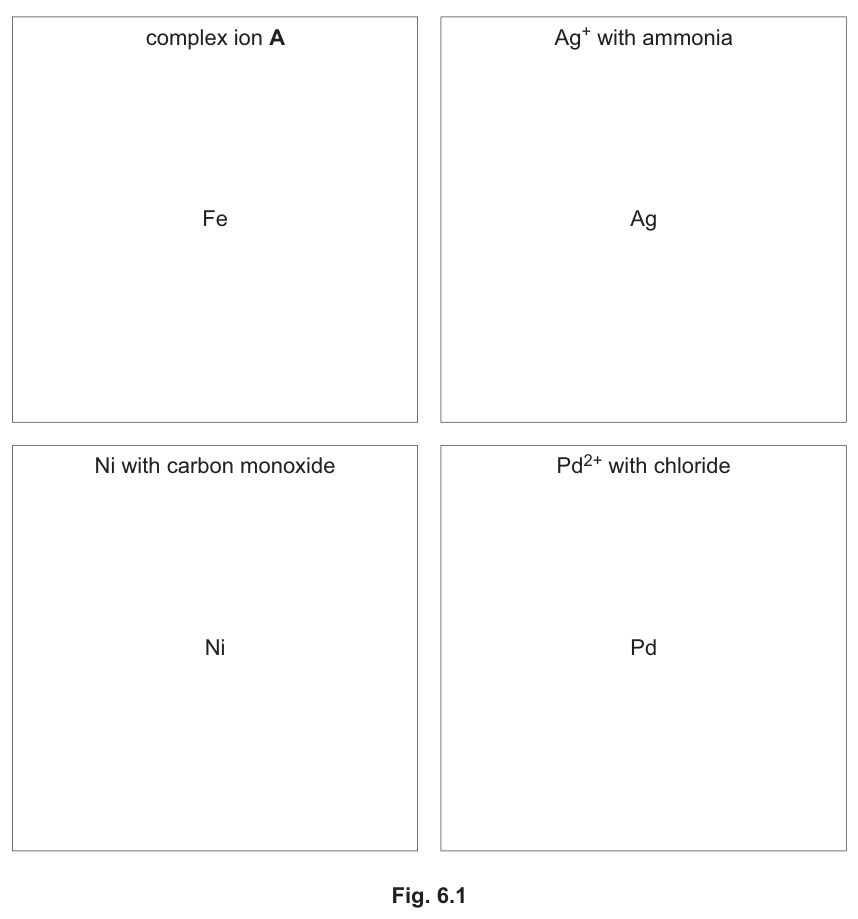
Answer
See diagram below for the completed Fig. 6.1.
Complex ion A (): Octahedral geometry. Bond angle .
Ag with ammonia (): Linear geometry. Bond angle .
Ni with CO (): Tetrahedral geometry. Bond angle .
Pd with chloride (): Square planar geometry. Bond angle .
Octahedral (90°), Linear (180°), Tetrahedral (109.5°), Square planar (90°). See diagram.
Background Concept
Complex ions can have different geometries depending on the coordination number (number of ligands) and the electronic configuration of the metal ion (specifically configurations often form square planar complexes).
- Coordination number 6: Octahedral geometry. Bond angles are (and for opposite ligands). Represented with two plain lines (in plane), two wedges (coming out), and two dashes (going in), or similar 3D representation.
- Coordination number 4: Can be tetrahedral or square planar.
- Tetrahedral: Bond angles . Represented with a 3D cross or pyramid shape.
- Square planar: Bond angles . All ligands in one plane (usually represented as a cross with plain lines).
- Coordination number 2: Linear geometry. Bond angle .
Understanding the Question
We need to draw the 3D structures and label bond angles for four specific complexes in the boxes provided in Fig. 6.1.
- Complex ion A: . Coordination number 6. Geometry: Octahedral.
- Ag with ammonia: Ag typically forms linear complexes with coordination number 2 ( configuration). Ligands are NH. Formula: .
- Ni with CO: Ni is a transition metal, CO is a neutral ligand. Ni(0) is . Coordination number 4. Geometry: Tetrahedral. Formula: .
- Pd with chloride: Pd is a ion. ions (especially 4d and 5d) strongly prefer square planar geometry with coordination number 4. Ligands are Cl. Formula: .
Approach
For each box, identify the central atom/ion, the ligands, the coordination number, and the geometry. Draw the structure using appropriate bond types (plain, wedge, dash) to show 3D shape. Label one bond angle clearly.
Step-by-Step Reasoning
Box 1: Complex ion A ()
- Central ion: Fe.
- Ligands: 6 CN. The question states C bonds to Fe. So draw Fe-C bonds. The ligand is written as CN or NC. To show C bonding to Fe, write NC on the outside or use an arrow, but in simple structural formulas, often just CN with the understanding C is the donor, or NC-Fe. The mark scheme shows 'CN' and 'NC' to indicate orientation. Let's follow the mark scheme style: Central Fe, with 6 bonds. Top/Bottom/Right-Back/Left-Back/Front-Left/Front-Right.
- Geometry: Octahedral.
- Drawing: Draw Fe in the centre. Draw 6 bonds. Two vertical (up/down) as plain lines. Two horizontal (left/right) as dashed lines (going back). Two diagonal (front-left/front-right) as wedges (coming forward). Attach CN/NC groups. Note: C must bond to Fe. So if drawing NC, the bond is from C (right side of NC) to Fe. If drawing CN, bond is from C (left side of CN) to Fe. Mark scheme uses 'NC' with dashed bond (N is outer, C is inner) and 'CN' with wedge (C is inner, N is outer? Wait. C bonds to Fe. So bond is Fe-C. If label is 'CN', C is next to Fe. If label is 'NC', N is next to outside, C is next to Fe. So bond is Fe-C.
- Angle: Label between adjacent ligands (e.g., top and right-back).
Box 2: Ag with ammonia
- Central ion: Ag.
- Ligands: 2 NH (ammonia). N donates lone pair.
- Geometry: Linear (coordination number 2 for Ag).
- Drawing: HN — Ag — NH. All in a straight line.
- Angle: Label between the two N-Ag-N bonds.
Box 3: Ni with carbon monoxide
- Central atom: Ni.
- Ligands: 4 CO. C bonds to Ni.
- Geometry: Tetrahedral.
- Drawing: Ni in centre. One bond up (plain), one bond down-left (plain), one bond down-right (wedge), one bond back-right (dashed). Attach CO groups. Ensure C is bonded to Ni. Mark scheme shows 'CO' (C next to Ni) and 'OC' (O next to outside, C next to Ni).
- Angle: Label between two adjacent bonds (e.g., down-left and down-right).
Box 4: Pd with chloride
- Central ion: Pd.
- Ligands: 4 Cl.
- Geometry: Square planar (characteristic of Pd ).
- Drawing: Pd in centre. Four bonds in a cross shape (up, down, left, right), all plain lines (all in plane).
- Angle: Label between adjacent bonds (e.g., up and right).
Key Takeaways
- Coordination number 6 is almost always octahedral ().
- Coordination number 2 is linear (), common for Ag, Au, Cu.
- Coordination number 4 can be tetrahedral () or square planar (). ions like Pd, Pt, Ni (with strong field ligands like CN) are square planar. Ni(CO) is tetrahedral.
- 3D representation uses plain lines (in plane), wedges (forward), dashes (back).
Common Mistakes
- Drawing square planar for Ni(CO) (it is tetrahedral).
- Drawing tetrahedral for [PdCl] (it is square planar).
- Forgetting to label the bond angle.
- Drawing the wrong number of ligands (e.g., 4 for Fe complex).
- Not showing 3D bonds (wedges/dashes) for octahedral and tetrahedral shapes. For square planar and linear, plain lines are sufficient.
- Bonding the wrong atom: In CN, C bonds to metal. In CO, C bonds to metal. In NH, N bonds to metal. In Cl, Cl bonds to metal.
Things to Be Careful About
- Bond Angles: Octahedral (), Linear (), Tetrahedral (), Square Planar (). Note that octahedral and square planar both have angles, so the geometry must be clear from the drawing.
- 3D Bonds: For octahedral and tetrahedral, you must use wedges and dashes to show the 3D shape. For square planar and linear, the structure is flat, so plain lines are fine (though a slight perspective can be used, plain cross is standard for square planar).
- Ligand Orientation: In CN, C is the donor. So the bond should be to C. Writing 'NC-' with bond to C is correct. Writing '-CN' with bond to C is correct. The mark scheme is flexible but shows C connecting to the metal.
A hydrocarbon is known to be either compound D or compound E.
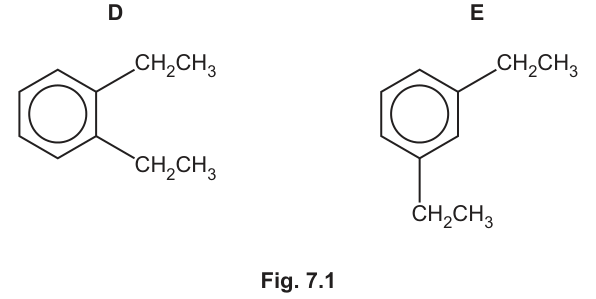
Answer
1,3-diethylbenzene
1,3-diethylbenzene
Background Concept
Disubstituted benzene rings are named by assigning the lowest possible locants to the substituents. When two identical substituents are present, the positions are numbered to give the smallest set of numbers. The prefixes 1,2- (ortho), 1,3- (meta), and 1,4- (para) describe the relative positions on the ring.
Understanding the Question
Compound E has two ethyl groups () attached to a benzene ring. From the structure shown, the ethyl groups are separated by one carbon between them, giving a 1,3-relationship.
Approach
Identify the parent structure (benzene), note the substituents (two ethyl groups), and assign locants to give the lowest numbers. Starting from one ethyl group at position 1, the other is at position 3.
Step-by-Step Reasoning
- The parent is a benzene ring with two identical substituents.
- The substituents are ethyl groups ().
- Numbering from one ethyl group (position 1), the next carbon is position 2, and the second ethyl group is at position 3.
- This gives the lowest locant set: 1,3 (rather than 1,5 which would result from numbering the other way).
- The name is 1,3-diethylbenzene.
Key Takeaways
- For disubstituted benzenes, always number to give the lowest locant set.
- 1,2- = ortho, 1,3- = meta, 1,4- = para (though systematic names use numbers).
Common Mistakes
- Writing "m-diethylbenzene" — while acceptable in some contexts, the question asks for the systematic name.
- Numbering incorrectly to give 1,5 instead of 1,3.
Things to Be Careful About
- Ensure the name uses "diethyl" (not "ethyl") since there are two identical substituents.
- The comma between numbers and hyphen between numbers and letters must be correct.
The proton () NMR spectra of D and E are compared. They are very similar. The proton () NMR spectrum of D is shown in Fig. 7.2.
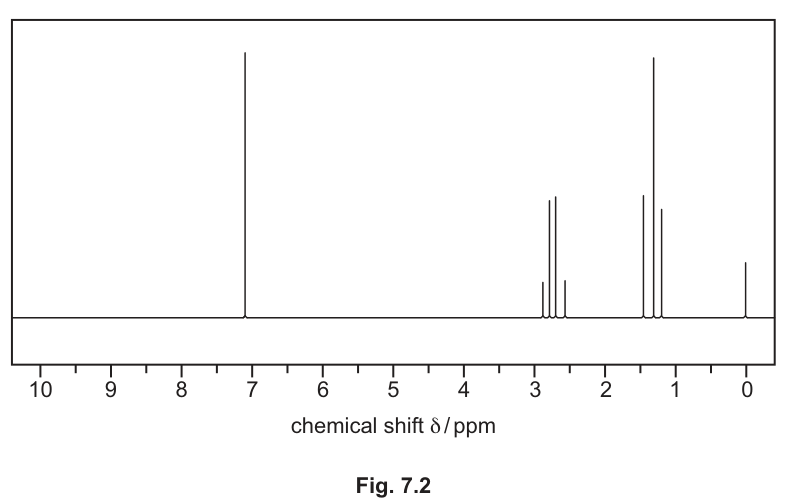
Answer
(deuterated chloroform)
CDCl3
Background Concept
Proton NMR spectroscopy requires a solvent that does not contain hydrogen atoms (or whose hydrogen signals are well outside the region of interest), because the solvent would otherwise overwhelm the sample signals. Deuterated solvents are used because deuterium () does not produce a signal in a NMR experiment.
Understanding the Question
The question asks for a suitable solvent for obtaining a NMR spectrum. The sample is a hydrocarbon (diethylbenzene), which is non-polar, so the solvent must dissolve it and must not interfere with the proton signals.
Approach
Recall the most commonly used deuterated solvent for organic NMR — — which is suitable for most non-polar and moderately polar organic compounds.
Step-by-Step Reasoning
- The solvent must be deuterated so it does not produce signals in the spectrum.
- is the standard solvent for most organic compounds, including hydrocarbons.
- It dissolves non-polar compounds well and its residual peak at 7.26 ppm is easily identifiable and does not interfere.
Key Takeaways
- is the default solvent for NMR of organic compounds.
- Other acceptable answers include (deuterated acetone) or (deuterated benzene), but is most common.
Common Mistakes
- Writing "chloroform" instead of "deuterated chloroform" or "" — ordinary would give a large proton signal.
- Writing a non-deuterated solvent like (which has no H at all but is not deuterated; while technically it wouldn't interfere, the mark scheme expects ).
Things to Be Careful About
- The answer must specify the deuterated form, not the protonated form.
The proton () NMR spectrum of E is obtained twice, once before and once after shaking with .
Describe any differences between these two spectra. Explain your answer.
Answer
There is no difference between the two spectra because compound E (1,3-diethylbenzene) has no OH, NH, or SH protons that can be exchanged with deuterium from .
No difference; E has no H atoms that can be exchanged with D
Background Concept
The shake test is used in NMR to identify exchangeable protons — those attached to electronegative atoms such as oxygen (in alcohols, phenols, carboxylic acids), nitrogen (in amines, amides), or sulfur. When is added, these protons are replaced by deuterium (), which does not appear in a NMR spectrum, so the corresponding peaks disappear. CH protons are not exchanged under these mild conditions.
Understanding the Question
Compound E is 1,3-diethylbenzene. The question asks what happens to its NMR spectrum when it is shaken with , and requires an explanation.
Approach
Examine the structure of E for any OH, NH, or SH groups. Since E is a pure hydrocarbon (only C and H atoms), it has no such groups, so no exchange can occur.
Step-by-Step Reasoning
- Compound E is 1,3-diethylbenzene: .
- All hydrogen atoms are bonded to carbon (CH bonds).
- CH protons are not acidic enough to be exchanged with under the mild conditions of the shake test.
- Therefore, the spectrum before and after addition is identical — no peaks disappear.
Key Takeaways
- exchange only removes peaks from OH, NH, and SH protons.
- A hydrocarbon will show no change in its NMR spectrum upon addition.
Common Mistakes
- Saying "the peak disappears" without checking whether the compound actually has exchangeable protons.
- Confusing this with the reaction of with acyl chlorides or other reactive species.
Things to Be Careful About
- The answer must include BOTH parts: the observation (no difference) AND the explanation (no H that can be exchanged with D). Missing either half loses the mark.
Complete Table 7.1 for the proton () NMR spectrum of D.
Table 7.1
| chemical shift / ppm | number of atoms responsible for the peak | group responsible for the peak | splitting pattern |
|---|---|---|---|
| 1.3 | |||
| 2.7 | |||
| 7.1 | [shaded] | [shaded] |
Table 7.2
| environment of proton | example | chemical shift range / ppm |
|---|---|---|
| alkane | , , | 0.9–1.7 |
| alkyl next to C=O | , , | 2.2–3.0 |
| alkyl next to aromatic ring | , , | 2.3–3.0 |
| alkyl next to electronegative atom | , , | 3.2–4.0 |
| attached to alkene | 4.5–6.0 | |
| attached to aromatic ring | 6.0–9.0 | |
| aldehyde | 9.3–10.5 | |
| alcohol | 0.5–6.0 | |
| phenol | 4.5–7.0 | |
| carboxylic acid | 9.0–13.0 | |
| alkyl amine | 1.0–5.0 | |
| aryl amine | 3.0–6.0 | |
| amide | 5.0–12.0 |
Answer
| chemical shift / ppm | number of atoms | group responsible | splitting pattern |
|---|---|---|---|
| 1.3 | 6 | triplet | |
| 2.7 | 4 | quartet | |
| 7.1 | 4 | — | — |
Explanation of splitting:
- (6H): adjacent to (2H), so → triplet
- (4H): adjacent to (3H), so → quartet
1.3 ppm: 6H, CH3, triplet; 2.7 ppm: 4H, CH2, quartet; 7.1 ppm: 4H
Background Concept
In NMR, equivalent protons give one signal whose integration reflects the number of protons in that environment. The chemical shift identifies the type of environment (from data tables), and the splitting pattern follows the rule: a set of equivalent protons is split by equivalent protons on the adjacent carbon into peaks.
Compound D is 1,2-diethylbenzene. The molecule has a plane of symmetry passing through the midpoint of the C1C2 bond and the midpoint of the C4C5 bond, making the two ethyl groups equivalent and the aromatic protons fall into two equivalent pairs.
Understanding the Question
Complete Table 7.1 for compound D by assigning: the number of protons responsible for each peak, the group (CH3 or CH2), and the splitting pattern. The 7.1 ppm row only requires the number of protons (group and splitting are shaded/not required).
Approach
- Identify all proton environments in D using symmetry.
- Count protons in each environment.
- Use the data table to assign chemical shifts.
- Apply the rule to determine splitting.
Step-by-Step Reasoning
Environment 1: CH3 protons
- Two equivalent groups (one on each ethyl) → 6H total.
- Chemical shift ~1.3 ppm (alkane region, 0.91.7 ppm from data table).
- Adjacent carbon has 2H (the ), so → triplet.
Environment 2: CH2 protons
- Two equivalent groups → 4H total.
- Chemical shift ~2.7 ppm (alkyl next to aromatic ring, 2.33.0 ppm from data table).
- Adjacent carbon has 3H (the ), so → quartet.
Environment 3: Aromatic protons
- Four aromatic H atoms (two pairs of equivalent protons at positions 3,6 and 4,5) → 4H.
- Chemical shift ~7.1 ppm (aromatic region, 6.09.0 ppm from data table).
- The group and splitting columns are shaded (not required for this row).
Key Takeaways
- Symmetry reduces the number of distinct proton environments.
- The rule applies only to protons on adjacent carbons (usually coupling).
- Integration ratios must sum to the total number of H atoms in the molecule (6 + 4 + 4 = 14 = ✓).
Common Mistakes
- Writing 3H for the CH3 peak instead of 6H (forgetting there are two equivalent CH3 groups).
- Writing 2H for the CH2 peak instead of 4H.
- Confusing which group causes which splitting (CH3 is split by CH2, not vice versa).
- Writing "multiplet" for the aromatic region when the question only asks for the number of protons in that row.
Things to Be Careful About
- The mark scheme awards one mark per correct column (number of H, group, splitting). All three must be correct for a row to score.
- "Quadruplet" is also accepted for "quartet".
Compounds D and E can be distinguished by carbon-13 NMR spectroscopy.
State the number of peaks in each spectrum.
The carbon-13 NMR spectrum of D has .............................. peaks.
The carbon-13 NMR spectrum of E has .............................. peaks.
Answer
The carbon-13 NMR spectrum of D has 5 peaks.
The carbon-13 NMR spectrum of E has 6 peaks.
D: 5 peaks; E: 6 peaks
Background Concept
In NMR, each chemically distinct carbon environment gives one peak. The number of peaks is determined by the symmetry of the molecule. For disubstituted benzenes, the symmetry plane (or planes) determines which aromatic carbons are equivalent.
Understanding the Question
Compounds D (1,2-diethylbenzene) and E (1,3-diethylbenzene) must be distinguished by counting the number of unique carbon environments in each.
Approach
Identify all symmetry elements in each molecule, then count the number of unique carbon environments.
Step-by-Step Reasoning
Compound D (1,2-diethylbenzene):
- Plane of symmetry bisects the C1C2 bond and the C4C5 bond.
- Unique carbons:
- (both equivalent by symmetry) → 1 signal
- (both equivalent) → 1 signal
- Aromatic C1 and C2 (equivalent, bearing ethyl groups) → 1 signal
- Aromatic C3 and C6 (equivalent) → 1 signal
- Aromatic C4 and C5 (equivalent) → 1 signal
- Total: 5 peaks
Compound E (1,3-diethylbenzene):
- Plane of symmetry passes through C2 and C5.
- Unique carbons:
- (both equivalent) → 1 signal
- (both equivalent) → 1 signal
- Aromatic C1 and C3 (equivalent, bearing ethyl groups) → 1 signal
- Aromatic C2 (unique, between the two substituted carbons) → 1 signal
- Aromatic C4 and C6 (equivalent) → 1 signal
- Aromatic C5 (unique, opposite C2) → 1 signal
- Total: 6 peaks
Key Takeaways
- The number of peaks equals the number of chemically distinct carbon environments.
- Symmetry planes in disubstituted benzenes make certain ring carbons equivalent.
- 1,2-disubstituted benzenes with identical substituents have fewer peaks than 1,3-disubstituted ones because of different symmetry.
Common Mistakes
- Forgetting that the two ethyl groups are equivalent in both isomers (both have a symmetry plane making them equivalent).
- Miscounting aromatic carbons by not identifying which are equivalent under the symmetry plane.
- Confusing the number of peaks with the total number of carbon atoms (both have 10 carbons, but symmetry reduces the number of signals).
Things to Be Careful About
- The answer requires BOTH numbers (5 for D and 6 for E). Getting one wrong loses the mark.
- Note that D has fewer peaks than E despite having the same molecular formula — this is the basis of the distinction.
Compound D can be oxidised to compound F by alkaline followed by dilute acid.
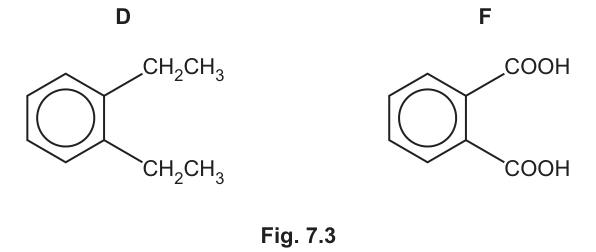
Write an equation for this reaction using molecular formulae for D and F. The products of this reaction are F, water and carbon dioxide.
Use [O] to represent one atom of oxygen from the oxidising agent.
Working
D is 1,2-diethylbenzene:
F is benzene-1,2-dicarboxylic acid (phthalic acid):
Each ethyl group () is oxidised to on the ring, with the terminal carbon lost as .
Check: Left: C = 10, H = 14, O = 12. Right: C = 8 + 2 = 10, H = 6 + 8 = 14, O = 4 + 4 + 4 = 12. ✓
Answer
C10H14 + 12[O] → C8H6O4 + 2CO2 + 4H2O
Background Concept
Alkaline followed by dilute acid is a vigorous oxidising condition that cleaves alkyl side chains on aromatic rings. Any alkyl group with at least one benzylic hydrogen is oxidised to a carboxylic acid group () on the ring. The carbon atoms beyond the benzylic position are lost as .
For an ethyl group (): the (benzylic) carbon becomes the carboxyl carbon, and the carbon is oxidised to .
Understanding the Question
Compound D (1,2-diethylbenzene, ) is oxidised to compound F (phthalic acid, ). The products are F, , and . The equation must use [O] to represent oxygen from the oxidising agent.
Approach
- Write the molecular formulae of D and F.
- Determine how many [O] atoms are needed by balancing C, H, and O on both sides.
- The two terminal methyl carbons become 2 .
- Balance hydrogen: D has 14H, F has 6H, so 8H go to water → 4 .
- Count oxygen on the right: 4 (from F) + 4 (from 2CO2) + 4 (from 4H2O) = 12, so 12[O] needed.
Step-by-Step Reasoning
- D: (benzene ring C6H4 + two ethyl groups C2H5 each = C6H4 + C4H10 = C10H14)
- F: (benzene ring C6H4 + two COOH groups = C6H4 + C2H2O4 = C8H6O4)
- Carbon balance: 10 = 8 + 2(1) → 2 CO2 ✓
- Hydrogen balance: 14 = 6 + 4(2) → 4 H2O ✓
- Oxygen balance: RHS has 4 + 4 + 4 = 12 O atoms → 12[O] on LHS ✓
Key Takeaways
- Each ethyl side chain requires 6[O] to become one COOH + one CO2 + two H2O.
- The [O] notation represents one oxygen atom from the oxidising agent.
- Always verify the balance of all three elements.
Common Mistakes
- Forgetting that the terminal carbon of each ethyl group becomes CO2 (writing only F as the organic product).
- Incorrectly writing 6[O] instead of 12[O] (forgetting there are two ethyl groups).
- Writing O2 instead of [O] (the question specifies [O]).
Things to Be Careful About
- Use molecular formulae (not structural formulae) as instructed.
- The coefficient of [O] must be correct — it is the key mark.
F reacts with an excess of to form compound G. The molecular formula of G is .
G reacts with ethane-1,2-diol, , to form a mixture of products that includes compounds J, molecular formula , and K, molecular formula .
Draw the structures of compounds G, J and K in Fig. 7.4.
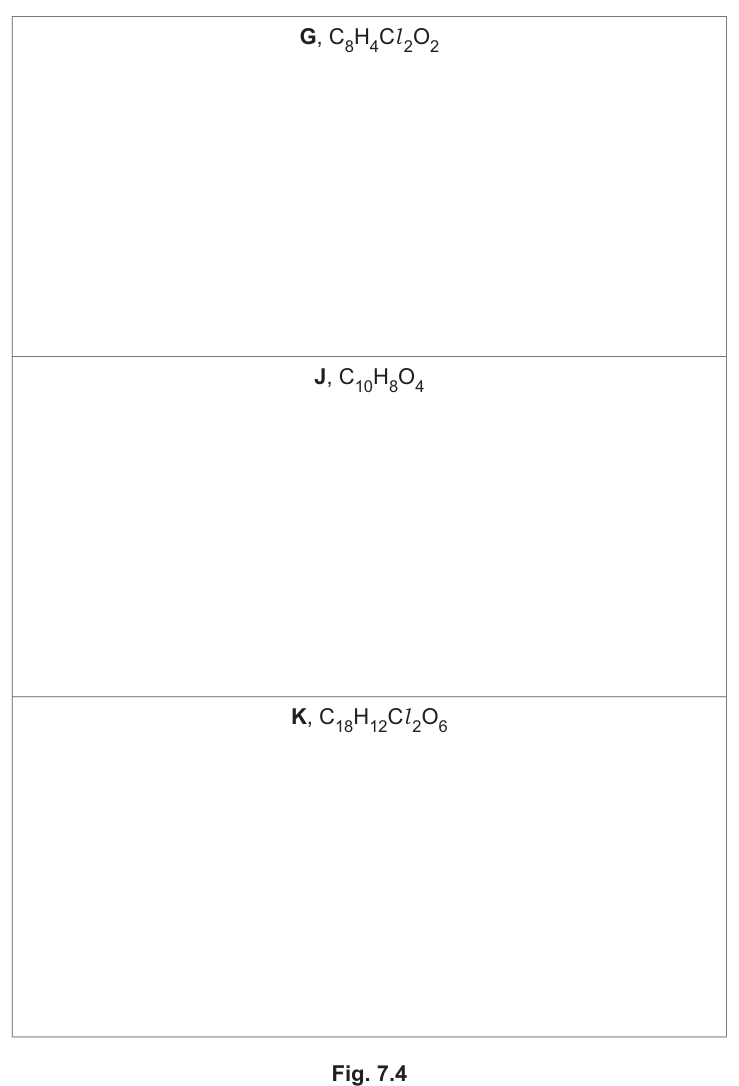
Answer
Compound G (): benzene-1,2-dicarbonyl dichloride (phthaloyl chloride) — benzene ring with two adjacent groups.
Compound J (): cyclic diester — benzene ring fused to an 8-membered ring containing two ester linkages ().
Compound K (): two benzene rings, each bearing one remaining group, linked by a bridge (one ester from each ring's other reacting with the two OH groups of the diol).
G: 1,2-C6H4(COCl)2; J: cyclic diester (benzene fused to 8-membered ring with two COO groups and CH2CH2); K: two C6H4(COCl) units linked by COOCH2CH2OOC bridge
Background Concept
Carboxylic acids react with excess to form acyl chlorides (), releasing and . A dicarboxylic acid forms a diacyl chloride. Acyl chlorides react with alcohols (including diols) via nucleophilic addition-elimination to form esters. When a diol reacts with a diacyl chloride, both ends can react intramolecularly (forming a cyclic diester) or intermolecularly (forming a larger product).
Understanding the Question
F (phthalic acid, ) reacts with excess to give G (). G then reacts with ethane-1,2-diol to give J () and K (). Three structures must be drawn.
Approach
- G: F has two groups; replacing both with gives two groups. Formula check: ✓ (loss of 2H and 2O, gain of 2Cl relative to F).
- J: G + → cyclic diester + 2HCl. Both groups react with the two groups of the diol, forming an 8-membered ring fused to the benzene ring. Formula: + - 2HCl = ✓.
- K: Two molecules of G react with one molecule of diol, but only one from each G reacts (the other remains). Formula: 2() + - 2HCl = ✓.
Step-by-Step Reasoning
Structure G:
- Start with phthalic acid: benzene-1,2-dicarboxylic acid.
- Replace both of the groups with .
- Result: 1,2-benzenedicarbonyl dichloride (phthaloyl chloride).
- Benzene ring with two adjacent groups.
Structure J:
- The diol's two groups each attack a on the same G molecule.
- This forms two ester bonds, creating a ring: .
- The ring is 8-membered (2 from each C=O carbon, 2 from each O, 2 from each CH2) fused to the benzene ring.
- No Cl remains (both COCl groups reacted).
Structure K:
- One from each of two G molecules reacts with the two groups of one diol molecule.
- Each G retains one unreacted group.
- The bridge between the two benzene rings is .
- Each benzene ring also has one remaining adjacent to the ester linkage.
Key Takeaways
- Excess converts all to .
- A diol + diacyl chloride can form a cyclic diester (intramolecular) or a bridged product (intermolecular).
- Molecular formulae are the key to deducing structures: count atoms and verify against the proposed structure.
- K is a mixture product where only partial reaction occurs (one COCl per G reacts).
Common Mistakes
- Drawing G as a mono-acyl chloride (forgetting excess converts both groups).
- Drawing J as a linear diester rather than a cyclic one (the formula with no Cl indicates both COCl groups reacted).
- Forgetting that K retains two COCl groups (one on each ring), as shown by the two Cl atoms in the formula.
- Drawing incorrect ring size for J (it is an 8-membered ring, not 6 or 7).
Things to Be Careful About
- All structures must show the correct connectivity and the benzene ring with appropriate substitution pattern (1,2-relationship preserved throughout).
- For J, the ester linkages must be drawn correctly: (not in the wrong orientation relative to the ring).
- Verify each structure's molecular formula matches what is given.
Bromine reacts with methylbenzene in the dark in the presence of a suitable catalyst to form HBr and compound L, . L is one of three isomers that can form in this reaction.
The mechanism for the reaction involves methylbenzene reacting with a ion. This ion is produced when bromine reacts with the catalyst.
Complete the equation for the reaction of with the catalyst.
Answer
Br2 + AlBr3 -> Br+ + AlBr4–
Background Concept
In electrophilic aromatic substitution (EAS) reactions involving benzene or arenes, the aromatic ring is not nucleophilic enough to react with a non-polar halogen molecule like alone. A Lewis acid catalyst (such as , , or ) is required to polarise the halogen molecule and generate a stronger electrophile, typically the halogen cation ( or ).
Understanding the Question
The question asks for the balanced equation showing how the bromine molecule reacts with the catalyst (aluminium bromide) to produce the bromonium ion () electrophile. The catalyst acts as a Lewis acid by accepting a lone pair from one of the bromine atoms.
Approach
Recall the standard mechanism for generating the electrophile in the bromination of arenes. The accepts a lone pair from , forming a complex that dissociates into and the tetrabromoaluminate anion .
Step-by-Step Reasoning
- Reactants: and . The aluminium in has an incomplete octet and acts as a Lewis acid.
- Interaction: A lone pair from one bromine atom in forms a dative bond with the aluminium atom.
- Dissociation: The Br-Br bond breaks heterolytically. One bromine takes the bonding electrons and becomes part of the ion, while the other bromine leaves as the electrophile.
- Equation: .
Key Takeaways
- Halogenation of arenes requires a Lewis acid catalyst ( or ) to generate the electrophile .
- The byproduct is always the tetrahalometallate(III) anion, e.g., or .
Common Mistakes
- Writing or instead of (the question implies by the product usually, though is also acceptable in some contexts, but is the standard match for ). Actually, the mark scheme specifies .
- Forgetting the negative charge on the ion.
- Unbalanced equation.
Things to Be Careful About
- Ensure the equation is balanced in terms of atoms and charge.
- The catalyst is often written as or ; here is required to form .
One of the isomers of L forms in much smaller amounts than the other two isomers.
Draw the structure of this isomer and explain why it forms in the smallest amount.
Answer
Structure:
1-bromo-3-methylbenzene (meta-bromotoluene).
Explanation:
The methyl group is an activating group and directs incoming electrophiles to the 2, 4, and 6 positions (ortho and para positions). Therefore, substitution at the 3 position (meta) is the least favourable, resulting in the smallest amount of product.
(Note: The structure is a benzene ring with a group at position 1 and a atom at position 3.)
See structure: 1-bromo-3-methylbenzene. Explanation: methyl group is 2,4,6-directing.
Background Concept
In electrophilic aromatic substitution, substituents already on the benzene ring influence the position of the new substituent. Alkyl groups like methyl () are electron-donating by induction. They activate the ring and direct incoming electrophiles to the ortho (2, 6) and para (4) positions. This is because the intermediate carbocation formed by attack at these positions is more stable (has more resonance structures stabilising the positive charge) than the intermediate formed by attack at the meta position.
Understanding the Question
The question asks for the isomer of that forms in the smallest amount. Since methyl is an ortho/para director, the major products are 2-bromotoluene (ortho) and 4-bromotoluene (para). The minor product is 3-bromotoluene (meta). We need to draw this structure and explain why it is minor.
Approach
- Identify the directing effect of the methyl group (ortho/para or 2,4,6 directing).
- Determine that the meta position (3) is the least favoured.
- Draw 1-bromo-3-methylbenzene.
- Explain that the methyl group directs to 2, 4, 6, making 3 the minor product.
Step-by-Step Reasoning
- Isomer identification: The three isomers are 2-bromo (ortho), 3-bromo (meta), and 4-bromo (para). Methyl is an ortho/para director. Thus, 2- and 4-bromotoluene are major, and 3-bromotoluene is minor.
- Structure: Draw a benzene ring. Put at the top (position 1). Put at position 3 (meta to methyl).
- Explanation: The methyl group donates electron density into the ring (inductive effect), activating it. It stabilises the arenium ion intermediate for ortho and para attack more than for meta attack. Therefore, the methyl group is described as a 2,4,6-directing group. Attack at the 3-position is least likely, so this isomer forms in the smallest amount.
Key Takeaways
- Alkyl groups are ortho/para directors (2,4,6-directing).
- Meta products are minor in electrophilic substitution of alkylbenzenes.
Common Mistakes
- Drawing the ortho or para isomer as the minor product.
- Saying "methyl is a meta director" (incorrect).
- Not drawing the structure correctly (e.g., wrong positions of substituents).
Things to Be Careful About
- The question asks for the isomer in the smallest amount (meta), not the major one.
- Ensure the explanation links the directing effect to the specific positions (2, 4, 6 vs 3).
Complete the mechanism in Fig. 8.1 for the reaction between methylbenzene and the ion.
Include all relevant curly arrows and charges.
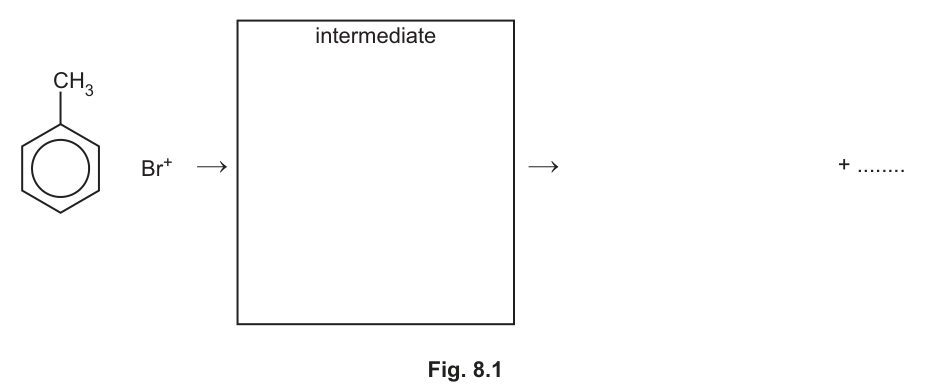
Answer
Step 1: A curly arrow starts from the centre of the benzene ring (the delocalised system) and points to the ion.
Step 2 (Intermediate): Draw a cyclohexadienyl cation (arenium ion). The ring has a group at position 1. At position 2 (ortho), there is both a atom and an atom attached to the same carbon (which is now hybridised). The remaining five carbons form a delocalised system with a positive charge (drawn as a inside the ring or with a horseshoe arrow indicating delocalisation).
Step 3: A curly arrow starts from the bond at position 2 and points into the ring (towards the delocalised system).
Final Products: 2-bromotoluene (1-bromo-2-methylbenzene) and .
(Diagram reference: See Fig. 8.2 in marking scheme for exact arrow placement and intermediate structure.)
See mechanism: arrow from ring to Br+, arenium ion intermediate, arrow from C-H bond to ring, products 2-bromotoluene + H+.
Background Concept
The mechanism of electrophilic aromatic substitution involves two main steps:
- Electrophilic attack: The electrophile () attacks the electron-rich delocalised system of the benzene ring, forming a sigma complex (arenium ion). This breaks the aromaticity. The carbon attacked becomes hybridised and bears both the new substituent and the original hydrogen.
- Deprotonation (restoration of aromaticity): A base (often the ion, though here simplified to loss of ) removes the proton from the carbon. The electrons from the C-H bond return to the ring to restore the delocalised system.
Understanding the Question
The question provides a template (Fig 8.1) with methylbenzene + going to an intermediate box, then to products. We must fill in the curly arrows, the intermediate structure, and the final products. The marking scheme diagram (Fig 8.2) shows attack at the ortho position.
Approach
- Draw the first arrow: from the electrons to the electrophile.
- Draw the intermediate: carbon with Br and H, positive charge delocalised over the ring.
- Draw the second arrow: from the C-H bond to the ring to restore aromaticity.
- Draw the final organic product and the ion.
Step-by-Step Reasoning
- M1 (First arrow): A curly arrow must originate from the delocalised system (inside the hexagon) and point to the . Do not start from a specific double bond if a circle is used, or from the center of the ring.
- Intermediate: The carbon attacked (let's say C2, ortho to methyl) now has 4 single bonds: to C1, C3, H, and Br. The ring is no longer fully aromatic. Draw a positive charge delocalised over the remaining 5 carbons (often drawn as a in the ring with a curved arrow showing delocalisation, or a circle with a ).
- M3 (Second arrow and products): A curly arrow starts from the bond between C2 and H and points into the ring (towards the delocalised system). This restores the double bond/delocalisation. The products are the substituted arene (2-bromotoluene) and a proton ().
Key Takeaways
- Electrophilic attack breaks aromaticity, forming a carbocation intermediate.
- Loss of a proton restores aromaticity.
- Curly arrows must show the movement of electron pairs.
Common Mistakes
- Starting the first arrow from a specific bond instead of the delocalised system (though often allowed if consistent, the centre is safer).
- Forgetting the positive charge on the intermediate.
- Drawing the intermediate with the charge on the carbon that has Br and H attached (it should be delocalised in the ring).
- Forgetting the in the final products.
Things to Be Careful About
- The intermediate is an carbon at the site of attack; ensure Br and H are both shown on that carbon.
- The final organic product must show the restored aromatic ring (circle or alternating double bonds).
Chlorobutane and chlorobenzene are added separately to samples of warm aqueous .
One of the chloro-compounds reacts slowly and the other does not react.
Answer
Chloro-compound that reacts: chlorobutane ().
Observation: a white precipitate forms.
chlorobutane; white precipitate
Background Concept
Halogenoalkanes (alkyl halides) undergo nucleophilic substitution reactions. When warmed with aqueous silver nitrate () in the presence of ethanol (usually, though the question says warm aqueous), the halogen is hydrolysed to form a halide ion (). The halide ion then reacts with silver ions to form an insoluble silver halide precipitate. The colour of the precipitate depends on the halide: is white, is cream, is yellow.
Halogenoarenes (aryl halides) like chlorobenzene do not undergo nucleophilic substitution under these conditions because the lone pair on the chlorine is delocalised into the benzene ring, strengthening the C-Cl bond.
Understanding the Question
We have chlorobutane (a halogenoalkane) and chlorobenzene (a halogenoarene). We add them separately to warm aqueous . We need to identify which reacts and describe the observation.
Approach
- Recall that halogenoalkanes react to release halide ions, while halogenoarenes do not.
- Chlorobutane will react, releasing .
- reacts with to form , a white precipitate.
Step-by-Step Reasoning
- Reactivity: Chlorobutane is a halogenoalkane. The C-Cl bond is polar and the carbon is electrophilic. Water (or ) can act as a nucleophile. Chlorobenzene has a C-Cl bond that is strengthened by resonance with the ring, so it does not react.
- Observation: The reaction of chlorobutane produces chloride ions. . Silver chloride is a white precipitate.
Key Takeaways
- Halogenoalkanes react with aqueous to give a precipitate.
- Halogenoarenes do not react under these conditions.
- is a white precipitate.
Common Mistakes
- Saying chlorobenzene reacts.
- Describing the precipitate as cream or yellow (that's for Br or I).
- Forgetting to mention the precipitate is white.
Things to Be Careful About
- The question specifies "warm aqueous ". Usually ethanol is added to dissolve the organic compound, but the key observation is the white precipitate.
Answer
Equation 1 (Hydrolysis):
(Alternatively: )
Equation 2 (Precipitation):
C4H9Cl + H2O -> C4H9OH + H+ + Cl-; Ag+ + Cl- -> AgCl
Background Concept
The reaction of a halogenoalkane with water (hydrolysis) is a nucleophilic substitution ( or ). Water attacks the electron-deficient carbon, displacing the chloride ion. The chloride ion is then free to react with silver ions.
Understanding the Question
We need two equations to explain the observation in (b)(i): the formation of the white precipitate from chlorobutane.
Approach
- Write the hydrolysis of chlorobutane to show the release of .
- Write the ionic equation for the formation of silver chloride from silver ions and chloride ions.
Step-by-Step Reasoning
- Hydrolysis: Chlorobutane reacts with water. The C-Cl bond breaks. Products are butanol, hydrogen ions, and chloride ions. . (Note: using is also acceptable if the solution is basic, but aqueous is slightly acidic/neutral, so water hydrolysis is standard).
- Precipitation: The released reacts with from the silver nitrate. .
Key Takeaways
- Hydrolysis releases halide ions.
- Silver ions precipitate halide ions as insoluble silver halides.
Common Mistakes
- Writing the hydrolysis equation with instead of water (the question says aqueous , so water is the nucleophile primarily, though can be used).
- Forgetting to balance the hydrolysis equation (producing ).
- Not writing the ionic equation for precipitation (writing molecular equation like is often not accepted; ionic is preferred).
Things to Be Careful About
- The mark scheme accepts .
- The precipitation equation is .
Explain the difference in reactivity of chlorobutane and chlorobenzene with warm aqueous .
Answer
In chlorobenzene, the lone pair on the chlorine atom is delocalised into the system of the benzene ring. This delocalisation gives the C–Cl bond partial double-bond character, making it stronger and shorter than the C–Cl bond in chlorobutane. Therefore, chlorobenzene does not undergo nucleophilic substitution under these conditions.
In chlorobutane, the C–Cl bond is a pure single bond and is more easily broken (hydrolysed) by nucleophiles like water.
Lone pair on Cl delocalised into ring in chlorobenzene; strengthens C-Cl bond (partial double bond character).
Background Concept
In halogenoarenes (aryl halides), the halogen atom is attached directly to an hybridised carbon of the benzene ring. The lone pair on the halogen can overlap with the delocalised system of the ring. This is a resonance effect (specifically, conjugation).
Understanding the Question
Explain why chlorobutane reacts (slowly) but chlorobenzene does not react with warm aqueous .
Approach
- Compare the nature of the C-Cl bond in both compounds.
- In chlorobutane, it's a polar single bond.
- In chlorobenzene, resonance delocalisation strengthens the bond.
Step-by-Step Reasoning
- Chlorobenzene: The lone pair on the chlorine atom is delocalised into the benzene ring's system. This creates partial double-bond character between the carbon and chlorine.
- Bond strength: The partial double bond is stronger and shorter than a pure single bond. It requires more energy to break.
- Chlorobutane: The C-Cl bond is a standard polar single bond. It is easier for a nucleophile (water) to attack the carbon and displace the chloride ion.
- Conclusion: The delocalisation in chlorobenzene prevents the reaction (hydrolysis) that occurs in chlorobutane.
Key Takeaways
- Lone pair delocalisation into the ring strengthens the C-X bond in aryl halides.
- This makes aryl halides unreactive towards nucleophilic substitution under mild conditions.
Common Mistakes
- Saying "the ring is stable" (vague; must mention delocalisation of the lone pair).
- Saying "the bond is ionic" (it's covalent).
- Not mentioning partial double bond character or bond strength.
Things to Be Careful About
- Use precise terminology: "delocalisation of the lone pair", " system", "partial double bond character".
Phenylamine, , and propylamine, , can be produced by different reduction reactions.
Identify an organic compound that can be converted into by a reduction reaction. State the reagents and conditions for this reaction.
organic compound .............................................................................................................
reagents ............................................................................................................................
conditions ..........................................................................................................................
Answer
organic compound: nitrobenzene /
reagents: Sn and HCl
conditions: concentrated HCl and heat / boil / reflux
nitrobenzene; Sn and HCl; concentrated HCl and heat/reflux
Background Concept
Aromatic amines like phenylamine (aniline) are typically prepared by the reduction of nitro compounds. The nitro group () attached to an aromatic ring is reduced to an amino group (). This is a fundamental transformation in organic synthesis for introducing the amine functionality onto an aromatic ring.
Understanding the Question
The question asks for the organic precursor to phenylamine () via a reduction reaction, along with the specific reagents and conditions required for this transformation.
Approach
Recall the standard laboratory method for reducing a nitroarene to an arylamine. This involves a metal-acid reduction using tin and concentrated hydrochloric acid under heating.
Step-by-Step Reasoning
- The functional group in phenylamine is attached to a benzene ring. The direct precursor with the same carbon skeleton and a reducible group is nitrobenzene ().
- The reduction of nitrobenzene to phenylamine is classically carried out using tin (Sn) and concentrated hydrochloric acid (HCl).
- The reaction requires heating (boiling or refluxing) to proceed at a reasonable rate. The initial product is the phenylammonium ion (), and a subsequent addition of base (like NaOH) is needed to liberate the free amine, though the mark scheme only asks for the reduction reagents and conditions.
Key Takeaways
Nitroarenes are reduced to arylamines using Sn/HCl and heat. This is a fundamental preparation method in organic chemistry.
Common Mistakes
- Forgetting the need for concentrated acid and heat; dilute acid or room temperature will not drive the reaction to completion.
- Writing 'H2 and Ni/Pt catalyst' which is used for aliphatic nitriles/amides but is not the standard method taught for nitroarenes in this syllabus.
Things to Be Careful About
- Ensure the organic compound is correctly named or formulated as nitrobenzene / .
- State 'Sn and HCl' for reagents and 'concentrated HCl and heat' for conditions; partial credit is given for two correct points out of three.
Identify an organic compound that can be converted into by a reduction reaction. State the reagent for this reaction.
organic compound .............................................................................................................
reagent ..............................................................................................................................
Answer
organic compound: propanenitrile / (or propylamide / )
reagent:
propanenitrile ();
Background Concept
Aliphatic amines like propylamine can be prepared by the reduction of nitriles or amides. Nitriles () are reduced to primary amines () using a strong reducing agent. Amides () can also be reduced to amines () using the same reagent.
Understanding the Question
The question asks for an organic precursor to propylamine () via reduction, and the specific reagent required.
Approach
Identify a compound with the same carbon skeleton that contains a reducible nitrogen functional group (nitrile or amide), then state the appropriate reducing agent.
Step-by-Step Reasoning
- Propylamine has a three-carbon chain. The corresponding nitrile is propanenitrile ( or ). The corresponding amide is propanamide ( or ).
- The reduction of nitriles or amides to amines requires a strong reducing agent. Lithium aluminium hydride () is the standard reagent for this transformation.
- Note that is typically used in dry ether, followed by acid workup, but the mark scheme only requires the reagent name.
Key Takeaways
Nitriles and amides are reduced to primary amines using . This is a key method for extending the carbon chain by one carbon when starting from a haloalkane (via nucleophilic substitution with ) followed by reduction.
Common Mistakes
- Suggesting with a Ni or Pt catalyst. While this can reduce nitriles in some contexts, is the specific reagent expected in this syllabus for nitrile/amide reduction to amines.
- Writing the wrong carbon chain length (e.g., butanenitrile).
Things to Be Careful About
- Ensure the organic compound has exactly three carbons: propanenitrile () or propanamide ().
- State as the reagent; do not include solvent or workup unless asked.
Identify a single test that will distinguish between and by producing a white precipitate with only one of these amines.
Draw the structure of the compound that is precipitated.
testing reagent ..................................................................................................................
amine that gives a precipitate ...........................................................................................
structure of the compound that is precipitated:
Answer
testing reagent: bromine (aq)
amine that gives a precipitate: phenylamine /
structure of the compound that is precipitated:
bromine (aq); phenylamine; 2,4,6-tribromophenylamine structure
Background Concept
The amino group () in phenylamine is a strongly activating group that donates electron density into the benzene ring via resonance (delocalisation of the nitrogen lone pair into the -system). This makes the ring highly susceptible to electrophilic substitution, much more so than benzene itself. When phenylamine reacts with bromine water at room temperature, it undergoes immediate tri-substitution at the 2, 4, and 6 positions, forming a white precipitate of 2,4,6-tribromophenylamine.
Aliphatic amines like propylamine do not have an aromatic ring and do not undergo this electrophilic aromatic substitution reaction with bromine water.
Understanding the Question
The question asks for a single test to distinguish between phenylamine (an aromatic amine) and propylamine (an aliphatic amine) that produces a white precipitate with only one of them. It also requires drawing the structure of the precipitated compound.
Approach
Use the difference in reactivity between the aromatic ring in phenylamine and the aliphatic chain in propylamine. Bromine water is a standard test for activated aromatic rings.
Step-by-Step Reasoning
- Bromine water () is added to both amines.
- Phenylamine reacts rapidly with bromine water at room temperature without a catalyst. The group activates the ring, causing substitution at all ortho and para positions (2, 4, and 6), forming 2,4,6-tribromophenylamine as a white precipitate.
- Propylamine does not react with bromine water to form a precipitate (it may undergo slow oxidation or acid-base reaction, but no white precipitate forms).
- The structure of 2,4,6-tribromophenylamine is a benzene ring with an group at position 1 and bromine atoms at positions 2, 4, and 6.
Key Takeaways
Phenylamine is so reactive towards electrophilic substitution that it decolourises bromine water and forms a white precipitate of 2,4,6-tribromophenylamine without a catalyst. This is a characteristic test for activated aromatic rings.
Common Mistakes
- Suggesting in or vapour: these conditions give mono-substitution or no reaction without a catalyst, not the precipitate.
- Forgetting to draw all three bromine atoms at the 2, 4, and 6 positions; mono- or di-bromination is incorrect for this reaction.
- Drawing the precipitate from propylamine (which doesn't form one).
Things to Be Careful About
- Specify 'bromine (aq)' or 'bromine water'; elemental bromine alone may not give the same immediate precipitate.
- The structure must clearly show the benzene ring (with circle or alternating double bonds) and the correct positions of the substituents: at top, at 2, 4, 6.
Answer
phenylamine < ammonia < propylamine
least basic ........................................................... most basic
Explanation:
- A base has a lone pair on the nitrogen atom that can accept a proton / .
- In phenylamine, the lone pair on the nitrogen atom is delocalised into the benzene ring / -system, making it less available to accept a proton.
- In propylamine, the electron-donating alkyl group (propyl group) increases the electron density on the nitrogen atom, making the lone pair more available to accept a proton.
phenylamine < ammonia < propylamine
Background Concept
The basicity of amines depends on the availability of the lone pair of electrons on the nitrogen atom to accept a proton (). Factors that affect this availability include:
- Delocalisation: If the lone pair is delocalised into a -system (like a benzene ring), it is less available to accept a proton, decreasing basicity.
- Inductive effect: Electron-donating groups (like alkyl groups) push electron density towards the nitrogen atom, increasing the electron density on the lone pair and making it more available to accept a proton, increasing basicity.
- Solvation effects: In aqueous solution, the stability of the conjugate acid (ammonium ion) also plays a role, but for this comparison, electronic effects dominate.
Understanding the Question
The question asks to order phenylamine, ammonia, and propylamine in order of increasing basicity and explain the reasoning based on their structures.
Approach
Compare the availability of the nitrogen lone pair in each compound:
- Phenylamine: lone pair delocalised into the ring.
- Ammonia: no delocalisation, no alkyl groups (baseline).
- Propylamine: lone pair enhanced by electron-donating alkyl group.
Step-by-Step Reasoning
- Order: phenylamine < ammonia < propylamine.
- Ammonia vs. Propylamine: In propylamine (), the propyl group is an electron-donating alkyl group. Through the +I (positive inductive) effect, it pushes electron density towards the nitrogen atom. This increases the electron density on the lone pair, making it more available to accept a proton compared to ammonia (). Thus, propylamine is more basic than ammonia.
- Ammonia vs. Phenylamine: In phenylamine (), the lone pair on the nitrogen atom is delocalised into the -system of the benzene ring. This resonance delocalisation means the lone pair is shared with the ring and is less available to accept a proton. Therefore, phenylamine is less basic than ammonia.
- Combined order: Since phenylamine is less basic than ammonia and propylamine is more basic than ammonia, the order is phenylamine < ammonia < propylamine.
Key Takeaways
- Alkyl groups increase basicity via the +I inductive effect.
- Delocalisation of the lone pair (e.g., into an aromatic ring) decreases basicity.
- Ammonia serves as a baseline: aliphatic amines are more basic, aromatic amines are less basic.
Common Mistakes
- Stating that phenylamine is more basic because the ring is 'electron-donating': the ring actually accepts electron density from the lone pair via resonance, making the lone pair less available.
- Forgetting to mention the lone pair's role in accepting a proton; basicity is defined by proton acceptance.
- Confusing the inductive effect of alkyl groups with the delocalisation effect in phenylamine.
Things to Be Careful About
- Use precise terminology: 'delocalised into the benzene ring / -system' and 'electron-donating alkyl group'.
- Ensure the order is correctly placed in the inequality: least basic on the left, most basic on the right.
- Explain why each amine is more or less basic than ammonia; simply stating the order without explanation scores no marks.
Propanoic acid, methanoic acid and ethanedioic acid are all weak acids.
Answer
Displayed formula of ethanedioic acid: HOOC–COOH with all atoms and bonds shown explicitly (see diagram).
Background Concept
A displayed (or full structural) formula shows every atom and every bond in a molecule. For carboxylic acids, the functional group is –COOH, which contains a carbonyl group (C=O) and a hydroxyl group (–OH) attached to the same carbon. Ethanedioic acid (also called oxalic acid) is the simplest dicarboxylic acid, with two carboxyl groups bonded directly to each other: HOOC–COOH.
Understanding the Question
The question asks for the displayed formula of ethanedioic acid. This means every atom must be drawn and every bond (single, double) must be shown as a line. No condensed or skeletal formula is acceptable.
Approach
Draw two carbon atoms joined by a single bond. Attach a C=O double bond and a C–OH single bond to each carbon. Ensure all hydrogen atoms in the hydroxyl groups are shown.
Step-by-Step Reasoning
- Ethanedioic acid has the molecular formula C₂H₂O₄ and the structural formula HOOC–COOH.
- Place two carbon atoms side by side, connected by a single bond (C–C).
- On each carbon, draw a double bond to an oxygen atom (C=O).
- On each carbon, draw a single bond to an oxygen atom of a hydroxyl group (C–O–H).
- All atoms (C, O, H) and all bonds (one C–C, two C=O, two C–O, two O–H) must be visible.
Key Takeaways
Displayed formulas must show every atom and every bond. For dicarboxylic acids like ethanedioic acid, the two –COOH groups are directly bonded to each other with no carbon chain between them.
Common Mistakes
- Drawing a skeletal formula or condensed formula instead of a displayed formula. Mark schemes reject these.
- Forgetting the hydrogen atoms on the hydroxyl groups.
- Drawing the two carboxyl groups separated by a carbon chain (that would be a different acid).
Things to Be Careful About
The question says "displayed formula" — this is a specific term meaning all atoms and all bonds must be shown. A structural formula (HOOC–COOH) or a skeletal formula would not score. Check that there are exactly 2 C, 2 O (double-bonded), 2 O (single-bonded in –OH), and 2 H atoms, with the correct bond types.
The three acids, propanoic acid, methanoic acid and ethanedioic acid, can be distinguished using a combination of two chemical tests. Neither testing reagent is an acid–base indicator.
Identify two suitable testing reagents and complete Table 10.1 to show the observations from each test.
reagent 1 ........................................................ reagent 2 ........................................................
Table 10.1
| observation when treated with reagent 1 | observation when treated with reagent 2 | |
|---|---|---|
| propanoic acid | ||
| methanoic acid | ||
| ethanedioic acid |
Answer
reagent 1: Tollens' reagent (or Fehling's solution)
reagent 2: acidified potassium manganate(VII) (KMnO₄ / MnO₄⁻)
Table 10.1
| observation when treated with reagent 1 (Tollens') | observation when treated with reagent 2 (acidified MnO₄⁻) | |
|---|---|---|
| propanoic acid | no change | no change |
| methanoic acid | silver mirror (or red precipitate) | colourless (decolourises) |
| ethanedioic acid | no change | colourless (decolourises) |
Note: If Fehling's solution is used as reagent 1, the observation for methanoic acid is a red precipitate.
reagent 1: Tollens' reagent (or Fehling's solution); reagent 2: acidified KMnO₄. Observations: propanoic acid — no change / no change; methanoic acid — silver mirror (or red ppt) / colourless; ethanedioic acid — no change / colourless.
Background Concept
Most carboxylic acids are not easily oxidised. However, two exceptions are well known:
-
Methanoic acid (HCOOH) has a hydrogen atom directly attached to the carbonyl carbon, giving it an aldehyde-like structure (H–C(=O)–OH). This allows it to act as a reducing agent, reducing Tollens' reagent (ammoniacal silver nitrate) to give a silver mirror, and Fehling's solution (Cu²⁺) to give a red precipitate of Cu₂O. It also reduces acidified MnO₄⁻ (purple) to Mn²⁺ (colourless).
-
Ethanedioic acid (HOOC–COOH) can be oxidised to carbon dioxide and water. It reduces acidified MnO₄⁻ (purple to colourless) but does NOT reduce Tollens' reagent or Fehling's solution.
Propanoic acid (CH₃CH₂COOH) has neither of these features and is not oxidised by any of these reagents under normal conditions.
Understanding the Question
We need two chemical tests (neither an acid-base indicator) that together can distinguish all three acids. The test must give a different observation for at least some of the acids.
Approach
- Use Tollens' reagent (or Fehling's) to identify methanoic acid (the only one that gives a positive test).
- Use acidified KMnO₄ to distinguish ethanedioic acid from propanoic acid (both methanoic and ethanedioic decolourise it, propanoic does not).
- Together, these two tests give a unique observation pattern for each acid.
Step-by-Step Reasoning
Reagent 1 — Tollens' reagent (or Fehling's solution):
- Propanoic acid: no reaction → no change.
- Methanoic acid: oxidised to CO₂; Ag⁺ reduced to Ag → silver mirror (Tollens') or Cu₂O red precipitate (Fehling's).
- Ethanedioic acid: no reaction → no change.
Reagent 2 — Acidified KMnO₄ (MnO₄⁻ / H⁺):
- Propanoic acid: no reaction → purple solution remains (no change).
- Methanoic acid: oxidised to CO₂; MnO₄⁻ reduced to Mn²⁺ → purple solution becomes colourless.
- Ethanedioic acid: oxidised to CO₂; MnO₄⁻ reduced to Mn²⁺ → purple solution becomes colourless.
Combined observations:
- Propanoic acid: no change / no change → uniquely identified.
- Methanoic acid: silver mirror (or red ppt) / colourless → uniquely identified.
- Ethanedioic acid: no change / colourless → uniquely identified.
All three acids give a distinct combination of observations.
Key Takeaways
Methanoic acid is the only carboxylic acid that acts as a reducing agent towards Tollens' and Fehling's reagents (due to its aldehyde-like H–COOH structure). Ethanedioic acid reduces acidified MnO₄⁻ but not Tollens'/Fehling's. Propanoic acid does neither. Combining these tests gives a unique fingerprint for each acid.
Common Mistakes
- Suggesting an acid-base indicator (e.g., universal indicator, pH paper) — the question explicitly excludes these.
- Using bromine water or 2,4-DNPH — these do not distinguish these acids appropriately.
- Claiming ethanedioic acid gives a positive Tollens' test — it does not.
- Forgetting that methanoic acid also decolourises acidified MnO₄⁻ (both methanoic and ethanedioic do).
- Writing "decolourises" without specifying from what (purple MnO₄⁻ to colourless Mn²⁺).
Things to Be Careful About
- The mark scheme accepts either Tollens' or Fehling's as reagent 1, but not both (they give redundant information for distinguishing all three).
- "Colourless" for the MnO₄⁻ test means the purple colour disappears; write "decolourises" or "purple to colourless".
- For Tollens', write "silver mirror"; for Fehling's, write "red precipitate". Do not mix the two.
- Both columns must be completely correct to earn full marks (M3/M4 in the mark scheme). One correct column gives 1 mark; both give 2 marks.
When propanoic acid is treated with chlorine gas in the presence of ultraviolet light, a mixture of products is formed. One of these products is 2,2-dichloropropanoic acid.
Explain why 2,2-dichloropropanoic acid is stronger than propanoic acid. Refer to the structure of each compound in your answer.
Answer
The two chlorine atoms in 2,2-dichloropropanoic acid are electron-withdrawing (electronegative) and exert a positive inductive effect through the carbon chain.
This inductive effect:
- weakens the O–H bond in the carboxyl group, making it easier to release H⁺; and/or
- stabilises the conjugate base (the carboxylate ion, –COO⁻) by dispersing/delocalising the negative charge.
In propanoic acid (CH₃CH₂COOH), the alkyl group is electron-donating, which destabilises the conjugate base and makes the acid weaker.
Working
No calculation required — this is an explanation.
Answer (summary)
2,2-dichloropropanoic acid is stronger because the electronegative Cl atoms withdraw electron density via the inductive effect, weakening the O–H bond and/or stabilising the carboxylate conjugate base.
The electronegative chlorine atoms withdraw electron density through the carbon chain (inductive effect), weakening the O–H bond and/or stabilising the conjugate base (carboxylate ion), making proton release easier.
Background Concept
The strength of a carboxylic acid depends on how readily it donates a proton (H⁺) from the –COOH group. This is governed by the stability of the resulting conjugate base (the carboxylate ion, R–COO⁻). If the conjugate base is stabilised, the equilibrium lies further to the right and the acid is stronger.
Substituents on the carbon chain can affect this through the inductive effect:
- Electron-withdrawing groups (e.g., halogens like –Cl, –F) pull electron density away from the carboxylate group through the σ-bonds. This stabilises the negative charge on the carboxylate ion and weakens the O–H bond, making the acid stronger.
- Electron-donating groups (e.g., alkyl groups like –CH₃, –CH₂CH₃) push electron density toward the carboxylate group, destabilising the negative charge and making the acid weaker.
The inductive effect operates through bonds and diminishes with distance. More electronegative atoms and more of them have a greater effect.
Understanding the Question
We are comparing propanoic acid (CH₃CH₂COOH) with 2,2-dichloropropanoic acid (CH₃CCl₂COOH). The latter has two chlorine atoms on carbon 2 (the carbon adjacent to the carboxyl group). We must explain why the dichloro derivative is the stronger acid, referring to the structure of each compound.
Approach
- Identify the structural difference: two Cl atoms on C2 in 2,2-dichloropropanoic acid vs. two H atoms on C2 in propanoic acid.
- State that Cl is electronegative / electron-withdrawing.
- Explain the consequence: weakening of the O–H bond and/or stabilisation of the conjugate base.
Step-by-Step Reasoning
Structure comparison:
- Propanoic acid: CH₃–CH₂–COOH. The ethyl group (CH₃CH₂–) is electron-donating by the inductive effect.
- 2,2-Dichloropropanoic acid: CH₃–CCl₂–COOH. The two Cl atoms on C2 are highly electronegative (Cl electronegativity ≈ 3.16 vs C ≈ 2.55).
Inductive effect:
- The two Cl atoms pull electron density away from the carboxyl group through the σ-bond framework. This is a positive inductive effect (+I is electron-donating; here we describe the Cl effect as electron-withdrawing, sometimes called –I effect).
- Note: In CIE terminology, halogens are described as "electron-withdrawing" or "electronegative". The mark scheme accepts "chlorine atoms are electron withdrawing / electronegative".
Effect on acid strength (two acceptable explanations, either or both):
- Weakening of the O–H bond: The electron withdrawal reduces electron density on the oxygen of the O–H bond, making it more polar and easier to break, releasing H⁺ more readily.
- Stabilisation of the conjugate base: The carboxylate ion (R–COO⁻) has a negative charge delocalised over two oxygen atoms. The electron-withdrawing Cl atoms help to分散 (disperse) this negative charge through the inductive effect, stabilising the ion. A more stable conjugate base means the acid more readily gives up H⁺.
Both explanations are acceptable and often go together. The mark scheme awards one mark for identifying the electron-withdrawing nature of Cl, and one mark for either weakening the O–H bond or stabilising the conjugate base.
Reference to structure:
- The question requires referring to the structure of each compound. Mention that propanoic acid has an electron-donating alkyl group (or simply no electron-withdrawing groups), while 2,2-dichloropropanoic acid has two electronegative Cl atoms on the α-carbon.
Key Takeaways
Electron-withdrawing substituents (especially halogens on the α-carbon) increase carboxylic acid strength via the inductive effect. This can be explained either by weakening the O–H bond or by stabilising the conjugate base. Both explanations are chemically valid and often work together.
Common Mistakes
- Saying "chlorine is more electronegative" without linking it to the inductive effect or its consequence on acid strength.
- Not referring to the structure of both compounds (the question explicitly asks for this).
- Saying the Cl atoms "attract electrons" without specifying through the σ-bonds (inductive effect through bonds, not through space).
- Confusing the inductive effect with resonance (Cl does not participate in resonance with the carboxylate here; it's purely inductive through σ-bonds).
- Writing "the Cl atoms make the acid stronger" without explaining why.
- Saying "the conjugate base is more stable because of resonance" — the resonance is the same in both acids; the difference is the inductive stabilisation.
Things to Be Careful About
- The mark scheme gives two marks: M1 for "chlorine atoms are electron withdrawing / electronegative" and M2 for "weakening O–H bond OR stabilising conjugate base". Either explanation in M2 is acceptable.
- You must refer to the structure of each compound. Simply saying "Cl is electron-withdrawing" without comparing to propanoic acid may not earn full marks.
- Use precise terminology: "inductive effect", "electron-withdrawing", "conjugate base", "O–H bond".
- Do not say "Cl pulls electrons through the double bond" — the effect is through σ-bonds (the carbon chain).