Chemistry 9701/42 — February/March 2025
Cambridge A-Level · A Level Structured Questions · worked solutions for every part, with the mark scheme
Topics Transition Elements · Chemical Energetics · Carboxylic Acids and Derivatives · Hydroxy Compounds · Equilibria · Nitrogen Compounds · +8 more
Silver, Ag, is a metal in the d-block of the Periodic Table.
Silver can form compounds containing either or ions.
Explain why silver is a transition element.
Answer
Silver is a transition element because it forms a stable ion, , which has an incomplete d subshell / partially filled d orbitals.
Silver forms a stable Ag2+ ion with an incomplete d subshell.
Background Concept
A transition element is defined as an element that forms at least one stable ion with a partially filled d subshell. The d-block elements are those whose highest-energy electrons are in d orbitals, but not all d-block elements are transition elements. For example, zinc (Zn) forms only Zn2+ with the configuration [Ar]3d10 — a full d subshell — so zinc is not a transition element. Silver (Ag) has the electron configuration [Kr]4d10 5s1. It commonly forms Ag+ ([Kr]4d10, full d subshell) but can also form Ag2+ ([Kr]4d9, incomplete d subshell). Because Ag2+ is a stable ion with a partially filled d subshell, silver satisfies the definition and is classified as a transition element.
Understanding the Question
The question asks us to explain why silver, a d-block metal, is classified as a transition element. We need to recall the definition of a transition element and apply it to silver.
Approach
Recall the definition: an element that forms at least one stable ion with a partially filled d subshell. Check whether silver forms such an ion. Ag+ has a full 4d10 subshell, but Ag2+ has 4d9 — partially filled. Since Ag2+ is stable, silver qualifies.
Step-by-Step Reasoning
- The definition of a transition element: an element that forms at least one stable ion with an incomplete d subshell.
- Silver's electron configuration is [Kr]4d10 5s1.
- Ag+ has [Kr]4d10 — the d subshell is full, so Ag+ alone would not qualify.
- However, Ag2+ has [Kr]4d9 — the d subshell is incomplete (partially filled).
- Ag2+ is a stable ion of silver. Therefore, silver forms a stable ion with an incomplete d subshell and is a transition element.
Key Takeaways
- The definition of a transition element is based on the existence of at least one stable ion with a partially filled d subshell.
- Being in the d-block is not sufficient; the ion must have an incomplete d subshell.
- Silver qualifies via its Ag2+ ion even though its most common ion Ag+ has a full d subshell.
Common Mistakes
- Saying "silver is in the d-block so it is a transition element" — this is insufficient; the d-block alone does not define a transition element (zinc and scandium are d-block but not transition elements by this definition).
- Stating that Ag+ has an incomplete d subshell — Ag+ has [Kr]4d10, a full d subshell.
- Confusing "partially filled" with "unfilled" — the ion must have at least one d electron and at least one vacant d orbital.
Things to Be Careful About
- The mark scheme specifically credits the Ag2+ ion with an incomplete d subshell.
- Use precise terminology: "incomplete d subshell" or "partially filled d orbitals".
Table 1.1 gives data relevant to the Born–Haber cycle for silver(I) fluoride, AgF.
Table 1.1
| standard energy change | value / |
|---|---|
| first ionisation energy of silver | +732 |
| enthalpy change of atomisation of silver | +289 |
| enthalpy change of atomisation of fluorine | +79 |
| enthalpy change of formation of silver(I) fluoride | -203 |
| lattice energy of silver(I) fluoride | -955 |
Write equations for the standard enthalpy changes described. Include state symbols.
-
standard enthalpy change of atomisation of silver
-
standard enthalpy change of formation of silver(I) fluoride
Answer
Standard enthalpy change of atomisation of silver:
Standard enthalpy change of formation of silver(I) fluoride:
Ag(s) → Ag(g); Ag(s) + ½F2(g) → AgF(s)
Background Concept
The standard enthalpy change of atomisation of an element is the enthalpy change when 1 mole of gaseous atoms is formed from the element in its standard state. For a solid metal like silver, this is simply the conversion of solid silver to gaseous silver atoms: Ag(s) → Ag(g).
The standard enthalpy change of formation of a compound is the enthalpy change when 1 mole of the compound is formed from its elements in their standard states under standard conditions (298 K, 1 atm). For AgF, the elements are silver (solid) and fluorine (gas, F2). Since one mole of AgF contains one mole of Ag and one mole of F, we need ½ mole of F2 to provide one mole of F atoms.
Understanding the Question
We are asked to write balanced equations, with state symbols, for two standard enthalpy changes: atomisation of silver and formation of silver(I) fluoride.
Approach
Apply the definitions directly:
- Atomisation of silver: solid silver → gaseous silver atoms, 1 mole each side.
- Formation of AgF: silver (solid) + fluorine (gas) → silver(I) fluoride (solid), balanced so that 1 mole of AgF is produced.
Step-by-Step Reasoning
- Atomisation of Ag: one mole of Ag(s) becomes one mole of Ag(g). Equation: Ag(s) → Ag(g). State symbols: (s) for solid, (g) for gas.
- Formation of AgF: the elements in their standard states are Ag(s) and F2(g). To make 1 mole of AgF(s), we need 1 mole of Ag atoms and 1 mole of F atoms. F2 provides 2 F atoms, so we use ½ F2. Equation: Ag(s) + ½F2(g) → AgF(s).
Key Takeaways
- Atomisation always produces gaseous atoms from the element in its standard state.
- Formation always produces exactly 1 mole of the compound from elements in their standard states.
- State symbols are essential in these equations.
Common Mistakes
- Writing Ag(g) → Ag(s) (reversing the atomisation).
- Writing F(g) instead of ½F2(g) for the formation — fluorine's standard state is F2(g).
- Forgetting state symbols entirely — the question explicitly asks for them.
Things to Be Careful About
- The standard state of fluorine is F2(g), not F(g).
- The coefficient ½ is required in front of F2 so that exactly 1 mole of AgF is formed.
Answer
Lattice energy is the energy change when 1 mole of an ionic solid (lattice/crystal/compound) is formed from its gaseous ions (under standard conditions).
The energy change when 1 mole of an ionic solid is formed from its gaseous ions.
Background Concept
Lattice energy is a key quantity in Born-Haber cycles. It is defined as the enthalpy change when 1 mole of an ionic solid is formed from its constituent ions in the gaseous state. For example, for AgF:
The lattice energy is exothermic (negative) because forming ionic bonds releases energy.
Understanding the Question
We need to give the precise definition of lattice energy. The mark scheme requires two key components: (1) the energy change when 1 mole of an ionic solid is formed, and (2) from gaseous ions.
Approach
State the definition in full, ensuring both components are present.
Step-by-Step Reasoning
- Identify the process: formation of an ionic solid.
- Specify the quantity: 1 mole.
- Specify the reactants: gaseous ions.
- Combine: lattice energy is the energy change when 1 mole of an ionic solid is formed from its gaseous ions.
Key Takeaways
- Lattice energy is always defined for the formation of the solid from gaseous ions, not the reverse.
- It is exothermic for most ionic compounds.
Common Mistakes
- Defining lattice energy as the energy to break the lattice into gaseous ions — that is the lattice dissociation energy (equal in magnitude, opposite in sign).
- Omitting "1 mole" or "gaseous ions" — both are required for full marks.
Things to Be Careful About
- The mark scheme requires "1 mole of an ionic solid" and "from gaseous ions". Both phrases must appear.
- "Under standard conditions" is often included but not always required.
Calculate the first electron affinity, , of fluorine, using data from Table 1.1.
It may be helpful to draw a labelled energy cycle as part of the working for your answer.
Working
Using the Born-Haber cycle:
Substituting:
Answer
-348 kJ mol^-1
Background Concept
A Born-Haber cycle is an application of Hess's law to the formation of an ionic compound. The enthalpy change of formation of an ionic compound is the sum of several steps:
- Atomisation of the metal (Ag(s) → Ag(g))
- Ionisation of the metal (Ag(g) → Ag+(g) + e-)
- Atomisation of the non-metal (½F2(g) → F(g))
- Electron affinity of the non-metal (F(g) + e- → F-(g))
- Lattice energy (Ag+(g) + F-(g) → AgF(s))
By Hess's law, the sum of these steps equals the enthalpy change of formation.
Understanding the Question
We are given all the data except the first electron affinity of fluorine and asked to calculate it using the Born-Haber cycle.
Approach
Set up the Born-Haber equation:
ΔHf = ΔHatom(Ag) + IE1(Ag) + ΔHatom(F) + EA1(F) + LE(AgF)
Substitute the known values and solve for EA1.
Step-by-Step Reasoning
- Write the Born-Haber equation:
ΔHf = ΔHatom(Ag) + IE1(Ag) + ΔHatom(F) + EA1(F) + LE(AgF) - Substitute values:
-203 = +289 + 732 + 79 + EA1 + (-955) - Simplify the right side:
+289 + 732 + 79 - 955 = 145
So -203 = 145 + EA1 - Solve for EA1:
EA1 = -203 - 145 = -348 kJ/mol
Key Takeaways
- The Born-Haber cycle sums all the enthalpy changes in forming an ionic compound.
- The electron affinity of a halogen is exothermic (negative).
- Always check the sign of each term in the cycle.
Common Mistakes
- Forgetting to include the atomisation of fluorine (79 kJ/mol).
- Sign errors on the lattice energy (it is negative, -955).
- Getting the final sign wrong — electron affinity of fluorine is negative.
Things to Be Careful About
- The mark scheme requires the result to 3 significant figures minimum.
- The electron affinity is negative because energy is released when an electron is added to a fluorine atom.
Table 1.2 shows some thermodynamic data at 298 K.
Table 1.2
| energy change at 298 K | value / |
|---|---|
| lattice energy of AgF(s) | -955 |
| enthalpy change of hydration of | -464 |
| enthalpy change of hydration of | -506 |
Working
Answer
-15 kJ mol^-1
Background Concept
The enthalpy change of solution of an ionic compound is the energy change when 1 mole of the solid dissolves in water. It can be calculated from the lattice energy and the hydration enthalpies of the ions:
ΔHsol = -LE + ΔHhyd(cation) + ΔHhyd(anion)
The negative of the lattice energy represents the energy needed to break the lattice (lattice dissociation), and the hydration enthalpies represent the energy released when the ions are surrounded by water molecules.
Understanding the Question
We are given the lattice energy of AgF and the hydration enthalpies of Ag+ and F-, and asked to calculate the enthalpy change of solution.
Approach
Apply the formula ΔHsol = -LE + ΔHhyd(Ag+) + ΔHhyd(F-).
Step-by-Step Reasoning
- Write the formula: ΔHsol = -LE + ΔHhyd(Ag+) + ΔHhyd(F-)
- Substitute: ΔHsol = -(-955) + (-464) + (-506)
- Simplify: ΔHsol = 955 - 464 - 506 = -15 kJ/mol
Key Takeaways
- The enthalpy of solution combines lattice breaking (endothermic) and hydration (exothermic).
- A negative ΔHsol indicates the dissolution is exothermic and thermodynamically favourable.
Common Mistakes
- Forgetting the negative sign on the lattice energy term.
- Adding the lattice energy instead of subtracting it.
Things to Be Careful About
- The lattice energy is negative (-955), so -LE = +955.
- The result is -15 kJ/mol, a small negative value.
Use your answer to (c)(i) to suggest whether AgF is soluble in water at 298 K. Explain your answer.
Answer
Yes, AgF is (slightly) soluble in water because the enthalpy change of solution is (slightly) exothermic / negative.
Yes — the enthalpy change of solution is slightly exothermic (negative).
Background Concept
Solubility is related to the enthalpy change of solution. If ΔHsol is negative (exothermic), the dissolution process releases energy, which favours solubility. Even a slightly negative value indicates the process is energetically favourable, though entropy also plays a role. In this case, the small negative value (-15 kJ/mol) suggests AgF is slightly soluble.
Understanding the Question
We are asked to use the calculated ΔHsol to suggest whether AgF dissolves in water.
Approach
A negative ΔHsol means dissolution is exothermic, which favours solubility. State that AgF is soluble and justify with the exothermic enthalpy change.
Step-by-Step Reasoning
- ΔHsol = -15 kJ/mol, which is negative (exothermic).
- An exothermic dissolution releases energy, making the process thermodynamically favourable.
- Therefore, AgF is (slightly) soluble in water.
Key Takeaways
- A negative enthalpy of solution favours solubility.
- The magnitude indicates the degree of solubility — a small negative value suggests slight solubility.
Common Mistakes
- Saying AgF is insoluble because the value is small — a negative value still favours solubility.
- Not linking the answer to the sign of ΔHsol.
Things to Be Careful About
- The mark scheme requires both the solubility conclusion and the justification (exothermic/negative ΔHsol).
- The answer "yes" without justification would not score the mark.
Table 1.3 shows some data relevant to the silver(I) halides, AgCl to AgI.
Table 1.3
| silver(I) halide | first electron affinity of halogen / | lattice energy / |
|---|---|---|
| AgCl | -349 | -905 |
| AgBr | -325 | -890 |
| AgI | -295 | -876 |
Answer
As we go from Cl to I, the atomic radius increases / there are more electron shells / more shielding by inner shells. The nucleus has less attraction for the incoming electron, so the first electron affinity becomes less exothermic (less negative).
Atomic radius increases down the group, more shielding, less attraction for the incoming electron, so electron affinity becomes less exothermic (less negative).
Background Concept
The first electron affinity is the energy change when one mole of gaseous atoms each gains one electron to form one mole of gaseous 1- ions:
X(g) + e- → X-(g)
For halogens, this is exothermic because the added electron enters a partially filled p subshell and is attracted to the nucleus. Down the group, the atomic radius increases and there is more shielding, so the attraction between the nucleus and the incoming electron decreases, making the electron affinity less exothermic (less negative).
Understanding the Question
We are asked to explain why the first electron affinities of the halogens become less negative from Cl to I.
Approach
Identify the trend: EA1 becomes less exothermic down the group. Explain using atomic size and shielding arguments.
Step-by-Step Reasoning
- From Cl to I, the atomic radius increases because each successive element has an additional electron shell.
- The additional inner shells provide more shielding of the nuclear charge.
- The effective nuclear charge experienced by the incoming electron decreases.
- Therefore, less energy is released when the electron is added, making EA1 less exothermic (less negative).
Key Takeaways
- Electron affinity becomes less exothermic down a group.
- The trend is explained by increasing atomic radius and shielding.
Common Mistakes
- Saying electron affinity becomes more exothermic down the group — this is incorrect.
- Confusing electron affinity with ionisation energy.
Things to Be Careful About
- The mark scheme requires both the size/shielding reason and the consequence (less attraction, less exothermic).
- Use precise terminology: "less exothermic" or "less negative".
Answer
From AgCl to AgI, the halide ions (X-) get larger. The attraction between the ions decreases, so the ionic bond is weaker and the lattice energy becomes less exothermic (less negative).
Halide ions get larger down the group, decreasing attraction between ions, so lattice energy becomes less exothermic (less negative).
Background Concept
Lattice energy depends on the charges and sizes of the ions. For ions of the same charge, the lattice energy becomes less exothermic as the ionic radius increases, because the electrostatic attraction between the ions decreases with increasing distance. In the silver halides, the cation (Ag+) is the same, but the halide anion increases in size from Cl- to I-.
Understanding the Question
We are asked to explain why the lattice energies of AgCl, AgBr, and AgI become less negative.
Approach
Identify that the halide ions increase in size down the group, which reduces the electrostatic attraction and hence the lattice energy.
Step-by-Step Reasoning
- All silver halides have the same cation Ag+.
- The halide ions Cl-, Br-, I- increase in ionic radius down the group.
- Larger ions mean greater distance between the centres of the positive and negative charges.
- The electrostatic attraction between the ions decreases.
- The ionic bond is weaker, so less energy is released when the lattice forms — lattice energy becomes less exothermic (less negative).
Key Takeaways
- Lattice energy becomes less exothermic as ionic radius increases (for constant charge).
- The trend in lattice energy follows the trend in ionic size.
Common Mistakes
- Attributing the trend to the cation — the cation is the same in all three.
- Saying lattice energy becomes more exothermic — the opposite is true.
Things to Be Careful About
- The mark scheme requires both the size increase and the consequence (decreased attraction/weaker bond).
- Use "less exothermic" or "less negative" rather than "smaller".
An electrochemical cell is constructed using the electrodes shown in Table 1.4.
Table 1.4
| electrode | half-equation | |
|---|---|---|
| 1 | +0.222 | |
| 2 | +0.342 |
Calculate the standard cell potential, .
Construct an equation for the overall cell reaction.
Working
The more positive potential is the reduction (cathode): Cu2+ + 2e- → Cu.
The less positive potential is the oxidation (anode): Ag + Cl- → AgCl + e-.
Answer
Overall cell reaction:
E°cell = +0.120 V; Cu2+(aq) + 2Ag(s) + 2Cl-(aq) → Cu(s) + 2AgCl(s)
Background Concept
The standard cell potential is the difference between the electrode potentials of the two half-cells. The more positive electrode potential is the reduction (cathode), and the less positive is the oxidation (anode):
E°cell = E°(cathode) - E°(anode)
The overall cell reaction is obtained by combining the two half-equations so that the electrons cancel.
Understanding the Question
We are given two half-equations with their standard electrode potentials and asked to calculate E°cell and write the overall cell reaction.
Approach
- Identify the cathode (more positive E°) and anode (less positive E°).
- Calculate E°cell = E°cathode - E°anode.
- Reverse the anode half-equation and combine with the cathode half-equation, balancing electrons.
Step-by-Step Reasoning
- E°(Cu2+/Cu) = +0.342 V (more positive, cathode)
- E°(AgCl/Ag) = +0.222 V (less positive, anode)
- E°cell = +0.342 - (+0.222) = +0.120 V
- Cathode: Cu2+ + 2e- → Cu
- Anode (reversed): Ag + Cl- → AgCl + e-
- To cancel electrons, multiply the anode equation by 2: 2Ag + 2Cl- → 2AgCl + 2e-
- Combine: Cu2+ + 2Ag + 2Cl- → Cu + 2AgCl
Key Takeaways
- The more positive electrode potential is the cathode.
- E°cell = E°(cathode) - E°(anode).
- The overall reaction combines the half-equations with balanced electrons.
Common Mistakes
- Subtracting in the wrong order.
- Not reversing the anode half-equation.
- Forgetting to balance the electrons when combining.
Things to Be Careful About
- The mark scheme requires the cell potential to 2 significant figures minimum.
- The overall equation must be balanced — 2Ag and 2Cl- on the left, 2AgCl on the right.
In a different experiment, electrode 1 is set up using a saturated solution of KCl.
Saturated KCl(aq) contains 36.0 g of KCl per of solution at 298 K.
The Nernst equation for electrode 1 is:
Calculate the electrode potential, , of electrode 1 under these conditions.
Working
Molar mass of KCl = 39.1 + 35.5 = 74.6 g mol^-1
Applying the Nernst equation:
Answer
+0.182 V
Background Concept
The Nernst equation relates the electrode potential to the concentration of the species involved. For the AgCl/Ag electrode:
the Nernst equation is:
where z is the number of electrons transferred (z = 1 here). The concentration of Cl- is determined by the solubility of KCl in the saturated solution.
Understanding the Question
We are given a saturated KCl solution (36.0 g per 100 cm3) and asked to calculate the electrode potential using the Nernst equation.
Approach
- Calculate the molar concentration of Cl- from the mass and volume of KCl.
- Substitute into the Nernst equation.
- Evaluate the logarithm and compute E.
Step-by-Step Reasoning
- Molar mass of KCl: K = 39.1, Cl = 35.5, so M = 74.6 g/mol.
- Moles of KCl in 100 cm3: 36.0 / 74.6 = 0.4826 mol.
- Concentration: 0.4826 mol / 0.100 dm3 = 4.826 mol/dm3 ≈ 4.83 mol/dm3.
(Alternatively: 36.0/74.6 × 10 = 4.83 mol/dm3) - Since KCl dissociates completely, [Cl-] = 4.83 mol/dm3.
- Nernst equation: E = 0.222 + (0.059/1) log(1/4.83)
- log(1/4.83) = log(0.207) = -0.684
- E = 0.222 + 0.059 × (-0.684) = 0.222 - 0.0404 = 0.1816 ≈ 0.182 V
Key Takeaways
- The Nernst equation accounts for concentration effects on electrode potential.
- Saturated KCl provides a known, high concentration of Cl-.
- The electrode potential decreases when [Cl-] is high (the log term is negative).
Common Mistakes
- Forgetting to convert the concentration to mol/dm3.
- Using the wrong value of z (it is 1, since one electron is transferred).
- Sign errors in the log term.
Things to Be Careful About
- The mark scheme requires the result to 2 significant figures minimum.
- The concentration calculation must be correct — 4.83 mol/dm3.
- The final answer is +0.182 V, slightly less than the standard potential +0.222 V.
Propanone, , is a common organic solvent and reagent.
Propanone reacts with methanol, , under acidic conditions to form compound A, as shown by reaction 1.
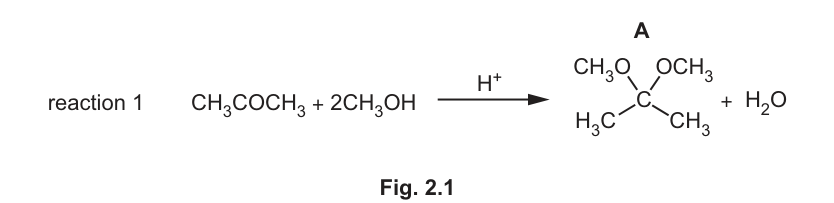
The overall order of reaction 1 can be found by studying experimental data.
Table 2.1 shows how the initial rate of reaction changes as and are varied. In each experiment, a large excess of is used.
Table 2.1
| experiment | relative initial rate of reaction | ||
|---|---|---|---|
| 1 | 0.010 | 0.010 | 1.00 |
| 2 | 0.015 | 0.015 | 2.25 |
| 3 | 0.015 | 0.020 | 3.00 |
Answer
The concentration of remains (almost) constant throughout the reaction, so any observed change in rate can be attributed solely to changes in and .
The concentration of CH3COCH3 stays (almost) constant, so it does not affect the observed rate changes.
Background Concept
In kinetics experiments, when we want to determine the order with respect to one reactant, we need to isolate its effect. If multiple reactants are changing simultaneously, we cannot distinguish their individual contributions to the rate change. One common strategy is to use a large excess of one reactant so that its concentration remains effectively constant throughout the reaction — this is called a pseudo-order or isolation method.
Understanding the Question
The question asks why propanone is used in large excess in each experiment. The table shows that only and are varied between experiments, and we are asked to determine the order with respect to these two species. The role of propanone must be understood in this context.
Approach
Consider what would happen if propanone were NOT in excess: its concentration would decrease significantly as the reaction proceeds, and this change would be confounded with the changes in and . By using a large excess, the fractional change in is negligible.
Step-by-Step Reasoning
- The initial rate method requires measuring the rate at the very start of the reaction, when concentrations are known.
- Even with initial rates, if propanone is not in large excess, its concentration varies between experiments (since it is a reactant), making it impossible to isolate the effect of and .
- By using a large excess of propanone, is essentially the same in all experiments and changes negligibly during each run.
- This means the observed rate differences between experiments can be attributed entirely to the deliberate changes in and .
Key Takeaways
- The isolation method (pseudo-order conditions) allows determination of individual reaction orders.
- A reactant in large excess has a concentration that is effectively constant, so its contribution to the rate is folded into the rate constant.
- This is a standard experimental design principle in kinetics.
Common Mistakes
- Saying 'to make the reaction go faster' — this is not the reason.
- Saying 'propanone is a catalyst' — it is a reactant, not a catalyst.
- Failing to connect the excess to the ability to isolate the effect of the other reactants.
Things to Be Careful About
- The answer should mention that the concentration stays constant (or does not change significantly), not just that it is 'in excess'. The mark scheme requires the consequence of the excess to be stated.
Use the data in Table 2.1 to determine the order of reaction 1 with respect to and to ions. Explain your answers.
Answer
Order with respect to :
Comparing experiments 2 and 3: is constant at .
increases from to (factor of ).
Rate increases from to (factor of ).
Since rate changes by the same factor as , the reaction is first order with respect to .
Order with respect to :
Comparing experiments 1 and 2: both and increase by a factor of .
Rate increases from to (factor of ).
Since is first order, it contributes a factor of to the rate change.
The remaining factor of is due to changing by .
Therefore the reaction is first order with respect to .
First order with respect to CH3OH and first order with respect to H+
Background Concept
The method of initial rates determines reaction order by observing how the initial rate changes when one reactant concentration is varied while others are held constant. If doubling a concentration doubles the rate, the reaction is first order in that species. If doubling the concentration quadruples the rate, it is second order. When two concentrations change simultaneously, we must account for the known order of one to deduce the order of the other.
Understanding the Question
Three experiments are given with different combinations of and . The task is to determine the order with respect to each reactant. The key challenge is that no two experiments differ in only one variable — we must use the information from one comparison to interpret another.
Approach
- Find two experiments where one concentration is held constant — this directly gives the order with respect to the other.
- Use that known order to interpret a comparison where both concentrations change.
Step-by-Step Reasoning
Step 1: Order with respect to H+
- Experiments 2 and 3 have the same .
- changes: .
- Rate changes: .
- Rate ratio equals concentration ratio, so order with respect to is 1.
Step 2: Order with respect to CH3OH
- Experiments 1 and 2: changes by , and also changes by .
- Rate changes by .
- If the rate equation is rate = , then .
- We know , so , giving , so .
- Alternatively, comparing experiments 1 and 3: changes by , changes by , rate changes by . Then , so , confirming .
Key Takeaways
- Always look for a pair of experiments where one variable is controlled.
- When both variables change, use the known order to factor out its contribution.
- The overall order here (excluding propanone) is 2, but including propanone (first order from part a(iii)) gives overall order 3.
Common Mistakes
- Comparing experiments 1 and 2 and concluding second order overall without separating the two contributions.
- Forgetting that also changes between experiments 1 and 2.
- Writing 'rate × 2.25 and concentration × 1.5, so order = 2' without accounting for the simultaneous change in .
Things to Be Careful About
- The mark scheme requires both the correct order AND the supporting numerical reasoning for each.
- State which experiments you are comparing.
- Show the factor by which rate and concentration change explicitly.
In a separate experiment, a large excess of and ions are added to a solution containing a known concentration of .
Fig. 2.2 shows how varies over time.
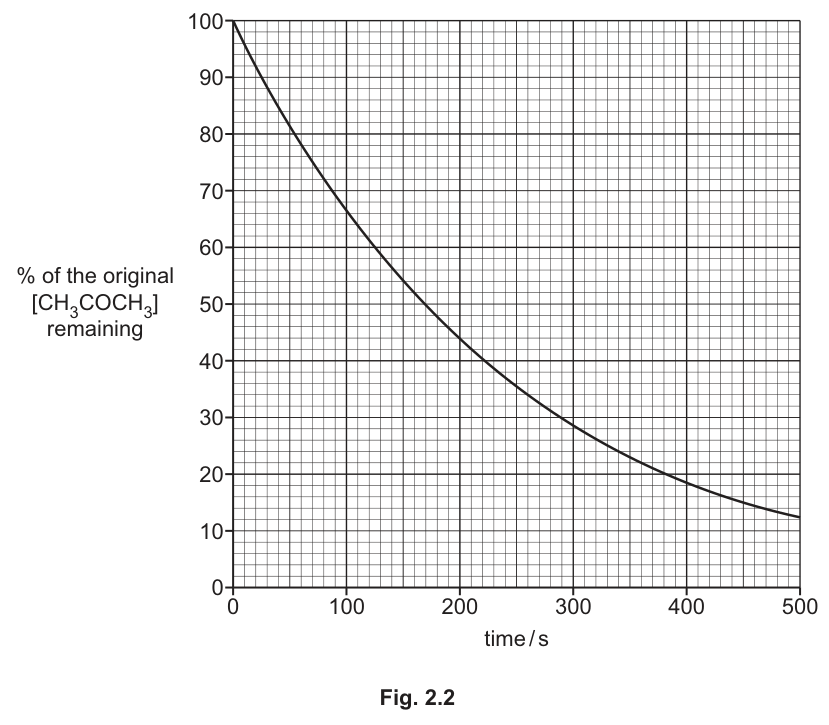
Use Fig. 2.2 to show how, under these conditions, reaction 1 is first order with respect to .
Answer
From Fig. 2.2:
- First half-life: falls from to in approximately .
- Second half-life: falls from to in approximately (from to ).
The half-life is constant (approximately ), which is characteristic of a first-order reaction.
Two half-lives are both approximately 170 s (constant), confirming first order with respect to CH3COCH3.
Background Concept
A defining feature of first-order reactions is that the half-life is independent of the initial concentration. For a first-order reaction, , which contains no concentration term. This means that whether the concentration starts at 100%, 50%, or 25%, the time taken to halve it is always the same. This is a powerful diagnostic tool: if successive half-lives read from a concentration-time graph are constant, the reaction is first order with respect to that species.
Understanding the Question
In this experiment, and are in large excess, so they remain effectively constant. The graph shows decreasing over time. We must use the graph to demonstrate that the reaction is first order with respect to propanone.
Approach
Read off the time for the concentration to fall from 100% to 50% (first half-life), then from 50% to 25% (second half-life). If these are equal, the reaction is first order.
Step-by-Step Reasoning
- From the graph, at , the concentration is 100%.
- The concentration reaches 50% at approximately . First half-life = 170 s.
- The concentration reaches 25% at approximately . Second half-life = .
- Since the half-life is constant regardless of the starting concentration, the reaction is first order with respect to .
Note: The mark scheme accepts values in the range 155–170 s for the half-lives, as reading from a graph involves some uncertainty.
Key Takeaways
- Constant half-life is the hallmark of first-order kinetics.
- When other reactants are in excess, the observed kinetics reflect only the species whose concentration is changing — this is the pseudo-first-order method.
- Reading graphs requires identifying the time for each successive halving of concentration.
Common Mistakes
- Only quoting one half-life — the question requires showing constancy, which needs at least two.
- Reading the time for the concentration to reach zero rather than halving.
- Stating 'the graph is exponential' without explicitly quoting and comparing half-lives.
Things to Be Careful About
- Quote actual values from the graph (the mark scheme requires 'two quoted half-lives').
- State that they are the same/constant.
- The range 155–170 s is accepted; do not be overly precise about readings from a graph.
Propanone also reacts with acidified cyanide ions to form the hydroxynitrile compound B, as shown by reaction 2.
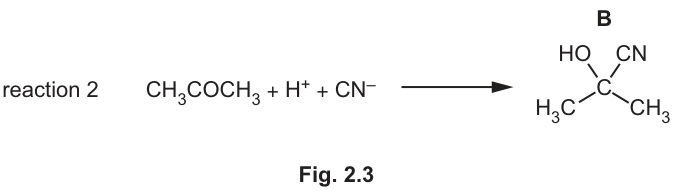
The following rate equation is determined for reaction 2.
Four possible mechanisms for reaction 2 are shown in Table 2.2.
Table 2.2
| proposed reaction mechanism | steps |
|---|---|
| 1 | fast \slow |
| 2 | fast \slow |
| 3 | slow \fast |
| 4 | slow \fast |
Suggest which of these mechanisms is consistent with the rate equation for reaction 2. Explain your answer.
Answer
Mechanism 4 is consistent with the rate equation.
The rate equation is , which is first order in and first order in .
In mechanism 4, the slow (rate-determining) step is:
This step contains only and , in a 1:1 ratio, which matches the orders in the rate equation. The species in the rate-determining step and their stoichiometric coefficients correspond directly to the orders in the rate law.
Mechanism 4
Background Concept
The rate-determining step (RDS) is the slowest step in a reaction mechanism, and it controls the overall rate. The rate equation reflects the species involved in the RDS (and any species in fast equilibrium steps preceding it). For a simple case where the RDS is the first step, the rate equation directly mirrors the stoichiometry of that step: each species in the RDS appears in the rate equation raised to the power of its coefficient in that step.
If a species appears in a fast step before the RDS, it may also appear in the rate equation (through the equilibrium approximation). But species appearing only AFTER the RDS (in fast steps) do not appear in the rate equation at all.
Understanding the Question
Four mechanisms are proposed for the reaction of propanone with cyanide ions under acidic conditions. The experimentally determined rate equation is . We must identify which mechanism is consistent with this rate equation and explain why.
Approach
Examine the slow step of each mechanism and check whether the species in that step match those in the rate equation, with the correct stoichiometric ratio.
Step-by-Step Reasoning
Mechanism 1: Slow step is . This contains an intermediate and , neither of which appears in the rate equation. Inconsistent.
Mechanism 2: Slow step is . This contains HCN, not and separately. The rate equation would be , which does not match. Inconsistent.
Mechanism 3: Slow step is . This contains but not . The rate equation would be , which does not match. Inconsistent.
Mechanism 4: Slow step is . This contains exactly and in a 1:1 ratio, giving . Consistent with the observed rate equation.
Key Takeaways
- The rate equation tells us what is in (or before) the rate-determining step.
- Species in fast steps after the RDS do not appear in the rate equation.
- The stoichiometric coefficients in the RDS give the orders in the rate equation (for a first-step RDS).
Common Mistakes
- Choosing mechanism 1 because it has a fast step involving and — but the fast step before the RDS does not determine the rate equation directly unless it is a pre-equilibrium (which is more complex and not indicated here).
- Confusing which species appear in the rate equation with which appear in the overall reaction.
- Not explicitly stating the connection between the slow step and the rate equation.
Things to Be Careful About
- The mark scheme requires three points: identifying mechanism 4, stating the slow step contains only species from the rate equation, and that the stoichiometric ratio matches the orders. All three must be present for full marks.
Carboxylic acid C, , forms when B is hydrolysed under hot acidic conditions.
Answer
Hydrolysis of the nitrile group () in B under hot acidic conditions converts it to a carboxylic acid group ().
Compound C is 2-hydroxy-2-methylpropanoic acid:
2-hydroxy-2-methylpropanoic acid: (CH3)2C(OH)(COOH)
Background Concept
Nitriles () undergo hydrolysis under hot acidic conditions to form carboxylic acids (). The triple bond is converted to through addition of water. The rest of the molecule is unchanged. This is a standard reaction in organic synthesis for extending a carbon chain by one carbon and then converting the nitrile to an acid.
Understanding the Question
Compound B is 2-hydroxy-2-methylpropanenitrile: . When hydrolysed under hot acidic conditions, the group becomes , giving compound C with molecular formula .
Approach
Replace the group with while keeping the rest of the structure (the central carbon with two methyl groups and one hydroxyl group) unchanged.
Step-by-Step Reasoning
- B has the structure: central C bonded to , , , and .
- Hot acidic hydrolysis converts .
- C has the structure: central C bonded to , , , and .
- Molecular formula check: ✓ (4 carbons, 8 hydrogens, 3 oxygens).
- Name: 2-hydroxy-2-methylpropanoic acid.
Key Takeaways
- Nitrile hydrolysis gives carboxylic acids.
- The carbon of the CN becomes the carbon of the COOH.
- Other functional groups in the molecule are unaffected by this hydrolysis.
Common Mistakes
- Drawing the wrong connectivity (e.g., placing OH and COOH on different carbons).
- Forgetting to show all atoms and bonds in the displayed formula.
- Drawing the structure of B instead of C (forgetting the hydrolysis).
Things to Be Careful About
- The question says 'draw the structure', which means a displayed formula showing all atoms and bonds is expected.
- Ensure the correct number of carbons (4 total) and the correct placement of functional groups on the same central carbon.
Working
For a weak acid:
Answer
2.13
Background Concept
For a weak acid HA that partially dissociates: . The acid dissociation constant is . When the acid is weak (small relative to ), we can approximate , and since , this gives . The relationship between and is .
Understanding the Question
Compound C is a weak carboxylic acid with . We are given its concentration () and asked to calculate the pH of this solution.
Approach
- Convert to .
- Apply the weak acid approximation to find .
- Calculate pH from .
Step-by-Step Reasoning
- .
- The approximation is valid here because , which is much less than 1, confirming the acid is weak enough for the approximation.
- .
- .
Key Takeaways
- The weak acid approximation is the standard method for calculating pH of a weak acid solution.
- Always convert to before using it in calculations.
- Check that the approximation is valid (though at A-level this is usually assumed).
Common Mistakes
- Using directly instead of converting to .
- Forgetting to take the square root.
- Reporting pH to only 1 decimal place when 2 significant figures (after the decimal) are required.
- Using the strong acid formula which would give — clearly wrong for a weak acid.
Things to Be Careful About
- The mark scheme requires minimum 2 significant figures in the pH (2.13 is acceptable).
- Units are not required for pH.
- Ensure is calculated correctly from — a common error is writing instead of .
C can be used to form buffer solution D.
Answer
A buffer solution is a solution that resists changes in pH when small amounts of acid or base are added.
A solution that resists changes in pH when small amounts of acid or base are added.
Background Concept
A buffer solution contains a mixture of a weak acid and its conjugate base (or a weak base and its conjugate acid). When a small amount of strong acid is added, the conjugate base neutralises it; when a small amount of strong base is added, the weak acid neutralises it. In both cases, the ratio changes only slightly, so the pH changes very little.
Understanding the Question
This is a straightforward definition question worth 2 marks. The mark scheme requires two elements: (1) resists/minimises/opposes changes in pH, and (2) when small amounts of acid or base are added.
Approach
State the definition concisely, ensuring both key elements are present.
Step-by-Step Reasoning
- Element 1: The solution resists (minimises/opposes) changes in pH.
- Element 2: This occurs when small amounts of (strong) acid or base are added.
- Both elements together form the complete definition.
Key Takeaways
- A buffer definition must include both the 'resists pH change' aspect and the 'addition of small amounts of acid/base' condition.
- The word 'small' is important — buffers have a limited capacity.
Common Mistakes
- Only stating 'resists pH change' without mentioning what causes the change (addition of acid or base).
- Saying 'maintains a constant pH' — buffers do not maintain exactly constant pH, they resist changes.
- Omitting 'small amounts' — large additions will overwhelm the buffer.
Things to Be Careful About
- Both marks are needed: the resistance to pH change AND the condition (small additions of acid/base). Missing either loses a mark.
Buffer solution D is made when of NaOH(aq) is added to of a solution of C.
The of C is 3.95.
Calculate the pH of buffer solution D.
Show your working.
Working
Moles of NaOH added =
Moles of C initially =
NaOH neutralises C to form the conjugate base :
Moles of conjugate base formed =
Moles of acid HA remaining =
Using the expression:
Answer
3.77
Background Concept
When a strong base is added to a weak acid, it partially neutralises the acid, converting some of it to its conjugate base. The resulting solution contains both the weak acid and its conjugate base — a buffer. The pH of a buffer can be calculated using the expression rearranged to solve for . Since both species are in the same solution volume, the ratio of concentrations equals the ratio of moles, simplifying the calculation.
Understanding the Question
of NaOH is added to of of acid C (). We need to find the pH of the resulting buffer solution.
Approach
- Calculate moles of NaOH and moles of acid C.
- Determine which is in excess and calculate moles of acid remaining and conjugate base formed.
- Use the expression with the mole ratio to find .
- Calculate pH.
Step-by-Step Reasoning
Step 1: Moles
- Moles NaOH =
- Moles C =
Step 2: Reaction
NaOH is the limiting reagent. It converts of HA to :
- Moles =
- Moles HA remaining =
Step 3: Buffer equation
(The volume cancels in the ratio since both are in the same solution.)
Step 4: pH
Note: Since is not the case here (), this makes sense because there is more acid than conjugate base (), so the pH should be below the .
Key Takeaways
- In a buffer calculation, the volume cancels when taking the ratio of acid to conjugate base moles.
- The Henderson-Hasselbalch equation gives the same result: .
- Always check that the answer is reasonable relative to .
Common Mistakes
- Forgetting that NaOH only partially neutralises the acid (not all of it reacts since acid is in excess).
- Using concentrations instead of moles without accounting for the total volume (though the ratio works either way since volume cancels).
- Inverting the ratio: writing instead of .
- Calculating moles of NaOH as (forgetting to divide by 1000).
Things to Be Careful About
- The mark scheme requires 2 significant figures minimum for the pH.
- ECF is allowed from M1 (the mole calculation) into M2 and M3.
- Ensure the correct species is identified as the conjugate base (formed from neutralisation) and the remaining acid.
and ions are able to form a variety of complexes with different species.
Answer
A central metal atom or ion surrounded by ligands bonded by coordinate (dative covalent) bonds.
A central metal atom or ion surrounded by ligands bonded by coordinate bonds.
Background Concept
In transition metal chemistry, a complex (or coordination compound) consists of a central metal atom or ion bonded to surrounding molecules or ions called ligands. The bond formed between a ligand and the metal is a coordinate (dative covalent) bond, meaning both electrons in the shared pair come from the ligand (which must have a lone pair) and are accepted by the metal (which must have an empty orbital, typically a d-orbital).
Understanding the Question
The question simply asks for the definition of a 'complex'. This is a foundational term in the study of transition metals and coordination chemistry.
Approach
Recall the standard IUPAC-style definition used in A-Level Chemistry: identify the central species (metal atom/ion) and what is around it (ligands), and specify the type of bonding (coordinate bonds).
Step-by-Step Reasoning
- Identify the central component: a metal atom or, more commonly for these questions, a metal ion (e.g., , ).
- Identify the surrounding species: ligands (e.g., , , ).
- Specify the bonding: the ligands are attached via coordinate (dative covalent) bonds.
- Combine these into a concise definition.
Key Takeaways
A complex is defined by three elements: a central metal atom/ion, surrounding ligands, and coordinate bonds. Remembering 'coordinate' is crucial, as simple 'covalent' is often not accepted.
Common Mistakes
- Saying 'covalent bonds' instead of 'coordinate' or 'dative covalent' bonds.
- Forgetting to mention the central metal atom or ion.
- Calling the surrounding species 'molecules' instead of 'ligands' (though 'molecules or ions' is acceptable, 'ligands' is the precise term).
Things to Be Careful About
Ensure you include both 'central metal atom/ion' AND 'surrounded by ligands'. Mark schemes typically require both parts of the definition to award the mark.
Table 3.1 gives some details of different complexes of and of .
Complete Table 3.1.
Table 3.1
| complex | ion | ligand | coordination number | formula and charge of complex |
|---|---|---|---|---|
| E | 6 | |||
| F | ||||
| G | en |
Answer
| complex | ion | ligand | coordination number | formula and charge of complex |
|---|---|---|---|---|
| E | 6 | |||
| F | 4 | |||
| G | en | 6 |
E: [Fe(NH3)6]2+ ; F: Fe2+, Cl-, 4 ; G: Fe3+, 6
Background Concept
The formula and charge of a complex are determined by the charge of the central metal ion and the charges of the ligands. The overall charge of the complex is the algebraic sum of the metal ion charge and the ligand charges.
The coordination number is the total number of coordinate bonds formed between the ligands and the central metal ion. Monodentate ligands (like , , ) form one bond each. Bidentate ligands (like ethane-1,2-diamine, 'en') form two bonds each.
Understanding the Question
We are given a table with missing values for three complexes (E, F, G). We must deduce the missing ion, ligand, coordination number, or formula/charge based on the given information.
Approach
- For E: Metal is , ligand is neutral , CN is 6. Formula is .
- For F: Formula is . Ligand is (charge -1). CN is 4 (four ). Charge of complex is -2. Let metal charge be . . So ion is .
- For G: Formula is . Ligand is 'en' (neutral). CN is (since 'en' is bidentate). Charge is +3. Since ligands are neutral, metal charge is +3. So ion is .
Step-by-Step Reasoning
Complex E:
- Ion: Given as .
- Ligand: Given as (neutral).
- Coordination number: Given as 6.
- Formula and charge: .
Complex F:
- Formula given: .
- Ligand: (chloride ion).
- Coordination number: 4 (four chloride ligands).
- Ion charge: Let it be . . Ion is .
Complex G:
- Formula given: .
- Ligand: 'en' (ethane-1,2-diamine, neutral).
- Coordination number: 'en' is bidentate (forms 2 bonds). .
- Ion charge: Let it be . . Ion is .
Key Takeaways
Always check if a ligand is monodentate or bidentate to calculate the correct coordination number. Remember that the overall charge is the sum of the metal ion charge and the ligand charges.
Common Mistakes
- Forgetting that 'en' is bidentate and writing a coordination number of 3 for complex G.
- Miscalculating the metal ion charge in complex F (e.g., thinking because of the context, but the math gives ).
Things to Be Careful About
Ensure all missing cells in the table are filled. The mark scheme awards marks for any two correct rows, any four correct cells, or all six correct cells. Double-check your charge calculations.
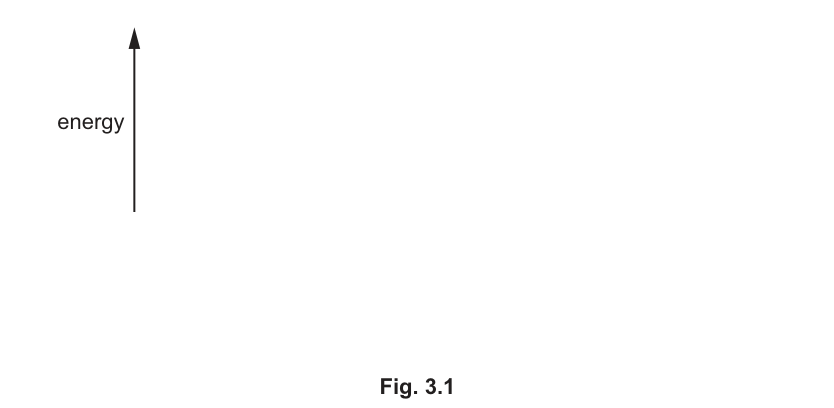
Answer
See diagram: 3 higher energy levels, 2 lower energy levels.
Background Concept
When ligands approach a central metal ion, the five degenerate (equal energy) d-orbitals split into two energy levels due to electrostatic repulsion between the ligand electrons and the d-orbital electrons.
In an octahedral complex, the splitting results in two lower-energy orbitals () and three higher-energy orbitals ().
In a tetrahedral complex, the geometry is inverted relative to the octahedral case (ligands approach between the axes rather than along them). This reverses the splitting pattern: the orbitals () are lower in energy, and the orbitals () are higher in energy. The energy gap () is smaller than in octahedral complexes ().
Understanding the Question
The question asks to complete a diagram showing the d-orbital splitting for a tetrahedral complex. The provided template has a vertical 'energy' axis and blank space to draw the orbitals.
Approach
Draw two groups of boxes (representing orbitals). For a tetrahedral complex, there must be two boxes at a lower energy level and three boxes at a higher energy level.
Step-by-Step Reasoning
- Draw two horizontal boxes grouped together at a lower energy level (representing the set: ).
- Draw three horizontal boxes grouped together at a higher energy level (representing the set: ).
- Ensure there is a clear energy gap between the two groups.
Key Takeaways
Tetrahedral splitting is the inverse of octahedral splitting: 2 lower, 3 higher. Memorise this to avoid the common mistake of drawing the octahedral pattern (3 lower, 2 higher).
Common Mistakes
- Drawing 3 lower and 2 higher boxes (this is octahedral, not tetrahedral).
- Forgetting to group the boxes (2 together, 3 together).
Things to Be Careful About
The question specifically asks for a tetrahedral complex. Read carefully! The mark scheme requires 'three higher AND two lower boxes'.
Table 3.2 gives details of some complexes of .
Table 3.2
| complex | colour | value of |
|---|---|---|
| violet | 1 | |
| red | ||
| colourless |
Answer
- The ligands are different ( vs ), so the d–d energy gap () is different.
- This means a different frequency (or wavelength) of light is absorbed (and thus different light is transmitted/reflected, giving a different colour).
Different ligands cause a different d-d energy gap, leading to absorption of different frequencies/wavelengths of light.
Background Concept
The colour of transition metal complexes arises from d-d electron transitions. When light shines on the complex, electrons in the lower-energy d-orbitals can absorb photons and jump to the higher-energy d-orbitals. The energy of the absorbed photon matches the energy gap () between the split d-orbitals: .
The colour observed is the complementary colour to the one absorbed. The value of depends on the nature of the ligands (spectrochemical series) and the oxidation state/identity of the metal ion. Different ligands cause different amounts of d-orbital splitting.
Understanding the Question
We are comparing (violet) and (red). Both have as the central ion, but one has ligands and the other has one ligand replacing an . We must explain why their colours differ.
Approach
- Identify the difference between the two complexes: the ligands are different (mixed ligand complex vs pure aqua complex).
- State that different ligands cause a different d-d energy gap ().
- Link the different to the absorption of different frequencies/wavelengths of light.
Step-by-Step Reasoning
- The two complexes have different ligands ( only vs and ).
- Different ligands produce a different crystal field splitting, meaning the d–d energy gap () is different.
- Since , a different energy gap means a different frequency (or wavelength) of light is absorbed.
- Different light absorbed means different light is transmitted/reflected, resulting in a different observed colour.
Key Takeaways
Colour differences in complexes with the same metal ion are always due to different ligands causing a different d-d energy gap, which changes the absorbed wavelength.
Common Mistakes
- Saying 'different energy levels' without specifying 'd-d energy gap' or 'd-orbital splitting'.
- Saying 'different amount of light absorbed' without mentioning frequency/wavelength/energy.
- Forgetting to link the energy gap to the frequency/wavelength of light.
Things to Be Careful About
The mark scheme specifically looks for 'd–d energy gap / is different' and 'different frequency / wavelength'. Ensure you mention both the gap and the light property.
Answer
K_stab = [[Fe(H2O)5SCN]2+] / ([[Fe(H2O)6]3+][SCN-])
Background Concept
The stability constant () describes the equilibrium position of a complex ion formation reaction. For the reaction where a ligand replaces water in an aqua complex:
Water is the solvent and its concentration is essentially constant, so it is omitted from the equilibrium expression.
Understanding the Question
Write the expression for the formation of from and .
Approach
Write the products over reactants, omitting water. Use square brackets for concentrations.
Step-by-Step Reasoning
- Product:
- Reactants: and
- Expression:
Key Takeaways
Always omit from expressions as it is the solvent. Ensure charges on complex ions are correctly included in the formula.
Common Mistakes
- Including in the denominator.
- Forgetting the charges on the complex ions in the formula (though strictly not required in the K expression itself, the formula must be correct).
Things to Be Careful About
The mark scheme shows the expression with the complex ion in square brackets inside square brackets: . This is correct notation: outer brackets for concentration, inner brackets for the complex ion formula.
Use information in Table 3.2 to calculate the value of the equilibrium constant, , for the following reaction.
Working
The target reaction is:
From Table 3.2, we have two formation equilibria:
The target reaction is equation (2) minus equation (1):
Answer
(or 1700 to 2 s.f.)
1714 (or 1700 to 2 s.f.)
Background Concept
When a reaction is the sum or difference of other reactions, its equilibrium constant is the product or quotient of the equilibrium constants of those reactions. Specifically, if Reaction C = Reaction A - Reaction B, then .
Understanding the Question
Calculate for a ligand exchange reaction using the values from Table 3.2.
Approach
- Write the equilibrium equations corresponding to the two values.
- Manipulate these equations to obtain the target equation.
- Calculate using the corresponding mathematical operation on the values.
Step-by-Step Reasoning
- Target:
- Eq 1 (from of SCN complex):
- Eq 2 (from of F complex):
-
To get the target, reverse Eq 1 and add to Eq 2:
Result:
Reverse Eq 1:
Add Eq 2: - Round to appropriate significant figures (minimum 2 s.f. from the data): 1700 or 1714.
Key Takeaways
To find for a new reaction from known values, write the equations, manipulate them (reverse = invert K, add = multiply K), and apply the operations to the K values.
Common Mistakes
- Adding the K values instead of dividing.
- Forgetting to invert the K value when reversing a reaction.
- Incorrect significant figures (data has 3 s.f., so 1710 or 1714 is acceptable; mark scheme says min 2 s.f.).
Things to Be Careful About
The mark scheme accepts min 2 s.f. Ensure you show the division clearly.
A few drops of KF(aq) are added to a solution of , followed by a few drops of KSCN(aq).
Use information in Table 3.2 to describe any observations after each addition. Explain your answer.
Answer
- After adding KF(aq): The solution turns from violet/purple to colourless.
- After adding KSCN(aq): The solution remains colourless (no change / stays colourless).
- Explanation: The of () is greater than the of (). Therefore, is more stable, and the equilibrium lies further to the right for the fluoride complex. The red cannot form (or is immediately displaced) because the fluoride complex is more stable.
Turns colourless with KF, stays colourless with KSCN. Kstab of Fe-F complex is larger, so it is more stable.
Background Concept
A higher value indicates a more stable complex. In a mixture of ligands, the ligand that forms the more stable complex (higher ) will predominantly coordinate to the metal ion. This is a competitive ligand exchange equilibrium.
Understanding the Question
We start with (violet). We add a few drops of KF, then a few drops of KSCN. We must describe the colour changes and explain them using the values.
Approach
- Determine the colour of (violet).
- Add : compare of with . Since , the F complex forms. Its colour is colourless. So violet -> colourless.
- Add : now we have in solution. Compare values: and . Since , the F complex is much more stable. Adding will not displace . The solution remains colourless.
Step-by-Step Reasoning
Addition of KF:
- Initial solution: is violet.
- Reaction:
- (large, equilibrium lies to the right).
- Product is colourless.
- Observation: Solution turns from violet/purple to colourless.
Addition of KSCN:
- Solution now contains (colourless).
- We add . Could it form (red)?
- Compare stabilities: is much greater than .
- The fluoride complex is more stable. The equilibrium for SCN complex formation does not proceed to the right (or is negligible).
- Observation: Solution remains colourless (no change).
- Explanation: of is greater than that of , so the fluoride complex is more stable and SCN- cannot displace F-.
Key Takeaways
When multiple ligands are present, the one with the higher will dominate. Sequential addition tests the relative stabilities. A more stable complex will not be displaced by a less stable one.
Common Mistakes
- Saying the solution turns red after adding KSCN (ignoring the relative Kstab values).
- Not describing the first colour change (violet to colourless).
- Explaining the second observation incorrectly (e.g., saying 'no reaction occurs' without referencing the Kstab values or stability).
Things to Be Careful About
The mark scheme requires two marks: one for the observations (violet to colourless, then stays colourless) and one for the explanation (Kstab comparison or relative stability). Ensure both are present.
Hydrated compound J, , contains the green complex ion .
The value of can be determined by titration of a sample of J with acidified ions.
ions oxidise ions in acidic conditions.
Write half equations for the oxidation of ions and for the reduction of ions.
-
oxidation of
-
reduction of
Answer
oxidation of :
reduction of :
Oxidation: C2O4^2- -> 2CO2 + 2e^- ; Reduction: MnO4^- + 8H^+ + 5e^- -> Mn^2+ + 4H2O
Background Concept
In redox titrations involving and ethanedioate (), we need the half-equations for the oxidation and reduction processes.
- Oxidation of ethanedioate: Carbon in has oxidation state +3. In , it is +4. Each carbon loses 1 electron, so the ion loses 2 electrons to form 2 molecules.
- Reduction of manganate(VII): Manganese in is +7. In acidic conditions, it is reduced to (+2), gaining 5 electrons. Oxygen is balanced with water, hydrogen with .
Understanding the Question
Write the two half-equations for the reaction given in the question stem.
Approach
Recall or derive the standard half-equations for these common species in acidic conditions.
Step-by-Step Reasoning
Oxidation:
- Reactant:
- Product: (carbon is oxidised from +3 to +4)
- Balance C:
- Balance charge: Left is -2, right is 0. Add to right.
- Equation:
Reduction:
- Reactant:
- Product:
- Balance Mn: Already balanced.
- Balance O: Add to right.
- Balance H: Add to left.
- Balance charge: Left is . Right is . Add to left.
- Equation:
Key Takeaways
These are standard half-equations that should be memorised for A-Level Chemistry. Note the acidic conditions for permanganate reduction.
Common Mistakes
- Forgetting to balance the oxygen and hydrogen in the permanganate half-equation.
- Getting the electrons wrong (e.g., instead of for Mn).
- Forgetting the charge on the ethanedioate ion.
Things to Be Careful About
Ensure state symbols are not required unless specified (mark scheme doesn't show them for half-equations here, but it's good practice. The mark scheme only awards marks for the correct species and electrons). The mark scheme gives 1 mark for each correct half-equation.
A student prepares a solution containing 0.100 g of J.
The student titrates this solution with acidified . The titre obtained is .
Assume all of the ions are oxidised.
Calculate the value of in .
Give your answer to the nearest whole number. Show your working.
[: , 437.1]
Working
Step 1: Moles of
Step 2: Moles of
From the balanced equation, react with .
Step 3: Moles of
Each formula unit contains 3 ions.
Step 4: Mass of anhydrous
Step 5: Mass and moles of water
Step 6: Value of
Answer
3
Background Concept
This is a classic water of crystallisation calculation using a redox titration. The steps are:
- Find moles of titrant () used.
- Use the stoichiometric ratio from the balanced equation to find moles of analyte ().
- Use the formula of the complex to find moles of the complex.
- Calculate the mass of the anhydrous complex.
- Subtract from the total mass to find the mass of water.
- Find moles of water and the ratio to determine .
Understanding the Question
We have of hydrated . It is titrated with of . We need to find .
Approach
Follow the step-by-step calculation outlined above. Be careful with the stoichiometric ratio (5:2) and the fact that there are 3 oxalate ions per complex formula unit.
Step-by-Step Reasoning
Moles of :
Moles of :
Ratio is .
Moles of complex:
Formula is , so 1 mol complex contains 3 mol .
Mass of anhydrous complex:
Mass of water:
Moles of water:
Ratio :
Key Takeaways
Always track the stoichiometry carefully: the 5:2 ratio from the titration equation, and the 3:1 ratio from the complex formula. Round only at the final step to avoid rounding errors.
Common Mistakes
- Forgetting to divide moles of oxalate by 3 to get moles of complex.
- Using the wrong molar mass (e.g., including water in the before calculating the anhydrous mass).
- Arithmetic errors in the final division.
Things to Be Careful About
- Give the answer to the nearest whole number as requested: 3.
- Keep intermediate values to at least 3-4 significant figures to avoid rounding errors.
- The mark scheme awards method marks (M1, M2, M3, M4) for each stage of the calculation. Show your working clearly.
State the difference in the basicities of ammonia, , propanamide, , and propylamine, .
Explain your answer.
Answer
Order: propanamide < ammonia < propylamine
Explanation:
Basicity depends on the availability of the lone pair on the nitrogen atom to accept a proton (H⁺).
- Propanamide (weakest): The lone pair on the nitrogen atom is delocalised into the carbonyl (C=O) group. This makes it much less available to bond with a proton.
- Ammonia (intermediate): The lone pair on nitrogen is fully available to accept a proton, but there are no electron-donating groups to increase electron density.
- Propylamine (strongest): The propyl (alkyl) group is electron-donating (positive inductive effect). This increases the electron density on the nitrogen atom, making the lone pair more available to accept a proton.
Background Concept
The basicity of nitrogen-containing compounds depends on the availability of the lone pair of electrons on the nitrogen atom to act as a Lewis base (donate to a proton, H⁺).
- Aliphatic amines (e.g., propylamine): Alkyl groups are electron-donating via the inductive effect. They push electron density towards the nitrogen, making the lone pair more negative and more attractive to protons. Thus, aliphatic amines are stronger bases than ammonia.
- Ammonia (NH₃): Has a localized lone pair. It is the reference point. No electron-donating alkyl groups, but no electron-withdrawing or delocalising groups either.
- Amides (e.g., propanamide): The nitrogen lone pair is adjacent to a carbonyl group (C=O). The lone pair delocalises (resonates) into the pi-system of the carbonyl group. This is represented by resonance structures where the N-C bond has partial double bond character and the oxygen bears a negative charge. Because the lone pair is involved in this delocalisation, it is not available to accept a proton. Consequently, amides are very weak bases (essentially neutral).
Understanding the Question
The question asks to order three nitrogen compounds—propanamide (an amide), ammonia (an inorganic amine), and propylamine (a primary aliphatic amine)—from weakest to strongest base, and to explain the reasons.
Approach
- Identify the functional groups: Propanamide is an amide; ammonia is the reference base; propylamine is a primary aliphatic amine.
- Determine the order: Amides are the least basic (lone pair delocalised). Amines are more basic than ammonia due to the inductive effect of alkyl groups. So: Amide < Ammonia < Amine.
- Explain:
- For propanamide: Mention delocalisation of the nitrogen lone pair into the C=O group.
- For propylamine: Mention the electron-donating (positive inductive) effect of the alkyl/propyl group.
- For both: Mention that basicity requires the lone pair to accept/coordinate to a proton.
Step-by-Step Reasoning
- Ordering: The correct order is propanamide < ammonia < propylamine.
- General Principle: Basicity is the ability of the nitrogen lone pair to accept a proton (H⁺).
- Propanamide: In amides, the lone pair on nitrogen is delocalised into the carbonyl group (C=O). The resonance involves the overlap of the nitrogen p-orbital with the pi-system of the carbonyl. This delocalisation significantly reduces the electron density on nitrogen, making the lone pair unavailable for protonation. Hence, it is the weakest base.
- Ammonia: The lone pair is on an sp³ nitrogen and is localized. It can accept a proton, but there is no additional electron density being pushed onto the nitrogen.
- Propylamine: The propyl group (CH₃CH₂CH₂–) is an alkyl group. Alkyl groups exert a positive inductive effect (+I), pushing electron density through the sigma bonds towards the nitrogen. This increases the electron density on the nitrogen lone pair, making it more attractive to protons (H⁺). Hence, it is the strongest base.
Key Takeaways
- Amides are weak bases because the nitrogen lone pair is delocalised into the carbonyl group.
- Aliphatic amines are stronger bases than ammonia due to the electron-donating inductive effect of alkyl groups.
- Basicity is determined by the availability of the lone pair to accept a proton.
Common Mistakes
- Stating that amides are basic because they have a nitrogen lone pair (ignoring delocalisation).
- Confusing the inductive effect direction (alkyl groups are electron-donating, not withdrawing).
- Forgetting to mention that basicity involves accepting a proton (coordination to H⁺).
Things to Be Careful About
- Ensure the order is correct: weakest first.
- Use precise terminology: "delocalised" for amides, "electron-donating" or "positive inductive effect" for alkyl groups.
- Explicitly link the electronic effect to the availability of the lone pair for proton acceptance.
Fig. 4.1 shows two different ways to synthesise propylamine.
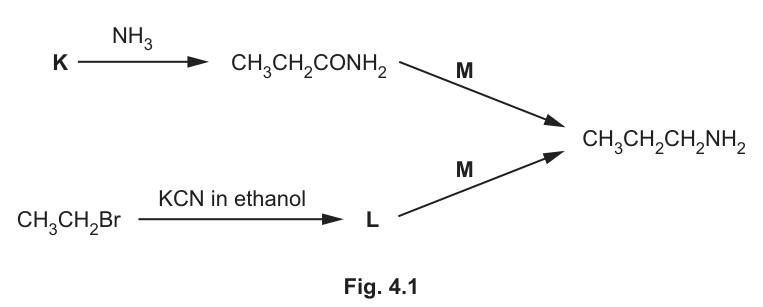
Identify compounds K and L and reagent M from Fig. 4.1.
Answer
- K: CH₃CH₂COCl (propanoyl chloride)
- L: CH₃CH₂CN (propanenitrile)
- M: LiAlH₄ (lithium tetrahydridoaluminate) or H₂ / Ni (hydrogen with nickel catalyst)
Background Concept
There are two common routes to synthesise primary amines from carboxylic acid derivatives or halogenoalkanes:
-
From Acyl Chlorides: An acyl chloride reacts with excess ammonia to form a primary amide. The amide can then be reduced to a primary amine using a strong reducing agent like LiAlH₄ or catalytic hydrogenation (H₂/Ni).
- Reaction: R-COCl + 2NH₃ → R-CONH₂ + NH₄Cl
- Reduction: R-CONH₂ + 4[H] → R-CH₂NH₂ + H₂O
-
From Halogenoalkanes: A halogenoalkane reacts with potassium cyanide (KCN) in ethanol to form a nitrile. The nitrile is then reduced to a primary amine.
- Reaction: R-Br + KCN → R-CN + KBr (Nucleophilic substitution)
- Reduction: R-CN + 4[H] → R-CH₂NH₂
Understanding the Question
Fig. 4.1 shows two pathways to synthesise propylamine (CH₃CH₂CH₂NH₂).
- Pathway 1: Compound K reacts with NH₃ to form propanamide (CH₃CH₂CONH₂). This implies K is an acyl chloride with a 3-carbon chain.
- Pathway 2: Bromoethane (CH₃CH₂Br) reacts with KCN to form compound L. This is a nucleophilic substitution extending the carbon chain by one. L is then reduced to propylamine.
- Reagent M: Used in both pathways to reduce the intermediate (amide or nitrile) to the amine.
Approach
- Identify K: Since K + NH₃ → propanamide (CH₃CH₂CONH₂), K must be propanoyl chloride (CH₃CH₂COCl). Reaction: CH₃CH₂COCl + 2NH₃ → CH₃CH₂CONH₂ + NH₄Cl.
- Identify L: CH₃CH₂Br + KCN → L. The CN group replaces Br. So L is propanenitrile (CH₃CH₂CN).
- Identify M: Both amides and nitriles are reduced to primary amines. Common reducing agents are LiAlH₄ (in dry ether, followed by acid workup) or H₂ with a Ni catalyst (high pressure/temp). LiAlH₄ is the standard A-level reagent for reducing amides and nitriles.
Step-by-Step Reasoning
- Compound K: The product is propanamide (CH₃CH₂CONH₂). The reaction with ammonia to form an amide typically involves an acyl chloride. Therefore, K is propanoyl chloride, CH₃CH₂COCl.
- Compound L: Bromoethane (CH₃CH₂Br) reacts with KCN. This is a nucleophilic substitution where CN⁻ replaces Br⁻. The product is propanenitrile, CH₃CH₂CN. Note the carbon chain increases from 2 to 3 carbons.
- Reagent M: Both propanamide and propanenitrile are converted to propylamine (CH₃CH₂CH₂NH₂). This is a reduction reaction. LiAlH₄ is a strong reducing agent capable of reducing both amides and nitriles to amines. Alternatively, catalytic hydrogenation (H₂ / Ni) can be used.
Key Takeaways
- Acyl chlorides react with ammonia to form amides.
- Halogenoalkanes react with cyanide ions to form nitriles (chain extension).
- Both amides and nitriles can be reduced to primary amines using LiAlH₄ or H₂/Ni.
Common Mistakes
- Identifying K as propanoic acid (reacts slowly with ammonia to form salt, not amide directly without heat; acyl chloride is the standard reagent).
- Identifying L as butanenitrile (wrong chain length; bromoethane has 2 carbons, KCN adds 1, total 3).
- Forgetting that M is a reducing agent (some students might suggest NaBH₄, which is too weak to reduce amides/nitriles to amines).
Things to Be Careful About
- Ensure the carbon count is correct: Propanamide has 3 carbons. Propanoyl chloride has 3 carbons.
- Bromoethane (2C) + KCN (1C) = Propanenitrile (3C).
- Reagent M must be a strong reducing agent (LiAlH₄) or catalytic hydrogenation.
Compound N is shown in Fig. 4.2.
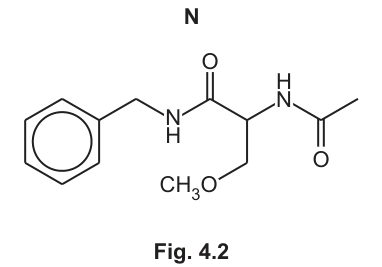
Compound N is treated with an excess of concentrated HCl(aq).
N undergoes complete hydrolysis to form three organic products.
The products are isolated from the reaction mixture at pH 4.
Draw the structures of the three organic products at pH 4.
Assume that the group does not react.
Answer
The three organic products at pH 4 are:
-
Benzylammonium ion:
(Benzene ring attached to CH₂-NH₃⁺)
-
Protonated amino acid derivative:
(HOOC-CH(CH₂OCH₃)-NH₃⁺)
-
Ethanoic acid:
(Note: At pH 4, amine groups are protonated to -NH₃⁺ and carboxylic acid groups remain as -COOH.)
Background Concept
Hydrolysis of Amides/Peptides:
Amide bonds (-CO-NH-) are hydrolysed by heating with aqueous acid (e.g., excess conc. HCl) or base. Acid hydrolysis produces carboxylic acids and ammonium salts (protonated amines).
- R-CO-NH-R' + H₂O + HCl → R-COOH + R'-NH₃⁺Cl⁻
Protonation States and pH:
- Carboxylic acids (-COOH): pKa ≈ 2-5. At pH < pKa, the group is protonated (-COOH). At pH > pKa, it is deprotonated (-COO⁻). At pH 4, a typical carboxylic acid (pKa ~2-4) will be partially protonated, but in the context of A-level questions with "excess acid" followed by isolation, we often consider the dominant species or follow the specific instruction. The mark scheme states "all acid groups as -COOH". This implies we treat pH 4 as acidic enough to keep COOH protonated, or simply that the hydrolysis produces COOH and at pH 4 it hasn't fully deprotonated (or we just draw the hydrolysis product). Actually, pKa of acetic acid is 4.76. At pH 4, [HA] > [A-]. So COOH is the major species. For the amino acid part, the carboxyl group has pKa ~2. At pH 4, it would be mostly COO-. However, the mark scheme explicitly says "all acid groups as -COOH". This is a specific instruction for the answer.
- Amines (-NH₂ / -NH-): pKa of conjugate acid (R-NH₃⁺) ≈ 9-11. At pH < pKa, the amine is protonated (-NH₃⁺ or -NH₂R⁺). At pH 4, all amine groups will be fully protonated.
Understanding the Question
Compound N is a peptide-like molecule: Benzene-CH₂-NH-CO-CH(CH₂OCH₃)-NH-CO-CH₃.
It is treated with excess conc. HCl (complete hydrolysis of amide bonds).
Products are isolated at pH 4.
We need to draw the three organic products at this pH.
Assumption: The ether group (CH₃O-) does not react.
Approach
- Hydrolyse the molecule: Break the amide bonds.
- Bond 1: Ph-CH₂-NH | CO-CH(...)
- Bond 2: ...CH(...) | NH-CO-CH₃
- Identify fragments:
- Fragment 1: Ph-CH₂-NH₂ (benzylamine). From acid hydrolysis, this becomes Ph-CH₂-NH₃⁺.
- Fragment 2: HOOC-CH(CH₂OCH₃)-NH₂ (an amino acid derivative). From acid hydrolysis, the amine becomes -NH₃⁺. So +H₃N-CH(CH₂OCH₃)-COOH.
- Fragment 3: CH₃COOH (ethanoic acid).
- Apply pH 4 conditions:
- Benzylamine (pKa ~9.4): At pH 4, it is protonated → Ph-CH₂-NH₃⁺.
- Amino acid part: Amine (pKa ~9) is protonated → -NH₃⁺. Carboxylic acid: Mark scheme says keep as -COOH.
- Ethanoic acid: Keep as -COOH.
Step-by-Step Reasoning
- Hydrolysis: The molecule has two amide linkages.
- Structure: Ph-CH₂-NH-CO-CH(CH₂OCH₃)-NH-CO-CH₃
- Hydrolysis breaks C-N bonds in amides.
- Left part: Ph-CH₂-NH₂ (becomes Ph-CH₂-NH₃⁺ in acid).
- Middle part: HOOC-CH(CH₂OCH₃)-NH₂ (becomes HOOC-CH(CH₂OCH₃)-NH₃⁺ in acid).
- Right part: HOOC-CH₃ (ethanoic acid, CH₃COOH).
- Protonation at pH 4:
- Benzylamine derivative: The amine group (pKa of conjugate acid ~9-10) will be protonated at pH 4. Structure: C₆H₅-CH₂-NH₃⁺.
- Amino acid derivative: The amine group on the central carbon will be protonated (-NH₃⁺). The carboxylic acid group: The mark scheme specifies "all acid groups as -COOH". So we draw HOOC-CH(CH₂OCH₃)-NH₃⁺. (Note: The ether group -OCH₃ remains unchanged).
- Ethanoic acid: CH₃COOH.
Key Takeaways
- Acid hydrolysis of amides/peptides yields carboxylic acids and ammonium ions (protonated amines).
- At acidic pH (like pH 4), amines are protonated (-NH₃⁺).
- Carboxylic acids may be protonated (-COOH) depending on pKa and specific question instructions (here, explicitly instructed to keep as -COOH).
Common Mistakes
- Drawing the products as neutral molecules (forgetting protonation of amines in acid hydrolysis).
- Drawing the carboxylic acid as carboxylate (-COO⁻) at pH 4 (mark scheme says -COOH).
- Breaking the wrong bonds (e.g., ether cleavage, which is not asked for / assumed not to happen).
- Missing the ether group in the middle product.
Things to Be Careful About
- Check the pH. pH 4 is acidic. Amines are definitely protonated.
- Follow the mark scheme instruction for acid groups: "all acid groups as -COOH".
- Ensure the ether linkage (CH₃O-) is preserved in the middle product.
Compound P can be synthesised from 1-methyl-4-nitrobenzene by the route shown in Fig. 4.3.
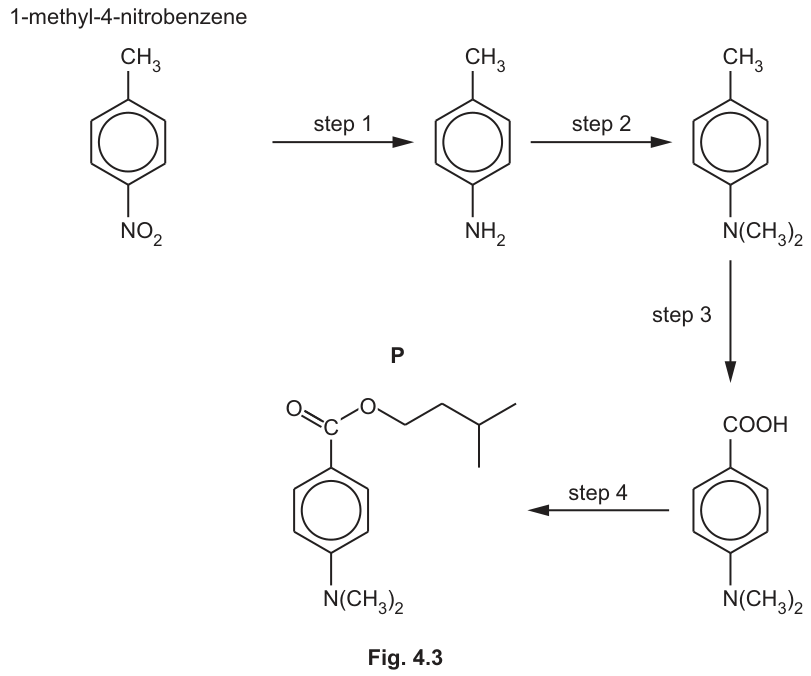
Step 1 is a reduction reaction.
Complete the equation for this reaction. Use [H] to represent an atom of hydrogen from the reducing agent.
Answer
Background Concept
Reduction of nitroarenes (nitrobenzene derivatives) to amines (phenylamines) is a standard reaction.
- Reagents: Tin (Sn) and concentrated hydrochloric acid (HCl), or Iron (Fe) and HCl, followed by neutralisation. Or catalytic hydrogenation (H₂/Ni).
- The nitro group (-NO₂) is reduced to an amino group (-NH₂).
- Using [H] to represent reducing agent (atoms of hydrogen):
- -NO₂ → -NH₂ requires addition of 6 hydrogen atoms and removal of 2 oxygen atoms (as water).
- Equation: R-NO₂ + 6[H] → R-NH₂ + 2H₂O.
Understanding the Question
Part (d)(i) asks to complete the equation for Step 1 in Fig 4.3.
- Reactant: 1-methyl-4-nitrobenzene (C₇H₇NO₂). Formula check: Benzene ring (C6) + CH3 + NO2. C6H4(CH3)(NO2) = C7H7NO2. Correct.
- Product: 1-methyl-4-aminobenzene (p-toluidine). Formula: C6H4(CH3)(NH2) = C7H9N. Wait. C7H7NH2 = C7H9N. The question writes product as C7H7NH2. Let's check atoms. Reactant C7H7NO2. Product C7H7NH2 (which is C7H9N). Difference: -O2 + 4H? No.
- Let's balance: C7H7NO2 + x[H] -> C7H7NH2 + yH2O.
- N: 1 -> 1.
- O: 2 -> 2y. So y=2.
- H: 7 + x = 7 + 2 + 2(2) = 11. x = 4? Wait.
- Reactant: C7H7NO2. (p-nitrotoluene). H count: 4 (ring) + 3 (methyl) = 7. Correct.
- Product: C7H7NH2. (p-toluidine). H count: 4 (ring) + 3 (methyl) + 2 (amine) = 9. Written as C7H7NH2 implies C7H9N.
- Equation: C7H7NO2 + 6[H] -> C7H7NH2 + 2H2O.
- Check H: 7 + 6 = 13. Right side: 7+2 (in NH2) + 4 (in 2H2O) = 13. Correct.
- Check O: 2 -> 2. Correct.
Approach
- Identify the change: -NO₂ becomes -NH₂.
- Balance oxygen: 2 O atoms become 2 H₂O.
- Balance hydrogen: Product has 2 extra H on N (NH2 vs NO2... wait. NO2 has no H. NH2 has 2 H. Water has 4 H. Total H needed on right side extra = 2+4=6. So 6[H].
Step-by-Step Reasoning
- Reactant: C₇H₇NO₂ (4-nitrotoluene).
- Product: C₇H₇NH₂ (4-methylaniline / p-toluidine).
- Reduction of nitro group: -NO₂ + 6[H] → -NH₂ + 2H₂O.
- Full equation: C₇H₇NO₂ + 6[H] → C₇H₇NH₂ + 2H₂O.
Key Takeaways
- Nitro group reduction: R-NO₂ + 6[H] → R-NH₂ + 2H₂O.
- Always check atom balance, especially H and O when using [H].
Common Mistakes
- Wrong number of [H] (e.g., 4[H] or 8[H]).
- Forgetting water as a product.
- Wrong formula for product.
Things to Be Careful About
- The question gives the product formula as C₇H₇NH₂. Be careful counting hydrogens.
- Ensure the equation is balanced.
Complete Table 4.1 to give details of each step of the synthesis shown in Fig. 4.3.
Table 4.1
| step | reagents and conditions | type of reaction |
|---|---|---|
| 1 | reduction | |
| 2 | ||
| 3 | ||
| 4 | condensation |
Answer
| step | reagents and conditions | type of reaction |
|---|---|---|
| 1 | Sn / conc. HCl (+ heat) | reduction |
| 2 | CH₃Br (or CH₃Cl / CH₃I) in ethanol | nucleophilic substitution |
| 3 | hot KMnO₄ (or hot MnO₄⁻ / H⁺) | oxidation |
| 4 | 3-methylbutan-1-ol (+ conc. H₂SO₄) | condensation |
(Note for Step 4: The alcohol is 3-methylbutan-1-ol, structure HOCH₂CH₂CH(CH₃)₂)
Background Concept
Step 1: Reduction of Nitroarene to Phenylamine
- Reagents: Tin (Sn) and concentrated HCl, or Iron (Fe) and HCl. Heat is usually required.
- Product: Phenylamine derivative (p-toluidine here).
Step 2: Alkylation of Amine
- Goal: Convert -NH₂ to -N(CH₃)₂.
- Reagents: Excess alkyl halide (e.g., CH₃Br or CH₃Cl) in ethanol, or sequential methylation. Since we want a tertiary amine (dimethylamino), we use methyl halide. Often excess CH₃Br is used to drive it to the tertiary amine, though mixtures can occur. In synthesis questions, CH₃Br / ethanol is the standard answer for N-methylation.
- Type: Nucleophilic substitution (amine acts as nucleophile, attacking alkyl halide).
Step 3: Side-chain Oxidation
- Goal: Convert -CH₃ on benzene ring to -COOH.
- Reagents: Hot alkaline or acidic potassium manganate(VII) (KMnO₄ / MnO₄⁻ / H⁺). Usually heated under reflux.
- Note: The amine group -N(CH₃)₂ is sensitive to oxidation, but in this context (A-level), we assume the side-chain oxidation proceeds. Actually, N,N-dimethyl-p-toluidine oxidation... the amine might get oxidised, but for the purpose of the exam question, we focus on the methyl to carboxyl conversion. Reagents: hot KMnO₄.
- Type: Oxidation.
Step 4: Esterification
- Goal: Convert -COOH to ester -COO-R.
- Reactant: 3-methylbutan-1-ol (from Fig 4.d.ii.4: HO-CH₂-CH₂-CH(CH₃)₂... wait, let's trace the structure in Fig 4.3 for P.
- P has ester group -O-CH₂-CH₂-CH(CH₃)-... wait. The image shows -O-CH₂-CH₂-CH(CH₃)₂? Let's look at Fig 4.d.ii.4. HO-CH₂-CH₂-CH(CH₃)-... it's a skeletal structure. HO-CH₂-CH₂-CH(CH₃)₂ is 3-methylbutan-1-ol. Yes.
- Reagents: Carboxylic acid + alcohol + catalyst (conc. H₂SO₄). Heat.
- Type: Condensation (or esterification).
Understanding the Question
Complete Table 4.1 for the synthesis of Compound P from 1-methyl-4-nitrobenzene.
- Step 1: Nitro to Amine.
- Step 2: Amine to Dimethylamine.
- Step 3: Methyl to Carboxylic Acid.
- Step 4: Carboxylic Acid to Ester.
Approach
- Step 1: Standard nitro reduction. Sn/HCl.
- Step 2: N-alkylation. CH₃Br / ethanol. Type: Substitution.
- Step 3: Side chain oxidation. KMnO₄ / heat. Type: Oxidation.
- Step 4: Esterification. Alcohol (3-methylbutan-1-ol) + acid catalyst. Type: Condensation.
Step-by-Step Reasoning
- Step 1: Reactant is 1-methyl-4-nitrobenzene. Product is 1-methyl-4-aminobenzene. Reagents: Sn and conc. HCl (with heat). Type is given as reduction.
- Step 2: Reactant is 1-methyl-4-aminobenzene (-NH₂). Product is 1-methyl-4-(dimethylamino)benzene (-N(CH₃)₂). This requires methylation. Reagents: CH₃Br (or CH₃Cl, CH₃I) in ethanol. Type: Nucleophilic substitution (the lone pair on N attacks the methyl halide).
- Step 3: Reactant has a methyl group on the ring and a dimethylamino group. Product has a carboxylic acid group (-COOH) where the methyl was. The dimethylamino group remains. Reagents: Hot KMnO₄ (or hot MnO₄⁻ with acid). Type: Oxidation.
- Step 4: Reactant is 4-(dimethylamino)benzoic acid. Product P is an ester. The alcohol part comes from Fig 4.d.ii.4, which is 3-methylbutan-1-ol (skeletal: HO-CH₂-CH₂-CH(CH₃)₂... wait, let's look at the structure in Fig 4.3 for P. The ester alkyl chain is -O-CH₂-CH₂-CH(CH₃)-... actually it looks like -O-CH₂-CH₂-CH(CH₃)₂. Yes, 3-methylbutan-1-ol. Reagents: 3-methylbutan-1-ol + conc. H₂SO₄ (catalyst). Type: Condensation (esterification is a type of condensation).
Key Takeaways
- Nitroarenes are reduced to amines with Sn/HCl.
- Amines can be alkylated with haloalkanes (nucleophilic substitution).
- Alkyl side chains on benzene rings (with at least one H on the benzylic carbon) are oxidised to carboxylic acids by hot KMnO₄.
- Carboxylic acids react with alcohols in the presence of acid catalyst to form esters (condensation).
Common Mistakes
- Step 2: Using CH₃OH (methanol) instead of CH₃Br (methyl bromide). Alcohols don't alkylate amines easily without special conditions; haloalkanes are standard.
- Step 3: Forgetting "hot" or "reflux" for KMnO₄ oxidation.
- Step 4: Forgetting the acid catalyst (conc. H₂SO₄) or the specific alcohol name/structure.
- Reaction types: Calling esterification "addition" (it's condensation/elimination of water).
Things to Be Careful About
- Step 2 reagents: CH₃Br / ethanol is correct. Just "CH₃Br" might not be enough if conditions are required, but "in ethanol" covers it.
- Step 3: KMnO₄ must be hot/concentrated to oxidise the side chain completely to COOH.
- Step 4: The alcohol is 3-methylbutan-1-ol. Ensure the structure matches the ester in P.
Cumene is an aromatic hydrocarbon used in the synthesis of other useful chemicals.
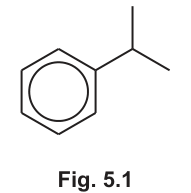
Complete Table 5.1 to show the number of and hybridised carbon atoms that are present in a molecule of cumene.
Table 5.1
| type of hybridisation | ||
|---|---|---|
| number of carbon atoms |
Answer
| type of hybridisation | ||
|---|---|---|
| number of carbon atoms | 6 | 3 |
sp2 = 6, sp3 = 3
Background Concept
Hybridisation describes how atomic orbitals mix to form new hybrid orbitals used in bonding. Carbon with three regions of electron density (trigonal planar geometry, as in a benzene ring where each carbon forms two bonds and contributes one electron to the system) is hybridised. Carbon with four regions of electron density (tetrahedral geometry, as in saturated and single bonds) is hybridised.
Understanding the Question
The question asks you to count the number of carbon atoms of each hybridisation type in a single molecule of cumene (isopropylbenzene), whose structure is given in Fig. 5.1. The molecule consists of a benzene ring bonded to an isopropyl group .
Approach
Examine each carbon atom and determine how many -bonding regions it has. Ring carbons each have three regions (two C–C bonds and one C–H or C–C bond to the substituent), so they are . The three carbons in the isopropyl group each have four single bonds, so they are .
Step-by-Step Reasoning
Benzene ring: The six carbon atoms in the aromatic ring each participate in the delocalised system. Each ring carbon forms three bonds (to two neighbouring ring carbons and to either a hydrogen or the substituent), giving trigonal planar geometry. All six are hybridised.
Isopropyl group: The central carbon of forms four bonds (one to the ring, one to H, two to methyl carbons) — . Each of the two carbons also forms four bonds (one to the central carbon, three to H) — . Total carbons = 3.
Key Takeaways
- Aromatic ring carbons are always hybridised.
- Saturated alkyl carbons (only single bonds) are hybridised.
- Count carefully: the carbon bonded to the ring from the side chain is , not .
Common Mistakes
- Counting the carbon attached to the ring as — it is because it forms four single bonds.
- Forgetting that the ring carbon bonded to the substituent is still (it retains its -system participation).
- Miscounting the total number of carbons (cumene has 9 carbons total: 6 + 3).
Things to Be Careful About
- The question asks for the number of carbon atoms of each type, not the total number of atoms or bonds.
- Ensure you have identified the correct structure from Fig. 5.1 — it is isopropylbenzene, not propylbenzene.
Cumene can be synthesised via a Friedel–Crafts alkylation reaction, as shown in Fig. 5.2.
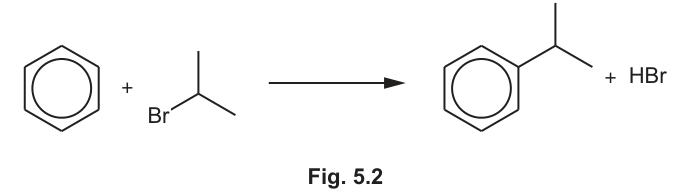
Answer
Electrophilic substitution (electrophilic aromatic substitution)
Electrophilic substitution
Background Concept
Friedel–Crafts alkylation is a method of attaching an alkyl group to an aromatic ring. The reaction proceeds via electrophilic aromatic substitution: a carbocation electrophile is generated, attacks the electron-rich system of benzene, forms a sigma complex (arenium ion) intermediate, and then loses a proton to restore aromaticity.
Understanding the Question
The question simply asks you to name the mechanism type. Fig. 5.2 shows benzene reacting with 2-bromopropane in the presence of a catalyst to form cumene and HBr — this is the classic Friedel–Crafts alkylation.
Approach
Recognise that Friedel–Crafts alkylation is a specific example of electrophilic aromatic substitution, where an electrophile (here, a carbocation) replaces a hydrogen on the aromatic ring.
Step-by-Step Reasoning
The mechanism involves:
- Generation of an electrophile (the carbocation) from the haloalkane using a Lewis acid catalyst.
- Attack of the electrophile on the electrons of benzene.
- Loss of to restore aromaticity.
This sequence is the definition of electrophilic substitution on an aromatic ring.
Key Takeaways
- All Friedel–Crafts reactions (both alkylation and acylation) proceed via electrophilic aromatic substitution.
- The key feature is that the aromatic ring acts as a nucleophile attacking an electrophile, and a hydrogen is substituted (not added across the ring).
Common Mistakes
- Writing "nucleophilic substitution" — benzene is electron-rich and acts as a nucleophile; the reaction is electrophilic substitution.
- Writing "addition" — the ring is not permanently broken; aromaticity is restored.
Things to Be Careful About
- The full accepted name is "electrophilic substitution" or "electrophilic aromatic substitution." Either is creditable.
The first step of the reaction forms the cation.
Identify a suitable reagent for the formation of this cation from 2-bromopropane, .
Answer
(aluminium bromide)
AlBr3
Background Concept
In Friedel–Crafts alkylation, a Lewis acid catalyst is needed to polarise and ultimately cleave the C–Br bond of the haloalkane, generating a carbocation electrophile. Aluminium halides (typically or ) serve this role by accepting a lone pair from the halogen, weakening the C–X bond.
Understanding the Question
The question states that the first step forms the cation from 2-bromopropane. You need to identify the reagent that facilitates this ionisation.
Approach
Since the haloalkane is a bromoalkane (contains Br), the appropriate aluminium halide catalyst is . (If it were a chloroalkane, would be used.)
Step-by-Step Reasoning
The mechanism of electrophile generation:
is a Lewis acid (electron-pair acceptor). The lone pair on bromine coordinates to the aluminium, polarising and breaking the C–Br bond, releasing the secondary carbocation.
Key Takeaways
- The catalyst in Friedel–Crafts alkylation must match the halogen in the haloalkane: for chloroalkanes, for bromoalkanes.
- The role of the catalyst is to generate the electrophile (carbocation).
Common Mistakes
- Writing when the substrate is a bromoalkane — while might still function, is the correct choice for a bromo substrate.
- Writing "concentrated sulfuric acid" or "" — these are catalysts for other reactions.
Things to Be Careful About
- The question asks for a "suitable reagent" — the name "aluminium bromide" or the formula are both acceptable.
Complete Fig. 5.3 to show the mechanism for the reaction of benzene with the cation.
Include all relevant curly arrows and charges.
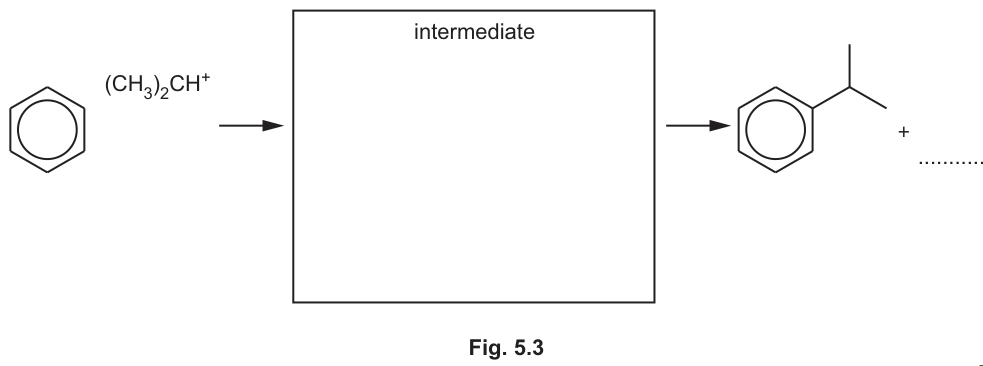
Answer
Curly arrow from ring to C+ of electrophile; intermediate with H and CH(CH3)2 on same carbon with delocalised positive charge in ring; curly arrow from C-H bond into ring with loss of H+
Background Concept
Electrophilic aromatic substitution proceeds in two stages. In the first stage, the electrons of the aromatic ring attack the electrophile, forming a new C–C bond. This destroys the aromaticity and produces a positively charged intermediate called the sigma complex (or arenium ion), in which the positive charge is delocalised over three carbon atoms (ortho and para positions relative to the site of attack). In the second stage, a base (often the or a solvent molecule) removes the proton from the carbon bearing the electrophile, and the C–H bond electrons return to the ring, restoring aromaticity.
Understanding the Question
Fig. 5.3 provides a template: benzene + → [intermediate box] → cumene + ___. You must fill in the intermediate structure, draw the curly arrows for both steps, and identify the by-product ().
Approach
- Draw a curly arrow from the delocalised system (inside the hexagon) to the positively charged carbon of .
- Draw the intermediate: the ring now has one carbon bearing both H and , with a positive charge delocalised over the remaining five carbons (shown as a horseshoe with a + sign, or by drawing the three resonance structures).
- Draw a curly arrow from the C–H bond (on the carbon) back into the ring, and write as the product.
Step-by-Step Reasoning
M1 — Curly arrow from ring to electrophile: The arrow starts from inside the hexagon (representing the electrons) and points towards the carbon atom of that bears the positive charge. This shows the ring acting as a nucleophile.
M2 — Intermediate structure: The carbon that was attacked is now hybridised, bonded to H and . The positive charge is delocalised over the other five ring carbons — typically drawn as a horseshoe (arc) inside the ring with a + sign, or by showing the three contributing resonance forms. The ring is no longer fully aromatic.
M3 — Curly arrow from C–H into ring and loss of H⁺: A curly arrow starts from the C–H bond on the carbon and points into the ring (towards the adjacent C–C bond), showing the electrons returning to the system. is written as the by-product, restoring aromaticity.
Key Takeaways
- The intermediate is a sigma complex (arenium ion) with delocalised positive charge.
- The curly arrow convention: from electron source to electron destination.
- Aromaticity is temporarily lost and then restored.
Common Mistakes
- Drawing the curly arrow from the electrophile to the ring (wrong direction — arrows go from electrons to where they are going).
- Forgetting to show the positive charge on the intermediate, or placing it on the wrong carbon.
- Drawing the intermediate with a full benzene ring (aromatic) rather than showing the disrupted system.
- Not showing the C–H bond curly arrow for the second step.
Things to Be Careful About
- The intermediate must show that one carbon is (bonded to both H and the electrophile group).
- The positive charge must be delocalised (horseshoe + or resonance structures), not localised on one carbon.
- The by-product is , not or anything else.
The Friedel–Crafts alkylation of benzene by 1-bromopropane, , also produces cumene as the major product.
The cation formed in the first step quickly rearranges to form the cation.
Suggest why this is the case. Explain your answer.
Answer
The cation is a secondary () carbocation, which is more stable than the primary () cation because it has a greater positive inductive effect from two alkyl groups (which donate electron density towards the electron-deficient carbon).
The secondary carbocation (CH3)2CH+ is more stable than the primary carbocation due to the greater positive inductive effect of two alkyl groups
Background Concept
Carbocations are electron-deficient species (the positively charged carbon has only six electrons in its valence shell). Their stability increases with the number of alkyl groups attached to the centre. This is because alkyl groups exhibit a positive inductive effect (): they push electron density towards the electron-deficient carbon, partially dispersing the positive charge. The stability order is: tertiary secondary primary methyl.
Understanding the Question
When 1-bromopropane undergoes Friedel–Crafts alkylation, the initially formed primary carbocation rearranges to the secondary carbocation . You need to explain why this rearrangement occurs.
Approach
Compare the stability of the two carbocations. The secondary carbocation has two alkyl groups donating electron density to the positive centre, compared to only one alkyl group in the primary carbocation. The more stable carbocation is favoured.
Step-by-Step Reasoning
- is a primary () carbocation with one alkyl group providing a positive inductive effect.
- is a secondary () carbocation with two alkyl groups providing a greater positive inductive effect.
- The secondary carbocation is more stable because the positive charge is better dispersed by the electron-donating effect of two methyl groups.
- Therefore, a hydride shift (migration of from the adjacent carbon) converts the less stable primary cation to the more stable secondary cation.
Key Takeaways
- Carbocation stability: .
- The positive inductive effect of alkyl groups stabilises the electron-deficient carbon.
- Rearrangements occur to form more stable intermediates.
Common Mistakes
- Saying "more alkyl groups means more electrons" without specifying the inductive effect.
- Confusing the inductive effect with hyperconjugation (though both contribute, the mark scheme specifically asks for the positive inductive effect).
- Saying "tertiary" when the product is secondary.
Things to Be Careful About
- The question asks you to both suggest WHY and EXPLAIN, so you must state that the secondary cation is more stable AND give the reason (greater positive inductive effect).
Cumene oxidises in air to form phenol, , and propanone, .
Table 5.2 gives some relevant standard entropies for reaction 1.
Table 5.2
| compound | ||||
|---|---|---|---|---|
| standard entropy, | 278 | 205 | 146 | 200 |
Working
Answer
-137 J K^-1 mol^-1
Background Concept
The standard entropy change of a reaction is calculated using the formula:
Entropy is a measure of the number of ways energy can be distributed among particles. A negative indicates a decrease in disorder, which can occur when fewer moles of gas are produced than consumed, or when more complex molecules break into fewer products.
Understanding the Question
You are given the standard entropies of all four species in the reaction:
You must calculate for this reaction.
Approach
Identify products and reactants, sum their standard entropies, and subtract reactants from products.
Step-by-Step Reasoning
Products: () and ()
Reactants: () and ()
Entropy change:
The negative sign is chemically sensible: one mole of gaseous is consumed (gases have high entropy), and the products are both liquids/solids with lower entropy than the reactant cumene.
Key Takeaways
- Always use products minus reactants.
- The unit is (not ).
- A negative is expected when a gas is consumed.
Common Mistakes
- Reversing the subtraction (reactants minus products), giving .
- Forgetting the negative sign.
- Using kJ instead of J (the values in the table are in ).
Things to Be Careful About
- The answer must include units: .
- Ensure you include all species from the balanced equation (each has coefficient 1 here).
Working
Answer
Since (negative), reaction 1 is feasible at .
ΔG = -330 kJ mol^-1, which is negative, so the reaction is feasible
Background Concept
The Gibbs free energy change determines whether a reaction is thermodynamically feasible (spontaneous) at a given temperature:
If , the reaction is feasible. If , it is not feasible under those conditions. Temperature must be in Kelvin, and and must be in consistent units (both kJ or both J).
Understanding the Question
You must show that reaction 1 is feasible at , given and (from part c(i)).
Approach
- Convert temperature to Kelvin: .
- Convert from to : .
- Substitute into .
- State that , so the reaction is feasible.
Step-by-Step Reasoning
Step 1 — Temperature conversion:
Step 2 — Unit conversion:
Step 3 — Substitution:
Step 4 — Conclusion:
Since is negative (), the reaction is thermodynamically feasible at .
Note: The large negative dominates over the unfavourable (negative) term, making negative even at this temperature.
Key Takeaways
- Always check units: in kJ, in J must be converted to match.
- Temperature must be in Kelvin.
- A reaction can be feasible even with a negative if is sufficiently negative.
Common Mistakes
- Using instead of .
- Forgetting to convert from J to kJ, giving (absurd positive value).
- Stating only the numerical answer without the conclusion about feasibility.
- Mark scheme note: ecf from part c(i) is allowed, so if your was wrong but used correctly here, you can still earn M2.
Things to Be Careful About
- The sign when substituting: where is negative gives , so .
- You must state the conclusion explicitly: "feasible because ."
- The question says "show that" — you must present the calculation clearly, not just state the answer.
Fig. 5.4 shows two reactions of phenol.
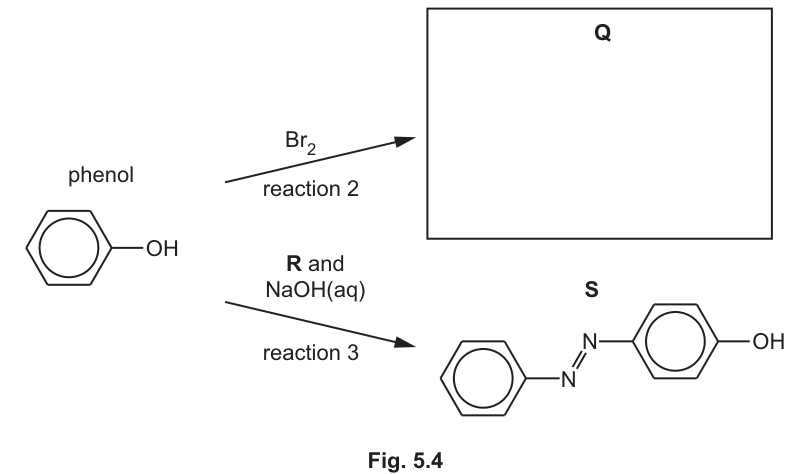
State the conditions for the bromination of phenol in reaction 2.
Explain why these conditions are different from those for the bromination of benzene.
Answer
Conditions for bromination of phenol:
- Use aqueous bromine (bromine water)
- No catalyst () is needed
- Room temperature
Why these conditions differ from benzene:
- The lone pair on the oxygen atom of the group overlaps with (is delocalised into) the system of the ring
- This increases the electron density in the ring, making it more electron-rich
- The ring can therefore polarise (the electrophile) more effectively, so no catalyst is required
Aqueous bromine (bromine water), no AlBr3 catalyst needed. The lone pair on oxygen delocalises into the pi system, increasing electron density in the ring, making it more reactive towards electrophiles and able to polarise Br2 without a catalyst.
Background Concept
Phenol is significantly more reactive towards electrophilic substitution than benzene. This is because the group is an activating group: the lone pair on the oxygen atom can overlap with the system of the aromatic ring (p- conjugation), donating electron density into the ring. This makes the ring more nucleophilic and able to attract and polarise electrophiles more effectively, reducing the need for a strong catalyst.
In contrast, benzene has no activating substituent, so it requires a Lewis acid catalyst ( or ) to generate a sufficiently strong electrophile () from .
Understanding the Question
The question has two parts: (1) state the conditions for bromination of phenol, and (2) explain why these are milder than those for benzene. You need four marking points: conditions, orbital overlap, increased electron density, and enhanced polarisation.
Approach
First, state the conditions clearly (bromine water, no catalyst). Then build the explanation logically: lone pair on O → overlap with ring system → increased electron density → ring polarises more easily → no catalyst needed.
Step-by-Step Reasoning
M1 — Conditions: Phenol reacts with aqueous bromine (bromine water) at room temperature without any catalyst. This contrasts with benzene, which requires anhydrous with an or catalyst.
M2 — Orbital overlap: The oxygen atom in the group has lone pairs of electrons in p-orbitals. One of these p-orbitals overlaps with the system of the aromatic ring, allowing delocalisation of electron density from oxygen into the ring.
M3 — Increased electron density: This delocalisation increases the electron density in the ring (particularly at the ortho and para positions), making the ring more nucleophilic and more attractive to electrophiles.
M4 — Polarisation of electrophile: Because the ring is more electron-rich, it can polarise the molecule more effectively. The induced dipole in is sufficient for the ring to attack, so no catalyst is needed to generate a full electrophile.
Key Takeaways
- The group activates the ring towards electrophilic substitution.
- The mechanism of activation is p- overlap (lone pair delocalisation).
- Phenol is so reactive that it undergoes tribromination (all ortho and para positions substituted) with bromine water.
- The logical chain: lone pair → overlap → electron density → polarisation → no catalyst needed.
Common Mistakes
- Saying "phenol has a lone pair" without specifying it is on the oxygen and that it overlaps with the ring system.
- Saying "phenol is more reactive" without explaining WHY (the orbital overlap mechanism).
- Confusing this with the inductive effect — the key effect here is resonance/delocalisation, not inductive.
- Stating conditions as "Br2 with FeBr3" (that is for benzene, not phenol).
Things to Be Careful About
- You must mention BOTH the orbital overlap AND the consequence (increased electron density) — they are separate marks.
- "No catalyst needed" is part of the conditions mark, not a separate point.
- The explanation must link back to why bromination of phenol is easier than bromination of benzene.
Answer
2,4,6-tribromophenol
2,4,6-tribromophenol
Background Concept
Phenol is so activated towards electrophilic substitution that it undergoes multiple substitutions with bromine water. The group is strongly activating and ortho/para-directing, so all three available ortho and para positions (2, 4, and 6) are substituted by bromine in a single reaction with excess bromine water. The product is 2,4,6-tribromophenol, a white precipitate.
Understanding the Question
You are asked to draw the structure of compound Q, the product of reaction 2 (phenol + ).
Approach
Since phenol is highly activated, bromination occurs at all ortho and para positions simultaneously. Draw a benzene ring with at position 1 and at positions 2, 4, and 6.
Step-by-Step Reasoning
- The group directs incoming electrophiles to the ortho (2, 6) and para (4) positions.
- With bromine water (excess ), all three positions react.
- The product is 2,4,6-tribromophenol: a benzene ring with at C1, and at C2, C4, and C6.
Key Takeaways
- Phenol + bromine water gives 2,4,6-tribromophenol (white precipitate) — this is a test for phenol.
- The group is ortho/para-directing and strongly activating.
- Unlike benzene, phenol does not require a catalyst and gives multiple substitution.
Common Mistakes
- Drawing only mono-bromination (4-bromophenol) — phenol with bromine water gives the tri-substituted product.
- Placing bromines at meta positions.
- Forgetting to include the group.
Things to Be Careful About
- Draw all atoms and bonds clearly if the question asks for a displayed formula; a structural formula showing the ring with Br and OH substituents is acceptable.
- Ensure the bromines are at the correct positions (2, 4, 6 relative to OH at position 1).
Answer
Benzenediazonium chloride ()
Benzenediazonium chloride
Background Concept
Azo coupling is a reaction between a diazonium salt and an activated aromatic compound (such as phenol or an aromatic amine) to form an azo compound containing the linkage. The diazonium ion acts as a weak electrophile and attacks the electron-rich ring of phenol at the para position (or ortho if para is blocked). The reaction is carried out in alkaline solution (NaOH) to generate the phenoxide ion, which is even more reactive than phenol itself.
Understanding the Question
Fig. 5.4 shows phenol reacting with reagent R and NaOH(aq) to form compound S, which is 4-hydroxyphenylazobenzene. You must identify R.
Approach
The product S contains an azo group () linking a phenol ring to a benzene ring. This is a classic azo coupling product. The reagent R must be a diazonium salt — specifically benzenediazonium chloride, which provides the electrophile.
Step-by-Step Reasoning
- Compound S is 4-hydroxyphenylazobenzene: .
- The portion comes from the diazonium salt.
- The portion comes from phenol.
- Therefore R = benzenediazonium chloride ().
- NaOH(aq) converts phenol to the phenoxide ion, making it more reactive towards the weak electrophile.
Key Takeaways
- Azo coupling requires a diazonium salt and an activated aromatic compound.
- The reaction is done in alkaline conditions to generate the more reactive phenoxide ion.
- Benzenediazonium chloride is the standard reagent for coupling with phenol.
Common Mistakes
- Writing "aniline" (the precursor to the diazonium salt, not the coupling reagent itself).
- Writing "nitrosobenzene" or other nitrogen-containing compounds.
- Not specifying that it is the chloride salt (though the cation structure alone may be accepted).
Things to Be Careful About
- The full name "benzenediazonium chloride" or the structure of the benzenediazonium cation are both acceptable.
- The diazonium ion is (positive charge on the nitrogen attached to the ring).
Answer
Azo group ()
Azo
Background Concept
The linkage connecting two aromatic rings is called the azo group. Compounds containing this group are called azo compounds, and many are intensely coloured, making them useful as dyes (azo dyes). The name comes from the French word for nitrogen.
Understanding the Question
Reaction 3 produces compound S (4-hydroxyphenylazobenzene), which contains the linkage between two aromatic rings. You are asked to name this functional group.
Approach
Identify the group in the structure of S and name it.
Step-by-Step Reasoning
Looking at compound S in Fig. 5.4: . The group is the azo functional group.
Key Takeaways
- The azo group is (a nitrogen-nitrogen double bond linking two carbon-containing groups).
- Azo compounds are often coloured and used as dyes.
Common Mistakes
- Calling it a "diazo group" — the diazo group () is found in diazonium salts; the azo group () is the linkage in the coupling product.
- Writing "nitrogen group" or "imine" — these are incorrect.
Things to Be Careful About
- The answer is simply "azo" — no need for elaborate description.
The reaction of phenol with produces a mixture of isomers with molecular formula .
Identify the two isomers that are produced in the largest quantities.
Explain your answer.
Answer
The two isomers produced in the largest quantities are 2-nitrophenol (ortho) and 4-nitrophenol (para).
The group is an electron-donating group (lone pair on oxygen delocalises into the ring system), so it directs incoming electrophiles to the ortho and para positions.
2-nitrophenol and 4-nitrophenol; the -OH group is electron-donating and directs to ortho and para positions
Background Concept
When phenol undergoes electrophilic substitution, the group acts as an activating, ortho/para-directing substituent. This is because the lone pair on oxygen is delocalised into the ring system, increasing electron density specifically at the ortho and para positions. When phenol reacts with dilute nitric acid, a mixture of 2-nitrophenol (ortho) and 4-nitrophenol (para) is formed as the major products.
Understanding the Question
You are told that phenol + gives a mixture of isomers with molecular formula (mononitrophenols). You must identify the two isomers formed in the largest quantities and explain why.
Approach
The group directs electrophilic substitution to the ortho (position 2) and para (position 4) positions. Therefore the two major products are 2-nitrophenol and 4-nitrophenol.
Step-by-Step Reasoning
- The molecular formula corresponds to a mononitrophenol (one group replacing one on the ring).
- Possible isomers: 2-nitrophenol (ortho), 3-nitrophenol (meta), 4-nitrophenol (para).
- The group donates electron density into the ring via its lone pair (resonance effect), increasing electron density at ortho and para positions.
- Therefore the electrophile () preferentially attacks at positions 2 and 4.
- The two major products are 2-nitrophenol and 4-nitrophenol.
Key Takeaways
- is an ortho/para director because it is electron-donating by resonance.
- Meta products are minor because the meta position does not benefit from the increased electron density.
- This directing effect applies to all electrophilic substitutions of phenol (nitration, bromination, etc.).
Common Mistakes
- Including 3-nitrophenol as a major product (it is the minor product).
- Saying "the group is electron-withdrawing" — it is electron-donating by resonance (though the oxygen is electronegative, the lone pair donation dominates).
- Confusing the directing effect with the inductive effect.
Things to Be Careful About
- You must give BOTH the structures/names AND the explanation (the group is electron-donating and ortho/para-directing).
- The question asks for the two isomers "produced in the largest quantities" — these are the ortho and para products.
Maleic anhydride is an unsaturated cyclic compound used in the formation of several polymers.
Maleic anhydride can be used to form maleic acid and tartaric acid.
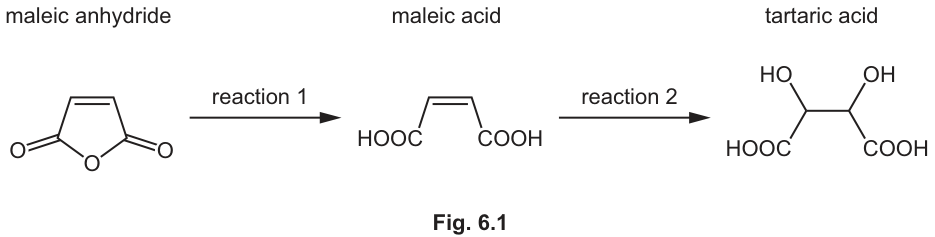
Maleic acid reacts with ethane-1,2-diol to form a condensation polymer.
Draw a section of this polymer, showing only one repeat unit.
The new functional group formed should be shown fully displayed.
Answer
The repeat unit is:
with the ester group shown fully displayed (all bonds to oxygen drawn explicitly).
See diagram — repeat unit of polyester from maleic acid and ethane-1,2-diol with fully displayed ester linkage
Background Concept
Condensation polymerisation occurs between monomers bearing two complementary functional groups (e.g. a dicarboxylic acid and a diol), with the elimination of a small molecule (usually water) at each linkage. When a diacid reacts with a diol, the product is a polyester, with ester linkages () joining the monomer units.
Understanding the Question
Maleic acid is (a dicarboxylic acid with a double bond in the chain). Ethane-1,2-diol is . The question asks for one repeat unit of the condensation polymer, with the new functional group (the ester) fully displayed.
Approach
Identify that the reaction is between groups and groups to form ester linkages. Each repeat unit contains one maleic acid residue and one diol residue joined by two ester bonds (one at each end). Draw the repeat unit in brackets with bonds extending through the brackets.
Step-by-Step Reasoning
- Maleic acid has two groups; ethane-1,2-diol has two groups.
- Each reacts with an to form an ester linkage , losing .
- The repeat unit is:
- The ester group must be fully displayed: show the double bond and the single bond explicitly.
- The double bond from maleic acid remains in the polymer backbone.
Key Takeaways
- A diacid + diol gives a polyester.
- The repeat unit must show both ester linkages (one at each end of the maleic acid residue).
- "Fully displayed" means showing all bonds to the ester oxygen atoms.
Common Mistakes
- Drawing only one ester linkage per repeat unit.
- Not showing the double bond in the maleic acid portion.
- Forgetting brackets around the repeat unit with bonds extending through them.
- Not fully displaying the ester group (e.g. writing without showing the bond separately).
Things to Be Careful About
- The question specifies ONE repeat unit only.
- The ester group must be fully displayed (all bonds shown), while the rest can be in skeletal form.
- State symbols are not required for polymer structures.
Answer
Cold, dilute, acidified (or cold, dilute ).
Cold, dilute, acidified KMnO4
Background Concept
The conversion of maleic acid (which contains a double bond) to tartaric acid (which has two groups on adjacent carbons) is a syn-dihydroxylation of an alkene. The classic reagent for this in A-level chemistry is cold, dilute, acidified potassium manganate(VII), which adds two hydroxyl groups across the double bond.
Understanding the Question
Reaction 2 converts the in maleic acid into two groups in tartaric acid. The question asks for a suitable reagent and conditions.
Approach
Recognise the transformation: alkene → vicinal diol. This is oxidation by cold, dilute . The key conditions are cold and dilute (if hot and concentrated, cleavage of the double bond would occur).
Step-by-Step Reasoning
- Maleic acid:
- Tartaric acid:
- The has been converted to with an on each carbon.
- This is syn-dihydroxylation, achieved by cold, dilute, acidified .
- If the were hot and concentrated, oxidative cleavage would break the entirely, giving different products.
Key Takeaways
- Cold, dilute adds two groups across a (syn-dihydroxylation).
- Hot, concentrated cleaves the bond.
- The purple colour of is discharged (decolourised) as is formed.
Common Mistakes
- Writing "hot, concentrated " (this would cleave the double bond).
- Writing only "" without specifying cold and dilute.
- Confusing this with bromine water (which adds , not ).
Things to Be Careful About
- The conditions must include "cold" and "dilute" to earn the mark.
- "Acidified" is often included but the mark scheme accepts the reagent name alone.
Compound U can be formed from tartaric acid in two steps, as shown in Fig. 6.2.
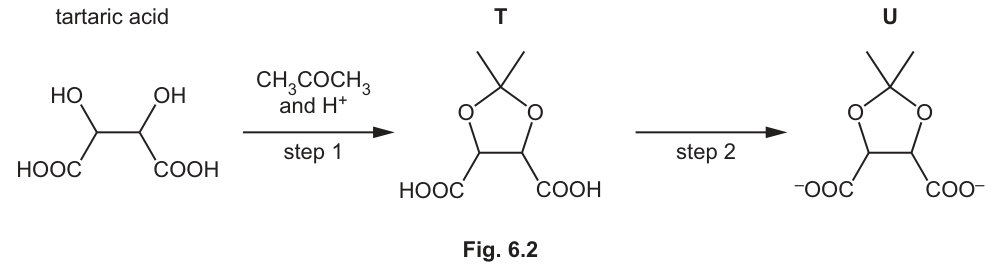
Answer
Condensation (or dehydration or elimination).
Condensation
Background Concept
When a ketone (propanone) reacts with two alcohol groups on adjacent carbons (as in tartaric acid), a cyclic acetal (ketal) is formed with the elimination of a molecule of water. This is a condensation reaction — two molecules join with the loss of a small molecule (). It can also be described as dehydration (loss of water) or elimination.
Understanding the Question
Tartaric acid has two groups on adjacent carbons. Propanone () reacts with these to form compound T, which has a five-membered ring containing two oxygen atoms and a carbon bearing two methyl groups (an isopropylidene ketal/acetal). Water is lost in the process.
Approach
Compare the structures: tartaric acid + propanone → T + . Two molecules combine with loss of a small molecule = condensation.
Step-by-Step Reasoning
- Tartaric acid has two adjacent groups.
- Propanone has a group.
- The two groups react with the , forming two bonds and a five-membered ring.
- One molecule of is eliminated.
- This is a condensation reaction (also acceptable: dehydration or elimination).
Key Takeaways
- Acetal/ketal formation from a diol + ketone is a condensation reaction.
- The acts as an acid catalyst.
- "Condensation" in this context does not necessarily mean polymerisation — it simply means two molecules join with loss of a small molecule.
Common Mistakes
- Writing "addition" (the is not simply added across; water is lost).
- Writing "substitution" (no atom is replaced by another).
Things to Be Careful About
- The mark scheme accepts condensation, dehydration, or elimination — any one of these.
Answer
A bidentate ligand is a species with two lone pairs of electrons that forms two dative (coordinate) bonds to a central transition metal atom/ion.
A species with two lone pairs that forms two dative (coordinate) bonds to a central transition metal atom/ion
Background Concept
In coordination chemistry, ligands are species that donate lone pairs of electrons to a central metal ion to form coordinate (dative) bonds. The number of coordinate bonds a ligand can form to the metal defines its denticity: monodentate (one bond), bidentate (two bonds), tridentate (three bonds), etc. Bidentate ligands such as ethane-1,2-diamine (), ethanedioate (), and water in certain contexts form two bonds to the same metal centre.
Understanding the Question
The question asks for the meaning of "bidentate ligand" in the context of compound U acting as a ligand to . Two marks are available, so two distinct points must be made.
Approach
Define both aspects: (1) the ligand has two lone pairs available for donation, and (2) it forms two dative/coordinate bonds to the central metal ion.
Step-by-Step Reasoning
- A ligand is a species that donates electron pairs to a metal ion.
- "Bi-dentate" means "two-toothed" — the ligand attaches at two points.
- It has two lone pairs of electrons available for donation.
- It forms two dative (coordinate) bonds to a central transition metal atom/ion.
- Both points are needed for full marks.
Key Takeaways
- A bidentate ligand forms exactly two coordinate bonds to one metal centre.
- The word "dative" or "coordinate" is essential — it specifies the type of bond.
- The metal must be identified as a transition element (or metal atom/ion).
Common Mistakes
- Omitting "dative" or "coordinate" (writing just "bonds" loses the mark).
- Saying "two bonds to different metal ions" (both bonds go to the SAME metal centre).
- Not mentioning lone pairs.
- Writing "it forms two bonds" without specifying they are dative/coordinate.
Things to Be Careful About
- Both the lone pair point AND the dative bond point are needed (2 marks).
- The metal must be specified as a transition element or central metal ion.
Complete the three-dimensional diagrams in Fig. 6.3 to show both stereoisomers of .
Use
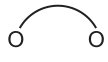
to represent ligand U.
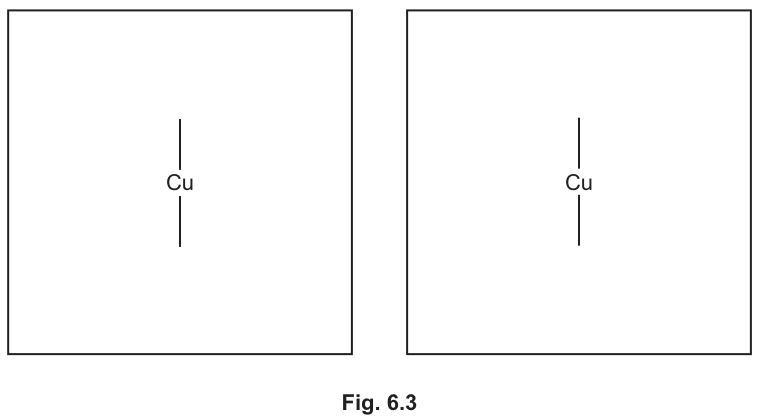
Answer
Both stereoisomers of are drawn as octahedral complexes with three bidentate ligands arranged in a propeller fashion around the central , using wedges (toward viewer) and dashes (away from viewer) to show 3D geometry. The two structures are non-superimposable mirror images (Δ and Λ optical isomers).
Two octahedral diagrams showing Δ and Λ optical isomers of [Cu(U)3]4- with three bidentate ligands in propeller arrangement
Background Concept
Octahedral complexes with three bidentate ligands (such as or ) exhibit optical isomerism. The three bidentate ligands can wrap around the metal centre in two non-superimposable ways, giving rise to a pair of enantiomers: the Δ (delta, right-handed propeller) and Λ (lambda, left-handed propeller) forms. These are mirror images that cannot be superimposed, analogous to left and right hands.
Understanding the Question
The question provides two empty boxes with a vertical line through "Cu" (representing the axial positions of the octahedron) and asks the candidate to complete them with the two stereoisomers. The ligand is represented by a curved line joining two O atoms (the bidentate symbol).
Approach
- Recognise that three bidentate ligands give octahedral coordination (6 coordinate bonds to Cu).
- The vertical line through Cu represents two axial bonds (top and bottom).
- The remaining four coordination sites are filled by two ligands in the equatorial plane, shown using wedges (coming toward viewer) and dashes (going away).
- One isomer has the ligands arranged in a right-handed (Δ) propeller; the other in a left-handed (Λ) propeller.
Step-by-Step Reasoning
- Draw the first isomer: place one bidentate ligand vertically (using the given axial line), and two others in the remaining positions using wedge-dash notation to show 3D geometry. The curved lines connecting the O pairs show the chelate rings.
- Draw the second isomer as the mirror image: reverse the wedge/dash assignments so the propeller direction is opposite.
- Both must be enclosed in square brackets with the 4- charge shown outside.
- The key feature is that the two diagrams are non-superimposable mirror images.
Key Takeaways
- Three bidentate ligands around an octahedral centre always give a pair of optical isomers (Δ and Λ).
- Wedge-dash notation is essential for showing 3D geometry.
- The two isomers must be clearly mirror images (not rotations of the same structure).
Common Mistakes
- Drawing the same isomer twice (just rotated) rather than a true mirror image.
- Not using wedge/dash notation (drawing flat 2D structures).
- Forgetting the square brackets and 4- charge.
- Placing the ligand symbols incorrectly relative to the given axial line.
Things to Be Careful About
- Use the given ligand symbol (curved line joining two O's) — do not draw the full structure.
- The vertical line already drawn through Cu represents the axial bonds; build the equatorial ligands around it.
- Both isomers must be clearly distinguishable as mirror images.
A student analyses an aromatic compound, X, , using NMR spectroscopy.
Fig. 6.4 shows the carbon-13 NMR spectrum of a sample of X dissolved in .
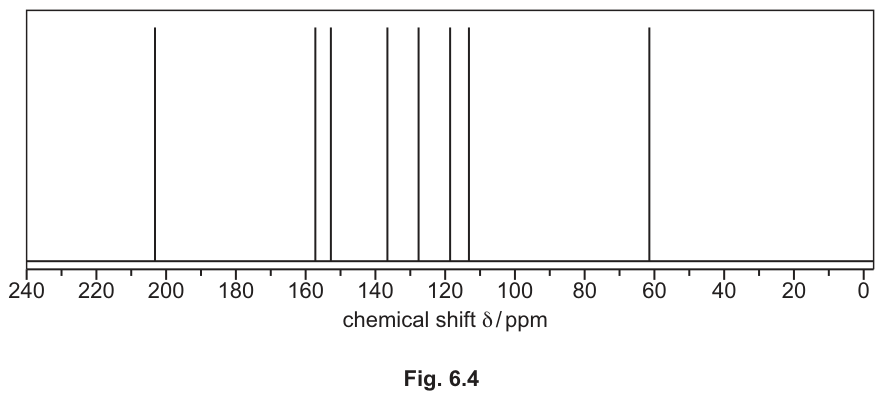
Separate samples of X were analysed using proton () NMR spectroscopy.
Table 6.1 gives information obtained from this analysis.
Table 6.1
| solvent | number of signals in proton () NMR spectrum |
|---|---|
| 6 | |
| 4 |
Answer
8 (eight) different carbon environments.
8
Background Concept
In NMR spectroscopy, each chemically distinct carbon environment gives rise to one signal (peak). The number of peaks equals the number of different carbon environments in the molecule. Symmetrical molecules give fewer peaks than the total number of carbon atoms because equivalent carbons resonate at the same chemical shift.
Understanding the Question
The NMR spectrum of compound X (Fig. 6.4) shows distinct peaks at approximately 203, 158, 154, 137, 128, 120, 115, and 61 ppm. The question asks how many different carbon environments are present.
Approach
Simply count the number of distinct peaks in the spectrum. Each peak corresponds to one unique carbon environment.
Step-by-Step Reasoning
- Examine Fig. 6.4 and count the vertical lines (peaks).
- There are 8 distinct peaks visible.
- Therefore, X has 8 different carbon environments.
- Since X has molecular formula (8 carbon atoms total), all 8 carbons are in different environments — the molecule has no symmetry.
Key Takeaways
- Number of NMR peaks = number of different carbon environments.
- If the number of peaks equals the total number of carbon atoms, the molecule is unsymmetrical.
Common Mistakes
- Miscounting peaks (e.g. missing closely-spaced peaks in the 110-160 ppm region).
- Confusing the number of peaks with the number of hydrogen environments.
Things to Be Careful About
- Peaks that are very close together (e.g. at 154 and 158 ppm) are still separate environments and must be counted individually.
Answer
To remove peaks/signals from acidic (labile) protons such as (or ) groups, because exchanges with these protons and replaces them with deuterium, which does not appear in the NMR spectrum.
To remove peaks from acidic/labile protons (OH/COOH) by exchange with deuterium
Background Concept
Protons attached to electronegative atoms (such as , , ) are labile — they can exchange with deuterium from . When the sample is dissolved in , these exchangeable protons are replaced by (deuterium), which is not detected in NMR (deuterium resonates at a completely different frequency). This simplifies the spectrum by removing the often broad and variable signals from and protons.
Understanding the Question
Table 6.1 shows that X gives 6 signals in but only 4 signals in . The question asks why is used as the solvent.
Approach
Recognise that the difference in signal count (6 vs 4) is due to two exchangeable protons being replaced by deuterium. The purpose of using is to identify/remove these labile proton signals.
Step-by-Step Reasoning
- contains deuterium, which can exchange with labile protons (, , ).
- After exchange, these positions contain instead of .
- does not give a signal in NMR.
- Therefore, the proton signals disappear, simplifying the spectrum.
- The reduction from 6 to 4 signals confirms two exchangeable groups.
Key Takeaways
- exchange removes signals from labile protons (, , ).
- The number of signals lost tells you how many exchangeable protons are present.
- This is a useful diagnostic tool in structure determination.
Common Mistakes
- Saying "to dissolve the compound" (solubility is not the primary reason for choosing specifically).
- Saying "to avoid interference from water peaks" (the reason is proton exchange, not avoiding a water peak per se).
- Not mentioning that deuterium does not appear in NMR.
Things to Be Careful About
- The key phrase is "remove peaks/signals from acidic/labile/OH protons" — simply saying "exchange" without stating the effect on the spectrum may not earn the mark.
Aromatic compound X gives a yellow precipitate when it reacts with alkaline .
Use the information in (c) to suggest a structure for X.
Explain your reasoning.
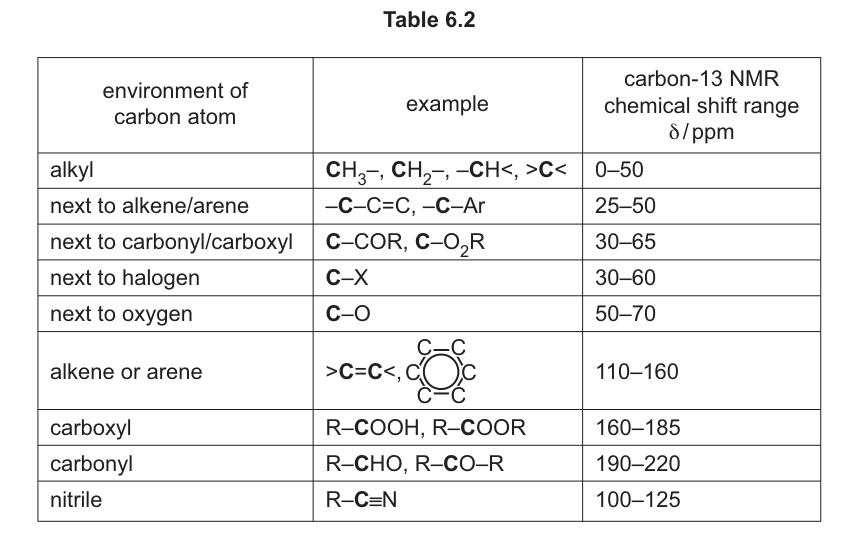
Answer
X is a dihydroxyphenyl methyl ketone (an acetyl dihydroxybenzene), e.g. 2,4-dihydroxyacetophenone.
Reasoning:
- Yellow precipitate with alkaline → positive iodoform test → group present.
- NMR peak at ~203 ppm (range 190–220) → ketone carbonyl ().
- NMR peak at ~61 ppm (range 50–70) → carbon next to oxygen (), consistent with adjacent to or aryl .
- 8 carbon environments with 8 carbon atoms → molecule is unsymmetrical.
- 6 signals in vs 4 in → 2 exchangeable protons → two groups on the ring.
- Molecular formula : benzene ring () + () + 2 groups = ✓
A dihydroxyphenyl methyl ketone (acetyl dihydroxybenzene), e.g. 2,4-dihydroxyacetophenone
Background Concept
Structure determination from spectroscopic data requires integrating multiple pieces of evidence: the molecular formula constrains the number of atoms; NMR tells us the number and types of carbon environments; NMR (especially the exchange experiment) tells us about hydrogen environments and exchangeable protons; and chemical tests (like the iodoform test) confirm specific functional groups.
The iodoform test () gives a yellow precipitate of with methyl ketones () and with compounds containing (which are oxidised to methyl ketones under the alkaline conditions).
Understanding the Question
Compound X has molecular formula and is aromatic. We are given:
- NMR: 8 peaks at ~203, 158, 154, 137, 128, 120, 115, 61 ppm
- NMR: 6 signals in , 4 signals in
- Positive iodoform test (yellow precipitate with alkaline )
- Table 6.2 gives chemical shift ranges for different carbon environments
Approach
- Use the iodoform test to identify a group.
- Use the NMR peak at 203 ppm to confirm a ketone carbonyl.
- Use the exchange (6 → 4 signals) to identify two groups.
- Use the 8 carbon environments (with 8 total carbons) to confirm the molecule is unsymmetrical.
- Combine with the molecular formula and aromaticity to propose a structure.
Step-by-Step Reasoning
-
Iodoform test: Yellow precipitate with alkaline means is formed. This requires a group (methyl ketone). So X contains .
-
NMR at ~203 ppm: This falls in the carbonyl range (190–220 ppm) from Table 6.2, confirming a ketone . This is consistent with the methyl ketone identified above.
-
NMR at ~61 ppm: This is in the "next to oxygen" range (50–70 ppm). In the context of a methyl ketone on a benzene ring, this could be the carbon (which is next to the carbonyl, range 30–65 ppm) or an aromatic carbon bonded to oxygen. The mark scheme accepts "methyl/carbon next to C=O" for this peak.
-
NMR peaks at 110–160 ppm (five peaks): These are aromatic/alkene carbons. With 5 peaks in this region, we have 5 aromatic carbons visible as separate environments (the 6th aromatic carbon is the one bearing the group, which may overlap or be one of the 154/158 peaks).
-
NMR: 6 signals in , 4 in : The loss of 2 signals upon exchange means 2 exchangeable protons → two groups.
-
Molecular formula check: . A benzene ring (, trisubstituted) + () + 2 () = ✓
-
Symmetry: 8 carbon environments with 8 total carbons means no symmetry. The substituents (, , ) must be arranged so that no plane of symmetry exists. For example, 2,4-dihydroxyacetophenone has no symmetry (all 6 ring carbons are different, plus the carbonyl C and methyl C = 8 environments). However, 2,6-dihydroxyacetophenone has a mirror plane and would give only 6 environments, so it is excluded. Similarly, 3,5-dihydroxyacetophenone is excluded.
-
Viable structures: 2,3-; 2,4-; 2,5-; and 3,4-dihydroxyacetophenone all satisfy the criteria (8 environments, unsymmetrical). Any one of these is acceptable.
Key Takeaways
- The iodoform test specifically identifies (methyl ketone) or groups.
- exchange identifies the number of labile protons (, , ).
- The number of peaks vs total carbon atoms reveals molecular symmetry.
- Structure determination requires combining ALL evidence — no single piece is sufficient.
Common Mistakes
- Proposing a symmetrical structure (e.g. 3,5-dihydroxyacetophenone) which would give fewer than 8 carbon environments.
- Proposing a structure with a group (would give a peak at 160–185 ppm, not 190–220 ppm).
- Forgetting to check the molecular formula against the proposed structure.
- Not explaining the reasoning (the question requires explanation, not just a structure).
- Proposing an aldehyde instead of a ketone (the iodoform test and the 203 ppm peak confirm a methyl ketone, not an aldehyde — though aldehydes also appear at 190–220 ppm, the iodoform test specifically requires ).
Things to Be Careful About
- The molecule must be UNSYMMETRICAL (8 different carbon environments = 8 carbons total).
- Two groups must be present (from the exchange).
- The must be present (from the iodoform test AND the 203 ppm peak).
- The structure must account for all atoms in .
- At least two linked pieces of reasoning are needed for full marks (the mark scheme requires the methyl ketone point plus any two linked statements from the list).