Chemistry 9701/43 — October/November 2024
Cambridge A-Level · A Level Structured Questions · worked solutions for every part, with the mark scheme
Topics Transition Elements · Carboxylic Acids and Derivatives · Nitrogen Compounds · Equilibria · Group 2 · Chemical Energetics · +6 more
Disodium phosphate, , reacts with an acid to form monosodium phosphate, .
Identify the ions that are a conjugate acid–base pair in this reaction, using the formulae of the species involved.
conjugate acid: ....................................................................
conjugate base: ....................................................................
Answer
conjugate acid:
conjugate base:
Conjugate acid: H2PO4^-; conjugate base: HPO4^2-
Background Concept
A conjugate acid–base pair consists of two species that differ by exactly one proton (). The acid is the species that can donate a proton; the base is the species that can accept a proton. When a base accepts a proton, it becomes its conjugate acid; when an acid donates a proton, it becomes its conjugate base. The two species in a conjugate pair therefore differ in both the number of hydrogen atoms and the overall charge.
Understanding the Question
The stem tells us that disodium phosphate, , reacts with an acid to form monosodium phosphate, . The question asks us to identify the two phosphate species that form a conjugate acid–base pair. The sodium ions are spectator ions and play no role in the acid–base chemistry.
Approach
Compare the formulae of the two phosphate-containing ions. The species with more hydrogen atoms is the acid; the species with fewer hydrogen atoms is the base. They form a conjugate pair if they differ by one .
Step-by-Step Reasoning
The two phosphate ions are and . The reaction is:
accepts a proton to become . Therefore:
- is the base (proton acceptor)
- is its conjugate acid (formed when the base gains a proton)
They differ by exactly one , so they constitute a conjugate acid–base pair. The mark scheme requires BOTH species to be identified correctly for the single mark.
Key Takeaways
- A conjugate acid–base pair differs by one proton.
- The acid member has one more hydrogen (and one less negative charge) than the base member.
- Spectator ions such as are not part of the acid–base pair.
Common Mistakes
- Swapping the labels: the acid has MORE hydrogens, not fewer.
- Including in the pair — the sodium ions are spectators.
- Writing instead of — the question specifies the actual species present.
Things to Be Careful About
- The mark is awarded only if BOTH species are correct — it is an all-or-nothing mark.
- Give the ionic formulae exactly as shown in the stem: and .
Answer
A buffer solution is a solution that resists changes in pH / allows only small changes in pH when small amounts of acid or alkali (base) are added.
A solution that resists changes in pH when small amounts of acid or alkali are added.
Background Concept
A buffer solution is a system that maintains a nearly constant pH despite the addition of small amounts of acid or base. It works because it contains a weak acid and its conjugate base (or a weak base and its conjugate acid) in comparable concentrations. When is added, the conjugate base neutralises it; when is added, the weak acid neutralises it. The pH does change slightly, but only by a very small amount.
Understanding the Question
This is a definition question worth 2 marks. The mark scheme splits the definition into two distinct ideas: (1) the effect — resists changes in pH, and (2) the condition — when small amounts of acid or alkali are added. Both ideas must be present to earn both marks.
Approach
Recall the standard textbook definition of a buffer solution. Make sure both the effect and the condition are stated.
Step-by-Step Reasoning
The two marks are awarded as follows:
- Effect: allows only small changes in pH / resists changes in pH.
- Condition: when small amounts of acid or alkali/base ( or ) are added.
A complete answer combines both: "A buffer solution resists changes in pH when small amounts of acid or alkali are added."
Key Takeaways
- A buffer does not keep pH perfectly constant — it resists change.
- The qualifier "small amounts" is essential — adding a large excess of acid or base will overwhelm the buffer.
- Buffers contain a weak acid and its conjugate base (or vice versa).
Common Mistakes
- Writing "maintains a constant pH" — the mark scheme wants "resists changes" or "allows only small changes".
- Omitting the condition "when small amounts of acid or alkali are added" — this loses the second mark.
- Saying "neutralises acids and bases" without mentioning the pH-resisting effect.
Things to Be Careful About
- The mark scheme explicitly requires both parts. A one-sentence answer that covers both ideas scores full marks.
- The terms "alkali" and "base" are both accepted; "" is also acceptable.
Write two equations to show how a mixture of and can act as a buffer solution.
equation 1: .........................................................................................................................
equation 2: .........................................................................................................................
Answer
equation 1:
equation 2:
HPO4^2- + H+ -> H2PO4^- and H2PO4^- + OH- -> HPO4^2- + H2O
Background Concept
A buffer contains both members of a conjugate acid–base pair. In this case, the pair is (weak acid) and (its conjugate base). The buffer resists pH change through two complementary reactions:
- When acid () is added, the conjugate base accepts the proton.
- When alkali () is added, the weak acid donates a proton to neutralise it.
Understanding the Question
We must write two equations showing how the mixture of and acts as a buffer. One equation shows the response to added acid; the other shows the response to added alkali. Each equation is worth 1 mark.
Approach
Identify which species reacts with and which reacts with . The base () reacts with ; the acid () reacts with . Write balanced ionic equations.
Step-by-Step Reasoning
Equation 1 — response to added acid:
The hydrogen phosphate ion accepts the added proton, converting to dihydrogen phosphate. This removes the added from solution, so the pH barely changes.
Equation 2 — response to added alkali:
The dihydrogen phosphate ion donates a proton to the hydroxide ion, forming hydrogen phosphate and water. This removes the added .
The mark scheme also accepts the full compound equations:
The ionic equations are cleaner and always acceptable.
Key Takeaways
- The conjugate base mops up added ; the weak acid mops up added .
- Both buffer components must be present for the buffer to work in both directions.
- The equations show the interconversion between the two components of the buffer pair.
Common Mistakes
- Writing the equations in the wrong direction (showing the components being regenerated rather than consumed).
- Forgetting as a product in the hydroxide reaction.
- Using or instead of the two specified species.
- Writing unbalanced equations.
Things to Be Careful About
- The in equation 1 represents any acid added; the in equation 2 represents any alkali added.
- Both equations must be balanced — charge and atoms.
- The mark scheme gives 1 mark per correct equation.
Answer
(hydrogen carbonate)
HCO3^- (hydrogen carbonate)
Background Concept
Blood plasma is maintained at a pH of about 7.4 by buffer systems. The most important is the carbonic acid / hydrogen carbonate buffer:
The hydrogen carbonate ion, , acts as the base member of this pair, neutralising excess acid. The phosphate buffer () also exists in blood but is less significant.
Understanding the Question
This is a one-mark recall question asking for one inorganic ion that acts as a buffer in blood. The answer is the hydrogen carbonate ion, .
Approach
Recall the main buffer system in blood: the carbonic acid / hydrogen carbonate system. The ion is .
Step-by-Step Reasoning
The hydrogen carbonate ion, , is the key buffer ion in blood. It works alongside carbonic acid, :
- When blood becomes too acidic, reacts with to form .
- When blood becomes too alkaline, dissociates, releasing .
Key Takeaways
- (hydrogen carbonate) is the principal buffer ion in blood.
- It is part of the buffer system.
Common Mistakes
- Writing instead of — the question asks for the ION, not the acid.
- Writing — this is not the blood buffer ion.
- Writing a full compound like — the question asks for the ion.
Things to Be Careful About
- The question specifies "inorganic ion" — is the correct answer.
- Either the formula or the name "hydrogen carbonate" is accepted.
Compound E is the hydroxide of a Group 2 element. Compound E is a strong alkali.
of E is dissolved in water to make of solution F. Solution F has a pH of 13.09 at .
Working
Answer
(shown)
[OH-] = 0.123 mol dm^-3
Background Concept
The pH of a solution is defined as . The ionic product of water at 298 K is . These two relationships allow conversion between pH and . An alternative route uses and .
Understanding the Question
Solution F has pH 13.09 at 298 K. We must show that . This is a "show that" question — the final value is given, so the working must demonstrate how it is obtained.
Approach
Method 1 (using ):
- Calculate from pH.
- Use to find .
Method 2 (using pOH):
- .
- .
Both methods are accepted by the mark scheme.
Step-by-Step Reasoning
Method 1 — using :
Since :
Method 2 — using pOH:
Both routes give the same result, confirming the value given in the question.
Key Takeaways
- at 298 K.
- at 298 K.
- Either the route or the pOH route can be used to convert between pH and .
Common Mistakes
- Using instead of .
- Forgetting that only at 298 K.
- Arithmetic errors in evaluating or .
Things to Be Careful About
- The mark scheme awards 1 mark for showing or , and 1 mark for the division by (or for showing pOH = 0.91 and ).
- Give the answer to at least 2 significant figures.
Answer
Each formula unit of E, X(OH), contains two hydroxide ions, so .
Each formula unit of X(OH)2 contains 2 OH- ions, so [E] = [OH-]/2 = 0.0615 mol dm^-3.
Background Concept
Group 2 elements form hydroxides with the general formula X(OH), where X is the Group 2 metal. When such a hydroxide dissolves completely (as a strong alkali does), each formula unit dissociates into one ion and two ions:
Understanding the Question
We have established that in solution F. The question asks us to explain why the concentration of compound E itself is exactly half of this value, .
Approach
Recognise that E is a Group 2 hydroxide with formula X(OH). The stoichiometry of dissociation gives a 1:2 ratio between E and .
Step-by-Step Reasoning
E is a Group 2 hydroxide, so its formula is X(OH). On complete dissociation:
Each mole of X(OH) produces 2 moles of ions. Therefore:
Key Takeaways
- Group 2 hydroxides have the formula X(OH), with two per formula unit.
- For a fully dissociated Group 2 hydroxide, .
Common Mistakes
- Forgetting the factor of 2 — this is the entire point of the question.
- Assuming E is a Group 1 hydroxide (XOH) which would give a 1:1 ratio.
- Confusing the concentration of the compound with the concentration of its ions.
Things to Be Careful About
- The stem tells us E is a "hydroxide of a Group 2 element" and a "strong alkali" — both clues point to X(OH) fully dissociating.
- The answer must explain WHY the factor of 2 applies, not just state the result.
Use the concentration given in (ii) to identify compound E.
compound E: ................................................................................
Working
moles of E
molar mass of E
E = X(OH), so RAM of X
Answer
compound E is barium hydroxide,
Ba(OH)2 (barium hydroxide)
Background Concept
To identify an unknown compound from solution data, we use the relationships:
- moles = concentration volume (volume in dm)
- molar mass = mass / moles
For a Group 2 hydroxide X(OH), the molar mass is the sum of the atomic mass of X plus two hydroxide groups: .
Understanding the Question
We know the mass of E (2.63 g), the volume of solution F (250 cm = 0.250 dm), and the concentration of E (0.0615 mol dm, from part (ii)). We must use these to identify which Group 2 hydroxide E is.
Approach
- Calculate the number of moles of E in solution F.
- Calculate the molar mass of E.
- Subtract the mass of two OH groups to find the atomic mass of the metal, then identify it.
Step-by-Step Reasoning
Step 1 — moles of E:
moles
Step 2 — molar mass of E:
Step 3 — identify the metal:
E = X(OH), so:
Barium has atomic mass approximately 137. Therefore E is barium hydroxide, .
Key Takeaways
- moles = concentration volume (volume must be in dm).
- molar mass = mass / moles.
- For X(OH), subtract 34 from the molar mass to find the atomic mass of the metal.
Common Mistakes
- Using volume in cm instead of dm (250 cm = 0.250 dm).
- Forgetting to subtract the mass of two OH groups (34) to find the metal's atomic mass.
- Confusing barium (Ba, 137) with other Group 2 elements such as strontium (Sr, 88).
Things to Be Careful About
- The mark scheme allows two routes: calculating of E directly (171) OR calculating the RAM of the metal (137). Either route leads to Ba(OH).
- The mark is awarded for the identification "barium hydroxide / Ba(OH)" — the calculation must support it.
Compound E is much more soluble than magnesium hydroxide.
A saturated solution of magnesium hydroxide in water has a concentration of at .
Calculate the solubility product, , of magnesium hydroxide. Include units.
Working
Answer
1.10 x 10^-11 mol^3 dm^-9
Background Concept
The solubility product, , is the equilibrium constant for the dissolution of a sparingly soluble ionic compound. For magnesium hydroxide:
The equilibrium expression is:
The concentration of equals the solubility (the amount that dissolves per dm), and the concentration of is twice the solubility because each formula unit produces two hydroxide ions.
Understanding the Question
We are given the concentration of a saturated solution of as . This is the solubility, which equals . We must calculate and include units. The question is worth 3 marks: expression, value, and units.
Approach
- Write the dissociation equilibrium and the expression.
- Determine and from the given solubility.
- Substitute into the expression and calculate.
- Determine the units from the expression.
Step-by-Step Reasoning
Step 1 — Write the expression:
Step 2 — Determine ion concentrations:
The solubility is , meaning that this amount of dissolves per dm of saturated solution.
(one per formula unit)
(two per formula unit)
Step 3 — Substitute and calculate:
Step 4 — Determine units:
Units of come from the expression: has units mol dm and has units (mol dm) = mol dm. Multiplying:
Key Takeaways
- .
- For a hydroxide X(OH), solubility.
- Units of depend on the stoichiometry of the dissolution — always derive them from the expression.
Common Mistakes
- Forgetting to square in the expression.
- Using instead of .
- Giving units as mol dm instead of mol dm.
- Rounding the final answer to 1 significant figure when the data allows 3.
Things to Be Careful About
- The correct answer is (minimum 2 significant figures).
- The mark scheme awards: 1 mark for the expression, 1 mark for the value, 1 mark for the units.
- ecf applies: if the expression is correct but the arithmetic is wrong, the units mark can still be earned.
Answer
Down Group 2, both lattice enthalpy and hydration enthalpy become less exothermic (less negative). However, the lattice enthalpy decreases more than the hydration enthalpy, so the enthalpy of solution becomes more exothermic (more negative) down the group. Therefore, barium hydroxide dissolves more readily than magnesium hydroxide.
Down Group 2, lattice enthalpy decreases more than hydration enthalpy, so enthalpy of solution becomes more exothermic, making Ba(OH)2 more soluble than Mg(OH)2.
Background Concept
The solubility of an ionic compound is governed by the enthalpy of solution, which is the sum of the lattice enthalpy and the hydration enthalpy:
Both and are exothermic (negative) for ionic compounds. Lattice enthalpy is the energy released when gaseous ions come together to form the solid lattice; hydration enthalpy is the energy released when gaseous ions are surrounded by water molecules.
Down Group 2, the cations get larger (Mg < Ca < Sr < Ba). Larger ions have lower charge density, so both the lattice enthalpy and the hydration enthalpy become less exothermic (less negative).
Understanding the Question
We must explain why barium hydroxide (compound E, identified in part (b)) is much more soluble than magnesium hydroxide. This is a Group 2 solubility trend question, worth 3 marks. The three marks correspond to: (1) both enthalpies become less exothermic, (2) lattice enthalpy changes more than hydration enthalpy, (3) enthalpy of solution becomes more exothermic.
Approach
Use the enthalpy of solution cycle: . Analyse how each term changes down the group and, crucially, compare the RATES of change. The relative magnitudes determine the trend in .
Step-by-Step Reasoning
Mark 1 — both become less exothermic:
Down Group 2 (from Mg to Ba), the cation radius increases. Both the lattice enthalpy and the hydration enthalpy become less exothermic (less negative).
Mark 2 — lattice enthalpy changes more:
The lattice enthalpy decreases more rapidly than the hydration enthalpy. This is because the lattice enthalpy depends on the sum of the cation and anion radii (both contribute to the interionic distance), while the hydration enthalpy depends mainly on the cation radius interacting with water. The larger change in lattice enthalpy dominates.
Mark 3 — enthalpy of solution becomes more exothermic:
Since , and becomes less negative faster than , the sum becomes more negative (more exothermic) down the group. A more exothermic enthalpy of solution makes dissolution more thermodynamically favourable, so solubility increases.
Therefore, barium hydroxide (further down the group than magnesium) has a more exothermic enthalpy of solution and is much more soluble.
Key Takeaways
- .
- Down Group 2, both and become less exothermic, but changes more.
- The net effect is that becomes more exothermic down the group, increasing solubility.
- This explains why the solubility of Group 2 hydroxides increases down the group (opposite to the sulfates).
Common Mistakes
- Saying "both become less exothermic, so solubility decreases" — this ignores the relative rates of change, which is the crucial point.
- Not mentioning that lattice enthalpy changes more than hydration enthalpy — this is a required mark.
- Confusing the hydroxide trend (solubility increases down the group) with the sulfate trend (solubility decreases down the group).
- Using entropy arguments instead of enthalpy — the mark scheme specifically requires the enthalpy of solution reasoning.
Things to Be Careful About
- The mark scheme awards 3 independent marks (marked independently — each can be earned separately).
- The explanation must specifically address the RELATIVE magnitudes of the changes, not just state that both change.
- Use precise terminology: "lattice enthalpy" (or "lattice energy"), "hydration enthalpy", and "enthalpy of solution".
Predict and explain the variation in enthalpy change of hydration for the ions , , and .
Answer
The enthalpy change of hydration becomes less negative (or less exothermic) down the group from F⁻ to I⁻. This is due to the increase in ionic radius/size, which results in decreased attraction to water molecules (weaker ion-dipole forces).
The enthalpy change of hydration becomes less negative down the group due to increased ionic radius, resulting in weaker ion-dipole attractions to water.
Background Concept
The enthalpy change of hydration, , is the enthalpy change when one mole of gaseous ions is fully surrounded by water molecules to form infinitely dilute solution. It is always exothermic (negative) because ion-dipole attractions form between the ions and the polar water molecules.
Understanding the Question
The question asks to predict and explain the trend in for the halide ions F⁻, Cl⁻, Br⁻, and I⁻. We need to identify how the value changes as we move down Group 7 and provide a physical explanation for this change.
Approach
Consider the factors that determine the strength of ion-dipole interactions: the charge on the ion and the size (ionic radius) of the ion. Since all these ions have a 1⁻ charge, the difference must be due to their size. As we move down the group, the ionic radius increases.
Step-by-Step Reasoning
- Trend prediction: As the ionic radius increases down the group (F⁻ < Cl⁻ < Br⁻ < I⁻), the charge density of the ion decreases. A lower charge density means the ion is less effective at attracting the partially positive hydrogen atoms of water molecules. Therefore, less energy is released when the ions are hydrated. The enthalpy change of hydration becomes less negative (less exothermic) down the group.
- Explanation: The larger the ion, the greater the distance between the centre of the negative charge and the water dipoles. According to Coulomb's law, the force of attraction decreases with increasing distance. Thus, the ion-dipole forces between the larger halide ions and water are weaker, releasing less energy.
Key Takeaways
Hydration enthalpy becomes less exothermic for larger ions with the same charge because of weaker ion-dipole attractions due to increased ionic radius.
Common Mistakes
- Stating that the enthalpy change becomes 'less negative' without explaining why.
- Using the term 'atomic radius' instead of 'ionic radius'.
- Saying 'weaker bonds' instead of 'weaker ion-dipole forces' or 'decreased attraction'.
Things to Be Careful About
- Always specify that the trend is 'down the group' or 'from F⁻ to I⁻'.
- Ensure you mention 'ionic radius' or 'ionic size', not just 'size'.
- Use precise terminology: 'ion-dipole forces' or 'attraction to water', not 'bonding'.
Fig. 2.1 shows an incomplete energy cycle involving calcium fluoride, .
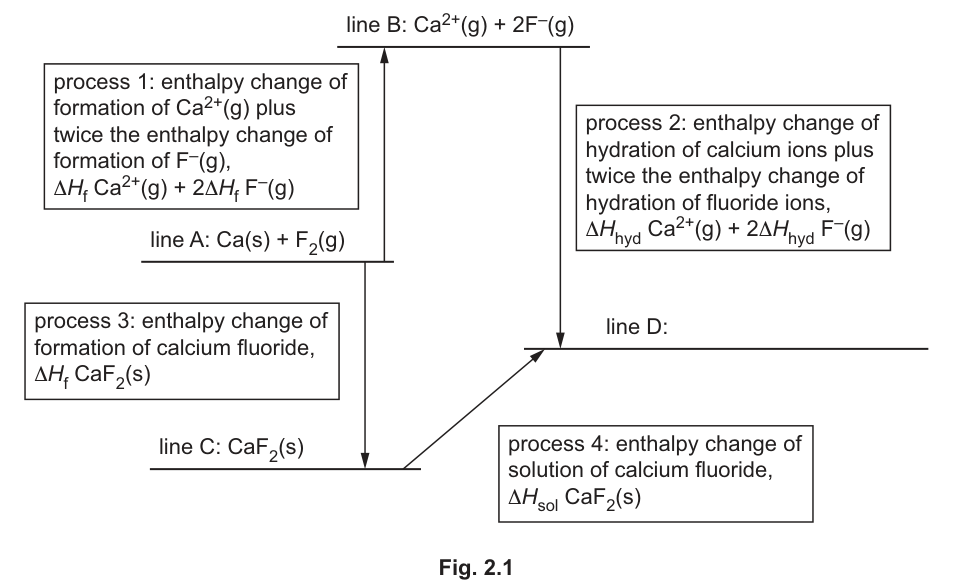
Answer
or
CaF2(aq)
Background Concept
An energy cycle (or Born-Haber type cycle) for the solution of an ionic compound relates the enthalpy of formation, lattice enthalpy, hydration enthalpies, and enthalpy of solution. Line D represents the final state after the solution process (process 4) is complete.
Understanding the Question
We are given an incomplete energy cycle for CaF₂. Line A is the elements in their standard states, Line B is the gaseous ions, Line C is the solid ionic compound, and Line D is the unknown final state. Process 4 is the enthalpy change of solution, which takes the solid ionic compound to the aqueous state.
Approach
The enthalpy change of solution, , is the enthalpy change when one mole of an ionic solid dissolves in water to form an infinitely dilute solution. The final state must therefore be the aqueous ions or the dissolved compound.
Step-by-Step Reasoning
Process 4 goes from Line C () to Line D. Since process 4 is the enthalpy change of solution, Line D must represent the aqueous state. This can be written as or, more explicitly, as the separated hydrated ions: . Both are acceptable and must include state symbols.
Key Takeaways
In an energy cycle for solution, the final line (aqueous state) represents the ions dissolved in water, either as a formula with (aq) or as separated hydrated ions.
Common Mistakes
- Forgetting the state symbol (aq).
- Writing the aqueous ions without the correct stoichiometry (e.g., ).
Things to Be Careful About
Always include state symbols in energy cycle diagrams. (aq) is required for the aqueous state.
The value of the enthalpy change for process 1 can be calculated using the values of five other enthalpy changes which are not referred to in Fig. 2.1.
Identify these five other enthalpy changes, using either names or symbols.
Answer
- Atomisation energy of Ca ()
- Atomisation energy of F₂ () or F–F bond energy
- First ionisation energy of Ca ( or )
- Second ionisation energy of Ca ( or )
- First electron affinity of F ( or )
Atomisation energy of Ca, atomisation energy of F2 (or F-F bond energy), first ionisation energy of Ca, second ionisation energy of Ca, first electron affinity of F.
Background Concept
Process 1 in the cycle is:
To break this down into standard enthalpy changes, we must consider the steps to convert the elements in their standard states to gaseous ions.
Understanding the Question
We need to identify the five specific enthalpy changes that, when summed, give the enthalpy change for process 1. These are the standard steps used in a Born-Haber cycle to form gaseous ions from elements.
Approach
Break down the overall process into sub-processes:
- Convert Ca(s) to Ca(g) and then to Ca²⁺(g).
- Convert F₂(g) to F(g) and then to F⁻(g).
Step-by-Step Reasoning
- Atomisation of Ca: requires the enthalpy of atomisation of calcium, .
- Atomisation of F₂: requires half the enthalpy of atomisation of fluorine, or we can consider which is the bond dissociation energy (or atomisation energy of F₂), .
- First ionisation of Ca: requires the first ionisation energy, or .
- Second ionisation of Ca: requires the second ionisation energy, or .
- Electron affinity of F: requires the first electron affinity, or . Since we need , this step occurs twice, but the question asks for the five types of enthalpy changes.
Key Takeaways
The formation of gaseous ions from elements involves atomisation (for both metal and non-metal), successive ionisation energies (for the metal), and electron affinity (for the non-metal).
Common Mistakes
- Confusing atomisation of F₂ with bond dissociation energy (both are acceptable, but be precise).
- Forgetting that Ca requires both first and second ionisation energies.
- Including lattice energy or hydration enthalpy, which are not part of process 1.
Things to Be Careful About
- Ensure you list five distinct types of enthalpy changes.
- Use correct terminology: 'atomisation energy', 'ionisation energy', 'electron affinity'.
Answer
Lattice energy, , is the enthalpy change (or energy released) when one mole of an ionic compound is formed from its gaseous ions.
The enthalpy change when one mole of an ionic compound is formed from its gaseous ions.
Background Concept
Lattice enthalpy is a key term in the Born-Haber cycle. There are two common definitions: lattice formation enthalpy (gaseous ions to solid) and lattice dissociation enthalpy (solid to gaseous ions). The symbol in this context typically refers to lattice formation enthalpy, which is exothermic.
Understanding the Question
We need to provide the standard IUPAC definition of lattice energy (lattice formation enthalpy) as used in Cambridge A-Level Chemistry.
Approach
Recall the definition focusing on: 'one mole', 'ionic compound', 'formed', and 'gaseous ions'.
Step-by-Step Reasoning
The definition must state that it is an energy change (or enthalpy change) associated with the formation of one mole of the solid ionic lattice from its constituent gaseous ions. Since bonds are being formed, energy is released, so it is often described as 'energy released' or 'enthalpy change' (which will be negative).
Key Takeaways
Always include 'one mole', 'ionic compound', 'formed', and 'gaseous ions' in the definition of lattice formation enthalpy.
Common Mistakes
- Saying 'formed from elements' instead of 'gaseous ions'.
- Forgetting to specify 'one mole'.
- Using the word 'bond' instead of 'ionic compound' or 'lattice'.
Things to Be Careful About
Check the mark scheme to see if they want 'enthalpy change' or 'energy released'. Both are usually acceptable, but be consistent. The definition here is for formation (exothermic).
Complete the expression to give the mathematical relationship between of calcium fluoride and the enthalpy changes for processes 1 and 3.
Answer
or simply:
ΔH_latt = ΔH_f(CaF2(s)) - ΔH_f(Ca2+(g)) - 2ΔH_f(F-(g))
Background Concept
Hess's law states that the total enthalpy change for a reaction is independent of the route taken. In an energy cycle, the sum of enthalpy changes around a closed loop must be zero, or the enthalpy change of one path must equal the enthalpy change of an alternative path between the same start and end points.
Understanding the Question
We need to find a relationship between (which is the enthalpy change from gaseous ions to solid, i.e., Line B to Line C) and processes 1 and 3.
Approach
Identify the paths from Line B to Line C:
- Direct path: Line B to Line C, which is the formation of the lattice, .
- Alternative path: Line B to Line A (reverse of process 1) then Line A to Line C (process 3).
Step-by-Step Reasoning
Path 1: (from to )
Path 2: Reverse of process 1 + process 3
Reverse of process 1: , enthalpy change =
Process 3: , enthalpy change =
Equating the paths:
Substituting the expressions for process 1 and process 3:
Key Takeaways
Use Hess's law to equate different paths around an energy cycle. Be careful with signs when reversing processes.
Common Mistakes
- Adding process 1 instead of subtracting it.
- Forgetting the stoichiometric coefficient (2) for the fluoride ion formation enthalpy.
Things to Be Careful About
- Ensure the direction of the lattice enthalpy matches the definition (formation from gaseous ions to solid is negative; if the cycle defines it as dissociation, the sign would be positive. Here, process 3 - process 1 gives the formation enthalpy).
Use data from Table 2.1 to calculate a value for the hydration energy, , of fluoride ions, .
Table 2.1
| value / | |
|---|---|
| enthalpy change of solution of calcium fluoride, | +13 |
| overall enthalpy change of process 1 in Fig. 2.1 | +1395 |
| enthalpy change of formation of calcium fluoride | -1214 |
| enthalpy change of hydration of | -1650 |
Working
From the energy cycle, the sum of enthalpy changes along one path equals the sum along the alternative path:
Substitute the known values:
Answer
-473
Background Concept
The energy cycle relates the enthalpy changes of different processes. According to Hess's law, the total enthalpy change is path-independent. We can write an equation equating the sum of enthalpy changes along one route to the sum along another route.
Understanding the Question
We are given four values from Table 2.1 and need to calculate for F⁻(g). The cycle has four processes:
- Process 1: ,
- Process 2: , (where )
- Process 3: ,
- Process 4: ,
Approach
Set up the equation: Process 1 + Process 2 = Process 3 + Process 4. Solve for .
Step-by-Step Reasoning
- Write the Hess's law equation:
- Simplify the left side:
- Rearrange to solve for :
- Solve for :
Key Takeaways
Carefully set up the Hess's law equation from the cycle. Pay attention to signs and stoichiometric coefficients (the factor of 2 for fluoride hydration).
Common Mistakes
- Getting the signs wrong (e.g., adding 1650 instead of subtracting).
- Forgetting to multiply by 2.
- Arithmetic errors in solving the algebraic equation.
Things to Be Careful About
- Ensure all values are in the correct units (kJ mol⁻¹).
- The final answer should be negative, as hydration is exothermic.
Answer
Entropy is a measure of the number of possible arrangements of particles or energy in a system.
Entropy is a measure of the number of possible arrangements of particles or energy in a system.
Background Concept
Entropy () is a thermodynamic quantity that represents the degree of disorder or randomness in a system. More formally, it is related to the number of microstates (possible arrangements of particles and energy) that correspond to a given macrostate.
Understanding the Question
We need to provide the standard definition of entropy as expected in Cambridge A-Level Chemistry.
Approach
Recall the definition focusing on 'arrangements', 'particles', and 'energy'.
Step-by-Step Reasoning
Entropy can be defined as the number of possible ways in which the atoms and molecules of a system can be arranged, or the number of possible arrangements of particles and energy in a system. An increase in entropy corresponds to an increase in disorder or randomness.
Key Takeaways
Entropy is fundamentally about the number of possible arrangements (microstates) of a system.
Common Mistakes
- Saying 'disorder' without mentioning 'arrangements' or 'particles/energy'. While 'disorder' is an intuitive concept, the formal definition requires 'arrangements'.
- Saying 'chaos' instead of 'arrangements'.
Things to Be Careful About
Use precise language: 'number of possible arrangements of particles / energy in a system'.
At , the Gibbs free energy change, , for the solution of compound T is .
The enthalpy change of solution, , of compound T is at .
Calculate the value of the entropy change, , for the solution of compound T at .
Working
The Gibbs free energy equation is:
Rearrange to solve for :
Given:
Substitute the values:
Rounding to 3 significant figures:
Answer
+80.5
Background Concept
The Gibbs free energy change, , determines the feasibility of a process at constant temperature and pressure. The equation is:
where is the enthalpy change, is the temperature in Kelvin, and is the entropy change. For a process to be feasible (spontaneous), must be negative.
Understanding the Question
We are given , , and for the solution of compound T, and we need to calculate . Note the units: and are in kJ mol⁻¹, but is required in J K⁻¹ mol⁻¹.
Approach
Rearrange the Gibbs equation to solve for , ensuring consistent units (convert kJ to J).
Step-by-Step Reasoning
- Convert and to J mol⁻¹:
- Rearrange the equation:
- Substitute:
- Calculate:
- Round to 3 significant figures (as the data is given to 3 sf):
Key Takeaways
Always check units when using the Gibbs equation. Enthalpy and free energy are often in kJ, but entropy is in J. Convert before calculating.
Common Mistakes
- Forgetting to convert kJ to J, resulting in an answer that is off by a factor of 1000.
- Using the wrong sign for or .
- Incorrect algebraic rearrangement.
Things to Be Careful About
- The question asks for the answer in J K⁻¹ mol⁻¹, not kJ K⁻¹ mol⁻¹.
- Maintain appropriate significant figures (3 sf based on the given data).
Predict whether compound T becomes more or less soluble as the water is heated from to . Explain your answer.
Answer
Compound T becomes more soluble as the water is heated.
Explanation: The entropy change, , is positive. As temperature () increases, the term becomes more positive, making more negative. This causes to become more negative (or less positive), making the solution more feasible and thus increasing solubility.
Compound T becomes more soluble as the temperature increases because the positive entropy change means that -TΔS becomes more negative, making ΔG more negative.
Background Concept
The solubility of a compound is related to the feasibility of its dissolution process. A process is feasible (spontaneous) when . The Gibbs equation is:
If is positive (endothermic dissolution) and is positive (increase in disorder), then at higher temperatures, the term becomes larger and more negative, eventually making negative.
Understanding the Question
We need to predict whether compound T becomes more or less soluble when heated from 298 K to 360 K, and explain why. We know from part (e) that is positive (+80.5 J K⁻¹ mol⁻¹) and is positive (+30.0 kJ mol⁻¹).
Approach
Analyze how the terms in the Gibbs equation change with increasing temperature, given the signs of and .
Step-by-Step Reasoning
- At 298 K, , which is positive, meaning the solution is not feasible (or only slightly soluble).
- As increases to 360 K, the term increases (since is positive).
- Therefore, becomes more negative.
- Since is constant (approximately), the overall becomes more negative.
- A more negative means the dissolution process becomes more feasible, so the compound becomes more soluble.
Key Takeaways
For endothermic dissolutions with a positive entropy change, solubility increases with temperature.
Common Mistakes
- Saying 'solubility increases because is positive' without mentioning the role of .
- Confusing the effect of temperature on .
- Not explicitly stating that is positive.
Things to Be Careful About
- Ensure the explanation clearly links the positive to the temperature dependence of .
- Use the correct terminology: 'more feasible', 'more negative '.
A and B react together to give product AB.
When the concentrations of A and B are both , the rate of formation of AB is . When the concentrations of A and B are both , the rate of formation of AB is .
Complete the three possible rate equations that are consistent with these data.
rate = .................................................................................................................................
rate = .................................................................................................................................
rate = .................................................................................................................................
Working
Doubling both and increases the rate by a factor of 4, so the overall order is 2. The orders can be 1 in each reactant, 2 in A only, or 2 in B only.
Answer
rate = k[A][B]; rate = k[A]^2; rate = k[B]^2
Background Concept
A rate equation shows how the rate of a reaction depends on the concentrations of the reactants. For , the general form is , where and are the orders with respect to A and B. The overall order is . When concentrations are changed, the rate changes by a factor equal to the concentration factor raised to the order for each reactant.
Understanding the Question
Two experiments are given. In the second experiment both and are doubled from to . We need to write three rate equations that are all consistent with the observed rate change. This is a deduction from data, not a calculation of .
Approach
Compare the two rates. Since both concentrations are doubled at the same time, the rate factor is . Calculate the rate ratio and set it equal to . Then list the integer combinations of and that give that overall order.
Step-by-Step Reasoning
The first rate is and the second is .
Rate ratio .
Both concentrations are doubled, so rate ratio . Since , .
Possible non-negative integer orders are:
- , , giving
- , , giving
- , , giving
These are the three required rate equations.
Key Takeaways
Rate data can fix the overall order of a reaction, but when both concentrations are changed together it cannot distinguish which reactant is responsible. Several rate equations may fit the same data.
Common Mistakes
- Assuming the orders are equal to the stoichiometric coefficients in .
- Forgetting that a zero-order reactant can be omitted from the rate equation.
- Trying to deduce individual orders when only simultaneous changes are given.
Things to Be Careful About
- Use the rate ratio, not the difference in rates.
- Include in every rate equation.
- The three equations must be written separately as the question asks for three possible equations.
Choose one of the rate equations you have written in (i), and calculate the value of the rate constant, . Include the units of .
Working
Using with the first set of data:
Units:
Answer
7.62 mol^-1 dm^3 s^-1
Background Concept
The rate constant is the proportionality constant in a rate equation. Its value depends on temperature and catalyst, and its units depend on the overall order of the reaction. For a second-order reaction such as , the units of are .
Understanding the Question
We must choose one of the rate equations written in part (i), substitute one set of concentrations and the corresponding rate, and calculate with correct units. The mark scheme allows any of the three equations because they all give the same numeric here.
Approach
Use the first experiment with and rate . Substitute into and solve for .
Step-by-Step Reasoning
The units are obtained from:
So . Using the second experiment would give , the same value to 3 significant figures.
Key Takeaways
The units of a rate constant are determined by the overall order of the reaction. For second order, the concentration terms in the denominator are squared, giving .
Common Mistakes
- Forgetting the units of .
- Using the wrong concentration power in the denominator.
- Quoting too few significant figures; the mark scheme requires at least 3 significant figures.
Things to Be Careful About
- Use the chosen rate equation consistently.
- The numeric value is the same for all three equations here because in the data.
- Include the unit in the final answer.
Explain why it is not possible to calculate a value for the half-life, , of this reaction using the value of the rate constant calculated in (ii) and the equation .
Answer
The equation applies only to first-order reactions. This reaction is second order, so it does not have a constant half-life.
Reaction is second order, not first order; half-life is not constant.
Background Concept
For a first-order reaction, the half-life is constant and is related to the rate constant by . For a second-order reaction, the half-life depends on the initial concentration, so there is no single constant half-life.
Understanding the Question
Part (i) showed that this reaction is second order overall. The question asks why the first-order half-life equation cannot be used with the calculated .
Approach
Identify the order of the reaction and recall that the equation is only valid for first-order kinetics.
Step-by-Step Reasoning
The reaction is second order, not first order. The equation is derived specifically for first-order reactions, where the half-life is independent of concentration. In a second-order reaction, the half-life changes as the reaction proceeds, so a single value of cannot be calculated from using that equation.
Key Takeaways
The constant-half-life relationship is a special feature of first-order reactions. For other orders, half-life depends on concentration.
Common Mistakes
- Trying to use for any order.
- Stating that the reaction is first order.
Things to Be Careful About
- The mark scheme accepts any statement that the reaction is second order, is not first order, or does not have a constant half-life.
Catalysts may be homogeneous or heterogeneous.
Identify two metals that act as heterogeneous catalysts in the removal of from the exhaust gases of car engines.
............................................................... and ..............................................................
Answer
Platinum (Pt) and palladium (Pd). (Rhodium, Rh, is also acceptable.)
Pt and Pd
Background Concept
Catalytic converters in car exhausts use solid transition metals as heterogeneous catalysts. They speed up the conversion of harmful gases such as , , and unburnt hydrocarbons into less harmful products.
Understanding the Question
The question asks for two metals that act as heterogeneous catalysts in removing from exhaust gases. This is a recall question.
Approach
Recall the metals used in a catalytic converter: platinum, palladium and rhodium.
Step-by-Step Reasoning
Any two of platinum (Pt), palladium (Pd) and rhodium (Rh) are acceptable. These metals provide a surface on which and other exhaust gases adsorb and react.
Key Takeaways
Catalytic converters rely on Pt, Pd and Rh as heterogeneous catalysts.
Common Mistakes
- Naming metals such as iron or nickel, which are not used in catalytic converters for this purpose.
- Naming alloys or compounds instead of metals.
Things to Be Careful About
- The question asks for metals, so give element names or symbols.
- Any two of the three correct metals score the mark.
Iron acts as a heterogeneous catalyst in the Haber process.
Describe the mode of action of this iron catalyst.
Answer
- and adsorb onto the iron surface, forming bonds with surface atoms.
- Adsorption weakens the and H–H bonds.
- molecules form and desorb from the surface.
Adsorption, bond weakening, desorption.
Background Concept
A heterogeneous catalyst is in a different phase from the reactants. In the Haber process, solid iron catalyses the reaction between gaseous and . The reaction takes place on the iron surface.
Understanding the Question
Describe the mode of action of the iron catalyst. The mark scheme rewards three key ideas: adsorption, bond weakening and desorption.
Approach
Think of the surface-catalysed process as a sequence: reactant molecules stick to the surface, their bonds are weakened, reaction occurs, and products leave the surface.
Step-by-Step Reasoning
- and molecules adsorb onto the iron surface, forming bonds between the reactant atoms and surface iron atoms.
- Adsorption weakens the covalent bonds within the reactants, especially the strong triple bond, lowering the activation energy.
- Reaction occurs on the surface, and the molecules formed desorb, freeing the surface for more reactant molecules.
Key Takeaways
Heterogeneous catalysis involves adsorption, weakening of reactant bonds, reaction on the surface, and desorption of products.
Common Mistakes
- Describing the catalyst as taking part in the reaction and being used up.
- Omitting one of the three key stages; the mark scheme gives 2 marks for all three, 1 mark for any two.
Things to Be Careful About
- Use the terms adsorption and desorption precisely.
- Mention bond weakening, not just 'the catalyst provides a surface'.
- Do not say the catalyst is consumed.
ions act as a homogeneous catalyst in the reaction between and .
Write equations for the two reactions that occur when is added to a mixture of and .
equation 1:
equation 2: .......................................................................................................................
Answer
S2O8^2- + 2Fe^2+ -> 2SO4^2- + 2Fe^3+; 2Fe^3+ + 2I^- -> 2Fe^2+ + I2
Background Concept
A homogeneous catalyst is in the same phase as the reactants. ions catalyse the redox reaction between and by providing an alternative pathway with a lower activation energy. The catalyst is oxidised in one step and regenerated in another.
Understanding the Question
Write the two reactions that occur when is added to a mixture of and . The catalyst must be regenerated, so is first oxidised to , then oxidises back to .
Approach
Identify the oxidising and reducing agents. is a strong oxidising agent and oxidises to . The formed then oxidises to , regenerating .
Step-by-Step Reasoning
Equation 1: .
This shows being reduced to sulfate and being oxidised to .
Equation 2: .
This shows being reduced back to and iodide being oxidised to iodine.
Adding the two equations gives the overall reaction , with regenerated.
Key Takeaways
A homogeneous catalyst is regenerated during the reaction. Writing the two steps of the catalytic cycle shows how the catalyst is oxidised and then reduced.
Common Mistakes
- Writing the overall reaction instead of the two catalysed steps.
- Not balancing charges and atoms in the equations.
- Showing being consumed without being regenerated.
Things to Be Careful About
- Both equations are needed for the 2 marks.
- The equations may be written with any whole-number multiples.
- Check that atoms and charges balance.
Answer
A homogeneous catalyst is in the same phase/state as the reactants. A heterogeneous catalyst is in a different phase/state from the reactants.
Homogeneous: same phase as reactants; heterogeneous: different phase from reactants.
Background Concept
Catalysts can be classified by phase. A homogeneous catalyst is in the same phase as the reactants; a heterogeneous catalyst is in a different phase.
Understanding the Question
Explain the difference between the two types. The mark scheme requires both halves.
Approach
Compare the phases of the catalyst and the reactants.
Step-by-Step Reasoning
A homogeneous catalyst and the reactants are in the same phase, e.g. all aqueous or all gaseous. A heterogeneous catalyst is in a different phase from the reactants, e.g. a solid catalyst with gaseous or aqueous reactants.
Key Takeaways
The distinction is based on phase, not on whether the catalyst is a metal or a compound.
Common Mistakes
- Saying homogeneous means 'liquid' and heterogeneous means 'solid'.
- Only giving one half of the comparison.
Things to Be Careful About
- The mark scheme gives 1 mark only if both parts are correct.
- Use the words 'same phase' and 'different phase'.
ions can be oxidised to ions under alkaline conditions by suitable oxidising agents.
Iron is a transition element. Explain why iron forms stable compounds in both the +2 and the +3 oxidation states.
Answer
The and orbitals/subshells have similar energies, so iron can lose either two or three electrons with comparable ease, giving stable +2 and +3 oxidation states.
Similar energies of 3d and 4s orbitals allow loss of two or three electrons.
Background Concept
Transition elements have partially filled d subshells. For iron, the and orbitals are very close in energy, so the ionisation energies needed to remove the second and third electrons are similar.
Understanding the Question
Explain why iron forms stable +2 and +3 compounds. The mark scheme wants the idea of similar and orbital energies.
Approach
Recall the electron configuration of iron and consider which electrons are lost to form and .
Step-by-Step Reasoning
Iron has the configuration . The and subshells are close in energy. Losing the two electrons gives . Losing one additional electron gives . Because the and energies are similar, the energy required to remove the third electron is not very much greater than that needed for the second, so both +2 and +3 oxidation states are accessible and stable.
Key Takeaways
The closeness in energy of the and orbitals explains the variable oxidation states of transition elements.
Common Mistakes
- Saying is formed by losing electrons first.
- Suggesting that the electrons are always removed before the electrons without mentioning similar energies.
Things to Be Careful About
- Use the exact idea of similar energies of and orbitals.
- Do not discuss electron configurations of ions in detail unless needed.
The half-equation for the reduction of under alkaline conditions, and its value, are shown.
Four more half-equations for reactions under alkaline conditions, and their values, are shown.
Select two oxidising agents that can oxidise ions to ions under alkaline conditions.
Write an equation, and give the value, for each of the two reactions that occur.
oxidising agent 1: ..............................
equation: ...........................................................................................................................
oxidising agent 2: ..............................
equation: ...........................................................................................................................
Working
Under alkaline conditions, is present as and as . An oxidising agent must have a reduction potential more positive than . From the list, and qualify.
Answer
Oxidising agent 1:
Oxidising agent 2:
ClO^- and O2; Ecell = +1.45 V and +0.96 V; equations as above.
Background Concept
Electrode potentials measure the tendency of a half-reaction to occur as a reduction. The more positive the value, the stronger the oxidising agent. For a spontaneous redox reaction, the cell potential must be positive.
Understanding the Question
Under alkaline conditions, is present as and as . The half-reaction has . We must choose two oxidising agents from the list that can oxidise to , write the balanced equation for each, and give .
Approach
An oxidising agent must have a reduction potential more positive than . Compare the given values. and qualify; Al and Zn do not. Then combine the reduction half-equation of the oxidising agent with the reverse of the half-equation, balancing electrons.
Step-by-Step Reasoning
For :
Reduction:
Oxidation of : (reverse of given half-equation)
Multiply the oxidation by 2 and add:
Cancel and :
.
For :
Reduction:
Oxidation:
Add and cancel and :
.
Al and Zn are not chosen because their values are much more negative than , so they would act as reducing agents rather than oxidising agents for .
Key Takeaways
A species can oxidise another only if its reduction potential is more positive than the reduction potential of the couple being oxidised. The cell potential is the difference between the two reduction potentials.
Common Mistakes
- Choosing Al or Zn because they are metals.
- Writing the Fe half-reaction in the wrong direction.
- Not balancing electrons when combining half-equations.
- Forgetting to cancel ions in the final equation.
Things to Be Careful About
- Use the alkaline-condition half-equations exactly as given.
- must be positive for a feasible reaction.
- The mark scheme requires both the correct oxidising agents and the correct values, as well as the balanced equations.
Transition metal atoms and transition metal ions form complexes by combining with ligands.
Answer
Transition elements have empty (d) orbitals that are energetically accessible, allowing them to accept lone pairs from ligands and form dative covalent bonds.
Empty (d) orbitals are energetically accessible and can accept lone pairs from ligands to form dative bonds.
Background Concept
Complex ion formation involves a central metal ion acting as a Lewis acid (electron pair acceptor) and ligands acting as Lewis bases (electron pair donors). The bond formed is a dative covalent (coordinate) bond. For this to occur, the metal ion must have available orbitals of suitable energy to accept the electron pairs.
Understanding the Question
The question asks for the fundamental reason why transition elements specifically are able to form complex ions. The command word is "explain", so a reason must be given, not just a statement.
Approach
Identify what makes transition metals special in terms of their electronic structure — they have partially filled d-orbitals, and importantly, they have empty d-orbitals (or d-orbitals that can accommodate additional electron pairs) that are energetically accessible for bonding.
Step-by-Step Reasoning
Transition metal atoms have electron configurations involving (n-1)d and ns orbitals. When they form ions, the d-orbitals remain partially filled, and there are empty d-orbitals (or d-orbitals of appropriate energy) available. These empty d-orbitals can accept lone pairs of electrons from ligands (such as H₂O, NH₃, CN⁻, Cl⁻), forming coordinate (dative) covalent bonds. This is the defining feature that allows transition metals to form complex ions.
Key Takeaways
- The key requirement for complex formation is available orbitals of suitable energy to accept electron pairs.
- Transition metals have empty (or partially filled) d-orbitals that are energetically accessible.
- The bond formed is a dative covalent bond (coordinate bond).
Common Mistakes
- Saying only "they have d-orbitals" without specifying they are empty or energetically accessible.
- Saying they form ionic bonds with ligands (the bond is dative covalent).
- Mentioning variable oxidation states as the reason for complex formation (that is a consequence, not the cause).
Things to Be Careful About
The mark scheme specifically requires mention of "empty (d) orbitals" and either "energetically accessible" or their ability to accept lone pairs / form dative bonds. Simply saying "they have d-orbitals" is insufficient.
ions form complex ion G.
Each G ion contains two ions, both of which are octahedrally coordinated.
Each G ion contains one molecule, which donates one pair of electrons to each ion, and one ion, which donates one pair of electrons to each ion.
The remaining ligands are molecules.
Deduce the formula of complex ion G. Include its overall charge.
formula of G: .........................................................
Working
Each is octahedrally coordinated (coordination number = 6).
The molecule donates one pair to each : occupies 1 site per Co.
The ion donates one pair to each : occupies 1 site per Co.
Remaining sites per : sites occupied by .
Total ligands: .
Charge: .
Answer
[Co₂O₂NH₂(NH₃)₈]³⁺
Background Concept
In a complex ion, the coordination number is the total number of coordinate bonds from ligands to the central metal ion. An octahedral complex has a coordination number of 6. When a ligand bridges two metal centres (as and do here), it donates one electron pair to each metal, occupying one coordination site on each. The overall charge of the complex is the sum of the metal ion charges and the ligand charges.
Understanding the Question
We are told the complex contains 2 ions (both octahedral), one molecule bridging both (donating one pair to each), one ion bridging both (donating one pair to each), and the rest are molecules. We must deduce the full formula including charge.
Approach
- Determine how many coordination sites each ligand occupies on each Co.
- Subtract these from 6 (octahedral) to find how many per Co.
- Multiply by 2 for the total number of .
- Sum all charges for the overall charge.
Step-by-Step Reasoning
- Each Co²⁺ has coordination number 6 (octahedral).
- donates 1 pair to each Co → 1 site used per Co.
- donates 1 pair to each Co → 1 site used per Co.
- Sites remaining per Co for : .
- Total in the complex: .
- Charge calculation: (for ) (for ) (for ) .
- Formula: .
Key Takeaways
- Bridging ligands occupy one coordination site on each metal centre they bridge.
- The overall charge is found by summing all ionic charges within the complex.
- Octahedral geometry always means coordination number 6.
Common Mistakes
- Forgetting that and each occupy a site on BOTH cobalt centres (not just one).
- Miscounting as 4 total instead of 8.
- Getting the charge wrong by forgetting contributes .
Things to Be Careful About
The mark scheme requires all three components for 2 marks: (the bridging ligands), 8 ammonia molecules, and the correct charge. Getting any two of these earns 1 mark.
The d-orbitals of the ions present in complex ion G are split. State the number of d-orbitals that are at a higher energy level and the number of d-orbitals that are at a lower energy level in each ion.
| number of d-orbitals at a higher energy level | |
| number of d-orbitals at a lower energy level |
Answer
| number of d-orbitals at a higher energy level | 2 |
| number of d-orbitals at a lower energy level | 3 |
Higher: 2, Lower: 3
Background Concept
In an octahedral complex, the five d-orbitals of the central metal ion are split into two groups by the electrostatic interaction with the six ligands. The and orbitals (the set) point directly at the ligands and are raised in energy. The , , and orbitals (the set) point between the ligands and are lowered in energy relative to the barycentre.
Understanding the Question
The question asks for the number of d-orbitals at each energy level in an octahedral complex. This is a straightforward recall of the splitting pattern.
Approach
Recall that octahedral splitting gives a 3 + 2 pattern: 3 orbitals at lower energy () and 2 orbitals at higher energy ().
Step-by-Step Reasoning
- Five d-orbitals split in an octahedral field.
- The set (, ): 2 orbitals at higher energy.
- The set (, , ): 3 orbitals at lower energy.
- The mark scheme requires BOTH values for the single mark.
Key Takeaways
- Octahedral splitting always produces a 3 + 2 pattern regardless of the metal ion.
- The 3 lower orbitals are and the 2 upper are .
Common Mistakes
- Confusing octahedral (3 lower, 2 higher) with tetrahedral (2 lower, 3 higher) splitting.
- Only giving one value (both are needed for the mark).
Things to Be Careful About
The mark scheme explicitly states "BOTH" are required — giving only one number earns zero marks.
ions form a different complex ion, M.
Each M ion contains two ions, both of which are octahedrally coordinated, but the ligands are different from the ligands in G.
Explain why G and M have different colours.
Answer
G and M have different ligands, so the energy gap () between the split d-orbitals is different in each complex. This means a different frequency (wavelength/energy) of visible light is absorbed, resulting in different observed colours.
Different ligands cause different ΔE (d-d energy gap), so different frequencies of visible light are absorbed.
Background Concept
The colour of a transition metal complex arises from d-d electron transitions. When visible light strikes the complex, an electron in a lower-energy d-orbital absorbs a photon and is promoted to a higher-energy d-orbital. The energy of the absorbed photon equals , the splitting between the two d-orbital sets. The colour observed is the complementary colour of the light absorbed. The magnitude of depends on the identity of the ligands (spectrochemical series), the oxidation state of the metal, and the geometry of the complex.
Understanding the Question
We are told that G and M both contain two octahedrally coordinated ions but have different ligands. We must explain why they have different colours. The command word is "explain", requiring cause-and-effect reasoning.
Approach
The chain of reasoning is: different ligands → different → different frequency of light absorbed → different colour observed.
Step-by-Step Reasoning
- G and M have different ligands (stated in the question).
- Different ligands produce different crystal field splitting energies () — this is the first mark.
- Since , a different means a different frequency (or wavelength or energy) of visible light is absorbed — this is the second mark.
- The colour observed is the complementary colour of the absorbed light, so different absorbed wavelengths give different observed colours.
Key Takeaways
- Colour in transition metal complexes is due to d-d transitions.
- The energy gap determines which wavelength is absorbed.
- Ligand identity is a key factor in determining .
- The observed colour is complementary to the absorbed colour.
Common Mistakes
- Saying "different ligands give different colours" without mentioning the energy gap or absorbed light.
- Not specifying that the light absorbed is in the visible region.
- Confusing absorbed colour with observed colour.
Things to Be Careful About
The mark scheme requires both the point AND the different frequency/wavelength/energy of visible light absorbed point. The word "visible" is important — the mark scheme specifically mentions visible light.
Cadmium forms complex ion X, .
When a solution containing ions is added to an aqueous solution of X, a ligand exchange reaction takes place, forming complex ion Y. Y contains no ligands and no ligands.
Y is in a much higher concentration in the mixture than X.
The oxidation state and coordination number of cadmium do not change in this reaction.
Answer
Answer
[Cd(NH₃)₄]²⁺ + 4CN⁻ → [Cd(CN)₄]²⁻ + 4NH₃
Background Concept
Ligand exchange reactions occur when one set of ligands in a complex is replaced by another set. The stability constant quantifies the extent of complex formation — a larger means the complex is more stable and forms preferentially. In this question, displaces from the cadmium complex because has a much larger than .
Understanding the Question
We are told:
- X is
- is added, causing ligand exchange
- Y contains no and no ligands
- Oxidation state and coordination number of Cd do not change
Since Cd stays in the +2 oxidation state and coordination number 4, and all are replaced by , Y must be .
Approach
- Identify the product complex Y from the constraints.
- Write the balanced ionic equation showing all replaced by .
Step-by-Step Reasoning
- Cd in X: oxidation state +2, coordination number 4, four ligands.
- After exchange: Cd still +2, still CN=4, all ligands are (since Y has no or ).
- Charge of Y: , so Y is .
- Equation:
- Check charge balance: left side = +2 + 4(-1) = -2; right side = -2 + 0 = -2. ✓
- Check atom balance: 4 NH₃ on each side, 4 CN on each side, 1 Cd on each side. ✓
Key Takeaways
- In ligand exchange, the metal centre's oxidation state and coordination number are often preserved.
- The charge of the product complex must be calculated from the metal oxidation state and ligand charges.
- Ionic equations for complex formation/exchange must be balanced in both atoms and charge.
Common Mistakes
- Writing (wrong charge — forgetting each contributes -1).
- Writing the equation with instead of (it asks for an ionic equation).
- Forgetting to include the 4 on the product side.
Things to Be Careful About
The equation must use the formulae of the complex ions as given (i.e., write not just ). The mark scheme gives 1 mark for the correct equation and allows ECF for the second mark.
Cadmium forms complex ion Z in the same oxidation state and with the same coordination number as in X. All the ligands in Z are ions.
When is added to a solution of X, very little Z forms.
Write the three cadmium complexes, , and , in order of increasing stability constant, .
Answer
(smallest ) (largest )
That is:
Z < X < Y
Background Concept
The stability constant measures how readily a complex forms from its constituent ions. A larger means the complex is more thermodynamically stable. In a competition between two ligands for the same metal centre, the ligand forming the more stable complex (higher ) will displace the other. If adding a ligand causes very little of the new complex to form, the new complex has a lower than the existing one.
Understanding the Question
We have three complexes:
- X:
- Y:
- Z:
From the question: Y forms readily from X (Y is in much higher concentration than X when CN⁻ is added), so . Very little Z forms when NaCl is added to X, so .
Approach
Use the experimental evidence to rank the stability constants:
- CN⁻ displaces NH₃ → Y more stable than X.
- Cl⁻ does NOT displace NH₃ → Z less stable than X.
Step-by-Step Reasoning
- When CN⁻ is added to X, the reaction proceeds to form Y in much higher concentration than X remains. This means the equilibrium strongly favours Y, so .
- When Cl⁻ is added to X, very little Z forms. This means the equilibrium does not favour Z over X, so .
- Combining: .
- Order of increasing : Z, X, Y.
Key Takeaways
- A ligand that displaces another from a complex forms the more stable complex (higher ).
- If a ligand cannot displace the existing ligands, its complex has a lower .
- The spectrochemical series predicts relative ligand strengths: CN⁻ > NH₃ > Cl⁻.
Common Mistakes
- Reversing the order (putting Y as smallest).
- Confusing the order of increasing with decreasing .
Things to Be Careful About
The question asks for increasing order (smallest to largest). The mark scheme shows Z, X, Y from left to right.
Ethanedioate ions, , form complexes with transition element ions.
The concentration of ions can be found by reaction with acidified ions. ions are protonated and form molecules which are oxidised by .
The half-equations are shown.
Working
Reduction (×1):
Oxidation (×3):
Adding and cancelling and :
Answer
Cr₂O₇²⁻ + 8H⁺ + 3HOOCCOOH → 2Cr³⁺ + 7H₂O + 6CO₂
Background Concept
To combine half-equations into an overall redox equation, the number of electrons lost in oxidation must equal the number gained in reduction. One half-equation is multiplied by an appropriate factor so that electrons cancel. Species appearing on both sides (such as H⁺ or H₂O) are then simplified.
Understanding the Question
We are given two half-equations and asked to construct the overall equation for the reaction between acidified and . The reduction half-equation is written as a reduction (gaining electrons), and the oxidation half-equation is written in reverse (the given equation shows being reduced to , so we reverse it to show being oxidised to ).
Approach
- Write the reduction half-equation as given (×1, involves 6e⁻).
- Reverse the oxidation half-equation and multiply by 3 (to give 6e⁻ lost).
- Add together, cancelling electrons.
- Simplify H⁺ terms (14 on left, 6 on right → net 8 on left).
Step-by-Step Reasoning
- Reduction:
- Oxidation (reversed and ×3):
- Add:
- Cancel from both sides:
- Check charge: left = -2 + 8(+1) + 0 = +6; right = 2(+3) + 0 + 0 = +6. ✓
Key Takeaways
- Always ensure electrons cancel before simplifying other species.
- H⁺ can appear on both sides and must be simplified to the net amount.
- Check both atom balance and charge balance in the final equation.
Common Mistakes
- Forgetting to multiply the oxidation half-equation by 3.
- Writing 14H⁺ instead of 8H⁺ (failing to cancel the 6H⁺ produced by oxidation).
- Reversing the wrong half-equation.
Things to Be Careful About
The equation must be fully balanced in atoms and charge. The mark scheme gives only 1 mark, so the equation must be correct in its entirety.
A sample of a solution of reacts with exactly of an acidified solution of .
Calculate the concentration of the solution of .
Working
Moles of :
From the equation, ratio : = 1 : 3
Moles of (= moles of ):
Concentration of :
Answer
0.0972 mol dm⁻³
Background Concept
Redox titrations use the stoichiometric ratio from the balanced equation to relate the moles of one reactant to the moles of another. The dichromate-ethanedioate titration has a 1:3 ratio (one reacts with three ). The concentration of the unknown is found from .
Understanding the Question
A sample of reacts with exactly of . We must find the concentration of the solution.
Approach
- Calculate moles of from its concentration and volume.
- Use the 1:3 ratio to find moles of .
- Divide by the volume of the oxalate solution to get concentration.
Step-by-Step Reasoning
- Moles of : mol.
- From the balanced equation in (d)(i): 1 mol reacts with 3 mol (equivalent to 3 mol since each oxalate ion is protonated to give one ethanedioic acid molecule).
- Moles of : mol.
- This amount was in .
- Concentration: .
- The mark scheme notes this can be calculated as (multiplying by 40 is equivalent to dividing by 0.025).
Key Takeaways
- The 1:3 ratio comes directly from the balanced equation constructed in (d)(i).
- Each ion gives one molecule upon protonation, so moles of oxalate = moles of ethanedioic acid.
- Always convert cm³ to dm³ when using .
Common Mistakes
- Using a 1:1 ratio instead of 1:3.
- Forgetting to convert cm³ to dm³.
- Dividing by 16.20 instead of 25.0 (using the wrong volume for the unknown).
Things to Be Careful About
The answer should be given to at least 2 significant figures. The mark scheme allows ECF from part (d)(i) if the ratio used is consistent with whatever equation was written there. The final answer of 0.0972 mol dm⁻³ is correct to 3 s.f.
The shapes of four different complexes, P, Q, R and S, are shown in Table 5.1.
The symbol J represents an atom or ion of a transition element.
The symbol L is used to represent a monodentate ligand.
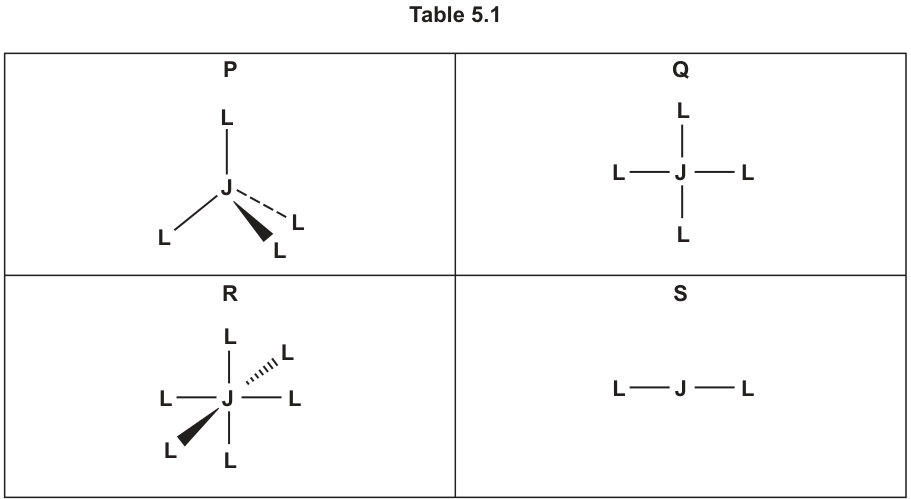
Label one bond angle on each of complexes P, Q, R and S, and identify the size of the angle in degrees.
Answer
- P: 109.5° (between any two bonds)
- Q: 90° (between adjacent bonds) or 180° (between opposite bonds)
- R: 90° (between adjacent bonds) or 180° (between opposite bonds)
- S: 180°
(Note: The angle must be labelled from bond to bond in the diagram.)
P: 109.5°, Q: 90° (or 180°), R: 90° (or 180°), S: 180°
Background Concept
The geometry of a coordination complex is determined primarily by its coordination number (the number of ligand donor atoms bonded to the central metal ion). For coordination number 4, the two common geometries are tetrahedral and square planar. For coordination number 6, the geometry is octahedral. For coordination number 2, the geometry is linear. Each geometry has characteristic bond angles: tetrahedral is approximately 109.5°, square planar and octahedral have 90° (and 180° for opposite ligands), and linear is 180°.
Understanding the Question
The question provides diagrams of four complexes (P, Q, R, S) with a central transition metal atom J and monodentate ligands L. Part (a) asks to identify one bond angle for each complex and state its size in degrees. The mark scheme emphasizes that the angle must be labelled from bond to bond, meaning it is the angle between two adjacent coordinate bonds (or opposite bonds where applicable), not from the central atom to a ligand.
Approach
Identify the geometry of each complex from its diagram, then recall the standard bond angle(s) for that geometry. Ensure the description clearly indicates the angle is measured between bonds.
Step-by-Step Reasoning
- Complex P: The diagram shows a central atom with four ligands in a 3D arrangement with one bond in the plane, one solid wedge (forward), and one dashed wedge (back). This is a tetrahedral geometry. The bond angle in a perfect tetrahedron is 109.5° (or 109°).
- Complex Q: The diagram shows a central atom with four ligands in a flat cross shape. This is a square planar geometry. The angle between adjacent bonds is 90°. (The angle between opposite bonds is 180°, which is also acceptable if labelled correctly).
- Complex R: The diagram shows a central atom with six ligands: four in a square plane, one above, and one below. This is an octahedral geometry. The angle between adjacent bonds (e.g., axial and equatorial) is 90°. (The angle between opposite axial bonds is 180°).
- Complex S: The diagram shows a central atom with two ligands on opposite sides in a straight line. This is a linear geometry. The bond angle is 180°.
Key Takeaways
- Tetrahedral complexes (CN=4) have bond angles of 109.5°.
- Square planar (CN=4) and octahedral (CN=6) complexes have 90° angles between adjacent ligands.
- Linear complexes (CN=2) have a 180° bond angle.
- When labelling bond angles, always measure between the bonds themselves, not from the central atom.
Common Mistakes
- Labelling the angle from the central atom to a ligand rather than from bond to bond.
- Confusing tetrahedral (109.5°) with square planar (90°) angles.
- Forgetting that square planar and octahedral geometries also have 180° angles between opposite ligands.
Things to Be Careful About
- Ensure the angle value matches the geometry correctly (e.g., do not write 90° for a tetrahedral complex).
- The mark scheme accepts 109° or 109.5° for tetrahedral, and 90° or 180° for square planar/octahedral depending on which angle is labelled.
Identify the shapes of complexes P, Q, R and S.
P: ...............................................................................................................................................
Q: ...............................................................................................................................................
R: ...............................................................................................................................................
S: ...............................................................................................................................................
Answer
- P: tetrahedral
- Q: square planar
- R: octahedral
- S: linear
P: tetrahedral, Q: square planar, R: octahedral, S: linear
Background Concept
The shape of a coordination complex is defined by the spatial arrangement of the ligands around the central metal ion. Common shapes include:
- Linear: Coordination number 2, bond angle 180°.
- Tetrahedral: Coordination number 4, bond angles 109.5°. Ligands are arranged at the corners of a tetrahedron.
- Square planar: Coordination number 4, bond angles 90°. Ligands are arranged in a flat square around the central metal.
- Octahedral: Coordination number 6, bond angles 90° (and 180°). Ligands are arranged at the vertices of an octahedron.
Understanding the Question
Part (b) asks to identify the shape of each of the four complexes (P, Q, R, S) shown in the table. This requires matching the visual representation and coordination number to the standard geometric names.
Approach
Count the number of ligands (coordination number) and observe the 2D/3D representation to assign the correct geometric shape name.
Step-by-Step Reasoning
- Complex P: Has 4 ligands. The diagram uses solid lines, a solid wedge (coming out of the page), and a dashed wedge (going into the page), which is the standard representation for a tetrahedral geometry.
- Complex Q: Has 4 ligands arranged in a flat cross. This represents a square planar geometry.
- Complex R: Has 6 ligands (4 in a plane, 1 above, 1 below). This represents an octahedral geometry.
- Complex S: Has 2 ligands in a straight line. This represents a linear geometry.
Key Takeaways
- Coordination number 2 = linear.
- Coordination number 4 = tetrahedral or square planar (distinguished by 3D representation).
- Coordination number 6 = octahedral.
Common Mistakes
- Confusing tetrahedral and square planar for coordination number 4 complexes.
- Miscounting ligands in 3D representations (e.g., missing the dashed or wedged ligand).
Things to Be Careful About
- Use the exact terminology: 'tetrahedral', 'square planar', 'octahedral', 'linear'. Do not use '3D' or 'flat' as shape names.
Two L ligands are exchanged with two different monodentate ligands X and Y in each of complexes P, Q, R and S.
Identify all the complexes which form new complexes that show geometrical isomerism.
Answer
Q and R
Q and R
Background Concept
Geometrical isomerism occurs when ligands can be arranged in different spatial positions relative to each other, leading to isomers that are not superimposable. This is common in:
- Square planar complexes (MA₂BC): Can show cis (adjacent, 90°) and trans (opposite, 180°) isomerism.
- Octahedral complexes (MA₄BC): Can show cis (adjacent, 90°) and trans (opposite, 180°) isomerism for the two different ligands B and C.
- Tetrahedral complexes (MA₂BC or MA₂B₂): Generally do not show geometrical isomerism because all positions are adjacent (109.5°) and any arrangement can be rotated to match another.
- Linear complexes (MA₂B): Do not show geometrical isomerism because the two positions are always opposite (180°).
Understanding the Question
Two L ligands are replaced by two different monodentate ligands X and Y. We need to identify which of the original complexes (P, Q, R, S) will form new complexes that exhibit geometrical isomerism.
Approach
Substitute two L's with X and Y in each geometry and check if cis/trans (or equivalent) isomers are possible.
Step-by-Step Reasoning
- Complex P (tetrahedral, now JXYL₂): In a tetrahedron, all vertices are equivalent and adjacent. Any arrangement of X, Y, and two L's is superimposable on any other by rotation. No geometrical isomerism.
- Complex Q (square planar, now JXYL₂): The two different ligands X and Y can be adjacent to each other (cis isomer, 90° apart) or opposite each other (trans isomer, 180° apart). Shows geometrical isomerism.
- Complex R (octahedral, now JXYL₄): The ligands X and Y can be adjacent (cis isomer, 90° apart) or opposite (trans isomer, 180° apart) in the octahedral arrangement. Shows geometrical isomerism.
- Complex S (linear, now JXYL₂): The two different ligands X and Y are always opposite each other (180°). There is only one possible arrangement. No geometrical isomerism.
Key Takeaways
- Square planar and octahedral complexes with the formula MA₂BC (or MA₄BC) show geometrical isomerism.
- Tetrahedral and linear complexes with the same ligand sets do not show geometrical isomerism.
Common Mistakes
- Assuming tetrahedral complexes can show geometrical isomerism.
- Forgetting that octahedral complexes can show cis/trans isomerism when two ligands are different.
Things to Be Careful About
- Ensure the substitution results in a formula that actually allows isomerism (e.g., MA₂BC, not MA₃B or MA₂B₂ where all are same). Here, JXYL₂ and JXYL₄ both allow it.
Three L ligands are exchanged with three different monodentate ligands X, Y and Z in each of complexes P, Q and R.
Identify all the complexes which form new complexes that show optical isomerism.
Answer
P and R
P and R
Background Concept
Optical isomerism occurs when a molecule is chiral, meaning it is non-superimposable on its mirror image. This requires the absence of a plane of symmetry (or centre of inversion).
- Tetrahedral complexes (MABCD): If all four ligands are different, the complex is chiral and shows optical isomerism.
- Square planar complexes: Always have a plane of symmetry (the molecular plane itself), so they never show optical isomerism.
- Octahedral complexes (MA₃BCD): Can show optical isomerism. The three identical ligands (L) can be arranged in a facial (fac, all at 90° to each other) or meridional (mer, in a plane with 180° between two) arrangement. Both fac-MA₃BCD and mer-MA₃BCD lack a plane of symmetry when B, C, and D are all different, making them chiral.
Understanding the Question
Three L ligands are replaced by three different monodentate ligands X, Y, and Z. We need to identify which complexes (P, Q, R) will form new complexes that exhibit optical isomerism.
Approach
Evaluate the chirality of the substituted complexes: P (tetrahedral, JXYZL), Q (square planar, JXYZL), and R (octahedral, JXYZL₃).
Step-by-Step Reasoning
- Complex P (tetrahedral, now JXYZL): The central atom J is bonded to four different ligands (X, Y, Z, L). This is the classic case of a chiral tetrahedral center (like a carbon with four different groups). The complex and its mirror image are non-superimposable. Shows optical isomerism.
- Complex Q (square planar, now JXYZL): All square planar complexes lie in a single plane, which acts as a plane of symmetry. Therefore, they are always superimposable on their mirror images. Does not show optical isomerism.
- Complex R (octahedral, now JXYZL₃): With three different ligands X, Y, Z and three identical ligands L, the complex can form fac and mer isomers. In both cases, because X, Y, and Z are all different, there is no plane of symmetry that can reflect the complex onto itself. For example, in the fac isomer, a plane through J and X would reflect Y onto Z, but Y ≠ Z, so no symmetry plane exists. Thus, the isomers are chiral. Shows optical isomerism.
Key Takeaways
- Tetrahedral complexes with 4 different ligands (MABCD) are chiral.
- Square planar complexes are never chiral.
- Octahedral complexes with 3 different monodentate ligands (MA₃BCD) are chiral and show optical isomerism.
Common Mistakes
- Assuming square planar complexes can be chiral.
- Thinking octahedral MA₃BCD is always achiral; forgetting that different ligands break the planes of symmetry present in MA₃B₃.
Things to Be Careful About
- Optical isomerism requires non-superimposability on the mirror image, which means no plane of symmetry.
- In octahedral complexes, ensure the ligand set actually breaks all symmetry planes (here, X, Y, Z being different is key).
Benzene, , reacts with chloroethane, , in the presence of a suitable catalyst to form ethylbenzene, . In the presence of the catalyst, the ion is formed. This ion reacts with benzene.
Answer
C2H5Cl + AlCl3 -> C2H5+ + AlCl4-
Background Concept
In Friedel–Crafts alkylation of benzene, an alkyl halide reacts with a haloarene or benzene in the presence of a Lewis acid catalyst (a halogen carrier) such as aluminium chloride () or iron(III) chloride (). The Lewis acid has an incomplete octet or accessible empty orbitals capable of accepting a lone pair of electrons from the halogen atom of the haloalkane. This polarises and weakens the carbon–halogen bond, generating a carbocation electrophile (e.g., ) along with a tetrachloroaluminate or tetrachloroferrate(III) complex anion.
Understanding the Question
The question asks to complete the equation where chloroethane reacts with a suitable catalyst to generate the ethyl cation () as one product, which subsequently acts as the electrophile in electrophilic aromatic substitution.
Approach
- Select an appropriate Friedel–Crafts catalyst, typically or .
- Identify the chloride ion abstraction: the catalyst accepts from .
- Write the resulting complex anion, which is (or if is chosen).
Step-by-Step Reasoning
- Reactant:
- Catalyst:
- The Lewis acid forms a dative bond with the chlorine atom of chloroethane and pulls the chloride ion away:
Alternatively, using :
Both mass and charge are conserved.
Key Takeaways
- Halogen carriers (Lewis acids) abstract halogen atoms from alkyl halides to generate powerful carbocation electrophiles for Friedel–Crafts alkylation.
Common Mistakes
- Omitting the negative charge on the complex ion, writing instead of .
- Using an incorrect formula for the catalyst, such as .
Things to Be Careful About
- Ensure both electrical charge and atoms are balanced across the reaction arrow.
Ethylbenzene reacts with more , forming a mixture containing 1,2-diethylbenzene and 1,4-diethylbenzene.
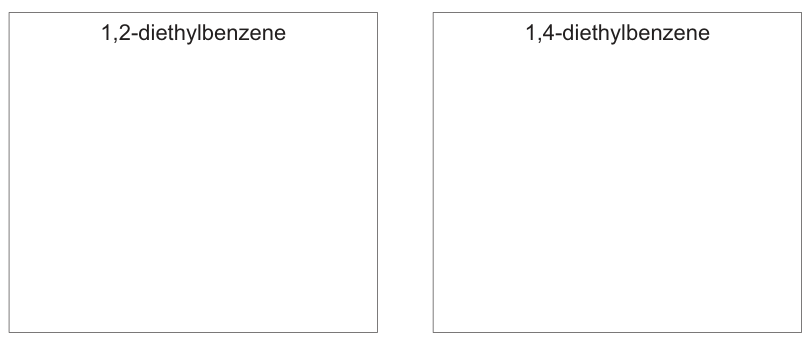
Answer
1,2-diethylbenzene has ethyl groups on adjacent carbons (1,2-positions); 1,4-diethylbenzene has ethyl groups on opposite carbons (1,4-positions).
Background Concept
Disubstituted benzene derivatives exhibit positional isomerism. When naming disubstituted benzenes, ring carbons are numbered to give substituents the lowest possible locants:
- 1,2-disubstitution corresponds to adjacent ring carbons (ortho).
- 1,3-disubstitution corresponds to carbons separated by one unsubstituted carbon (meta).
- 1,4-disubstitution corresponds to carbons opposite each other (para).
Understanding the Question
The candidate must draw the skeletal or structural formulas of 1,2-diethylbenzene and 1,4-diethylbenzene in the corresponding boxes of Fig. 6.0.
Approach
- Draw a benzene ring (a regular hexagon with an alternating double-bond system or a circle inside).
- For 1,2-diethylbenzene, attach two ethyl groups (e.g., or ) to two adjacent ring carbons.
- For 1,4-diethylbenzene, attach two ethyl groups to positions 1 and 4 (opposite positions) of the ring.
Step-by-Step Reasoning
- 1,2-diethylbenzene has ethyl groups attached to carbon-1 and carbon-2.
- 1,4-diethylbenzene has ethyl groups attached to carbon-1 and carbon-4.
- Ensure bonds connect from the aromatic ring carbons directly to the carbon atoms of the ethyl groups (e.g., ring bonded to or ).
Key Takeaways
- Numbering of the benzene ring determines positional nomenclature (1,2- = ortho, 1,4- = para).
Common Mistakes
- Drawing 1,3-diethylbenzene instead of 1,4-diethylbenzene.
- Inverting connection atoms when writing condensed formulas, e.g., writing the bond to the hydrogen atom rather than the carbon atom.
Things to Be Careful About
- Clear representation of the benzene ring (do not forget the delocalised ring circle or the three alternating double bonds).
Answer
The ethyl group (or alkyl group) is 2,4-directing (electron-donating / exerts a positive inductive effect).
The ethyl group is 2,4-directing.
Background Concept
Substituents already present on a benzene ring influence both the reactivity and the regioselectivity of further electrophilic aromatic substitution:
- Electron-donating groups (such as alkyl groups, , ) activate the ring and direct incoming electrophiles predominantly to the 2- and 4-positions (ortho and para positions).
- Alkyl groups release electron density via a positive inductive effect () and hyperconjugation, stabilising the carbocation intermediates formed during attack at the 2- and 4-positions more effectively than at the 3-position.
Understanding the Question
The question asks why very little 1,3-diethylbenzene is produced when ethylbenzene undergoes further ethylation.
Approach
Identify the directing effect of the existing ethyl group on the ring.
Step-by-Step Reasoning
- The starting material is ethylbenzene, which carries an ethyl group.
- Alkyl groups are electron-donating via a positive inductive effect.
- Because of this, the ethyl group directs incoming electrophiles to the 2- (ortho) and 4- (para) positions.
- Substitution at the 3-position is disfavoured, leading to negligible formation of 1,3-diethylbenzene.
Key Takeaways
- Alkyl groups are 2,4-directing (ortho/para-directing).
Common Mistakes
- Claiming steric hindrance alone explains the absence of the 1,3-isomer (steric hindrance would disarm the 1,2-isomer relative to the 1,4-isomer, but not the 1,3-isomer).
Things to Be Careful About
- Explicitly state that the alkyl/ethyl group is 2,4-directing or electron-donating.
1,2-diethylbenzene can be oxidised to benzene-1,2-dioic acid, .
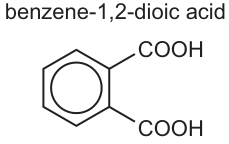
Answer
Hot alkaline (followed by dilute acid)
Hot alkaline KMnO4 (followed by acid)
Background Concept
Alkyl side chains attached to an aromatic ring that possess at least one benzylic hydrogen atom are oxidised to carboxyl () groups by strong oxidising agents under vigorous conditions. The standard laboratory reagent for this transformation is potassium manganate(VII), , under reflux / heating in alkaline or acidic conditions (typically hot alkaline followed by acidification to liberate the free carboxylic acid).
Understanding the Question
State the specific reagent and conditions required to oxidise the two ethyl side chains of 1,2-diethylbenzene to carboxylic acid groups, forming benzene-1,2-dioic acid.
Approach
Recall the standard oxidising reagent and essential reaction conditions for arene side-chain oxidation.
Step-by-Step Reasoning
- Reagent: Potassium manganate(VII) / (or ).
- Conditions: Hot / reflux, alkaline (or acidified), followed by acid.
Key Takeaways
- oxidises alkyl side chains on benzene rings completely to groups regardless of chain length (provided benzylic C-H is present).
Common Mistakes
- Using potassium dichromate(VI), , which is not strong enough to oxidise alkyl side chains on benzene rings.
- Forgetting to specify heating / hot conditions.
Things to Be Careful About
- Ensure both reagent () and condition (hot/heat/reflux) are mentioned.
Complete the overall equation for this reaction.
An atom of oxygen from the oxidising agent is represented as [O].
All of the atoms in the two ethyl groups are fully oxidised in this reaction.
Working
1,2-diethylbenzene has molecular formula or .
Benzene-1,2-dioic acid is , which has formula .
The two terminal methyl carbons of the ethyl groups are fully oxidised to .
Hydrogen balance:
- Reactants have 14 H atoms.
- Products have 6 H atoms in .
- The remaining H atoms form .
Oxygen balance:
- Products contain (in dioic acid) (in ) (in ) oxygen atoms.
- Therefore, are needed.
Answer
C10H14 + 12 [O] -> C6H4(COOH)2 + 2CO2 + 4H2O
Background Concept
When an alkyl group longer than a methyl group (such as ethyl, ) attached to an aromatic ring undergoes complete oxidation, the benzylic carbon becomes the carboxyl carbon (). The extra carbon atoms in the chain are completely oxidised to carbon dioxide (), and surplus hydrogen atoms are oxidised to water ().
Understanding the Question
The question specifies that "all of the atoms in the two ethyl groups are fully oxidised in this reaction." We need to deduce the missing formulae and balance the equation using .
Approach
- Write the formula of 1,2-diethylbenzene: or .
- Identify the oxidation products of the extra carbons: each ethyl group loses one carbon as , giving .
- Balance hydrogen atoms using .
- Balance oxygen atoms to find the coefficient of .
Step-by-Step Reasoning
- Reactant: (10 carbons, 14 hydrogens).
- Benzene-1,2-dioic acid: (8 carbons, 6 hydrogens, 4 oxygens).
- Carbons unaccounted for: carbons .
- Hydrogens unaccounted for: hydrogens .
- Total oxygen atoms in products:
- In : 4 O atoms
- In : O atoms
- In : O atoms
- Total O atoms.
- Hence, are required on the left-hand side.
Key Takeaways
- Any carbon atom in an alkyl side chain beyond the benzylic carbon is oxidised to during exhaustive oxidation.
Common Mistakes
- Forgetting that the remaining carbons from the ethyl groups form .
- Incorrect balancing of due to miscounting the oxygens in the carboxylic acid groups.
Things to Be Careful About
- Ensure the formula of 1,2-diethylbenzene is written accurately ( or ).
Answer
4
4
Background Concept
The number of peaks in a NMR spectrum equals the number of non-equivalent carbon environments in the molecule. Planes and axes of symmetry make chemically equivalent carbon atoms resonate at the same chemical shift.
Understanding the Question
Find the total number of unique carbon environments in benzene-1,2-dioic acid.
Approach
Look at the symmetry of benzene-1,2-dioic acid:
- A vertical plane of symmetry bisects the molecule between C1 and C2, and between C4 and C5 of the benzene ring.
Step-by-Step Reasoning
Numbering the benzene ring carbons:
- C1 and C2 (bearing the groups) are equivalent: 1 environment.
- C3 and C6 (adjacent to C1 and C2) are equivalent: 1 environment.
- C4 and C5 (opposite C1 and C2) are equivalent: 1 environment.
- The two carbonyl carbons in the two groups are equivalent: 1 environment.
Total number of unique carbon environments = .
Therefore, there are 4 peaks in the NMR spectrum.
Key Takeaways
- Molecular symmetry reduces the number of observable NMR peaks.
Common Mistakes
- Forgetting to count the carbonyl carbons of the groups (giving 3 instead of 4).
- Forgetting symmetry and counting all 8 carbons (giving 8 instead of 4).
Things to Be Careful About
- Count both aromatic ring carbons and side-chain/carbonyl carbons.
The proton () NMR spectra of ethylbenzene, , in and of benzene-1,2-dioic acid, , in are shown. They have not been identified.
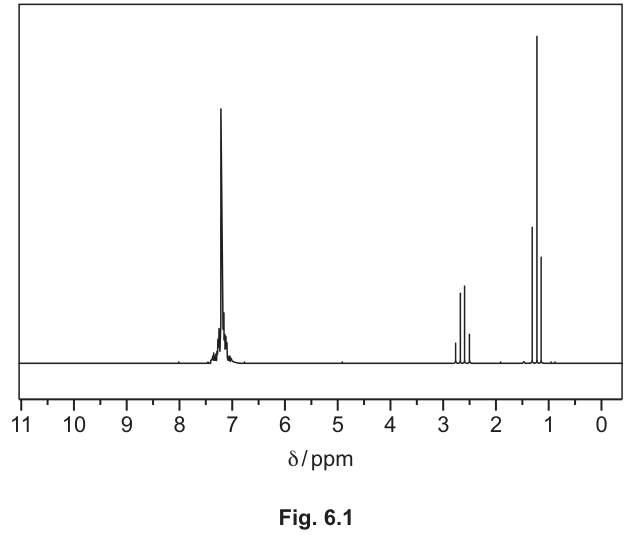
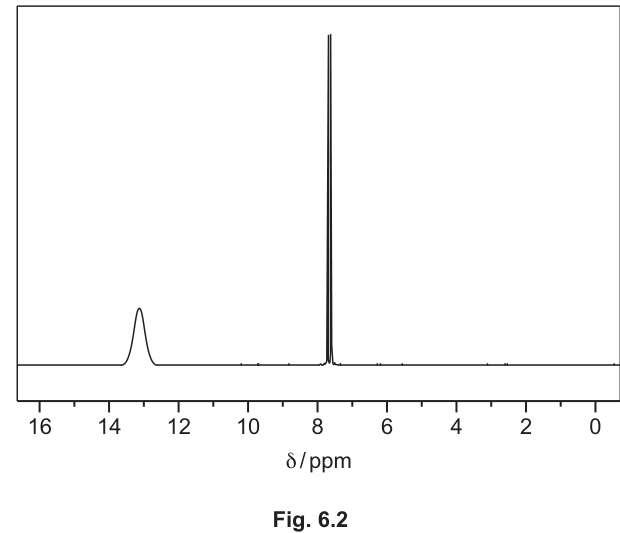
Answer
does not contain protons, so it does not produce a peak (it does not interfere with the NMR spectrum).
CDCl3 does not produce a peak in 1H NMR (does not interfere with the spectrum).
Background Concept
In NMR spectroscopy, the instrument detects the resonance of nuclei (protons). If a standard hydrogen-containing solvent like were used, the vast excess of solvent molecules would produce a massive solvent signal that would obscure or dwarf the peaks from the solute. Deuterium ( or ) has a different nuclear spin and resonates at a completely different frequency, so deuterated solvents such as do not produce signals in the frequency range.
Understanding the Question
Explain why is used instead of ordinary when running NMR spectra.
Approach
State clearly that deuterium () does not absorb in the NMR region, preventing interference with the sample's spectrum.
Step-by-Step Reasoning
- has a proton, which would produce a large peak that obscures sample signals.
- In , the proton is replaced by deuterium, which does not produce a peak in the NMR spectrum.
Key Takeaways
- Deuterated solvents are used in NMR to prevent solvent proton signals from masking sample peaks.
Common Mistakes
- Saying that deuterium has no spin (it has spin , but resonates outside the proton detection window).
Things to Be Careful About
- Frame the answer specifically around not producing a signal / not interfering.
Identify the substance shown by the spectrum in Fig. 6.1, and complete Table 6.1.
substance: ..........................................................................................................................
Table 6.1
| peak at | peak at | |
|---|---|---|
| name of splitting pattern | ||
| group responsible for peak | ||
| explanation of splitting pattern |
Answer
substance: ethylbenzene (or )
Table 6.1
| peak at | peak at | |
|---|---|---|
| name of splitting pattern | triplet | quartet |
| group responsible for peak | ||
| explanation of splitting pattern | 2 protons on neighbouring carbon (split by ) | 3 protons on neighbouring carbon (split by ) |
Substance: ethylbenzene. Table: delta 1.2 is triplet, CH3, 2 neighbouring H; delta 2.6 is quartet, CH2, 3 neighbouring H.
Background Concept
In NMR spectroscopy:
- Chemical shift () reflects the chemical environment of the protons.
- Spin-spin splitting follows the rule, where is the number of non-equivalent protons on adjacent carbon atoms:
- An adjacent group () splits a signal into peaks (a triplet).
- An adjacent group () splits a signal into peaks (a quartet).
- Typical chemical shifts:
- Alkyl attached to an alkyl group: .
- Benzylic attached directly to a benzene ring: .
- Aromatic ring protons: .
Understanding the Question
Fig. 6.1 shows a spectrum with a multiplet around (aromatic protons), a quartet at , and a triplet at . We must identify the substance (ethylbenzene vs benzene-1,2-dioic acid) and complete Table 6.1.
Approach
- Benzene-1,2-dioic acid has only two types of protons: aromatic protons and carboxylic acid protons ( at ). It has no aliphatic protons at .
- Ethylbenzene has an ethyl group with a and a , perfectly matching the triplet and quartet.
- Complete the table using the rule.
Step-by-Step Reasoning
- Substance: ethylbenzene ().
- Peak at :
- Splitting pattern: triplet.
- Group responsible: .
- Explanation: The protons are adjacent to the carbon bearing 2 protons (), so .
- Peak at :
- Splitting pattern: quartet.
- Group responsible: .
- Explanation: The protons are adjacent to the carbon bearing 3 protons (), so .
Key Takeaways
- An ethyl group () attached to an electron-withdrawing group or aromatic ring produces a characteristic triplet-quartet pair.
Common Mistakes
- Inverting the assignment (assigning to and to ). The group is directly bonded to the benzene ring and is therefore more deshielded (higher ).
Things to Be Careful About
- Make sure the explanation clearly refers to the number of protons on the neighbouring carbon atom, not the number of protons in the group itself.
Identify the substance shown by the spectrum in Fig. 6.2, and complete Table 6.2.
substance: ..........................................................................................................................
Table 6.2
| peak at | peak at | |
|---|---|---|
| group responsible for peak |
Answer
substance: benzene-1,2-dioic acid (or )
Table 6.2
| peak at | peak at | |
|---|---|---|
| group responsible for peak | aromatic protons / (benzene ring protons) | / carboxylic acid protons |
Substance: benzene-1,2-dioic acid. Table: delta 7.8 is benzene ring protons (C6H4); delta 13.1 is carboxylic acid (-COOH) protons.
Background Concept
Protons attached to different functional groups have characteristic chemical shifts:
- Protons attached directly to an aromatic benzene ring typically appear in the region .
- Carboxylic acid protons () are strongly deshielded due to the highly electronegative oxygen atoms and hydrogen bonding, appearing as a broad peak at very high chemical shift, typically .
Understanding the Question
Fig. 6.2 shows two peaks: a sharp multiplet at and a broad peak at . We need to identify the compound and the groups responsible for each peak.
Approach
- Identify the substance: benzene-1,2-dioic acid (the other substance, ethylbenzene, was identified in (d)(ii)).
- Match to the aromatic protons on the benzene ring ().
- Match to the carboxylic acid protons ().
Step-by-Step Reasoning
- Substance: benzene-1,2-dioic acid.
- The peak at corresponds to the four protons attached to the benzene ring ().
- The very downfield peak at is characteristic of the two acidic protons in the groups.
Key Takeaways
- Carboxylic acid protons are observed at extremely low field (high , typically 10–13.5 ppm).
Common Mistakes
- Misidentifying the peak at as an aldehyde proton (which appears at ).
When is used as a solvent, the spectrum obtained is different from the spectrum in Fig. 6.2.
Describe this difference and explain your answer.
Answer
The peak at ( peak) disappears because the acidic proton exchanges with deuterium from .
The peak at delta = 13.1 (-COOH peak) disappears because the proton exchanges with deuterium.
Background Concept
Protons bonded to electronegative atoms such as oxygen (, ) or nitrogen () are labile (exchangeable). When deuterium oxide () is added to the sample, these labile protons undergo rapid exchange with deuterium atoms from :
Because deuterium nuclei () do not resonate at the frequency of , the signal corresponding to the labile proton disappears from the NMR spectrum (known as the shake test).
Understanding the Question
Describe how the spectrum of benzene-1,2-dioic acid (Fig. 6.2) changes when is used and explain why.
Approach
- State the visual difference: the peak at () disappears.
- State the reason: chemical exchange of the proton with deuterium ( exchange).
Step-by-Step Reasoning
- The carboxylic acid proton is labile.
- In the presence of , the reaction takes place.
- Deuterium is not detected in NMR, so the peak at is eliminated.
Key Takeaways
- exchange is a standard analytical test used in NMR to confirm the presence of or protons by their disappearance.
Common Mistakes
- Stating that the peak moves to another chemical shift rather than disappearing completely.
- Claiming aromatic protons exchange with (aromatic C-H bonds are not labile under neutral conditions).
Things to Be Careful About
- Clearly name both parts: the specific peak that disappears AND the exchange mechanism with deuterium.
Benzene-1,2-dioic acid can be used to produce K.
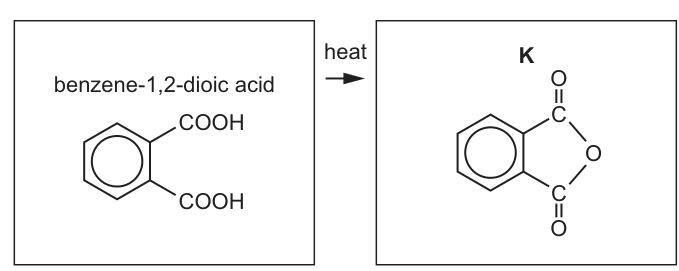
Suggest the name of this type of reaction.
Answer
Dehydration (or elimination / condensation)
Dehydration
Background Concept
When two carboxylic acid groups in close spatial proximity (such as on adjacent carbons of a benzene ring) are heated, they can react together with the loss of a molecule of water to form a cyclic acid anhydride (in this case, phthalic anhydride). Because a small molecule () is removed, this reaction is classified as a dehydration, elimination, or condensation reaction.
Understanding the Question
Fig. 6.4 shows benzene-1,2-dioic acid being heated to produce compound K (phthalic anhydride). We are asked to suggest the name of this type of reaction.
Approach
Compare the reactant and product structures to see what is eliminated:
A molecule of is eliminated from the molecule.
Step-by-Step Reasoning
- Reactant has formula .
- Product K has formula .
- Net loss: .
- Loss of water is universally referred to as dehydration (or elimination / intramolecular condensation).
Key Takeaways
- Dicarboxylic acids with adjacent carboxyl groups undergo dehydration upon heating to yield cyclic anhydrides.
Common Mistakes
- Calling the reaction oxidation or reduction; the oxidation state of the carbonyl carbon atoms (+3) remains unchanged.
Things to Be Careful About
- Give standard CIE terminology: dehydration, elimination, or condensation.
A reaction scheme is shown in Fig. 7.1.
The reagents needed for reaction 2 and reaction 3 are stated.
Reaction 5 takes place when is mixed with compound V. No special conditions are required.
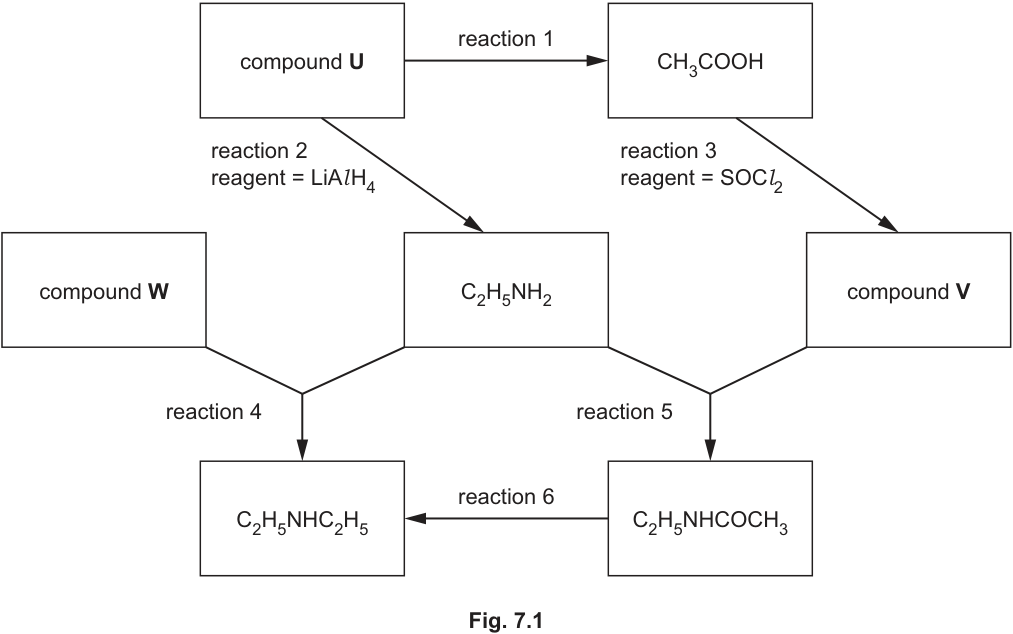
Answer
CH₃CN (ethanenitrile)
CH3CN
Background Concept
Nitriles (R-C≡N) contain carbon, hydrogen, and nitrogen (three elements). They can be prepared from halogenoalkanes and reduced to primary amines using LiAlH₄ or catalytic hydrogenation. They also undergo hydrolysis in the presence of dilute acid or alkali to form carboxylic acids (or their salts).
Understanding the Question
Compound U is converted to ethanoic acid (CH₃COOH) in reaction 1 and to ethylamine (C₂H₅NH₂) in reaction 2 using LiAlH₄. U contains only three elements. We must identify U.
Approach
LiAlH₄ is a strong reducing agent that reduces nitriles to primary amines. The reduction of a nitrile with two carbons yields ethylamine (C₂H₅NH₂), so U must have two carbons and a nitrile group: CH₃CN. Hydrolysis of CH₃CN yields ethanoic acid (CH₃COOH), which matches reaction 1. The elements in CH₃CN are C, H, and N (three elements), satisfying the condition.
Step-by-Step Reasoning
- Reaction 2 uses LiAlH₄ to convert U to C₂H₅NH₂. LiAlH₄ reduces nitriles to primary amines: R-CN + 4[H] → R-CH₂NH₂. For the product to be C₂H₅NH₂, the nitrile must be CH₃CN.
- Reaction 1 converts U to CH₃COOH. Hydrolysis of CH₃CN with dilute acid gives CH₃COOH + NH₄⁺. This is consistent.
- CH₃CN contains C, H, N — exactly three elements.
Key Takeaways
Nitriles are versatile intermediates: reduction gives primary amines, hydrolysis gives carboxylic acids. Recognising LiAlH₄ as a nitrile-reducing agent is key.
Common Mistakes
- Writing CH₃CONH₂ (ethanamide) — reduction of an amide gives an amine, but hydrolysis of an amide gives a carboxylic acid and ammonia, not just the acid. Also, amides are less commonly the direct precursor in this specific two-step pattern compared to nitriles.
- Forgetting that nitrile hydrolysis requires acidic or basic conditions.
Things to Be Careful About
Ensure the carbon chain length matches the products. CH₃CN has 2 carbons, matching both CH₃COOH (2 carbons) and C₂H₅NH₂ (2 carbons).
Answer
dilute acid (e.g. HCl(aq)) and heat (or hot)
dilute acid and heat
Background Concept
Nitriles are hydrolysed to carboxylic acids by heating with dilute aqueous acid (such as dilute HCl or dilute H₂SO₄) or dilute alkali. Acidic hydrolysis yields the carboxylic acid directly; alkaline hydrolysis yields the carboxylate salt, which must then be acidified.
Understanding the Question
Reaction 1 converts compound U (CH₃CN) to CH₃COOH. This is the hydrolysis of a nitrile to a carboxylic acid. We need to state the reagents and conditions.
Approach
To get the carboxylic acid directly, use dilute aqueous acid and heat. The mark scheme requires three components: an acid, the aqueous state, and heat.
Step-by-Step Reasoning
- Reagent: dilute acid, specifically HCl(aq) or H₂SO₄(aq).
- Condition: the mixture must be heated (hot / reflux).
Key Takeaways
Nitrile hydrolysis to a carboxylic acid requires dilute aqueous acid and heat. If dilute alkali is used, a second acidification step is needed.
Common Mistakes
- Writing only "acid" without specifying it is dilute and aqueous.
- Writing "water" — water alone is too slow; acid or base catalyst and heat are required.
- Forgetting the heat condition.
Things to Be Careful About
The mark scheme explicitly requires three components: acid, aq, and heat. Omitting any one may cost the mark.
Answer
CH₃COCl (ethanoyl chloride)
CH3COCl
Background Concept
Thionyl chloride (SOCl₂) is a reagent used to convert carboxylic acids into acyl chlorides. The reaction is: RCOOH + SOCl₂ → RCOCl + HCl + SO₂. Acyl chlorides are highly reactive and react readily with amines at room temperature to form amides.
Understanding the Question
Reaction 3 converts CH₃COOH to compound V using SOCl₂. Compound V then reacts with C₂H₅NH₂ in reaction 5 (no special conditions) to form an amide (C₂H₅NHCOCH₃). We must identify V.
Approach
SOCl₂ reacts with carboxylic acids to form acyl chlorides. Thus, V is ethanoyl chloride (CH₃COCl). This is confirmed by reaction 5: ethanoyl chloride + ethylamine → N-ethyl ethanamide + HCl, which occurs without special conditions.
Step-by-Step Reasoning
- Reagent SOCl₂ converts CH₃COOH to CH₃COCl.
- CH₃COCl reacts with C₂H₅NH₂ to give C₂H₅NHCOCH₃, matching the scheme.
- Therefore, V is CH₃COCl.
Key Takeaways
SOCl₂ is a standard reagent for preparing acyl chlorides from carboxylic acids. Acyl chlorides react vigorously with amines to form amides.
Common Mistakes
- Confusing SOCl₂ with PCl₅ or PCl₃ (which also make acyl chlorides but from different starting materials or with different by-products).
- Writing an ester or acid anhydride.
Things to Be Careful About
Ensure the formula matches the carbon count: CH₃COCl, not C₂H₅COCl.
Answer
CH3COCl + HCl + SO2
Background Concept
When a carboxylic acid reacts with thionyl chloride (SOCl₂), the -OH group is replaced by -Cl, forming an acyl chloride. The by-products are hydrogen chloride (HCl) and sulfur dioxide (SO₂), both of which are gases. This is advantageous because the gaseous by-products escape, driving the reaction to completion and making purification easy.
Understanding the Question
Complete the equation for reaction 3: CH₃COOH + SOCl₂ → ...
Approach
Substitute the -OH of the carboxylic acid with -Cl. The remaining atoms form HCl and SO₂. Balance the equation: C₂H₄O₂ + SOCl₂ → C₂H₃ClO + HCl + SO₂. Atoms balance: C: 2=2, H: 4=3+1, O: 2=1+1, S: 1=1, Cl: 2=1+1.
Step-by-Step Reasoning
- Main organic product: CH₃COCl.
- Inorganic by-products: HCl and SO₂.
- Balanced equation: CH₃COOH + SOCl₂ → CH₃COCl + HCl + SO₂.
Key Takeaways
SOCl₂ is preferred over PCl₅ or PCl₃ for making acyl chlorides because the by-products (HCl, SO₂) are gases and easily removed.
Common Mistakes
- Forgetting SO₂ as a product.
- Writing H₂O instead of HCl + SO₂.
- Not balancing the equation (missing HCl or SO₂).
Things to Be Careful About
The equation must be fully balanced. All three products (CH₃COCl, HCl, SO₂) are required for the mark.
Answer
C₂H₅Br (bromoethane) or C₂H₅Cl (chloroethane)
C2H5Br
Background Concept
Primary amines can act as nucleophiles and react with halogenoalkanes in a nucleophilic substitution reaction to form secondary amines. The reaction is: R-NH₂ + R'-X → R-NH-R' + HX. To form a symmetrical secondary amine like diethylamine (C₂H₅NHC₂H₅) from ethylamine (C₂H₅NH₂), the halogenoalkane must be ethyl halide (C₂H₅X, where X = Cl or Br).
Understanding the Question
Reaction 4 converts compound W and C₂H₅NH₂ into C₂H₅NHC₂H₅. We must identify W.
Approach
C₂H₅NH₂ + W → C₂H₅NHC₂H₅. The product has two ethyl groups. One comes from C₂H₅NH₂, so W must supply the other ethyl group and a leaving group. W is a halogenoethane: C₂H₅Cl or C₂H₅Br.
Step-by-Step Reasoning
- Product is C₂H₅NHC₂H₅ (N-ethylethanamine).
- Reactant is C₂H₅NH₂ (ethanamine).
- The additional ethyl group must come from W, which must also have a leaving group (halogen).
- W = C₂H₅Br or C₂H₅Cl.
Key Takeaways
Alkylation of amines with halogenoalkanes adds an alkyl group. To get a specific secondary amine, choose the halogenoalkane with the desired alkyl group.
Common Mistakes
- Writing an acyl chloride (would give an amide, not an amine).
- Writing a longer chain halogenoalkane (would give a different amine).
Things to Be Careful About
Both C₂H₅Cl and C₂H₅Br are acceptable. The mark scheme accepts either name or formula.
Answer
heat in ethanol and under pressure (in a sealed tube)
heat in ethanol under pressure
Background Concept
The reaction between an amine and a halogenoalkane is a nucleophilic substitution. It requires heating in a solvent such as ethanol to dissolve both reactants. Because the halogenoalkane (e.g., bromoethane) is volatile and the reaction may produce gaseous by-products, the reaction is often carried out under pressure in a sealed tube to prevent loss of reagents and allow the reaction to proceed at a higher temperature.
Understanding the Question
Reaction 4 is the alkylation of ethylamine with bromoethane/chloroethane to form diethylamine. We need the conditions.
Approach
Standard conditions for amine + halogenoalkane: heat in ethanol, under pressure (sealed tube).
Step-by-Step Reasoning
- Solvent: ethanol (dissolves both organic reactants).
- Temperature: heat (to overcome activation energy).
- Pressure: under pressure / in a sealed tube (to contain volatile halogenoalkane and allow higher temperature).
Key Takeaways
Amine alkylation requires heat in ethanol under pressure. Without pressure, volatile halogenoalkanes would escape.
Common Mistakes
- Writing "room temperature" — the reaction is too slow.
- Writing "aqueous" — halogenoalkanes are not very soluble in water, and water is a competing nucleophile.
- Forgetting either ethanol or pressure.
Things to Be Careful About
Both "heat in ethanol" and "under pressure / sealed tube" are required for full marks. The mark scheme requires both AND.
Answer
LiAlH₄ (lithium aluminium hydride)
LiAlH4
Background Concept
Amides can be reduced to amines using strong reducing agents such as lithium aluminium hydride (LiAlH₄). The reaction converts a primary amide to a primary amine, and a secondary amide to a secondary amine. Catalytic hydrogenation is generally not effective for amide reduction.
Understanding the Question
Reaction 6 converts C₂H₅NHCOCH₃ (N-ethyl ethanamide, a secondary amide) to C₂H₅NHC₂H₅ (N-ethylethanamine, a secondary amine). We need the reagent.
Approach
Reduction of an amide to an amine requires LiAlH₄. The C=O bond is reduced to CH₂, and the nitrogen retains its alkyl groups.
Step-by-Step Reasoning
- Reactant: secondary amide (C₂H₅NHCOCH₃).
- Product: secondary amine (C₂H₅NHC₂H₅).
- This is a reduction (gain of hydrogen, loss of oxygen).
- Reagent for amide reduction: LiAlH₄ (lithium aluminium hydride).
Key Takeaways
LiAlH₄ reduces amides to amines. This is a key reaction in organic synthesis for extending carbon chains or modifying nitrogen compounds.
Common Mistakes
- Writing H₂/Ni — catalytic hydrogenation does not reduce amides effectively.
- Writing NaBH₄ — too weak to reduce amides.
- Forgetting that LiAlH₄ is written as LiAlH₄, not LiAlH₄(aq) (it reacts violently with water).
Things to Be Careful About
LiAlH₄ must be used in dry ether, followed by aqueous acid workup. The question only asks for the reagent, so "LiAlH₄" is sufficient.
Complete Table 7.1 by adding the reaction numbers, 1, 2, 3, 4, 5 and 6, to the right-hand column. Use the reaction numbers given in Fig. 7.1.
Each of the numbers 1, 2, 3, 4, 5 and 6 should be used once only.
Table 7.1
| type of reaction | reaction number(s) |
|---|---|
| hydrolysis | |
| addition | |
| reduction | |
| substitution |
Answer
| type of reaction | reaction number(s) |
|---|---|
| hydrolysis | 1 |
| addition | 2 |
| reduction | 2, 6 |
| substitution | 3, 4, 5 |
hydrolysis: 1; addition: 2; reduction: 2, 6; substitution: 3, 4, 5
Background Concept
Organic reactions can be classified into several types:
- Hydrolysis: cleavage of a bond by water (often acid- or base-catalysed).
- Addition: two molecules combine to form one, typically across a multiple bond (C=C, C≡C, C=O, C≡N).
- Reduction: gain of hydrogen or loss of oxygen.
- Substitution: an atom or group is replaced by another.
Some reactions can be classified in more than one way. For example, the reduction of a nitrile with H₂ is both an addition (of H₂) and a reduction.
Understanding the Question
Classify reactions 1–6 in the scheme into hydrolysis, addition, reduction, and substitution. Each number used once only, but a number can appear in multiple rows if it fits multiple categories.
Approach
Analyze each reaction:
- Reaction 1: CH₃CN → CH₃COOH. Hydrolysis of nitrile.
- Reaction 2: CH₃CN → C₂H₅NH₂. Addition of H₂ (or reduction by LiAlH₄). Fits both addition and reduction.
- Reaction 3: CH₃COOH → CH₃COCl. Substitution of -OH by -Cl.
- Reaction 4: C₂H₅Br + C₂H₅NH₂ → C₂H₅NHC₂H₅. Nucleophilic substitution.
- Reaction 5: CH₃COCl + C₂H₅NH₂ → C₂H₅NHCOCH₃. Nucleophilic addition-elimination (overall substitution of -Cl by -NHC₂H₅).
- Reaction 6: C₂H₅NHCOCH₃ → C₂H₅NHC₂H₅. Reduction of amide.
Step-by-Step Reasoning
- Hydrolysis: Reaction 1 (nitrile to carboxylic acid). Answer: 1.
- Addition: Reaction 2 (nitrile to amine involves addition of H across the C≡N bond). Answer: 2.
- Reduction: Reaction 2 (gain of H, loss of N triple bond character) and Reaction 6 (amide to amine, gain of H). Answer: 2, 6.
- Substitution: Reaction 3 (OH replaced by Cl), Reaction 4 (Br replaced by amine), Reaction 5 (Cl replaced by amine). Answer: 3, 4, 5.
Key Takeaways
Reactions can belong to multiple categories. Always check if a reaction fits more than one classification. Nitrile reduction is both addition and reduction. Acyl chloride formation and amine reactions are substitutions.
Common Mistakes
- Missing that reaction 2 is both addition and reduction.
- Classifying reaction 5 as addition only — it is an addition-elimination, which is overall a substitution.
- Missing reaction 6 as a reduction.
Things to Be Careful About
The mark scheme allows a reaction number to appear in multiple rows. Ensure all valid classifications are included. Reaction 5 is technically addition-elimination, but at A-Level it is often classified as substitution (nucleophilic acyl substitution).
Compare the basicities of , and .
Explain your answer.
............................................ ............................................ ............................................
most basic [space] least basic
Answer
Most basic: C₂H₅NHC₂H₅ Least basic: C₂H₅NHCOCH₃
Explanation:
- Basicity depends on the availability of the lone pair on nitrogen to accept a proton (H⁺).
- C₂H₅NHC₂H₅ is more basic than NH₃ because the two ethyl groups have a positive inductive effect (+I), donating electron density to the nitrogen atom, making the lone pair more available to accept a proton.
- C₂H₅NHCOCH₃ is less basic than NH₃ because the lone pair on nitrogen is delocalised into the carbonyl (C=O) group by resonance, making it less available to accept a proton.
C2H5NHC2H5 > NH3 > C2H5NHCOCH3
Background Concept
Basicity of nitrogen compounds depends on the availability of the lone pair of electrons on the nitrogen atom to accept a proton (H⁺). Two main factors affect this:
- Inductive effect: Electron-donating groups (like alkyl groups) push electron density towards nitrogen, increasing basicity. Electron-withdrawing groups decrease basicity.
- Delocalisation (resonance): If the lone pair is delocalised into an adjacent π-system (like a C=O group in amides), it is less available to accept a proton, decreasing basicity.
The general order of basicity is: aliphatic amines > ammonia > aromatic amines > amides.
Understanding the Question
Compare the basicities of N-ethylethanamine (C₂H₅NHC₂H₅, a secondary amine), ammonia (NH₃), and N-ethyl ethanamide (C₂H₅NHCOCH₃, an amide). Explain the order.
Approach
- Rank the three compounds: secondary amine > ammonia > amide.
- Explain why the amine is more basic than ammonia: +I effect of ethyl groups.
- Explain why the amide is less basic than ammonia: delocalisation of the lone pair into the C=O group.
- Link basicity to lone pair availability for proton acceptance.
Step-by-Step Reasoning
- Ranking: C₂H₅NHC₂H₅ (most basic) > NH₃ > C₂H₅NHCOCH₃ (least basic).
- Amine vs ammonia: In C₂H₅NHC₂H₅, the two ethyl groups are electron-donating (+I effect). They push electron density towards the nitrogen atom, increasing the electron density on the lone pair. This makes the lone pair more attractive to a proton (H⁺), so the amine is more basic than ammonia.
- Amide vs ammonia: In C₂H₅NHCOCH₃, the nitrogen lone pair is adjacent to a carbonyl group (C=O). The lone pair is delocalised into the π-system of the C=O bond (resonance). This delocalisation reduces the electron density on nitrogen, making the lone pair less available to accept a proton. Thus, the amide is less basic than ammonia.
- Key phrase: Basicity is linked to the ability of the lone pair (or p orbital) on nitrogen to accept/donate to a proton (H⁺).
Key Takeaways
- Alkyl groups increase basicity via the +I inductive effect.
- Adjacent carbonyl groups decrease basicity via lone pair delocalisation (resonance).
- Always link basicity to lone pair availability for proton acceptance.
Common Mistakes
- Writing that amides are basic because nitrogen has a lone pair — failing to mention delocalisation.
- Saying alkyl groups "attract" electrons — they donate electrons (+I effect), they do not attract.
- Forgetting to link the explanation to proton acceptance (H⁺).
- Ranking ammonia incorrectly (e.g., thinking amides are more basic than ammonia).
Things to Be Careful About
- Use precise terminology: "positive inductive effect" or "electron-donating", not just "push electrons".
- Mention "delocalised into C=O group" for amides, not just "resonance".
- The mark scheme requires four points: ranking (M1), lone pair/proton acceptance (M2), +I effect for amine (M3), delocalisation for amide (M4). Ensure all are covered.
An aqueous solution of phenol, , is acidic at .
Explain why phenol is more acidic than water.
Answer
The lone pair on the oxygen atom (in a p orbital) is delocalised into the delocalised -system of the benzene ring. This delocalisation weakens the O–H bond in phenol, making it easier to lose a proton. Alternatively, the resulting phenoxide ion () is stabilised by delocalisation of the negative charge into the ring, making it more stable than the hydroxide ion ().
Lone pair on O delocalised into ring; phenoxide ion stabilised by delocalisation.
Background Concept
Phenol () is a weak acid, meaning it partially dissociates in water to release ions. The acidity depends on the ease of breaking the O–H bond and the stability of the resulting anion (conjugate base). In phenol, the oxygen atom is attached to an -hybridised carbon of the benzene ring. The oxygen atom has a lone pair of electrons in a p orbital that is parallel to the p orbitals forming the delocalised -system of the ring. This allows the lone pair to overlap and delocalise into the ring system.
Understanding the Question
The question asks to explain why phenol is more acidic than water. Acidity is a measure of the tendency to donate a proton (). We need to compare the O–H bond strength and the stability of the conjugate bases ( vs ).
Approach
- Describe the electronic interaction between the oxygen lone pair and the benzene ring (delocalisation).
- Explain how this affects the O–H bond (weakens it).
- Explain how this affects the stability of the phenoxide ion compared to the hydroxide ion.
Step-by-Step Reasoning
- M1: In phenol, the oxygen atom has a lone pair of electrons. Because the oxygen is attached to the benzene ring, this lone pair is in a p orbital that overlaps with the delocalised -system of the ring. This means the lone pair is delocalised into the ring.
- M2: This delocalisation has two consequences that increase acidity:
- It withdraws electron density from the O–H bond, weakening it and making it easier to break heterolytically to release .
- When the proton is lost, the resulting phenoxide ion () has a negative charge on the oxygen. This negative charge can also delocalise into the benzene ring (across the ortho and para positions). This delocalisation stabilises the phenoxide ion more than the hydroxide ion (), which has no such stabilisation. A more stable conjugate base means the forward reaction (dissociation) is more favourable.
Key Takeaways
- Phenol is more acidic than water/alcohols due to delocalisation of the oxygen lone pair into the aromatic ring.
- This delocalisation weakens the O–H bond and stabilises the phenoxide anion.
Common Mistakes
- Saying "the ring is electron-withdrawing" without explaining the mechanism (delocalisation of lone pair).
- Saying "phenol has a weaker bond" without explaining why (delocalisation).
- Forgetting to mention the stability of the anion/conjugate base.
Things to Be Careful About
- Use precise terminology: "lone pair on oxygen", "delocalised into the ring", "stabilised anion".
- Do not say the ring "pulls" electrons; say the lone pair "delocalises" or "overlaps".
Name the two products formed when phenol reacts with an excess of .
............................................................... and ...............................................................
Answer
2,4,6-tribromophenol and hydrogen bromide (HBr).
2,4,6-tribromophenol and HBr
Background Concept
Phenol undergoes electrophilic substitution reactions much more readily than benzene because the –OH group is strongly activating. The lone pair on the oxygen delocalises into the ring, increasing electron density, particularly at the ortho (2, 6) and para (4) positions. When phenol reacts with bromine water () at room temperature, no catalyst is needed, and substitution occurs at all available ortho and para positions (2, 4, and 6), forming a white precipitate of 2,4,6-tribromophenol. The hydrogen atom replaced by bromine forms HBr.
Understanding the Question
The question asks for the names of the two products when phenol reacts with an excess of aqueous bromine. One is the organic substitution product, the other is the inorganic by-product.
Approach
- Identify the organic product: substitution at 2, 4, 6 positions gives 2,4,6-tribromophenol.
- Identify the inorganic product: the displaced H combines with Br to form HBr.
Step-by-Step Reasoning
- Phenol + excess -> 2,4,6-tribromophenol (white precipitate) + HBr.
- The organic product is 2,4,6-tribromophenol.
- The inorganic product is hydrogen bromide (HBr).
Key Takeaways
- Phenol reacts with bromine water without a catalyst to give 2,4,6-tribromophenol.
- The by-product is HBr.
Common Mistakes
- Forgetting that it's a tribromo substitution (only writing monobromophenol).
- Naming the inorganic product incorrectly (e.g., bromine instead of hydrogen bromide).
Things to Be Careful About
- Ensure the name is exactly "2,4,6-tribromophenol".
- "Hydrogen bromide" or "HBr" are both acceptable.
Draw the structures of the two isomeric organic products, with , that are formed when phenol reacts with at room temperature.

Answer
The two isomeric organic products are 2-nitrophenol (ortho-nitrophenol) and 4-nitrophenol (para-nitrophenol).
2-nitrophenol and 4-nitrophenol (structures drawn)
Background Concept
Nitration of phenol with dilute nitric acid () at room temperature is a mild reaction. Unlike benzene, which requires a mixture of concentrated and (nitrating mixture) and heat, phenol is reactive enough to be nitrated by dilute acid. The –OH group directs substitution to the ortho (2, 6) and para (4) positions. At room temperature, mononitration occurs, producing a mixture of 2-nitrophenol and 4-nitrophenol. The molecular formula for nitrophenol is (), which matches the question.
Understanding the Question
Draw the structures of the two isomeric organic products with formed from phenol and dilute . These are the mono-nitration products.
Approach
- Determine the position of the nitro group: ortho (2-position) and para (4-position).
- Draw the benzene ring with an –OH group and a – group at the respective positions.
Step-by-Step Reasoning
- The reaction is electrophilic substitution. The –OH group is an ortho/para director.
- At room temperature with dilute acid, mononitration occurs.
- The products are 2-nitrophenol (ortho) and 4-nitrophenol (para).
- Structure 1: Benzene ring with –OH at position 1 and – at position 2 (ortho).
- Structure 2: Benzene ring with –OH at position 1 and – at position 4 (para).
- Note: 3-nitrophenol (meta) is a minor product and usually not considered a major isomer in this context unless specified, but the question asks for two isomers, implying the major ortho and para products. Also calculation confirms mononitration (, mass of minus H is ). Phenol . .
Key Takeaways
- Dilute nitric acid nitrates phenol at room temperature to give ortho and para isomers.
- The molecular mass helps confirm the degree of substitution (mononitration).
Common Mistakes
- Drawing the nitro group incorrectly (e.g., N bonded to O instead of C, or wrong connectivity vs ).
- Drawing 3-nitrophenol (meta) as a major product.
- Drawing dinitro products (which would have higher ).
Things to Be Careful About
- Ensure the benzene ring is drawn correctly (circle or alternating double bonds).
- Show all atoms and bonds in the functional groups if required, but skeletal/semi-skeletal is usually fine for rings. The mark scheme shows semi-skeletal with explicit –OH and –/.
- 4-nitrophenol: –OH at top, – (or ) at bottom (para position).
- 2-nitrophenol: –OH at top right, – at bottom right (ortho position).
Answer
2C6H5OH + 2Na -> 2C6H5ONa + H2
Background Concept
Phenol is acidic enough to react with reactive metals like sodium to produce hydrogen gas and a salt (sodium phenoxide), similar to how alcohols react with sodium but faster. The reaction is a redox reaction where sodium is oxidised to and protons from the phenol are reduced to .
Understanding the Question
Write the balanced chemical equation for the reaction between phenol and sodium metal.
Approach
- Reactant: and .
- Products: Sodium phenoxide () and hydrogen gas ().
- Balance the equation.
Step-by-Step Reasoning
- Phenol reacts with sodium: .
- To avoid fractions, multiply by 2: .
Key Takeaways
- Acids (including phenol) react with metals to form salts and hydrogen gas.
- Balance equations carefully, especially with diatomic hydrogen.
Common Mistakes
- Writing (wrong hydrogen formula).
- Unbalanced equation.
- Writing water as a product (that's acid-base with alkalis, not metal).
Things to Be Careful About
- State symbols are not explicitly required by the mark scheme but good practice: for Na, or for phenol (usually liquid or solution), for salt, for . The mark scheme doesn't show them, so plain formulae are fine.
- Ensure the formula for sodium phenoxide is correct: .
Phenol can be produced from phenylamine in a two-step synthesis.
Describe the reagents and conditions needed in each step.
step one:
reagents: ....................................................................................................................................
conditions: .................................................................................................................................
step two:
reagents: ....................................................................................................................................
conditions: .................................................................................................................................
Answer
Step one:
- Reagents: and (or and )
- Conditions: Temperature
Step two:
- Reagents: (water)
- Conditions: Warm / Temperature
Step 1: NaNO2/HCl, <10 C. Step 2: H2O, warm.
Background Concept
Phenylamine (aniline, ) can be converted to phenol via a diazonium salt intermediate. This is a two-step process:
- Diazotisation: Phenylamine reacts with nitrous acid () at low temperatures to form a benzenediazonium salt (). Nitrous acid is unstable, so it is generated in situ by reacting sodium nitrite () with hydrochloric acid ().
- Hydrolysis: The diazonium salt is unstable and decomposes in water when warmed to release nitrogen gas and form phenol.
Understanding the Question
Describe the reagents and conditions for the two steps to convert phenylamine to phenol.
Approach
- Identify Step 1 as diazotisation. List reagents () and low temperature condition ().
- Identify Step 2 as hydrolysis. List reagent (water) and warm temperature condition.
Step-by-Step Reasoning
- Step one: Phenylamine reacts with nitrous acid to form benzenediazonium chloride. Since is not stable, and are used. The reaction must be kept cold () because diazonium salts decompose exothermically at higher temperatures.
- Reagents: and (or and ).
- Conditions: (ice bath).
- Step two: The benzenediazonium salt is treated with water and warmed. The diazonium group () is replaced by , releasing gas.
- Reagents: .
- Conditions: Warm / .
Key Takeaways
- Synthesis of phenol from phenylamine involves a diazonium salt intermediate.
- Diazotisation requires cold temperatures () and .
- Hydrolysis requires water and warming.
Common Mistakes
- Forgetting the temperature condition for step one (crucial for safety and yield).
- Using concentrated / for step one (that's nitration, not diazotisation).
- Writing for step two (that would just deprotonate phenol, not form it from diazonium salt; hydrolysis uses water).
Things to Be Careful About
- Reagents for step one: is the standard way to write it. is also accepted.
- Conditions: Must specify temperature. for step one, warm/ for step two.
- The question asks for reagents and conditions separately.