Chemistry 9701/42 — October/November 2024
Cambridge A-Level · A Level Structured Questions · worked solutions for every part, with the mark scheme
Topics Chemical Energetics · Equilibria · Transition Elements · Hydrocarbons · Reaction Kinetics · Electrochemistry · +7 more
The equation for reaction 1 is shown.
Reaction 1 is first order with respect to the concentration of X. The half-life of the reaction, , is at .
A solution of X with a concentration of is prepared at . Calculate the average rate of reaction 1 over the first .
average rate of reaction 1 =
Working
The half-life is s, so over s the reaction passes through two half-lives.
After two half-lives:
Change in :
Average rate:
Answer
mol dm s
7.5 × 10^-5 mol dm^-3 s^-1
Background Concept
In first-order kinetics, the rate of reaction is directly proportional to the concentration of one reactant: rate = . A defining feature of first-order reactions is that the half-life — the time for the concentration to fall to half its initial value — is constant and independent of the starting concentration. Mathematically, . This constancy makes the half-life a powerful tool for predicting concentrations at future times.
Understanding the Question
The reaction X 2Y is first order in X, with s at 20°C. A solution is prepared with mol dm. We must find the average rate over the first 1800 s. The average rate is the total change in concentration of X divided by the total time elapsed. Crucially, 1800 s is exactly two half-lives, so the concentration falls from 0.180 to 0.045 mol dm.
Approach
First recognise that 1800 s = 2 × 900 s, so two half-lives elapse. After one half-life the concentration halves; after two it quarters. Compute after 1800 s, subtract from the initial concentration to get the change, and divide by 1800 s. The result is the average rate of consumption of X.
Step-by-Step Reasoning
After one half-life (t = 900 s): mol dm.
After two half-lives (t = 1800 s): mol dm.
Change in = 0.180 − 0.045 = 0.135 mol dm.
Average rate = 0.135 / 1800 = mol dm s.
The rate is reported as a positive quantity even though is decreasing; the rate of reaction is conventionally positive.
Key Takeaways
- For a first-order reaction, the half-life is constant regardless of concentration.
- After half-lives, the remaining concentration is of the initial.
- Average rate = total change in concentration ÷ total time.
Common Mistakes
- Treating 1800 s as one half-life and halving only once — the correct answer requires two halvings.
- Quoting the rate as negative — rates are always positive.
- Forgetting units (mol dm s).
Things to Be Careful About
- The concentration after two half-lives is 0.045, not 0.090 mol dm.
- The average rate over the whole interval is not the same as the instantaneous rate at any moment; it is the slope of the chord on a concentration–time graph.
- The rate is measured with respect to X, the reactant consumed.
Answer
rate
rate = k[X]
Background Concept
A rate equation expresses how the rate of a reaction depends on the concentrations of the species involved. For a reaction that is first order with respect to a reactant X, the rate is directly proportional to : rate = . The proportionality constant is the rate constant, which depends on temperature but not on concentration.
Understanding the Question
The stem states that reaction 1 (X 2Y) is first order with respect to X. The rate equation must therefore include raised to the power 1, multiplied by the rate constant .
Approach
Write the general form rate = and set because the reaction is first order in X.
Step-by-Step Reasoning
Since the reaction is first order with respect to X, the exponent on is 1. The rate equation is simply rate = . No other species appears in the equation because the reaction is X 2Y and only X is a reactant.
Key Takeaways
- The rate equation reflects the experimentally determined order with respect to each reactant.
- First order in X means the exponent of is 1.
Common Mistakes
- Writing rate = (second order) by confusing order with stoichiometric coefficient.
- Including Y in the rate equation.
Things to Be Careful About
- The order is given in the stem — read it carefully.
- The rate constant has units that depend on the overall order; for first order, has units s.
Working
For a first-order reaction, .
Answer
s, as required.
7.70 × 10^-4 s^-1
Background Concept
For a first-order reaction, the half-life is related to the rate constant by . This relationship follows from integrating the first-order rate law. Rearranging gives . Since is constant for a first-order reaction, can be found from a single half-life measurement.
Understanding the Question
The half-life is given as 900 s at 20°C. We must show that s. This is a direct substitution into the half-life–rate-constant relationship.
Approach
Use and substitute s.
Step-by-Step Reasoning
This confirms the value given in the question. The units of for a first-order reaction are s.
Key Takeaways
- for first-order reactions.
- .
- First-order rate constants have units s.
Common Mistakes
- Using (inverted).
- Using instead of .
Things to Be Careful About
- , not 0.301.
- The units of must be s for a first-order reaction.
Calculate the initial rate of reaction 1 when the concentration of X is .
Include units.
rate = .............................. units ..............................
Working
rate
Answer
rate mol dm s
1.16 × 10^-4 mol dm^-3 s^-1
Background Concept
The rate equation rate = allows the instantaneous rate to be calculated at any concentration, provided is known. Here s (from part iii) and mol dm.
Understanding the Question
We must calculate the initial rate when mol dm, and give units. This is a direct substitution into the rate equation from part (ii).
Approach
Substitute s and mol dm into rate = .
Step-by-Step Reasoning
rate = mol dm s.
The units: (s) × (mol dm) = mol dm s.
Key Takeaways
- The rate equation can be used to find the rate at any concentration.
- Units of rate are always concentration per time.
Common Mistakes
- Forgetting to multiply by (just quoting ).
- Wrong units (e.g. mol dm or s alone).
- Rounding to the wrong number of significant figures (the mark scheme expects , i.e. 3 s.f.).
Things to Be Careful About
- Use the value of from part (iii), s.
- The answer should be given to 3 significant figures to match the data.
Catalysts may be homogeneous or heterogeneous.
Answer
Transition elements behave as catalysts because they have variable oxidation states and possess vacant d orbitals, allowing them to accept electrons and form dative bonds with reactants, providing an alternative reaction pathway with a lower activation energy.
Variable oxidation states and vacant d orbitals / ability to form dative bonds
Background Concept
Transition elements (d-block metals) are effective catalysts because they can adopt multiple oxidation states and have vacant d orbitals. This allows them to form intermediate complexes with reactants, providing an alternative reaction pathway with a lower activation energy. The catalyst is regenerated at the end of the reaction.
Understanding the Question
The question asks why transition elements behave as catalysts. The mark scheme credits any two of: variable oxidation state; vacant/empty/unfilled d orbitals; can form dative bonds / accept electrons.
Approach
State two distinct properties of transition elements that enable catalysis.
Step-by-Step Reasoning
Transition elements have variable oxidation states, so they can accept and donate electrons readily, shuttling between oxidation states during a reaction. They also have vacant d orbitals, which allow them to accept electron pairs from reactants, forming dative (coordinate) bonds and stabilising reaction intermediates. This lowers the activation energy and speeds up the reaction.
Key Takeaways
- Variable oxidation state enables electron transfer during catalysis.
- Vacant d orbitals allow dative bonding with reactants.
Common Mistakes
- Saying "they have a large surface area" — that is a property of the finely divided metal, not of transition elements per se.
- Giving only one reason when the mark scheme requires two.
Things to Be Careful About
- The mark scheme requires TWO points for one mark. Give both.
Name the metal catalyst in the Haber process and explain why it is a heterogeneous catalyst.
metal .........................................
Answer
metal: iron
Iron is a heterogeneous catalyst because it is a solid while the reactants (N and H) are gases — the catalyst and reactants are in different phases.
Iron (Fe); solid catalyst with gaseous reactants — different phases
Background Concept
A heterogeneous catalyst is in a different phase from the reactants. In the Haber process, N(g) and H(g) react over a solid iron catalyst. The catalyst is solid; the reactants are gases — different phases.
Understanding the Question
Name the metal catalyst in the Haber process (iron) and explain why it is heterogeneous (solid catalyst, gaseous reactants).
Approach
Recall the Haber process conditions: iron catalyst, ~450°C, 200 atm. Then identify the phase difference between catalyst and reactants.
Step-by-Step Reasoning
The Haber process uses iron (often with promoters such as AlO and KO) as the catalyst. It is heterogeneous because the catalyst is a solid while the reactants N and H are gases — the catalyst and reactants are in different phases.
Key Takeaways
- Heterogeneous = catalyst and reactants in different phases.
- The Haber process catalyst is iron.
Common Mistakes
- Naming platinum or nickel — those are catalysts for other processes.
- Saying "it is a solid" without noting the reactants are gases.
Things to Be Careful About
- The mark scheme requires BOTH the name (iron) and the phase explanation.
Platinum acts as a heterogeneous catalyst in the removal of nitrogen dioxide, , from the exhaust gases of car engines.
Describe the mode of action of a platinum catalyst in this process.
Answer
- Reactant molecules (e.g. NO and CO) are adsorbed onto the platinum surface
- Bonds within the reactants weaken, lowering the activation energy
- Product molecules are desorbed from the surface
Adsorption of reactants, weakening of reactant bonds, desorption of products
Background Concept
Heterogeneous catalysis occurs on the surface of a solid catalyst. The mechanism involves: (1) adsorption of reactant molecules onto the catalyst surface; (2) weakening of bonds within the reactants (due to chemisorption), which lowers the activation energy; (3) reaction to form products; (4) desorption of products, freeing the surface for more reactant molecules.
Understanding the Question
Platinum acts as a heterogeneous catalyst in removing NO from car exhaust gases. We must describe the mode of action: adsorption, bond weakening, desorption.
Approach
Describe the three key stages of heterogeneous catalysis on the platinum surface.
Step-by-Step Reasoning
- Adsorption: NO (and other exhaust gases such as CO) are adsorbed onto the platinum surface. The reactants are held on the surface by weak bonds.
- Bond weakening: The bonds within the adsorbed reactant molecules weaken because of the interaction with the metal surface, lowering the activation energy for the reaction.
- Desorption: The product molecules (e.g. N, CO) are desorbed from the surface, leaving the catalyst available for further reaction.
Key Takeaways
- Heterogeneous catalysis: adsorption bond weakening reaction desorption.
- The catalyst provides a surface and an alternative lower-energy pathway.
Common Mistakes
- Omitting "desorption" — the mark scheme explicitly credits it.
- Saying "the catalyst is used up" — it is regenerated.
Things to Be Careful About
- The mark scheme gives 2 marks for 3 correct points: adsorption, bond weakening, desorption. Include all three.
acts as a homogeneous catalyst in the oxidation of atmospheric sulfur dioxide, .
Write equations for the two reactions that occur.
equation 1 .........................................................................................................................
equation 2 .........................................................................................................................
Answer
NO2 + SO2 -> NO + SO3; 2NO + O2 -> 2NO2
Background Concept
A homogeneous catalyst is in the same phase as the reactants. NO catalyses the oxidation of SO by O in the atmosphere. NO oxidises SO to SO, being reduced to NO. NO is then re-oxidised by O back to NO, completing the catalytic cycle. The NO is regenerated, so it is not consumed overall.
Understanding the Question
Write two equations showing how NO catalyses the oxidation of SO. The two steps are: (1) NO + SO NO + SO; (2) 2NO + O 2NO.
Approach
Recognise the catalytic cycle: NO is the oxidant in step 1, and NO is re-oxidised in step 2.
Step-by-Step Reasoning
Step 1: NO oxidises SO to SO. NO is reduced to NO.
Step 2: NO is oxidised back to NO by atmospheric oxygen.
Adding the two equations: 2SO + O 2SO, with NO regenerated. This shows NO is a catalyst — it appears in the first step and is regenerated in the second.
Key Takeaways
- A catalyst is regenerated at the end of the reaction.
- Homogeneous catalysis often involves a redox cycle.
Common Mistakes
- Writing the overall equation instead of the two steps.
- Not balancing the second equation (2NO + O 2NO).
Things to Be Careful About
- Both equations must be balanced.
- The mark scheme awards one mark for BOTH equations.
dissolves in water, forming .
can be oxidised under acidic conditions.
The relevant electrode reaction and its value are shown.
Four more half-equations for reactions occurring under acidic conditions, and their values, are shown.
Select the oxidising agent that could oxidise to ions under acidic conditions.
Write an equation, and give the value, for the reaction that occurs.
oxidising agent .........................................
equation .........................................................................................................................
.............................. V
Working
To oxidise HSO to SO, the oxidising agent must have a more positive reduction potential than V. Only BiO/Bi with V satisfies this.
Oxidation (reverse of the given half-reaction, ×3):
Reduction (×2):
Overall:
Answer
oxidising agent: BiO
V
BiO+; 3H2SO3 + 2BiO+ + H2O -> 3SO4^2- + 8H+ + 2Bi; 0.11 V
Background Concept
Standard electrode potentials () measure the tendency of a half-reaction to occur as a reduction. A more positive means a greater tendency to gain electrons (be reduced). An oxidising agent is itself reduced; it can oxidise another species if its is more positive than the of the reduction half-reaction of the species being oxidised. The cell potential is .
Understanding the Question
We must select, from four half-equations, the oxidising agent that can oxidise HSO to SO under acidic conditions. The relevant half-reaction is SO + 4H + 2e HSO + HO, V. The oxidising agent must have V. Only BiO/Bi (+0.28 V) qualifies. We must write the balanced overall equation and calculate .
Approach
- Compare values: the oxidising agent must have V.
- Identify BiO as the only candidate.
- Write the oxidation half-reaction (reverse of the given reduction) and the reduction half-reaction.
- Balance electrons and combine.
- Calculate V.
Step-by-Step Reasoning
The four candidate half-reactions have values:
- HBO/B: −0.73 V — cannot oxidise ( V)
- BiO/Bi: +0.28 V — can oxidise ( V)
- S/HS: +0.14 V — cannot ( V)
- Sb/SbH: −0.51 V — cannot ( V)
So BiO is the oxidising agent.
Oxidation (HSO loses electrons — reverse of given reduction):
Reduction (BiO gains electrons):
Balance electrons (LCM of 2 and 3 = 6):
Sum:
Cancel 2HO from both sides:
Since , the reaction is feasible.
Key Takeaways
- A species with a more positive can oxidise a species with a less positive .
- .
- A positive indicates a spontaneous reaction.
Common Mistakes
- Choosing S/HS (+0.14 V) because it is close to +0.17 V — but it is still less positive, so it cannot oxidise HSO.
- Forgetting to reverse the oxidation half-reaction.
- Not balancing electrons before combining half-equations.
- Using the wrong sign in the calculation.
Things to Be Careful About
- The oxidising agent is the species that is reduced (BiO Bi), not the one that is oxidised.
- The overall equation must be balanced for atoms AND charge.
- , not the reverse.
- The mark scheme gives 1 mark for each of: identifying BiO, the balanced equation, and the value.
Answer
becomes more negative from to to because:
- The ionic charge increases from left to right (+1, +2, +3).
- The ionic radius decreases from left to right.
- This causes increased attractive force between the ion and the oxygen atoms of water molecules, releasing more energy on hydration.
ΔH_hyd becomes more negative left to right due to increasing charge and decreasing radius, causing stronger attraction to water molecules.
Background Concept
Enthalpy change of hydration () is the enthalpy change when one mole of gaseous ions is dissolved in sufficient water to form infinitely dilute solution with a concentration of 1 mol dm⁻³. It is always exothermic (negative) because energy is released when water molecules form ion–dipole bonds with the gaseous ion.
The magnitude of depends on the charge density of the ion — the ratio of charge to ionic radius. A higher charge density means stronger electrostatic attraction to the partial negative charge on the oxygen atom of water, resulting in more energy released (a more negative ).
Understanding the Question
The question asks for a prediction (direction of the trend) and an explanation (why the trend occurs) for the variation in across three period 3 cations: , , and . The command word "predict and explain" requires both the observation and the reasoning.
Approach
Identify the two structural factors that change across the period: ionic charge (increases) and ionic radius (decreases). Both contribute to increasing charge density, which strengthens ion–dipole interactions with water.
Step-by-Step Reasoning
Point 1 — Charge increases: Moving from Na to Mg to Al, the ionic charge goes from +1 to +2 to +3. A higher charge means a stronger electrostatic attraction to the end of water molecules.
Point 2 — Radius decreases: All three ions are isoelectronic with neon (10 electrons), but the nuclear charge increases from 11 to 12 to 13. The greater nuclear attraction pulls the same number of electrons closer, so ionic radius decreases: > > .
Point 3 — Combined effect: Higher charge and smaller radius both increase charge density, strengthening the ion–dipole attraction to water. More energy is released as water molecules orient around the ion, so becomes more negative.
Key Takeaways
- Hydration enthalpy magnitude is governed by charge density (charge/radius ratio).
- Across a period, both increasing charge and decreasing radius reinforce the trend toward more exothermic hydration.
- Always give the direction of the trend AND the reason in "predict and explain" questions.
Common Mistakes
- Stating only that "charge increases" without mentioning the radius effect — the mark scheme requires both factors.
- Saying "the ion gets smaller" without linking it to increased attraction to water molecules.
- Confusing with lattice enthalpy — hydration is about gaseous ions dissolving, not forming a lattice.
Things to Be Careful About
- Use the phrase "more negative" or "increases in magnitude" rather than just "increases," which is ambiguous.
- State that the attraction is specifically to the oxygen of water (or "water molecules"), not just "water."
- All three marks must be present: charge, radius, and the resulting stronger attraction.
Fig. 2.1 shows an incomplete energy cycle.
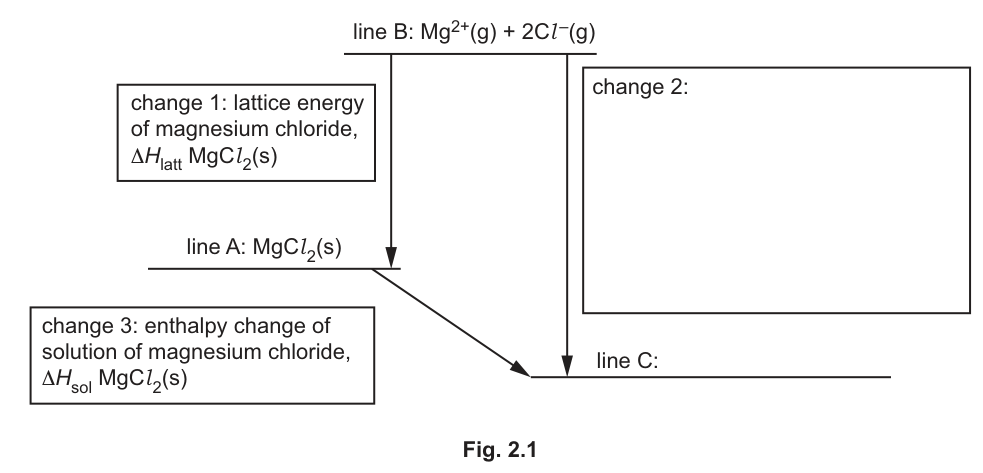
Answer
Line C:
Mg²⁺(aq) + 2Cl⁻(aq)
Background Concept
In a Born-Haber-type energy cycle for ionic compounds, the enthalpy change of solution represents the process: . The products of dissolution are the hydrated (aqueous) ions.
Understanding the Question
Line C is the bottom of the cycle, representing the final state after has dissolved. The question asks for the species on this line with state symbols.
Approach
The enthalpy change of solution (change 3) takes to the aqueous ions. Therefore line C must show .
Step-by-Step Reasoning
- Change 3 is of , which is the process of dissolving solid magnesium chloride to give aqueous ions.
- The products are one ion and two ions, both in the aqueous state.
- State symbols are essential — the mark scheme requires (aq).
Key Takeaways
- In solution cycles, the aqueous ions represent the hydrated ions in solution.
- Always include state symbols when asked — they are often the mark.
Common Mistakes
- Writing instead of the dissociated ions.
- Omitting state symbols.
- Forgetting the coefficient of 2 before .
Things to Be Careful About
- The mark is for the correct formulae AND state symbols together. Missing (aq) loses the mark.
Use both words and symbols to identify change 2 on Fig. 2.1.
Use changes 1 and 3 as examples of how this should be done.
Answer
Words: Enthalpy change of hydration of magnesium ions and chloride ions
Symbols:
ΔH_hyd Mg²⁺ + 2ΔH_hyd Cl⁻
Background Concept
Change 2 in the cycle goes from gaseous ions () directly to aqueous ions (). This is the combined hydration of all the ions present in one formula unit of .
The enthalpy change of hydration is defined for one mole of a single gaseous ion. Since contains one and two ions, the total hydration enthalpy is .
Understanding the Question
The question asks to identify change 2 using both words and symbols, following the format of changes 1 and 3. Change 1 is identified as "lattice energy of magnesium chloride, " and change 3 as "enthalpy change of solution of magnesium chloride, ".
Approach
Name the process in words (what happens to the gaseous ions to become aqueous) and then write the symbolic expression showing the correct stoichiometry.
Step-by-Step Reasoning
- Words mark: The process is the hydration of the gaseous ions — specifically the enthalpy change of hydration of magnesium ions AND chloride ions. Both must be mentioned.
- Symbols mark: Since there are two chloride ions per formula unit of , the expression is . The coefficient of 2 before the chloride term is essential.
Key Takeaways
- When expressing a combined enthalpy change from a cycle, the stoichiometric coefficients from the formula unit must appear.
- "Enthalpy change of hydration" applies to individual ions, not to the compound as a whole.
Common Mistakes
- Writing just "" without specifying which ions.
- Forgetting the coefficient of 2 before .
- Writing "lattice energy" or "solution energy" instead of "hydration."
Things to Be Careful About
- The mark scheme requires BOTH words and symbols — omitting either loses a mark.
- The word "and" between magnesium ions and chloride ions is important — both ions are hydrated.
Calculate a value for the lattice energy of magnesium chloride, , by selecting and using appropriate data from Table 2.1.
Table 2.1
| energy change | value / |
|---|---|
| enthalpy change of solution of magnesium chloride | |
| enthalpy change of formation of magnesium chloride | |
| first ionisation energy of magnesium | |
| second ionisation energy of magnesium | |
| electron affinity of chlorine | |
| enthalpy change of hydration of | |
| enthalpy change of hydration of |
Working
From the cycle: Change 2 = Change 1 + Change 3
Rearranging:
Substituting:
Answer
-2493 kJ mol⁻¹
Background Concept
A Born-Haber cycle (or in this case a solution cycle) relates different enthalpy changes through Hess's law. The key principle is that the total enthalpy change is the same regardless of the path taken between two states.
In this cycle, going from gaseous ions to aqueous ions (change 2) can be achieved either directly or via the solid (change 1 then change 3). Therefore:
This allows the lattice energy to be calculated if the hydration and solution enthalpies are known.
Understanding the Question
The table provides seven values, but only three are needed: , , and . The formation enthalpy, ionisation energies, and electron affinity are distractors (they would be needed for a full Born-Haber cycle but not for this solution cycle).
Approach
- Write the Hess's law relationship from the cycle.
- Rearrange to solve for .
- Select only the relevant data.
- Substitute carefully, watching signs and the factor of 2 for chloride.
Step-by-Step Reasoning
Step 1 — Hess's law from the cycle:
Change 2 (gaseous ions → aqueous ions) = Change 1 (gaseous ions → solid) + Change 3 (solid → aqueous ions)
Step 2 — Rearrange:
Step 3 — Select data: Only , , and are needed. The mark scheme specifically awards a mark for selecting these three only.
Step 4 — Substitute:
Step 5 — Calculate:
The factor of is a separate method mark in the scheme.
Key Takeaways
- In a solution cycle, the lattice energy can be found from hydration and solution enthalpies without needing formation, ionisation, or electron affinity data.
- Always check which path the cycle takes and write the Hess's law equation accordingly.
- The stoichiometric coefficient (×2 for chloride) is a common source of lost marks.
Common Mistakes
- Including the formation enthalpy or ionisation energies in the calculation (they belong to a full Born-Haber cycle, not this solution cycle).
- Forgetting the factor of 2 for .
- Sign errors: subtracting when it should be .
- Writing the answer as positive (lattice energy of formation from gaseous ions is always negative).
Things to Be Careful About
- The mark scheme gives one mark specifically for selecting only the correct three values — do not use all seven.
- The factor of 2 before earns a separate method mark.
- Final answer must be negative and to the correct value (-2493, not -2129 which would result from forgetting the ×2).
Answer
Entropy is the number of arrangements of the particles and of the energy in the system.
The number of arrangements of the particles and of the energy in the system.
Background Concept
Entropy () is a thermodynamic state function that quantifies the disorder or randomness of a system. More precisely, it measures the number of possible microscopic arrangements (microstates) consistent with the macroscopic state — both the spatial arrangements of particles and the distribution of energy among them.
Understanding the Question
The command word is "Define," which requires a precise, textbook definition. The mark scheme expects both aspects: arrangements of particles AND arrangements of energy.
Approach
State the formal definition covering both components.
Step-by-Step Reasoning
The definition must include:
- "Number of arrangements" (not just "disorder" or "randomness")
- "of the particles" (spatial arrangement)
- "and of the energy" (energy distribution among particles)
All three elements are needed for the mark. Simply saying "a measure of disorder" is insufficient for a definition question at A2 level.
Key Takeaways
- The formal definition of entropy at A-level includes both particle arrangements and energy arrangements.
- "Disorder" is a useful mental model but not an acceptable definition in exams.
Common Mistakes
- Writing only "a measure of disorder" — this is too vague and misses the energy component.
- Omitting "of the energy" — the mark scheme specifically requires both particle and energy arrangements.
- Confusing entropy with enthalpy or free energy.
Things to Be Careful About
- The word "number" is important — entropy is related to the count of microstates, not just their existence.
- Both components (particles AND energy) must appear for the mark.
At the enthalpy change of solution of compound is . The entropy change of solution of at the same temperature is .
Calculate the value of the Gibbs free energy change, , for the solution of at .
Working
Answer
+10.5 kJ mol⁻¹
Background Concept
The Gibbs free energy change () determines whether a process is thermodynamically feasible (spontaneous) at a given temperature:
If , the process is feasible (spontaneous). If , it is not feasible. If , the system is at equilibrium.
Units must be consistent: is typically in kJ mol⁻¹, in J K⁻¹ mol⁻¹, so must be divided by 1000 to give kJ K⁻¹ mol⁻¹ before multiplying by (in K).
Understanding the Question
Given kJ mol⁻¹ and J K⁻¹ mol⁻¹ at 25°C, calculate .
Approach
- Convert temperature: .
- Convert to kJ: .
- Substitute into .
Step-by-Step Reasoning
Step 1 — Equation:
Step 2 — Convert units:
Step 3 — Substitute:
The answer is positive, meaning the dissolution of Z is not feasible at 25°C.
Key Takeaways
- Always convert from J to kJ to match .
- Always convert temperature to Kelvin.
- A positive means the process is not spontaneous.
Common Mistakes
- Forgetting to convert from J to kJ, giving (wildly wrong).
- Using 25 instead of 298 for temperature.
- Sign error: writing .
Things to Be Careful About
- The mark scheme gives one mark for the equation and one for the answer. Both must be correct.
- Significant figures: the answer should be given to 3 s.f. (+10.5).
- Include the positive sign to show the process is non-feasible.
Use your answer to (d) to predict whether or not is soluble in water at . Explain your answer.
Answer
No, is not soluble in water at because is positive, so the process is not feasible.
No, ΔG is positive so the process is not feasible.
Background Concept
The sign of determines thermodynamic feasibility:
- : process is spontaneous (feasible)
- : process is non-spontaneous (not feasible)
- : equilibrium
For a dissolution process, if is positive, the compound will not dissolve spontaneously at that temperature.
Understanding the Question
Using the calculated kJ mol⁻¹ from part (d), predict solubility and explain.
Approach
State the prediction (no/not soluble) and the reason (positive means not feasible).
Step-by-Step Reasoning
- From part (d), kJ mol⁻¹.
- A positive means the dissolution is not thermodynamically feasible.
- Therefore Z is not soluble in water at 25°C.
- Both the prediction AND the reason are needed for the mark.
Key Takeaways
- → not feasible → not soluble.
- Always link the sign of to the word "feasible" or "spontaneous."
Common Mistakes
- Saying "no" without giving the reason (the mark requires both).
- Saying "because the reaction is endothermic" — the reason must be the positive , not the positive .
Things to Be Careful About
- The mark scheme requires the word "positive" (or "not feasible") as the explanation. Simply saying "because is +10.5" without stating what that means may not earn the mark.
Predict whether becomes more or less soluble as the water is heated from to . Explain your answer.
Answer
becomes more soluble as the water is heated because becomes more negative (less positive / closer to zero) as temperature increases, since is positive.
More soluble because ΔG becomes more negative (less positive) as T increases since ΔS is positive.
Background Concept
From , when is positive, increasing makes the term more negative. This reduces (makes it less positive or more negative), moving the system toward feasibility.
This is why many endothermic dissolutions become more soluble at higher temperatures — the entropy gain of dissolving becomes more important at higher .
Understanding the Question
Given that kJ mol⁻¹ and J K⁻¹ mol¹ (both positive), predict the effect of heating from 25°C to 95°C on solubility.
Approach
Consider what happens to as increases when :
- becomes more negative
- So decreases (becomes less positive)
- Eventually could become negative, making dissolution feasible
Step-by-Step Reasoning
- At 25°C (298 K): kJ mol⁻¹ (not feasible)
- At 95°C (368 K): kJ mol⁻¹ (still positive but smaller)
- The trend is that is decreasing toward zero as increases.
- Since is becoming less positive (closer to zero / more negative), the dissolution becomes more feasible.
- Therefore Z becomes more soluble.
The mark scheme accepts: "more soluble" + reason "because becomes more negative / less positive / smaller / closer to zero."
Key Takeaways
- When , increasing temperature always makes more negative (or less positive).
- This is the thermodynamic basis for the general rule that endothermic dissolutions with positive entropy changes become more soluble when heated.
- The direction of change in determines the direction of change in feasibility.
Common Mistakes
- Saying "more soluble because the reaction is endothermic" — while Le Chatelier's principle gives the same answer, the question asks you to use .
- Saying "less soluble" — this would be correct only if were negative.
- Not providing the reason — the mark requires both the prediction AND the explanation.
Things to Be Careful About
- The explanation must reference becoming more negative/less positive/closer to zero, not just "temperature increases."
- The word "because" is essential — the mark is for the causal link between changing and changing solubility.
The pH of a saturated solution of calcium hydroxide is 12.35 at .
Show that the concentration of hydroxide ions in a saturated solution of calcium hydroxide is at .
Working
pOH = 14 − 12.35 = 1.65
Answer
[OH⁻] = 0.0224 mol dm⁻³
Background Concept
pH is defined as . In aqueous solution at 298 K, the ionic product of water is , which means . Given either or , the other can be found. Calcium hydroxide is a strong base that fully dissociates, so the hydroxide concentration in a saturated solution directly reflects the solubility of .
Understanding the Question
The question gives the pH of a saturated solution as 12.35 and asks you to show that . The command word "show that" means you must demonstrate the calculation, not merely restate the value.
Approach
There are two equivalent routes: (1) find from pH, then use to find ; or (2) find pOH = 14 − pH, then . Route 2 is quicker and cleaner here.
Step-by-Step Reasoning
- Calculate pOH: .
- Convert to concentration: .
This exactly matches the value given in the question, so the statement is verified.
(Alternative route: , then .)
Key Takeaways
At 298 K, . Converting from pH to a concentration requires . links and in any aqueous solution.
Common Mistakes
- Writing instead of — this gives the hydrogen ion concentration, not hydroxide.
- Forgetting that pOH = 14 − pH (not pOH = pH).
- Rounding the pH to 12.4 before taking the antilog, which loses accuracy.
Things to Be Careful About
- Use the exact pH value in the exponent.
- The answer must be quoted to 4 significant figures (0.0224) to match the given value — the mark scheme expects this exact figure.
Use data given in (i) to calculate the solubility product, , of calcium hydroxide at .
Include the units of in your answer.
.............................. units ..............................
Working
Answer
Ksp = 5.62 × 10⁻⁶ mol³ dm⁻⁹
Background Concept
The solubility product is the equilibrium constant for the dissolution of a sparingly soluble salt. For , the expression is . The stoichiometry tells us that for every mole of that dissolves, one and two are produced, so in a solution made only by dissolving the solid.
Understanding the Question
We now take the found in part (i) and use it to calculate . The question explicitly asks for units — these arise from the powers in the expression: .
Approach
Write the dissociation equilibrium and its expression, substitute and , then calculate the numerical value and attach the correct units.
Step-by-Step Reasoning
- Dissociation: .
- .
- From stoichiometry, .
- Substitute: .
- Units: .
Key Takeaways
The coefficient in the formula becomes the exponent in the expression. The units of depend on the total number of ions produced — here three ions, so units are .
Common Mistakes
- Using (forgetting to halve) — this doubles the answer.
- Forgetting to square .
- Giving units as only — the mark scheme requires .
Things to Be Careful About
- The coefficient 2 in the formula becomes the exponent 2 in the expression.
- Units must be stated explicitly — the question prints a separate line for them.
- Quote the answer to 3 significant figures (5.62 × 10⁻⁶) to match the mark scheme.
A spatula measure of solid calcium chloride is stirred into a sample of saturated calcium hydroxide solution. All of the calcium chloride dissolves.
Describe one other observation that would be made and give an estimated value of the pH of the solution obtained.
Explain both your answers.
observation ........................................................................................................................
pH of solution .................................
explanation ........................................................................................................................
...........................................................................................................................................
Answer
- Observation: a white precipitate of forms.
- pH of solution: between 7 and 12.35 (lower than the original 12.35).
- Explanation: provides , a common ion. By Le Chatelier's principle, the equilibrium shifts to the left, precipitating . This removes from solution, so falls and pH decreases below 12.35.
White precipitate of Ca(OH)₂ forms; pH between 7 and 12.35 (common ion effect)
Background Concept
The common ion effect is a direct consequence of Le Chatelier's principle applied to solubility equilibria. When a salt is added to a saturated solution of another salt that shares a common ion, the concentration of that ion increases, so the equilibrium shifts to the left, precipitating more of the sparingly soluble salt. Here, dissociates to give , which is the same cation as in .
Understanding the Question
A spatula measure of solid is stirred into a saturated solution and all dissolves. You must give (1) one observation, (2) an estimated pH of the resulting solution, and (3) an explanation of both. The key insight is that adding forces out of solution, removing and lowering the pH.
Approach
Identify the common ion (), apply Le Chatelier's principle to predict the shift of the equilibrium, deduce what is observed (precipitation), and reason about how — and hence pH — changes.
Step-by-Step Reasoning
- dissolves: . This raises in the solution.
- The solubility equilibrium is .
- Increasing shifts the equilibrium to the left (Le Chatelier's principle), so solid precipitates — this is the white precipitate observed.
- As precipitates, is removed from solution, so decreases.
- Lower means higher pOH and therefore lower pH. The solution is still basic (it contains ), so pH stays above 7. The mark scheme accepts any pH strictly between 7.01 and 12.34.
Key Takeaways
The common ion effect reduces the solubility of a sparingly soluble salt. Adding a soluble salt sharing the cation of a sparingly soluble base lowers the pH of the saturated solution because hydroxide is precipitated out.
Common Mistakes
- Saying "the pH stays the same" — wrong, because is removed by precipitation.
- Saying the solution becomes acidic — it remains basic, just less so.
- Not identifying the precipitate as — the mark scheme requires this.
- Giving a pH of exactly 12.35 or exactly 7 — the mark scheme requires a value strictly between them.
Things to Be Careful About
- The observation must be a white precipitate — is white.
- The pH estimate must be a single value within the accepted range (7.01–12.34).
- The explanation must mention the common ion effect explicitly to score the second mark.
Calcium hydroxide reacts with dilute sulfuric acid to form calcium sulfate. Barium hydroxide behaves in a similar way, forming barium sulfate.
Explain why calcium sulfate is more soluble in water than barium sulfate.
Answer
- Both lattice energy and hydration energy decrease down Group 2 as ionic radius increases.
- The hydration energy decreases more than the lattice energy.
- Hence the enthalpy of solution (lattice + hydration) is more endothermic for than for , so is less soluble.
Hydration energy decreases more than lattice energy down Group 2, so the enthalpy of solution is more endothermic for BaSO₄ than CaSO₄, making BaSO₄ less soluble.
Background Concept
The solubility of a Group 2 sulfate is governed by the enthalpy of solution, . The lattice energy is the endothermic energy required to break the ionic lattice into gaseous ions. The hydration energy is the exothermic energy released when those gaseous ions are surrounded by water molecules. Dissolution is favoured when the exothermic hydration exceeds the endothermic lattice term, giving a negative (exothermic) .
Understanding the Question
We must explain why is more soluble than . The answer lies in how the two energy terms change down Group 2 as the cation gets larger.
Approach
State how both lattice and hydration energies change down the group (they both decrease in magnitude as ionic radius increases), identify which change is larger (hydration), and connect the result to the enthalpy of solution and hence solubility.
Step-by-Step Reasoning
- Down Group 2, the ionic radius increases ().
- Lattice energy decreases in magnitude down the group: has a more exothermic (more negative) lattice energy than .
- Hydration energy also decreases in magnitude down the group: the smaller ion has a higher charge density and attracts water molecules more strongly, so its hydration energy is more exothermic.
- The key point: hydration energy decreases more than lattice energy down the group.
- Therefore the net enthalpy of solution becomes more endothermic for . A more endothermic makes dissolution less energetically favourable, so is less soluble than .
Key Takeaways
Solubility of Group 2 sulfates decreases down the group. The deciding factor is the balance between lattice and hydration energies, with hydration energy being the dominant term because it changes more rapidly with ionic radius.
Common Mistakes
- Saying lattice energy is the dominant factor — it is hydration energy that decreases more.
- Confusing the direction: saying lattice energy increases down the group (it decreases).
- Only mentioning one of the two energies — both must be discussed.
- Not linking the energy argument to solubility (the conclusion must connect to solubility).
Things to Be Careful About
- Both lattice energy and hydration energy must be mentioned to score the first mark.
- The phrase "hydration energy decreases more" (or "is the dominant factor") is required for the second mark.
- The final mark requires the explicit conclusion that is more endothermic for .
Some solid calcium is added to an excess of aqueous ethanoic acid, , and left until all the calcium has reacted. The resulting mixture, mixture D, contains no undissolved solids.
Answer
Ca + 2CH3COOH -> Ca(CH3COO)2 + H2
Background Concept
Calcium is a reactive Group 2 metal that reacts with acids to form a salt and hydrogen gas. Ethanoic acid is a weak carboxylic acid, but it still reacts with reactive metals. Calcium forms a +2 ion, so two ethanoate ions () are needed to balance the charge in the salt .
Understanding the Question
Write the balanced equation for the reaction of solid calcium with aqueous ethanoic acid. This is a straightforward equation-writing task worth 1 mark.
Approach
Identify the products — calcium ethanoate and hydrogen gas — then balance the equation by matching the number of ethanoic acid molecules to the stoichiometry.
Step-by-Step Reasoning
- Calcium is oxidised: .
- Each from the acid is reduced: .
- Two ethanoic acid molecules supply two and leave two ions, which combine with to give .
- Balanced equation: .
Key Takeaways
Balancing an acid-metal reaction requires matching the metal's charge with the number of anions. Calcium is divalent, so two ethanoate ions are needed.
Common Mistakes
- Writing instead of — the charge on Ca²⁺ requires two ethanoate ions.
- Wrong stoichiometry, e.g. 1:1 instead of 1:2.
- Forgetting hydrogen gas as the other product.
Things to Be Careful About
- The equation must be balanced — atoms of each element on both sides.
- The mark scheme accepts the equation exactly as written above; no state symbols are required.
Use formulae of molecules and ions to identify two conjugate acid–base pairs present in mixture D.
Pair 1 should consist of organic species.
pair 1: ............................................ ............................................
conjugate acid conjugate base
pair 2: ............................................ ............................................
conjugate acid conjugate base
Answer
- Pair 1: (conjugate acid) / (conjugate base)
- Pair 2: (conjugate acid) / (conjugate base)
Pair 1: CH3COOH / CH3COO⁻; Pair 2: H3O⁺ / H2O
Background Concept
A conjugate acid-base pair consists of two species that differ by exactly one proton (). The acid is the species with the extra proton; the base is the species after the proton is removed. For example, and form a pair because .
Understanding the Question
In mixture D, after calcium has reacted with excess ethanoic acid, the solution contains (excess acid), (from ), , and small amounts of and . You must identify two conjugate pairs — pair 1 must be organic (both species contain carbon).
Approach
Recall that a conjugate pair differs by one proton. Look at the species present and find pairs that differ by H⁺.
Step-by-Step Reasoning
- and differ by one proton: . This is the organic pair.
- and differ by one proton: . This is the second pair.
- (The mark scheme also accepts / as pair 2, since .)
Key Takeaways
Conjugate acid-base pairs always differ by exactly one proton. The acid is the species with the extra H⁺.
Common Mistakes
- Writing and as a pair — they do not differ by one proton.
- Writing and as a pair — this is a redox pair, not an acid-base pair.
- Forgetting that / is a valid conjugate pair.
Things to Be Careful About
- Pair 1 must be organic — both species must contain carbon.
- The acid is the species with the extra proton; the base is the deprotonated form.
Answer
Ka = [H⁺][CH3COO⁻] / [CH3COOH]
Background Concept
The acid dissociation constant is the equilibrium constant for the dissociation of a weak acid. For a general weak acid , the expression is . For ethanoic acid, and .
Understanding the Question
Write the expression for ethanoic acid. This is a pure recall task worth 1 mark.
Approach
Apply the general formula for to ethanoic acid, placing products (H⁺ and the ethanoate ion) over the reactant (undissociated ethanoic acid).
Step-by-Step Reasoning
- Dissociation: .
- .
Key Takeaways
The expression always has the form: concentration of products over concentration of reactant, with each coefficient becoming an exponent (here all coefficients are 1).
Common Mistakes
- Omitting from the numerator.
- Writing the reciprocal (reactant over products).
- Including in the expression — water is not included because it is in large excess.
Things to Be Careful About
- The question only asks for the expression, not units — do not add units.
- Square brackets denote concentration in mol dm⁻³.
The concentration of calcium ethanoate, , in mixture D is .
The concentration of in mixture D is .
The of is at .
Calculate the pH of mixture D.
pH =
Working
Each provides two ethanoate ions:
Answer
pH = 5.22
pH = 5.22
Background Concept
A buffer solution contains a weak acid and its conjugate base in comparable concentrations. The pH is governed by the acid dissociation equilibrium. Rearranging gives , which is the basis of the Henderson–Hasselbalch equation. The conjugate base here comes from calcium ethanoate, , which dissociates to give two ethanoate ions per formula unit.
Understanding the Question
Mixture D is a buffer containing 0.394 mol dm⁻³ and 0.270 mol dm⁻³ . The critical trap is that the concentration of the ethanoate ion is double the concentration of the calcium salt, because each formula unit provides two ions.
Approach
- Calculate from the salt concentration.
- Substitute into the rearranged expression.
- Take the negative logarithm to find pH.
Step-by-Step Reasoning
- .
- Rearrange : .
- Substitute: .
- .
Key Takeaways
In buffer calculations, always check how many conjugate-base ions each formula unit of the salt provides. Divalent metal salts of monobasic acids give a factor of 2.
Common Mistakes
- Using instead of 0.788 — this is the most common error and gives pH = 5.49 instead of 5.22.
- Forgetting to take the negative logarithm at the end.
- Mixing up which concentration goes in the numerator (it is the acid, not the base).
Things to Be Careful About
- The factor of 2 from is the main trap in this question.
- Quote the pH to 2 decimal places (5.22) to match the mark scheme.
- The value is given to 3 significant figures, so the answer should reflect that precision.
Write two equations to show how mixture D can act as a buffer solution.
equation 1 .........................................................................................................................
equation 2 .........................................................................................................................
Answer
CH3COO⁻ + H⁺ -> CH3COOH; CH3COOH + OH⁻ -> CH3COO⁻ + H2O
Background Concept
A buffer solution resists changes in pH when small amounts of acid or base are added. It contains a weak acid () and its conjugate base (). The conjugate base neutralises added acid; the weak acid neutralises added base. The pH stays roughly constant because the ratio changes only slightly.
Understanding the Question
Write two equations showing how mixture D acts as a buffer. One equation must show how the buffer removes added (acid), and the other how it removes added (base).
Approach
Write the neutralisation of by the conjugate base, and the neutralisation of by the weak acid.
Step-by-Step Reasoning
- Removing added acid: the ethanoate ion reacts with : . The added is consumed, so pH barely changes.
- Removing added base: ethanoic acid reacts with : . The added is consumed, so pH barely changes.
Key Takeaways
Buffer action is described by two equations: the conjugate base mops up added , and the weak acid mops up added . The buffer works because these reactions consume the added species without significantly changing the acid/base ratio.
Common Mistakes
- Writing only one equation — the question asks for two.
- Getting the direction wrong (e.g. makes no sense).
- Writing — this does not show buffer action by the ethanoate system.
Things to Be Careful About
- The mark scheme accepts as an alternative for equation 1.
- Both equations must be balanced.
Transition metal atoms and transition metal ions form complexes by combining with species called ligands.
When is added to an aqueous solution containing a precipitation reaction occurs accompanied by a colour change.
In this reaction two of the water ligands each lose one ion. The ions are gained by ions from the .
State the colour change seen in this precipitation reaction.
from ............................................................. to .............................................................
Answer
from pink to blue
pink to blue
Background Concept
Transition metal complexes are coloured because electrons in partially filled d-orbitals can absorb visible light and be promoted between d-orbital energy levels. The colour observed depends on the size of the d-orbital splitting, which in turn depends on the ligand attached to the metal ion. Changing the ligand environment changes the splitting and therefore the colour.
Understanding the Question
This part asks for the observed colour change when is added to an aqueous solution containing . The reaction is a precipitation: two water ligands lose to , forming a neutral cobalt(II) hydroxide complex. You only need to state the initial and final colours.
Approach
Recall the standard colours of aqueous cobalt(II) complexes: the hexaaqua ion is pink, and the hydroxide-containing complex formed on adding alkali is blue. No calculation is needed.
Step-by-Step Reasoning
In aqueous solution, exists as the pink hexaaqua complex . When is added, two coordinated water molecules are deprotonated to give the neutral complex , which is insoluble and blue. The mark scheme accepts red/pink for the initial colour and blue for the final colour.
Key Takeaways
A change in ligand around a transition metal ion changes the d-orbital splitting and hence the colour. Standard colours such as pink aqueous and blue cobalt(II) hydroxide-type precipitates should be remembered.
Common Mistakes
- Reversing the order: the change is from pink to blue, not blue to pink.
- Saying 'colourless' or 'white'; the precipitate is blue.
- Giving only one colour; both initial and final colours are required.
Things to Be Careful About
The mark scheme allows 'red/pink' for the initial colour. Make sure the two colours are linked by 'to' in the correct order.
Answer
[Co(H2O)6]2+ + 2OH- -> Co(H2O)4(OH)2 + 2H2O
Background Concept
Coordinated water molecules in aqua complexes can behave as Brønsted acids, releasing ions. When a base such as is added, it accepts these protons. Here, each removes one from a coordinated water molecule, so the water ligand becomes a hydroxide ligand. The overall process is a deprotonation of the complex.
Understanding the Question
The equation is already started with on the left. You need to fill in the missing reactant and the two products. The stem tells you that two water ligands each lose one , and that the ions are gained by ions.
Approach
Identify that the missing reactant is . Since two ions are released, two ions are needed. Each forms , so two water molecules are produced. The complex loses two protons from two coordinated water molecules, leaving four water ligands and two hydroxide ligands.
Step-by-Step Reasoning
- Two coordinated water molecules lose one each: .
- Each reacts with : .
- Overall: .
Check atoms and charge: left has Co 1, O 8, H 14, charge ; right has Co 1, O 6 + 2 = 8, H 8 + 2 + 4 = 14, charge 0. Balanced.
Key Takeaways
Aqua complexes can be deprotonated by bases; the stoichiometry is controlled by the number of ions released. Balancing ionic equations requires checking both atoms and charge.
Common Mistakes
- Writing only one because only one precipitate forms; two are required because two are released.
- Writing as the product; the product still contains four water ligands.
- Forgetting the two water molecules formed from .
Things to Be Careful About
State symbols are not required by the mark scheme for this equation. Ensure the charges on the complex and hydroxide are correct, and that the equation is balanced in both atoms and charge.
This precipitation reaction can also be described as a different type of reaction.
Name this type of reaction.
Answer
acid-base
acid-base
Background Concept
A Brønsted-Lowry acid is a proton donor and a base is a proton acceptor. In this reaction the coordinated water molecules lose ions, so the complex is acting as an acid; the ions accept , so they act as a base. The reaction is therefore an acid-base reaction, even though it is also a precipitation.
Understanding the Question
The question asks for a different type of reaction, in addition to precipitation, that describes this process. The clue is the transfer of from water ligands to .
Approach
Look for proton transfer. If a species donates and another accepts , the reaction is acid-base.
Step-by-Step Reasoning
The complex donates two ions from two water ligands. These ions are accepted by two ions, forming water. Proton transfer is the defining feature of an acid-base reaction, so the answer is acid-base.
Key Takeaways
A single chemical change can be classified in more than one way. Here it is both a precipitation and an acid-base reaction.
Common Mistakes
- Saying 'redox' – no oxidation states change.
- Saying 'ligand substitution' – although ligands change, the key proton transfer makes it acid-base.
- Saying 'neutralisation' alone may not be credited; use 'acid-base'.
Things to Be Careful About
Give the exact term 'acid-base'. The mark scheme does not require a full explanation, but the reasoning above shows why it is correct.
is an uncharged tridentate ligand. donates three lone pairs to a metal atom or ion.
Cobalt forms an octahedral complex ion, , with . Complex ion has a charge.
Answer
[CoL2]2+
Background Concept
A ligand is a species that donates one or more lone pairs to a metal ion. Denticity is the number of donor atoms (coordination sites) one ligand occupies. A tridentate ligand donates three lone pairs and therefore occupies three coordination sites. An octahedral complex has coordination number six: six donor atoms arranged around the metal.
Understanding the Question
is uncharged and tridentate. Cobalt forms an octahedral complex with , and has a charge. You need to write the formula of , showing how many ligands are present.
Approach
Divide the coordination number by the denticity to find the number of ligands. Then add the charge, remembering that is uncharged.
Step-by-Step Reasoning
Octahedral requires 6 coordination sites. Each provides 3 sites, so number of = 6/3 = 2. Since is uncharged, the charge on must come entirely from the cobalt ion. The formula is therefore .
Key Takeaways
Number of ligands = coordination number / denticity. Neutral ligands do not contribute to the charge of a complex.
Common Mistakes
- Writing or by confusing denticity with the number of ligands.
- Adding a charge to ; is stated to be uncharged.
- Forgetting the square brackets and overall charge.
Things to Be Careful About
The formula must show two ligands and the overall charge. The cobalt oxidation state is not asked here, but it follows from the same charge balance.
Answer
+2
+2
Background Concept
In a complex ion, the sum of the oxidation states of the metal and all ligands equals the overall charge on the complex. Neutral ligands, such as water, ammonia and , contribute 0 to this sum.
Understanding the Question
is and is uncharged. You need the oxidation state of cobalt.
Approach
Set up a charge balance: oxidation state of Co + sum of ligand charges = complex charge.
Step-by-Step Reasoning
Let the oxidation state of Co be . Each is neutral, so the ligand contribution is 0. The complex charge is , so , giving .
Key Takeaways
Oxidation states in complexes are found by charge balance. Neutral ligands make no contribution.
Common Mistakes
- Including the charge of the complex as if it were on the metal.
- Assuming carries a charge when it is stated to be uncharged.
Things to Be Careful About
Write the answer with the sign, +2, not just 2.
The d-orbitals of the cobalt atom or ion present in are split in energy.
State the number of d-orbitals that are at a higher energy level and the number of d-orbitals that are at a lower energy level.
| number of d-orbitals at a higher energy level | |
| number of d-orbitals at a lower energy level |
Answer
higher energy: 2
lower energy: 3
2 higher, 3 lower
Background Concept
In an octahedral complex, the five d-orbitals are no longer degenerate. The ligands approach along the x, y and z axes, raising the energy of the two orbitals that point along the axes ( and ) more than the three orbitals that point between the axes (, , ). This gives two sets: the higher-energy set contains 2 orbitals, and the lower-energy set contains 3 orbitals.
Understanding the Question
You are asked for the number of d-orbitals at higher and lower energy in the octahedral complex . This is a recall question about the octahedral splitting pattern.
Approach
Recall the octahedral splitting diagram: 2 orbitals higher, 3 orbitals lower.
Step-by-Step Reasoning
In an octahedral field, the five d-orbitals split into a lower set of three () and a higher set of two (). Therefore the number at higher energy is 2 and the number at lower energy is 3.
Key Takeaways
The octahedral d-orbital splitting pattern is 2 (higher) and 3 (lower). This pattern underlies the colours and magnetic properties of transition metal complexes.
Common Mistakes
- Reversing the numbers; 3 higher and 2 lower is not the octahedral pattern.
- Writing 5 and 0; the d-orbitals are split, not all at one energy.
Things to Be Careful About
The question asks for numbers of orbitals, not the names of the sets. Give 2 and 3 in the correct rows.
Answer
Non-degenerate d-orbitals are d-orbitals that have different energies / are not of the same energy.
d-orbitals of different energy
Background Concept
Degenerate orbitals are orbitals that have the same energy. When a ligand field is present, the d-orbitals in a transition metal complex may be split into sets of different energies; they are then non-degenerate.
Understanding the Question
This is a definition question. You need to state what 'non-degenerate' means for d-orbitals.
Approach
Define the term directly: non-degenerate means not of the same energy.
Step-by-Step Reasoning
In an isolated atom, the five d-orbitals are degenerate. In a complex, the ligand field splits them, so they have different energies. Therefore non-degenerate d-orbitals are d-orbitals that have different energies / are not of the same energy.
Key Takeaways
'Non-degenerate' is a precise term meaning different energies. It is the opposite of degenerate.
Common Mistakes
- Saying 'unequal number of electrons' – degeneracy is about energy, not electron count.
- Saying 'orbitals that cannot hold the same number of electrons'.
Things to Be Careful About
Use the exact idea of different energies. The mark scheme accepts 'not of the same energy' or 'have different energy'.
The mineral chromite contains a compound which has the formula . The oxidation state of iron in is .
A sample of of is dissolved in an excess of sulfuric acid. The resulting solution is made up to . This is solution F.
All the ions in of solution F are oxidised to ions by exactly of .
One ion reacts with five ions. Assume no other oxidation reaction occurs.
Answer
5Fe2+ + MnO4- + 8H+ -> 5Fe3+ + Mn2+ + 4H2O
Background Concept
In acid solution, manganate(VII), , is a strong oxidising agent. It is reduced to . Iron(II) is oxidised to iron(III). Redox equations can be built from half-equations: an oxidation half-equation and a reduction half-equation, then combined so that the number of electrons lost equals the number gained.
Understanding the Question
You need to write the balanced ionic equation for the reaction of with in acid. The stem also tells you that one reacts with five , which is a useful check.
Approach
Write the two half-equations, balance electrons, and add them.
Step-by-Step Reasoning
Oxidation: .
Reduction: .
Multiply the oxidation half-equation by 5 so that 5 electrons are released: .
Add the two half-equations: .
Check: atoms balance (Fe 5, Mn 1, O 4, H 8) and charge balances (left ; right ).
Key Takeaways
The half-equation method is reliable for redox equations. in acid always gives and water, with 5 electrons accepted.
Common Mistakes
- Forgetting the and .
- Writing or as the reduction product.
- Not multiplying the Fe half-equation by 5.
- Leaving the equation unbalanced in charge.
Things to Be Careful About
Use rather than as the acid source. The coefficient 5 on and is essential because accepts 5 electrons.
Working
Answer
mol
1.87 × 10^-3 mol
Background Concept
Titration calculations use concentration × volume (in dm³) to find moles of the known reagent, then the stoichiometric ratio from the balanced equation to find moles of the unknown. Here the known reagent is , which provides ions. The ratio from part (c)(i) is 5 : 1 .
Understanding the Question
25.0 cm³ of solution F required 18.7 cm³ of 0.0200 mol dm⁻³ . You need the moles of in that 25.0 cm³ aliquot.
Approach
Convert the volume to dm³, calculate moles of , then multiply by 5.
Step-by-Step Reasoning
Volume of = 18.7 cm³ = 18.7/1000 = 0.0187 dm³.
Moles = 0.0200 × 0.0187 = mol.
From the equation, 1 reacts with 5 , so moles = 5 × = mol.
This is the amount in the 25.0 cm³ portion titrated.
Key Takeaways
Always convert cm³ to dm³ by dividing by 1000. Use the mole ratio from the balanced equation, not the ratio of volumes.
Common Mistakes
- Forgetting to divide 18.7 by 1000.
- Using the ratio as 1 : 5 instead of 5 : 1 .
- Using 250 cm³ instead of 25.0 cm³; the question asks for moles in the 25.0 cm³ aliquot.
Things to Be Careful About
dissociates to give one per formula unit, so moles of equals moles of . Keep three significant figures, matching the data.
Calculate the of and use your answer to deduce the value of .
of = ..............................
value of = ..............................
Working
Moles of in = mol.
Moles of = mol (1 mol compound gives 1 mol ).
Answer
(or );
Mr = 224 (or 223.5); n = 2
Background Concept
To find a relative molecular mass from a titration, you first find the amount of substance in the portion analysed, scale it to the whole sample, and then use . The formula contains one Fe per formula unit, so the moles of in the whole solution equal the moles of dissolved. The subscript is then found by comparing the experimental with the sum of relative atomic masses.
Understanding the Question
4.18 g of was dissolved and made up to 250 cm³. A 25.0 cm³ portion contained mol from part (c)(ii). You need the of the compound and the value of .
Approach
Scale the moles from the aliquot to the whole 250 cm³, use mass/moles to get , then set up an expression for in terms of and solve.
Step-by-Step Reasoning
- Moles in 25.0 cm³ = mol.
- The whole solution is 250 cm³, which is 10 times larger, so moles in 250 cm³ = mol.
- Each formula unit of provides one , so moles of = mol.
- = mass / moles = 4.18 / () = 223.5, which rounds to 224.
- Using relative atomic masses Fe = 55.8, Cr = 52.0, O = 16.0: = 55.8 + 52.0n + 4(16.0) = 119.8 + 52.0n.
- Equate to 223.5: 119.8 + 52.0n = 223.5, so 52.0n = 103.7, n = 1.99 ≈ 2.
Key Takeaways
A dilution factor is needed when only an aliquot is titrated. = mass/moles. The formula subscript is found by solving a simple algebraic equation.
Common Mistakes
- Forgetting to multiply by 10 to scale from 25 cm³ to 250 cm³.
- Using the mass of the aliquot rather than the whole 4.18 g sample.
- Using incorrect relative atomic masses.
- Not rounding n to a whole number; n must be an integer.
Things to Be Careful About
The mark scheme allows = 224 or 223.5. Show the scaling step clearly because it carries a method mark. Use consistent significant figures.
ions form a number of different complex ions, including , and .
The abbreviation en represents 1,2-diaminoethane. The numerical values of two stability constants, , are given in Table 5.1.
Table 5.1
| complex | |
|---|---|
Answer
Alternatively:
K_stab = [[Ni(en)3]2+] / ([Ni2+][en]3)
Background Concept
The stability constant, , quantifies the thermodynamic stability of a complex ion relative to its constituent metal ion and free ligands. For the overall formation reaction:
the expression is:
Water molecules coordinated to the metal in the hexaaqua complex, , are not included in the denominator when the reaction is written from , because the free water concentration is essentially constant (~55.5 mol dm) and is absorbed into the constant. If the reaction is written starting from the hexaaqua complex:
then appears in the denominator instead of , and is omitted. Both forms are acceptable and give the same numerical value.
Understanding the Question
Part (a) asks for the expression for . The complex forms from and three bidentate ethylenediamine (en) ligands. We need to write the equilibrium constant expression correctly, with the complex concentration in the numerator and the free metal ion and free ligand concentrations in the denominator, raised to their stoichiometric powers.
Approach
Identify the formation reaction: . Write as products over reactants, omitting water. The ligand 'en' appears with a power of 3 because three en molecules are required.
Step-by-Step Reasoning
The overall ligand exchange reaction is:
Applying the definition of the equilibrium constant:
If instead we start from the hexaaqua ion:
then:
Both expressions are correct. Water is never included in expressions.
Key Takeaways
- expressions always have the complex in the numerator and free metal ion + free ligands in the denominator.
- Water of coordination is omitted from expressions.
- The ligand concentration is raised to the power equal to the number of ligand molecules (or the number of coordination sites it occupies, for monodentate ligands).
Common Mistakes
- Including in the expression — water is the solvent and its concentration is effectively constant.
- Writing instead of — forgetting the stoichiometric coefficient.
- Including the charge in the concentration brackets — write , not or similar.
Things to Be Careful About
- The expression must be balanced: numerator has one complex, denominator has one metal ion and three ligand molecules.
- Both forms (from or from ) are acceptable; do not lose marks by writing only one if the question does not specify.
- Use square brackets for concentrations; do not write without brackets.
A solution of is added to a solution that contains and .
Predict which complex ion, or , is present in the resulting mixture in the highest concentration. Explain your answer.
complex ion present in largest concentration = ............................................
explanation ........................................................................................................................
Answer
complex ion present in largest concentration =
explanation: has a larger ( compared with ), so it is more stable and the equilibrium lies further to the right.
[Ni(en)3]2+; larger K_stab means more stable
Background Concept
The stability constant is an equilibrium constant for the formation of a complex ion from the free metal ion and ligands. A larger means the equilibrium lies further to the right, i.e., more complex is formed relative to the free components. This reflects greater thermodynamic stability of the complex.
When two different ligands compete for the same metal ion, the ligand that produces the complex with the larger will be preferentially bound, provided concentrations are comparable.
Understanding the Question
A solution containing is mixed with equal concentrations (0.10 mol dm) of both NH and en. We must predict which complex — or — will be present at the highest concentration.
Approach
Compare the two values. The complex with the larger is more stable and will be favoured at equilibrium. Since both ligands are present at the same concentration, the value alone determines which complex dominates.
Step-by-Step Reasoning
From Table 5.1:
- for
- for
for the en complex is about times larger. This enormous difference means that at equilibrium, virtually all the Ni will be bound as . The en ligand displaces both water and ammonia because the resulting complex is thermodynamically far more stable.
This is partly due to the chelate effect: en is a bidentate ligand (it forms two bonds to the metal per molecule), so replacing six water molecules with three en molecules increases the number of particles in solution (from 7 to 9), giving a favourable entropy change that drives the equilibrium to the right.
Key Takeaways
- A larger means a more stable complex and equilibrium lies further to the right.
- When competing ligands are present at equal concentrations, the complex with the larger dominates.
- Chelate ligands (bidentate or polydentate) form more stable complexes than monodentate ligands at the same concentration — this is the chelate effect.
Common Mistakes
- Saying 'en is a stronger ligand' without reference to or stability — must mention the larger or greater stability.
- Confusing with (dissociation constant) — larger means more stable, not less.
- Not stating which complex is present in largest concentration before giving the explanation.
Things to Be Careful About
- The mark scheme requires BOTH the name of the complex AND the explanation (larger / more stable). Giving only one may lose a mark.
- Do not say 'higher concentration of en' — both ligands are at 0.10 mol dm.
- The explanation must link to stability or equilibrium position.
Answer
[Ni(H2O)6]2+ + 3en -> [Ni(en)3]2+ + 6H2O
Background Concept
Ligand exchange (substitution) reactions in coordination chemistry involve replacement of one set of ligands by another. When a hexaaqua metal ion reacts with a ligand L, water molecules are displaced:
For bidentate ligands like en (1,2-diaminoethane, HNCHCHNH), each en molecule occupies two coordination sites. To fill six coordination sites around Ni, three en molecules are needed:
Understanding the Question
Part (b)(ii) asks for the balanced equation for the ligand exchange reaction that occurs when is added to a solution containing en. From part (b)(i), we know that is the product. We must write the full balanced equation showing reactants and products.
Approach
Start with the hexaaqua complex on the left. Add three en molecules (since each en is bidentate and 3 × 2 = 6 sites). The products are the new complex and six water molecules released.
Step-by-Step Reasoning
Reactants:
- : the starting complex with six water ligands
- : three ethylenediamine molecules, each bidentate
Products:
- : the new complex with three en ligands
- : six water molecules displaced
Balancing check:
- Ni: 1 on each side ✓
- Charge: +2 on each side ✓
- N atoms: 3 en × 2 N = 6 N on left; 3 en × 2 N = 6 N on right ✓
- C atoms: 3 en × 2 C = 6 C on left; 3 en × 2 C = 6 C on right ✓
- HO: 6 on left (as ligands); 6 on right (released) ✓
The equation is:
Key Takeaways
- Bidentate ligands occupy two coordination sites each; count sites carefully when balancing.
- Water molecules coordinated to the metal are released as free HO in the products.
- The overall charge is conserved: +2 on both sides.
Common Mistakes
- Writing '6en' instead of '3en' — en is bidentate, so only 3 are needed for 6 coordination sites.
- Forgetting the 6HO on the product side.
- Writing the equation with NH instead of en — the question asks about the reaction with en specifically.
- Not balancing: the number of water molecules displaced must equal the number originally coordinated.
Things to Be Careful About
- Use '→' (or '⟶') for the arrow; an equilibrium arrow is not required here since the reaction goes essentially to completion (very large ).
- Write 'en' not the full formula — the question uses the abbreviation en.
- State symbols are not required for this equation in the mark scheme, but if included, HO should be (l) and the complexes (aq).
Complete Fig. 5.1 to show the three-dimensional structures of the two isomers of .
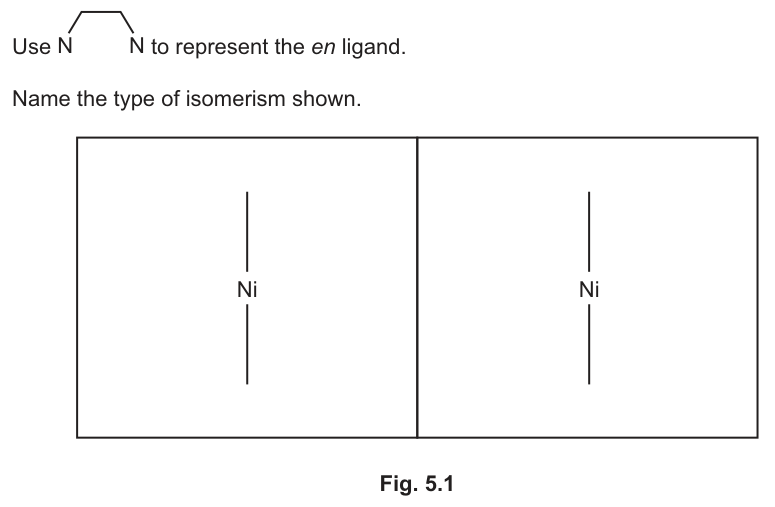
Name the type of isomerism shown.
type of isomerism shown ..........................................................................................................
Answer
type of isomerism shown: optical isomerism
optical isomerism
Background Concept
Optical isomerism occurs when a molecule (or complex ion) has a non-superimposable mirror image. These two forms are called enantiomers. For a complex to show optical isomerism, it must lack a plane of symmetry and a centre of inversion.
In octahedral complexes, optical isomerism is common when there are three bidentate ligands, giving a structure like . The three bidentate ligands can wrap around the metal centre in a right-handed (Δ, delta) or left-handed (Λ, lambda) propeller arrangement. These two arrangements are non-superimposable mirror images — exactly like your left and right hands.
The en ligand (1,2-diaminoethane, ) is bidentate: each molecule uses its two nitrogen lone pairs to form two coordinate bonds to the metal, creating a five-membered chelate ring (Ni–N–C–C–N). In , three en ligands occupy all six coordination positions, with each en spanning two adjacent (cis) positions.
Understanding the Question
Part (c) asks us to draw the two 3D structures of that are optical isomers, using the given representation where 'N⌒N' denotes an en ligand (two N atoms connected by a curved line representing the –CHCH– bridge). We must also name the type of isomerism.
Approach
- Draw an octahedral Ni centre with six coordination positions.
- Place three en ligands, each occupying two adjacent (cis) positions.
- Draw the first isomer with the three chelate rings arranged in a right-handed (or left-handed) fashion.
- Draw the second isomer as the non-superimposable mirror image.
- Use wedge (solid triangle) and dash (dotted lines) bonds to show 3D perspective.
- Name the isomerism as 'optical isomerism'.
Step-by-Step Reasoning
Drawing the first isomer:
- Place Ni at the centre of an octahedron.
- Use the convention: plain vertical lines for bonds in the plane of the paper (top and bottom positions), solid wedges for bonds coming out of the plane towards the viewer, and dashed lines for bonds going behind the plane.
- Assign the three en ligands:
- Ligand 1: occupies the top position and one right-hand position (e.g., top-right, coming out of the plane). Connect the two N atoms with a curved line.
- Ligand 2: occupies the bottom position and one left-hand position (e.g., bottom-left, going behind the plane). Connect with a curved line.
- Ligand 3: occupies the remaining two positions (front-right and back-left, or similar cis arrangement). Connect with a curved line.
- Ensure all three en ligands are arranged so the complex has no plane of symmetry.
Drawing the second isomer:
- Draw the mirror image of the first structure. If the first has the chelate rings winding clockwise (Δ), the second winds anticlockwise (Λ).
- The second structure must be non-superimposable on the first — you cannot rotate it to match.
Naming the isomerism:
- These are optical isomers (also called enantiomers). They are non-superimposable mirror images of each other.
- The type of isomerism is optical isomerism.
Mark scheme image description:
The marking scheme shows:
- Left structure: Ni at centre, with N atoms at six octahedral positions. Three curved lines (en ligands) connect pairs of N atoms. Bonds to N atoms use: plain vertical lines (top/bottom), solid wedges (front), dashed lines (back). The three chelate rings form a right-handed propeller.
- Right structure: mirror image — same arrangement but with wedges and dashes swapped on the left/right sides, forming a left-handed propeller.
Key Takeaways
- octahedral complexes show optical isomerism when all three ligands are identical.
- The two isomers are non-superimposable mirror images (enantiomers).
- Use wedge-dash notation to convey 3D structure: solid wedge = coming towards you, dashed = going away, plain line = in the plane.
- Optical isomers have identical physical properties except for the direction they rotate plane-polarised light.
Common Mistakes
- Drawing geometric isomers (cis/trans) instead of optical isomers — with three identical bidentate ligands in an octahedral complex, there are no cis/trans isomers, only optical isomers.
- Drawing superimposable structures — the two drawings must be non-superimposable mirror images. Check by mentally trying to rotate one to match the other.
- Forgetting the curved lines connecting the two N atoms of each en ligand — the en is bidentate, so both N atoms must be shown bonded to Ni and connected to each other.
- Drawing en as monodentate (only one N bonded to Ni) — en always bonds through both nitrogens.
- Not using 3D notation (wedges/dashes) — a flat 2D drawing does not show the chirality.
- Naming the isomerism as 'geometric' or 'structural' — it is specifically optical isomerism.
Things to Be Careful About
- The mark scheme awards 1 mark for a correct 3D octahedral structure, 1 mark for the second optical isomer (mirror image), and 1 mark for naming 'optical isomerism'. All three must be present.
- The en ligand must be drawn as N⌒N (two N atoms connected by a curved/bridged line), not as a straight line or as separate monodentate ligands.
- Both structures must be clearly distinguishable as mirror images. If they look identical, you have drawn the same structure twice.
- Do not write 'enantiomerism' — the mark scheme accepts 'optical isomerism'. 'Enantiomerism' may not be credited at CIE.
Fig. 6.1 shows two reactions of ethanedioic acid, .
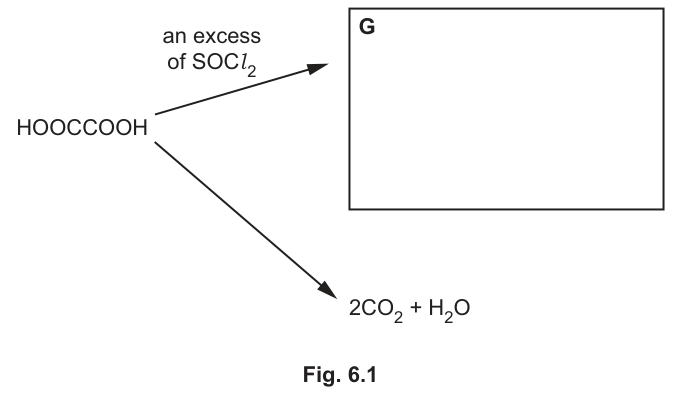
Answer
The product G is ethanedioyl dichloride (oxalyl chloride):
ClOCCOCl (ethanedioyl dichloride / oxalyl chloride)
Background Concept
Thionyl chloride (SOCl₂) is a common reagent used to convert carboxylic acids (–COOH) into acyl chlorides (–COCl). The –OH group of the carboxylic acid is replaced by a chlorine atom, with SO₂ and HCl produced as by-products. When a dicarboxylic acid such as ethanedioic acid (HOOCCOOH) reacts with an excess of SOCl₂, both carboxylic acid groups are converted to acyl chloride groups.
Understanding the Question
The question asks you to draw the organic product G formed when ethanedioic acid reacts with an excess of SOCl₂. The key word is 'excess', meaning both –COOH groups will react.
Approach
Identify the functional group transformation: –COOH → –COCl. Apply it to both ends of the molecule since SOCl₂ is in excess.
Step-by-Step Reasoning
- Ethanedioic acid has the structure HOOC–COOH (two carboxylic acid groups joined directly).
- SOCl₂ replaces the –OH of each –COOH with –Cl, forming –COCl.
- With excess SOCl₂, both groups react.
- The product is ClOC–COCl (ethanedioyl dichloride, commonly called oxalyl chloride).
Key Takeaways
- SOCl₂ converts –COOH to –COCl.
- Excess reagent ensures all reactive groups are converted.
- Oxalyl chloride (ClOCCOCl) is a useful reagent in organic synthesis.
Common Mistakes
- Drawing only one –COCl group (forgetting the 'excess' means both react).
- Writing the formula as ClCO–COCl without showing the structure clearly.
- Confusing SOCl₂ with PCl₅ (both give acyl chlorides but the by-products differ).
Things to Be Careful About
- Ensure both carbonyl groups are shown with the =O and the –Cl attached to the carbon.
- The two carbonyl carbons are directly bonded (no CH₂ between them in ethanedioic acid derivatives).
In Fig. 6.1, is given as the reagent that reacts with to produce G.
Identify a different reagent that also reacts with to produce G.
Answer
(or )
PCl5 (or PCl3)
Background Concept
Carboxylic acids can be converted to acyl chlorides using several chlorinating agents: thionyl chloride (SOCl₂), phosphorus(V) chloride (PCl₅), and phosphorus(III) chloride (PCl₃). All achieve the same functional group transformation (–COOH → –COCl) but differ in the by-products formed.
Understanding the Question
The question asks for a reagent other than SOCl₂ that produces the same product G (ethanedioyl dichloride) from ethanedioic acid.
Approach
Recall the standard reagents for converting carboxylic acids to acyl chlorides. Any of PCl₅, PCl₃, or PCl₃/PCl₅ would be acceptable.
Step-by-Step Reasoning
- The transformation needed is –COOH → –COCl (same as with SOCl₂).
- PCl₅ reacts with carboxylic acids: RCOOH + PCl₅ → RCOCl + POCl₃ + HCl.
- PCl₃ reacts similarly: 3RCOOH + PCl₃ → 3RCOCl + H₃PO₃.
- Either is an acceptable answer as an alternative to SOCl₂.
Key Takeaways
- Three common reagents convert –COOH to –COCl: SOCl₂, PCl₅, and PCl₃.
- The choice of reagent affects by-products but not the organic product.
Common Mistakes
- Writing PCl₄ (does not exist as a stable reagent for this purpose).
- Confusing PCl₃ with PCl₅ (both work, but students sometimes write incorrect formulas).
Things to Be Careful About
- The question asks for a different reagent from SOCl₂, so do not repeat SOCl₂.
- Write the correct formula: PCl₅ (phosphorus(V) chloride) or PCl₃ (phosphorus(III) chloride).
Answer
- Oxygen ()
- Acidified potassium manganate(VII) ()
Oxygen and acidified KMnO4
Background Concept
Ethanedioic acid (oxalic acid, HOOCCOOH) can be oxidised to carbon dioxide and water. This is because the carbon atoms in ethanedioic acid are in the +3 oxidation state, and can be further oxidised to +4 (as in CO₂). Two common oxidising agents achieve this: combustion in oxygen (complete oxidation) and acidified potassium manganate(VII) (a strong oxidising agent in acidic solution that is reduced from MnO₄⁻ to Mn²⁺).
Understanding the Question
The question asks for two different reagents that oxidise HOOCCOOH to form CO₂ and H₂O. The products given (2CO₂ + H₂O) indicate complete oxidation of both carbon atoms.
Approach
Identify oxidising agents capable of fully oxidising a carboxylic acid. Combustion (oxygen) is the most obvious. For a chemical oxidising agent, acidified KMnO₄ is the standard choice for oxidising ethanedioic acid (this reaction is also used in kinetics experiments due to the colour change from purple to colourless).
Step-by-Step Reasoning
- Oxygen (O₂) — combustion of ethanedioic acid gives 2CO₂ + H₂O. This is a complete oxidation.
- Acidified KMnO₄ — the MnO₄⁻ ion in acidic solution is a powerful oxidising agent. Ethanedioic acid reduces MnO₄⁻ to Mn²⁺ while being oxidised to CO₂. The ionic equation is: 5HOOCCOOH + 2MnO₄⁻ + 6H⁺ → 10CO₂ + 2Mn²⁺ + 8H₂O.
- Both give the products stated in the question (CO₂ and H₂O).
Key Takeaways
- Ethanedioic acid is unusual among carboxylic acids in that it can be further oxidised (the carbon is already at +3, below the +4 maximum).
- Acidified KMnO₄ is the classic reagent for this oxidation and is used in rate-of-reaction experiments.
- Combustion in oxygen also achieves complete oxidation.
Common Mistakes
- Writing alkaline KMnO₄ instead of acidified (the question specifies acidified conditions for this oxidation).
- Writing an oxidising agent that would not fully oxidise to CO₂ (e.g. mild oxidants).
- Confusing this with the oxidation of alcohols (where K₂Cr₂O₇ is more commonly cited).
Things to Be Careful About
- The question asks for reagents, not conditions — 'oxygen' and 'acidified KMnO₄' are the expected answers.
- K₂Cr₂O₇ could also be accepted as an oxidising agent, but the mark scheme specifically lists oxygen and acidified KMnO₄.
ionises as shown.
is a much stronger acid than methanoic acid, .
Suggest an explanation for this difference in acidity.
Answer
- The second C=O group (carbonyl) is electron-withdrawing (strongly electronegative), exerting a negative inductive effect ().
- This weakens the O–H bond (making H⁺ easier to lose) and/or stabilises the resulting anion (HOOCCOO⁻) by dispersing the negative charge.
The electron-withdrawing C=O group weakens the O-H bond and stabilises the anion, making HOOCCOOH a stronger acid than HCOOH.
Background Concept
The strength of a carboxylic acid depends on how readily it donates a proton (H⁺) and how stable the resulting carboxylate anion is. Electron-withdrawing groups (EWGs) attached to or near the carboxyl group increase acidity by two mechanisms: (1) they pull electron density away from the O–H bond through the sigma framework (negative inductive effect, −I), weakening the bond and making proton loss easier; and (2) they stabilise the negative charge on the conjugate base (carboxylate anion) by dispersing it over a larger region of electron density.
Ethanedioic acid (HOOCCOOH) has a second –COOH group directly attached to the first. Methanoic acid (HCOOH) has only a hydrogen on the other side. The adjacent C=O group in ethanedioic acid is strongly electron-withdrawing due to the electronegativity of oxygen, whereas the H in methanoic acid has negligible inductive effect.
Understanding the Question
The question asks you to explain why HOOCCOOH is a much stronger acid than HCOOH. You need to identify the structural difference (the second C=O group) and explain how it affects acidity. Two marks are available, so you need two linked points.
Approach
- Identify the structural difference: HOOCCOOH has an additional C=O group compared to HCOOH.
- Explain the effect of this group: it is electron-withdrawing (−I effect).
- State the consequence: this either weakens the O–H bond (making proton loss easier) or stabilises the anion (making the equilibrium lie further to the right), or both.
Step-by-Step Reasoning
- In HOOCCOOH, the carbon bearing the –COOH group is also bonded to another C=O group. In HCOOH, that carbon is bonded to H.
- The C=O group contains a highly electronegative oxygen atom, making it strongly electron-withdrawing through the sigma bond (−I inductive effect).
- This electron withdrawal pulls electron density away from the O–H bond, weakening it and making it easier for H⁺ to dissociate.
- Additionally, the negative charge on the conjugate base (⁻OOCCOOH) is stabilised by the electron-withdrawing effect of the adjacent C=O, which disperses the charge.
- Both effects shift the equilibrium further to the right, giving a lower pKa (stronger acid).
The mark scheme accepts either 'weakens O–H bond' OR 'stabilises anion' for the second mark, so either reasoning is sufficient.
Key Takeaways
- Electron-withdrawing groups increase carboxylic acid acidity.
- The −I effect operates through sigma bonds and diminishes with distance.
- Two valid explanations exist: bond weakening and anion stabilisation (both are correct; either scores).
Common Mistakes
- Saying 'the second COOH is electron-withdrawing' without specifying the C=O or the inductive effect — the mark scheme wants the C=O identified as the electron-withdrawing feature.
- Confusing this with resonance stabilisation (the −I effect is through sigma bonds, not pi delocalisation, in this context).
- Writing 'HOOCCOOH has more oxygen atoms' without explaining the mechanism.
Things to Be Careful About
- You must mention the electron-withdrawing nature of the C=O (or the −I effect) for the first mark.
- For the second mark, you must connect this to either O–H bond weakening OR anion stabilisation — just saying 'it's more acidic' is circular and scores zero.
Benzene-1,4-dicarboxylic acid, , can be made from benzene, , in two steps as shown in Fig. 6.2.
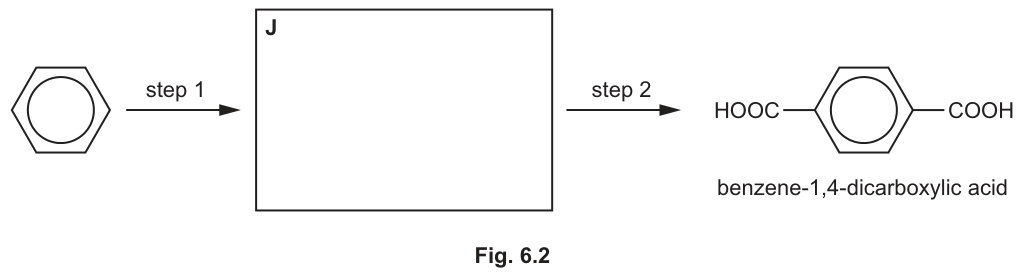
Answer
J is 1,4-dimethylbenzene (para-xylene):
1,4-dimethylbenzene (p-xylene)
Background Concept
To synthesise benzene-1,4-dicarboxylic acid from benzene in two steps, we need to work backwards. The final product has two –COOH groups at para positions on the benzene ring. The second step (oxidation) converts alkyl side chains to carboxylic acid groups. Therefore, the intermediate J must have two methyl groups at para positions — 1,4-dimethylbenzene (p-xylene). The first step is a Friedel-Crafts alkylation introducing methyl groups.
Understanding the Question
The question asks you to identify the intermediate J in a two-step synthesis from benzene to benzene-1,4-dicarboxylic acid. You need to recognise what functional group transformation occurs in step 2 (oxidation of side chains to –COOH) and deduce what J must be before that oxidation.
Approach
- Step 2 must be oxidation (side-chain oxidation converts –CH₃ to –COOH).
- Therefore J must already have the carbon skeleton with two alkyl groups at para positions.
- Step 1 must be Friedel-Crafts alkylation to introduce two methyl groups.
- J = 1,4-dimethylbenzene.
Step-by-Step Reasoning
- Benzene-1,4-dicarboxylic acid has –COOH groups at positions 1 and 4 (para).
- Alkyl side chains on benzene rings can be oxidised to –COOH using hot alkaline KMnO₄ followed by acidification.
- Therefore, before oxidation, the ring must have –CH₃ groups at positions 1 and 4.
- J is 1,4-dimethylbenzene (p-xylene): a benzene ring with CH₃ groups at opposite (para) positions.
Key Takeaways
- Side-chain oxidation (KMnO₄) converts any alkyl group on benzene to –COOH.
- Working backwards from the product is essential in multi-step synthesis.
- Friedel-Crafts alkylation introduces alkyl groups onto the benzene ring.
Common Mistakes
- Drawing 1,2-dimethylbenzene (ortho) or 1,3-dimethylbenzene (meta) instead of 1,4 (para).
- Drawing J as the dicarboxylic acid itself (not recognising that oxidation is step 2).
- Drawing an intermediate with only one methyl group.
Things to Be Careful About
- The methyl groups must be at para positions (1,4) to give the 1,4-dicarboxylic acid after oxidation.
- Draw the benzene ring correctly (hexagon with circle or alternating double bonds).
Identify the reagents and conditions for step 1 and step 2.
step 1 ................................................................................................................................
step 2 ................................................................................................................................
Answer
Step 1: and (Friedel-Crafts alkylation)
Step 2: Hot alkaline followed by acid (side-chain oxidation)
Step 1: CH3Cl + AlCl3; Step 2: hot alkaline KMnO4
Background Concept
Friedel-Crafts alkylation uses a halogenoalkane (e.g. CH₃Cl) in the presence of a Lewis acid catalyst (AlCl₃) to introduce an alkyl group onto a benzene ring via electrophilic substitution. The electrophile is generated by the catalyst polarising the C–Cl bond.
Side-chain oxidation uses hot alkaline potassium manganate(VII) (KMnO₄) to oxidise any alkyl group attached to a benzene ring to a carboxylic acid group (–COOH). The reaction requires heating under reflux. After oxidation, the solution is acidified to protonate the carboxylate salt to the free carboxylic acid.
Understanding the Question
The question asks for reagents AND conditions for each step. For step 1, you need the alkylating agent and catalyst. For step 2, you need the oxidising agent and the condition (hot/heat under reflux, alkaline).
Approach
- Step 1 introduces methyl groups → Friedel-Crafts alkylation → CH₃Cl + AlCl₃.
- Step 2 oxidises methyl groups to carboxylic acid groups → hot alkaline KMnO₄.
Step-by-Step Reasoning
Step 1:
- Benzene → 1,4-dimethylbenzene requires two methyl groups to be added.
- Friedel-Crafts alkylation: CH₃Cl + AlCl₃ generates CH₃⁺ electrophile.
- Excess CH₃Cl (or two equivalents) needed for disubstitution.
- The methyl group is an ortho/para director, so the second substitution goes to the para position (giving 1,4).
Step 2:
- 1,4-dimethylbenzene → benzene-1,4-dicarboxylic acid requires oxidation of both –CH₃ groups.
- Reagent: KMnO₄ (potassium manganate(VII)).
- Conditions: hot (heat under reflux) and alkaline (NaOH or KOH present).
- Followed by acidification (H⁺/H₃O⁺) to give the free dicarboxylic acid.
Key Takeaways
- Friedel-Crafts alkylation: CH₃Cl + AlCl₃ (anhydrous conditions).
- Side-chain oxidation: hot alkaline KMnO₄, then acidify.
- Methyl groups are activating and ortho/para-directing in electrophilic substitution.
Common Mistakes
- Writing 'AlCl₃' alone for step 1 without CH₃Cl (both are needed).
- Writing 'cold dilute KMnO₄' for step 2 (must be hot and concentrated/alkaline for side-chain oxidation).
- Forgetting to mention 'alkaline' or 'hot' for step 2.
- Writing PCl₅ for step 2 (wrong reaction entirely).
Things to Be Careful About
- Both reagent AND conditions are needed for each step to earn the mark.
- For step 2, 'hot' or 'heat under reflux' and 'alkaline' are the key conditions.
- The mark scheme accepts 'hot alkaline KMnO₄' as a single phrase covering both reagent and conditions.
Draw the structure of exactly one repeat unit of the polymer formed when benzene-1,4-dicarboxylic acid reacts with ethane-1,2-diol, . The linkage formed between the monomers should be shown fully displayed.
Answer
Repeat unit: -[C(=O)-C6H4-C(=O)-O-CH2-CH2-O]- with fully displayed ester linkage
Background Concept
Condensation polymerisation occurs between monomers with two complementary functional groups, eliminating a small molecule (usually water) at each linkage. A dicarboxylic acid reacts with a diol to form a polyester, with ester linkages (–COO–) connecting the monomer units. The repeat unit shows one unit of each monomer joined by the ester linkage, with open bonds at each end indicating continuation of the chain.
Understanding the Question
The question asks for exactly one repeat unit of the polyester formed from benzene-1,4-dicarboxylic acid and ethane-1,2-diol. The ester linkage must be fully displayed (showing all atoms and bonds in the –COO– group explicitly). Two marks: one for the correctly displayed ester linkage, one for the rest of the structure.
Approach
- Identify the monomers: benzene-1,4-dicarboxylic acid (HOOC–C₆H₄–COOH) and ethane-1,2-diol (HO–CH₂–CH₂–OH).
- The ester forms between –COOH and –OH, eliminating H₂O.
- Draw the repeat unit showing: –C(=O)–C₆H₄–C(=O)–O–CH₂–CH₂–O– with open bonds at both ends.
- Fully display the ester linkage: show C=O and C–O– explicitly.
Step-by-Step Reasoning
- Benzene-1,4-dicarboxylic acid provides: –C(=O)–C₆H₄–C(=O)– (the diacid portion in the chain).
- Ethane-1,2-diol provides: –O–CH₂–CH₂–O– (the diol portion in the chain).
- The ester linkage is –C(=O)–O– formed by loss of H₂O from –COOH + HO–.
- The repeat unit is: –[C(=O)–C₆H₄–C(=O)–O–CH₂–CH₂–O]–
- The ester linkage must be fully displayed: show the C=O double bond and the C–O single bond explicitly.
- Open bonds at each end show the chain continues.
Key Takeaways
- Polyester from diacid + diol: the repeat unit contains both monomer fragments joined by ester linkages.
- 'Fully displayed' means showing all atoms and bonds in the functional group (not condensed).
- Open bonds at the ends of the repeat unit indicate the polymer continues.
Common Mistakes
- Drawing two repeat units instead of one.
- Not fully displaying the ester linkage (e.g. writing –COO– instead of showing C=O and C–O separately).
- Forgetting the benzene ring in the diacid portion.
- Drawing the wrong connectivity (e.g. putting the O from the diol on the wrong side).
- Not showing open bonds at the ends of the repeat unit.
Things to Be Careful About
- The ester linkage must be fully displayed with the =O shown explicitly.
- The benzene ring should be drawn correctly (hexagon with circle or alternating bonds).
- The –CH₂–CH₂– from the diol must be shown clearly.
- Only ONE repeat unit is required (the question says 'exactly one').
State the type of polymerisation that occurs when benzene-1,4-dicarboxylic acid reacts with ethane-1,2-diol and name the linkage formed between the monomers.
type of polymerisation .......................................................................................................
linkage ...............................................................................................................................
Answer
Type of polymerisation: Condensation
Linkage: Ester
Condensation polymerisation; ester linkage
Background Concept
Polymerisation reactions are classified as either addition (monomers join without loss of any atoms, typically involving C=C double bonds) or condensation (monomers join with the elimination of a small molecule such as H₂O or HCl). When a dicarboxylic acid reacts with a diol, an ester linkage is formed with the loss of water — this is condensation polymerisation producing a polyester.
Understanding the Question
The question asks for the type of polymerisation and the name of the linkage. Both must be correct to earn the single mark (the mark scheme says 'condensation AND ester').
Approach
- A diacid + diol → ester linkages + water eliminated → condensation polymerisation.
- The linkage between monomer units is an ester group (–COO–).
Step-by-Step Reasoning
- The reaction involves –COOH groups reacting with –OH groups.
- Each reaction eliminates H₂O (one H from –OH of the acid, one OH from the alcohol, or vice versa).
- Since a small molecule is lost, this is condensation polymerisation (not addition).
- The functional group linking the monomers is –C(=O)–O–, which is an ester linkage.
Key Takeaways
- Diacid + diol → polyester (condensation, ester linkage).
- Diacid + diamine → polyamide (condensation, amide linkage).
- The type of polymerisation is determined by whether a small molecule is eliminated.
Common Mistakes
- Writing 'addition' instead of 'condensation'.
- Writing 'amide' instead of 'ester' (confusing with polyamide formation).
- Writing 'carboxylate' instead of 'ester' for the linkage.
- Giving only one of the two required answers (both 'condensation' AND 'ester' are needed for the mark).
Things to Be Careful About
- The mark scheme requires BOTH answers to be correct for the single mark — 'condensation AND ester'.
- 'Ester' is the name of the linkage; 'esterification' is the reaction type (do not confuse them).
Benzene reacts with chlorine gas to form chlorobenzene. This reaction can be described as the reaction between benzene molecules and ions. The ions are formed by adding a suitable catalyst to the chlorine gas.
Answer
aluminium chloride (or )
aluminium chloride (or AlCl3)
Background Concept
Benzene is unusually stable due to its delocalised pi electron system. Because of this stability, benzene does not undergo addition reactions with halogens like alkenes do. Instead, it undergoes electrophilic substitution, but only when a strong electrophile is generated. A Lewis acid catalyst is required to polarise the halogen molecule and generate the electrophile (e.g., from ).
Understanding the Question
The question asks for the name or formula of the catalyst used when benzene reacts with chlorine gas to form chlorobenzene.
Approach
Recall the standard conditions for the halogenation of benzene. The reaction requires a Lewis acid catalyst to generate the electrophile.
Step-by-Step Reasoning
For the chlorination of benzene, chlorine gas () is not a strong enough electrophile on its own. A Lewis acid catalyst such as aluminium chloride () or iron(III) chloride () is added. The catalyst reacts with to form a complex that generates the electrophile. The mark scheme accepts aluminium chloride or .
Key Takeaways
Benzene requires a Lewis acid catalyst (like or ) for electrophilic substitution with halogens to generate the necessary electrophile.
Common Mistakes
Writing "iron" instead of "iron(III) chloride" or "aluminium" instead of "aluminium chloride". The catalyst must be the Lewis acid, not the bare metal.
Things to Be Careful About
Ensure the catalyst is a Lewis acid (e.g., , ), not a transition metal catalyst used for addition reactions (like Ni or Pt for hydrogenation).
The mechanism for this reaction is shown.
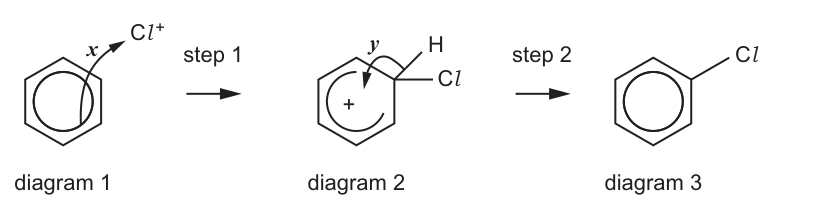
The movement of a pair of electrons is represented by in diagram 1.
-
State where this pair of electrons is before step 1 takes place.
-
State where this pair of electrons is after step 1 has taken place.
Answer
Before step 1: delocalised pi system (or delocalised ring)
After step 1: C–Cl bond
Before: delocalised pi system; After: C-Cl bond
Background Concept
In the first step of electrophilic aromatic substitution, the electron-rich delocalised pi system of the benzene ring acts as a nucleophile. It attacks the electrophile (), forming a new sigma bond. This disrupts the delocalised system, leaving a positive charge on the ring (an arenium ion or sigma complex).
Understanding the Question
The question asks to identify the location of the pair of electrons represented by curly arrow before and after step 1 in the mechanism diagram.
Approach
Arrow starts from the benzene ring and points to . Before the step, these electrons are in the delocalised pi system. After the step, they have formed a new bond between carbon and chlorine.
Step-by-Step Reasoning
- Before step 1: The curly arrow originates from the delocalised pi system (the circle inside the benzene ring). These are the delocalised pi electrons.
- After step 1: The arrow points to the ion. The pair of electrons has been used to form a new covalent bond between a carbon atom of the ring and the chlorine atom. Thus, the electrons are now in the C–Cl bond.
Key Takeaways
Curly arrows in mechanism diagrams show the movement of electron pairs. An arrow starting from a pi system and ending at an electrophile indicates the formation of a new sigma bond at the expense of the pi system.
Common Mistakes
Saying "the electrons come from a double bond". Benzene does not have localized double bonds; the electrons are in a delocalised pi system.
Things to Be Careful About
Use precise terminology: "delocalised pi system" or "delocalised ring" rather than "double bond" or "pi bond" (singular).
The movement of another pair of electrons is represented by in diagram 2.
-
State where this pair of electrons is before step 2 takes place.
-
State where this pair of electrons is after step 2 has taken place.
Answer
Before step 2: C–H bond
After step 2: delocalised pi system (or delocalised ring)
Before: C-H bond; After: delocalised pi system
Background Concept
In the second step of electrophilic aromatic substitution, the arenium ion intermediate loses a proton () to restore the stable delocalised pi system. A base (often the complex formed from the catalyst and , like ) removes the proton. The electrons from the C–H bond move back into the ring to reform the delocalised pi system.
Understanding the Question
The question asks to identify the location of the pair of electrons represented by curly arrow before and after step 2.
Approach
Arrow starts from the C–H bond on the saturated carbon and points into the ring. Before the step, these electrons are in the C–H bond. After the step, they reform the delocalised pi system.
Step-by-Step Reasoning
- Before step 2: The curly arrow originates from the C–H bond on the hybridised carbon atom in the arenium ion intermediate.
- After step 2: The arrow points into the ring, indicating that the electron pair from the C–H bond moves back into the ring to restore the delocalised pi system. The is lost, and the electrons remain in the delocalised pi system.
Key Takeaways
The second step of electrophilic substitution is a deprotonation step that restores aromaticity. The electrons from the broken C–H bond replenish the pi system.
Common Mistakes
Saying the electrons go to form a double bond. They go into the delocalised pi system, restoring aromaticity.
Things to Be Careful About
Again, use "delocalised pi system" or "delocalised ring" rather than "double bond".
There are six carbon atoms in diagram 2.
State how many of these carbon atoms are hybridised, hybridised, and hybridised.
hybridised .................................
hybridised .................................
hybridised .................................
Answer
hybridised: 0
hybridised: 5
hybridised: 1
sp: 0, sp2: 5, sp3: 1
Background Concept
In benzene, all six carbon atoms are hybridised, forming a planar ring with bond angles of 120°. Each carbon has a p-orbital perpendicular to the ring that contributes to the delocalised pi system.
In the arenium ion intermediate (diagram 2), one carbon atom has formed a new sigma bond with chlorine and still retains its bond to hydrogen. This carbon is now bonded to four groups (two ring carbons, one H, one Cl) and is hybridised with tetrahedral geometry (bond angles ~109.5°). The other five carbon atoms remain hybridised and continue to contribute to the delocalised pi system (though it is now broken over only five carbons).
Understanding the Question
The question asks for the number of , , and hybridised carbon atoms in diagram 2 (the arenium ion intermediate).
Approach
Identify the hybridisation of each carbon in the intermediate. Five carbons are part of the remaining conjugated system and are . One carbon is saturated (bonded to H, Cl, and two ring carbons) and is . No carbons are hybridised.
Step-by-Step Reasoning
- Diagram 2 shows the arenium ion. Five carbon atoms are still part of the delocalised pi system (indicated by the broken horseshoe and positive charge). These five carbons are hybridised.
- One carbon atom is bonded to both H and Cl, and has no p-orbital contribution to the pi system. This carbon is hybridised.
- There are no triple bonds or linear geometries, so 0 carbons are hybridised.
- Therefore: = 0, = 5, = 1.
Key Takeaways
In electrophilic substitution intermediates, the carbon that bonds to the electrophile becomes hybridised, while the rest of the ring remains hybridised.
Common Mistakes
Assuming all carbons are because the product is aromatic. Remember to look at the intermediate (diagram 2), not the final product (diagram 3).
Things to Be Careful About
Count carefully: there are 6 carbons total. 5 + 1 = 6.
Answer
C6H6 + Cl2 -> C6H5Cl + HCl
Background Concept
The overall reaction for the chlorination of benzene involves replacing one hydrogen atom on the benzene ring with a chlorine atom. The displaced hydrogen combines with the remaining chlorine atom to form hydrogen chloride.
Understanding the Question
Complete the balanced equation for the reaction between benzene and chlorine to form chlorobenzene.
Approach
Benzene is . Chlorine is . The organic product is chlorobenzene (). The byproduct is hydrogen chloride ().
Step-by-Step Reasoning
This is a balanced equation. The catalyst (e.g., ) is written above the arrow, but the question only asks to complete the equation with the main reactants and products.
Key Takeaways
Electrophilic substitution of benzene with halogens produces a halogenoarene and hydrogen halide.
Common Mistakes
Forgetting the byproduct, or writing instead of .
Things to Be Careful About
Ensure the equation is balanced. Benzene has 6 H, chlorobenzene has 5 H, so 1 H is left for HCl.
The mechanism for this reaction is electrophilic substitution.
Complete the following sentence. Write formulae in the gaps provided.
During this reaction, the electrophile is ................................. and a ................................. atom in benzene is substituted by a ................................. atom.
Answer
During this reaction, the electrophile is and a hydrogen (or H) atom in benzene is substituted by a chlorine (or Cl) atom.
Cl+; H; Cl
Background Concept
In electrophilic substitution, an electrophile (an electron-pair acceptor) replaces an atom on an aromatic ring. For the chlorination of benzene, the electrophile is the chloronium ion (), generated by the reaction of with the Lewis acid catalyst. The atom on the benzene ring that is replaced is a hydrogen atom.
Understanding the Question
Complete the sentence identifying the electrophile and the atoms involved in the substitution.
Approach
The electrophile is . The atom substituted is hydrogen (H). The atom that substitutes it is chlorine (Cl).
Step-by-Step Reasoning
- The electrophile is .
- In benzene (), the atom being substituted is hydrogen (H).
- It is substituted by chlorine (Cl).
Key Takeaways
Electrophilic aromatic substitution involves the replacement of a hydrogen atom on the ring by the electrophile.
Common Mistakes
Saying the electrophile is . is polarised by the catalyst to form , which is the actual electrophile.
Things to Be Careful About
Write formulae as requested: , H, Cl.
Chloroethane reacts with . Chlorobenzene does not.
Name the mechanism of the reaction that chloroethane undergoes with , and identify the major organic product that is formed.
mechanism ........................................................................................................................
major organic product .......................................................................................................
Answer
mechanism: nucleophilic substitution
major organic product: ethanol
nucleophilic substitution; ethanol
Background Concept
Chloroethane () is a primary halogenoalkane. When heated with aqueous sodium hydroxide (), it undergoes nucleophilic substitution. The hydroxide ion () acts as a nucleophile, attacking the electron-deficient carbon bonded to chlorine. The C–Cl bond breaks, and a C–OH bond forms, producing ethanol () and a chloride ion.
Understanding the Question
Name the mechanism and identify the major organic product when chloroethane reacts with .
Approach
Recall the reaction of primary halogenoalkanes with aqueous hydroxide ions. The mechanism is nucleophilic substitution, and the product is an alcohol.
Step-by-Step Reasoning
- Chloroethane is .
- Aqueous provides ions, which are nucleophiles.
- The attacks the atom bonded to , displacing .
- Mechanism: nucleophilic substitution.
- Product: , which is ethanol.
Key Takeaways
Primary halogenoalkanes undergo nucleophilic substitution with aqueous hydroxide to form primary alcohols.
Common Mistakes
Confusing the conditions: aqueous gives substitution (alcohol), while ethanolic gives elimination (alkene). The question specifies .
Things to Be Careful About
Ensure the mechanism name is exactly "nucleophilic substitution". Do not just write "substitution".
Explain the difference in reactivity of chloroethane and chlorobenzene when treated with .
Answer
In chlorobenzene, the lone pair on the chlorine atom is delocalised into the delocalised pi system of the benzene ring. This gives the C–Cl bond partial double-bond character, making it stronger and harder to break than the C–Cl bond in chloroethane.
See explanation
Background Concept
The reactivity of halogenoalkanes vs halogenoarenes towards nucleophilic substitution depends on the strength of the C–X bond and the availability of the carbon atom for nucleophilic attack.
In halogenoalkanes (like chloroethane), the C–Cl bond is a pure sigma bond. The chlorine is more electronegative than carbon, making the carbon partially positive and susceptible to nucleophilic attack.
In halogenoarenes (like chlorobenzene), the lone pair on the chlorine atom is in a p-orbital that overlaps with the delocalised pi system of the benzene ring. This delocalisation gives the C–Cl bond partial double-bond character, making it shorter and stronger than a typical C–Cl sigma bond. Additionally, the electron density of the ring repels nucleophiles.
Understanding the Question
Explain why chloroethane reacts with but chlorobenzene does not.
Approach
Compare the C–Cl bonds in both molecules. Highlight the delocalisation of the chlorine lone pair in chlorobenzene and its effect on bond strength.
Step-by-Step Reasoning
- Chloroethane: The C–Cl bond is a standard sigma bond. The carbon is partially positive () and is readily attacked by the nucleophile (). The bond is relatively easy to break.
- Chlorobenzene: The lone pair on the chlorine atom is delocalised into the delocalised pi system of the benzene ring (resonance). This delocalisation gives the C–Cl bond partial double-bond character.
- Because of the partial double-bond character, the C–Cl bond in chlorobenzene is stronger (has a higher bond enthalpy) and is harder to break than the C–Cl bond in chloroethane.
- Therefore, nucleophilic substitution does not occur under normal conditions with chlorobenzene.
Key Takeaways
Lone pair delocalisation into an aromatic ring strengthens the C–X bond in halogenoarenes, making them unreactive towards nucleophilic substitution compared to halogenoalkanes.
Common Mistakes
Saying "the ring is electron-rich and repels nucleophiles". While true, the primary reason for the lack of reactivity in standard nucleophilic substitution conditions is the strength of the C–Cl bond due to delocalisation. The mark scheme specifically looks for delocalisation and bond strength.
Things to Be Careful About
Be precise: say "delocalisation of the lone pair of Cl with the pi system" and "C–Cl bond is stronger / partly double". Do not just say "the bond is stronger" without explaining why.
The amino acid serine, , exists in two optically active forms. These optical isomers, isomer P and isomer Q, are shown in Fig. 8.1.
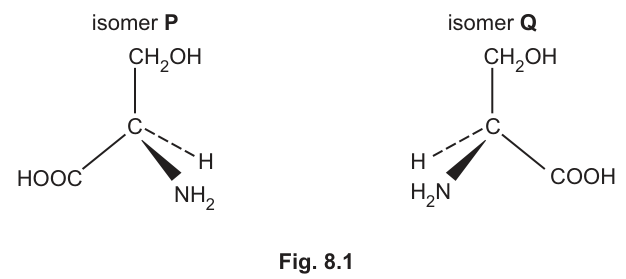
Isomer and isomer have identical physical and chemical properties, with the exception of two specific properties. One of these two properties is their differing effect on plane polarised light.
State the other property by which they differ.
Answer
Biological activity.
Biological activity
Background Concept
Optical isomers (enantiomers) are non-superimposable mirror images of each other. Because they have the same connectivity and the same physical properties (boiling point, melting point, density, etc.), they are indistinguishable in an achiral environment. However, they interact differently with other chiral entities. In biological systems, receptors, enzymes, and other biomolecules are themselves chiral. Therefore, one enantiomer of a drug or amino acid may fit perfectly into a biological receptor (like a key in a lock), while its mirror image may not fit at all, or may even cause an adverse effect.
Understanding the Question
The question asks for the second property that differs between optical isomers, given that their differing effect on plane polarised light is the first. This is a direct recall question about the fundamental characteristics of enantiomers.
Approach
Recall the standard list of differences between enantiomers: rotation of plane polarised light (opposite directions) and interaction with other chiral molecules (biological activity, taste, smell).
Step-by-Step Reasoning
The mark scheme specifically looks for "biological activity". While they also differ in taste and smell (e.g., limonene), biological activity is the most significant and universally cited difference in the context of pharmaceuticals and amino acids.
Key Takeaways
Enantiomers have identical physical and chemical properties in achiral environments but differ in two key ways: the direction they rotate plane polarised light and their biological activity (interaction with chiral biological molecules).
Common Mistakes
Students often write "chemical properties" as a whole, which is incorrect because their chemical properties are identical towards achiral reagents. The difference only arises in chiral environments.
Things to Be Careful About
Be precise with terminology. "Biological activity" is the expected answer. Avoid vague terms like "how they react" without specifying the chiral nature of the interaction.
A solution of pure isomer of a particular concentration rotates plane polarised light by in a clockwise direction.
Describe how a solution of pure isomer of the same concentration affects plane polarised light.
Answer
Rotates plane polarised light by in the anticlockwise (or counterclockwise) direction.
Rotates plane polarised light by 5.0° in the anticlockwise direction
Background Concept
When plane polarised light passes through a solution containing a single enantiomer, the plane of vibration is rotated. If one enantiomer rotates it clockwise (dextrorotatory, +), its mirror image will rotate it by the exact same magnitude but in the opposite direction, anticlockwise (levorotatory, -). A racemic mixture (50:50) shows no net rotation because the effects cancel out.
Understanding the Question
Isomer P rotates light by clockwise. Isomer Q is the non-superimposable mirror image of P. We need to describe how Q affects the light.
Approach
Apply the rule that enantiomers rotate plane polarised light by equal magnitudes in opposite directions.
Step-by-Step Reasoning
Since P rotates light clockwise, Q must rotate it anticlockwise. The concentration is the same, so the magnitude of rotation is identical.
Key Takeaways
Enantiomers have equal but opposite specific rotation values. If one is , the other is .
Common Mistakes
Forgetting to specify the direction (anticlockwise) or the magnitude (). Just saying "it rotates light" is not enough; the direction and magnitude must be stated.
Things to Be Careful About
Ensure the direction is clearly stated as "anticlockwise" or "counterclockwise". "Left" or "right" can be ambiguous without a reference frame.
State another term, in addition to stereoisomers, optical isomers and non-superimposable mirror images, which can be used to describe this pair of chiral compounds, isomer and isomer .
Answer
Enantiomers.
Enantiomers
Background Concept
Stereoisomers that are non-superimposable mirror images of each other are specifically called enantiomers. This is the precise IUPAC-preferred term in this context, distinguishing them from diastereomers (stereoisomers that are not mirror images).
Understanding the Question
The question asks for another term for optical isomers / non-superimposable mirror images.
Approach
Recall the specific terminology for this type of stereoisomerism.
Step-by-Step Reasoning
The term is enantiomers. This is a standard definition question.
Key Takeaways
Optical isomers = enantiomers. Diastereomers are stereoisomers that are not mirror images.
Common Mistakes
Confusing enantiomers with diastereomers or geometric isomers (E/Z). Geometric isomers are a type of diastereomer.
Things to Be Careful About
Ensure spelling is correct: e-n-a-n-t-i-o-m-e-r-s.
Give the term used to describe a mixture containing equal amounts of isomer and isomer .
Answer
Racemic (mixture / racemate).
Racemic
Background Concept
A mixture containing equal amounts (50:50 ratio) of two enantiomers is called a racemic mixture or racemate. Because the equal and opposite rotations of plane polarised light cancel each other out, a racemic mixture is optically inactive (net rotation = 0).
Understanding the Question
The question asks for the term describing a mixture with equal amounts of isomer P and isomer Q.
Approach
Recall the standard term for a 1:1 mixture of enantiomers.
Step-by-Step Reasoning
The term is racemic (or racemic mixture, racemate). The mark scheme accepts "racemic".
Key Takeaways
Racemic mixture = 50:50 mixture of enantiomers = optically inactive.
Common Mistakes
Writing "racemic mixture" when just "racemic" is asked, or confusing it with "diastereomeric mixture". The term "racemic" is an adjective, so "racemic mixture" or "racemate" is the noun phrase.
Things to Be Careful About
The mark scheme accepts "racemic". Ensure you don't write "racemic mixture" if only one word is expected, though usually both are accepted. The key is the word "racemic".
Describe one way in which a single pure optical isomer of serine can be produced, instead of making a mixture of isomer and isomer .
Answer
Use of a chiral catalyst (or chiral starting material / enzyme / biological synthesis).
Use of a chiral catalyst
Background Concept
Standard chemical synthesis from achiral starting materials typically produces a racemic mixture (50:50) because the transition states leading to the two enantiomers are enantiomeric and thus have equal activation energies. To produce a single enantiomer (asymmetric synthesis), a chiral influence must be introduced.
Understanding the Question
The question asks for one way to produce a single pure optical isomer instead of a mixture.
Approach
Think about how to break the symmetry in the reaction. This can be done by using a chiral reagent, catalyst, or starting material, or by using biological methods (enzymes).
Step-by-Step Reasoning
- Chiral catalyst: A chiral catalyst will create a chiral environment, making one transition state lower in energy than the other, thus favouring the production of one enantiomer.
- Chiral starting material: If you start with a chiral molecule, the existing chirality can direct the formation of a new chiral centre (diastereoselective synthesis).
- Enzymatic synthesis: Enzymes are highly chiral and stereospecific; they will only produce one enantiomer.
The mark scheme specifically looks for "use of chiral catalyst".
Key Takeaways
Asymmetric synthesis requires a chiral influence (catalyst, reagent, or enzyme) to favour the production of one enantiomer over the other.
Common Mistakes
Writing "fractional distillation" or "chromatography". These are separation techniques, not methods to produce a single isomer from a reaction. The question asks how to produce it instead of making a mixture.
Things to Be Careful About
Ensure the answer describes a synthesis method, not a separation method. "Chiral catalyst" is the most direct and commonly accepted answer.
Complete Table 8.1 to describe the peaks seen in the proton () NMR spectrum of dissolved in .
Use as many rows in Table 8.1 as you need to, leaving the other rows blank.
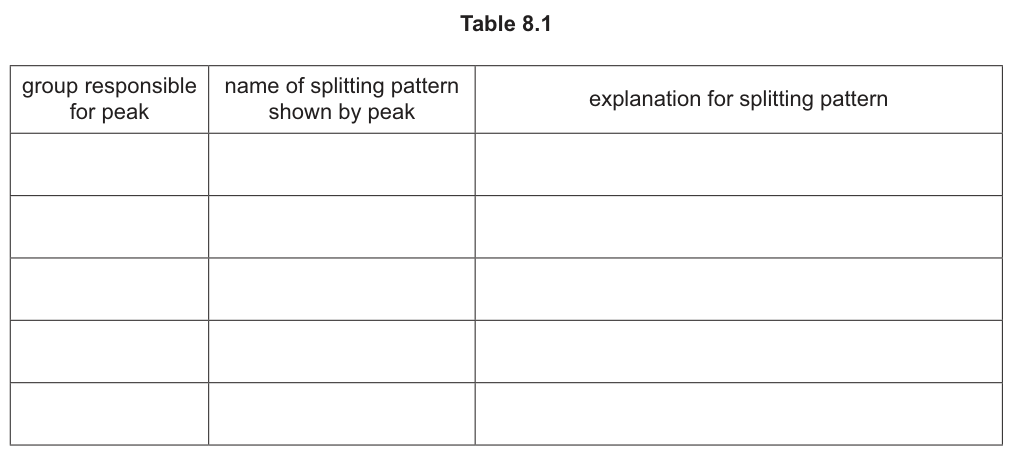
Answer
| group responsible for peak | name of splitting pattern shown by peak | explanation for splitting pattern |
|---|---|---|
| doublet | due to 1 proton on neighbouring carbon () | |
| triplet | due to 2 protons on neighbouring carbon () |
(Note: and protons exchange with and do not appear in the spectrum or cause splitting.)
See table above
Background Concept
In H NMR spectroscopy, the splitting pattern (multiplicity) of a peak is determined by the number of protons on adjacent carbons using the rule, where is the number of neighbouring protons. However, protons attached to heteroatoms like oxygen () and nitrogen (, ) are labile. When the solvent is (deuterium oxide), these labile protons undergo rapid exchange with deuterium (). Deuterium does not produce a signal in the standard H NMR range (its resonance is at a very different frequency), and it does not cause splitting of adjacent protons in typical routine spectra (or the coupling is not resolved). Therefore, and peaks disappear or broaden out, and they do not contribute to the splitting of neighbouring protons.
Understanding the Question
We need to complete a table for the H NMR spectrum of serine () dissolved in . We must identify the groups responsible for peaks, the splitting pattern, and the explanation.
Approach
- Identify all proton environments in serine: (2H), (1H), (2H), (1H).
- Apply exchange: and protons exchange with D. The proton also exchanges. Only the protons remain.
- Analyze the remaining protons: group and group.
- Apply the rule to each.
Step-by-Step Reasoning
- Protons in : The protons on (alcohol and carboxylic acid) and exchange with deuterium. They do not appear as sharp peaks and do not cause splitting. Thus, only the and protons are relevant.
- group: This group is attached to the chiral carbon. The carbon has 1 proton. Using the rule: . So, the peak is a doublet. Explanation: splitting due to 1 proton on the neighbouring carbon.
- group: This carbon is attached to the group. The carbon has 2 protons. Using the rule: . So, the peak is a triplet. Explanation: splitting due to 2 protons on the neighbouring carbon.
The mark scheme specifically requires: " and only in column one", " gives a doublet, gives a triplet", and the explanations for splitting.
Key Takeaways
Always consider the solvent. In , labile protons (, , ) exchange and disappear. Only protons contribute to splitting and appear in the spectrum. Apply the rule only to neighbouring protons.
Common Mistakes
- Including , , or in the table. These exchange with .
- Forgetting that does not split signals in this context.
- Miscounting neighbouring protons. Remember to look at the adjacent carbon's protons, not the total number of protons in the molecule.
Things to Be Careful About
The question specifies as the solvent. If it were , the and peaks would appear and would cause splitting (though splitting is often not resolved due to exchange, in ideal theory they would split). Here, is key.
Proline is a naturally occurring amino acid. The skeletal formula of proline is shown.
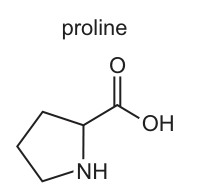
State the number of peaks in the carbon-13 () NMR spectrum of proline.
Answer
5
5
Background Concept
In C NMR spectroscopy, each chemically distinct carbon environment gives a separate peak. Symmetry in a molecule can make different carbons equivalent, reducing the number of peaks. We must count the number of unique carbon atoms.
Understanding the Question
We are given the skeletal formula of proline and asked for the number of peaks in its C NMR spectrum.
Approach
Draw out the full structure of proline, label each carbon, and determine if any are equivalent by symmetry.
Step-by-Step Reasoning
Proline is a cyclic amino acid. The structure is a pyrrolidine ring (5-membered ring containing N) with a carboxylic acid group attached to the carbon adjacent to the nitrogen (the alpha carbon).
Let's number the carbons:
- Carboxyl carbon (): Unique environment.
- Alpha carbon (): Attached to the carboxyl group, the ring nitrogen, and a ring . Unique.
- Ring (beta carbon, adjacent to alpha): Attached to alpha carbon and another ring . Unique.
- Ring (gamma carbon, middle of the chain): Attached to beta and delta . Unique.
- Ring (delta carbon, adjacent to nitrogen): Attached to gamma and the nitrogen. Unique.
There is no plane of symmetry in proline that makes any carbons equivalent. All 5 carbons are in different chemical environments.
Therefore, there are 5 peaks in the C NMR spectrum.
Key Takeaways
Always check for symmetry. In cyclic molecules without a plane of symmetry, all carbons are usually unique. Proline has 5 carbons and no symmetry, so 5 peaks.
Common Mistakes
- Assuming the three groups in the ring are equivalent. They are not, because one is next to , one is next to , and one is in the middle.
- Forgetting the carboxyl carbon.
Things to Be Careful About
The skeletal formula might make it look like there are fewer carbons if you don't count the carboxyl carbon or misinterpret the ring vertices. Count every vertex and end of line that represents a carbon.
Glutamic acid is a naturally occurring amino acid.
The skeletal formula of glutamic acid is shown.
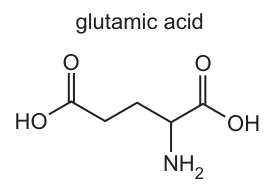
The isoelectric point of glutamic acid is pH 3.
A sample of glutamic acid is dissolved in a solution of pH 1. A strong alkali is then added until the pH of the mixture reaches pH 14. During this process all possible ionised forms of glutamic acid are present at different times, depending on the pH of the solution.
Complete the boxes below to show four different ionised forms of glutamic acid that are present at the stated pH values.
Answer
- at pH 1: Fully protonated. (net charge +1)
- at pH 3: One carboxyl deprotonated. (net charge 0, zwitterion)
- at pH 9: Both carboxyls deprotonated. (net charge -1) [or ]
- at pH 14: Fully deprotonated. (net charge -1)
(Structures drawn below)
See structures above
Background Concept
Amino acids have at least two ionisable groups: the amino group (, basic) and the carboxyl group (, acidic). Glutamic acid has an additional carboxyl group on its side chain.
Typical pKa values:
- -carboxyl group (): ~2.1
- Side-chain carboxyl group (): ~4.1
- Amino group (): ~9.7
The isoelectric point (pI) is the pH at which the amino acid has a net charge of zero. For glutamic acid (an acidic amino acid), pI is the average of the two carboxyl pKa values: (given as 3 in the question).
- pH < pKa: The group is protonated ( or ).
- pH > pKa: The group is deprotonated ( or ).
Understanding the Question
We need to draw the structure of glutamic acid at four pH values: 1, 3, 9, and 14. The question states that all possible ionised forms are present at different times.
Approach
Analyze the protonation state of each functional group at the given pH values using the approximate pKa values.
Step-by-Step Reasoning
Glutamic acid structure:
Groups to consider: Side-chain (pKa ~4), -COOH (pKa ~2), -NH (pKa ~9.7).
-
at pH 1: pH is below all pKa values (1 < 2 < 4 < 9.7).
- Both carboxyl groups are protonated: .
- Amino group is protonated: .
- Structure: . Net charge: +1.
-
at pH 3: pH is between the two carboxyl pKa values (2 < 3 < 4 < 9.7). This is near the pI (3).
- The -carboxyl (pKa ~2) is deprotonated: .
- The side-chain carboxyl (pKa ~4) is mostly protonated: .
- Amino group is protonated: .
- Structure: . Net charge: 0. (This is the zwitterion form dominant at pI).
-
at pH 9: pH is above both carboxyl pKa values and near the amino pKa (2 < 4 < 9 < 9.7).
- Both carboxyl groups are deprotonated: .
- The amino group is partially deprotonated. At pH 9, it's close to pKa 9.7, so a mix of and exists. The mark scheme accepts either, but typically becomes dominant above pKa. Let's provide the fully deprotonated amino form or the zwitterionic carboxyl form.
- Option 1 (major species above pKa of NH3+): . Net charge: -1.
- Option 2 (still significant at pH 9): . Net charge: -1 (wait, if NH3+ and two COO-, net charge is -1. Yes).
- The mark scheme shows both are acceptable for pH 9. Let's use as the primary answer, noting the alternative.
-
at pH 14: pH is above all pKa values (14 > 9.7 > 4 > 2).
- Both carboxyl groups are deprotonated: .
- Amino group is deprotonated: .
- Structure: . Net charge: -2.
Key Takeaways
To determine the ionisation state of an amino acid at a given pH:
- List the pKa values of all ionisable groups.
- If pH < pKa, the group is protonated.
- If pH > pKa, the group is deprotonated.
- Draw the structure accordingly and calculate the net charge.
Common Mistakes
- Forgetting that glutamic acid has two carboxyl groups. Students often treat it like a standard amino acid with only one COOH.
- Getting the order of deprotonation wrong. Carboxyl groups (acidic) deprotonate first (at lower pH), then the amino group (basic) deprotonates at high pH.
- Drawing at pH 14. At pH 14, the amino group is deprotonated to .
Things to Be Careful About
- At pH 9, the mark scheme allows either or because pH 9 is close to the pKa of the amino group (~9.7). However, the carboxyl groups must be deprotonated () at pH 9.
- Ensure the structures are drawn clearly with correct charges. The skeletal formula in the question shows and ; you must modify these based on pH.