Chemistry 9701/41 — October/November 2024
Cambridge A-Level · A Level Structured Questions · worked solutions for every part, with the mark scheme
Topics Transition Elements · Electrochemistry · Carboxylic Acids and Derivatives · Nitrogen Compounds · Equilibria · Group 2 · +6 more
Disodium phosphate, , reacts with an acid to form monosodium phosphate, .
Identify the ions that are a conjugate acid–base pair in this reaction, using the formulae of the species involved.
conjugate acid .................................................................... conjugate base ....................................................................
Answer
conjugate acid:
conjugate base:
conjugate acid: H2PO4^-; conjugate base: HPO4^2-
Background Concept
A Brønsted–Lowry acid is a proton (H) donor and a Brønsted–Lowry base is a proton acceptor. A conjugate acid–base pair is a pair of species that differ by exactly one proton, H. When a base accepts a proton it becomes its conjugate acid; when an acid loses a proton it becomes its conjugate base. The relationship is always acid base + H.
Understanding the Question
The stem describes the reaction of disodium phosphate, , with an acid to form monosodium phosphate, . The question asks you to identify the ions that form a conjugate acid–base pair. The Na ions are spectators; the proton transfer happens between and .
Approach
Find the two species that differ by exactly one H. has one hydrogen and a 2− charge; has two hydrogens and a 1− charge. They differ by one H, so they are a conjugate pair. The species with more hydrogens is the acid.
Step-by-Step Reasoning
When accepts a proton, it becomes :
So is the base (proton acceptor) and is its conjugate acid. The mark requires BOTH ions: conjugate acid , conjugate base .
Key Takeaways
A conjugate acid–base pair always differs by exactly one proton. The acid has one more H and one more unit of positive charge (or one less unit of negative charge) than the base.
Common Mistakes
- Giving only one of the two ions — the mark requires both.
- Swapping the labels: (more H) is the acid; is the base.
- Including Na in the pair — sodium is a spectator ion, not part of the proton transfer.
Things to Be Careful About
Write the ions with their correct charges: and . The question explicitly asks for the formulae of the species involved.
Answer
A buffer solution resists changes in pH / allows only small changes in pH when small amounts of acid or alkali (H or OH) are added.
A buffer solution resists changes in pH when small amounts of acid or alkali are added.
Background Concept
A buffer solution is a mixture of a weak acid and its conjugate base (or a weak base and its conjugate acid) that maintains a relatively constant pH. It works because the two components neutralise small added amounts of acid or base, shifting the equilibrium to keep [H] (and hence pH) nearly constant.
Understanding the Question
The command word is "define". Two marks are available, so the definition must contain two distinct ideas: (1) the solution resists/only allows small changes in pH, and (2) this resistance applies when small amounts of acid or alkali are added.
Approach
Give the definition in two parts matching the two marks.
Step-by-Step Reasoning
Mark 1: "A buffer solution resists changes in pH" or "allows only small changes in pH".
Mark 2: "when small amounts of acid or alkali/base (H or OH) are added".
Both ideas are needed for full marks.
Key Takeaways
The definition must capture both the effect (resisting pH change) and the condition (small amounts of added acid or base).
Common Mistakes
- Saying a buffer "keeps the pH constant" without the "small amounts" qualifier — buffers do not keep pH perfectly constant.
- Omitting the condition that the added acid or base is in small amounts.
- Stating only that it "resists pH change" without mentioning acid or alkali.
Things to Be Careful About
Use the mark-scheme wording: "resists changes in pH" and "small amounts of acid or alkali/base". The two marks are independent.
Write two equations to show how a mixture of and can act as a buffer solution.
equation 1 .........................................................................................................................
equation 2 .........................................................................................................................
Answer
Equation 1 (added acid):
Equation 2 (added alkali):
HPO4^2- + H+ -> H2PO4- ; H2PO4- + OH- -> HPO4^2- + H2O
Background Concept
A buffer contains both members of a conjugate acid–base pair. The base component removes added H (acid) and the acid component removes added OH (alkali). Here the pair is (base) and (acid).
Understanding the Question
Write two equations showing how the / mixture acts as a buffer: one for reaction with added acid (H), one for reaction with added alkali (OH). The mark scheme accepts either the full salt equations or the simpler ion-only equations.
Approach
For added acid: the base accepts H to form . For added alkali: the acid donates H to OH to form and water.
Step-by-Step Reasoning
Equation 1 (added acid):
The base component removes the added protons, so the pH does not fall much.
Equation 2 (added alkali):
The acid component neutralises added hydroxide, so the pH does not rise much.
The full salt versions are also accepted: and , but the ion equations show the buffer chemistry more clearly.
Key Takeaways
A buffer's two equations always pair the conjugate base with H and the conjugate acid with OH. The products are simply the other member of the conjugate pair.
Common Mistakes
- Writing both equations with H (forgetting the alkali equation).
- Not balancing charges in the ion equations.
- Writing the reactions in the reverse direction.
Things to Be Careful About
Check charge balance: has 2− + 1+ = 1− on each side; has 1− + 1− = 2− on each side.
Answer
(hydrogen carbonate ion)
HCO3^- (hydrogen carbonate ion)
Background Concept
Blood maintains a pH close to 7.4 using several buffer systems. The most important is the carbonic acid/hydrogencarbonate buffer: / .
Understanding the Question
Identify one inorganic ion that acts as a buffer in blood. The answer is the hydrogencarbonate ion, .
Approach
Recall the blood buffer systems; the primary one involves .
Step-by-Step Reasoning
The hydrogencarbonate ion buffers blood by reacting with added H to form carbonic acid () and by releasing H (or reacting with OH) to keep pH stable. Answer: .
Key Takeaways
(hydrogencarbonate) is the key inorganic buffer ion in blood.
Common Mistakes
- Giving instead of — the ion is what acts as the buffer.
- Giving a non-inorganic species or a metal ion.
Things to Be Careful About
The mark scheme accepts either "" or "hydrogen carbonate". Give the ion with its charge.
Compound is the hydroxide of a Group 2 element. Compound is a strong alkali.
of is dissolved in water to make of solution . Solution has a pH of at .
Working
pOH = 14.00 − 13.09 = 0.91
Answer
0.123 mol dm^-3
Background Concept
At 298 K, the ionic product of water is , and . A strong alkali dissociates fully, so can be found directly from the pH.
Understanding the Question
Solution F has pH 13.09. Show that . Two valid routes exist: via pOH, or via [H] and .
Approach
Method 1 (pOH): , then .
Method 2 (): , then .
Step-by-Step Reasoning
Using pOH:
This confirms the stated value.
Using : , then
Both routes give the same answer.
Key Takeaways
at 298 K. For a strong base, .
Common Mistakes
- Using .
- Forgetting that only at 298 K.
- Mis-evaluating .
Things to Be Careful About
Keep three significant figures to match the given pH. The mark scheme allows either method; show the intermediate step clearly.
Answer
Compound E is and dissociates fully, giving two hydroxide ions per formula unit:
So .
[E] = [OH-]/2 because E is X(OH)2 with two OH- per formula unit
Background Concept
E is the hydroxide of a Group 2 element and a strong alkali, so it has the formula and dissociates fully:
Each formula unit releases two hydroxide ions.
Understanding the Question
Given from (i), explain why . The factor of two comes from the stoichiometry of dissociation.
Approach
Since each mole of E produces two moles of OH, .
Step-by-Step Reasoning
E is . On full dissociation, one formula unit gives two OH ions. Therefore the concentration of E is half the concentration of OH:
The one mark is for stating that there are two hydroxide ions per formula unit of E.
Key Takeaways
For a strong diprotic base like , because each formula unit produces two OH.
Common Mistakes
- Forgetting the factor of two.
- Treating E as a monobasic alkali.
Things to Be Careful About
The mark is for the stoichiometric statement: two OH ions per formula unit of E / .
Use the concentration given in (ii) to identify compound .
compound ................................................................................................................
Working
: ✓
Answer
Barium hydroxide,
Ba(OH)2 (barium hydroxide)
Background Concept
Concentration, volume and amount of substance are linked by , and molar mass (RFM) by . Identifying an unknown compound means matching the calculated RFM to the known Group 2 hydroxides.
Understanding the Question
Using from (ii), identify E. We know 2.63 g of E was dissolved to make 250 cm = 0.250 dm of solution.
Approach
Find moles of E from , then RFM from , and compare with the RFMs of the Group 2 hydroxides.
Step-by-Step Reasoning
Check the Group 2 hydroxides:
- : 24.3 + 34 = 58.3
- : 40.1 + 34 = 74.1
- : 87.6 + 34 = 121.6
- : 137.3 + 34 = 171.3 ≈ 171
So E is barium hydroxide, . (Equivalently, the metal's RAM is 171 − 34 = 137, which is barium.)
Key Takeaways
and let you identify an unknown compound from concentration and mass data.
Common Mistakes
- Using volume in cm instead of dm (must divide by 1000).
- Arithmetic slip in the RFM.
- Choosing Sr(OH) (RFM 121.6) instead of Ba(OH).
Things to Be Careful About
The mark scheme requires both the calculation and the name/formula. Give "barium hydroxide / Ba(OH)".
Compound is much more soluble than magnesium hydroxide.
A saturated solution of magnesium hydroxide in water has a concentration of at .
Calculate the solubility product, , of magnesium hydroxide. Include units.
Working
Answer
1.10 × 10^-11 mol^3 dm^-9
Background Concept
The solubility product is the equilibrium constant for the dissolution of a sparingly soluble salt. For
If the saturated solution has concentration , then and , so .
Understanding the Question
A saturated solution of Mg(OH) has concentration . Calculate with units.
Approach
Set . Then .
Step-by-Step Reasoning
Units: .
Key Takeaways
For a salt AB, . The stoichiometric factor (2s for OH) is essential — omitting it changes the value by a factor of 4.
Common Mistakes
- Forgetting to square .
- Using instead of .
- Omitting or giving wrong units (must be mol dm, not mol dm).
Things to Be Careful About
The mark scheme gives 1 mark for the expression, 1 for the value (minimum 2 significant figures), and 1 for units. Show the expression, substitute, and state the units.
Answer
- Down the group, both and become less exothermic as the cation radius increases.
- decreases more than .
- Hence becomes more exothermic down the group, so dissolves much more readily than .
ΔHsol becomes more exothermic down the group because ΔHlatt decreases more than ΔHhyd
Background Concept
The enthalpy of solution is the sum of the lattice enthalpy (energy required to separate the ions of the solid lattice, endothermic) and the hydration enthalpies of the ions (exothermic):
A more exothermic (more negative) favours dissolution, making the salt more soluble.
Understanding the Question
E (barium hydroxide) is much more soluble than magnesium hydroxide. Explain why, in terms of lattice and hydration enthalpies. This is an "explain" question: each point must carry the reason, not just an observation.
Approach
Compare how and change down Group 2 as the cation radius increases, and how this affects .
Step-by-Step Reasoning
Down Group 2, the cation radius increases (Ba is much larger than Mg). Larger ions have lower charge density, so:
- The lattice enthalpy becomes less exothermic (less negative), because the ions are further apart and the electrostatic attraction is weaker.
- The hydration enthalpy also becomes less exothermic (less negative), because the larger ion attracts water molecules less strongly.
- Crucially, the lattice enthalpy decreases more than the hydration enthalpy (lattice energy depends on , which changes more with cation radius than the hydration energy's dependence). Therefore becomes more exothermic down the group.
Since dissolution of Ba(OH) is more exothermic than that of Mg(OH), barium hydroxide is much more soluble.
The three marks are independent: (1) both and become less exothermic down the group; (2) changes more than ; (3) hence becomes more exothermic down the group.
Key Takeaways
Solubility of Group 2 hydroxides increases down the group because becomes more exothermic: the drop in lattice enthalpy outweighs the drop in hydration enthalpy.
Common Mistakes
- Stating both enthalpies change without saying which changes more — the comparison is the key point.
- Confusing which enthalpy changes more.
- Not linking the enthalpy change to solubility.
Things to Be Careful About
Use precise terminology: lattice enthalpy and hydration enthalpy. The mark scheme allows "less exothermic" or "more exothermic/more negative" wording; be consistent. The three marks are independent, so each point should stand alone.
Predict and explain the variation in enthalpy change of hydration for the ions , , and .
Answer
The enthalpy change of hydration becomes less negative (less exothermic) down the group from F⁻ to I⁻. This is due to the increase in ionic radius (size) of the halide ions, which leads to a decreased attraction to water molecules (weaker ion-dipole forces).
Becomes less negative/less exothermic due to increased ionic radius causing weaker ion-dipole forces with water.
Background Concept
The enthalpy change of hydration, , is the enthalpy change when one mole of gaseous ions is dissolved in water to form infinitely dilute aqueous ions. This process is always exothermic because ion-dipole forces form between the ions and the polar water molecules, releasing energy. The strength of these ion-dipole forces depends on the charge density of the ion. For ions with the same charge (like the halide ions F⁻, Cl⁻, Br⁻, I⁻), the charge density is determined by the ionic radius.
Understanding the Question
The question asks for the trend in for the halide ions down Group 17 and the explanation for this trend. We need to relate the position in the group to ionic size and then to the strength of the interaction with water.
Approach
- Determine the trend in ionic radius down the group.
- Relate the change in ionic radius to the charge density and the strength of the ion-dipole forces with water.
- Conclude how this affects the magnitude (negativity) of the hydration enthalpy.
Step-by-Step Reasoning
- Trend in size: As you move down Group 17 from F to I, the number of electron shells increases. This causes the ionic radius to increase.
- Effect on attraction: A larger ion has a lower charge density. The electric field around the ion is more spread out, so the attraction between the ion and the partial charges on the water dipoles is weaker. Weaker ion-dipole forces mean less energy is released when the hydrated ions form.
- Conclusion on enthalpy: Since less energy is released, the enthalpy change of hydration becomes less negative (less exothermic) down the group.
Key Takeaways
Hydration enthalpy becomes less exothermic down a group of ions with the same charge because the increasing ionic radius decreases the charge density, weakening the ion-dipole attractions to water molecules.
Common Mistakes
- Stating that the 'size' increases without specifying 'ionic radius' or 'size of the ion'.
- Saying 'the ion gets further from water' instead of 'weaker ion-dipole force due to lower charge density'.
- Confusing hydration enthalpy with lattice enthalpy trends (lattice enthalpy also becomes less exothermic, but the reasoning must specifically mention attraction to water for hydration).
Things to Be Careful About
- Ensure you state that the value becomes 'less negative' or 'less exothermic', not just 'decreases' (which could be misinterpreted as becoming more negative).
Fig. 2.1 shows an incomplete energy cycle involving calcium fluoride, .
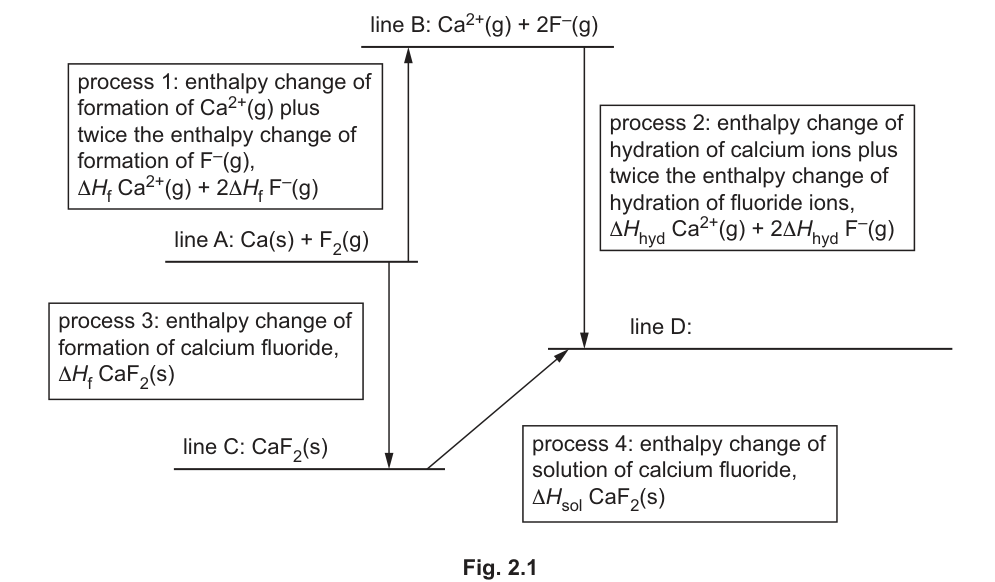
Answer
or
CaF2(aq) or Ca2+(aq) + 2F-(aq)
Background Concept
In a Born-Haber cycle or an enthalpy cycle for solution, the starting materials are typically the solid ionic compound and the elements in their standard states. The cycle shows the different pathways to reach the final state, which is the aqueous solution of the ions. For a dissolution process, the final state (line D) must represent the dissolved ions in water.
Understanding the Question
Part (b) provides an energy cycle for the formation and dissolution of calcium fluoride. Line D is the endpoint reached after the hydration of gaseous ions (process 2) or after the solution of the solid (process 4). We need to complete the label for line D with the correct chemical species and state symbols.
Approach
Identify what process 2 and process 4 produce. Process 2 hydrates Ca²⁺(g) and F⁻(g). Process 4 dissolves CaF₂(s). Both lead to the same final state: aqueous calcium ions and aqueous fluoride ions.
Step-by-Step Reasoning
- Line B contains .
- Process 2 is the hydration of these ions: .
- Line C is .
- Process 4 is the enthalpy change of solution: .
- Therefore, line D must represent the dissolved state: . Writing it as is also generally accepted in this context, but showing the dissociated ions is more precise.
Key Takeaways
The final line in a solution Born-Haber cycle always represents the fully dissociated aqueous ions.
Common Mistakes
- Forgetting state symbols. The question explicitly requires them.
- Writing without the dissociated ions (though often accepted, is safer).
Things to Be Careful About
- Always include state symbols, especially (aq) for the final dissolved state.
The value of the enthalpy change for process 1 can be calculated using the values of five other enthalpy changes which are not referred to in Fig. 2.1.
Identify these five other enthalpy changes, using either names or symbols.
Answer
The five enthalpy changes are:
- Atomisation energy of Ca (or of Ca)
- Atomisation energy of F₂ (or bond energy of F–F / of F₂)
- First ionisation energy of Ca (or of Ca)
- Second ionisation energy of Ca (or of Ca)
- Electron affinity of F (or of F)
Atomisation of Ca, atomisation of F2, 1st IE of Ca, 2nd IE of Ca, electron affinity of F
Background Concept
Process 1 is defined as:
This is not a standard single enthalpy change. It is a composite process that can be broken down into the steps used to form gaseous ions from their elements. This is exactly what happens in the formation of the gaseous ions in a Born-Haber cycle.
Understanding the Question
We need to identify the five standard enthalpy changes (from element to gaseous ion) that, when summed, give the enthalpy change for process 1.
Approach
Trace the path from to using standard thermodynamic steps:
- Turn solid Ca into gaseous Ca atoms.
- Turn F₂ gas into gaseous F atoms.
- Remove two electrons from Ca(g) to make Ca²⁺(g).
- Add one electron to each F(g) to make F⁻(g).
Step-by-Step Reasoning
- Ca(s) → Ca(g): This is the atomisation energy of calcium ( of Ca).
- F₂(g) → 2F(g): This is the atomisation energy of fluorine ( of F₂), which is equivalent to the F–F bond enthalpy.
- Ca(g) → Ca⁺(g) + e⁻: This is the first ionisation energy of calcium ( of Ca).
- Ca⁺(g) → Ca²⁺(g) + e⁻: This is the second ionisation energy of calcium ( of Ca).
- 2F(g) + 2e⁻ → 2F⁻(g): This is twice the electron affinity of fluorine ( of F).
Summing these five steps gives the overall process 1.
Key Takeaways
Any process forming gaseous ions from elements in their standard states can be decomposed into atomisation, ionisation, and electron affinity steps.
Common Mistakes
- Forgetting that F₂ is diatomic, so you need the atomisation of F₂ (or bond enthalpy of F–F), not just 'bond breaking'.
- Forgetting the second ionisation energy for Ca, since it forms Ca²⁺, not Ca⁺.
- Confusing electron affinity with ionisation energy.
Things to Be Careful About
- Ensure you specify 'first' and 'second' ionisation energies for Ca.
- 'Atomisation energy of F' is incorrect; it must be 'atomisation energy of F₂' or 'bond enthalpy of F–F' because the starting material is F₂(g).
Answer
Lattice energy () is the enthalpy change when one mole of an ionic compound is formed from its gaseous ions.
The enthalpy change when one mole of an ionic compound is formed from its gaseous ions.
Background Concept
Lattice enthalpy is a key concept in understanding the stability of ionic compounds. It measures the strength of the ionic bonds in the crystal lattice. There are two common definitions:
- Formation: Enthalpy change when one mole of an ionic solid is formed from its gaseous ions. (This is the definition used in CIE mark schemes, and it is exothermic, so is negative).
- Dissociation: Enthalpy change when one mole of an ionic solid is separated into its gaseous ions. (This is endothermic, so is positive).
Understanding the Question
The question asks for the definition of lattice energy, . Based on the context of the Born-Haber cycle provided (where lattice enthalpy is formed from gaseous ions to solid), we must use the formation definition.
Approach
Recall the standard CIE definition for lattice formation enthalpy, ensuring both 'one mole of ionic compound' and 'gaseous ions' are included.
Step-by-Step Reasoning
- State the process: formation of one mole of ionic compound.
- Specify the starting state: from its gaseous ions.
- Combine: 'The enthalpy change when one mole of an ionic compound is formed from its gaseous ions.'
Key Takeaways
Always specify 'one mole' and 'gaseous ions' in the lattice enthalpy definition. Be careful to use the formation definition (gaseous ions → solid) as opposed to dissociation (solid → gaseous ions) unless explicitly asked for lattice dissociation enthalpy.
Common Mistakes
- Saying 'from gaseous atoms' instead of 'gaseous ions'.
- Forgetting to specify 'one mole'.
- Using the word 'energy' instead of 'enthalpy change' (though 'lattice energy' is often used loosely, specifically denotes enthalpy).
Things to Be Careful About
- The mark scheme awards one mark for 'energy change / energy released when one mole of an ionic compound is formed' and one mark for 'from its gaseous ion(s)'. Both parts are essential.
Complete the expression to give the mathematical relationship between of calcium fluoride and the enthalpy changes for processes 1 and 3.
Answer
or simply:
Delta Hf(CaF2(s)) - Delta Hf(Ca2+(g)) - 2Delta Hf(F-(g))
Background Concept
Hess's Law states that the total enthalpy change for a reaction is independent of the pathway taken. In a Born-Haber cycle, we can set up an equation where the sum of enthalpy changes around a closed loop is zero, or where two pathways between the same start and end points are equal.
Understanding the Question
We need an expression for (lattice enthalpy of formation: ) in terms of process 1 and process 3.
- Process 1: ()
- Process 3: ()
- Lattice enthalpy: ()
Approach
Draw the cycle mentally or on paper:
Path A: Elements → Gaseous ions (Process 1) → Solid (Lattice enthalpy)
Path B: Elements → Solid (Process 3)
By Hess's Law: Process 1 + = Process 3
Therefore: = Process 3 - Process 1.
Step-by-Step Reasoning
- Write the cycle equation:
- Rearrange for :
- Substitute the terms for process 1:
- Final expression:
Key Takeaways
Lattice enthalpy can always be found by subtracting the enthalpy change to form gaseous ions from the enthalpy change of formation of the solid.
Common Mistakes
- Getting the sign wrong: adding process 1 instead of subtracting it.
- Forgetting the '2' in front of the fluoride formation enthalpy.
Things to Be Careful About
- The mark scheme accepts either the numerical process labels (process 3 - process 1) or the full thermodynamic symbols. Ensure the algebraic signs are correct.
Use data from Table 2.1 to calculate a value for the hydration energy, , of fluoride ions, .
Table 2.1
| value / | |
|---|---|
| enthalpy change of solution of calcium fluoride, | |
| overall enthalpy change of process 1 in Fig. 2.1 | |
| enthalpy change of formation of calcium fluoride | |
| enthalpy change of hydration of |
Working
From the energy cycle (Hess's Law):
Substitute the given values (let ):
Answer
-473 kJ mol^-1
Background Concept
A Born-Haber cycle or solution cycle is a Hess's Law application where the sum of enthalpy changes along one path equals the sum along another path between the same initial and final states. For the dissolution of an ionic solid:
Path 1: Solid → Gaseous ions (Process 1) → Aqueous ions (Process 2, hydration)
Path 2: Solid → Aqueous ions (Process 3, formation backwards? No, Process 3 is elements to solid. Let's trace from elements):
Actually, looking at the diagram:
Start: Line A = Ca(s) + F₂(g)
Path Up: Process 1 → Line B (gaseous ions) → Process 2 (hydration) → Line D (aqueous)
Path Down: Process 3 (formation) → Line C (solid) → Process 4 (solution) → Line D (aqueous)
So:
Understanding the Question
We are given values for Process 1, Process 3, Process 4, and part of Process 2 (). We need to find .
- Process 1 = +1395 kJ/mol
- Process 3 () = -1214 kJ/mol
- Process 4 () = +13 kJ/mol
- Process 2 =
Approach
- Write the Hess's Law equation for the cycle.
- Substitute the known values.
- Solve the algebraic equation for .
Step-by-Step Reasoning
- Equation:
- Simplify left side:
- Simplify right side:
- Equate:
- Add 255 to both sides:
- Divide by 2:
Key Takeaways
Always carefully track the signs of the enthalpy changes. Hydration enthalpies are negative, formation of stable compounds is negative, but solution can be positive or negative.
Common Mistakes
- Sign errors when moving terms across the equation (e.g., instead of ).
- Forgetting to multiply the fluoride hydration enthalpy by 2.
- Using the wrong values from the table.
Things to Be Careful About
- The question gives 'overall enthalpy change of process 1' as +1395. Do not confuse this with lattice enthalpy.
- Ensure units are consistent (all in kJ mol⁻¹).
Answer
Entropy is a measure of the number of possible arrangements of particles or energy in a system.
Number of possible arrangements of particles/energy in a system.
Background Concept
Entropy () is a thermodynamic quantity that represents the degree of disorder or randomness in a system. More formally, it is related to the number of microstates (possible arrangements of particles and energy) that correspond to a given macrostate. The Second Law of Thermodynamics states that the total entropy of an isolated system always increases for a spontaneous process.
Understanding the Question
The question asks for the definition of entropy. This is a standard recall question.
Approach
Recall the formal statistical mechanics definition of entropy often used in A-Level Chemistry.
Step-by-Step Reasoning
- Key phrase: 'number of possible arrangements'.
- What is being arranged? 'Particles / energy'.
- Where? 'In a system'.
- Combine: 'Number of possible arrangements of particles / energy in a system'.
Key Takeaways
Entropy is not just 'disorder' (though that's a common simplification); it is precisely the number of microstates or arrangements available to the system.
Common Mistakes
- Saying 'entropy is a measure of disorder' without mentioning 'arrangements' or 'particles/energy'. While often accepted, the mark scheme specifically looks for 'arrangements'.
- Forgetting 'in a system'.
Things to Be Careful About
- Use the exact wording from the mark scheme if possible: 'number of possible arrangements of particles / energy in a system'.
At , the Gibbs free energy change, , for the solution of compound is .
The enthalpy change of solution, , of compound is at .
Calculate the value of the entropy change, , for the solution of compound at .
Working
The Gibbs free energy equation is:
Given:
Rearrange for :
Substitute values:
Rounding to 3 significant figures:
Answer
+80.5 J K^-1 mol^-1
Background Concept
The Gibbs free energy change () determines the feasibility of a process at constant temperature and pressure. The equation is:
where:
- is the Gibbs free energy change (J mol⁻¹ or kJ mol⁻¹)
- is the enthalpy change (J mol⁻¹ or kJ mol⁻¹)
- is the temperature in Kelvin (K)
- is the entropy change (J K⁻¹ mol⁻¹)
A process is feasible (spontaneous) if .
Understanding the Question
We are given , , and for the solution of compound T. We need to calculate . Note the units: and are in kJ mol⁻¹, but is required in J K⁻¹ mol⁻¹. This is a common trap.
Approach
- Convert and to J mol⁻¹ to match the required units for .
- Rearrange the Gibbs equation to solve for .
- Substitute and calculate.
Step-by-Step Reasoning
- Convert units:
- Rearrange :
- Substitute:
- Round to 3 significant figures (as given in the data):
Key Takeaways
Always check units before calculating. Mixing kJ and J is the most common error in Gibbs free energy calculations.
Common Mistakes
- Forgetting to convert kJ to J, resulting in an answer that is off by a factor of 1000 (e.g., 0.0805).
- Getting the sign wrong in the rearrangement: instead of .
- Not including the positive sign, though the question might accept the magnitude.
Things to Be Careful About
- The mark scheme awards marks for stating/rearranging the equation and for the final correct value. Show your working clearly.
- Use at least 3 significant figures for the final answer.
Predict whether compound becomes more or less soluble as the water is heated from to . Explain your answer.
Answer
Compound T becomes more soluble as the water is heated.
Explanation: The entropy change () for the solution is positive (as calculated in part e). Therefore, the term in the Gibbs equation () becomes more negative as temperature () increases. This makes more negative, increasing the feasibility of the solution process (i.e., it becomes more soluble).
Becomes more soluble because Delta S is positive, so -TDelta S becomes more negative as T increases, making Delta G more negative.
Background Concept
The solubility of a compound is related to the Gibbs free energy change of its dissolution (). A process is feasible (spontaneous) when . The equation is:
If is positive (endothermic, as it is here: +30.0 kJ mol⁻¹), the process is driven by entropy (). The term must be sufficiently negative to overcome the positive .
Understanding the Question
We need to predict how solubility changes with temperature. We know from part (e) that is positive (+80.5 J K⁻¹ mol⁻¹) and is positive (+30.0 kJ mol⁻¹). We are increasing from 298 K to 360 K.
Approach
- Analyze the sign of .
- Determine how the term changes as increases.
- Conclude the effect on and therefore on solubility.
Step-by-Step Reasoning
- From part (e), (positive).
- In the equation , since is positive, the term is negative.
- As temperature increases (from 298 K to 360 K), the magnitude of the negative term increases (it becomes more negative).
- Since is constant (approximately), making more negative will make the overall more negative.
- A more negative means the process is more feasible (more spontaneous).
- Therefore, the compound becomes more soluble at higher temperatures.
Key Takeaways
For endothermic dissolutions (), solubility increases with temperature because the entropy term drives the process more effectively at higher .
Common Mistakes
- Saying 'solubility decreases' because 'it's endothermic' (confusing Le Chatelier with Gibbs free energy, though Le Chatelier would also predict increased solubility for endothermic processes, the explanation must use Gibbs).
- Not mentioning that is positive or that becomes more negative.
- Simply stating 'it becomes more soluble' without the explanation (the question asks to 'explain').
Things to Be Careful About
- The mark scheme specifically looks for the link: is positive → is negative / becomes more negative as increases → becomes more negative → more soluble.
- Ensure you use the word 'soluble' or 'solubility', not just 'reactive' or 'feasible' (though feasible is the underlying reason, 'soluble' answers the specific question).
and react together to give product .
When the concentrations of and are both , the rate of formation of is . When the concentrations of and are both , the rate of formation of is .
Complete the three possible rate equations that are consistent with these data.
rate = .................................................................................................................................
rate = .................................................................................................................................
rate = .................................................................................................................................
Answer
rate = k[A][B]; rate = k[A]^2[B]^0; rate = k[A]^0[B]^2
Background Concept
A rate equation shows how the rate depends on the concentrations of reactants, with each concentration raised to a power called the order with respect to that reactant. The sum of the individual orders is the overall order. Orders must be found from experimental data, not from the stoichiometric equation.
Understanding the Question
We are told that A and B react to give AB, and given two experiments. In both experiments [A] and [B] are equal, but they are doubled from 0.0100 to 0.0200 mol dm^-3. The rate increases from 7.62e-4 to 3.05e-3 mol dm^-3 s^-1. We need to write three rate equations consistent with these data.
Approach
Calculate the rate factor when both concentrations are doubled. If rate = k[A]^m[B]^n, doubling both concentrations multiplies the rate by . Compare this with the observed factor to find . Then list all whole-number pairs that add to this total.
Step-by-Step Reasoning
Rate ratio = (about 4). Doubling both concentrations gives a factor . Since , . Therefore the reaction is second order overall. Possible pairs of orders are , and . These give the three rate equations:
Because the two concentrations were always changed together, the data cannot distinguish between these possibilities.
Key Takeaways
Orders are experimental quantities. When all reactant concentrations are changed by the same factor, only the sum of orders can be found. Zero order means changing that concentration has no effect on rate.
Common Mistakes
Writing rate = k[A]^2[B]^2 would give overall order 4, not 2, and is inconsistent. Another mistake is using the coefficients 1 and 1 from the equation A + B -> AB as if they were orders. Also, forgetting the zero-order possibilities means only one or two equations are written.
Things to Be Careful About
Use the exact data to calculate the rate ratio. Keep the rate constant symbol k in each equation. Include zero exponents if they help make the zero order explicit.
Choose one of the rate equations you have written in (i), and calculate the value of the rate constant, . Include the units of .
Working
Choose .
Using the first set of data:
Units:
Answer
7.62 mol^-1 dm^3 s^-1
Background Concept
The rate constant k is the proportionality constant in the rate equation. Its value is found by substituting a rate and the corresponding concentrations into the rate equation. The units of k depend on the overall order.
Understanding the Question
We must choose one of the three rate equations from part (i), calculate k using one set of data, and give units. Since [A] = [B] in the data, any of the three equations gives the same numerical value of k.
Approach
Pick the simplest equation, rate = k[A][B]. Substitute the first experiment's values: rate = 7.62e-4, [A] = [B] = 0.0100. Solve for k. Then derive units from the rate equation.
Step-by-Step Reasoning
The units are:
If the second experiment were used, the same value would be obtained: , which rounds to 7.63; either is acceptable to 3 significant figures.
Key Takeaways
For a second-order reaction with equal concentrations, k has units mol^-1 dm^3 s^-1. Always check significant figures (at least 3) and units.
Common Mistakes
Using the wrong concentration product, e.g. [A] + [B] instead of [A][B]. Forgetting units. Giving too few significant figures. If you choose rate = k[A]^2, you must square the concentration, not multiply by [B].
Things to Be Careful About
Use consistent units. The mark scheme allows error carried forward from part (i), so if your chosen rate equation differs, use it consistently. Include the unit in the final answer.
Explain why it is not possible to calculate a value for the half-life, , of this reaction using the value of the rate constant calculated in (ii) and the equation .
Answer
The reaction is second order overall, not first order, so the half-life is not constant and the first-order equation does not apply.
Reaction is second order, so half-life is not constant; the equation only applies to first-order reactions.
Background Concept
For a first-order reaction, the half-life is constant and is related to k by . This relationship is derived from the first-order integrated rate law. For other orders, half-life depends on concentration and is not constant.
Understanding the Question
Part (ii) gave a second-order rate constant. The question asks why the first-order formula cannot be used to find the half-life.
Approach
Identify the order of the reaction from part (i). Then recall that the 0.693 relationship applies only to first-order reactions.
Step-by-Step Reasoning
The reaction is second order overall (). The equation is only valid for first-order reactions, where the half-life is independent of concentration. For a second-order reaction, the half-life depends on the initial concentration, so there is no single value of that can be calculated from k alone using that formula.
Key Takeaways
First-order: constant half-life, . Second-order: half-life increases as concentration decreases, so it is not a constant.
Common Mistakes
Trying to calculate a numerical half-life anyway. Stating that the reaction is zero order. Saying 'the reaction is not first order' without linking it to the half-life formula.
Things to Be Careful About
The mark scheme accepts 'reaction is second order' or 'reaction is not first order' or 'half-life is not constant'. Any one of these is enough.
Catalysts may be homogeneous or heterogeneous.
Identify two metals that act as heterogeneous catalysts in the removal of from the exhaust gases of car engines.
............................................................... and ...............................................................
Answer
Platinum and palladium (or rhodium).
Pt and Pd (or Rh)
Background Concept
Catalytic converters in car exhausts use solid transition-metal catalysts to convert harmful gases such as NO, NO2, CO and unburnt hydrocarbons into less harmful products. These catalysts are heterogeneous because they are solids while the exhaust gases are gases.
Understanding the Question
The question asks for two metals that act as heterogeneous catalysts in the removal of NO2 from car exhaust gases. This is a straightforward recall question.
Approach
Recall the metals used in catalytic converters: platinum, palladium and rhodium. Choose any two.
Step-by-Step Reasoning
Platinum (Pt), palladium (Pd) and rhodium (Rh) are all used in catalytic converters. They catalyse the reduction of NO2 to N2 and the oxidation of CO and hydrocarbons. Any two of these metals are acceptable.
Key Takeaways
Common heterogeneous catalysts: Pt, Pd, Rh in catalytic converters; iron in the Haber process; vanadium(V) oxide in the Contact process.
Common Mistakes
Writing metals that are not used, such as copper or zinc. Writing 'catalyst' without naming a metal.
Things to Be Careful About
The mark scheme accepts any two of Pt, Pd, Rh. Write the symbols or names clearly.
Iron acts as a heterogeneous catalyst in the Haber process.
Describe the mode of action of this iron catalyst.
Answer
- Reactants ( and ) adsorb onto the iron surface, forming bonds with the catalyst.
- Bonds within the reactant molecules are weakened.
- Products () desorb from the surface.
Adsorption of reactants, bond weakening, desorption of products.
Background Concept
A heterogeneous catalyst is in a different phase from the reactants. In the Haber process, solid iron catalyses the reaction between gaseous N2 and H2. The reaction occurs on the surface of the iron.
Understanding the Question
We need to describe the mode of action of the iron catalyst. The mark scheme wants three surface steps: adsorption, bond weakening, desorption.
Approach
Think of the catalytic cycle on the solid surface: reactant molecules stick to the surface, their bonds are weakened, reaction occurs, and products leave the surface.
Step-by-Step Reasoning
- Adsorption: N2 and H2 molecules adsorb onto the iron surface, forming bonds between the reactant atoms and surface iron atoms. This brings the reactants close together and increases their concentration on the surface.
- Bond weakening: The bonds within the adsorbed N2 and H2 molecules are weakened, lowering the activation energy for bond breaking.
- Desorption: The NH3 product molecules desorb from the surface, leaving the active sites available for more reactant molecules.
The overall effect is to provide an alternative reaction pathway with a lower activation energy.
Key Takeaways
Heterogeneous catalysis involves adsorption, reaction on the surface, and desorption. The catalyst is not consumed and provides active sites.
Common Mistakes
Omitting 'surface' or 'adsorption'. Saying the catalyst is consumed. Confusing adsorption (sticking to surface) with absorption (soaking into bulk).
Things to Be Careful About
All three steps are needed for full marks. The mark scheme gives 1 mark for any two and 2 marks for all three.
ions act as a homogeneous catalyst in the reaction between and .
Write equations for the two reactions that occur when is added to a mixture of and .
equation 1 ........................................................................................................
equation 2 .......................................................................................................................
Answer
S2O8^2- + 2Fe^2+ -> 2SO4^2- + 2Fe^3+; 2Fe^3+ + 2I^- -> 2Fe^2+ + I2
Background Concept
A homogeneous catalyst is in the same phase as the reactants. Here Fe2+(aq) catalyses the reaction between I-(aq) and S2O8^2-(aq). The catalyst participates in the reaction, is oxidised, then regenerated.
Understanding the Question
We need to write the two reactions that occur when Fe2+ is added to a mixture of I- and S2O8^2-. One reaction involves S2O8^2- oxidising Fe2+ to Fe3+; the other involves Fe3+ oxidising I- to I2 and regenerating Fe2+.
Approach
Identify the stronger oxidising agent: S2O8^2- oxidises Fe2+ to Fe3+. Then Fe3+ oxidises I- to I2, returning to Fe2+. Balance both redox equations.
Step-by-Step Reasoning
S2O8^2- is reduced to 2SO4^2- and takes two electrons, so it oxidises two Fe2+ to two Fe3+:
Then Fe3+ oxidises iodide to iodine:
Fe2+ is regenerated, so it acts as a catalyst. The overall reaction is .
Key Takeaways
A homogeneous catalyst is regenerated at the end. Writing the two half-reactions and balancing electrons is the key skill.
Common Mistakes
Writing S2O8^2- + 2I- -> 2SO4^2- + I2 as one of the two reactions (that is the overall reaction, not the catalytic steps). Forgetting to balance charges. Using Fe3+ as the oxidant in the first equation.
Things to Be Careful About
The mark scheme allows any multiples, so 2S2O8^2- + 4Fe2+ -> 4SO4^2- + 4Fe3+ is also acceptable. Include state symbols if asked; here they are not required.
Answer
A homogeneous catalyst is in the same phase/state as the reactants; a heterogeneous catalyst is in a different phase/state from the reactants.
Homogeneous: same phase as reactants; heterogeneous: different phase from reactants.
Background Concept
Catalysts can be classified by phase relative to reactants. Homogeneous: same phase as reactants. Heterogeneous: different phase. This affects how they work and how they are separated.
Understanding the Question
The question asks for the difference between homogeneous and heterogeneous catalysts. It is a one-mark definition.
Approach
State the phase relationship for each type. The mark scheme requires both halves.
Step-by-Step Reasoning
A homogeneous catalyst is in the same phase (state) as the reactants; a heterogeneous catalyst is in a different phase from the reactants. For example, Fe2+(aq) with aqueous reactants is homogeneous, while solid iron with gaseous reactants in the Haber process is heterogeneous.
Key Takeaways
Same phase = homogeneous; different phase = heterogeneous. Heterogeneous catalysts often act on surfaces.
Common Mistakes
Only defining one type. Saying 'homogeneous means liquid' or 'heterogeneous means solid'. The key is the phase relative to the reactants.
Things to Be Careful About
Both halves are needed for the mark. Use 'phase' or 'state'.
ions can be oxidised to ions under alkaline conditions by suitable oxidising agents.
Iron is a transition element. Explain why iron forms stable compounds in both the +2 and the +3 oxidation states.
Answer
The 3d and 4s subshells are very close in energy, so iron can lose either two or three electrons with similar ease, giving stable +2 and +3 oxidation states.
Similar energy of 3d and 4s subshells allows loss of two or three electrons.
Background Concept
Transition elements show variable oxidation states because the 3d and 4s subshells are very close in energy. Electrons can be removed from both subshells with similar ease.
Understanding the Question
Iron forms stable +2 and +3 compounds. We need to explain why, using the orbital energy argument. The mark scheme specifically wants 'similar energy of the 3d and 4s subshells/orbitals'.
Approach
Recall iron's electron configuration and the small energy gap between 3d and 4s. Explain that losing two or three electrons is energetically feasible.
Step-by-Step Reasoning
Iron has configuration [Ar]3d6 4s2. The 3d and 4s orbitals are very close in energy. It can lose the two 4s electrons to form Fe2+, or lose two 4s and one 3d electron to form Fe3+. Because the 3d and 4s energies are similar, both +2 and +3 oxidation states are stable.
Key Takeaways
Variable oxidation states in transition metals arise from the small energy difference between 3d and 4s orbitals. Fe2+ and Fe3+ are both common.
Common Mistakes
Saying Fe3+ is stable because it has a half-filled d subshell (d5). While true, the mark scheme wants the orbital energy similarity. Avoid giving only 'it can lose different numbers of electrons' without mentioning orbital energies.
Things to Be Careful About
Use the exact phrase 'similar energy of 3d and 4s subshells/orbitals' to secure the mark.
The half-equation for the reduction of under alkaline conditions, and its value, are shown.
Four more half-equations for reactions under alkaline conditions, and their values, are shown.
Select two oxidising agents that can oxidise ions to ions under alkaline conditions.
Write an equation, and give the value, for each of the two reactions that occur.
oxidising agent 1: ..............................
equation: ...........................................................................................................................
oxidising agent 2: ..............................
equation: ...........................................................................................................................
Answer
Oxidising agent 1:
Oxidising agent 2:
ClO^- and O2; Ecell = +1.45 V and +0.96 V; equations as shown.
Background Concept
A redox reaction is feasible if is positive. For two half-reactions, . The oxidising agent is the species that is reduced; it must have a more positive reduction potential than the couple being oxidised.
Understanding the Question
Under alkaline conditions, Fe2+ is present as Fe(OH)2 and Fe3+ as Fe(OH)3. The given half-equation is , . We must choose two oxidising agents from four half-equations that can oxidise Fe2+ to Fe3+, write the balanced equation for each and give .
Approach
For oxidation of Fe2+, use the reverse of the Fe half-equation. Calculate for each candidate: . Only candidates with positive are feasible. Then combine the half-equations to give balanced equations.
Step-by-Step Reasoning
Candidate values: Al(OH)4- -2.35 V, ClO- +0.89 V, O2 +0.40 V, Zn(OH)4^2- -1.22 V.
For ClO-:
so it is feasible. For O2:
so it is feasible. For Al and Zn, would be negative, so they cannot oxidise Fe2+.
To balance the ClO- reaction, multiply the Fe oxidation half-equation by 2:
Add . The 2OH- cancel, giving:
For O2, multiply the Fe oxidation by 4:
Add . The 4OH- cancel, giving:
Key Takeaways
To choose an oxidising agent, compare reduction potentials: a more positive means a stronger oxidising agent. Balance redox equations in alkaline conditions using OH- and H2O, and cancel spectator ions.
Common Mistakes
Choosing Al(OH)4- or Zn(OH)4^2- because they are metal species; their values are too negative, so they are reducing agents relative to Fe2+. Writing the Fe half-equation in the wrong direction. Forgetting to cancel OH-. Using the acidic Fe3+/Fe2+ half-equation instead of the alkaline hydroxide forms.
Things to Be Careful About
must be positive. Include the sign and units (V). Balance atoms and charges in each equation. The mark scheme gives separate marks for choosing the correct agents and values, and for each balanced equation.
Transition metal atoms and transition metal ions form complexes by combining with ligands.
Answer
Transition metal ions/atoms have empty (and energetically accessible) 3d orbitals that can accept a lone pair of electrons from ligands, forming dative (coordinate) bonds.
Empty, energetically accessible d orbitals accept lone pairs from ligands to form dative bonds.
Background Concept
A complex is a central metal atom or ion surrounded by ligands — species that donate a lone pair of electrons to the metal, forming a dative (coordinate) bond. For a species to act as the central atom of a complex, it must have low-lying, vacant orbitals capable of accepting these electron pairs.
Understanding the Question
This is a one-mark 'explain' question. It asks for the electronic reason transition elements, uniquely among the elements, readily form complex ions.
Approach
Link the defining feature of transition elements — an incomplete d subshell in the atom or its ions — to the requirement of a Lewis acid (electron-pair acceptor) in dative bond formation.
Step-by-Step Reasoning
Transition elements have partially filled d subshells, which means some of their 3d orbitals are empty. These empty d orbitals are close enough in energy to the occupied orbitals to be energetically accessible. A ligand's lone pair can therefore be donated into an empty d orbital, creating a dative covalent bond. This is why species such as or form complexes while, for example, does not — sodium has no available d orbitals.
Key Takeaways
- Complex formation requires vacant, low-energy orbitals on the metal.
- The incomplete/empty d subshell is the defining electronic feature that enables this.
Common Mistakes
- Writing 'small ions with high charge density attract ligands' — this is not the credited answer; the mark requires empty d orbitals.
- Omitting the word 'empty' or 'd' — vague answers such as 'they have space for electrons' score zero.
Things to Be Careful About
- The mark scheme accepts any of: empty d orbitals are energetically accessible; empty d orbitals can form dative bonds; empty d orbitals can accept a lone pair from ligands. Any one of these phrasings earns the mark.
ions form complex ion .
Each ion contains two ions, both of which are octahedrally coordinated.
Each ion contains one molecule, which donates one pair of electrons to each ion, and one ion, which donates one pair of electrons to each ion.
The remaining ligands are molecules.
Deduce the formula of complex ion . Include its overall charge.
formula of .........................................................
Working
Each is octahedral (6 coordinate).
Bridging ligands supply one donor atom to each Co:
- : one pair to each Co → occupies 1 site on each Co (2 sites total).
- : one pair to each Co → occupies 1 site on each Co (2 sites total).
Remaining sites per Co: , so ligands in total.
Charge: (O and NH are neutral).
Answer
[Co2O2NH2(NH3)8]3+
Background Concept
In an octahedral complex the metal ion has coordination number 6 — six donor atoms bonded to it. Ligands may be monodentate (one donor atom, e.g. ) or bridging (one donor atom shared between two metal centres). The overall charge of a complex equals the sum of the charges of the metal ions and the ligand charges.
Understanding the Question
You are told complex G contains two ions, both octahedral; one molecule donating one pair to each Co (so it bridges the two metals, taking one site on each); one ion likewise donating one pair to each Co; and the rest of the ligands are . You must deduce the formula and the overall charge.
Approach
Work out how many coordination sites the bridging ligands occupy on each cobalt, fill the remaining sites with ammonia, then total the charges.
Step-by-Step Reasoning
- Each Co needs 6 donor atoms (octahedral).
- The molecule donates one electron pair to each Co, so it occupies exactly one site on each Co — 2 sites used in total across the complex.
- The ion likewise donates one pair to each Co — another 2 sites used.
- Each Co therefore has sites left, filled by : that is ammonia ligands.
- Charges: two give ; gives ; and all are neutral. Total .
- Hence .
The mark scheme awards one mark for any two of: the core, the correct count of 8 ammonia ligands (making both Co octahedral), and the correct charge — and two marks for all three.
Key Takeaways
- A ligand 'donating one pair to each of two metals' is a bridging ligand occupying one site on each metal, not two sites on one metal.
- Always count coordination sites per metal centre, then total ligand charges for the overall charge.
Common Mistakes
- Treating or as occupying two sites on a single Co, leading to the wrong number of ligands.
- Forgetting the charge of , giving a charge of instead of .
- Assigning a charge to neutral (e.g. treating it as ).
Things to Be Careful About
- The mark scheme allows error carried forward: if your core formula is wrong but your ammonia count and charge are consistent with your own ligands, partial credit is given. Still, aim for the fully correct formula.
The d-orbitals of the ions present in complex ion are split. State the number of d-orbitals that are at a higher energy level and the number of d-orbitals that are at a lower energy level in each ion.
| number of d-orbitals at a higher energy level | |
|---|---|
| number of d-orbitals at a lower energy level |
Answer
| number of d-orbitals at a higher energy level | 2 |
|---|---|
| number of d-orbitals at a lower energy level | 3 |
In an octahedral field the and orbitals are raised in energy, while the , and orbitals are lowered.
2 at higher energy; 3 at lower energy
Background Concept
When a transition metal ion is surrounded octahedrally by six ligands, the five d orbitals are no longer degenerate. The two orbitals pointing along the axes ( and ) experience greater repulsion from the ligand lone pairs and are raised in energy; the three orbitals between the axes (, , ) are lowered. This splitting into a higher set of 2 and a lower set of 3 is the basis of the colour of transition metal complexes.
Understanding the Question
A one-mark recall item: state how the five d orbitals divide between the higher and lower energy levels in the octahedral ions of complex G.
Approach
Recall the standard octahedral splitting pattern: 2 orbitals up, 3 down.
Step-by-Step Reasoning
In an octahedral field, the set (, ) — two orbitals — lies at higher energy; the set (, , ) — three orbitals — lies at lower energy. Both numbers must be given to earn the single mark.
Key Takeaways
- Octahedral splitting: 2 high, 3 low. (Tetrahedral complexes split the opposite way: 3 high, 2 low.)
Common Mistakes
- Reversing the numbers (writing 3 high, 2 low) — this describes the tetrahedral pattern.
- Giving only one of the two numbers; the mark requires BOTH.
Things to Be Careful About
- The question states the coordination is octahedral, so use the octahedral pattern even though the complex contains two metal centres — the splitting is the same in each.
ions form a different complex ion, .
Each ion contains two ions, both of which are octahedrally coordinated, but the ligands are different from the ligands in .
Explain why and have different colours.
Answer
Different ligands in and cause a different splitting of the d-orbital energy levels, so the energy gap between the split d orbitals is different.
Since , a different means a different frequency (and wavelength) of visible light is absorbed by each complex, so the transmitted (complementary) light — and hence the observed colour — is different.
Different ligands give different d-orbital splitting (ΔE), so a different frequency/wavelength of visible light is absorbed, giving different colours.
Background Concept
The colour of a transition metal complex arises because the split d orbitals allow electrons to be promoted from the lower set to the higher set by absorbing visible light of energy exactly equal to the gap, . The observed colour is the complementary colour of the light absorbed. The size of depends on the identity of the ligands: different ligands create different electric fields around the metal ion, producing different amounts of d-orbital splitting.
Understanding the Question
Two marks are available. You must explain why two complexes of the same ion () with different ligands have different colours. The command word 'explain' requires the causal chain, not just the statement 'different ligands give different colours'.
Approach
Build the chain: different ligands → different d-orbital splitting / different → different frequency of visible light absorbed → different observed colour.
Step-by-Step Reasoning
- G and M contain the same metal ion but different ligands. The ligand field strength differs, so the energy gap between the split d orbitals is different in the two complexes. This earns the first mark ( different / d–d energy gap different).
- Electrons are promoted by absorbing photons with . A different means a different frequency (equivalently different wavelength or energy) of light from the visible region is absorbed. This earns the second mark.
- Since the light absorbed differs, the complementary transmitted light differs, so the complexes appear different colours.
Key Takeaways
- Colour differences between complexes of the same metal ion are always traced back to differences in caused by the ligands.
- The absorption is a d–d transition within the split d orbitals.
Common Mistakes
- Only writing 'they have different ligands so different colours' — this earns neither mark; the energy gap and the frequency of absorbed light must both be mentioned.
- Saying 'different frequencies of light are emitted' — the process is absorption, not emission.
- Referring to ultraviolet or infrared light; the mark requires light from the visible region.
Things to Be Careful About
- Both marking points are needed: (1) differs, (2) therefore a different frequency/wavelength of visible light is absorbed. Include both explicitly.
Cadmium forms complex ion , .
When a solution containing ions is added to an aqueous solution of , a ligand exchange reaction takes place, forming complex ion . contains no ligands and no ligands.
is in a much higher concentration in the mixture than .
The oxidation state and coordination number of cadmium do not change in this reaction.
Working
Cadmium keeps oxidation state and coordination number 4. has no or ligands, so all four ligands are :
Answer
[Cd(NH3)4]2+ + 4CN- -> [Cd(CN)4]2- + 4NH3
Background Concept
Ligand exchange occurs when an incoming ligand forms a more stable complex than the complex containing the original ligands; the original ligands are displaced. The metal's oxidation state and coordination number usually remain unchanged. Charges must balance in the ionic equation.
Understanding the Question
is . Adding gives with no or ligands, same oxidation state (+2) and same coordination number (4). You must write the full ionic equation using complex-ion formulae.
Approach
First deduce : coordination number 4 with only ligands gives . Then write the substitution of the four ammonia ligands by four cyanide ions and check charge balance.
Step-by-Step Reasoning
- Oxidation state of Cd stays ; coordination number stays 4.
- Since contains no and no , all four ligands must be : , charge .
- Equation: .
- Charge check: left ; right . Balanced.
- predominates because has a much larger than .
The mark scheme awards one mark for the correct complex (or ) and one for the fully correct equation, with ecf if the complex is wrong but used consistently.
Key Takeaways
- In ligand exchange, deduce the new complex from the fixed oxidation state and coordination number, then balance charges.
Common Mistakes
- Writing — forgetting to add the four ligand charges to the metal ion.
- Writing only without the full equation — the equation mark is separate.
- Unbalanced equation (wrong number of or ).
Things to Be Careful About
- Use the formulae of the complex ions as instructed — do not write 'Cd(CN)4' without the square brackets and charge.
Cadmium forms complex ion in the same oxidation state and with the same coordination number as in . All the ligands in are ions.
When is added to a solution of , very little forms.
Write the three cadmium complexes, , and , in order of increasing stability constant, .
Answer
(smallest ) — — (largest )
[CdCl4]2- < [Cd(NH3)4]2+ < [Cd(CN)4]2-
Background Concept
The stability constant, , measures the extent of formation of a complex from its metal ion and ligands. A larger means the complex is more thermodynamically stable and predominates at equilibrium.
Understanding the Question
Three complexes of Cd(II) with coordination number 4: , , . Two experimental facts are given: adding to gives mostly (so ), and adding NaCl to gives very little (so ).
Approach
Convert each observation into an inequality between stability constants, then combine them into a single ordering.
Step-by-Step Reasoning
- is in much higher concentration than after ligand exchange → is much larger than .
- Very little forms when is added to → is smaller than .
- Therefore the order of increasing is , i.e. .
Key Takeaways
- The position of a ligand-exchange equilibrium is governed by the relative stability constants: the complex with the larger predominates.
- Cyanide forms very stable complexes with many metal ions (strong-field ligand, and Cd–CN bonding is strong).
Common Mistakes
- Reversing the order (e.g. putting smallest) by misreading which complex predominates.
- Writing the complexes in the wrong order but with correct formulae — the whole mark depends on the correct sequence.
Things to Be Careful About
- The order runs from smallest on the left to largest on the right, as labelled in the question — do not reverse the convention.
Ethanedioate ions, , form complexes with transition element ions.
The concentration of ions can be found by reaction with acidified ions.
ions are protonated and form molecules which are oxidised by .
The half-equations are shown.
Working
Reverse the ethanedioic acid half-equation (oxidation) and multiply by 3 to supply 6 electrons for the dichromate reduction:
Answer
Cr2O7 2- + 8H+ + 3HOOCCOOH -> 2Cr3+ + 7H2O + 6CO2
Background Concept
To construct an overall redox equation, the oxidation half-equation is reversed and both half-equations are multiplied so that the number of electrons lost equals the number gained; the electrons then cancel.
Understanding the Question
The two half-equations are given. Dichromate is reduced (electrons on the left); ethanedioic acid is oxidised to , so its half-equation must be reversed. One mark for the fully balanced equation.
Approach
Reverse the second half-equation, scale it by 3 (to give 6 electrons matching the 6 in the dichromate half-equation), add, and cancel the electrons and any species appearing on both sides.
Step-by-Step Reasoning
- Dichromate half-equation consumes 6 e⁻: .
- Oxidation of one releases 2 e⁻, so three molecules are needed: .
- Adding and cancelling 6 e⁻: .
- Cancel from both sides, leaving on the left:
- Check: Cr (2 = 2), O (), H (), C (6 = 6), charge (). Balanced.
Key Takeaways
- Always reverse the oxidation half-equation and scale by the lowest common multiple of electrons.
- Cancel species (here ) that appear on both sides after adding.
Common Mistakes
- Forgetting to cancel the ions, writing on the left instead of .
- Not multiplying the ethanedioic acid half-equation by 3, leaving unbalanced electrons.
- Writing instead of — the question specifies the protonated form is oxidised.
Things to Be Careful About
- The equation must be fully balanced in atoms and charge; a single-mark item leaves no room for partial credit.
A sample of a solution of reacts with exactly of an acidified solution of .
Calculate the concentration of the solution of .
Working
From the equation, :
This is in , so:
Answer
0.0972 mol dm^-3
Background Concept
In a redox titration, moles of the standard solution are found from concentration × volume; the balanced equation supplies the stoichiometric ratio; the unknown concentration then follows from moles ÷ volume. Here the 1:3 ratio between and (equivalently ) comes from the equation constructed in part (i).
Understanding the Question
of solution reacts exactly with of (acidified). Find the concentration of the oxalate solution. Two marks: one for the correct moles steps, one for the final concentration.
Approach
moles → ×3 → moles → divide by → concentration.
Step-by-Step Reasoning
- Moles of dichromate:
- The equation shows 1 mol oxidises 3 mol , and each provides one (protonated to one ):
- These moles are in :
The mark scheme allows error carried forward: a wrong mole value used correctly in the ratio and concentration steps still earns the later marks.
Key Takeaways
- Always use the stoichiometric ratio from your own balanced equation — here the factor of 3 is the crux.
- Concentration = moles ÷ volume in dm³ (divide cm³ by 1000).
Common Mistakes
- Using a 1:1 ratio and getting — the equation in (i) clearly shows 3 ethanedioic acid molecules per dichromate.
- Dividing by 16.20 cm³ instead of 25.0 cm³ when computing the oxalate concentration.
- Unit slips: forgetting to convert cm³ to dm³.
Things to Be Careful About
- Give at least 2 significant figures; the exact answer is (3 s.f.).
- The mark scheme explicitly allows ecf, so a consistent wrong ratio can still gain the concentration mark — but the fully correct chain earns both marks.
The shapes of four different complexes, , , and , are shown in Table 5.1.
The symbol represents an atom or ion of a transition element.
The symbol is used to represent a monodentate ligand.
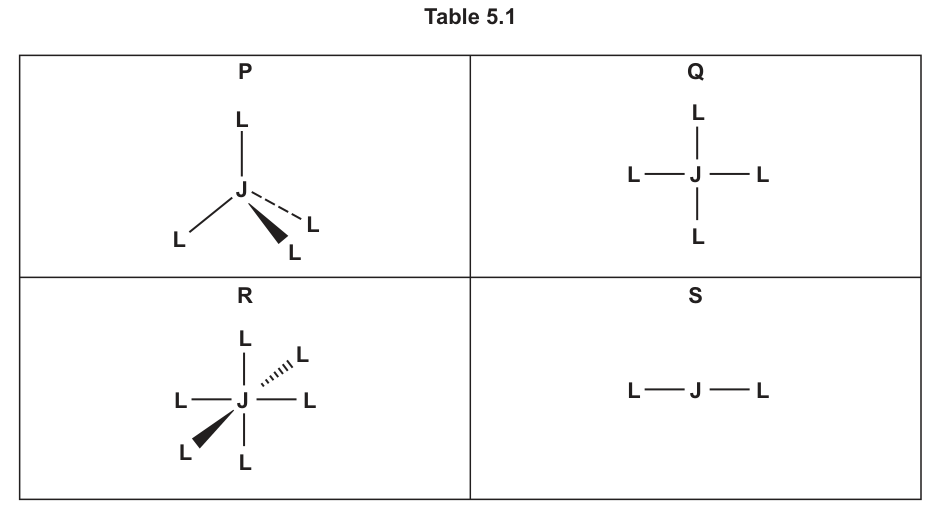
Label one bond angle on each of complexes , , and , and identify the size of the angle in degrees.
Answer
P (tetrahedral): (label between any two bonds)
Q (square planar): (label between adjacent bonds; if opposite bonds are labelled)
R (octahedral): (label between adjacent bonds; if opposite bonds are labelled)
S (linear): (label between the two bonds)
P: 109.5°, Q: 90°, R: 90°, S: 180° (angles labelled between bonds)
Background Concept
The geometry of a transition metal complex is determined by its coordination number (the number of ligand donor atoms bonded to the central metal ion) and the nature of the ligands. Four common geometries for coordination number 2, 4, and 6 are:
- Linear (coordination number 2): bond angle .
- Tetrahedral (coordination number 4): bond angle .
- Square planar (coordination number 4): bond angles (and between opposite ligands).
- Octahedral (coordination number 6): bond angles (between adjacent ligands) and (between opposite ligands).
When labelling bond angles on a 3D representation, the angle must be drawn from bond to bond (or from ligand to central metal to ligand), not from ligand to ligand.
Understanding the Question
The question provides 3D diagrams of four complexes (P, Q, R, S) with a central metal ion J and monodentate ligands L. You are asked to identify the bond angle for each geometry and label it on the diagram.
Approach
Identify the geometry of each complex from its structure, recall the standard bond angles for that geometry, and describe where the angle should be labelled on the diagram (between two bonds meeting at the central atom).
Step-by-Step Reasoning
- Complex P: The central atom J is bonded to 4 ligands in a 3D arrangement with one ligand pointing up, two in the plane, one wedged forward, and one dashed back. This is a tetrahedral geometry. The standard bond angle is . The angle is labelled between any two bonds meeting at J.
- Complex Q: The central atom J is bonded to 4 ligands in a flat cross shape. This is a square planar geometry. The angle between adjacent bonds is . (The angle between opposite bonds is , which is also acceptable if labelled).
- Complex R: The central atom J is bonded to 6 ligands (2 axial, 4 equatorial). This is an octahedral geometry. The angle between adjacent bonds (e.g., axial and equatorial, or two adjacent equatorial) is . (The angle between opposite bonds is ).
- Complex S: The central atom J is bonded to 2 ligands in a straight line. This is a linear geometry. The bond angle is .
Key Takeaways
- Memorise the standard bond angles for the four most common coordination geometries: linear (), tetrahedral (), square planar (), and octahedral ( / ).
- When labelling angles on a diagram, ensure the arc is drawn from one bond to another bond meeting at the central atom.
Common Mistakes
- Labeling the angle from ligand to ligand: The mark scheme explicitly requires the angle to be drawn from bond to bond (i.e., the vertex must be at the central metal atom J).
- Confusing tetrahedral and square planar angles: Tetrahedral is , not .
- Forgetting state/degrees: Always include the degree symbol () for bond angles.
Things to Be Careful About
- The angle must be clearly marked on the diagram. In an exam, draw a small arc between two bonds and write the value next to it.
- For octahedral and square planar, and are both correct as long as they correspond to the angle you actually labelled (adjacent vs. opposite bonds).
Identify the shapes of complexes , , and .
...............................................................................................................................................
...............................................................................................................................................
...............................................................................................................................................
...............................................................................................................................................
Answer
P: tetrahedral
Q: square planar
R: octahedral
S: linear
P: tetrahedral, Q: square planar, R: octahedral, S: linear
Background Concept
The shape of a complex ion is determined by its coordination number (the number of coordinate bonds to the central metal ion) and the repulsion between the ligand electron pairs (VSEPR theory applied to complexes).
- Coordination number 2: Ligands arrange themselves as far apart as possible, resulting in a linear shape ().
- Coordination number 4: Can be tetrahedral (most common, e.g., , ) or square planar (common for metal ions like , , with strong-field ligands like ).
- Coordination number 6: Almost always octahedral (e.g., , ).
Understanding the Question
You are given the 3D structures of four complexes (P, Q, R, S) and asked to name their shapes. This is a direct identification task based on the visual representation and the number of ligands.
Approach
Count the number of ligands (coordination number) and observe their 3D arrangement to match the standard geometries.
Step-by-Step Reasoning
- Complex P: Has 4 ligands arranged in a 3D non-planar shape (one up, two in plane, one forward, one back). This is the classic representation of a tetrahedral geometry.
- Complex Q: Has 4 ligands arranged in a flat cross (all in one plane). This is a square planar geometry.
- Complex R: Has 6 ligands (2 axial, 4 equatorial) arranged around the central metal. This is an octahedral geometry.
- Complex S: Has 2 ligands arranged in a straight line. This is a linear geometry.
Key Takeaways
- Memorise the visual representations of the four common complex geometries: linear (2 ligands), tetrahedral (4 ligands, 3D), square planar (4 ligands, flat), and octahedral (6 ligands).
- The symbol J represents any transition metal ion; the shape depends only on the coordination number and ligand field, not the specific metal.
Common Mistakes
- Calling a tetrahedral complex 'square planar' or vice versa. Look for the 3D wedge/dash notation: if there are wedges and dashes, it is tetrahedral (unless it's a specific square planar representation, but standard CIE uses wedges/dashes for tetrahedral).
- Forgetting to use the exact terminology: 'tetrahedral', 'square planar', 'octahedral', 'linear'.
Things to Be Careful About
- Ensure the spelling is correct (e.g., 'tetrahedral', not 'tetrahedron').
Two ligands are exchanged with two different monodentate ligands and in each of complexes , , and .
Identify all the complexes which form new complexes that show geometrical isomerism.
Answer
Q and R
Q and R
Background Concept
Geometrical isomerism occurs when ligands can be arranged in different spatial positions relative to each other, resulting in isomers that are not mirror images (i.e., they are diastereomers). This is common in:
- Square planar complexes (coordination number 4): type can form cis (adjacent, ) and trans (opposite, ) isomers.
- Octahedral complexes (coordination number 6): or type can form cis and trans isomers.
Geometrical isomerism cannot occur in:
- Tetrahedral complexes: All positions are adjacent to each other (bond angles ). Swapping any two ligands produces the same molecule (superimposable). Even tetrahedral has no geometrical isomers.
- Linear complexes: Only two positions, opposite each other. Swapping ligands does not create a new spatial arrangement. is the only possible composition; or has no isomers.
Understanding the Question
Two L ligands in each complex are replaced by two different monodentate ligands X and Y. We need to identify which of the resulting complexes (, etc.) can show geometrical isomerism.
Approach
Analyze the new complex formula and geometry for each case:
- P (tetrahedral): Becomes . Tetrahedral complexes with this formula do not show geometrical isomerism.
- Q (square planar): Becomes . Square planar complexes with two pairs of different ligands () show cis-trans isomerism.
- R (octahedral): Becomes . Octahedral complexes with two identical and two different ligands ( or similar) show cis-trans isomerism.
- S (linear): Becomes . Linear complexes do not show geometrical isomerism.
Step-by-Step Reasoning
- Complex P (Tetrahedral): Original . After substitution: . In a tetrahedron, all vertices are equivalent and adjacent. No matter where X and Y are placed, the molecule can be rotated to match any other arrangement. No geometrical isomerism.
- Complex Q (Square Planar): Original . After substitution: . This is of the type . The two X ligands can be cis (adjacent, ) or trans (opposite, ). Shows geometrical isomerism.
- Complex R (Octahedral): Original . After substitution: . This is of the type . The two X ligands can be cis (adjacent, ) or trans (opposite, ). Shows geometrical isomerism.
- Complex S (Linear): Original . After substitution: . There is only one way to arrange three different ligands around a central atom in a linear geometry (the central atom is in the middle, the other two are at the ends, but wait: means J is central, bonded to X, Y, L? No, linear is coordination number 2. Original is . If two L are exchanged with X and Y, the complex becomes . In a linear complex , there is only one arrangement. No geometrical isomerism.
Key Takeaways
- Geometrical isomerism requires a geometry where ligands can be either adjacent (cis) or opposite (trans). This is possible in square planar and octahedral complexes.
- Tetrahedral and linear complexes do not exhibit geometrical isomerism when substituted with two different ligands.
Common Mistakes
- Thinking tetrahedral complexes can have cis-trans isomers. Remember that in a tetrahedron, all bond angles are , so all positions are 'adjacent'.
- Forgetting that linear complexes with 3 different ligands () still only have one structure.
Things to Be Careful About
- The question specifies exchanging two L ligands with two different ligands X and Y. Ensure you are considering type substitution, not .
Three ligands are exchanged with three different monodentate ligands , and in each of complexes , and .
Identify all the complexes which form new complexes that show optical isomerism.
Answer
P and R
P and R
Background Concept
Optical isomerism occurs when a molecule is chiral, meaning it is non-superimposable on its mirror image. For coordination complexes, this typically happens when the complex lacks a plane of symmetry or a centre of inversion.
- Tetrahedral complexes of type (four different ligands) are always chiral and show optical isomerism. Even can be chiral if the two A ligands are not symmetrically placed, but (three identical, three different) is chiral.
- Octahedral complexes can show optical isomerism if they lack a plane of symmetry. For example, (bidentate ligands), (cis), and (any arrangement of the three different ligands with three identical ones) are chiral.
- Square planar complexes generally have a plane of symmetry (the molecular plane itself) and do not show optical isomerism.
- Linear complexes have multiple planes of symmetry and do not show optical isomerism.
Understanding the Question
Three L ligands in complexes P, Q, and R are replaced by three different monodentate ligands X, Y, and Z. We need to identify which resulting complexes are chiral (show optical isomerism).
Approach
Determine the formula of the new complex for each geometry and check for a plane of symmetry:
- P (tetrahedral): Becomes . Four different ligands + one identical. Check for symmetry.
- Q (square planar): Becomes . Check for symmetry.
- R (octahedral): Becomes . Check for symmetry.
Step-by-Step Reasoning
- Complex P (Tetrahedral): Original . After substitution: . This is a tetrahedral complex with four different ligands (X, Y, Z, L) around the central metal J. A tetrahedron with four different substituents has no plane of symmetry. It is chiral and exists as a pair of optical isomers (enantiomers). Shows optical isomerism.
- Complex Q (Square Planar): Original . After substitution: . A square planar complex is flat. The entire molecular plane (containing J, X, Y, Z, L) is a plane of symmetry. The mirror image is superimposable on the original. No optical isomerism.
- Complex R (Octahedral): Original . After substitution: . This is an octahedral complex with three identical ligands (L) and three different ligands (X, Y, Z).
- If the three L ligands are in a fac arrangement (all mutually cis, occupying one face of the octahedron), the X, Y, Z occupy the other face. There is no plane of symmetry because X, Y, Z are all different. The mirror image is non-superimposable. Shows optical isomerism.
- If the three L ligands are in a mer arrangement (two trans, one cis to both), the plane containing the three L ligands and the central metal is a plane of symmetry ONLY IF the remaining three positions (occupied by X, Y, Z) are symmetrically arranged. Since X, Y, Z are all different, they cannot be symmetrically arranged across any plane. Thus, even the mer isomer is chiral. Shows optical isomerism.
Therefore, always shows optical isomerism.
Key Takeaways
- Tetrahedral complexes with four different ligands () are chiral.
- Octahedral complexes with three identical and three different ligands () are chiral because the three different ligands prevent any plane of symmetry.
- Square planar and linear complexes generally possess a plane of symmetry (the molecular plane or axial planes) and do not exhibit optical isomerism.
Common Mistakes
- Assuming all octahedral complexes with different ligands are chiral. (e.g., trans isomer has a plane of symmetry and is achiral).
- Forgetting that the molecular plane of a square planar complex is a plane of symmetry, making it achiral.
- Thinking tetrahedral is achiral. It is chiral because the three A ligands do not create a plane of symmetry when B, C, D are all different.
Things to Be Careful About
- When checking for optical isomerism in octahedral complexes, consider both fac and mer arrangements if applicable. In this case, both are chiral.
- Ensure you are looking for a plane of symmetry, not just a centre of inversion.
Benzene, , reacts with chloroethane, , in the presence of a suitable catalyst to form ethylbenzene, . In the presence of the catalyst, the ion is formed. This ion reacts with benzene.
Answer
C2H5Cl + AlCl3 → C2H5+ + AlCl4-
Background Concept
In Friedel-Crafts alkylation, a halogenoalkane reacts with a Lewis acid catalyst (commonly or ) to generate a carbocation electrophile. The Lewis acid accepts a lone pair from the halogen atom of the halogenoalkane, polarising and ultimately breaking the C–Cl bond heterolytically. This produces the carbocation () and a tetrachloroaluminate ion () or tetrachloroferrate ion ().
Understanding the Question
The question asks you to complete the equation showing how the electrophile is formed from chloroethane in the presence of the catalyst. You need to identify the catalyst and the other product.
Approach
Recall that is the most common Lewis acid used in Friedel-Crafts reactions. It accepts the chloride ion from chloroethane, forming and releasing the ethyl carbocation.
Step-by-Step Reasoning
- The catalyst is (or is also acceptable).
- acts as a Lewis acid, accepting the lone pair on the chlorine of .
- The C–Cl bond breaks heterolytically, giving (the electrophile) and (the counter-ion).
Key Takeaways
- Friedel-Crafts alkylation requires a Lewis acid to generate the carbocation electrophile.
- The catalyst is consumed in the electrophile-generation step but regenerated later when donates back.
Common Mistakes
- Writing as or omitting the charge on .
- Confusing this with the reaction of with (which generates for chlorination).
Things to Be Careful About
- Ensure the charges are correct: and must both be shown with their charges.
- is also accepted as an alternative catalyst.
Ethylbenzene reacts with more , forming a mixture containing 1,2-diethylbenzene and 1,4-diethylbenzene.
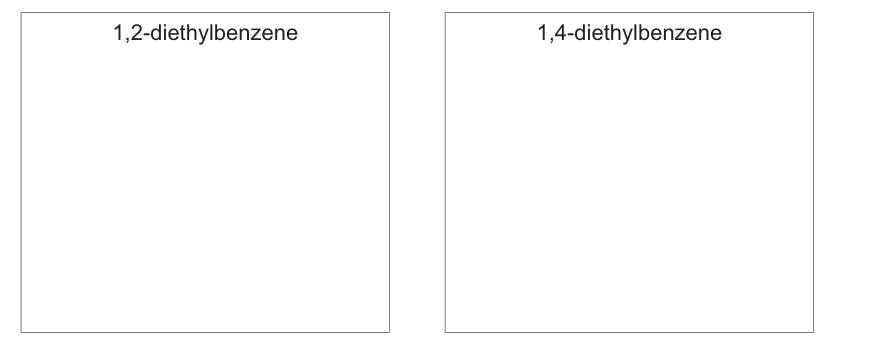
Answer
1,2-diethylbenzene: benzene ring with C2H5 groups at positions 1 and 2 (adjacent). 1,4-diethylbenzene: benzene ring with C2H5 groups at positions 1 and 4 (opposite).
Background Concept
In electrophilic substitution on benzene, the position of the second substituent relative to the first is described using numbers (1,2-; 1,3-; 1,4-) or the terms ortho, meta, and para. 1,2-substitution places groups on adjacent carbons (ortho), while 1,4-substitution places them opposite each other (para).
Understanding the Question
You must draw the structures of 1,2-diethylbenzene and 1,4-diethylbenzene. Each has a benzene ring with two ethyl () groups attached at the specified positions.
Approach
Draw a hexagonal benzene ring (with the circle inside or alternating double bonds) and attach groups at the correct positions: adjacent for 1,2- and opposite for 1,4-.
Step-by-Step Reasoning
- 1,2-diethylbenzene: Place two groups on adjacent carbon atoms of the ring (positions 1 and 2).
- 1,4-diethylbenzene: Place two groups on opposite carbon atoms of the ring (positions 1 and 4).
Key Takeaways
- The numbering system (1,2-; 1,3-; 1,4-) corresponds to ortho, meta, and para respectively.
- Ethyl groups are drawn as or expanded as .
Common Mistakes
- Placing groups at the wrong positions (e.g., 1,3- instead of 1,2-).
- Drawing the ethyl group incorrectly (e.g., as a methyl group).
Things to Be Careful About
- Ensure the benzene ring is drawn correctly (hexagon with circle or three alternating double bonds).
- The ethyl group must be clearly shown as (two carbons).
Answer
The ethyl group is electron-donating (positive inductive effect), so it directs incoming electrophiles to the 2- and 4-positions (ortho and para). Therefore very little 1,3-diethylbenzene (meta product) is formed.
The ethyl group is a 2,4-director (ortho/para director) due to its positive inductive effect / electron-donating nature.
Background Concept
Substituents already present on a benzene ring influence where the next electrophilic attack occurs. Alkyl groups such as ethyl are activating and ortho/para-directing. This is because the alkyl group pushes electron density into the ring via the positive inductive effect (), which is felt most strongly at the ortho and para positions. These positions therefore have the highest electron density and are preferentially attacked by the electrophile.
Understanding the Question
The question asks why 1,3-diethylbenzene (the meta isomer) is barely formed. You need to explain the directing effect of the first ethyl group.
Approach
State that the ethyl group is electron-donating and therefore directs the second substitution to positions 2 and 4 (ortho and para), not position 3 (meta).
Step-by-Step Reasoning
- The first ethyl group on the ring exerts a positive inductive effect, pushing electron density into the -system.
- This increased electron density is greatest at the ortho (2) and para (4) positions relative to the ethyl group.
- The electrophile therefore attacks preferentially at these positions.
- The meta (3) position has relatively less electron density, so very little 1,3-diethylbenzene forms.
Key Takeaways
- Alkyl groups are ortho/para directors due to their electron-donating inductive effect.
- The directing effect explains the product distribution in polysubstituted benzenes.
Common Mistakes
- Saying the ethyl group is electron-withdrawing (it is electron-donating).
- Confusing the directing effect with the activating/deactivating effect (alkyl groups do both: they activate AND direct ortho/para).
- Saying 'the ethyl group is bulky so it blocks position 3' — steric effects influence the ortho:para ratio but do not explain the absence of meta product.
Things to Be Careful About
- The mark scheme accepts either '2,4-directing' or 'electron-donating / positive inductive effect' as the explanation. You must link the electronic effect to the observed product distribution.
1,2-diethylbenzene can be oxidised to benzene-1,2-dioic acid, .
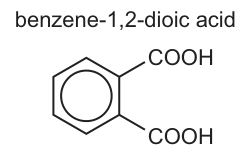
Answer
Hot alkaline (or ), followed by acid.
Hot alkaline KMnO4 (followed by acid)
Background Concept
Alkyl side chains on benzene rings can be oxidised to carboxylic acid groups using hot alkaline potassium manganate(VII) (). The ion is the oxidising agent; under alkaline conditions it is reduced to (or ). After the oxidation is complete, the solution is acidified to protonate the carboxylate ions formed under alkaline conditions, giving the free carboxylic acid.
Understanding the Question
You are asked for the reagent and conditions to oxidise the ethyl groups of 1,2-diethylbenzene to groups, forming benzene-1,2-dioic acid.
Approach
Recall that hot alkaline is the standard reagent for this transformation, followed by acidification.
Step-by-Step Reasoning
- The reagent is (potassium manganate(VII)) or equivalently the ion.
- Conditions: heat (reflux) under alkaline conditions (e.g., with or ).
- Followed by addition of acid (e.g., dilute ) to protonate the carboxylate and give the diacid.
Key Takeaways
- Alkyl side chains on benzene are oxidised to regardless of chain length (provided there is at least one benzylic hydrogen).
- The ring itself is unaffected by this oxidation.
Common Mistakes
- Writing only 'acidified ' — the oxidation is done under alkaline conditions, then acidified.
- Omitting 'hot' or 'reflux' from the conditions.
- Writing — this does not oxidise alkyl side chains on benzene.
Things to Be Careful About
- Both 'alkaline ' and 'alkaline ' are acceptable. The key is that the conditions are hot and alkaline, followed by acid.
Complete the overall equation for this reaction.
An atom of oxygen from the oxidising agent is represented as .
All of the atoms in the two ethyl groups are fully oxidised in this reaction.
Working
1,2-diethylbenzene:
Each ethyl group () is fully oxidised: the carbon attached to the ring becomes , and the terminal carbon becomes . Hydrogens form .
Two ethyl groups contribute: 4 C, 10 H → 2 C in COOH + 2 C in CO; 2 H in COOH + 8 H in 4 HO.
Oxygen needed on the right: 4 (from 2 COOH) + 4 (from 2 CO) + 4 (from 4 HO) = 12.
Answer
C10H14 + 12[O] → C6H4(COOH)2 + 2CO2 + 4H2O
Background Concept
When an alkyl side chain on benzene is 'fully oxidised', every carbon in the side chain that has a hydrogen attached is converted to a carboxyl group () or, if it has no remaining connection to the ring, to . For an ethyl group (): the benzylic carbon becomes part of , and the terminal carbon becomes . All hydrogens are converted to water.
Understanding the Question
You must write the complete balanced equation showing 1,2-diethylbenzene reacting with to give benzene-1,2-dioic acid, with all atoms from the two ethyl groups accounted for. The question states 'all of the atoms in the two ethyl groups are fully oxidised'.
Approach
- Determine the molecular formula of 1,2-diethylbenzene.
- Determine what the oxidation products are from each ethyl group.
- Balance the equation by counting all atoms.
Step-by-Step Reasoning
-
Molecular formula: . Ring carbons = 6, ring hydrogens = 4, ethyl carbons = 4, ethyl hydrogens = 10. Total: .
-
Products: The two groups remain on the ring (forming ). Each terminal carbon of the ethyl groups becomes (so 2 ). The hydrogens not in form .
-
Atom balance for H: Total H in reactant = 14. H in = 4 (ring) + 2 (COOH) = 6. Remaining H = 14 − 6 = 8, which forms 4 .
-
Oxygen balance: Right side has 4 O (from 2 COOH) + 4 O (from 2 CO) + 4 O (from 4 HO) = 12 O. So 12 needed.
-
Final equation:
Key Takeaways
- Full oxidation of an ethyl group means the benzylic C → COOH and the terminal C → CO.
- Always verify by counting atoms of each element on both sides.
Common Mistakes
- Forgetting that the terminal carbon of each ethyl group becomes (not staying as part of the ring product).
- Incorrectly counting hydrogens: the ring has 4 H (not 6, since two positions are substituted), and the COOH groups each have 1 H.
- Getting the coefficient of wrong by miscounting oxygen atoms on the product side.
Things to Be Careful About
- The mark scheme requires all species to have correct formulae AND correct balancing (2 separate marks).
- is also acceptable for the reactant formula.
Answer
4
4
Background Concept
In NMR, each chemically distinct carbon environment gives one signal. Molecules with symmetry have equivalent carbons that produce a single peak. Identifying the number of peaks requires recognising all symmetry elements (planes, axes) and grouping carbons accordingly.
Understanding the Question
You must predict the number of peaks in the NMR spectrum of benzene-1,2-dioic acid (phthalic acid), which has two adjacent groups on the ring.
Approach
Identify the plane of symmetry and group the carbons into sets of equivalent environments.
Step-by-Step Reasoning
- Benzene-1,2-dioic acid has a plane of symmetry that bisects the C1–C2 bond and the C4–C5 bond (the plane passes through the midpoint of the bond between the two substituted carbons and the midpoint of the opposite bond).
- This makes: C1 ≡ C2 (both bonded to COOH), C3 ≡ C6, C4 ≡ C5.
- The two COOH carbons are also equivalent by this symmetry.
- Distinct environments: (i) COOH carbon, (ii) C1/C2 (aromatic, bonded to COOH), (iii) C3/C6 (aromatic, adjacent to C1/C2), (iv) C4/C5 (aromatic, adjacent to each other).
- Total = 4 peaks.
Key Takeaways
- Always look for symmetry elements before counting distinct environments.
- In ortho-disubstituted benzenes with identical substituents, there is one plane of symmetry giving 4 aromatic carbon signals plus 1 substituent signal (but here the substituent carbons are also symmetric, so 4 total).
Common Mistakes
- Saying 6 (forgetting symmetry).
- Saying 3 (over-symmetrising and treating all ring carbons as equivalent).
- Not counting the COOH carbon as a separate environment.
Things to Be Careful About
- The COOH carbons are a distinct environment from the ring carbons and must be counted separately.
- The question asks for the number of peaks, not the integration or chemical shift.
The proton () NMR spectra of ethylbenzene, , in and of benzene-1,2-dioic acid, , in are shown. They have not been identified.
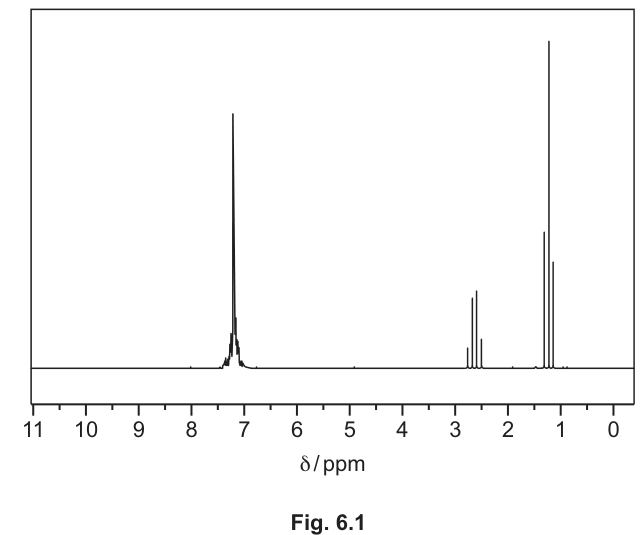
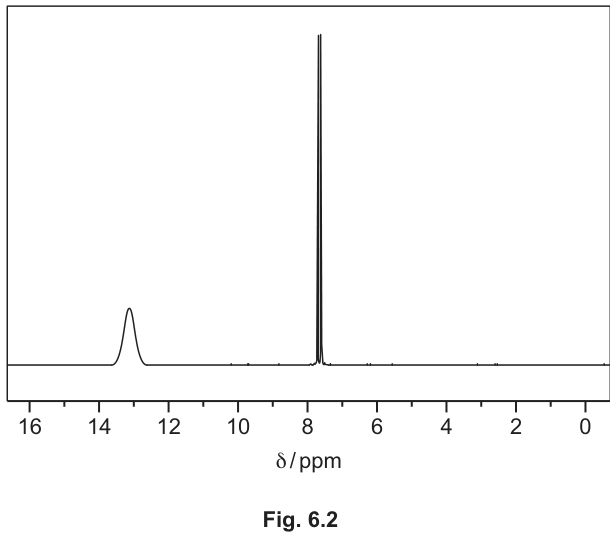
Answer
does not produce a peak in the NMR spectrum (deuterium does not resonate under these conditions), so it does not interfere with the sample's spectrum.
CDCl3 does not cause a peak / does not interfere with the spectrum
Background Concept
In NMR, the solvent must be transparent to the observation — it must not produce signals in the proton spectrum. Regular contains a proton that would give a large peak around ppm, potentially obscuring aromatic signals from the sample. Deuterium () has a completely different resonance frequency and does not appear in a NMR spectrum, so is 'invisible' in the proton spectrum.
Understanding the Question
Explain why is used rather than as the solvent for obtaining proton NMR spectra.
Approach
State that deuterium does not give a signal in NMR, so the solvent peak is absent.
Step-by-Step Reasoning
- has one H atom that would produce a signal in the NMR spectrum.
- This solvent peak could overlap with or obscure sample peaks.
- has deuterium instead of hydrogen; deuterium is not detected in NMR.
- Therefore gives no interfering peak.
Key Takeaways
- Deuterated solvents are used in NMR to avoid solvent interference.
- Deuterium is NMR-active but at a different frequency; it is invisible in a proton experiment.
Common Mistakes
- Saying 'CDCl3 is more volatile' or 'cheaper' — irrelevant to NMR.
- Saying 'CDCl3 does not dissolve the sample' — it does dissolve organic samples.
Things to Be Careful About
- The key phrase is that CDCl3 'does not cause a peak' or 'does not interfere with the spectrum'. Simply saying 'it is deuterated' without explaining the consequence may not score.
Identify the substance shown by the spectrum in Fig. 6.1, and complete Table 6.1.
substance ..........................................................................................................................
Table 6.1
| peak at | peak at | |
|---|---|---|
| name of splitting pattern | ||
| group responsible for peak | ||
| explanation of splitting pattern |
Answer
Substance: ethylbenzene ()
| peak at | peak at | |
|---|---|---|
| name of splitting pattern | triplet | quartet |
| group responsible for peak | ||
| explanation of splitting pattern | split by 2 H on neighbouring group | split by 3 H on neighbouring group |
Ethylbenzene; δ=1.2: triplet, CH3, split by 2H on neighbouring CH2; δ=2.6: quartet, CH2, split by 3H on neighbouring CH3
Background Concept
In NMR, the chemical shift tells us about the electronic environment of each proton. The splitting pattern follows the rule: a set of equivalent protons is split by neighbouring non-equivalent protons into peaks. A triplet arises from 2 neighbouring H, a quartet from 3 neighbouring H.
Understanding the Question
Fig. 6.1 shows three signals: a singlet at ~7.2 (aromatic H), a quartet at ~2.6, and a triplet at ~1.2. You must identify the compound and complete the table for the two aliphatic peaks.
Approach
- The pattern (aromatic singlet + triplet + quartet) is characteristic of an ethyl group attached to a benzene ring → ethylbenzene.
- Apply the rule to each aliphatic peak.
Step-by-Step Reasoning
- Identification: The three signals (aromatic, ~2.6 quartet, ~1.2 triplet) match the ethyl group pattern in ethylbenzene.
- Peak at δ = 1.2: This is the group (typical chemical shift for a methyl attached to a CH). It is split by the 2 H on the adjacent CH, giving peaks → triplet.
- Peak at δ = 2.6: This is the group (deshielded by the adjacent aromatic ring). It is split by the 3 H on the adjacent CH, giving peaks → quartet.
Key Takeaways
- The triplet-quartet pair is the signature of an ethyl group in NMR.
- The rule applies to the number of H on the immediately adjacent carbon(s).
- Chemical shift of ~2.6 for CH indicates deshielding by the aromatic ring.
Common Mistakes
- Reversing the splitting: saying the CH is a quartet and CH is a triplet.
- Saying 'split by 3 H' for the CH peak (the CH has 3 H but is split by the 2 H on the neighbouring CH).
- Forgetting to state the group responsible (not just the splitting pattern).
Things to Be Careful About
- The mark scheme requires all seven entries (3 for each column + substance) for full marks, with partial credit at 3 and 5 correct.
- 'Quadruplet' is accepted as an alternative to 'quartet'.
Identify the substance shown by the spectrum in Fig. 6.2, and complete Table 6.2.
substance ..........................................................................................................................
Table 6.2
| peak at | peak at | |
|---|---|---|
| group responsible for peak |
Answer
Substance: benzene-1,2-dioic acid ()
| peak at | peak at | |
|---|---|---|
| group responsible for peak | H on benzene ring / aromatic H | / carboxylic acid proton |
Benzene-1,2-dioic acid; δ=7.8: aromatic H (H on benzene ring); δ=13.1: COOH proton
Background Concept
A very broad, downfield peak around –13 ppm is diagnostic of a carboxylic acid proton. The extreme deshielding is due to the electron-withdrawing effect of the adjacent carbonyl group and hydrogen bonding. Aromatic protons typically appear at –8.5 ppm.
Understanding the Question
Fig. 6.2 shows only two signals: one at ~7.8 and a broad one at ~13.1. You must identify the compound and state which group gives each peak.
Approach
The peak at 13.1 is unmistakably a COOH proton. Combined with the aromatic peak at 7.8, this identifies benzene-1,2-dioic acid.
Step-by-Step Reasoning
- Peak at δ = 13.1: Broad, very downfield → proton (carboxylic acid).
- Peak at δ = 7.8: Aromatic region → H on the benzene ring.
- Only two signals means the molecule has high symmetry (consistent with the plane of symmetry in 1,2-disubstituted benzene with identical groups).
- Substance: benzene-1,2-dioic acid.
Key Takeaways
- A peak at is almost certainly a COOH proton.
- The absence of aliphatic peaks (no signal below 7) confirms all non-aromatic H are in COOH groups.
Common Mistakes
- Identifying the compound as ethylbenzene (which would show peaks at 1.2 and 2.6).
- Saying the 13.1 peak is due to the aromatic ring (it is not).
Things to Be Careful About
- All three entries (substance + two groups) must be correct for the mark.
When is used as a solvent, the spectrum obtained is different from the spectrum in Fig. 6.2.
Describe this difference and explain your answer.
Answer
The peak at disappears because the proton exchanges with deuterium from , forming , which does not produce a signal in the NMR spectrum.
The COOH peak at 13.1 disappears as the proton exchanges with deuterium (D) from D2O
Background Concept
(heavy water) exchanges its deuterium with labile protons — those attached to electronegative atoms such as O, N, or S. Carboxylic acid protons (), alcohol protons (), and amine protons (, ) are all labile. After exchange, the proton is replaced by deuterium, which is invisible in NMR, so the corresponding peak disappears.
Understanding the Question
When is used as the solvent instead of , the spectrum of benzene-1,2-dioic acid changes. Describe and explain this change.
Approach
Identify which peak disappears (the COOH peak at 13.1) and explain why (H/D exchange).
Step-by-Step Reasoning
- The proton is labile (acidic, attached to oxygen).
- In , the following exchange occurs: .
- Deuterium does not resonate at the NMR frequency, so the proton is invisible.
- The peak at therefore disappears.
- The aromatic peak at remains (aromatic C–H bonds are not labile and do not exchange).
Key Takeaways
- DO exchange is a diagnostic tool for identifying OH, NH, and COOH protons.
- Only protons on electronegative atoms (O, N, S) exchange; C–H protons do not.
Common Mistakes
- Saying all peaks disappear (only the COOH peak does).
- Saying the peak shifts position rather than disappearing.
- Not mentioning that deuterium does not show up in NMR.
Things to Be Careful About
- Both parts of the answer are required: the observation (peak disappears) AND the explanation (H exchanges with D). One without the other does not score.
Benzene-1,2-dioic acid can be used to produce .
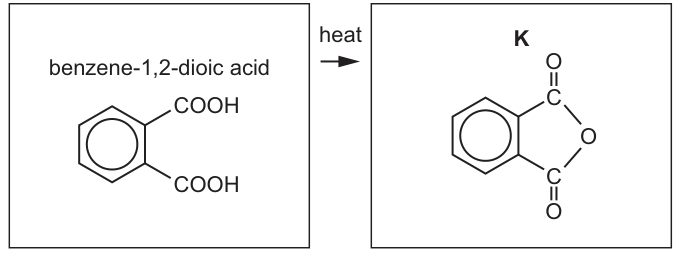
Suggest the name of this type of reaction.
Answer
Dehydration (or elimination / (auto)condensation)
Dehydration
Background Concept
When two carboxylic acid groups are positioned adjacent to each other (as in a 1,2-dicarboxylic acid), heating can cause intramolecular loss of water between the two groups, forming a cyclic anhydride. This is a specific case of condensation (loss of a small molecule) that occurs within a single molecule, hence 'autocondensation' or 'intramolecular condensation'. It can also be described as a dehydration or elimination reaction.
Understanding the Question
Benzene-1,2-dioic acid is heated to form compound K (phthalic anhydride), which is a cyclic anhydride with a five-membered ring containing . You must name the type of reaction.
Approach
Compare the structures: the diacid loses and forms a cyclic anhydride. This is dehydration / elimination / (auto)condensation.
Step-by-Step Reasoning
- Reactant: (benzene-1,2-dioic acid).
- Product: phthalic anhydride (cyclic anhydride, ) + .
- Water is eliminated from the molecule → dehydration.
- Since it occurs within one molecule between two adjacent COOH groups → (auto)condensation.
- A molecule of water is removed → elimination.
Key Takeaways
- 1,2-dicarboxylic acids readily form cyclic anhydrides on heating (5- or 6-membered anhydride rings are particularly stable).
- Multiple terms are acceptable: dehydration, elimination, or (auto)condensation.
Common Mistakes
- Saying 'hydrolysis' (this is the reverse reaction).
- Saying 'oxidation' or 'reduction' (no change in oxidation state).
Things to Be Careful About
- Any of the three terms (dehydration, elimination, autocondensation) scores the mark. Do not write 'condensation' alone without 'auto' — while arguably acceptable, the mark scheme specifically lists '(auto)condensation'.
A reaction scheme is shown in Fig. 7.1.
The reagents needed for reaction 2 and reaction 3 are stated.
Reaction 5 takes place when is mixed with compound . No special conditions are required.
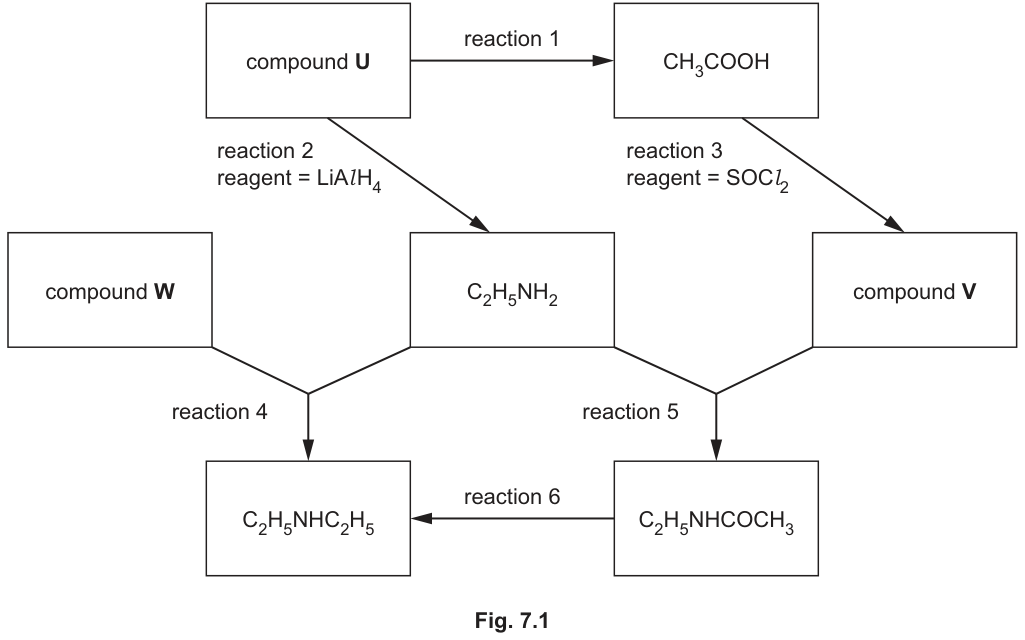
Answer
(ethanenitrile)
CH3CN
Background Concept
Nitriles () are a functional group containing carbon, hydrogen, and nitrogen. They can be hydrolysed to carboxylic acids and reduced to primary amines. The hydrolysis of a nitrile requires an aqueous acid or alkali and heat. The reduction of a nitrile to an amine is typically achieved using lithium aluminium hydride () followed by acid workup, or catalytic hydrogenation.
Understanding the Question
We are given a reaction scheme where compound U converts to (ethanoic acid) via reaction 1, and to (ethylamine) via reaction 2 using . We are told U contains only three elements.
Approach
Since reaction 2 is a reduction with producing a primary amine (), U must be a nitrile with the same carbon skeleton. Reduction of gives (). Hydrolysis of gives . This matches both pathways perfectly. The elements in are C, H, and N (three elements), which satisfies the condition.
Step-by-Step Reasoning
- Identify the product of reaction 2: is a primary amine with 2 carbons.
- Reagents for reaction 2 are , which reduces nitriles to primary amines. The nitrile must have 2 carbons: .
- Check reaction 1: Hydrolysis of yields , which matches the scheme.
- Check elemental composition: contains C, H, N (3 elements).
Key Takeaways
Nitriles are versatile intermediates in organic synthesis. They can be converted to carboxylic acids (via hydrolysis) or primary amines (via reduction), allowing the construction of carbon chains and functional group interconversions.
Common Mistakes
- Suggesting an amide or an ester for U, which would not reduce to a primary amine with in the same way or would have different hydrolysis products.
- Forgetting that nitriles contain nitrogen, thus missing the third element requirement.
Things to Be Careful About
Ensure the carbon count matches between the nitrile and the products. has 2 carbons, matching (2 carbons) and (2 carbons).
Answer
Dilute acid (e.g., ) and heat (or hot).
(Note: All three components — acid, aqueous, heat — are required for full marks.)
dilute acid (e.g., HCl(aq)) and heat
Background Concept
Hydrolysis of nitriles to carboxylic acids is typically carried out under acidic conditions. The nitrile is heated under reflux with a dilute aqueous acid (such as dilute or ). Alternatively, alkaline hydrolysis can be used, followed by acidification, but the mark scheme specifically rewards the acidic route here.
Understanding the Question
Reaction 1 converts compound U () to . This is a hydrolysis reaction. We need to state the reagents and conditions.
Approach
Recall the standard conditions for acidic hydrolysis of a nitrile: dilute aqueous acid and heat.
Step-by-Step Reasoning
- Reaction 1 is the conversion of a nitrile to a carboxylic acid.
- Reagent: dilute acid, specifically or . Must specify 'dilute' and 'aqueous'.
- Condition: heat (or hot, or reflux).
Key Takeaways
Nitrile hydrolysis requires both an acid (or base) catalyst and heat to proceed at a reasonable rate. Specifying 'dilute' and 'aqueous' is important to distinguish from other reactions.
Common Mistakes
- Writing just 'acid' without specifying 'dilute' or 'aqueous'.
- Writing 'heat' without specifying the reagent, or vice versa. The mark scheme requires all three components (acid, aq, heat).
- Suggesting alkaline hydrolysis without mentioning the subsequent acidification step.
Things to Be Careful About
Ensure you include all three marking points: acid, aqueous (aq), and heat. 'Concentrated acid' is not appropriate here.
Answer
(ethanoyl chloride)
CH3COCl
Background Concept
Carboxylic acids react with thionyl chloride () to form acyl chlorides (acid chlorides). This is a substitution reaction where the group of the carboxylic acid is replaced by a atom. The by-products are and , both of which are gases, making purification of the acyl chloride easy.
Understanding the Question
Reaction 3 converts to compound V using . We need to identify V.
Approach
Apply the known reaction between a carboxylic acid and to determine the product.
Step-by-Step Reasoning
- Reactant: (ethanoic acid).
- Reagent: (thionyl chloride).
- Product: The is replaced by , giving (ethanoyl chloride).
Key Takeaways
is a preferred reagent for converting carboxylic acids to acyl chlorides because the by-products ( and ) are gases and leave the reaction mixture, driving the reaction to completion and simplifying purification.
Common Mistakes
- Writing or other incorrect structures.
- Forgetting to replace the with .
Things to Be Careful About
Ensure the formula is written correctly as , not or similar.
Answer
CH3COCl + HCl + SO2
Background Concept
The reaction between a carboxylic acid and thionyl chloride () is a nucleophilic substitution at the carbonyl carbon. The group is replaced by , and the from the combines with the from to form . The remaining fragment forms gas.
Understanding the Question
Complete the balanced equation for reaction 3: ... We already identified V as in part (c). We need to add the by-products.
Approach
Write the main organic product () and balance the remaining atoms to find the inorganic by-products ( and ).
Step-by-Step Reasoning
- Organic product: .
- Remaining atoms from reactants: (from ), (from ), , (from ).
- These combine to form and .
- Balanced equation: .
Key Takeaways
Always include the inorganic by-products when balancing this equation. and are both gases, which is why this reaction is so useful in the laboratory.
Common Mistakes
- Forgetting to include or .
- Writing incorrect formulas for the by-products, such as or .
- Not balancing the equation (though in this case, it balances naturally with 1:1:1:1:1 stoichiometry).
Things to Be Careful About
Ensure all formulas are correctly written and the equation is balanced. State symbols are not required unless specified, but if included, and should be (g).
Answer
(bromoethane) or (chloroethane)
C2H5Br
Background Concept
Primary amines can undergo nucleophilic substitution with haloalkanes (alkyl halides) to form secondary amines. This is an alkylation reaction. The lone pair on the nitrogen of the amine attacks the electrophilic carbon of the haloalkane, displacing the halide ion.
Understanding the Question
Reaction 4 converts (ethylamine) and compound W to (diethylamine). We need to identify W.
Approach
Compare the reactants and products to determine what W must be. The product has an additional ethyl group () attached to the nitrogen. Therefore, W must be a source of an ethyl group, specifically a haloethane.
Step-by-Step Reasoning
- Reactant: (ethylamine).
- Product: (diethylamine).
- Change: One on the nitrogen is replaced by a group.
- Reagent W must provide the group and a leaving group. A haloethane, such as or , fits this role.
Key Takeaways
Alkylation of amines with haloalkanes is a way to increase the number of alkyl groups on the nitrogen. It is a nucleophilic substitution reaction.
Common Mistakes
- Suggesting an alcohol or ether as W, which would not undergo this substitution under the given conditions.
- Writing without a leaving group (e.g., just 'ethane' or 'ethyl group').
Things to Be Careful About
Specify a haloalkane with an ethyl group. , , or are all acceptable. Do not just write 'haloethane' without the formula if the question asks to 'identify'.
Answer
Heat in ethanol and under pressure (or in a sealed tube).
heat in ethanol under pressure
Background Concept
The reaction between an amine and a haloalkane is a nucleophilic substitution that requires heating. To prevent the volatile haloalkane and amine from escaping, and to ensure the reaction goes to completion, it is often carried out in a sealed tube or under pressure. Ethanol is used as a solvent to dissolve both the organic amine and the haloalkane.
Understanding the Question
Reaction 4 is the alkylation of ethylamine with a haloethane (compound W) to form diethylamine. We need to describe the conditions.
Approach
Recall the standard conditions for alkylation of amines: heating in an alcoholic solvent (ethanol) and often under pressure or in a sealed container.
Step-by-Step Reasoning
- Solvent: ethanol (to dissolve reactants).
- Condition 1: heat (to provide activation energy).
- Condition 2: under pressure or in a sealed tube (to contain volatile reactants and prevent loss of ammonia/amine gases).
Key Takeaways
Alkylation of amines requires specific conditions to handle volatile reagents and drive the reaction forward. Ethanol is the standard solvent.
Common Mistakes
- Writing just 'heat' without mentioning ethanol or pressure.
- Suggesting aqueous conditions, which would favor hydrolysis of the haloalkane over alkylation of the amine.
Things to Be Careful About
Both 'heat in ethanol' AND 'under pressure / in sealed tube' are required for full marks. Omitting either will cost a mark.
Answer
(lithium aluminium hydride)
LiAlH4
Background Concept
Amides can be reduced to amines using strong reducing agents. The most common reagent for this in A-Level Chemistry is lithium aluminium hydride (). The reaction converts the carbonyl group () of the amide to a methylene group (), effectively reducing the amide to an amine.
Understanding the Question
Reaction 6 converts (N-ethylethanamide, an amide) to (diethylamine, a secondary amine). We need to suggest the reagent.
Approach
Identify the type of reaction: reduction of an amide to an amine. Recall the standard reagent for this transformation.
Step-by-Step Reasoning
- Reactant: (amide).
- Product: (amine).
- Transformation: Reduction of to .
- Reagent: (lithium aluminium hydride), typically followed by dilute acid workup.
Key Takeaways
is a powerful reducing agent capable of reducing amides, nitriles, and carboxylic acids to amines. It is one of the few reagents that can reduce amides.
Common Mistakes
- Suggesting , which is not strong enough to reduce amides.
- Writing 'hydrogen' or '' without a catalyst, or suggesting catalytic hydrogenation which is less effective for amides than .
Things to Be Careful About
Write the full name or correct formula for . 'Lithium aluminium hydride' is the preferred name. Ensure the spelling is correct.
Complete Table 7.1 by adding the reaction numbers, 1, 2, 3, 4, 5 and 6, to the right-hand column. Use the reaction numbers given in Fig. 7.1.
Each of the numbers 1, 2, 3, 4, 5 and 6 should be used once only.
Table 7.1
| type of reaction | reaction number(s) |
|---|---|
| hydrolysis | |
| addition | |
| reduction | |
| substitution |
Answer
| type of reaction | reaction number(s) |
|---|---|
| hydrolysis | 1 |
| addition | 2 |
| reduction | 2, 6 |
| substitution | 3, 4, 5 |
(Note: Reaction 2 can be classified as both addition and reduction. Reaction 1 is hydrolysis. Reactions 3, 4, 5 are substitutions. Reaction 6 is reduction.)
hydrolysis: 1; addition: 2; reduction: 2, 6; substitution: 3, 4, 5
Background Concept
Organic reactions can be classified into several types:
- Hydrolysis: Cleavage of a bond by water (or aqueous acid/alkali). Nitrile hydrolysis is a classic example.
- Addition: Two or more molecules combine to form a larger one, with no atoms lost. Addition of to a nitrile (or triple bond) is an addition reaction.
- Reduction: Gain of hydrogen or loss of oxygen. Reduction of nitriles and amides with is a reduction.
- Substitution: An atom or group of atoms is replaced by another. Acyl chloride formation, amine alkylation, and acylation of amines are all substitution reactions.
Understanding the Question
We need to classify reactions 1-6 from the scheme into four categories: hydrolysis, addition, reduction, substitution. Each number 1-6 should be used once only, but some categories may have multiple reactions.
Approach
Analyze each reaction individually:
- Reaction 1: (hydrolysis of nitrile).
- Reaction 2: (reduction/addition of using ).
- Reaction 3: (substitution of by ).
- Reaction 4: (nucleophilic substitution).
- Reaction 5: (nucleophilic addition-elimination, classified as substitution in this context).
- Reaction 6: (reduction of amide).
Step-by-Step Reasoning
- Hydrolysis: Reaction 1 (nitrile to carboxylic acid). → 1
- Addition: Reaction 2 (nitrile to amine involves addition of hydrogen across the bond). → 2
- Reduction: Reaction 2 (gain of hydrogen) and Reaction 6 (reduction of amide with ). → 2, 6
- Substitution: Reaction 3 ( replaced by ), Reaction 4 (haloalkane alkylation), Reaction 5 (acylation of amine). → 3, 4, 5
Key Takeaways
Many reactions can be classified in more than one way. For example, reaction 2 is both an addition (of ) and a reduction (gain of ). The mark scheme accepts both classifications for reaction 2. Addition-elimination mechanisms (like reaction 5) are often classified broadly as substitutions in this context.
Common Mistakes
- Classifying reaction 5 as 'addition' only, forgetting the elimination step, or not recognizing it as a substitution overall.
- Forgetting that reaction 2 can be both addition and reduction.
- Misclassifying hydrolysis as substitution (though technically it is, the mark scheme specifically wants 'hydrolysis' for reaction 1).
Things to Be Careful About
Ensure each number 1-6 is used only once across the categories, except where a reaction genuinely fits multiple categories (like reaction 2). The mark scheme allows reaction 2 to appear in both 'addition' and 'reduction'.

Answer
Most basic:
Middle:
Least basic:
Explanation:
- Basicity depends on the availability of the lone pair on the nitrogen atom to accept a proton ().
- is more basic than because the two ethyl groups exert a +ve inductive effect (electron-donating), increasing the electron density on the nitrogen lone pair, making it more available to accept a proton.
- (an amide) is less basic than because the lone pair on the nitrogen is delocalised into the adjacent group (resonance), making it less available to accept a proton.
C2H5NHC2H5 > NH3 > C2H5NHCOCH3
Background Concept
Basicity of nitrogen-containing compounds depends on the availability of the lone pair of electrons on the nitrogen atom to accept a proton (). Two main factors influence this:
- Inductive effect: Alkyl groups are electron-donating (+ve inductive effect). They push electron density towards the nitrogen, increasing the electron density on the lone pair and making it more basic.
- Delocalisation (resonance): If the lone pair on nitrogen is delocalised into an adjacent -system (such as a group in an amide), it is less available to accept a proton, decreasing basicity.
Ammonia () is the reference point. Alkylamines are more basic than ammonia due to the +ve inductive effect of alkyl groups. Amides are much less basic than amines and even ammonia because the nitrogen lone pair is delocalised into the carbonyl group.
Understanding the Question
We need to rank the basicity of three compounds: (N-ethylethanamide, an amide), (diethylamine, a secondary amine), and (ammonia). We must also explain the ranking.
Approach
- Identify the structural features of each compound.
- Apply the principles of inductive effects and delocalisation to determine the relative availability of the nitrogen lone pair.
- Rank them from most basic to least basic.
- Provide a clear, concise explanation linking structure to basicity.
Step-by-Step Reasoning
- (diethylamine): Has two ethyl groups attached to nitrogen. These groups exert a +ve inductive effect, increasing electron density on nitrogen. Most basic.
- (ammonia): Has no alkyl groups, so no inductive effect. Intermediate basicity.
- (N-ethylethanamide): Has a carbonyl group () directly attached to the nitrogen. The lone pair on nitrogen is delocalised into the -system (resonance), making it much less available to accept a proton. Least basic.
Ranking:
Key Takeaways
- Alkylamines > Ammonia > Amides (in terms of basicity).
- Inductive effects increase basicity by increasing electron density on nitrogen.
- Delocalisation (resonance) decreases basicity by removing electron density from nitrogen.
Common Mistakes
- Ranking amides as more basic than amines or ammonia.
- Forgetting to mention the lone pair on nitrogen in the explanation.
- Not specifying that the inductive effect is '+ve' or 'electron-donating'.
- Saying the lone pair is 'used in bonding' instead of 'delocalised into the C=O group'.
Things to Be Careful About
- Ensure the ranking is in the correct order (most basic to least basic, as indicated by the blanks in the question).
- Use precise terminology: 'lone pair', 'accept a proton/H+', 'inductive effect', 'delocalised'.
- Do not say 'the lone pair is shared' — say 'delocalised into the C=O group'.
An aqueous solution of phenol, , is acidic at .
Explain why phenol is more acidic than water.
Answer
The lone pair on the oxygen atom is delocalised into the delocalised pi system of the benzene ring. This weakens the O–H bond and stabilises the phenoxide ion (conjugate base) formed after deprotonation.
Lone pair on oxygen delocalised into ring; stabilises phenoxide ion / weakens O-H bond
Background Concept
The acidity of a compound is determined by how easily it can donate a proton (H⁺) and, crucially, how stable the resulting conjugate base is. For water (H₂O), losing a proton gives the hydroxide ion (OH⁻). For phenol (C₆H₅OH), losing a proton gives the phenoxide ion (C₆H₅O⁻). In aliphatic alcohols like ethanol, the alkoxide ion (RO⁻) is destabilised by the electron-donating inductive effect of the alkyl group, making them less acidic than water. Phenol is an exception among organic compounds containing an –OH group.
Understanding the Question
The question asks for an explanation of why phenol is more acidic than water. This requires discussing both the ease of breaking the O–H bond and the stability of the resulting phenoxide anion compared to the hydroxide anion.
Approach
To explain the enhanced acidity, we must look at the structure of the phenoxide ion. The oxygen atom in phenol has a lone pair of electrons. Because oxygen is directly attached to the sp²-hybridised carbon of the benzene ring, this lone pair can overlap with the delocalised pi system of the ring. We will explain how this delocalisation affects both the O–H bond in the neutral molecule and the charge distribution in the conjugate base.
Step-by-Step Reasoning
- Delocalisation in phenol: The lone pair on the oxygen atom in phenol is not fully localised on the oxygen. It overlaps with and is delocalised into the delocalised pi system of the benzene ring. This electron donation into the ring slightly reduces the electron density on the oxygen, making the O–H bond more polar and weaker than in water.
- Stabilisation of the conjugate base: When phenol loses a proton, the phenoxide ion (C₆H₅O⁻) is formed. The negative charge on the oxygen in the phenoxide ion is delocalised over the benzene ring (specifically to the ortho and para positions). This delocalisation of charge significantly stabilises the phenoxide ion compared to the hydroxide ion (OH⁻), where the negative charge is localised on a single oxygen atom. Because the conjugate base is more stable, the equilibrium for dissociation lies further to the right, making phenol more acidic.
Key Takeaways
Phenol's acidity is a direct result of the interaction between the oxygen lone pair and the aromatic pi system. Delocalisation weakens the O–H bond and, more importantly, stabilises the resulting phenoxide anion by spreading the negative charge over the ring.
Common Mistakes
- Stating that the benzene ring is 'electron-withdrawing' without explaining the mechanism (delocalisation of the oxygen lone pair).
- Saying 'the ring stabilises the ion' without mentioning that the charge is delocalised into the ring.
- Confusing the inductive effect (which applies to alkyl groups) with resonance/delocalisation effects.
Things to Be Careful About
- Ensure you mention the lone pair on the oxygen and its delocalisation into the ring.
- You can accept either 'O–H bond is weakened' OR 'the anion/phenoxide ion is stabilised' as the second mark; both are valid ways to explain the increased acidity.
- Do not write 'resonance' if the mark scheme specifically looks for 'delocalised'; while conceptually similar in this context, CIE mark schemes often prefer 'delocalised' for aromatic systems.
Name the two products formed when phenol reacts with an excess of .
............................................................... and ...............................................................
Answer
2,4,6-tribromophenol and hydrogen bromide (or HBr)
2,4,6-tribromophenol and hydrogen bromide
Background Concept
Phenol undergoes electrophilic substitution reactions much more readily than benzene. The –OH group is strongly activating and ortho/para-directing. When phenol is treated with bromine water (Br₂(aq)) at room temperature, the activation is so strong that substitution occurs at all available ortho and para positions (positions 2, 4, and 6), even without a Lewis acid catalyst like AlBr₃.
Understanding the Question
The question asks for the names of the two products formed when phenol reacts with an excess of aqueous bromine. One product is the organic substituted phenol, and the other is the inorganic byproduct.
Approach
Identify the positions of substitution (2, 4, 6) to name the organic product. Recognise that the hydrogen atoms replaced by bromine combine with the remaining bromine atoms to form hydrogen bromide gas/dissolved HBr.
Step-by-Step Reasoning
- Organic product: Three bromine atoms substitute the hydrogen atoms at positions 2, 4, and 6 on the benzene ring. The IUPAC/common name for this compound is 2,4,6-tribromophenol. It forms as a white precipitate.
- Inorganic product: The three hydrogen atoms displaced from the ring combine with the three bromine atoms from the Br₂ molecules to form hydrogen bromide (HBr).
Key Takeaways
Excess bromine water with phenol leads to tri-substitution at the 2, 4, and 6 positions. The byproduct is always HBr in electrophilic aromatic substitution.
Common Mistakes
- Naming the product as 'tribromobenzene' (forgetting the –OH group).
- Forgetting the inorganic product (HBr) and only naming the organic precipitate.
- Writing 'bromine' instead of 'hydrogen bromide' for the second product.
Things to Be Careful About
- Ensure the name is exactly 2,4,6-tribromophenol. Just 'tribromophenol' is not specific enough.
- HBr can be written as hydrogen bromide or HBr.
Draw the structures of the two isomeric organic products, with , that are formed when phenol reacts with at room temperature.

Answer
See diagram for 2-nitrophenol and 4-nitrophenol
Background Concept
Nitration of phenol with dilute nitric acid (HNO₃(aq)) at room temperature is an electrophilic substitution reaction. The –OH group activates the ring and directs incoming electrophiles (NO₂⁺) to the ortho (2, 6) and para (4) positions. Unlike benzene nitration which requires concentrated HNO₃ and H₂SO₄, phenol is reactive enough to use dilute nitric acid. At room temperature, mono-nitration occurs, producing a mixture of isomers.
Understanding the Question
The question asks to draw the structures of the two isomeric organic products with Mᵣ = 139 formed from the reaction of phenol with dilute HNO₃(aq) at room temperature. Mᵣ = 139 corresponds to C₆H₅NO₃ (phenol is 94; replacing one H with NO₂ adds 45: 94 - 1 + 46 = 139). We need to draw the ortho and para isomers.
Approach
Draw the benzene ring with the –OH group. Place the –NO₂ group at the ortho position (adjacent carbon) for one isomer, and at the para position (opposite carbon) for the other. Ensure the nitro group is drawn correctly (nitrogen attached to the ring, with two oxygens).
Step-by-Step Reasoning
- Para isomer (4-nitrophenol): The –NO₂ group is attached to carbon 4, directly opposite the –OH group on the benzene ring. The structure shows a benzene ring (often drawn with a circle for delocalisation) with –OH at position 1 and –NO₂ (or O₂N–) at position 4.
- Ortho isomer (2-nitrophenol): The –NO₂ group is attached to carbon 2, adjacent to the carbon bearing the –OH group. The structure shows a benzene ring with –OH at position 1 and –NO₂ at position 2.
Key Takeaways
Dilute nitric acid at room temperature yields a mixture of ortho- and para-nitrophenol. The para isomer is often the major product due to steric hindrance at the ortho position, but both are formed and must be drawn if asked for 'the two isomers'.
Common Mistakes
- Drawing the nitro group attached via oxygen (–O–N=O) instead of via nitrogen (–NO₂). The nitrogen must bond to the ring.
- Forgetting to show both oxygens on the nitro group correctly (one double bond, one single bond with a formal charge, or using the O₂N– notation).
- Drawing meta-nitrophenol (position 3), which is not formed in this reaction.
- Drawing 2,4-dinitrophenol, which requires more concentrated acid or higher temperatures.
Things to Be Careful About
- The question asks for structures with Mᵣ = 139. 2,4-dinitrophenol has Mᵣ = 184, so only mono-nitro products are correct.
- Use displayed or structural formulas as appropriate; ensure all atoms and bonds in the nitro group are clear.
Answer
2C6H5OH + 2Na -> 2C6H5ONa + H2
Background Concept
Phenol, like water and alcohols, contains an O–H bond and can react with reactive metals such as sodium to produce a salt and hydrogen gas. This is a redox reaction where sodium is oxidised and hydrogen is reduced. The salt formed is a sodium phenoxide (C₆H₅ONa).
Understanding the Question
Write the balanced chemical equation for the reaction between phenol (C₆H₅OH) and sodium metal (Na).
Approach
Recognise this as a single displacement/redox reaction similar to 2Na + 2H₂O → 2NaOH + H₂. Replace one H in phenol with Na to form sodium phenoxide, and balance the equation to produce H₂ gas.
Step-by-Step Reasoning
- Reactants: Phenol is C₆H₅OH and sodium is Na.
- Products: The sodium replaces the hydrogen in the hydroxyl group to form sodium phenoxide, C₆H₅ONa. The displaced hydrogen atoms combine to form hydrogen gas, H₂.
- Balancing: To get one H₂ molecule, we need two hydrogen atoms. Therefore, we need two phenol molecules and two sodium atoms.
Key Takeaways
Phenols react with active metals to form phenoxides and hydrogen gas, demonstrating their weak acidic nature.
Common Mistakes
- Writing C₆H₅Na + H₂O (incorrectly substituting a ring hydrogen instead of the hydroxyl hydrogen).
- Forgetting to balance the equation (e.g., C₆H₅OH + Na → C₆H₅ONa + H, missing the diatomic H₂).
- Writing the organic product as C₆H₅O⁻Na⁺ without the correct stoichiometric coefficients.
Things to Be Careful About
- Ensure the equation is fully balanced with integer coefficients.
- State symbols are not explicitly required by the mark scheme for this specific part, but if included, H₂ should be (g) and C₆H₅ONa is typically (aq) or (s) depending on conditions; however, the mark scheme only requires the correct formulae and balancing.
Phenol can be produced from phenylamine in a two-step synthesis.
Describe the reagents and conditions needed in each step.
step one:
reagents ....................................................................................................................................
conditions .................................................................................................................................
step two:
reagents ....................................................................................................................................
conditions .................................................................................................................................
Answer
step one:
reagents: sodium nitrite (NaNO₂) and hydrochloric acid (HCl) (or nitrous acid, HNO₂)
conditions: temperature ≤ 10 °C
step two:
reagents: water (H₂O)
conditions: warm (temperature > 10 °C)
Step 1: NaNO2 + HCl, T <= 10 C. Step 2: H2O, warm.
Background Concept
Phenylamine (aniline, C₆H₅NH₂) can be converted to phenol via a diazonium salt intermediate. This is a two-step process involving diazotisation followed by hydrolysis. Diazonium salts are highly reactive and unstable at higher temperatures, so the first step must be kept cold. The second step involves replacing the diazonium group (–N₂⁺) with a hydroxyl group (–OH).
Understanding the Question
The question provides a two-step synthesis from phenylamine to phenol and asks for the reagents and conditions for each step.
Approach
Recall the standard procedure for converting an aromatic primary amine to a phenol. Step 1 is diazotisation: react the amine with nitrous acid (generated in situ from NaNO₂ and HCl) at low temperature. Step 2 is hydrolysis: warm the diazonium salt with water.
Step-by-Step Reasoning
Step one: Diazotisation
- Reagents: Nitrous acid (HNO₂) is not stable, so it is prepared in situ by adding sodium nitrite (NaNO₂) to dilute hydrochloric acid (HCl). The mark scheme accepts 'HNO₂ (+ HCl)' or 'NaNO₂ + HCl'.
- Conditions: The temperature must be kept low, typically ≤ 10 °C (often ice bath). If the temperature is too high, the diazonium salt decomposes.
Step two: Hydrolysis
- Reagents: The diazonium salt is hydrolysed using water (H₂O). Sometimes dilute acid is mentioned, but water alone is sufficient and accepted by the mark scheme.
- Conditions: The mixture must be warmed (temperature > 10 °C) to drive the hydrolysis reaction and release nitrogen gas (N₂), forming phenol.
Key Takeaways
The conversion of phenylamine to phenol requires diazotisation at low temperatures followed by hydrolysis with warming. The nitrogen is lost as N₂ gas.
Common Mistakes
- Using concentrated nitric acid and sulfuric acid in step one (this would nitrate the ring, not form a diazonium salt).
- Forgetting the low temperature condition (≤ 10 °C) in step one, which is critical for diazonium salt stability.
- Writing 'HCl' as the reagent for step two instead of water.
- Not specifying 'warm' or a temperature > 10 °C for step two.
Things to Be Careful About
- The mark scheme accepts 'any two' marks for a total of 2, but providing all four (reagents + conditions for both steps) is the safest approach to ensure full credit.
- Ensure you distinguish between the reagents for diazotisation (NaNO₂/HCl) and hydrolysis (H₂O).
- Temperature conditions are crucial: cold for step one, warm for step two.