Chemistry 9701/42 — May/June 2024
Cambridge A-Level · A Level Structured Questions · worked solutions for every part, with the mark scheme
Topics Group 2 · Chemical Energetics · Electrochemistry · Introduction to A Level Organic Chemistry · Hydrocarbons · Nitrogen Compounds · +6 more
Describe the trend in the solubility of the sulfates of magnesium, calcium and strontium.
Explain your answer.
Answer
magnesium sulfate > calcium sulfate > strontium sulfate
As the size of the Group 2 cation increases from magnesium to strontium, both the lattice enthalpy and the hydration enthalpy become less exothermic (less negative). The lattice enthalpy changes less in magnitude than the hydration enthalpy. Since the hydration enthalpy is the dominant factor, the enthalpy change of solution becomes less exothermic (more endothermic) down the group, making the sulfates less soluble.
magnesium sulfate > calcium sulfate > strontium sulfate
Background Concept
The solubility of an ionic compound in water depends on the enthalpy change of solution, which is the balance between the energy required to break apart the ionic lattice (lattice enthalpy, ) and the energy released when the gaseous ions are hydrated (hydration enthalpy, ):
Lattice enthalpy is the enthalpy change when 1 mole of an ionic solid is formed from its gaseous ions. Hydration enthalpy is the enthalpy change when 1 mole of gaseous ions is fully surrounded by water molecules.
Both enthalpies depend on ionic charge and ionic radius. As ionic radius increases (down a group), the electrostatic attractions between ions weaken, making both and less exothermic (less negative). However, they decrease at different rates.
Understanding the Question
The question asks for the trend in solubility of Group 2 sulfates (MgSO₄, CaSO₄, SrSO₄) going down the group, and an explanation using energetics. The answer must be written as: most soluble > middle > least soluble.
Approach
First, state the correct trend. Then explain it by considering how and change as the cation radius increases, and why their different rates of change lead to the observed solubility trend.
Step-by-Step Reasoning
M1 — Trend: magnesium sulfate > calcium sulfate > strontium sulfate. Solubility of Group 2 sulfates decreases down the group (opposite to the hydroxides).
M2 — Both enthalpies become less exothermic: As the Group 2 cation increases in size from Mg²⁺ to Ca²⁺ to Sr²⁺, the charge density decreases. This means both the lattice enthalpy () and the hydration enthalpy () become less exothermic (less negative). The lattice enthalpy becomes less exothermic because the larger cation is farther from the sulfate anion, reducing electrostatic attraction. The hydration enthalpy becomes less exothermic because the larger cation has lower charge density and attracts water molecules less strongly.
M3 — Relative change: The lattice enthalpy changes less in magnitude than the hydration enthalpy. This is because the sulfate ion (SO₄²⁻) is large, so the change in cation radius has a proportionally smaller effect on the interionic distance in the lattice than on the hydration of the cation. Alternatively, the hydration enthalpy is the dominant factor in determining .
M4 — Effect on solubility: Because becomes less exothermic more than , the overall becomes less exothermic (more endothermic / more positive) down the group. A less exothermic (or more endothermic) enthalpy of solution corresponds to lower solubility.
Key Takeaways
- Group 2 sulfates become less soluble down the group; Group 2 hydroxides become more soluble. This is because sulfate is a large anion, making lattice enthalpy less sensitive to cation size changes, so the hydration enthalpy dominates.
- Always explain solubility trends in terms of the competing enthalpies of lattice dissociation and hydration.
Common Mistakes
- Stating the wrong trend (confusing sulfates with hydroxides).
- Saying "lattice energy decreases" without specifying it becomes less exothermic / less negative.
- Not explaining that the two enthalpies change at different rates.
- Forgetting to mention that becomes less exothermic / more endothermic.
Things to Be Careful About
- Use "less exothermic" or "less negative" rather than just "decreases" for enthalpy values that are already negative.
- The explanation must link the enthalpy changes to solubility — a less exothermic means lower solubility.
- State symbols are not required in part (a) but the trend must be clearly ordered from most to least soluble.
Answer
Lattice enthalpy, , is the enthalpy change when 1 mole of an ionic solid is formed from its gaseous ions under standard conditions.
The enthalpy change when 1 mole of an ionic solid is formed from its gaseous ions under standard conditions.
Background Concept
Lattice enthalpy is a key quantity in understanding the stability of ionic compounds. It represents the strength of the ionic bonds in a crystal lattice. There are two conventions:
-
Formation convention (used by CIE): The enthalpy change when 1 mole of an ionic solid is formed from its gaseous ions. This is always exothermic (negative ).
-
Dissociation convention: The enthalpy change when 1 mole of an ionic solid is separated into its gaseous ions. This is always endothermic (positive ).
CIE uses the formation convention, so is negative.
Understanding the Question
The question asks for a definition of lattice energy (). This is a straightforward recall question requiring the precise definition with all key elements.
Approach
State the definition including: (1) enthalpy change / energy change, (2) 1 mole of ionic solid, (3) formed from gaseous ions, (4) under standard conditions.
Step-by-Step Reasoning
M1: Must state that it is an enthalpy change (or energy change) when 1 mole of an ionic solid (or ionic compound) is formed. The key word is "formed" — this indicates the exothermic direction.
M2: Must specify that the ions are in the gaseous state. The phrase "from gaseous ions" is essential. Under standard conditions is also expected.
A complete definition: " is the enthalpy change when 1 mole of an ionic solid is formed from its gaseous ions under standard conditions."
Key Takeaways
- Always include "1 mole", "ionic solid/compound", "formed from gaseous ions", and "standard conditions" in the definition.
- Note the direction: formation (exothermic) vs dissociation (endothermic). CIE uses formation.
Common Mistakes
- Saying "formed from atoms" instead of "formed from gaseous ions".
- Forgetting "1 mole".
- Saying "energy" without specifying "enthalpy change" (though "energy change" is sometimes accepted).
- Not specifying "gaseous" ions.
- Using the wrong direction (dissociation instead of formation).
Things to Be Careful About
- The definition must be precise. "Energy released when ionic bonds form" is too vague and will not score.
- Include "under standard conditions" for full marks.
Answer
As ionic radii increase, the lattice enthalpy becomes less exothermic (less negative) because the ions are further apart and electrostatic attraction is weaker.
As ionic charges increase, the lattice enthalpy becomes more exothermic (more negative) because the electrostatic attraction between the ions is stronger.
Ionic radius and ionic charge are the main factors.
Background Concept
Lattice enthalpy depends on the strength of electrostatic attractions between ions in the crystal lattice. According to Coulomb's law, the force of attraction between two charges is:
where and are the ionic charges and is the distance between the ion centres (sum of ionic radii).
Therefore, lattice enthalpy is affected by:
- Ionic radii: Larger ions → greater interionic distance → weaker attraction → less exothermic lattice enthalpy.
- Ionic charges: Higher charges → stronger attraction → more exothermic lattice enthalpy.
Understanding the Question
The question asks for the main factors affecting lattice energy magnitude and an explanation for each. Two marks are available, suggesting two factors with brief explanations.
Approach
Identify the two factors (ionic radius and ionic charge) and explain how each affects lattice enthalpy.
Step-by-Step Reasoning
M1 — Ionic radius: As ionic radii increase, the distance between ion centres increases. This weakens the electrostatic attraction between oppositely charged ions, so the lattice enthalpy becomes less exothermic (less negative). Example: MgO has a more exothermic lattice enthalpy than BaO because Mg²⁺ is smaller than Ba²⁺.
M2 — Ionic charge: As ionic charges increase, the electrostatic attraction between ions increases (Coulomb's law: force is proportional to the product of charges). This makes the lattice enthalpy more exothermic (more negative). Example: MgO (Mg²⁺ and O²⁻) has a more exothermic lattice enthalpy than NaF (Na⁺ and F⁻) partly because of the higher charges.
Both points must link the factor to the effect on lattice enthalpy (more/less exothermic).
Key Takeaways
- Lattice enthalpy increases (becomes more exothermic) with: smaller ionic radii and higher ionic charges.
- These are the two main factors; always explain the effect (more/less exothermic), not just state the factor.
Common Mistakes
- Only stating the factor without explaining the effect.
- Saying "lattice energy increases" without specifying direction (more/less exothermic).
- Confusing the effect: larger radius should give less exothermic, not more.
- Mentioning only one factor when two are required.
Things to Be Careful About
- Use "lattice enthalpy" or "lattice energy" consistently.
- Always state the direction of change: "more exothermic" or "less exothermic" (not just "increases" or "decreases").
- The explanation must connect the factor to the electrostatic attraction.
Table 1.1 shows some energy changes.
Table 1.1
| energy change | value / |
|---|---|
| standard enthalpy change of atomisation of potassium | +89 |
| first ionisation energy of potassium | +419 |
| second ionisation energy of potassium | +3070 |
| standard enthalpy change of atomisation of sulfur | +279 |
| S–S bond energy | +265 |
| first ionisation energy of sulfur | +1000 |
| second ionisation energy of sulfur | +2260 |
| first electron affinity of sulfur | -200 |
| second electron affinity of sulfur | +640 |
| standard enthalpy change of formation of potassium sulfide, | -381 |
Born–Haber cycles can be used to determine the lattice energies of ionic compounds.
Complete the Born–Haber cycle in Fig. 1.1 for potassium sulfide, .
Include state symbols for all of the species.
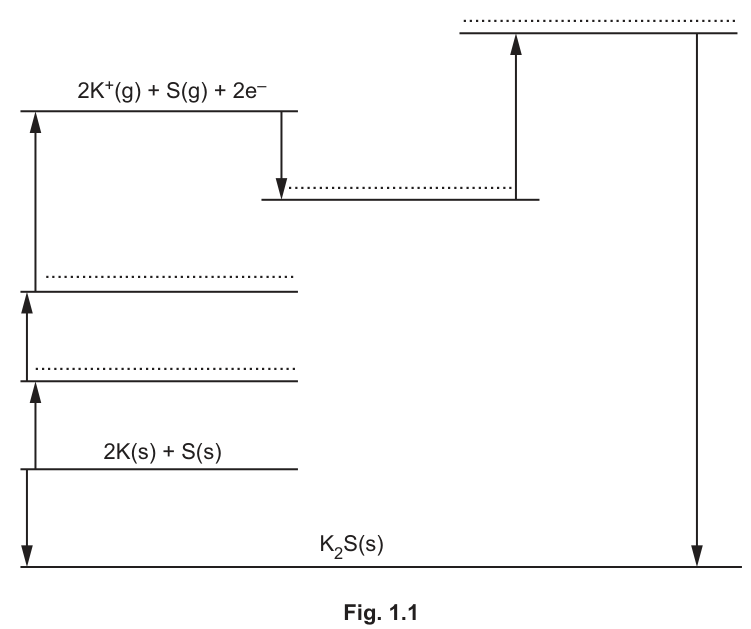
Answer
The completed Born–Haber cycle for K₂S(s) from bottom to top:
- Level 1 (bottom):
- Level 2: []
- Level 3 (first dotted): []
- Level 4 (second dotted): []
- Level 5 (given): []
- Level 6 (third dotted): []
- Level 7 (top dotted): []
- Arrow down from top to bottom: [lattice enthalpy]
See diagram: missing species are 2K(g) + S(s), 2K(g) + S(g), 2K+(g) + S-(g) + e-, and 2K+(g) + S2-(g)
Background Concept
A Born–Haber cycle is a Hess's law cycle that relates the enthalpy of formation of an ionic compound to a series of enthalpy changes that can be measured or looked up:
For a compound like K₂S, the cycle must account for:
- Atomisation of 2 moles of K(s) to 2K(g)
- First ionisation of 2 moles of K(g) to 2K⁺(g) + 2e⁻
- Atomisation of S(s) to S(g)
- First electron affinity of S(g) to S⁻(g) + e⁻
- Second electron affinity of S⁻(g) to S²⁻(g)
- Lattice enthalpy: 2K⁺(g) + S²⁻(g) → K₂S(s)
Understanding the Question
The question provides an incomplete Born–Haber cycle diagram for K₂S and asks to fill in the missing species at each energy level, with state symbols. The diagram shows energy levels with arrows, and four dotted lines need to be labelled.
Approach
Work through the cycle step by step from the elements (2K(s) + S(s)) upward to the gaseous ions (2K⁺(g) + S²⁻(g)), identifying the species at each stage. The cycle then goes from gaseous ions down to the solid (lattice enthalpy).
Step-by-Step Reasoning
Starting from the baseline 2K(s) + S(s):
Step 1 — Atomisation of potassium:
Enthalpy change:
Species at this level:
Step 2 — Atomisation of sulfur:
Enthalpy change:
Species at this level:
Step 3 — Ionisation of potassium:
Enthalpy change:
Species at this level (given):
Step 4 — First electron affinity of sulfur:
Enthalpy change:
Species at this level:
Step 5 — Second electron affinity of sulfur:
Enthalpy change:
Species at this level (top):
Step 6 — Lattice enthalpy:
This is the downward arrow from the top level to K₂S(s).
The four missing dotted levels (from bottom to top) are:
Alternative acceptable paths (mark scheme allows):
- Level 3 could be (ionising K before atomising S)
- Level 4 could be combined differently
The key is that all four missing species/levels are correctly identified with state symbols.
Key Takeaways
- In a Born–Haber cycle, work through each step: atomise elements, ionise metals, add electrons to non-metals, then lattice formation.
- Always include state symbols (s), (g), (aq) — they are essential.
- For compounds with more than one metal atom (like K₂S), multiply the metal-related enthalpies by the stoichiometric coefficient.
Common Mistakes
- Forgetting state symbols on species.
- Writing K(s) instead of 2K(s) or 2K(g) instead of 2K⁺(g).
- Confusing the order of steps (e.g., ionising before atomising is acceptable but must be consistent).
- Forgetting the electrons in intermediate species (e.g., writing 2K⁺(g) + S(g) instead of 2K⁺(g) + S(g) + 2e⁻).
- Not including all four missing levels.
Things to Be Careful About
- State symbols are mandatory for all species.
- The number of atoms/ions must match the formula: 2K, not K.
- Electrons must be shown where they appear (after ionisation, before full electron affinity).
- The cycle must close: the sum of all upward arrows equals the sum of all downward arrows (Hess's law).
Calculate the lattice energy, , of using relevant data from Table 1.1.
Show your working.
Working
From the Born–Haber cycle (Hess's law):
Substituting values from Table 1.1:
Answer
of K₂S(s) = -2116 kJ mol⁻¹
-2116 kJ mol^-1
Background Concept
The Born–Haber cycle applies Hess's law to relate the enthalpy of formation of an ionic compound to its constituent enthalpy changes. For K₂S:
The cycle can be written as: elements → gaseous atoms → gaseous ions → ionic solid.
The sum of all enthalpy changes around the cycle must equal zero (Hess's law). The formation enthalpy equals the sum of all the individual steps leading to the gaseous ions plus the lattice enthalpy.
Understanding the Question
The question asks to calculate the lattice enthalpy of K₂S using data from Table 1.1. The table provides various enthalpy values, but not all are needed — only the six relevant ones for the K₂S Born–Haber cycle.
Approach
- Identify the six correct values from the table.
- Apply the stoichiometric multiplier (×2) for potassium-related values.
- Set up the Hess's law equation and solve for .
Step-by-Step Reasoning
Selecting the correct values:
From Table 1.1, the relevant values for K₂S are:
- (×2 for 2 moles of K)
- (×2 for 2 moles of K)
Values NOT used (distractors):
- Second ionisation energy of potassium (+3070) — K only forms K⁺, not K²⁺
- First ionisation energy of sulfur (+1000) — sulfur gains electrons, doesn't lose them
- Second ionisation energy of sulfur (+2260) — not relevant
- S–S bond energy (+265) — not needed since we atomise S(s) directly
Setting up the equation:
The formation reaction is: ,
The alternative pathway:
- :
- :
- :
- :
- :
- :
By Hess's law:
Key Takeaways
- Always check which values from the table are relevant. Distractors are included to test understanding.
- Multiply metal-related enthalpies by the stoichiometric coefficient (×2 for K in K₂S).
- The lattice enthalpy (formation convention) is always negative (exothermic).
- Error carried forward (ecf) is allowed if the method is correct but an earlier value is wrong.
Common Mistakes
- Using the second ionisation energy of potassium (K only forms K⁺).
- Forgetting to multiply K-related values by 2.
- Including the S–S bond energy (not needed; atomisation enthalpy of S(s) already accounts for this).
- Using the first ionisation energy of sulfur (sulfur gains electrons, doesn't lose them).
- Sign errors: EA1 is negative (-200), EA2 is positive (+640).
- Arithmetic errors in the final calculation.
Things to Be Careful About
- The multiplier (×2) applies ONLY to potassium-related values (atomisation and first ionisation), not to sulfur values.
- State the equation clearly before substituting values.
- The final answer must have the correct unit: kJ mol⁻¹.
- The sign must be negative (lattice enthalpy of formation is exothermic).
Lithium nitrate, , decomposes on heating in a similar way to Group 2 nitrates to give the metal oxide, a brown gas and oxygen.
Write an equation for the decomposition of .
Answer
Equivalent whole-number form:
2LiNO3(s) -> Li2O(s) + 2NO2(g) + 1/2O2(g)
Background Concept
Most Group 1 nitrates decompose on heating to the metal nitrite and oxygen, for example . Lithium nitrate is exceptional because the ion is very small and has a high charge density. It polarises the nitrate ion strongly, so the decomposition follows the Group 2 pattern: the nitrate breaks down to the metal oxide, nitrogen dioxide (, the brown gas) and oxygen. The general Group 2 equation is , and behaves similarly.
Understanding the Question
The question tells you the three products: metal oxide, a brown gas and oxygen. You need to write a balanced equation for the decomposition of . No explanation is required.
Approach
Write the skeleton equation with the three products, then balance each element in turn. Lithium: two Li on the left, so one . Nitrogen: two N on the left, so two . Finally balance oxygen by adding the correct coefficient of .
Step-by-Step Reasoning
Start with . Balance Li: . Balance N: . Count O on the right: gives 1, gives 4, total 5. Left has 6 O from . So one more O atom is needed, i.e. . Hence . An equivalent whole-number version is .
Key Takeaways
Recognise that lithium nitrate is an exception among Group 1 nitrates; its decomposition resembles Group 2 nitrates. The brown gas is nitrogen dioxide, . Balancing can be done with a fractional coefficient for oxygen.
Common Mistakes
- Writing the nitrite product instead of the oxide: is the exception.
- Forgetting oxygen gas as a product.
- Writing an unbalanced equation, especially for oxygen.
- Calling the brown gas NO instead of .
Things to Be Careful About
State symbols are often expected: (s) for solids and (g) for gases. Either the fractional form or the doubled whole-number form is acceptable, but the equation must be balanced.
The other Group 1 nitrates, , decompose on heating to form the metal nitrite, , and oxygen.
The thermal stability of these nitrates increases down the group.
Suggest why the thermal stability of increases down the group.
Answer
Down the group the cation radius / size of increases, so its charge density decreases. The cation therefore has less polarising power, so it distorts/polarises the nitrate ion less and weakens the N–O bond less. The nitrate is more stable, so a higher temperature is needed for decomposition.
Thermal stability increases because cation charge density decreases, reducing polarisation/weakening of the nitrate ion.
Background Concept
The thermal stability of a metal nitrate depends on how strongly the cation polarises the nitrate ion. A small, highly charged cation has a high charge density and strong polarising power. It attracts and distorts the electron cloud of the nitrate ion, weakening the N–O bonds. The more the nitrate ion is distorted, the more easily it decomposes. Down Group 1, the cation radius increases, so charge density decreases and polarising power decreases. The nitrate ion is less distorted and its N–O bonds are less weakened, so the nitrate is more stable and requires a higher temperature to decompose.
Understanding the Question
You are asked to suggest why thermal stability increases down Group 1 for . This is an explanation question, so you must link the trend in cation size to the effect on the nitrate ion.
Approach
Use the chain: cation radius increases down the group charge density decreases polarising power decreases nitrate ion less polarised/distorted N–O bond less weakened more stable.
Step-by-Step Reasoning
State that the cation becomes larger down the group. Because the charge is the same (+1) but the radius increases, the charge density decreases. A lower charge density means the cation is less able to attract and distort the electron cloud of the nitrate ion. Consequently the nitrate ion is less polarised and the N–O bond is less weakened. Since decomposition requires breaking the N–O bond, the nitrate is more stable and needs a higher temperature.
Key Takeaways
Thermal stability of nitrates is governed by cation polarisation. Smaller/higher-charge cations destabilise the nitrate; larger/lower-charge cations stabilise it.
Common Mistakes
- Saying stability increases because the cation is bigger without mentioning polarisation.
- Confusing charge density with charge: all Group 1 cations have the same +1 charge.
- Saying the nitrate ion itself becomes larger down the group (it is the same anion).
Things to Be Careful About
The mark scheme wants both the cation size/charge density point and the effect on the nitrate ion. Use precise terms such as 'polarisation', 'distortion' and 'weakening of the N–O bond'.
Acidified manganate(VII) ions, , can be used to analyse solutions containing nitrite ions, , by titration.
is a solution of .
of is added to of acidified . The ions are in excess; all the ions are oxidised in the reaction.
The unreacted required of to reach the end-point.
The relevant half-equations are shown.
Calculate the concentration, in , of in .
Working
Total added:
used:
Unreacted (1 : 5 ):
that reacted with :
From the half-equations, react with , so:
This amount is in of :
Answer
(0.0607 mol dm)
0.0607 mol dm^-3
Background Concept
This is a back-titration. A known amount of acidified manganate(VII) is added in excess to the nitrite solution. The manganate(VII) oxidises all the nitrite ions to nitrate. The excess manganate(VII) is then titrated with ions. By subtracting the amount of manganate(VII) that reacted with from the total added, you find the amount that reacted with . The half-equations give the stoichiometric ratios.
Understanding the Question
of () is added to of acidified . The is in excess. The unreacted requires of . You need the concentration of in .
Approach
- Convert all volumes to .
- Calculate total moles of added.
- Calculate moles of used, then moles of unreacted using the 5:1 ratio.
- Subtract to find moles of that reacted with .
- Use the 5:2 ratio from the half-equations to find moles of .
- Divide by the volume of () to get concentration.
Step-by-Step Reasoning
Total .
.
Since , unreacted .
that reacted with .
From the half-equations: loses 2e and gains 5e, so react with . Therefore .
This is in , so .
Key Takeaways
Back-titration calculations require careful tracking of which reagent reacted with what. The half-equations are the source of the stoichiometric ratios. Always convert to .
Common Mistakes
- Forgetting to divide moles by 5 to get unreacted .
- Using the wrong ratio (2.5 is correct, not 0.4).
- Dividing by 250 instead of 0.250, or using directly.
- Quoting too many significant figures; 2 or 3 sf is appropriate.
Things to Be Careful About
The titration tells you the excess , not the amount that reacted with nitrite. The ratio from half-equations must balance electrons: and . The final concentration is in ; is equivalent to .
Table 2.1 shows electrode potentials for some electrode reactions involving manganese compounds.
Table 2.1
| electrode reaction | |
|---|---|
| -1.18 | |
| +1.23 | |
| +0.56 | |
| +1.67 | |
| +1.52 | |
| +0.59 | |
| +0.60 | |
| +1.70 |
Aqueous manganate(VI) ions, , are unstable in acidic conditions and undergo a disproportionation reaction.
The for this reaction is .
Construct an overall ionic equation for this disproportionation reaction.
Answer
Oxidation: (×2)
Reduction:
Adding:
3MnO4^2- + 4H+ -> 2MnO4^- + MnO2 + 2H2O
Background Concept
Disproportionation is a redox reaction in which the same species is both oxidised and reduced. For , the oxidation state of Mn is +6. It can be oxidised to (Mn +7) or reduced to (Mn +4). In acid, the two relevant electrode reactions are:
The cell potential is , so the reaction is feasible.
Understanding the Question
You are told that disproportionates in acid and given . You must construct the overall ionic equation for the disproportionation.
Approach
Write the oxidation half-equation () and the reduction half-equation (). Balance electrons, then add the two half-equations.
Step-by-Step Reasoning
Oxidation: .
Reduction: .
Multiply oxidation by 2: .
Add: .
Check: atoms and charge balance. Left charge ; right charge . O: left 12, right . H: left 4, right 4.
Key Takeaways
To combine half-equations, balance electrons first. The species that disproportionates appears as a reactant and in both products. The higher value corresponds to the reduction half-reaction.
Common Mistakes
- Writing and on the same side as reactants.
- Forgetting to multiply the oxidation half-equation by 2.
- Not balancing charge or atoms.
Things to Be Careful About
Use the acid conditions: and appear in the reduction half-equation. The final equation must be balanced in both atoms and charge.
Suggest and explain how the value of the disproportionation reaction changes with an increase in pH.
Answer
decreases / becomes less positive. Increasing pH lowers , so the equilibrium in the half-reaction, which consumes , shifts to the left. This makes its reduction potential less positive, so decreases.
Ecell decreases (becomes less positive)
Background Concept
Electrode potentials depend on the concentrations of species in the half-cell (Nernst equation). For a half-reaction involving , changing pH changes the potential. Here the reduction half-reaction consumes ; the oxidation half-reaction does not involve .
Understanding the Question
You need to suggest and explain how for the disproportionation changes when pH increases. Increasing pH means decreases.
Approach
Apply Le Chatelier's principle to the half-reaction that contains . A decrease in shifts the equilibrium to the left, making the reduction potential less positive. Since the other half-reaction is unaffected, decreases.
Step-by-Step Reasoning
The relevant is . The first half-reaction has on the left. With higher pH, is lower, so the equilibrium shifts to the left, meaning the oxidised form is less readily reduced. Its reduction potential becomes less positive. The oxidation potential of is unchanged. Hence decreases / becomes less positive. In strongly alkaline conditions the table shows , much smaller than .
Key Takeaways
pH affects only half-reactions containing or . Increasing pH usually makes a reduction potential less positive if is a reactant.
Common Mistakes
- Saying increases because pH increases.
- Ignoring which half-reaction contains .
- Confusing pH with without linking to .
Things to Be Careful About
The answer must state both the direction of change and the reason. 'Decreases' or 'becomes less positive' is required; 'less feasible' is not enough on its own.
Carbon disulfide, , is flammable and reacts readily with oxygen, as shown in reaction 1.
Table 3.1 shows the standard enthalpy of formation, , and the standard entropy, , for some substances.
Table 3.1
| 116.7 | 0.0 | -393.5 | -296.8 | |
| 237.8 | 205.2 | 213.8 | 248.2 |
Calculate the standard Gibbs free energy change, , in , for reaction 1 at .
Working
At , .
Answer
-1061.1 kJ mol^-1
Background Concept
Gibbs free energy links enthalpy and entropy: . A reaction is feasible (spontaneous) under the stated conditions when is negative. For a reaction, can be obtained from standard enthalpies of formation using products minus reactants, and can be obtained from standard entropies using products minus reactants. Because values are in kJ mol and values are in J K mol, must be converted to kJ K mol before substitution.
Understanding the Question
Reaction 1 is . The table gives and for each substance. We need at , i.e. . This requires calculating both and first.
Approach
Use the same products-minus-reactants pattern for both and . Remember that is an element in its standard state, so its is zero. Convert from J to kJ, then substitute into with .
Step-by-Step Reasoning
- Calculate :
This equals .
2. Calculate :
- Apply Gibbs:
The negative value shows the reaction is feasible at . The mark scheme accepts values in the range to kJ mol depending on rounding.
Key Takeaways
- and are both found by products minus reactants, using the correct stoichiometric coefficients.
- Always convert to the same energy unit as before using .
- A negative means the reaction is feasible under those conditions.
Common Mistakes
- Using values in the enthalpy calculation or values in the entropy calculation.
- Forgetting to multiply by the stoichiometric coefficients.
- Using in J K mol with in kJ mol without converting, giving a off by a factor of 1000.
- Using or getting the sign of wrong.
- Using instead of .
- Quoting fewer than 3 significant figures.
Things to Be Careful About
- must be in kelvin; .
- has , but its standard entropy is not zero.
- Keep the negative signs throughout; the final is negative.
- Give the final answer in kJ mol with at least 3 significant figures.
Carbon disulfide reacts with chlorine to form tetrachloromethane, as shown in reaction 2.
Calculate the maximum temperature, in , for reaction 2 to be feasible.
Working
At the maximum feasible temperature, .
(using )
Answer
(716 K to 3 s.f.)
715.7 K
Background Concept
A reaction is feasible when is zero or negative. The Gibbs equation is . For reaction 2, both and are negative. This means (in kJ mol). At low temperature the negative dominates and is negative; as increases, the positive term grows and eventually makes positive. The boundary between feasible and not feasible is .
Understanding the Question
Reaction 2 is with and . We need the maximum temperature in K for the reaction to be feasible. Because and have the same sign, there is a temperature limit.
Approach
Convert to kJ K mol. Set at the boundary and rearrange to . Since both values are negative, is positive. The reaction is feasible for temperatures below this value.
Step-by-Step Reasoning
- Convert: .
- At the boundary, , so .
- .
- For , is negative, so the reaction is feasible. For , is positive, so it is not feasible. Hence the maximum temperature is (or to 3 s.f.). The mark scheme accepts 715.7/716/715 K.
Key Takeaways
- When and have the same sign, there is a temperature at which .
- For negative and negative , the reaction is feasible only below this temperature.
- Always convert to kJ before using the Gibbs equation with in kJ.
Common Mistakes
- Using in J K mol with in kJ mol, giving instead of K.
- Forgetting that both and are negative, so the two negatives cancel in .
- Saying the reaction is feasible above this temperature; it is feasible below it.
- Quoting fewer than 3 significant figures.
Things to Be Careful About
- Temperature must be in kelvin, not .
- Use for the maximum feasible temperature.
- Keep the signs consistent; the final temperature is positive.
- Give the answer to at least 3 significant figures with the unit K.
Answer
The 3d and 4s sub-shells (or orbitals) are close in energy.
The 3d and 4s sub-shells are close in energy.
Background Concept
Transition elements are defined by the presence of incomplete d-subshells in their atoms or common ions. A key characteristic is their ability to exhibit variable oxidation states. This arises because the energy difference between the outermost s-subshell and the d-subshell of the same principal quantum number (e.g., 4s and 3d for the first transition series) is very small.
Understanding the Question
The question asks for the reason behind the variable oxidation states observed in transition elements. This is a direct recall question testing the understanding of electronic structure in transition metals.
Approach
Recall the electronic configuration of transition metals and the relative energies of the valence orbitals. The 4s and 3d orbitals are close in energy, meaning electrons from both can be involved in bonding or removed during ionization to varying extents.
Step-by-Step Reasoning
- Transition metals have electrons in both the ns and (n-1)d orbitals (e.g., 4s and 3d for Sc to Zn).
- The energy levels of the 4s and 3d sub-shells are very similar (close in energy).
- Because the energy difference is small, electrons can be removed from either sub-shell with comparable ease.
- This allows for the loss of varying numbers of electrons, leading to multiple stable oxidation states (e.g., Fe can be +2 or +3, Mn can be +2, +3, +4, +6, +7).
Key Takeaways
Variable oxidation states in transition metals are due to the similar energies of the ns and (n-1)d orbitals, allowing electrons from both to be used in bonding.
Common Mistakes
- Stating that 'd-orbitals are partially filled' is not the direct reason for variable oxidation states; it's the energy proximity of s and d orbitals.
- Confusing this with the reason for catalytic activity or coloured complexes.
Things to Be Careful About
- Be precise with terminology: 'sub-shells' or 'orbitals' and 'close in energy' or 'similar in energy'. Avoid vague statements like 'electrons are easily removed' without mentioning the specific orbitals and their energy relationship.
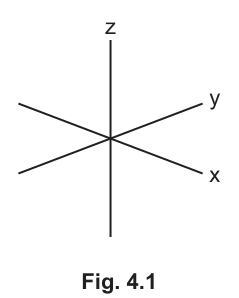
Answer
See diagram
Background Concept
The d-subshell consists of five orbitals: , , , , and . Four of these have a cloverleaf shape with four lobes in the respective planes. The orbital is unique; it has a different shape to accommodate the mathematical solution of the wave equation for that specific angular momentum.
Understanding the Question
The candidate is asked to sketch the orbital on a set of 3D axes (x, y, z). The '3' indicates the principal quantum number, but the shape is characteristic of all orbitals.
Approach
Recall the specific shape of the orbital: two lobes along the z-axis and a torus (doughnut-shaped ring) in the xy-plane. Ensure the axes are labelled correctly.
Step-by-Step Reasoning
- Draw three mutually perpendicular axes labelled x, y, and z.
- Along the z-axis, draw two lobes (teardrop shapes) pointing in opposite directions (positive and negative z). These are the main lobes.
- In the xy-plane (perpendicular to the z-axis), draw a ring or torus (doughnut shape) encircling the nucleus at the origin. This ring lies in the plane where the probability density of the z-lobes is zero.
- The axes should be clearly labelled.
Key Takeaways
The orbital is distinct from the other four d-orbitals, featuring two axial lobes and an equatorial torus.
Common Mistakes
- Drawing four lobes for the orbital (confusing it with or ).
- Forgetting the torus/ring in the xy-plane.
- Not labelling the axes.
Things to Be Careful About
- The torus is often drawn as a simple ring or a shaded doughnut. Ensure it is clearly in the xy-plane (perpendicular to the z-axis).
Samples of are reacted separately with an excess of solution and with an excess of solution .
The reaction of with solution is a precipitation reaction.
The reaction of with solution is a ligand substitution reaction.
Suggest a possible identity for solution and for solution . Give relevant observations and the formula of the copper-containing product for each reaction.
solution ..................................................................................................................
observations .............................................................................................................................
formula of the copper-containing product .................................................................................
solution ..................................................................................................................
observations .............................................................................................................................
formula of the copper-containing product .................................................................................
Answer
Solution A: NaOH(aq) (or OH⁻(aq))
Observations: Pale blue precipitate (forms)
Formula of product: (or )
Solution B: NH₃(aq) (or HCl(aq))
Observations: Dark/deep blue solution (if NH₃) OR yellow solution (if HCl)
Formula of product: (if NH₃) OR (if HCl)
A: NaOH, pale blue ppt, Cu(OH)2. B: NH3, dark blue solution, [Cu(NH3)4(H2O)2]2+ (or B: HCl, yellow solution, [CuCl4]2-)
Background Concept
Aqueous copper(II) ions exist as the hexaaquacopper(II) complex, , which is pale blue. When other reagents are added, two main types of reactions can occur:
- Precipitation: If a reagent provides an anion that forms an insoluble copper compound (like OH⁻), a precipitate forms.
- Ligand Substitution (Ligand Exchange): If a reagent provides a ligand that can replace water molecules in the coordination sphere (like NH₃ or Cl⁻), a new complex ion is formed, often with a different colour.
Understanding the Question
We are given reacting with excess solution A (precipitation) and excess solution B (ligand substitution). We must identify plausible reagents for A and B, state the observations, and give the formula of the copper-containing product for each.
Approach
- For A (precipitation): Think of a common reagent that precipitates Cu²⁺. Sodium hydroxide (NaOH) is the standard choice, forming copper(II) hydroxide.
- For B (ligand substitution): Think of common ligands that substitute water in Cu²⁺ complexes. Ammonia (NH₃) and chloride ions (Cl⁻ from HCl) are the standard examples taught in A-Level Chemistry.
- Match reagents to observations and products.
Step-by-Step Reasoning
Solution A (Precipitation):
- Reagent: NaOH(aq) or OH⁻(aq).
- Reaction: . (Note: is often written as to show it's derived from the aqua complex, but is accepted).
- Observation: A pale blue precipitate (solid) forms. (Note: with excess NaOH, the precipitate does not dissolve, unlike with Al³⁺ or Zn²⁺).
- Product formula: or .
Solution B (Ligand Substitution):
- Option 1: Ammonia (NH₃(aq)).
- Reaction: . (4 water molecules are replaced by 4 ammonia molecules; the complex is tetraamminecopper(II)).
- Observation: The pale blue solution turns to a dark/deep blue solution.
- Product formula: (or simply if water ligands are omitted, but the mark scheme allows the hydrated form).
- Option 2: Hydrochloric acid (HCl(aq) or Cl⁻(aq)).
- Reaction: . (With concentrated HCl/excess Cl⁻, yellow tetrachloridocuprate(II) forms).
- Observation: The solution turns yellow (or green if intermediate, but yellow is the final product with excess Cl⁻).
- Product formula: .
Any valid pair from the above (A=NaOH, B=NH3 or B=HCl) earns the marks.
Key Takeaways
- Cu²⁺(aq) gives a pale blue precipitate with OH⁻ (precipitation, no dissolution in excess).
- Cu²⁺(aq) gives a deep blue solution with excess NH₃ (ligand substitution).
- Cu²⁺(aq) gives a yellow solution with excess Cl⁻ (ligand substitution, requires high [Cl⁻]).
Common Mistakes
- Stating that the blue precipitate with NaOH dissolves in excess (it doesn't; Zn²⁺ and Al³⁺ do).
- Writing the formula for the ammonia complex as without water ligands is often accepted, but is more precise as per the mark scheme.
- Confusing the colour changes (e.g., saying green for NH3).
Things to Be Careful About
- Ensure the product formula has the correct charge (e.g., is negative, is positive).
- 'Observations' must include the colour and state (precipitate/solution).
Solutions containing the complex are colourless.
Explain why this complex is colourless.
Answer
The Ag⁺ ion has a full (complete) d-subshell (d¹⁰). There are no d electrons to be excited/promoted (no d-d transitions possible).
Ag+ is d10 (full d-subshell); no d-d transitions.
Background Concept
Colour in transition metal complexes arises from the absorption of visible light, which promotes electrons from lower-energy d-orbitals to higher-energy d-orbitals (d-d transitions). The energy gap between these split d-orbitals often corresponds to the energy of visible light photons.
- For d-d transitions to occur, the d-subshell must be partially filled (i.e., have at least one electron and at least one empty orbital).
- If the d-subshell is empty (d⁰, e.g., Sc³⁺) or full (d¹⁰, e.g., Zn²⁺, Ag⁺), d-d transitions cannot occur. Consequently, these ions/complexes are typically colourless (or white).
Understanding the Question
We are given the complex and told it is colourless. We must explain why, based on the electronic structure of the central metal ion.
Approach
- Identify the central metal ion and its oxidation state: Ag in is Ag⁺.
- Determine the electron configuration of Ag⁺.
- Relate the d-electron count to the possibility of d-d transitions.
Step-by-Step Reasoning
- Silver (Ag) is in Group 11. Atomic number 47. Configuration: .
- The Ag⁺ ion loses the 5s electron. Configuration: .
- The d-subshell is completely full (d¹⁰).
- Because the d-orbitals are full, there are no vacant d-orbitals of higher energy within the subshell for an electron to be promoted to. Therefore, no d-d transitions can occur.
- Without d-d transitions, visible light is not absorbed, and the complex appears colourless.
Key Takeaways
- Colour requires partially filled d-orbitals (d¹ to d⁹).
- d⁰ (Sc³⁺, Ti⁴⁺) and d¹⁰ (Zn²⁺, Cu⁺, Ag⁺) complexes are colourless because d-d transitions are impossible.
Common Mistakes
- Saying 'there are no electrons in the d-orbitals' (wrong for Ag⁺, it has 10).
- Saying 'the ligands don't cause splitting' (ligands always cause splitting, but if d is full, no transition happens).
- Not mentioning 'd-d transition' or 'excitation'.
Things to Be Careful About
- Be precise: 'full d-subshell' or 'd¹⁰'.
- Must mention 'no d-d transition' or 'no electrons to be excited'.
Two bidentate ligands are shown in Fig. 4.2.
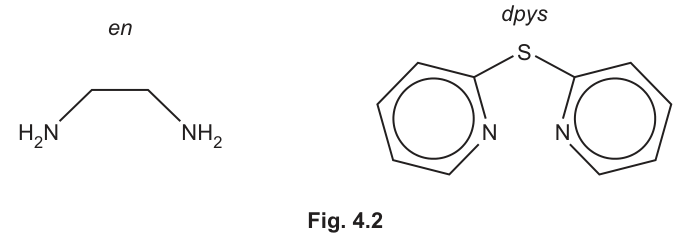
Explain what is meant by a bidentate ligand.
Answer
A species that has two lone pairs of electrons (which can be donated) to form two dative (co-ordinate) bonds with a central metal atom or ion.
Species with two lone pairs forming two dative bonds to a metal ion.
Background Concept
A ligand is an ion or molecule that donates a pair of electrons to a central metal ion to form a coordinate (dative covalent) bond. Ligands are classified by the number of donor atoms they use:
- Monodentate: One donor atom (e.g., H₂O, NH₃, Cl⁻).
- Bidentate: Two donor atoms (e.g., ethane-1,2-diamine 'en', oxalate ion 'ox').
- Multidentate: Three or more donor atoms (e.g., EDTA⁴⁻, which is hexadentate).
Understanding the Question
The question asks for the definition of a 'bidentate ligand', shown with examples like 'en' (ethane-1,2-diamine) and 'dpys'.
Approach
Define 'ligand' briefly in context, then specify the 'bi' (two) part: two lone pairs forming two coordinate bonds.
Step-by-Step Reasoning
- A ligand must have at least one lone pair of electrons to donate.
- 'Bidentate' means 'two-toothed'.
- Therefore, a bidentate ligand is a molecule or ion that contains two atoms, each with a lone pair of electrons, that can simultaneously donate these pairs to a central metal ion.
- This forms two dative (coordinate) bonds, creating a ring structure (chelate ring) with the metal ion.
Key Takeaways
- Bidentate = 2 donor atoms/lone pairs.
- Forms 2 coordinate bonds.
- Creates a chelate effect (increased stability).
Common Mistakes
- Saying 'two bonds' without specifying 'dative' or 'coordinate' or 'lone pairs'.
- Saying 'two electrons' instead of 'two lone pairs'.
- Confusing with bivalent (charge of +2).
Things to Be Careful About
- Must mention 'two lone pairs' (or two donor atoms) AND 'two dative/co-ordinate bonds'.
Ruthenium(III) ions, , form an octahedral complex, , with the ligands dpys and chloride ions.
This complex shows the same kind of stereoisomerism as but also shows a different type of stereoisomerism.
Complete the three-dimensional diagrams in Fig. 4.3 to show the three different stereoisomers of .
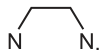
The dpys ligand can be represented using
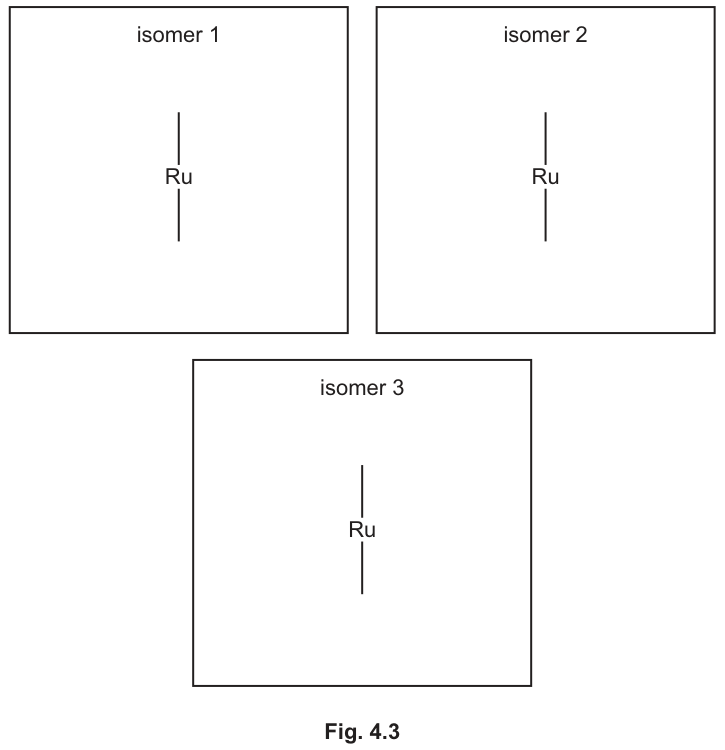
Answer
See diagram
Background Concept
Octahedral complexes of the type or (where a, b, c are ligands) can show stereoisomerism.
- Cis-trans (geometrical) isomerism: Occurs when two identical ligands are either adjacent (cis, 90°) or opposite (trans, 180°).
- Optical isomerism: Occurs when a molecule is non-superimposable on its mirror image (chiral). In octahedral complexes, this often happens with bidentate ligands in the cis configuration. The trans isomer usually has a plane of symmetry and is achiral (superimposable on its mirror image).
The complex is . Let 'dpys' be represented as a bidentate ligand with two N donor atoms (N-N arc).
- Total coordination number = 6 (octahedral).
- Ligands: 2 dpys (each takes 2 sites, so 4 sites total) + 2 Cl⁻ (2 sites). Total = 6.
Understanding the Question
We need to draw three stereoisomers in 3D diagrams (using the provided shorthand for dpys and a vertical axis for axial bonds). The complex has cis and trans forms. The cis form has optical isomers. So we need: cis-enantiomer 1, cis-enantiomer 2, and trans-isomer.
Approach
- Trans isomer: The two Cl ligands are opposite each other (180°). Place them on the vertical axis (top and bottom). The two bidentate dpys ligands must occupy the equatorial plane (four sites in a square plane). Draw the N-N arcs connecting adjacent equatorial positions.
- Cis isomers: The two Cl ligands are adjacent (90°). Place one Cl on the vertical axis (top) and one Cl on an equatorial position (e.g., right). The two dpys ligands occupy the remaining four sites. Because the dpys ligands are bidentate and span adjacent positions, the arrangement can be chiral. Draw two non-superimposable mirror images (enantiomers).
Step-by-Step Reasoning
Isomer 3 (Trans):
- Central Ru atom.
- Vertical axis: Cl at top, Cl at bottom.
- Equatorial plane: Four positions. Two dpys ligands. Each dpys connects two adjacent equatorial positions. E.g., one arc from top-right to bottom-right (wait, equatorial is a plane: front, back, left, right). Let's say positions are Front, Back, Left, Right. Arc 1 connects Front-Right. Arc 2 connects Back-Left. Or Arc 1 connects Front-Right and Arc 2 connects Back-Left? No, bidentate ligands span 90°. So Arc 1 connects Front and Right. Arc 2 connects Back and Left. This is the trans isomer. It has a plane of symmetry (vertical plane containing Cl-Ru-Cl and bisecting the ligands? Actually, trans-[M(bidentate)2X2] is achiral).
- Drawing: Ru in center. Cl up, Cl down. Equatorial: N-N arc (top-right to bottom-right? No, equatorial is horizontal plane). Let's use standard 3D drawing: vertical line for axial. Horizontal lines for equatorial (one solid, one dashed, or just a plane). The mark scheme shows: Cl top, Cl bottom. Equatorial: two arcs. One arc N-N from left-front to right-front? No, the mark scheme image shows: Cl top, Cl bottom. Equatorial plane has two dpys ligands. One dpys is N-N arc connecting left and front-right? Let's describe it generally: Two Cl trans (axial). Two dpys in equatorial plane.
Isomers 1 and 2 (Cis - Optical Isomers):
- Central Ru atom.
- One Cl axial (top). One Cl equatorial (e.g., right).
- The remaining four positions (bottom axial, left equatorial, front equatorial, back equatorial) are occupied by two dpys ligands.
- Actually, if Cl is top and right: positions left, front, back, bottom are left. dpys 1 could span front-bottom. dpys 2 could span back-left. This forms a chiral structure.
- Draw the mirror image for the second isomer (Cl top, left; dpys arranged oppositely).
- The mark scheme shows: Isomer 1 and Isomer 2 are the cis enantiomers. Cl are cis (e.g., one wedge, one dash, or one axial one equatorial). The dpys ligands are drawn as arcs.
- Isomer 3 is trans: Cl axial top and bottom. dpys ligands in the equatorial plane.
Note for the candidate: In the exam, you would draw these on the provided axes. Use the shorthand: two 'N's connected by a curved line (arch) to represent the bidentate dpys ligand. Ensure 3D perspective (wedges/dashes or 3D box representation) is used to show chirality in the cis isomers.
Key Takeaways
- type complexes show both cis-trans and optical isomerism.
- Trans isomer: X ligands opposite. Achiral (dipoles cancel, superimposable on mirror image).
- Cis isomer: X ligands adjacent. Chiral (exists as a pair of non-superimposable mirror images).
Common Mistakes
- Drawing the trans isomer with Cl cis.
- Drawing the cis isomers as identical (failing to show optical isomerism/mirror images).
- Forgetting the 3D aspect (wedges/dashes) needed to show optical isomerism.
- Incorrectly connecting the N atoms of the dpys shorthand (must connect adjacent coordination sites, 90° apart).
Things to Be Careful About
- The shorthand for dpys is two N's with an arch. Ensure the N's are at the correct coordination sites (90° apart for bidentate).
- In the trans isomer, the two Cl must be 180° apart.
- In the cis isomers, the two Cl must be 90° apart, and the two drawings must be non-superimposable mirror images.
Answer
Optical isomerism and cis-trans (geometrical) isomerism.
Optical and cis-trans (geometrical)
Background Concept
Stereoisomers have the same connectivity but different spatial arrangement.
- Cis-trans (geometrical) isomerism: Isomers where ligands are in different positions relative to each other (e.g., adjacent vs opposite in an octahedral complex).
- Optical isomerism: Isomers that are non-superimposable mirror images of each other (enantiomers). They have chiral centers or overall chirality.
Understanding the Question
The question asks to state the types of stereoisomerism shown by . From part (e)(i), we drew cis and trans forms (cis-trans isomerism) and two non-superimposable mirror images for the cis form (optical isomerism).
Approach
Simply name the two types observed.
Step-by-Step Reasoning
- The existence of cis and trans forms demonstrates cis-trans (or geometrical) isomerism.
- The existence of two non-superimposable mirror images (enantiomers) for the cis form demonstrates optical isomerism.
Key Takeaways
Complexes with bidentate ligands and two monodentate ligands of the same type () typically show both cis-trans and optical isomerism.
Common Mistakes
- Saying 'structural isomerism' (wrong, connectivity is the same).
- Forgetting 'geometrical' if saying 'cis-trans'.
- Only stating one type.
Things to Be Careful About
- Use the exact terms: 'optical' and 'cis-trans' (or 'geometrical').
Answer
The trans isomer (isomer 3) is non-polar. The bond dipoles (or partial charges) cancel out due to the symmetrical arrangement (opposite ligands).
Trans isomer; dipoles cancel.
Background Concept
A molecule or complex ion is non-polar if the individual bond dipoles cancel out due to symmetry. In an octahedral complex:
- Trans isomer: Identical ligands are opposite each other (180°). The dipoles from these ligands are equal and opposite, so they cancel. If the other ligands are also arranged symmetrically (as in the trans isomer of , where the bidentate ligands are in the equatorial plane and symmetric), the overall dipole moment is zero.
- Cis isomer: Identical ligands are adjacent (90°). Their dipoles do not cancel; they add up to a net dipole moment. The complex is polar.
Understanding the Question
Deduce which stereoisomer from (e)(i) is non-polar and explain why.
Approach
Look at the symmetry of the trans vs cis isomers. The trans isomer has a center of inversion or planes of symmetry that cause dipoles to cancel.
Step-by-Step Reasoning
- In the trans isomer, the two Cl ligands are opposite each other (top and bottom). Their bond dipoles cancel.
- The two bidentate dpys ligands are in the equatorial plane, arranged symmetrically. Their contributions also cancel or are symmetric.
- Overall, the trans isomer has a symmetrical charge distribution; dipoles cancel (or partial charges cancel).
- In the cis isomers, the two Cl ligands are at 90°. Their dipoles do not cancel, resulting in a net dipole moment (polar). Also, the cis isomers are chiral and lack the symmetry planes that would cancel dipoles in the trans form.
- Therefore, the trans isomer is non-polar.
Key Takeaways
- Trans isomers of octahedral complexes with symmetric ligand arrangements are often non-polar (dipoles cancel).
- Cis isomers are usually polar.
Common Mistakes
- Saying the cis isomer is non-polar.
- Not explaining why (must mention dipoles cancel or symmetry).
- Saying 'no dipoles' (there are bond dipoles, they just cancel).
Things to Be Careful About
- Specify 'trans isomer'.
- Explanation must mention 'dipoles cancel' or 'symmetrical' or 'partial charges cancel'.
Nitrosyl chloride, , can be formed by the reaction between nitrogen monoxide and chlorine, as shown.
The initial rate of this reaction is investigated, starting with different concentrations of and . The results obtained are shown in Table 5.1.
Table 5.1
| experiment | initial rate / | ||
|---|---|---|---|
| 1 | 0.0250 | 0.0150 | |
| 2 | 0.0750 | 0.0150 | |
| 3 | 0.0500 | 0.0600 |
Use the data in Table 5.1 to deduce the rate equation for this reaction.
Explain your reasoning.
Working
Order with respect to NO: Comparing experiments 1 and 2, is constant.
increases by a factor of
Rate increases by a factor of
order with respect to NO = 2
Order with respect to : Comparing experiments 1 and 3, doubles and quadruples.
Rate increases by a factor of
Contribution from NO:
Contribution from :
order with respect to = 1
Answer
rate = k[NO]²[Cl₂]
Background Concept
The rate equation expresses the relationship between the rate of a reaction and the concentrations of the reactants, each raised to a power called the order with respect to that reactant. The orders are determined experimentally and do not necessarily correspond to the stoichiometric coefficients in the balanced equation. To deduce orders from initial rate data, we compare experiments where only one reactant concentration changes at a time (or where we can mathematically separate the effects).
Understanding the Question
The question provides three experiments with varying concentrations of NO and Cl₂ and the corresponding initial rates. We must use the data to determine the order with respect to each reactant and then write the complete rate equation. The command word is "deduce" with the instruction to "explain your reasoning," so the working showing how each order is determined is essential for the marks.
Approach
- Find two experiments where one concentration is held constant so the effect of the other can be isolated.
- Calculate the factor by which concentration and rate change, then use the relationship to find the order.
- When no pair holds one variable constant, use the already-determined order to isolate the effect of the second variable.
- Combine into the rate equation.
Step-by-Step Reasoning
Finding the order with respect to NO (M1):
Experiments 1 and 2 both have mol dm⁻³, so any change in rate is due solely to the change in .
changes from 0.0250 to 0.0750, a factor of 3.
Rate changes from to , a factor of .
Since , the order with respect to NO is 2.
Finding the order with respect to Cl₂ (M2):
No pair of experiments holds constant while varying , so we use experiments 1 and 3 where both change.
doubles (factor 2), quadruples (factor 4).
Rate factor = .
We already know the order with respect to NO is 2, so the contribution from the doubling of NO is .
The remaining factor must come from Cl₂: .
Since , the order with respect to Cl₂ is 1.
Writing the rate equation (M3):
Combining: rate = k[NO]²[Cl₂]
Key Takeaways
- When one concentration is held constant between two experiments, the rate ratio directly gives the order of the other reactant.
- When both concentrations change, you must first determine one order, then use it to subtract its contribution from the overall rate factor to isolate the effect of the second reactant.
- The overall order is the sum of individual orders (here, 2 + 1 = 3, a third-order reaction).
Common Mistakes
- Assuming the orders match the stoichiometric coefficients (the equation shows 2NO + Cl₂, but the orders must be determined experimentally — here they happen to match, but this is not guaranteed).
- Failing to account for the contribution of the already-determined order when both concentrations change simultaneously.
- Rounding the rate ratio incorrectly (e.g., getting 8.9 and concluding first order rather than recognising it as 9 = 3²).
Things to Be Careful About
- Clearly state which experiments you are comparing and which concentration is held constant (or how you separate the effects).
- The mark scheme requires the reasoning to be shown, not just the final rate equation.
- Small experimental errors mean ratios may not be exact integers; recognise the nearest whole-number relationship.
Use your rate equation from (a)(i) and the data from experiment 1 to calculate the rate constant, , for this reaction. Include the units of .
Working
Units: rate has units mol dm⁻³ min¹; has units mol³ dm⁻⁹.
Answer
(2 s.f.)
units =
k = 3900 dm⁶ mol⁻² min⁻¹
Background Concept
The rate constant is the proportionality factor in the rate equation. Its numerical value and units depend on the overall order of the reaction. For a reaction of overall order , the units of are . For a third-order reaction (), this gives .
Understanding the Question
Using the rate equation determined in part (a)(i) and the data from experiment 1, calculate the numerical value of and state its units. The question explicitly asks for units, so these must be derived, not guessed.
Approach
- Rearrange the rate equation to isolate .
- Substitute the values from experiment 1.
- Derive units by dividing the units of rate by the units of the concentration terms.
Step-by-Step Reasoning
Substitution (M1):
Denominator: ; multiplied by .
To 2 significant figures: (or ).
The mark scheme allows ecf from part (a)(i), so if a different rate equation was written, the substitution should be consistent with it.
Units (M2):
Rate units: mol dm⁻³ min⁻¹
Concentration term units: = (mol dm⁻³)² × (mol dm⁻³) = mol³ dm⁻⁹
units = (mol dm⁻³ min¹) / (mol³ dm⁻⁹) = mol⁻² dm⁶ min⁻¹
This can also be written as dm⁶ mol⁻² min⁻¹ (the mark scheme gives this order).
Key Takeaways
- The units of are not fixed; they change with the overall order of the reaction.
- A quick check: for overall order , the units of must make the rate equation dimensionally consistent.
- Always give the answer to at least 2 significant figures as required by the mark scheme.
Common Mistakes
- Writing units as mol⁻² dm s⁻¹ when the rate is given in min⁻¹ (must match the time unit in the data).
- Forgetting to square the NO concentration in the denominator.
- Giving the answer to only 1 or 2 significant figures when more precision is available (though the mark scheme specifies minimum 2 s.f.).
- Incorrectly deriving units by forgetting that the concentration term is cubed (three concentration factors total).
Things to Be Careful About
- The mark scheme specifies a minimum of 2 significant figures for the value of .
- Units must be consistent with the time unit used in the rate (min⁻¹ here, not s⁻¹).
- If ecf is applied from part (a)(i), the substitution must be consistent with the (possibly incorrect) rate equation written there.
is another compound containing nitrogen, oxygen and chlorine.
In sunlight, can undergo homolytic fission to release chlorine radicals which can catalyse the conversion of ozone, , into oxygen.
Complete the mechanism for this process.
Answer
Initiation (homolytic fission):
Propagation step 1:
Propagation step 2:
Initiation: NO₂Cl → Cl• + NO₂•; Propagation 1: Cl• + O₃ → ClO• + O₂; Propagation 2: ClO• + O₃ → Cl• + 2O₂
Background Concept
Homogeneous catalysis by radicals involves a catalyst that is in the same phase as the reactants and participates in the reaction mechanism, being regenerated at the end of the cycle. In the stratosphere, chlorine radicals act as catalysts for ozone destruction. The mechanism consists of an initiation step (formation of radicals by homolytic fission, here triggered by sunlight) followed by propagation steps in which the radical reacts with a stable molecule to produce a new radical, which then reacts further to regenerate the original radical. The net effect is the conversion of reactants to products with the catalyst unchanged.
Understanding the Question
The question states that NO₂Cl undergoes homolytic fission in sunlight to release chlorine radicals, which catalyse the conversion of O₃ into O₂. We must complete the three-step mechanism: the initiation (showing the two radical products), and two propagation steps that together consume two O₃ molecules and produce three O₂ molecules while regenerating the Cl• radical.
Approach
- Initiation: homolytic fission of NO₂Cl breaks the N–Cl bond (or the Cl–O bond), giving Cl• and NO₂•.
- Propagation 1: Cl• attacks O₃, abstracting an oxygen atom to form ClO• and O₂.
- Propagation 2: ClO• reacts with another O₃, regenerating Cl• and producing 2O₂.
- Check: adding the two propagation steps gives 2O₃ → 3O₂ (the Cl• cancels as it is regenerated), confirming it is catalytic.
Step-by-Step Reasoning
Initiation:
NO₂Cl has the structure O₂N–Cl. Homolytic fission of the N–Cl bond gives one electron to each fragment:
Both fragments are radicals (one unpaired electron each). The Cl• is the catalytic species.
Propagation step 1:
The chlorine radical is highly reactive and attacks ozone:
Cl• abstracts an oxygen atom from O₃, forming the chlorine monoxide radical ClO• and releasing O₂.
Propagation step 2:
ClO• reacts with another ozone molecule:
ClO• abstracts an oxygen atom from the second O₃, regenerating Cl• and producing two O₂ molecules.
Verification: Adding propagation 1 and 2:
Cl• + O₃ + ClO• + O₃ → ClO• + O₂ + Cl• + 2O₂
Cancelling Cl• and ClO• from both sides: 2O₃ → 3O₂ ✓
The mark scheme awards 2 marks for all three steps correct, or 1 mark for any two steps correct.
Key Takeaways
- In a catalytic radical cycle, the catalyst (Cl•) is consumed in one propagation step and regenerated in another, so it does not appear in the overall equation.
- Each propagation step must produce a new radical to sustain the chain.
- The net reaction of the propagation steps gives the overall catalysed reaction.
Common Mistakes
- Writing ionic equations or forgetting the radical dots (•).
- Producing Cl₂ instead of Cl• in the initiation step (homolytic fission gives radicals, not ions or molecules with paired electrons).
- Failing to regenerate Cl• in the second propagation step, which would mean it is not acting as a catalyst.
- Writing O instead of O₂ as a product.
Things to Be Careful About
- Include the radical dot (•) on all radical species — this is essential notation.
- The initiation step produces two radicals from one molecule (homolytic fission), not heterolytic cleavage.
- Ensure the equation is balanced for atoms in each step.
Ozone reacts with nitrogen dioxide, as shown.
The rate of reaction is first order with respect to and first order with respect to .
Suggest equations for a two-step mechanism for this reaction.
step 1 ........................................................................................................................................
step 2 ........................................................................................................................................
Answer
Step 1 (slow, rate-determining):
Step 2 (fast):
Step 1: O₃ + NO₂ → NO₃ + O₂; Step 2: NO₃ + NO₂ → N₂O₅
Background Concept
For a multi-step reaction, the rate equation reflects the molecularity of the rate-determining step (the slowest step). If the reaction is first order in each of two reactants, the rate-determining step must involve one molecule of each reacting together. The individual steps must sum to give the overall balanced equation, and any species that appears as a product in one step and a reactant in another (an intermediate) cancels out.
Understanding the Question
The overall reaction is O₃ + 2NO₂ → N₂O₅ + O₂, with the rate equation being first order in O₃ and first order in NO₂. We must propose a two-step mechanism where the slow (first) step involves one O₃ and one NO₂ (giving the correct rate equation), and the two steps together sum to the overall equation.
Approach
- The rate-determining step must contain one O₃ and one NO₂ (to match rate = k[O₃][NO₂]).
- This step produces an intermediate that can react with the remaining NO₂ in step 2.
- Check that the two steps sum to the overall equation.
Step-by-Step Reasoning
Step 1 (M1):
Since the reaction is first order in both O₃ and NO₂, the slow step must involve one molecule of each:
This produces NO₃ (the nitrate radical) as an intermediate. The rate of this step = k[O₃][NO₂], which matches the given rate equation.
Step 2 (M2):
The intermediate NO₃ reacts with the second NO₂:
Verification: Adding steps 1 and 2:
O₃ + NO₂ + NO₃ + NO₂ → NO₃ + O₂ + N₂O₅
Cancelling NO₃ (intermediate) from both sides:
O₃ + 2NO₂ → N₂O₅ + O₂ ✓
This matches the overall equation exactly.
The mark scheme also allows an alternative where step 1 gives NO₅ (a combined adduct): O₃ + NO₂ → NO₅, then step 2: NO₅ + NO₂ → N₂O₅ + O₂. Both are acceptable.
Key Takeaways
- The rate-determining step must be consistent with the experimentally determined rate equation.
- Intermediates are produced in one step and consumed in a subsequent step; they do not appear in the overall equation.
- Always verify that the proposed steps sum to the given overall equation.
Common Mistakes
- Making the first step involve 2NO₂ (which would give second order in NO₂, contradicting the given rate equation).
- Forgetting to check that the steps sum to the overall equation.
- Including the intermediate in the overall equation or leaving out a species.
- Writing a step that is not chemically reasonable (e.g., O₃ → O₂ + O without a collision partner when the rate is first order in NO₂ too).
Things to Be Careful About
- The question asks for a mechanism consistent with the rate equation, not just any mechanism that sums to the overall equation. The first step must be the slow step and must involve exactly one O₃ and one NO₂.
- State symbols are not required for this part, but the equations must be balanced for atoms.
- The intermediate (NO₃) must appear as a product in step 1 and a reactant in step 2.
Aqueous solutions of methanoic acid, , and propanoic acid, , are mixed together.
An equilibrium is set up between two conjugate acid–base pairs.
Answer
A conjugate acid–base pair is a pair of species that differ by the presence or absence of a proton, .
A conjugate acid–base pair is a pair of species that differ by the presence or absence of a proton, H+.
Background Concept
In the Brønsted–Lowry theory, an acid is a proton donor and a base is a proton acceptor. A conjugate acid–base pair is two species that are related to each other by the gain or loss of a single proton, . The acid member of the pair has one more proton than the base member. For example, and form a conjugate acid–base pair, as do and .
Understanding the Question
This is a one-mark 'define' question. The examiner wants the precise relationship between the two species in a conjugate acid–base pair: they differ by one proton. No example is required, though giving one can help show understanding.
Approach
State that the two species differ by the presence or absence of a proton. Use the word 'proton' or ' ion' rather than 'hydrogen atom'.
Step-by-Step Reasoning
The mark scheme credits: species/molecules/pair that differ by the presence or absence of a ion/proton. A complete answer therefore has two parts: (1) it is a pair of species, and (2) the difference between them is one proton. For example, and differ by one .
Key Takeaways
A conjugate acid–base pair always differs by exactly one proton. The acid has the proton; the conjugate base does not.
Common Mistakes
- Writing 'differ by a hydrogen atom' instead of 'proton' or ' ion' – this is not accepted because a hydrogen atom contains an electron as well.
- Saying only 'an acid and its base' without stating that they differ by one proton.
Things to Be Careful About
Use the term 'proton' or ' ion'. If you give an example, make sure the two species differ by exactly one .
The of is 3.75 and of is 4.87.
Complete the equation for the Brønsted–Lowry equilibrium between the stronger of these two acids and water.
Answer
HCOOH + H2O ⇌ H3O+ + HCOO-
Background Concept
The strength of a weak acid is measured by its or . The smaller the , the larger the and the stronger the acid. Here has and has , so methanoic acid is the stronger acid.
Understanding the Question
The equation must show the stronger acid, , donating a proton to water. Water acts as a base and becomes the hydronium ion, ; the acid becomes its conjugate base, the methanoate ion, .
Approach
Identify the stronger acid by its lower . Then write the acid dissociation equilibrium: acid + water ⇌ hydronium ion + conjugate base.
Step-by-Step Reasoning
- Compare values: , so is the stronger acid.
- donates to .
- The products are and .
- The equation is .
Key Takeaways
Lower means stronger acid. In water, an acid forms its conjugate base and .
Common Mistakes
- Choosing propanoic acid because it has more carbons – acidity here is judged by , not chain length.
- Writing instead of ; in aqueous solution the proton is hydrated, and the mark scheme expects .
- Writing the conjugate base of propanoic acid, , instead of .
Things to Be Careful About
Use a reversible arrow, , because this is an equilibrium. Include the correct conjugate base with the negative charge.
Answer
Ka = [H+][CH3CH2CH2COO-]/[CH3CH2CH2COOH]
Background Concept
For a weak acid that dissociates as , the acid dissociation constant is . Water is the solvent and is not included.
Understanding the Question
Butanoic acid is . Its conjugate base is . The question asks for the expression only, not a numerical value.
Approach
Write the general expression and substitute the butanoate ion for .
Step-by-Step Reasoning
The dissociation is . Therefore .
Key Takeaways
is products over reactants, with water omitted. The conjugate base carries a negative charge.
Common Mistakes
- Including water in the expression.
- Writing the conjugate base without the negative charge.
- Putting the acid concentration in the numerator.
Things to Be Careful About
Square brackets denote concentration in . The expression has no units in this course; the numerical value of is quoted in for a monoprotic acid.
The of is 4.82.
A solution of has a pH of 3.25.
Calculate the concentration, in , of in this solution.
Working
, so .
.
For a weak acid, , so
Answer
0.0209 mol dm^-3
Background Concept
For a weak acid, and . Because the acid is weak, very little dissociates, so and the equilibrium concentration of the acid is approximately its initial concentration. This gives .
Understanding the Question
We know and for butanoic acid. We need the initial acid concentration.
Approach
Convert to and to . Then rearrange to find .
Step-by-Step Reasoning
- .
- .
- .
Key Takeaways
For weak acids, use when .
Common Mistakes
- Forgetting to convert to and using 4.82 directly.
- Using (inverted).
- Losing the negative sign when converting pH to .
Things to Be Careful About
Give the answer to at least 2 significant figures with unit . The approximation is valid because the acid is weak; the degree of dissociation is only about 2.7%.
Answer
A buffer solution is a solution that resists changes in pH when small amounts of acid () or base () are added.
A buffer solution is a solution that resists changes in pH when small amounts of acid (H+) or base (OH-) are added.
Background Concept
A buffer solution maintains a nearly constant pH despite addition of small amounts of acid or base. It usually contains a weak acid and its conjugate base (or a weak base and its conjugate acid). The conjugate base neutralises added ; the weak acid neutralises added .
Understanding the Question
This is a 2-mark definition. The mark scheme splits it into two ideas: (1) resists/opposes/minimises changes in pH; (2) when small amounts of acid/ and base/ are added.
Approach
Give a complete definition containing both ideas. Do not just say 'maintains pH' – you must mention small amounts of acid and base.
Step-by-Step Reasoning
A full answer: 'A buffer solution is a solution that resists changes in pH when small amounts of acid or base are added.' This earns both marks.
Key Takeaways
Buffers resist pH change, not prevent it completely. The definition must mention small amounts of acid and base.
Common Mistakes
- Saying 'maintains a constant pH' without 'resists changes' – less precise.
- Omitting 'small amounts'.
- Saying it resists changes when 'diluted' – dilution is not the key point.
Things to Be Careful About
Use 'resists' or 'minimises' rather than 'prevents'. Include both acid and base additions.
A buffer solution containing a mixture of and is prepared as follows.
A solution of of is mixed with of .
The buffer solution has pH 5.70. The of is .
Calculate the initial concentration, in , of used.
Working
Total volume after mixing .
Moles of .
In the final , .
Using :
This is the concentration in the final , so moles of at equilibrium .
These moles came from of the original acid solution:
Answer
(0.00936 mol dm)
0.00936 mol dm^-3
Background Concept
A buffer containing a weak acid HA and its conjugate base A- has , or equivalently . When two solutions are mixed, concentrations must be calculated after dilution: moles are conserved, but volume changes.
Understanding the Question
600 cm3 of CH3COOH solution (unknown concentration x) is mixed with 400 cm3 of 0.125 mol dm^-3 CH3COONa. The final buffer pH is 5.70. We need the initial concentration of the CH3COOH solution.
Approach
Find [H+] from pH. Calculate moles of CH3COONa. Use the buffer equilibrium expression to find [HA] in the final mixture. Since final volume is 1 dm3, this concentration equals moles of HA in the mixture. Then divide by the original volume of acid solution (0.600 dm3) to get initial concentration.
Step-by-Step Reasoning
- .
- Moles . In 1.000 dm3, .
- Rearrange : .
- Because final volume is 1.000 dm3, moles HA = 5.62e-3 mol.
- Original acid volume = 0.600 dm3, so initial concentration = 5.62e-3/0.600 = 9.36e-3 mol dm^-3.
Alternative: Henderson-Hasselbalch gives same result: pKa = 4.75; 5.70 = 4.75 + log(0.0500/(0.600x)); x = 9.35e-3.
Key Takeaways
Always account for dilution when mixing solutions. In a buffer, [A-] is essentially the salt concentration and [HA] is the equilibrium acid concentration.
Common Mistakes
- Using concentrations before dilution: forgetting that 600 cm3 acid becomes 0.600x mol in 1 dm3.
- Using [A-] = 0.125 directly without multiplying by volume.
- Forgetting to divide by 0.600 at the end.
- Using pH = pKa + log([A-]/[HA]) but not converting volumes to dm3.
Things to Be Careful About
Use dm3 for volume in concentration calculations. The small amount of HA that dissociates is negligible compared with 0.600x, so [HA] equilibrium ≈ [HA] initial after mixing. Give final answer to at least 2 significant figures with unit.
A fuel cell is an electrochemical cell that can be used to generate electrical energy by using oxygen to oxidise a fuel.
Methanoic acid, , is being investigated as a fuel in fuel cells.
When the cell operates, is oxidised to carbon dioxide.
The half-equation for the reaction at the cathode is: .
In this fuel cell, the overall cell reaction is the same as that for the complete combustion of .
Answer
HCOOH -> CO2 + 2H+ + 2e-
Background Concept
In a fuel cell, oxidation occurs at the anode and reduction at the cathode. Methanoic acid is oxidised to carbon dioxide. Balancing a half-equation requires equal numbers of atoms and equal total charge on both sides.
Understanding the Question
The cathode half-equation is given: . We need the anode half-equation for .
Approach
Balance carbon and oxygen first, then balance hydrogen using , then balance charge using electrons.
Step-by-Step Reasoning
- Carbon: 1 C on each side.
- Oxygen: 2 O on each side.
- Hydrogen: left has 2 H, right has none, so add on the right.
- Charge: right now has ; add to make charge 0.
- Balanced: .
Key Takeaways
Oxidation half-equations lose electrons. In acidic conditions, balance H with H+ and charge with electrons.
Common Mistakes
- Adding electrons to the wrong side.
- Balancing hydrogen with H2O instead of H+ in acidic half-equations.
- Forgetting that HCOOH has two H atoms.
Things to Be Careful About
Check both atom and charge balance. The oxidation state of carbon increases from +2 in HCOOH to +4 in CO2, confirming loss of 2 electrons.
Calculate the volume, in , of oxygen used when a current of is delivered by the cell for . Assume the cell operates at room conditions.
Working
Charge passed: .
Moles of electrons: .
From the cathode half-equation, , 4 mol electrons are needed per mol .
Moles of .
At room conditions, 1 mol gas occupies :
Answer
560 cm^3
Background Concept
Faraday's laws relate charge to amount of electrons: and , where . The stoichiometry of the cathode half-equation tells how many electrons are needed per molecule of oxygen. At room conditions, molar volume is .
Understanding the Question
The cell delivers 3.75 A for 40.0 min. We need volume of oxygen consumed. The cathode half-equation shows 4 electrons reduce 1 O2.
Approach
Calculate total charge, convert to moles of electrons, use 4:1 ratio to find moles of O2, then multiply by molar volume.
Step-by-Step Reasoning
- Time in seconds: .
- .
- .
- .
- .
Key Takeaways
In any electrochemical cell, the amount of product is linked to charge via Faraday's constant and the half-equation stoichiometry.
Common Mistakes
- Using time in minutes instead of seconds.
- Using 1 mol O2 per 2 electrons instead of 4.
- Using molar volume 24 dm3 but forgetting to convert to cm3 (answer 0.560 dm3 = 560 cm3).
- Quoting answer to more than 3 significant figures; 560 cm3 is fine.
Things to Be Careful About
Use . The cathode half-equation is the key stoichiometric link. At room conditions, 1 mol gas = 24000 cm3.
Methyl red can be synthesised as shown in Fig. 7.1.
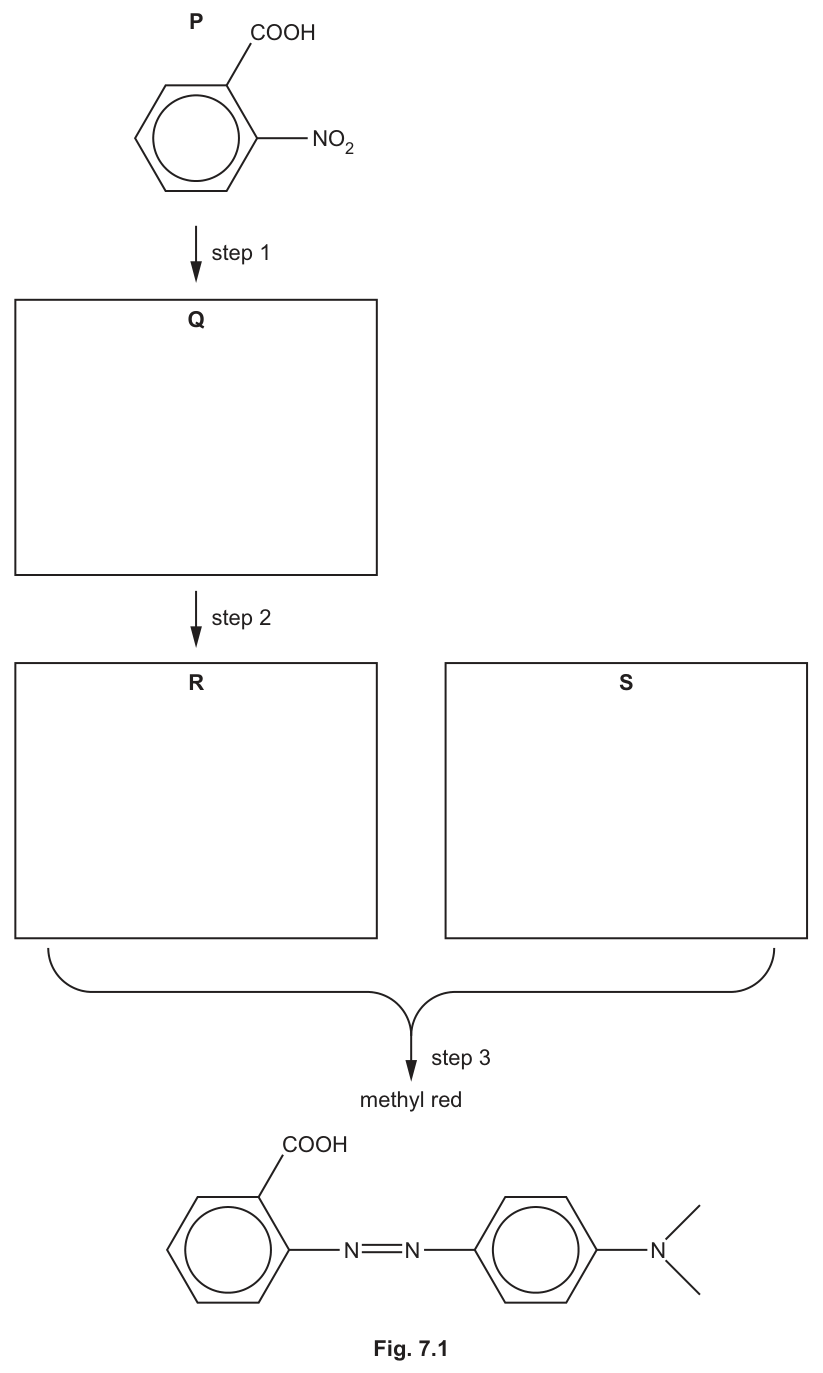
Answer
2-nitrobenzoic acid (or 2-nitrobenzenecarboxylic acid)
2-nitrobenzoic acid
Background Concept
Benzenecarboxylic acid is the IUPAC name for benzoic acid. When naming substituted benzenecarboxylic acids, the carbon atom attached to the carboxyl group (-COOH) is automatically assigned position 1. Substituents are then numbered to give the lowest possible locants.
Understanding the Question
The question asks for the systematic name of compound P. From Fig. 7.1, P is a benzene ring with a carboxyl group (-COOH) and a nitro group (-NO₂) on adjacent carbon atoms.
Approach
Identify the parent chain/ring (benzenecarboxylic acid). Number the ring starting from the carbon attached to the -COOH group (position 1). The -NO₂ group is on the adjacent carbon, which is position 2. Combine these into the systematic name.
Step-by-Step Reasoning
- The parent structure is benzoic acid (or benzenecarboxylic acid). The carbon bonded to -COOH is C1.
- The nitro group (-NO₂) is on the carbon adjacent to C1. Counting around the ring, this is position 2.
- Therefore, the name is 2-nitrobenzoic acid. Alternatively, using the parent name benzenecarboxylic acid, it is 2-nitrobenzenecarboxylic acid.
Key Takeaways
For substituted benzenecarboxylic acids, the -COOH carbon is always C1. Numbering proceeds to give the lowest locants to other substituents.
Common Mistakes
- Naming it as a derivative of benzene (e.g., 'nitrobenzene') instead of benzoic acid. The -COOH group has higher priority for nomenclature.
- Numbering incorrectly, e.g., calling it 6-nitrobenzoic acid (though technically equivalent, 2- is preferred and standard).
Things to Be Careful About
- Ensure the prefix '2-' is included.
- Both '2-nitrobenzoic acid' and '2-nitrobenzenecarboxylic acid' are accepted systematic names.
can be synthesised as shown in Fig. 7.2.
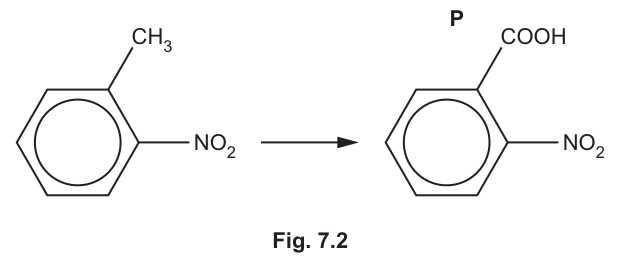
Suggest reagents and conditions for this reaction.
Answer
Reagents: alkaline (or acidified/neutral) (or )
Conditions: heat / reflux / hot
KMnO4, heat/reflux
Background Concept
Alkyl side-chains on benzene rings can be oxidised to carboxyl groups (-COOH) if they contain at least one hydrogen atom on the benzylic carbon (the carbon directly attached to the ring). A methyl group (-CH₃) is readily oxidised to -COOH.
Understanding the Question
Fig. 7.2 shows the conversion of 2-nitrotoluene (a benzene ring with a -CH₃ and an -NO₂ group ortho to each other) to compound P (2-nitrobenzoic acid). The -CH₃ group has been converted to a -COOH group. The question asks for the reagents and conditions for this oxidation.
Approach
Recall the standard reagent for oxidising alkyl side-chains on aromatic rings to benzoic acid derivatives. This is potassium manganate(VII) (). The reaction requires heating, typically under reflux.
Step-by-Step Reasoning
- The transformation is the oxidation of a methyl group (-CH₃) to a carboxyl group (-COOH).
- The standard reagent for this is potassium manganate(VII), (or the manganate(VII) ion, ). It can be used in alkaline, neutral, or acidified conditions (though often alkaline is specified, acidified also works).
- The reaction requires heat to proceed efficiently, typically carried out under reflux to prevent the loss of volatile components and ensure complete reaction.
- Note: The nitro group (-NO₂) is already in a high oxidation state and is not affected by these conditions.
Key Takeaways
Alkyl groups with benzylic hydrogens (like -CH₃, -CH₂R) are oxidised to -COOH by hot alkaline/acidified . This is a standard method for synthesising benzoic acid derivatives from alkylbenzenes.
Common Mistakes
- Suggesting (dichromate). While dichromate oxidises alcohols and aldehydes, it is not the standard reagent for oxidising alkylbenzenes directly to carboxylic acids in this context (though it can under vigorous conditions, is the expected answer).
- Forgetting the condition 'heat' or 'reflux'.
Things to Be Careful About
- Must specify both reagent () and condition (heat/reflux). Both are required for the mark.
- 'Hot' is acceptable for the condition.
A student attempts to synthesise by an alternative route, as shown in Fig. 7.3.
Compound is the major product in this reaction rather than .
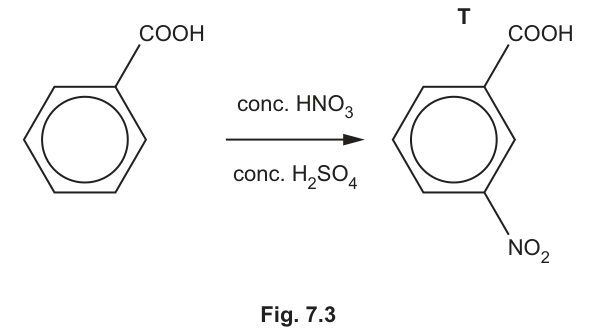
Explain why is the major product in this reaction.
Answer
The -COOH (carboxyl) group is electron-withdrawing (or electronegative) and is a meta-directing group (directs to 3- and 5-positions).
COOH is electron-withdrawing and meta-directing
Background Concept
In electrophilic aromatic substitution (EAS), substituents already on the benzene ring influence the position where a new substituent attaches. They are classified as activating or deactivating, and as ortho/para-directing or meta-directing.
- Electron-donating groups (e.g., -OH, -NH₂, -CH₃) activate the ring and direct ortho/para.
- Electron-withdrawing groups (e.g., -NO₂, -COOH, -CN) deactivate the ring and direct meta.
Understanding the Question
Fig. 7.3 shows the nitration of benzoic acid (using conc. / conc. ) to form compound T (3-nitrobenzoic acid, where the -NO₂ is meta to the -COOH). The question asks why T (the meta product) is the major product instead of P (the ortho product, 2-nitrobenzoic acid).
Approach
Identify the electronic effect of the -COOH group on the benzene ring and relate this to the directing effect in EAS.
Step-by-Step Reasoning
- The starting material is benzoic acid, which has a -COOH group attached to the ring.
- The -COOH group contains a carbonyl () which is polar. The oxygen is more electronegative than carbon, pulling electron density away from the ring. Thus, the -COOH group is electron-withdrawing (via induction and resonance).
- Electron-withdrawing groups deactivate the ring towards electrophilic attack, particularly at the ortho and para positions, because the intermediate carbocations (arenium ions) formed by attack at these positions are less stable (positive charge is closer to the electron-withdrawing group).
- Attack at the meta position (3- or 5-) produces a more stable intermediate carbocation.
- Therefore, the -COOH group is a meta-directing group, leading to 3-nitrobenzoic acid (T) as the major product.
Key Takeaways
Electron-withdrawing groups like -COOH, -NO₂, -CN are meta-directors in electrophilic aromatic substitution because they destabilise the ortho/para intermediates more than the meta intermediate.
Common Mistakes
- Saying '-COOH is electron-donating'. It is electron-withdrawing.
- Not mentioning the electronic nature (electron-withdrawing) and just saying 'it directs meta'. The explanation requires linking the electronic effect to the directing behaviour.
- Confusing with alkyl groups which are electron-donating and ortho/para-directing.
Things to Be Careful About
- Use precise terminology: 'electron-withdrawing' or 'electronegative' (referring to the group's effect on the ring), 'meta-directing'.
- The question asks 'Explain why', so a causal link is needed: electron-withdrawing nature leads to meta direction.
reacts in a similar way to phenol in step 3.
Answer
Q: 2-aminobenzoic acid (benzene ring with -COOH and -NH₂ ortho to each other)
R: 2-diazoniobenzoic acid / 3-diazoniobenzoic acid cation (benzene ring with -COOH and - ortho to each other)
S: N,N-dimethylaniline (benzene ring with - group)
(See diagram below for structures)
Q: 2-aminobenzoic acid; R: 2-diazoniobenzoic acid; S: N,N-dimethylaniline
Background Concept
Methyl red is an azo dye. Azo dyes are formed by the coupling reaction between a diazonium salt (electrophile) and an electron-rich aromatic compound (coupling component, like phenol or an amine).
- Diazotisation: A primary aromatic amine (like phenylamine/aminobenzoic acid) reacts with nitrous acid (, generated in situ from and ) at low temperatures () to form a diazonium salt ().
- Coupling: The diazonium ion attacks the electron-rich ring of the coupling component (activated by -OH or -NR₂ groups) at the position para (or ortho) to the activating group.
Understanding the Question
Fig. 7.1 shows a synthesis scheme:
- P (2-nitrobenzoic acid) Q R
- R + S methyl red
- Methyl red structure: benzoic acid ring (with -COOH) connected via -N=N- to a dimethylaniline ring (with - para to the azo linkage).
- Part (b) states S reacts similarly to phenol (i.e., it is an electron-rich aromatic compound that undergoes coupling).
Approach
Work backwards from methyl red and forwards from P to identify Q, R, and S.
- Step 1 converts P (nitro compound) to Q. Reduction of -NO₂ gives -NH₂. So Q is an amino-benzoic acid.
- Step 2 converts Q (amine) to R. This is diazotisation, forming a diazonium salt. So R is a diazonium-benzoic acid.
- Step 3 is coupling. R (diazonium) + S (coupling component) methyl red. Looking at the right-hand ring in methyl red, it is a benzene ring with a - group. Since coupling happens para to the activating group, S must be N,N-dimethylaniline.
Step-by-Step Reasoning
- Identify Q: P is 2-nitrobenzoic acid. Step 1 is a reduction (reagents in (b)(ii) are Fe/HCl or Sn/HCl, which reduce -NO₂ to -NH₂). So Q is 2-aminobenzoic acid. Structure: benzene ring with -COOH at position 1 and - at position 2.
- Identify R: Step 2 converts the amine Q to a diazonium salt (reagents in (b)(ii) are /HCl, ). So R is the diazonium salt of 2-aminobenzoic acid: 2-diazoniobenzoic acid (or 3-diazoniobenzoic acid depending on numbering, but structurally the - group is ortho to the -COOH). Structure: benzene ring with -COOH and - ortho to each other.
- Identify S: Step 3 is coupling. The product methyl red has a dimethylaniline moiety. The - group is a strong activator and directs coupling para to itself. In methyl red, the azo group is para to the - group. Therefore, S is N,N-dimethylaniline. Structure: benzene ring with - attached.
Key Takeaways
Azo dye synthesis involves: (1) reduction of nitro to amine, (2) diazotisation of amine to diazonium salt, (3) coupling with an activated aromatic ring (phenol or amine). Working forwards and backwards from the final product helps identify intermediates.
Common Mistakes
- Drawing Q as 3-aminobenzoic acid (meta). The starting material P has the groups ortho (2-position), so reduction keeps them ortho.
- Forgetting the positive charge on the diazonium group in R (-).
- Drawing S as a benzoic acid derivative. S provides the right-hand ring of methyl red, which has no -COOH group (the -COOH is on the left ring from P). S is simply N,N-dimethylaniline.
Things to Be Careful About
- Ensure the benzene rings are drawn correctly (circle or alternating double bonds, consistently).
- The diazonium group is - (linear, positive charge on the terminal nitrogen or delocalised, but usually written as - or - with a positive charge on the ring-attached N in some conventions, but CIE accepts - or - attached to the ring). Actually, the structure is Ar-.
- Position of substituents: ortho for the benzoic acid derivatives, para for the coupling in S (though S itself just has the -NMe2 group, the coupling happens para to it).
Suggest reagents and conditions for steps 1 and 2 in Fig. 7.1.
step 1 ................................................................................................................................
step 2 ................................................................................................................................
Answer
step 1: Reagents: or , conc. ; Conditions: heat / reflux
step 2: Reagents: (or ) and ; Conditions: (or cold / ice bath)
Step 1: Fe/Sn, conc HCl, heat; Step 2: NaNO2, HCl, <=10 C
Background Concept
This part of the synthesis involves two key reactions of aromatic nitrogen compounds:
- Reduction of nitroarenes: Aromatic nitro groups (-NO₂) are reduced to primary aromatic amines (-NH₂) using a metal (like Fe or Sn) and concentrated hydrochloric acid, followed by heating/reflux. (Note: The initial product is the ammonium salt, which is made basic to free the amine, but for this question, the reducing conditions are the key mark).
- Diazotisation: Primary aromatic amines react with nitrous acid () at low temperatures () to form diazonium salts. Nitrous acid is unstable and is generated in situ by mixing sodium nitrite () with hydrochloric acid ().
Understanding the Question
The question asks for reagents and conditions for step 1 (converting Q [amine] ... wait, step 1 converts P [nitro] to Q [amine]) and step 2 (converting Q [amine] to R [diazonium salt]).
- Step 1: 2-nitrobenzoic acid (P) 2-aminobenzoic acid (Q). This is a reduction.
- Step 2: 2-aminobenzoic acid (Q) 2-diazoniobenzoic acid (R). This is diazotisation.
Approach
Recall the standard reagents and conditions for reducing aromatic nitro compounds and for diazotising aromatic amines.
Step-by-Step Reasoning
- Step 1 (Reduction):
- Reaction: .
- Reagents: A metal such as iron () or tin () and concentrated hydrochloric acid (conc. ).
- Conditions: The mixture must be heated, typically under reflux (or 'hot').
- Step 2 (Diazotisation):
- Reaction: .
- Reagents: Sodium nitrite () or nitrous acid () and hydrochloric acid (). ( + generates in situ).
- Conditions: The temperature must be kept low, specifically (or 'cold', 'in ice bath'), because diazonium salts are unstable and decompose at higher temperatures to form phenols.
Key Takeaways
- Nitroarene to arylamine: + conc. , heat.
- Arylamine to diazonium salt: + , .
Common Mistakes
- Forgetting the temperature condition for diazotisation (). This is crucial because diazonium salts decompose.
- Suggesting for the reduction. While it reduces nitro groups, the standard method for aromatic nitro compounds in this context is metal/acid reduction.
- Writing 'room temperature' for step 2.
Things to Be Careful About
- Must include both reagent and condition for each step to get full marks.
- For step 1, 'conc. ' is important. Dilute acid might not work as well or is not the standard answer.
- For step 2, '' and '' are the practical reagents. Writing '' is also acceptable as the active species.
State the relative basicities of phenylamine, , benzylamine, , and ammonia, , in aqueous solution. Explain your answer.
Answer
benzylamine > ammonia > phenylamine
Explanation:
- In benzylamine, the alkyl () group is electron-donating (positive inductive effect, +I). This increases the electron density on the nitrogen atom, making the lone pair more available to accept a proton ().
- In phenylamine, the lone pair on the nitrogen atom is in a p-orbital that overlaps with (is delocalised into) the delocalised -system of the benzene ring. This makes the lone pair less available to accept a proton compared to ammonia.
- Ammonia has no such delocalisation or strong inductive effects, placing it between the two.
Background Concept
The basicity of an amine or ammonia is determined by the availability of the lone pair of electrons on the nitrogen atom to accept a proton () and form a dative (coordinate) bond. Two main electronic effects influence this availability:
- Inductive effect: Alkyl groups are electron-donating via the sigma bond framework (+I effect). They push electron density towards the nitrogen, making the lone pair more negative and more attractive to protons. Thus, aliphatic amines are generally stronger bases than ammonia.
- Delocalisation (Resonance) effect: If the nitrogen lone pair can overlap with an adjacent -system (like a benzene ring or a carbonyl group), it becomes delocalised. This spreads the electron density over a larger area, making the lone pair less concentrated and less available to bond with a proton. This significantly decreases basicity.
Understanding the Question
You are asked to rank three nitrogen-containing compounds—benzylamine (), ammonia (), and phenylamine ()—in order of decreasing basicity in aqueous solution, and to explain the reasoning. The key is to look at the structural environment of the nitrogen atom in each molecule.
Approach
- Identify the basic site: The lone pair on the nitrogen atom in all three molecules.
- Compare benzylamine and ammonia: Benzylamine has a benzyl group (). The group is an alkyl group attached directly to the nitrogen. Alkyl groups exert a +I (electron-donating inductive) effect, increasing electron density on N. Therefore, benzylamine > ammonia.
- Compare phenylamine and ammonia: In phenylamine, the nitrogen is attached directly to the benzene ring. The lone pair on N is in a p-orbital that overlaps with the -system of the ring. This delocalisation reduces the availability of the lone pair. Therefore, ammonia > phenylamine.
- Combine: benzylamine > ammonia > phenylamine.
Step-by-Step Reasoning
- Benzylamine (): The nitrogen is bonded to a group, which is bonded to the benzene ring. The group is an alkyl group. Alkyl groups donate electron density through the sigma bonds (positive inductive effect, +I). This increases the electron density on the nitrogen atom, making its lone pair more negative and more willing to donate to a proton. Thus, it is a stronger base than ammonia.
- Ammonia (): The nitrogen lone pair is fully localised on the nitrogen atom. There are no electron-donating alkyl groups to increase its density, nor is it delocalised into a -system. It serves as the baseline.
- Phenylamine (): The nitrogen is bonded directly to the benzene ring. The lone pair on the nitrogen atom resides in a p-orbital that is parallel to the p-orbitals of the benzene ring carbons. This allows the lone pair to delocalise (overlap) into the delocalised -electron system of the ring. Because the lone pair is shared with the ring, it is less available to accept a proton. Thus, it is a weaker base than ammonia.
Key Takeaways
- Basicity depends on lone pair availability, not just the presence of a lone pair.
- Alkyl groups increase basicity via the +I inductive effect.
- Direct attachment to a -system (like benzene) decreases basicity because the lone pair delocalises into the ring.
Common Mistakes
- Confusing benzylamine with phenylamine: Students often treat the group as if it acts like a phenyl group directly attached to N. The spacer breaks the conjugation, so the inductive effect of the alkyl group dominates, making benzylamine a stronger base than ammonia.
- Vague explanations: Simply saying "delocalised" without specifying what it is delocalised into (the -system of the ring) or why that matters (lone pair less available to accept ) may lose marks.
Things to Be Careful About
- Ensure the order is explicitly from most basic to least basic as requested by the template.
- Use precise terminology: "electron-donating" or "+I effect" for alkyl groups; "delocalised into the -system" or "overlaps with the ring" for phenylamine.
An excess of is added to separate samples of and benzene, .
reacts readily with to form organic product .
State the expected observations for this reaction. Draw the structure of .
observations ......................................................................................................................
structure of
Answer
Observations:
- A white precipitate forms.
- The orange/brown colour of bromine water is decolourised (or fades).
Structure of M (2,4,6-tribromophenylamine):
White precipitate; bromine water decolourised. Structure: 2,4,6-tribromophenylamine.
Background Concept
Phenylamine (aniline) is highly activated towards electrophilic aromatic substitution. The group is a strongly activating, ortho/para-directing group. Unlike benzene, which requires a Lewis acid catalyst (like ) and pure liquid bromine to react, phenylamine is so electron-rich that it reacts rapidly with aqueous bromine (bromine water) at room temperature without a catalyst.
The reaction typically substitutes at all available ortho and para positions (positions 2, 4, and 6) because the activation is so strong. The product, 2,4,6-tribromophenylamine, is insoluble in water and forms a white precipitate.
Understanding the Question
You are reacting phenylamine with excess bromine water. You need to state the visible observations and draw the organic product M.
Approach
- Observations: Bromine water is orange/brown. As it reacts, the colour disappears (decolourised). The organic product is a solid that doesn't dissolve in water, so a precipitate forms.
- Structure: Identify the positions for substitution. The group directs to ortho (2, 6) and para (4). With excess bromine, all three positions are substituted. Draw a benzene ring with at position 1 and at positions 2, 4, and 6.
Step-by-Step Reasoning
- Observation 1: Bromine water () is an orange/brown solution. As is consumed in the reaction, the solution loses its colour. -> Bromine water is decolourised.
- Observation 2: The product is 2,4,6-tribromophenylamine. Large organic molecules with multiple heavy halogen atoms and an group are generally insoluble in water. -> A white precipitate forms.
- Structure: Start with phenylamine. Add to the two ortho positions (adjacent to ) and the para position (opposite to ). The resulting molecule is 2,4,6-tribromophenylamine.
Key Takeaways
- Activated rings (like phenol and phenylamine) react with bromine water without a catalyst.
- Excess halogen leads to polysubstitution at all ortho/para positions.
- Always state both the colour change of the reagent and the formation of the product phase.
Common Mistakes
- Saying "brown precipitate": The precipitate is white. The bromine colour disappears into the solution/gas phase as it reacts.
- Drawing mono- or di-bromo products: With excess bromine water, trisubstitution occurs. Drawing only 2,4-dibromo or 4-bromo is incorrect.
- Forgetting the catalyst note: Students might say "no catalyst needed" as an observation, but the question asks for observations (what you see), not reaction conditions.
Things to Be Careful About
- The structure must show the benzene ring (either circle or alternating double bonds) with correct substitution positions. Positions 2, 4, and 6 are relative to the group at position 1.
Answer
- In phenylamine, the lone pair on the nitrogen atom (in a p-orbital) is delocalised (overlaps) into the delocalised -electron system of the benzene ring.
- This increases the electron density of the ring (making it more nucleophilic/electron-rich).
- The electron-rich ring can polarise the bond (or attract the electrophile ) more effectively than benzene.
- Benzene has a lower electron density and its delocalised system is more stable, so it requires a catalyst (and anhydrous conditions) to react with .
Background Concept
Electrophilic aromatic substitution requires the aromatic ring to act as a nucleophile, attacking an electrophile. The rate of reaction depends on the electron density of the -system. Benzene has a uniform, relatively low electron density and is stable (resonance energy). To react with a weak electrophile like , a strong electrophile (like ) is needed, generated by a catalyst (e.g., ).
Substituents on the ring can alter this electron density:
- Activating groups (like , ): Donate electron density into the ring (via +I or +M effects), making it more reactive towards electrophiles.
- Deactivating groups (like , ): Withdraw electron density, making the ring less reactive.
Understanding the Question
Explain why phenylamine reacts readily with bromine water, while benzene does not. Focus on the electronic differences between the two rings.
Approach
- Identify the electronic effect of the group in phenylamine.
- Explain how this effect changes the ring's properties (electron density).
- Connect this to the reaction with (polarisation of the electrophile).
- Contrast with benzene (no such effect, lower electron density, stable).
Step-by-Step Reasoning
- Phenylamine: The nitrogen atom in has a lone pair in a p-orbital. This p-orbital is parallel to the p-orbitals of the benzene ring carbons. The lone pair delocalises (overlaps) into the -system of the ring. This is a +M (mesomeric) effect.
- Effect on ring: This delocalisation pushes electron density into the ring, particularly at the ortho and para positions. The ring becomes much more electron-rich (nucleophilic) than benzene.
- Reaction with : Because the ring is so electron-rich, it can induce a strong dipole in the approaching molecule (polarise it), creating a sufficient electrophilic character () to attack the ring without needing a catalyst.
- Benzene: Benzene has no substituent to donate electrons. Its -system is stable and has lower electron density. It cannot polarise sufficiently on its own. It requires a Lewis acid catalyst to generate a stronger electrophile ().
Key Takeaways
- Lone pairs on substituents attached directly to a ring can delocalise into it, increasing reactivity.
- Higher electron density = better ability to polarise electrophiles = reaction without catalyst.
Common Mistakes
- Saying "nitrogen is more electronegative": This is irrelevant to the ring's reactivity in this context; the key is the donation of the lone pair.
- Not mentioning delocalisation: Simply saying "the nitrogen donates electrons" is vague. Must specify how (lone pair delocalised into the -system).
- Forgetting the consequence: Must link the increased electron density to the ability to react with (polarise it or attract the electrophile).
Things to Be Careful About
- Use the term "delocalised" or "overlaps" for the lone pair.
- Mention "electron density" of the ring.
- Mention "polarise the molecule" or "attract the electrophile".
Answer
In benzamide, the lone pair on the nitrogen atom is delocalised (into the -system) across the C=O group (or into the carbonyl group). This makes the lone pair less available to accept a proton compared to ammonia, where the lone pair is fully localised on the nitrogen.
Background Concept
Amides () are extremely weak bases, much weaker than amines. This is due to resonance (delocalisation) between the nitrogen lone pair and the adjacent carbonyl () group.
The resonance structures are:
The lone pair on nitrogen is involved in the -system of the amide bond. This makes the C-N bond have partial double bond character and locks the molecule in a planar geometry. Because the lone pair is delocalised, it is not available to bond with a proton.
Understanding the Question
Explain why benzamide () is a much weaker base than ammonia (). Compare the availability of the nitrogen lone pair in both molecules.
Approach
- Identify the lone pair on nitrogen in benzamide.
- Identify the adjacent functional group (carbonyl, ).
- Explain the interaction: delocalisation of the lone pair into the carbonyl -system.
- Conclude: less available lone pair = weaker base.
Step-by-Step Reasoning
- In ammonia (), the lone pair is on the nitrogen and is not delocalised. It is fully available to accept a proton.
- In benzamide, the nitrogen is attached to a carbonyl carbon (). The lone pair on the nitrogen can delocalise into the -bond of the carbonyl group (overlap with the antibonding orbital or form a resonance structure where N is positive and O is negative).
- This delocalisation spreads the electron density over the oxygen and nitrogen atoms, making the lone pair on nitrogen much less available to accept a proton.
- Therefore, benzamide is a much weaker base than ammonia.
Key Takeaways
- Amides are neutral/very weakly basic because of resonance delocalisation into the carbonyl.
- This is a key difference between amines (basic) and amides (non-basic).
Common Mistakes
- Saying "the carbonyl group is electron-withdrawing": While true inductively, the main reason for the lack of basicity is resonance/delocalisation. Must mention delocalisation.
- Confusing with phenylamine: In phenylamine, the lone pair delocalises into the benzene ring. In benzamide, it delocalises into the C=O group.
Things to Be Careful About
- Be precise: "delocalised into the C=O group" or "across the O-C-N system".
is formed by reacting benzoyl chloride, , with .
Complete the mechanism in Fig. 8.1 for the reaction of with .
Include all relevant lone pairs of electrons, curly arrows, charges and dipoles. Draw the structure of the organic intermediate.
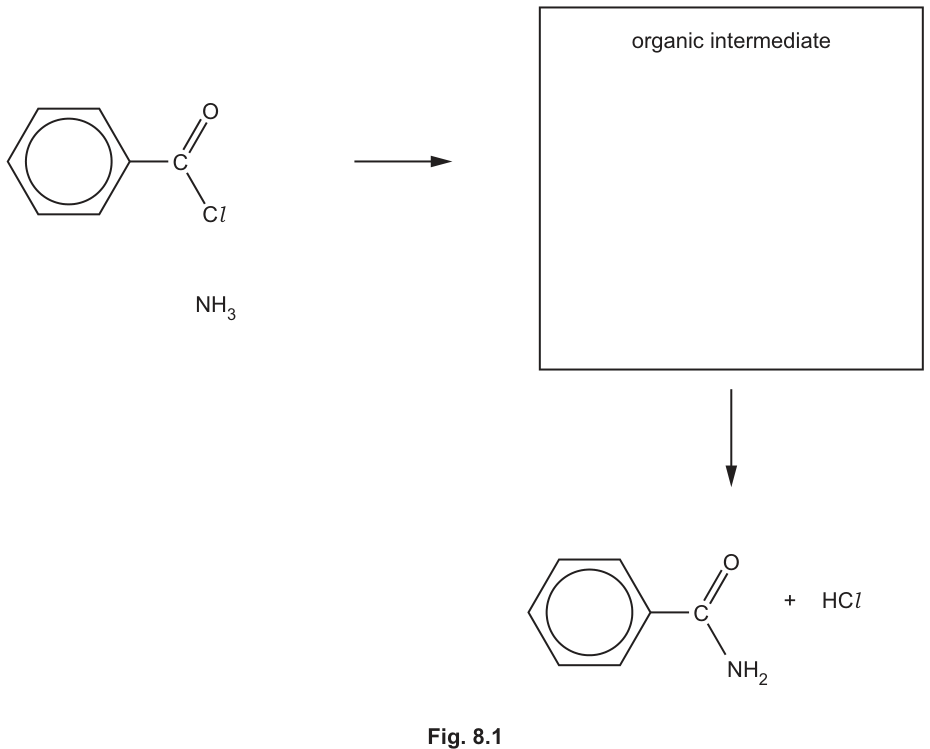
Answer
Mechanism Steps:
-
Nucleophilic Attack: The lone pair on the nitrogen of attacks the partially positive carbonyl carbon () of benzoyl chloride. Simultaneously, the -bond breaks, and the electrons move onto the oxygen atom.
- Arrow: From lone pair on N of to the carbonyl C.
- Arrow: From the double bond to the O atom.
- Dipoles: Show and on the carbonyl group in the starting material.
-
Intermediate Formation: A tetrahedral intermediate is formed. The oxygen now has a full negative charge () and a lone pair. The nitrogen has a full positive charge () because it has formed four bonds and lost its lone pair. (Structure: Benzene ring attached to C, which is attached to , , and ).
-
Elimination (Reformation of C=O): The lone pair on the moves down to reform the -bond. This forces the bond to break, with the electrons moving onto the chlorine atom to form a chloride ion ().
- Arrow: From a lone pair on to the C-O single bond (to reform double bond).
- Arrow: From the C-Cl bond to the Cl atom.
-
Final Product: The intermediate collapses to form benzamide () and (or and which may react with another to form , but the question asks for the mechanism to the organic intermediate and final organic product + HCl as shown in Fig 8.1).
Diagram Reference: See for the full curly-arrow mechanism.
Background Concept
Acyl chlorides () undergo nucleophilic addition-elimination reactions with nucleophiles like ammonia (), water, and alcohols. The mechanism proceeds in two main stages:
- Addition: The nucleophile attacks the electrophilic carbonyl carbon, breaking the -bond and forming a tetrahedral intermediate.
- Elimination: The bond reforms, expelling the leaving group (chloride ion, ), which is a good leaving group due to its electronegativity and stability.
The carbonyl carbon is electrophilic () because oxygen and chlorine are more electronegative than carbon, creating dipoles.
Understanding the Question
Complete the mechanism for the reaction of benzoyl chloride with ammonia to form benzamide and HCl. You must show:
- Lone pairs on reactants.
- Curly arrows showing electron movement.
- Dipoles on the carbonyl group.
- The structure of the organic intermediate (with charges).
- Curly arrows for the elimination step.
Approach
- Identify nucleophile and electrophile: Nucleophile = lone pair on N in . Electrophile = carbonyl C in .
- Draw Step 1 (Addition): Arrow from N lone pair to C. Arrow from C=O bond to O. Show dipoles (, , ).
- Draw Intermediate: Tetrahedral carbon. O has negative charge and 3 lone pairs. N has positive charge and 0 lone pairs (bonded to 3 H and 1 C). Cl is still attached.
- Draw Step 2 (Elimination): Arrow from O lone pair to C-O bond. Arrow from C-Cl bond to Cl.
- Check charges and arrows: Ensure arrows start from electrons (lone pair or bond) and end at atom or bond.
Step-by-Step Reasoning
- Starting Material Dipoles: In benzoyl chloride, the bond is polarised: . The bond is also polarised: . Show these dipoles on the starting material.
- Nucleophilic Attack: Ammonia () has a lone pair on nitrogen. Draw a curly arrow starting from this lone pair and pointing to the carbonyl carbon ().
- Bond Breaking: As the new C-N bond forms, the carbon would exceed 4 bonds if the C=O bond didn't break. Draw a curly arrow from the centre of the C=O double bond to the oxygen atom. This gives oxygen a full negative charge and an extra lone pair.
- Intermediate Structure: The central carbon is now hybridised (tetrahedral). It is bonded to: phenyl ring, (with 3 lone pairs), , and (nitrogen has 4 bonds, positive charge, 0 lone pairs). This is the tetrahedral intermediate.
- Elimination: The is unstable with a negative charge and wants to reform the double bond. Draw a curly arrow from a lone pair on to the C-O single bond to reform the -bond.
- Leaving Group Expulsion: Reforming the double bond pushes electrons out. Draw a curly arrow from the C-Cl bond to the Cl atom. This breaks the bond and forms .
- Final Result: The organic product is benzamide (). The leaving group is , which picks up a proton (from the group, effectively) to form HCl (or the loses a proton to become neutral , and takes it). The question shows HCl as a product, implying a proton transfer occurs (often with a second molecule of , but the core mechanism is addition-elimination).
Key Takeaways
- Acyl chloride mechanisms are addition-elimination, not substitution.
- Always show the tetrahedral intermediate with correct charges (, ).
- Arrows must start from lone pairs or bonds, not atoms.
Common Mistakes
- Drawing arrows from atoms: Curly arrows must start from the lone pair on N or the bond electrons, not from the N atom or C atom itself.
- Wrong intermediate charge: Forgetting the positive charge on nitrogen or negative charge on oxygen in the intermediate.
- Elimination arrow direction: Drawing the arrow from Cl to C (wrong) instead of from the bond to Cl.
- Forgetting dipoles: The question asks for dipoles on the starting material; missing loses marks.
Things to Be Careful About
- The intermediate has a positive charge on N and negative charge on O. Do not forget these.
- The arrow for reformation of C=O can start from any lone pair on the , not just a specific one.
- State symbols are not required for mechanism steps usually, but charges must be correct.
Phenylalanine, , is an amino acid with an isoelectric point of 5.5.
Answer
The isoelectric point (pI) is the pH at which an amino acid (or molecule) exists predominantly as a zwitterion (has no overall charge / is electrically neutral).
Background Concept
Amino acids contain both an acidic group () and a basic group (). In aqueous solution, a proton transfer occurs from the carboxyl group to the amino group, forming a zwitterion (). The zwitterion has both a positive and a negative charge, but the overall charge is zero.
The ionisation state of an amino acid depends on the pH of the solution:
- Low pH (acidic): Excess protonates the carboxylate group () and keeps the amino group protonated (). Net charge: +1.
- High pH (basic): Excess deprotonates the ammonium group () and the carboxyl group is already deprotonated (). Net charge: -1.
- Intermediate pH (isoelectric point): The molecule exists primarily as the zwitterion with net charge 0.
Understanding the Question
Define the term "isoelectric point" in the context of phenylalanine (an amino acid).
Approach
- State the condition: a specific pH.
- State the result: the molecule has no net charge (or exists as a zwitterion).
Step-by-Step Reasoning
- At the isoelectric point, the concentration of the cationic form equals the concentration of the anionic form, and the zwitterionic form is dominant.
- The net charge is zero.
- Definition: The pH at which the amino acid has no overall electrical charge (is neutral) / exists as a zwitterion.
Key Takeaways
- pI is a specific pH value.
- At pI, net charge = 0.
- Dominant species is the zwitterion.
Common Mistakes
- Saying "the pH where the amino acid is neutral": Technically correct but "no overall charge" or "zwitterion" is the precise chemical terminology rewarded.
- Confusing with equivalence point in titration.
Things to Be Careful About
- Use the word "zwitterion" or "no overall charge".
Answer
At pH 10 (which is above the isoelectric point of 5.5, so the environment is basic), the amino group remains (or loses a proton) and the carboxyl group is deprotonated to .
Structure:
(Detailed structure: Benzene ring attached to , attached to , attached to and .)
Background Concept
Amino acids are amphoteric. Their charge depends on pH relative to their pKa values.
- (carboxyl group) is typically around 2.
- (amino group) is typically around 9-10.
- pI (isoelectric point) is the average of the two pKa values: (matches the question).
Species at different pH:
- pH < 2: Cation (, ). Net charge +1.
- 2 < pH < 9: Zwitterion (, ). Net charge 0. (At pH 5.5, this is the dominant form).
- pH > 9: Anion (, ). Net charge -1.
Understanding the Question
Draw the structure of phenylalanine at pH 10. The pI is 5.5. pH 10 is basic (alkaline), well above the pI and above the pKa of the amino group.
Approach
- At pH 10, the solution is basic.
- Basic conditions remove protons.
- The carboxyl group () is fully deprotonated: .
- The ammonium group () will lose its extra proton to become .
- Draw the fully deprotonated (anionic) form.
Step-by-Step Reasoning
- Start with the zwitterion: .
- At pH 10, is high. It reacts with to form and .
- The remains deprotonated.
- Result: .
Key Takeaways
- High pH -> deprotonation -> negative charge.
- Low pH -> protonation -> positive charge.
- At pI -> zwitterion -> neutral.
Common Mistakes
- Drawing the zwitterion at pH 10: At pH 10, the amino group is deprotonated. Only draw if pH is below ~9.
- Drawing the cation: That's for low pH.
- Forgetting the negative charge on COO: Must show the charge.
Things to Be Careful About
- The question asks for the structure of at pH 10. Note the starting formula is the neutral molecular form, but in solution at pH 10, it will be the anion.
- Ensure the side chain () is unchanged (it is not ionisable at this pH).
and alanine, , react to form a dipeptide containing both amino acid residues.
Draw the structure of this dipeptide.
The peptide functional group formed should be displayed.
Answer
A dipeptide is formed by a condensation reaction between the carboxyl group of one amino acid and the amino group of the other, releasing water.
There are two possible dipeptides (depending on which amino acid is the N-terminus):
Option 1 (Phenylalanine-Alanine):
Option 2 (Alanine-Phenylalanine):
Structure (displayed peptide bond):
The peptide bond is . Both must be drawn with the C=O and N-H bonds shown explicitly.
(See for the full displayed structures.)
Background Concept
Amino acids can join together via condensation polymerisation (or form dipeptides/tripeptides). The carboxyl group () of one amino acid reacts with the amino group () of another, releasing a molecule of water ().
The bond formed is a peptide bond (an amide linkage): .
- The amino acid at the start (with the free group) is the N-terminus.
- The amino acid at the end (with the free group) is the C-terminus.
- Order matters: Alanine-Phenylalanine is different from Phenylalanine-Alanine.
Understanding the Question
Draw the structure of a dipeptide formed from phenylalanine () and alanine (). The peptide functional group must be displayed (i.e., show the C=O and N-H bonds, not just -CONH-).
Approach
- Identify the functional groups: and for both.
- Connect them: of AA1 + of AA2 -> + .
- Draw the backbone: .
- Substitute and with the side chains.
- Ensure the peptide bond is displayed (show C=O double bond and N-H bond).
Step-by-Step Reasoning
- Phenylalanine side chain (): (benzyl group).
- Alanine side chain (): (methyl group).
- Linkage: The C of the carboxyl group in AA1 bonds to the N of the amino group in AA2.
- Displayed peptide bond: Must show and . Do not just write .
- Possibility 1: Phe at N-terminus, Ala at C-terminus.
- Structure: .
- Possibility 2: Ala at N-terminus, Phe at C-terminus.
- Structure: .
- Either is acceptable unless specified. The mark scheme allows both (separated by OR).
- Key requirement: "The peptide functional group formed should be displayed." This means drawing the C=O and N-H bonds explicitly in the central linkage.
Key Takeaways
- Dipeptides have an N-terminus () and a C-terminus ().
- The peptide bond is an amide bond: .
- Always display the peptide bond fully (C=O, N-H) in structural questions.
- Order of amino acids creates different peptides.
Common Mistakes
- Drawing a polyester linkage: Wrong, it's an amide/peptide bond.
- Not displaying the peptide bond: Writing in the middle of a condensed formula instead of drawing the C=O and N-H bonds.
- Forgetting the terminal groups: Must have free on one end and free on the other.
- Wrong side chains: Mixing up benzyl () and methyl ().
- Adding water: The product is the dipeptide; water is a byproduct and not part of the structure.
Things to Be Careful About
- The question says "containing both amino acid residues". This confirms it's a dipeptide of one of each.
- "Displayed" means showing all bonds in the functional group. For , draw and .
- The chiral centres (alpha carbons) should ideally have the H atoms shown to make it a displayed/semi-displayed formula, though often just the connectivity is accepted if the peptide bond is clear. The mark scheme image shows H atoms on the alpha carbons.
Answer
The chlorine atoms are electronegative and exert a strong electron-withdrawing (inductive) effect. This stabilises the carboxylate anion () by dispersing the negative charge, or weakens the O–H bond, making it easier to release a proton.
The electronegative chlorine atoms exert an electron-withdrawing inductive effect, stabilising the carboxylate anion.
Background Concept
The acidity of a carboxylic acid depends on the stability of the conjugate base (the carboxylate anion, ). A more stable anion means the equilibrium lies further to the right, resulting in a stronger acid. Substituents on the alkyl group can influence this stability through the inductive effect. Electronegative atoms (like halogens) pull electron density away from the carboxylate group through sigma bonds. This is called the electron-withdrawing inductive effect (-I effect). By dispersing the negative charge on the oxygen atoms, the anion is stabilised. Conversely, electron-donating groups (like alkyl groups) push electron density towards the carboxylate, intensifying the negative charge and destabilising the anion, making the acid weaker.
Understanding the Question
The question asks to compare the acidity of trichloroethanoic acid () and ethanoic acid (). We need to explain why the trichloro compound is more acidic. The key difference is the substitution of three hydrogen atoms in the methyl group with chlorine atoms.
Approach
- Identify the structural difference: vs .
- Recall the property of chlorine: high electronegativity.
- Apply the inductive effect: Cl pulls electron density away from the COOH group.
- Explain the consequence: stabilisation of the conjugate base () or weakening of the O-H bond.
Step-by-Step Reasoning
- Electronegativity: Chlorine is much more electronegative than hydrogen. In , the three chlorine atoms pull electron density away from the rest of the molecule through the sigma bonds.
- Inductive Effect: This is the electron-withdrawing inductive effect (-I effect). It operates through the sigma bond framework.
- Stabilisation of Anion: When the acid dissociates, it forms the trichloroethanoate ion (). The electron-withdrawing chlorine atoms help to delocalise and stabilise the negative charge on the carboxylate group. A more stable anion means the acid is more willing to lose a proton.
- Alternative explanation: The withdrawal of electron density also weakens the O–H bond in the undissociated acid, making it easier for the to leave.
- Comparison: In ethanoic acid (), the methyl group is electron-donating (+I effect), which destabilises the ethanoate ion (), making it a weaker acid.
Key Takeaways
- Electron-withdrawing groups (like halogens) increase the acidity of carboxylic acids via the inductive effect.
- The effect is due to stabilisation of the conjugate base (carboxylate ion).
- More electronegative atoms or more of them (e.g., vs ) have a stronger effect.
Common Mistakes
- Saying "chlorine is a strong acid" or "chlorine makes it acidic" without explaining the mechanism (inductive effect/anion stabilisation).
- Confusing inductive effect with resonance (chlorine's lone pairs can donate via resonance, but the inductive withdrawal dominates in aliphatic chains).
- Forgetting to mention the anion or conjugate base.
Things to Be Careful About
- Use precise terminology: "electron-withdrawing", "inductive effect", "stabilise the anion".
- Do not say "chlorine pulls electrons" without specifying it's through sigma bonds (inductive effect).
- The mark scheme accepts "weakening the O-H bond" as an alternative to anion stabilisation.
Acyl chlorides are formed by reacting carboxylic acids with thionyl chloride, .
Ethanedioyl chloride, , can be prepared by reacting ethanedioic acid, , with an excess of .
Write an equation for this reaction.
Answer
(COOH)2 + 2SOCl2 -> (COCl)2 + 2HCl + 2SO2
Background Concept
Carboxylic acids react with thionyl chloride () to form acyl chlorides. This is a common method for preparing acyl chlorides because the by-products ( and ) are gases, which easily leave the reaction mixture, driving the reaction to completion and making purification easy.
The general equation is:
Understanding the Question
We are given ethanedioic acid (oxalic acid), , which is a dicarboxylic acid. It has two carboxyl groups. We need to write the equation for its reaction with excess thionyl chloride to form ethanedioyl chloride, .
Approach
- Write the general equation for one carboxyl group reacting with .
- Since ethanedioic acid has two carboxyl groups, multiply the stoichiometry by 2.
- Ensure the equation is balanced.
Step-by-Step Reasoning
- Ethanedioic acid: or .
- Reagent: (excess).
- Product: Ethanedioyl chloride or .
- By-products: and .
- Since there are two -COOH groups, we need 2 molecules of and produce 2 molecules each of and .
- Equation: .
Key Takeaways
- converts -COOH to -COCl.
- By-products are gaseous and .
- For dicarboxylic acids, multiply coefficients by 2.
Common Mistakes
- Forgetting to balance the equation (missing the '2' in front of , , ).
- Writing as a by-product (that's for or sometimes, but gives and ).
Things to Be Careful About
- State symbols are not strictly required unless specified, but if included, and are gases.
- Ensure the formula for ethanedioyl chloride is correct: .
Samples of are reacted separately with an excess of warm acidified and with .
The carbon-containing product from the reaction with has the molecular formula .
Complete the boxes in Fig. 9.1 to suggest the structure of the carbon-containing product in each reaction.
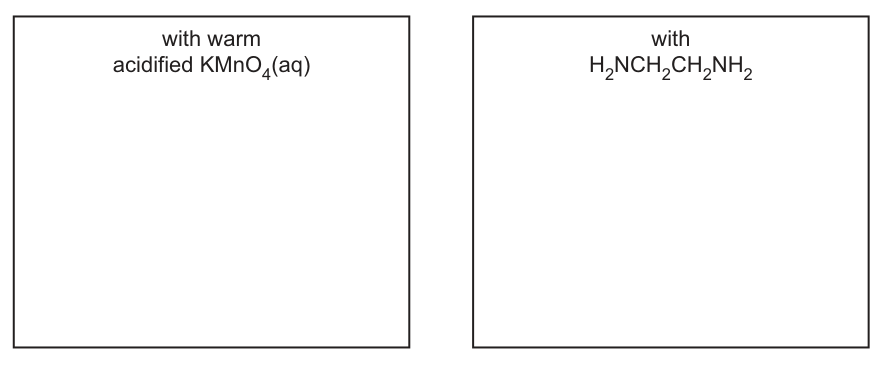
Answer
Left box (with warm acidified ):
Right box (with ):
A six-membered ring containing two amide linkages: 1,4-diazacyclohexane-2,3-dione.
Structure: A ring with -C(=O)-C(=O)-NH-CH2-CH2-NH-.
Working
Reaction 1: Oxidation
Ethanedioic acid and its derivatives (like ethanedioyl chloride) are easily oxidised by acidified potassium manganate(VII). The C-C bond breaks, and the carbon atoms are fully oxidised to carbon dioxide.
The carbon-containing product is .
Reaction 2: Nucleophilic addition-elimination (Condensation)
Ethanedioyl chloride reacts with ethane-1,2-diamine. Each -COCl group reacts with an -NH2 group.
Since the reagents are bifunctional (di-acid chloride and di-amine), they can form a polymer. However, with a 1:1 ratio or specific conditions, a cyclic dimer can form. The molecular formula given is .
Let's check the stoichiometry:
is .
is .
Product .
. This matches a 1:1 condensation.
The product is a cyclic diamide (cyclic polyamide).
Structure: Ring of -C(=O)-C(=O)-NH-CH2-CH2-NH-.
Answer
Left box:
Right box: Cyclic structure (1,4-diazacyclohexane-2,3-dione)
Left: CO2; Right: 1,4-diazacyclohexane-2,3-dione (cyclic diamide)
Background Concept
Oxidation of Ethanedioic Acid Derivatives: Ethanedioic acid (oxalic acid) and its derivatives are unique among carboxylic acids because they can be oxidised. The C-C bond between the two carboxyl groups is relatively weak and susceptible to oxidation. Strong oxidising agents like acidified or cleave the C-C bond, oxidising both carbon atoms to (oxidation state +4).
Reaction of Acyl Chlorides with Amines: Acyl chlorides react vigorously with amines (nucleophilic addition-elimination). The -Cl is replaced by an -NR2 group, forming an amide and HCl. If a diamine reacts with a di-acyl chloride, it can form a polyamide (nylon-like). However, if the chain length allows, cyclic amides (lactams) or cyclic diamides can form. Here, ethanedioyl chloride (2 carbons) reacts with ethane-1,2-diamine (2 carbons). A 1:1 reaction eliminates 2 HCl to form a 6-membered ring: 2 carbons from oxalyl, 2 carbons from diamine, 2 nitrogens.
Understanding the Question
We have ethanedioyl chloride .
- Reacted with warm acidified : Expect oxidative cleavage to .
- Reacted with (ethane-1,2-diamine): The product has formula . We need to draw the structure.
Approach
- For KMnO4 reaction: Recall that oxalates oxidise to CO2.
- For diamine reaction: Calculate the stoichiometry. () + diamine () -> product. Loss of 2 HCl. Form a ring.
Step-by-Step Reasoning
Left Box (KMnO4):
- Ethanedioyl chloride contains the skeleton (effectively).
- Acidified is a strong oxidant.
- Ethanedioic acid/derivatives oxidise to and (or and halide ions).
- The carbon-containing product is simply carbon dioxide, .
Right Box (Diamine):
- Reactants: () and ().
- Product formula: .
- Difference: .
- So, 2 molecules of HCl are eliminated. This is a condensation reaction.
- Each -COCl reacts with one -NH2.
- Since both reactants are bifunctional, they can link head-to-tail. With a 1:1 ratio, a cyclic structure forms.
- Ring atoms: C(=O)-C(=O)-NH-CH2-CH2-NH-. Total 6 atoms in ring.
- Name: 1,4-diazacyclohexane-2,3-dione (or pyrazine-2,3-dione derivative? No, pyrazine has N=N or N-C-N=C. This is a saturated ring with amides. 1,4-diazepane is 7. 1,4-diazacyclohexane is piperazine. With two ketones at 2,3 positions: 1,4-diazacyclohexane-2,3-dione).
- Structure: A hexagon. Top: C(=O)-C(=O). Bottom right: NH-CH2. Bottom left: CH2-NH. Wait.
- C1(=O)-C2(=O) (from oxalyl)
- N3H (from diamine)
- C4H2 (from diamine)
- C5H2 (from diamine)
- N6H (from diamine)
- Bond N6 to C1. Bond C2 to N3.
- Ring: C-C-N-C-C-N. Yes, 6-membered ring.
Key Takeaways
- Ethanedioic acid derivatives oxidise to CO2.
- Di-acyl chlorides + diamines form cyclic polyamides (if stoichiometry is 1:1) or linear polymers.
- Molecular formula helps determine the stoichiometry (loss of 2HCl implies 1:1 cyclic condensation).
Common Mistakes
- Drawing a linear polymer chain instead of the cyclic product specified by the molecular formula.
- Forgetting that KMnO4 oxidises the C-C bond in oxalates.
- Drawing the wrong ring size.
Things to Be Careful About
- The question asks for the "carbon-containing product". For KMnO4, it's CO2. (COCl2 is phosgene, not the product here).
- For the cyclic structure, ensure all atoms are shown or use a clear skeletal structure. The mark scheme shows the full displayed structure of the ring.
A polyester can be synthesised from the reaction of with ethane-1,2-diol, .
Draw two repeat units of the polymer formed. Any functional groups should be displayed.
Answer
Two repeat units of the polyester formed from ethanedioyl chloride and ethane-1,2-diol.
Structure: (with ester linkages displayed).
(With dashed continuation bonds at ends).
Working
Monomers: Ethanedioyl chloride () and ethane-1,2-diol .
Reaction: Condensation polymerisation. Ester linkages form between -OH and -COCl, releasing HCl.
Repeat unit: .
Draw two of these linked together.
Answer
See diagram description below.
(with dashed lines at ends)
Polyester repeat unit: -OCH2CH2OCOCO- (two units shown)
Background Concept
Condensation polymerisation occurs when monomers with two functional groups react, joining together with the loss of a small molecule (usually water or HCl). Here, a di-acyl chloride reacts with a diol to form a polyester. The functional groups are -COCl and -OH. The product is an ester linkage -COO- and HCl is eliminated.
Understanding the Question
We need to draw two repeat units of the polymer formed from and .
Approach
- Identify the reaction: Esterification between acyl chloride and alcohol.
- Determine the repeat unit: The diol part () and the di-acid chloride part ().
- Link them: .
- Draw two units with continuation bonds.
Step-by-Step Reasoning
- Ethanedioyl chloride: .
- Ethane-1,2-diol: .
- Reaction: .
- The repeat unit is .
- We need to draw two repeat units. So: .
- The mark scheme requires displayed functional groups (ester linkages shown as -O-C(=O)-).
- Continuation bonds must be dashed or wavy.
Key Takeaways
- Polyester from diol + di-acyl chloride.
- Repeat unit contains the diol residue and the di-acid residue.
- Draw two units to show the polymer chain.
Common Mistakes
- Drawing only one repeat unit.
- Forgetting the continuation bonds (dashed lines).
- Writing the wrong functional group (e.g., ether instead of ester).
- Not displaying the C=O in the ester group.
Things to Be Careful About
- The question says "Any functional groups should be displayed". So draw the C=O and C-O-C clearly.
- Ensure the connectivity is correct: Diol oxygen connects to carbonyl carbon.
- Mark scheme allows ecf on incorrect monomer, but here we have the correct monomers.
Compound , , reacts with alkaline to form yellow precipitate but does not react with .
The proton () NMR spectrum of in is shown in Fig. 9.2.
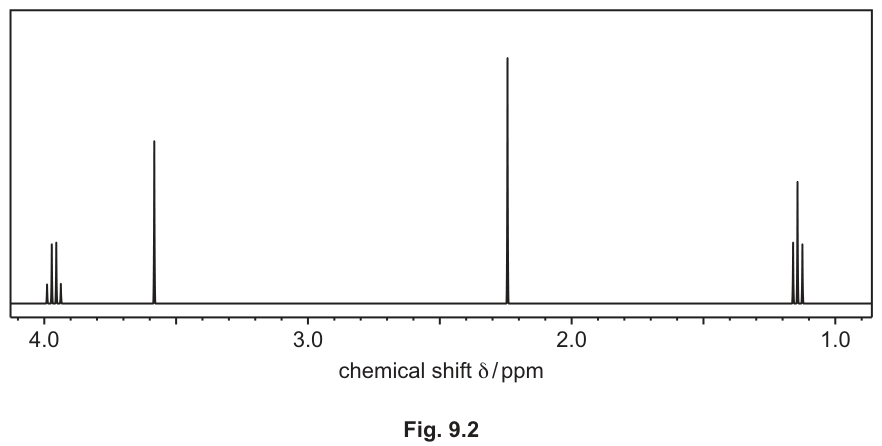
Table 9.1
| environment of proton | example | chemical shift range / ppm |
|---|---|---|
| alkane | , , | 0.9–1.7 |
| alkyl next to C=O | , , | 2.2–3.0 |
| alkyl next to aromatic ring | , , | 2.3–3.0 |
| alkyl next to electronegative atom | , , | 3.2–4.0 |
| attached to alkene | 4.5–6.0 | |
| attached to aromatic ring | 6.0–9.0 | |
| aldehyde | 9.3–10.5 | |
| alcohol | 0.5–6.0 | |
| phenol | 4.5–7.0 | |
| carboxylic acid | 9.0–13.0 | |
| alkyl amine | 1.0–5.0 | |
| aryl amine | 3.0–6.0 | |
| amide | 5.0–12.0 |
Answer
(triiodomethane or iodoform)
Working
Compound H reacts with alkaline to form a yellow precipitate. This is the positive iodoform test.
The yellow precipitate is triiodomethane (iodoform), .
This indicates the presence of a methyl ketone group () or a methyl carbinol group ().
Answer
/ triiodomethane
CHI3 (triiodomethane)
Background Concept
The iodoform test is used to detect the presence of a methyl ketone group () or a methyl carbinol group (, which is oxidised to a methyl ketone by the iodine/alkali).
Reagents: Iodine () and sodium hydroxide () (alkaline conditions).
Positive result: A pale yellow precipitate of triiodomethane (, also called iodoform) is formed.
Understanding the Question
Compound H reacts with alkaline to give a yellow precipitate J. We need to identify J.
Approach
Recall the product of the positive iodoform test.
Step-by-Step Reasoning
- Alkaline iodine test = iodoform test.
- Yellow precipitate = iodoform.
- Chemical formula: .
- Name: Triiodomethane or iodoform.
Key Takeaways
- Iodoform test positive = methyl ketone or ethanol/2-ol.
- Precipitate is .
Common Mistakes
- Calling it "iodine precipitate".
- Writing instead of .
Things to Be Careful About
- Use the chemical name or formula. is acceptable.
Complete Table 9.2 for the proton () NMR spectrum of , .
Table 9.2
| chemical shift / ppm | splitting pattern | number of atoms responsible for the peak | number of protons on adjacent carbon atoms |
|---|---|---|---|
| 1.15 | |||
| 2.25 | |||
| 3.60 | |||
| 3.95 |
Answer
| chemical shift / ppm | splitting pattern | number of atoms responsible for the peak | number of protons on adjacent carbon atoms |
|---|---|---|---|
| 1.15 | triplet | 3 | 2 |
| 2.25 | singlet | 3 | 0 |
| 3.60 | singlet | 2 | 0 |
| 3.95 | quartet | 2 | 3 |
Working
Total protons in = 10.
Sum of protons in table: 3+3+2+2 = 10. Matches.
- 1.15 ppm (triplet, 3H, adj 2H): Methyl group () next to . Shift 1.15 is typical for alkane . Triplet means 2 adjacent H (). So .
- 2.25 ppm (singlet, 3H, adj 0H): Methyl group with no adjacent H. Shift 2.25 is typical for (methyl ketone). Singlet means 0 adjacent H. So .
- 3.60 ppm (singlet, 2H, adj 0H): Methylene group () with no adjacent H. Shift 3.60 is typical for next to electronegative atom (O or C=O). Since it's a singlet, it's isolated. Likely or .
- 3.95 ppm (quartet, 2H, adj 3H): Methylene group () next to . Shift 3.95 is typical for next to Oxygen (ester/alcohol). Quartet means 3 adjacent H (). So .
Combining these: (ethyl ester part) and (methyl ketone part) and (linker).
Structure likely: (Ethyl 3-oxobutanoate / ethyl acetoacetate).
Check formula: . (acetoacetate part) + (ethyl) = ? Wait.
Acetoacetic acid is (). Ethyl ester is (). Matches.
Proton environments:
- (ethyl, end): 3H, triplet (next to CH2), ~1.2 ppm.
- (methyl ketone): 3H, singlet (next to C=O, no H), ~2.2 ppm.
- (between two C=O): 2H, singlet (no adjacent H on C), ~3.6 ppm.
- (ethyl, next to O): 2H, quartet (next to CH3), ~4.1 ppm.
Matches table perfectly.
See table above.
Background Concept
Proton NMR ( NMR) spectroscopy provides information about the hydrogen environments in a molecule.
- Chemical shift (): Indicates the electronic environment (shielding/deshielding). Table 9.1 gives ranges.
- Splitting pattern: Follows the rule, where is the number of protons on adjacent carbon atoms. Singlet (), doublet (), triplet (), quartet ().
- Integration (area under peak): Proportional to the number of protons producing the signal.
Understanding the Question
We have Compound H ().
- Positive iodoform test -> methyl ketone () or methyl carbinol.
- No reaction with -> no carboxylic acid (-COOH).
- NMR data provided for 4 signals.
We need to fill the table: shift (given), splitting, number of H, number of adjacent H.
Approach
- Use the rule to find adjacent protons from splitting.
- Use integration (implied by formula total H=10 and relative peak heights/areas, though areas aren't given numerically, the sum must be 10. The mark scheme implies 3, 3, 2, 2 based on the structure deduction).
- Use chemical shift ranges to identify groups.
Step-by-Step Reasoning
Total protons: 10.
Signals: 4 signals at 1.15, 2.25, 3.60, 3.95.
Signal at 1.15 ppm:
- Shift: 0.9-1.7 -> alkane or .
- Splitting: Triplet -> . Adjacent carbons have 2 H. So .
- Number of H: Must be 3 (methyl group gives triplet if next to CH2). If it were CH2, it would be triplet next to CH3, but shift 1.15 is very typical for terminal methyl.
- So: 3 H, adjacent 2 H.
Signal at 2.25 ppm:
- Shift: 2.2-3.0 -> alkyl next to C=O. Specifically is ~2.1-2.5.
- Splitting: Singlet -> . No adjacent H.
- Number of H: Must be 3 (methyl ketone ).
- So: 3 H, adjacent 0 H.
Signal at 3.60 ppm:
- Shift: 2.2-3.0 (alkyl next to C=O) or 3.2-4.0 (next to O). 3.60 is on the border. Likely or .
- Splitting: Singlet -> . No adjacent H on carbons. This suggests a group between two carbonyls or isolated.
- Number of H: 2 (methylene).
- So: 2 H, adjacent 0 H.
Signal at 3.95 ppm:
- Shift: 3.2-4.0 -> alkyl next to electronegative atom (O). Specifically ester is ~4.1.
- Splitting: Quartet -> . Adjacent carbons have 3 H. So .
- Number of H: 2 (methylene).
- So: 2 H, adjacent 3 H.
Synthesis:
- We have an ethyl group: (signals at 1.15 and 3.95). The 3.95 shift indicates it's attached to Oxygen: .
- We have a methyl ketone: (signal at 2.25).
- We have an isolated (signal at 3.60). Shift 3.60 is consistent with between two carbonyls () or next to carbonyl and oxygen.
- Formula . Ethyl group () + Methyl ketone () + () + remaining O. . Need more? Wait.
- Structure: Ethyl 3-oxobutanoate (ethyl acetoacetate): .
- Formula: . Correct.
- Protons:
- (ethyl): 3H, triplet (next to CH2), ~1.2 ppm.
- (acetyl): 3H, singlet (next to C=O), ~2.2 ppm.
- (active methylene): 2H, singlet (between two C=O, no adjacent H on C), ~3.6 ppm.
- (ethyl ester): 2H, quartet (next to CH3), ~4.1 ppm.
- This matches the table perfectly.
Key Takeaways
- Use splitting pattern () to find adjacent protons.
- Use chemical shift to identify functional group environment.
- Sum of protons must match molecular formula.
- Iodoform test confirms methyl ketone.
Common Mistakes
- Confusing the number of adjacent protons with the number of protons in the peak.
- Forgetting that a singlet means 0 adjacent protons (not 1).
- Misinterpreting the shift for next to ester oxygen (~4 ppm) vs alkane (~1 ppm).
Things to Be Careful About
- The table asks for "number of protons on adjacent carbon atoms". For a singlet, this is 0.
- Ensure the sum of "number of atoms" equals 10.
Answer
Structure: (ethyl 3-oxobutanoate / ethyl acetoacetate).
Working
- Molecular formula: .
- Iodoform test (+): Methyl ketone () present.
- No reaction with : No -COOH (so it's an ester or ketone, not acid).
- NMR:
- 1.15 (t, 3H, 2 adj):
- 2.25 (s, 3H, 0 adj):
- 3.60 (s, 2H, 0 adj):
- 3.95 (q, 2H, 3 adj):
- Combine: (methyl ketone) + (linker) + (ethyl ester).
- Result: Ethyl 3-oxobutanoate.
Answer
Ethyl 3-oxobutanoate (or ethyl acetoacetate)
CH3COCH2COOCH2CH3 (ethyl 3-oxobutanoate)
Background Concept
Structure deduction combines multiple pieces of evidence:
- Molecular formula: Degree of unsaturation (DoU) = . For : DoU = . Two double bonds or rings. Likely two C=O groups (ketone + ester).
- Chemical tests:
- Iodoform (+): group (methyl ketone) or .
- No reaction with : Not a carboxylic acid (would produce bubbles).
- NMR Spectroscopy:
- Chemical shifts identify functional groups.
- Splitting identifies connectivity ( rule).
- Integration identifies number of protons.
Understanding the Question
Deduce structure of H ().
- Positive iodoform -> methyl ketone.
- NMR shows ethyl group (), methyl ketone (), and isolated methylene ().
Approach
- Calculate DoU = 2. Suggests two C=O bonds (since no rings indicated and NMR is simple).
- Use iodoform test to fix fragment.
- Use NMR to build the rest: Ethyl ester group () and a bridge.
- Assemble: .
Step-by-Step Reasoning
- DoU: . Two degrees of unsaturation. Could be 2 C=O, or 1 C=O + 1 ring, etc. Given oxygens, likely carbonyls.
- Iodoform test: Confirms group. (3H singlet at 2.25 ppm confirms this: methyl next to carbonyl, no adjacent H).
- NMR at 3.95 (quartet, 2H) and 1.15 (triplet, 3H): Classic ethyl group pattern (). The shift 3.95 ppm indicates the is attached to an electronegative atom, likely Oxygen (ester or ether). Since we have carbonyls, likely ester .
- NMR at 3.60 (singlet, 2H): Methylene group with no adjacent protons. Shift 3.60 is downfield, suggesting it's between electron-withdrawing groups, like two carbonyls (). This is the 'active methylene' in beta-keto esters.
- Assemble: We have (from iodoform/2.25 ppm), (3.60 ppm), (from 3.95/1.15 ppm and ester shift).
- Connect: .
- Check formula: . Correct.
- Check tests: Methyl ketone present (iodoform +). No COOH (no reaction with carbonate). Correct.
- Name: Ethyl 3-oxobutanoate (common name: ethyl acetoacetate).
Key Takeaways
- Combine chemical tests (functional group identification) with NMR (connectivity and environment).
- Iodoform test is specific for methyl ketones.
- Beta-keto esters have a characteristic acidic methylene proton (singlet around 3-4 ppm).
Common Mistakes
- Proposing a carboxylic acid (ruled out by no reaction with carbonate).
- Proposing an alcohol (ruled out by iodoform test specificity, though ethanol gives positive, the NMR doesn't fit ethanol derivative well, and DoU=2 needs carbonyls).
- Incorrect connectivity (e.g., - this is ethyl 3-oxopentanoate? No, methyl 3-oxopentanoate. Formula . But iodoform test requires . In , the methyl ketone is (ethyl ketone), which is negative for iodoform. So connectivity must be ).
Things to Be Careful About
- The structure must be displayed clearly showing all atoms/bonds or clear skeletal.
- Name is not required, just structure.
- Ensure the ester linkage is correct: , not (same thing, but orientation matters for drawing).