Chemistry 9701/42 — February/March 2024
Cambridge A-Level · A Level Structured Questions · worked solutions for every part, with the mark scheme
Topics Equilibria · Introduction to A Level Organic Chemistry · Carboxylic Acids and Derivatives · Chemical Energetics · Electrochemistry · Hydrocarbons · +6 more
Potassium iodide, KI, is used as a reagent in both inorganic and organic chemistry.
KI forms an ionic lattice that is soluble in water.
Answer
The enthalpy change when one mole of a substance (solute) dissolves in water to form a solution of infinite dilution.
Enthalpy change when one mole of solute dissolves in water to form a solution of infinite dilution.
Background Concept
When an ionic solid dissolves in water, two main energy changes occur: the lattice energy (breaking the ionic lattice into gaseous ions, endothermic) and the hydration enthalpies (surrounding the gaseous ions with water molecules, exothermic). The overall enthalpy change of solution, , is the sum of these contributions. If the hydration releases more energy than is required to break the lattice, is exothermic; if not, it is endothermic.
Understanding the Question
The question asks for a precise definition of . This is a standard thermodynamic quantity that must be stated with the correct reference state: one mole of solute, dissolving in water, forming a solution of infinite dilution (meaning the concentration is so low that further dilution produces no further enthalpy change).
Approach
Recall the formal definition from the syllabus. The key elements are: (1) one mole of substance, (2) dissolving in water, (3) forming an aqueous solution of infinite dilution.
Step-by-Step Reasoning
- State the quantity: enthalpy change.
- Specify the amount: one mole of solute.
- Specify the process: dissolving in water (turning into an aqueous solution).
- Specify the reference state: solution of infinite dilution.
Key Takeaways
Definitions in chemistry must be precise. For , the phrase "infinite dilution" is essential — it means the enthalpy change is measured at a concentration where adding more solvent would not change the enthalpy further.
Common Mistakes
- Saying "dissolves in water" without specifying one mole.
- Omitting "infinite dilution" — this is a required part of the definition.
- Saying "molecule" instead of "substance" or "solute".
Things to Be Careful About
The definition must include all three elements: one mole, dissolves in water, infinite dilution. Missing any one element costs the mark.
KI(s) has a high solubility in water although its enthalpy change of solution is endothermic.
Explain how this high solubility is possible.
Answer
- There is a large increase in entropy ( is positive, so is positive).
- Therefore is negative (since outweighs ), making dissolution spontaneous.
Large increase in entropy (ΔS positive); ΔG is negative so dissolution is spontaneous.
Background Concept
The spontaneity of a process at constant temperature and pressure is determined by the Gibbs free energy change:
A process is spontaneous when . Even if is positive (endothermic), a sufficiently large positive can make negative at a given temperature.
Understanding the Question
KI has an endothermic enthalpy of solution (), yet it is highly soluble. The question asks how this is possible — we need to explain why the dissolution is thermodynamically favourable despite absorbing heat.
Approach
Use the Gibbs free energy equation. Since , we need and large enough that , giving .
Step-by-Step Reasoning
- When KI dissolves, the highly ordered ionic lattice breaks apart into mobile hydrated ions in solution. This represents a large increase in disorder, so .
- The term is therefore positive and large.
- Since , and is larger than , becomes negative.
- A negative means the process is spontaneous, explaining the high solubility.
Key Takeaways
Endothermic processes can be spontaneous if the entropy increase is large enough. The Gibbs equation is the key tool for analysing such situations.
Common Mistakes
- Saying "entropy increases so it dissolves" without mentioning or the Gibbs equation.
- Not explaining that outweighs .
- Confusing with .
Things to Be Careful About
Both points are required: (1) entropy increases / is positive / is positive, and (2) is negative because outweighs .
Table 1.1 gives some data about the halide ions, , and , and their potassium salts.
Table 1.1
| halide ion | enthalpy change of hydration, | lattice energy of potassium halide, |
|---|---|---|
Answer
- The anionic charge density decreases down the group (from to ) as the ionic radius increases.
- This means the attraction between the halide ion and the water dipoles weakens, so the hydration enthalpies become less exothermic (less negative).
Charge density decreases down the group; weaker ion-dipole attraction to water makes hydration less exothermic.
Background Concept
The enthalpy change of hydration, , is the enthalpy change when one mole of gaseous ions is surrounded by water molecules to form aqueous ions. It is always exothermic. The magnitude depends on the charge density of the ion: higher charge density means stronger attraction to the water dipoles, releasing more energy.
Charge density is proportional to charge / (ionic radius). For halide ions, the charge is constant (), so charge density depends inversely on ionic radius.
Understanding the Question
Table 1.1 shows values becoming less negative from () to (). We must explain this trend.
Approach
Explain that as we go down Group 17, ionic radius increases, charge density decreases, and the ion-dipole attraction to water weakens.
Step-by-Step Reasoning
- , , all have charge , but ionic radius increases down the group: .
- Therefore, charge density decreases: .
- Lower charge density means weaker electrostatic attraction between the ion and the partial positive end (H) of water dipoles.
- Weaker attraction means less energy is released during hydration, so becomes less exothermic (less negative).
Key Takeaways
For ions of the same charge, hydration enthalpy becomes less exothermic as ionic radius increases. This is a direct consequence of decreasing charge density and weaker ion-dipole interactions.
Common Mistakes
- Saying "size increases so hydration is less exothermic" without mentioning charge density or ion-dipole attraction.
- Confusing the trend with lattice energy (which also becomes less exothermic but for a different reason involving both ions).
- Not stating that the charge is the same — the trend is purely due to radius.
Things to Be Careful About
Both points are needed: (1) charge density decreases (or radius increases), and (2) the reason — weaker attraction to water dipoles / weaker ion-dipole force.
The values of these potassium halides are almost constant.
Use the and data in Table 1.1 to suggest why.
Answer
The difference between and remains roughly constant because and become less exothermic by a similar amount down the group.
ΔH_latt and ΔH_hyd become less exothermic by similar amounts, so their difference (ΔH_sol) remains roughly constant.
Background Concept
The enthalpy of solution is given by:
For potassium halides, is constant. The anion and lattice energy both change down the group.
Understanding the Question
is almost constant for KI, KBr, KCl. We must use the table data to explain why.
Approach
Calculate or observe the difference between and for each halide. Both become less exothermic by roughly the same amount, so their sum (plus the constant cation hydration) remains nearly constant.
Step-by-Step Reasoning
- From the table: changes from to to (differences: , kJ/mol).
- changes from to to (differences: , kJ/mol).
- Both become less exothermic by similar amounts as the halide ion gets larger.
- Since , and the anion contribution and lattice energy change by similar amounts, remains roughly constant.
Key Takeaways
When two terms in an enthalpy cycle change in the same direction by similar magnitudes, their sum (or the overall result) may remain nearly constant. This is a common pattern in energetics.
Common Mistakes
- Simply stating "they cancel out" without explaining why.
- Not referencing the data in the table.
- Saying the values are equal rather than noting they change by similar amounts.
Things to Be Careful About
The answer must state that both become less exothermic by a similar amount, or that their difference remains roughly constant.
The enthalpy change of solution of KI(s) is .
Use this information and the data in Table 1.1 to calculate the enthalpy change of hydration of the potassium ion, .
Working
Answer
-315 kJ mol^-1
Background Concept
The enthalpy cycle for solution of an ionic compound MX is:
This can be broken into:
- : (endothermic, reverse of lattice formation)
- :
- :
So:
Wait — the table gives as a negative value (exothermic formation of lattice from gaseous ions). So the dissociation of the lattice is kJ/mol.
Actually, re-reading the mark scheme: .
This means the cycle is written as: where is taken as the value from the table (negative).
Let me verify: . That's not .
The correct cycle:
kJ/mol. ✓
The mark scheme writes:
. This is algebraically equivalent since in the table is negative, and .
Actually:
Rearranging:
. ✓
Understanding the Question
Given for KI and the table data for , calculate for .
Approach
Use the enthalpy cycle: and rearrange.
Step-by-Step Reasoning
- kJ/mol
- kJ/mol (from table, exothermic lattice formation)
- kJ/mol
- kJ/mol
Key Takeaways
Always be careful with signs in enthalpy cycles. The table gives as the exothermic value (negative), so breaking the lattice requires (positive).
Common Mistakes
- Forgetting the sign of — using instead of in the formula.
- Sign errors in the algebraic rearrangement.
- Forgetting that is negative.
Things to Be Careful About
Check signs carefully. The table gives as a negative value. The cycle equation must be set up correctly.
Solid forms when KI(aq) is mixed with ions.
The solubility product, , of is at .
Calculate the solubility, in , of .
Working
Let solubility mol dm. Then and .
Answer
Solubility of
1.21 × 10⁻³ mol dm⁻³
Background Concept
The solubility product, , is the equilibrium constant for the dissolution of a sparingly soluble ionic compound. For :
If the solubility is mol dm, then and (from stoichiometry).
Understanding the Question
Given mol dm, calculate the molar solubility of .
Approach
Set up the expression in terms of solubility , then solve for .
Step-by-Step Reasoning
- Write the dissolution equation: .
- Let solubility mol dm.
- At equilibrium: , .
- .
- .
- .
- mol dm.
Key Takeaways
For a salt , if solubility is , then . Always account for stoichiometric coefficients in the equilibrium concentrations.
Common Mistakes
- Writing (forgetting the coefficient 2 in ).
- Forgetting to square in the expression.
- Arithmetic errors in calculating the cube root.
- Not giving the answer to at least 2 significant figures.
Things to Be Careful About
The expression must include the stoichiometric coefficients: , so , giving . The answer should be given to at least 2 significant figures.
The ionic radius of is compared to for .
Suggest how the of differs from of KI(s).
Explain your answer.
Answer
- has a greater charge ( vs ) and a smaller ionic radius ( nm vs nm) than .
- There is greater electrostatic attraction between and , so the ionic bonds are stronger and of is more exothermic (more negative) than that of KI.
ΔH_latt of PbI₂ is more exothermic (more negative) because Pb²⁺ has greater charge and smaller radius than K⁺, giving stronger ionic attraction.
Background Concept
Lattice energy (enthalpy) depends on the charges and sizes of the ions in the lattice. According to Coulomb's law, the electrostatic force between two ions is proportional to , where are the charges and is the distance between ion centres (sum of ionic radii).
Higher charges and smaller radii lead to stronger attraction and more exothermic (more negative) lattice energy.
Understanding the Question
Compare of with that of KI. Given: nm, nm. Also, has charge while has charge .
Approach
Compare the two cations on charge and radius. Both factors favour stronger attraction in .
Step-by-Step Reasoning
- has charge ; has charge . Greater charge means stronger electrostatic attraction to .
- has smaller ionic radius ( nm) than ( nm). Smaller radius means shorter distance between ion centres, increasing attraction.
- Both factors (higher charge and smaller radius) mean the – attraction is stronger than the – attraction.
- Therefore, of is more exothermic (more negative) than that of KI.
Key Takeaways
Lattice energy increases (becomes more exothermic) with increasing ionic charge and decreasing ionic radius. Always consider both factors when comparing lattice energies.
Common Mistakes
- Only mentioning one factor (charge or radius) when both apply.
- Saying "Pb²⁺ is more highly charged so lattice energy is higher" without mentioning radius.
- Confusing "more exothermic" with "more positive" — lattice energy is negative, so more exothermic means more negative.
Things to Be Careful About
Both the charge difference and the radius difference must be mentioned. The conclusion must state that is more exothermic (more negative), not just "different".
KI slowly oxidises in air, forming .
Table 1.2 shows some data relevant to this question.
Table 1.2
| substance | standard entropy, |
|---|---|
Working
Answer
-514.4 J K⁻¹ mol⁻¹
Background Concept
The standard entropy change of a reaction is calculated from standard molar entropies:
Each term is multiplied by the stoichiometric coefficient from the balanced equation.
Understanding the Question
Calculate for reaction 1 using the data in Table 1.2.
Approach
Apply the formula directly, being careful with stoichiometric coefficients.
Step-by-Step Reasoning
- Products:
- Total products = J K mol
- Reactants:
- Total reactants = J K mol
- J K mol
The negative value makes sense: 3 moles of gas (reactants) are consumed to produce 0 moles of gas (products), so disorder decreases.
Key Takeaways
Always multiply each value by its stoichiometric coefficient. The sign of can be predicted from the change in the number of gas moles.
Common Mistakes
- Forgetting to multiply by stoichiometric coefficients (e.g., using instead of ).
- Arithmetic errors in the addition/subtraction.
- Forgetting that has coefficient 1, not 2.
Things to Be Careful About
Use the exact values from the table. Give the answer to at least 3 significant figures. The unit is J K mol, not kJ.
Working
Since , the reaction is spontaneous at 298 K.
Answer
; reaction is spontaneous.
ΔG = -50.1 kJ mol⁻¹; negative, so spontaneous.
Background Concept
The Gibbs free energy change determines spontaneity:
If , the reaction is spontaneous (thermodynamically feasible). Units must be consistent: is typically in kJ mol, in J K mol, so must be divided by 1000 before multiplying by .
Understanding the Question
Use kJ mol and J K mol from part (c)(i) to show the reaction is spontaneous at 298 K.
Approach
Calculate using the Gibbs equation. Convert to kJ K mol before combining with .
Step-by-Step Reasoning
- kJ mol
- J K mol kJ K mol
- K
- kJ mol
- Since is negative, the reaction is spontaneous at 298 K.
Note: Even though is negative (which would opponent spontaneity), the large exothermic dominates at this temperature.
Key Takeaways
Always check units when using the Gibbs equation. in J must be converted to kJ (divide by 1000) to match in kJ. A negative means spontaneous.
Common Mistakes
- Forgetting to convert from J to kJ, giving a wildly wrong .
- Sign errors: with negative gives a positive contribution.
- Not stating that means spontaneous.
Things to Be Careful About
The unit conversion from J to kJ is the most common source of error. Show the conversion explicitly. Give to at least 3 significant figures.
The Group 1 carbonates are much more thermally stable than the Group 2 carbonates.
State and explain the trend in the thermal stability of the Group 2 carbonates.
Answer
- Thermal stability of Group 2 carbonates increases down the group.
- As you go down the group, the cationic radius (ion size) increases, so the polarising power of the cation decreases.
- This causes less polarisation (distortion) of the carbonate ion (), so the C–O bond is less weakened and the carbonate is more thermally stable.
Thermal stability increases down the group; larger cations polarise the carbonate ion less, weakening the C–O bond less.
Background Concept
Thermal decomposition of carbonates: . The stability depends on how easily the carbonate ion is polarised (distorted) by the cation. A small, highly charged cation polarises the large anion more, weakening the C–O bonds and making decomposition easier (less stable).
Polarising power . Down Group 2, the cation charge is constant () but radius increases, so polarising power decreases.
Understanding the Question
State and explain the trend in thermal stability of Group 2 carbonates (from Be to Ba).
Approach
State the trend (increases down the group), then explain using cation size and polarisation of the carbonate ion.
Step-by-Step Reasoning
- Trend: thermal stability increases down Group 2 (BeCO < MgCO < CaCO < SrCO < BaCO).
- Down the group, the ionic radius of the Group 2 cation increases (Be < Mg < Ca < Sr < Ba).
- Larger cations have lower charge density and lower polarising power.
- Less polarisation of the ion means the C–O bonds within the carbonate are less weakened/distorted.
- Stronger C–O bonds require more energy to break, so the carbonate is more thermally stable.
Key Takeaways
The Fajans' rules explain thermal stability trends in ionic compounds containing large anions. Smaller, more highly charged cations polarise anions more, destabilising them.
Common Mistakes
- Saying the trend is the opposite (decreases down the group).
- Not mentioning polarisation or distortion of the carbonate ion.
- Saying "larger ions are more stable" without explaining the mechanism (polarisation).
- Confusing this with Group 1 trend (Group 1 carbonates don't decompose on heating, except LiCO).
Things to Be Careful About
The explanation must include: (1) cation radius increases down the group, (2) less polarisation of the carbonate ion, (3) C–O bond is less weakened / stronger. All three elements are needed for full marks.
A student electrolyses a solution of KI(aq) for 8 minutes using a direct current.
The half-equation for the reaction that occurs at the anode is given.
Write a half-equation for the reaction that occurs at the cathode.
Include state symbols.
Answer
Alternatively:
2H⁺(aq) + 2e⁻ → H₂(g)
Background Concept
In the electrolysis of aqueous KI, at the cathode (negative electrode), reduction occurs. The possible reduction reactions are:
- (from water auto-ionisation)
Since is very difficult to reduce (very negative electrode potential), water/hydrogen ions are reduced instead, producing hydrogen gas.
Understanding the Question
Write the half-equation for the cathode reaction during electrolysis of KI(aq). State symbols are required.
Approach
At the cathode, reduction of water/hydrogen ions occurs because K⁺ is not reduced in aqueous solution. Write the standard hydrogen evolution half-equation with state symbols.
Step-by-Step Reasoning
- At the cathode, electrons are supplied. The species reduced is H (or HO), not K.
- The half-equation is: .
- State symbols are essential: (aq) for H, (g) for H.
Key Takeaways
In aqueous electrolysis, Group 1 and Group 2 metal ions are not reduced at the cathode; instead, hydrogen is evolved from water. Always include state symbols in half-equations.
Common Mistakes
- Writing — potassium is not reduced in aqueous solution.
- Forgetting state symbols.
- Writing the water equation instead of the H equation (both are acceptable, but the mark scheme prefers the H version).
Things to Be Careful About
State symbols are required and will be marked. The equation must be balanced with electrons.
After the electrolysis, the produced requires of to react completely.
Calculate the average current used in 8 minutes during the electrolysis.
Working
Moles of :
Moles of (from stoichiometry, 1 I₂ : 2 S₂O₃²⁻):
Moles of electrons (from anode half-equation, 1 I₂ : 2 e⁻):
Charge:
Current:
Answer
Average current A (or 0.428 A to 3 sf)
0.429 A
Background Concept
Faraday's law relates charge to moles of electrons:
where C mol (Faraday constant).
Current is charge per unit time:
The titration reaction: shows that 1 mol I reacts with 2 mol SO.
The anode half-equation: shows that 1 mol I is produced per 2 mol e.
Understanding the Question
Given the volume and concentration of NaSO used to titrate the I produced, and the time of electrolysis (8 minutes), calculate the average current.
Approach
Work backwards: titre data → moles SO → moles I → moles e → charge Q → current I.
Step-by-Step Reasoning
Step 1: Moles of thiosulfate
Step 2: Moles of I
From the stoichiometry (1 I : 2 SO):
Step 3: Moles of electrons
From the anode half-equation (1 I : 2 e):
Note: because the stoichiometric factors cancel: .
Step 4: Charge
Step 5: Current
Time
Key Takeaways
This is a classic Faraday's law calculation chain. Always work through the stoichiometry carefully: titration → moles of analyte → moles of electrons (from electrode reaction) → charge → current. Remember to convert time to seconds.
Common Mistakes
- Forgetting the 1:2 ratio between I and SO.
- Forgetting the 1:2 ratio between I and e in the half-equation.
- Not converting minutes to seconds (using 8 instead of 480).
- Arithmetic errors in the multiplication/division.
- Not using the correct value of F (96500 C mol).
Things to Be Careful About
- Show all intermediate steps clearly.
- Use error carried forward (ECF) if an earlier value is wrong — the mark scheme allows this.
- Give the final answer to at least 2 significant figures (0.429 A or 0.43 A).
KI is used as a source of ions in organic synthesis.
One example of this is shown in the synthetic route in Fig. 1.1.
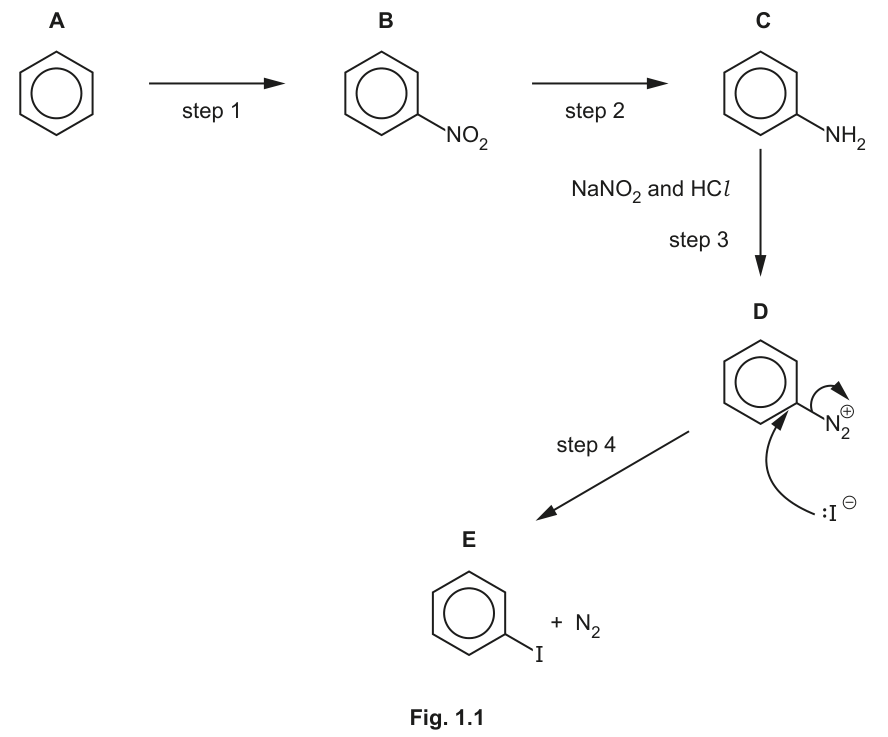
Answer
Step 1 (nitration of benzene): concentrated and concentrated (catalyst)
Step 2 (reduction of nitrobenzene to phenylamine): Sn and concentrated HCl
Step 1: concentrated HNO₃ and concentrated H₂SO₄. Step 2: Sn and concentrated HCl.
Background Concept
Nitration of benzene: Benzene reacts with a mixture of concentrated nitric acid and concentrated sulfuric acid (which acts as a catalyst to generate the nitronium ion, ). The reaction is electrophilic substitution, producing nitrobenzene.
Reduction of nitroarenes: Nitrobenzene can be reduced to phenylamine (aniline) using tin (Sn) and concentrated hydrochloric acid (HCl) as the reducing system. The nitro group () is reduced to an amino group ().
Understanding the Question
Fig. 1.1 shows a synthetic route: benzene → nitrobenzene → phenylamine → benzenediazonium ion → iodobenzene. Identify the reagents for steps 1 and 2.
Approach
Recall the standard reagents for aromatic nitration and nitro-group reduction.
Step-by-Step Reasoning
Step 1: Benzene → Nitrobenzene
- Reagent: concentrated and concentrated .
- Conditions: warm (typically 50°C), but the question only asks for reagents.
- Mechanism: electrophilic substitution (nitronium ion attack).
Step 2: Nitrobenzene → Phenylamine
- Reagent: Sn (tin) and concentrated HCl.
- The Sn/HCl system reduces to .
- After the reaction, NaOH is added to free the amine from its salt, but the question only asks for the reducing reagents.
Key Takeaways
These are standard reactions in aromatic chemistry. Nitration requires both HNO and HSO (the sulfuric acid generates the electrophile NO). Reduction of nitro groups to amines uses Sn/HCl or Fe/HCl.
Common Mistakes
- Writing only HNO for nitration (missing HSO catalyst).
- Saying "dilute" instead of "concentrated" for the acids.
- Writing NaOH/H for reduction (that's for aliphatic nitro compounds or different conditions).
- Confusing the reagents for nitration with those for halogenation (Br/FeBr).
Things to Be Careful About
- Both reagents must be named for each step.
- "Concentrated" is important for the nitration reagents.
- For step 2, Sn and HCl are the key reagents; the base workup is not required here.
Step 3 occurs in two stages.
stage I: and undergo an acid–base reaction to produce .
stage II: reacts with C, , to produce D, .
Complete the equations for stage I and for stage II.
stage I:
stage II:
Answer
Stage I:
Stage II:
Stage I: NaNO₂ + HCl → HNO₂ + NaCl. Stage II: C₆H₅NH₂ + HNO₂ + H⁺ → C₆H₅N₂⁺ + 2H₂O.
Background Concept
Diazotisation is the reaction of a primary aromatic amine (phenylamine/aniline) with nitrous acid (HNO) at low temperatures (0–5°C) to form a diazonium salt.
Nitrous acid is not stable, so it is generated in situ from sodium nitrite (NaNO) and a strong acid (HCl):
The diazonium ion formation involves:
- Protonation of HNO to form (nitrosonium equivalent).
- Electrophilic attack on the lone pair of the amine nitrogen.
- Loss of water to form the diazonium ion .
Overall:
Understanding the Question
Complete the two-stage equations for diazotisation of phenylamine.
Approach
Stage I is a simple acid-base reaction. Stage II is the overall reaction of the amine with nitrous acid in acidic conditions to form the diazonium ion.
Step-by-Step Reasoning
Stage I:
- NaNO + HCl is a simple acid-base (salt + acid) reaction.
- Products: HNO (nitrous acid) + NaCl.
- Equation:
Stage II:
- Reactants: phenylamine (), nitrous acid (), and H (from the acidic medium).
- Products: benzenediazonium ion () and water.
- Balance atoms:
- Check: Left side has N: 1+1=2, Right side has N: 2. ✓
- H: 5+2+1+1=9 on left; 5+4=9 on right. ✓
- O: 2 on left; 2 on right. ✓
- Charge: +1 on left; +1 on right. ✓
Key Takeaways
Diazotisation is a two-stage process: first generate HNO, then react it with the amine. The overall equation requires H as a reactant and produces 2HO.
Common Mistakes
- Writing the wrong products for stage I (e.g., NO instead of HNO).
- Forgetting H in stage II reactants.
- Not balancing water correctly (should be 2HO, not HO).
- Writing molecular HNO instead of HNO.
Things to Be Careful About
Both equations must be balanced. The H in stage II is essential — it comes from the excess HCl in the reaction mixture. The diazonium ion has a +1 charge.
The from KI reacts with D in step 4. The mechanism is shown in Fig. 1.1.
Suggest the name for this mechanism.
Answer
Nucleophilic (aromatic) substitution
Nucleophilic aromatic substitution
Background Concept
The reaction of a benzenediazonium ion with iodide ion (I) to form iodobenzene and nitrogen gas is a nucleophilic aromatic substitution reaction. Specifically, it is a substitution at the diazonium group where the nucleophile (I) replaces the diazonium group (), which leaves as stable N gas.
The mechanism involves:
- The nucleophile (I) attacks the carbon attached to the diazonium group.
- The C–N bond breaks, releasing N gas (a very good leaving group).
- The aromatic ring is restored.
This is sometimes called a Sandmeyer-type reaction (though the classical Sandmeyer uses Cu catalysts). With I, it can proceed without a copper catalyst because I is a good nucleophile and N is an excellent leaving group.
Understanding the Question
The question shows curly arrows in Fig. 1.1: I attacks the carbon bearing the diazonium group, and N leaves. Name this mechanism.
Approach
The nucleophile (I) substitutes the leaving group (N) on the aromatic ring. This is nucleophilic aromatic substitution.
Step-by-Step Reasoning
- The diazonium group () is an excellent leaving group (leaves as N gas).
- I acts as a nucleophile, attacking the electrophilic carbon attached to the diazonium group.
- The aromatic ring is temporarily disrupted but restored as N leaves.
- This is nucleophilic substitution on an aromatic ring.
- The mark scheme accepts "nucleophilic (aromatic) substitution".
Key Takeaways
Diazonium salts are versatile intermediates. They can undergo nucleophilic substitution where the diazonium group is replaced by various nucleophiles (Cl, Br, I, CN, OH, H). The reaction is driven by the release of stable N gas.
Common Mistakes
- Saying "electrophilic substitution" — the ring is not being attacked by an electrophile; the diazonium group is being replaced by a nucleophile.
- Saying "elimination" — although N leaves, a nucleophile also adds, so it's substitution, not elimination.
- Saying "addition-elimination" without specifying nucleophilic.
Things to Be Careful About
The mechanism is specifically nucleophilic aromatic substitution. The word "nucleophilic" is essential. "Aromatic" may be included for completeness but the key term is nucleophilic substitution.
Water is an amphoteric compound that also acts as a good solvent of polar and ionic compounds.
Equation 1 shows water acting as a Brønsted–Lowry acid.
Identify the two conjugate acid–base pairs in equation 1.
acid I: | conjugate base of acid I:
acid II: | conjugate base of acid II:
Answer
acid I: | conjugate base of acid I:
acid II: | conjugate base of acid II:
acid I: H2O, conjugate base: OH-; acid II: HNO2, conjugate base: NO2-
Background Concept
A Brønsted–Lowry acid is a proton () donor, and a Brønsted–Lowry base is a proton acceptor. When an acid donates a proton, it forms its conjugate base. When a base accepts a proton, it forms its conjugate acid. A conjugate acid–base pair differs by exactly one proton ().
Understanding the Question
The question provides an equilibrium equation: and asks to identify the two conjugate acid–base pairs, specifically naming the conjugate base for acid I () and the acid and conjugate base for acid II.
Approach
Identify which species donates a proton to become its conjugate base. donates a proton to become , so is acid I and is its conjugate base. On the other side, donates a proton to become , so is acid II and is its conjugate base.
Step-by-Step Reasoning
- Acid I is given as . Losing an gives . Thus, the conjugate base of acid I is .
- The reverse reaction involves donating a proton to become . Thus, acid II is and its conjugate base is .
Key Takeaways
Always look for the species that differs by exactly one on either side of the equilibrium arrow to identify conjugate pairs.
Common Mistakes
- Confusing the conjugate acid with the conjugate base (e.g., calling the acid).
- Including water as part of a second pair when it is already assigned as acid I.
Things to Be Careful About
Ensure you match the correct conjugate base to the correct acid as labelled in the question template.
Water also behaves as a Brønsted–Lowry acid when it dissolves .
Explain the ability of to act as a base.
Answer
The nitrogen atom in has a lone pair of electrons that can be donated to / accept a proton ().
Nitrogen has a lone pair that can accept a proton.
Background Concept
In the Brønsted–Lowry theory, a base is a proton () acceptor. For a molecule to act as a base, it must have a lone pair of electrons available to form a dative (coordinate) bond with the incoming proton.
Understanding the Question
The question asks to explain why methylamine () can act as a base when dissolved in water.
Approach
Examine the structure of . The nitrogen atom is in Group 15 and has five valence electrons. In methylamine, it forms three single bonds (one to C, two to H) and retains one lone pair. This lone pair is the key to its basicity.
Step-by-Step Reasoning
- Nitrogen in has a lone pair of electrons.
- According to the Brønsted–Lowry definition, a base accepts a proton.
- The lone pair on nitrogen can be donated to an ion (from water) to form a dative bond, forming the methylammonium ion .
Key Takeaways
Basicity in organic molecules often depends on the availability of lone pairs, particularly on nitrogen atoms.
Common Mistakes
- Saying nitrogen has a "negative charge" (it is neutral; the lone pair is what matters).
- Forgetting to mention the lone pair or proton explicitly.
Things to Be Careful About
Use precise terminology: "lone pair", "donate", "accept a proton" or "".
Answer
H2O + CH3COOH -> H3O+ + CH3COO-
Background Concept
When water acts as a base, it accepts a proton from an acid. The acid donates a proton to water, forming the hydronium ion (), and the acid becomes its conjugate base.
Understanding the Question
Write an equation where water acts as a base reacting with ethanoic acid ().
Approach
Ethanoic acid is the acid (proton donor). Water is the base (proton acceptor). Transfer an from to .
Step-by-Step Reasoning
- loses an to become .
- gains an to become .
- Combine these into a balanced equation: .
Key Takeaways
Water acting as a base always produces (hydronium ion) and the conjugate base of the acid.
Common Mistakes
- Writing instead of (both are often accepted, but is more precise when water is explicitly a reactant).
- Forgetting to balance the charges or atoms.
Things to Be Careful About
Ensure the equation is balanced and charges are correct.
The ionic product of water, , measures the extent to which water dissociates.
Fig. 2.1 shows how varies with temperature.
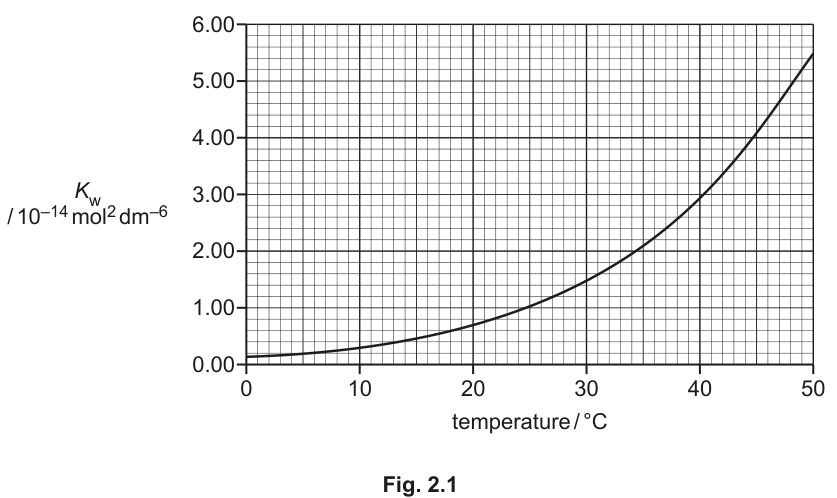
Answer
Kw = [H+][OH-]
Background Concept
Water undergoes autoionisation (self-ionisation): . The ionic product of water, , is the equilibrium constant for this reaction. Since water is a pure liquid, its concentration is not included in the expression.
Understanding the Question
Write the mathematical expression for .
Approach
Use the standard equilibrium constant expression: products over reactants, raised to their stoichiometric coefficients. Exclude pure liquids.
Step-by-Step Reasoning
- The dissociation is .
- . Since is constant and incorporated into , the expression simplifies to .
Key Takeaways
is always at a given temperature. At 298 K, .
Common Mistakes
- Including in the denominator.
- Forgetting that concentrations are in , so has units (though units are often not required in the expression itself).
Things to Be Careful About
Use square brackets for concentrations. Ensure the expression matches the autoionisation equation.
Use information from Fig. 2.1 to deduce whether the dissociation of water is an exothermic or an endothermic process.
Explain your answer.
Answer
The dissociation of water is endothermic.
As temperature increases, increases (or the equilibrium position moves to the right / water dissociates more), which indicates the forward reaction is endothermic.
Endothermic; Kw increases with temperature.
Background Concept
Le Chatelier's principle states that if a change is imposed on a system at equilibrium, the position of equilibrium shifts to counteract the change. For an endothermic reaction (positive ), increasing the temperature shifts the equilibrium to the right (products side) to absorb the added heat, increasing the value of the equilibrium constant .
Understanding the Question
Use Fig. 2.1 (a graph of vs temperature) to deduce whether water dissociation is exothermic or endothermic, and explain why.
Approach
Observe the trend in the graph: as temperature rises, increases. Link this increase in to the nature of the forward reaction (endothermic vs exothermic) using Le Chatelier's principle.
Step-by-Step Reasoning
- From Fig. 2.1, as temperature increases from 0 to 50 °C, increases from ~0.1 to ~5.5 (×10^-14).
- An increase in with temperature means the equilibrium position shifts to the right (more dissociation into and ).
- According to Le Chatelier's principle, increasing temperature favours the endothermic direction.
- Therefore, the forward dissociation of water is endothermic.
Key Takeaways
If increases with temperature, the reaction is endothermic. If decreases, it is exothermic.
Common Mistakes
- Stating "endothermic" without explaining the link to increasing or the equilibrium shifting right.
- Confusing the sign of (endothermic means ).
Things to Be Careful About
The explanation must explicitly connect the temperature increase to the increase and then to the endothermic nature.
An aqueous solution has at .
Use information from Fig. 2.1 to explain why this solution can be considered to be alkaline at .
Working
From Fig. 2.1, at , .
For a neutral solution, , so:
Answer
The neutral pH at is 6.91. Since the solution has pH = 7.00, which is greater than 6.91, , so the solution is alkaline.
(Alternatively: . . Since , the solution is alkaline.)
Neutral pH is 6.91; pH 7.00 is alkaline.
Background Concept
A solution is neutral when . At 298 K, , so neutral pH = 7.00. However, is temperature-dependent. At higher temperatures, increases, meaning and in pure water both increase, and the neutral pH becomes less than 7.00. A solution with pH 7.00 at a higher temperature will have , making it alkaline.
Understanding the Question
Explain why a solution with pH = 7.00 at 30 °C is alkaline, using data from Fig. 2.1.
Approach
- Read at 30 °C from the graph.
- Calculate the neutral pH at 30 °C.
- Compare the given pH (7.00) with the neutral pH, or compare and .
Step-by-Step Reasoning
- From Fig. 2.1, at 30 °C, , so .
- For neutrality, .
- Neutral pH = .
- The given solution has pH = 7.00, which is higher than the neutral pH of 6.91.
- A higher pH means lower and higher , so , which defines an alkaline solution.
Key Takeaways
Neutral pH is not always 7.00; it depends on temperature. Always calculate or compare and using the correct for the temperature.
Common Mistakes
- Assuming neutral pH is always 7.00 regardless of temperature.
- Failing to read accurately from the graph.
- Not showing the calculation or comparison clearly.
Things to Be Careful About
Ensure significant figures are consistent. Reading from the graph may have some uncertainty, so using a value like is acceptable. The comparison is a robust way to prove alkalinity.
The three physical states of have different standard entropies, , associated with them. Table 2.1 shows these values.
Table 2.1
| state of | standard entropy, |
|---|---|
| solid | |
| liquid | |
| gas |
Answer
molecules have more randomness / disorder (or more ways to arrange particles and energy) than in the solid state ().
Liquid water has more disorder/randomness than solid ice.
Background Concept
Entropy () is a measure of the randomness or disorder of a system, or more precisely, the number of microstates (ways to arrange particles and energy) available to the system. In a solid, particles are fixed in a lattice and can only vibrate, so there is low entropy. In a liquid, particles can move past each other, leading to more disorder and higher entropy.
Understanding the Question
Explain why the standard entropy of (+70.1 J K^-1 mol^-1) is greater than that of (+48.0 J K^-1 mol^-1).
Approach
Compare the particle arrangements and freedom of movement in solid vs liquid water.
Step-by-Step Reasoning
- In solid ice, water molecules are held in a rigid lattice with fixed positions.
- In liquid water, molecules can move, rotate, and slide past one another.
- This increased freedom of movement leads to more possible arrangements (microstates) and greater randomness/disorder.
- Therefore, .
Key Takeaways
Entropy increases from solid to liquid to gas due to increasing particle disorder and freedom of movement.
Common Mistakes
- Saying "liquid has more energy" (while true, entropy is specifically about disorder/microstates, not just energy).
- Not mentioning randomness or disorder explicitly.
Things to Be Careful About
Use terms like "randomness", "disorder", or "ways to arrange particles/energy" as these are the mark scheme keywords.
Answer
molecules have much more randomness / disorder (or many more ways to arrange particles and energy) than in the liquid state.
Gas phase has vastly more disorder/randomness than liquid.
Background Concept
When a substance melts (solid to liquid), particles gain some freedom to move, but they remain close together. When a substance boils (liquid to gas), particles separate completely and move freely throughout the available volume, leading to a massive increase in the number of possible microstates and thus a much larger increase in entropy.
Understanding the Question
Explain why the increase in is much greater for boiling () than for melting ().
Approach
Compare the degree of disorder and freedom of movement in gas vs liquid, and liquid vs solid.
Step-by-Step Reasoning
- Melting: solid to liquid. Molecules go from fixed positions to moving in a confined volume. Entropy increases by .
- Boiling: liquid to gas. Molecules go from being close together to being far apart and moving freely in a much larger volume. Entropy increases by .
- The gas phase has vastly more randomness/disorder and many more ways to arrange particles/energy than the liquid phase, compared to the relatively small increase from solid to liquid.
Key Takeaways
Entropy increases dramatically during vaporisation because gas molecules occupy a much larger volume and have far more freedom of movement than liquid molecules.
Common Mistakes
- Failing to quantify or compare the actual entropy changes.
- Not explaining why the gas phase has more disorder than the liquid phase.
Things to Be Careful About
The word "much" in the question implies a large difference. Use the data to show this ().
The energy changes for are shown.
Use these data to show that the melting point of is .
Working
At the melting point, the solid and liquid phases are in equilibrium, so .
Answer
The melting point is .
T = 273 K = 0 °C
Background Concept
The Gibbs free energy change is given by . At a phase transition (like melting or boiling), the two phases are in equilibrium, so . This allows us to calculate the transition temperature: .
Understanding the Question
Use the given and for to show the melting point is 0 °C.
Approach
- Calculate for melting using the table values.
- Use to solve for .
- Convert from Kelvin to Celsius.
Step-by-Step Reasoning
- .
- At equilibrium, , so .
- Ensure units match: .
- .
- Convert to Celsius: (or simply using 273 for conversion).
Key Takeaways
At phase transitions, . Always ensure and are in consistent units (J or kJ) before calculating .
Common Mistakes
- Forgetting to convert from kJ to J (or from J to kJ), leading to a temperature off by a factor of 1000.
- Using the wrong value (e.g., using gas instead of liquid).
- Forgetting to convert Kelvin to Celsius at the end.
Things to Be Careful About
Check significant figures. The data given has 3-4 sig figs, so is appropriate, which rounds to .
Metal–air batteries are electrochemical cells that generate electrical energy from the reaction of metal anodes with air.
The standard electrode potentials for the zinc–air battery are shown.
Answer
+1.62 V
Background Concept
The standard cell potential is calculated as (or ), where the cathode is the positive electrode (reduction) and the anode is the negative electrode (oxidation). The half-equation with the more positive value will undergo reduction.
Understanding the Question
Calculate the standard cell potential for a zinc–air battery using the given standard electrode potentials.
Approach
Identify the cathode (reduction) and anode (oxidation). The oxygen half-equation has (more positive, so reduction/cathode). The zinc half-equation has (more negative, so oxidation/anode). Apply the formula.
Step-by-Step Reasoning
- Cathode (reduction): , .
- Anode (oxidation): , .
- .
Key Takeaways
is always positive for a spontaneous cell. Use or .
Common Mistakes
- Subtracting in the wrong order (giving a negative value).
- Forgetting the sign of the anode potential.
Things to Be Careful About
Ensure you use the correct formula and sign conventions. The answer must be positive for a functioning battery.
The zinc–air battery usually operates at and . The overall cell potential is dependent on .
The Nernst equation shows how the electrode potential at the cathode changes with .
Calculate the electrode potential, , at .
Working
At pH 11, .
Substitute into the Nernst equation:
Answer
(to 2 sf)
E = +0.58 V
Background Concept
The Nernst equation relates the electrode potential to the standard electrode potential and the concentrations of species involved. For the oxygen half-equation in alkaline solution, the given form is:
where (number of electrons transferred).
Understanding the Question
Calculate the electrode potential at the cathode when the battery operates at pH 11.
Approach
- Calculate from the given pH using .
- Substitute into the Nernst equation and solve for .
Step-by-Step Reasoning
- pH = 11 .
- .
- Substitute into the equation: .
- , and .
- .
- Round to 2 significant figures: .
Key Takeaways
Always convert pH to or before substituting into the Nernst equation. Pay attention to the power inside the log.
Common Mistakes
- Forgetting to calculate from pH and using pH directly.
- Miscalculating (e.g., using instead of ).
- Arithmetic errors with the negative signs.
Things to Be Careful About
The Nernst equation given already has in the denominator. Ensure you square before taking the log. Round the final answer to an appropriate number of significant figures (2 sf is suggested by the mark scheme).
Iron is a transition metal in Group 8 of the Periodic Table.
Answer
The 3d and 4s sub-shells (orbitals) have very similar energies, so iron can lose different numbers of electrons to form different oxidation states.
Similar energies of 3d and 4s sub-shells allow variable loss of electrons.
Background Concept
Transition metals show variable oxidation states because their 3d and 4s sub-shells are very close in energy. In the neutral atom the 4s sub-shell fills before 3d, but during ionisation the 4s electrons are lost first. Because the 3d and 4s energy levels are similar, it is also possible to remove one or more 3d electrons without a huge energy cost, giving ions such as Fe2+ and Fe3+.
Understanding the Question
The question asks for a reason, not just a fact. A mark is awarded for recognising that the 3d and 4s sub-shells (or orbitals) have similar energies. Simply saying “iron can lose different numbers of electrons” is not enough.
Approach
State the key orbital-energy fact, then connect it to the ability to form more than one oxidation state.
Step-by-Step Reasoning
- Iron has the configuration [Ar]3d6 4s2.
- The 3d and 4s sub-shells are close in energy.
- Therefore different numbers of electrons can be removed, producing Fe2+ and Fe3+ (and other oxidation states).
- The small energy difference makes these different oxidation states accessible.
Key Takeaways
Variable oxidation states in transition metals are a consequence of the similar energies of the 3d and 4s sub-shells.
Common Mistakes
- Saying only “it can lose different numbers of electrons” without mentioning orbital energies.
- Stating that the 3d and 4s sub-shells have identical energies.
- Writing the wrong electron configuration when trying to illustrate the point.
Things to Be Careful About
Use the terms “sub-shells” or “orbitals” and mention both 3d and 4s. The mark scheme accepts “energies/energy levels of the 3d and 4s sub-shells/orbitals are similar” or “the difference between the 3d and 4s is small”.
Answer
Fe: [Ar] 3d^6 4s^2
Fe3+: [Ar] 3d^5
Fe = [Ar]3d^6 4s^2; Fe3+ = [Ar]3d^5
Background Concept
For iron, Z = 26, so the shorthand configuration is built on [Ar] (18 electrons). The next electrons fill 4s before 3d, giving [Ar]3d6 4s2. When iron forms Fe3+, the 4s electrons are lost first, followed by one 3d electron, leaving [Ar]3d5.
Understanding the Question
Complete the shorthand configurations of Fe and Fe3+. The answer must use [Ar] as the core and show the outer 3d/4s electrons.
Approach
Count electrons beyond argon, fill 4s before 3d for the atom, then remove electrons in the order 4s first for the ion.
Step-by-Step Reasoning
- Argon accounts for 18 electrons; Fe has 26, so there are 8 outer electrons.
- Filling order: 4s before 3d, so Fe = [Ar]3d6 4s2.
- Fe3+ has lost three electrons. The first two come from 4s, the third from 3d, so Fe3+ = [Ar]3d5.
Key Takeaways
The 4s sub-shell is filled before 3d in the atom, but emptied before 3d when ions form.
Common Mistakes
- Writing Fe3+ as [Ar]3d3 4s2.
- Writing Fe as [Ar]3d8.
- Forgetting the [Ar] core.
Things to Be Careful About
Use superscripts correctly: 3d6 4s2 and 3d5. The mark scheme requires both configurations.
An aqueous solution of contains the complex .
When solutions of KSCN(aq) and are mixed, a colour change is observed. The red complex forms.
Answer
A complex is a molecule or ion formed by a central metal atom/ion surrounded by, and bonded to, one or more ligands.
A central metal atom/ion surrounded by one or more ligands.
Background Concept
A ligand is a molecule or ion that donates a lone pair of electrons to a central metal atom/ion, forming a coordinate (dative covalent) bond. A complex is the species formed when one or more ligands are attached to a central metal atom/ion.
Understanding the Question
This is a definition question. The mark scheme requires both the central metal atom/ion and the surrounding ligands.
Approach
Give the definition in the order: central metal atom/ion + surrounded/bonded by one or more ligands.
Step-by-Step Reasoning
- Identify the central species: a metal atom or metal ion.
- Identify the attached species: one or more ligands.
- Combine: a complex is a molecule or ion formed by a central metal atom/ion surrounded by one or more ligands.
Key Takeaways
A complex always has a central metal atom/ion and at least one ligand.
Common Mistakes
- Omitting “central metal atom/ion”.
- Saying “compound” instead of “molecule or ion”.
- Forgetting to mention ligands.
Things to Be Careful About
The mark scheme allows “surrounded” or “bonded by”; both are acceptable. Avoid vague definitions such as “a metal with things attached”.
Answer
6
6
Background Concept
The coordination number of a complex is the number of coordinate bonds formed between the central metal ion and the ligands. Water is a monodentate ligand, so each H2O donates one lone pair.
Understanding the Question
In [Fe(H2O)6]3+, the subscript 6 shows that six water ligands are attached to Fe3+.
Approach
Count the number of ligands, each donating one bond.
Step-by-Step Reasoning
- The formula shows six H2O ligands.
- Each H2O is monodentate, forming one coordinate bond.
- Therefore the coordination number is 6.
Key Takeaways
Coordination number = number of coordinate bonds from ligands to the central metal ion.
Common Mistakes
- Confusing coordination number with oxidation state.
- Saying 3 because of the charge.
Things to Be Careful About
For monodentate ligands, coordination number equals the number of ligands. For polydentate ligands, it would be different.
The H—O—H bond angle in water is .
Suggest the H—O—H bond angle in .
Explain your answer.
Answer
106–108°. In the complex, the lone pair on the oxygen of water is donated to Fe3+, so one of oxygen's lone pairs becomes a bonding pair. There is now less lone-pair–bond-pair repulsion than in free water, so the H–O–H bond angle increases from 104.5° to about 107°.
106–108°, because the donated lone pair becomes a bonding pair, reducing lone-pair–bond-pair repulsion.
Background Concept
In a water molecule, oxygen has two O–H bonding pairs and two lone pairs. According to VSEPR theory, lone pairs repel more strongly than bonding pairs, compressing the H–O–H angle to 104.5°. When water acts as a ligand, one of its lone pairs is donated to the metal ion, so that lone pair becomes a bonding pair to Fe. The oxygen now has three bonding pairs (two O–H and one O–Fe) and one lone pair, similar to the situation in NH3, giving a bond angle close to 107°.
Understanding the Question
You must suggest a value and explain it. The mark scheme wants a value in the range 106–108° and a reason based on the lone pair being donated/bonding pair formation.
Approach
Compare the number of lone pairs and bonding pairs around oxygen in free water and in the coordinated ligand.
Step-by-Step Reasoning
- In free H2O: O has two bonding pairs and two lone pairs; lone-pair–lone-pair and lone-pair–bond-pair repulsions give 104.5°.
- In [Fe(H2O)6]3+, one lone pair on O is donated to Fe3+.
- That lone pair becomes a bonding pair, so O now has three bonding pairs and one lone pair.
- Lone-pair–bond-pair repulsion is less than lone-pair–lone-pair repulsion, so the angle opens up to about 107°.
Key Takeaways
Coordination changes the electron-pair geometry around the donor atom, affecting bond angles.
Common Mistakes
- Saying the angle stays 104.5°.
- Saying the angle decreases.
- Giving 109.5° without explaining the loss of one lone pair.
- Not mentioning that the lone pair is donated.
Things to Be Careful About
The mark scheme accepts any angle from 106° to 108°. The explanation must refer to the lone pair on O being donated (or one more electron pair becoming a bonding pair), so it repels less.
Answer
- The degenerate d orbitals split into two sets of different energies.
- An electron absorbs energy and moves from a lower d orbital to a higher d orbital.
- The energy absorbed is in the visible region; the colour seen is the complementary colour to the colour absorbed.
d orbitals split; electron absorbs visible light to move between levels; complementary colour observed.
Background Concept
In an isolated transition metal ion, the five 3d orbitals are degenerate (same energy). When ligands approach, the octahedral field splits them into two sets: a lower-energy set and a higher-energy set. Electrons can absorb visible light and be promoted from the lower set to the higher set. The wavelengths not absorbed are transmitted/reflected and give the complementary colour.
Understanding the Question
This is a three-mark explanation. Each mark corresponds to one of: d-orbital splitting, electron transition, absorption of visible light and complementary colour.
Approach
Build the explanation in the order the mark scheme uses: splitting → transition → absorption/colour.
Step-by-Step Reasoning
- In the complex, the five d orbitals are no longer degenerate; they split into two energy levels (M1).
- When visible light falls on the complex, an electron absorbs energy and jumps from a lower d orbital to a higher d orbital (M2).
- The energy absorbed corresponds to a wavelength in the visible region; the colour observed is the complementary colour to the colour absorbed (M3).
Key Takeaways
Colour in transition metal complexes arises from d–d electronic transitions caused by absorption of visible light.
Common Mistakes
- Saying electrons emit the colour rather than absorb light.
- Forgetting that d orbitals must split first.
- Not mentioning “complementary colour”.
- Saying all d orbitals have the same energy in the complex.
Things to Be Careful About
Use precise terms: “degenerate d orbitals split into two energy levels”, “electron moves to a higher energy level”, “absorption of light energy in the visible region”, “colour seen is complementary to colour absorbed”.
Aqueous solutions of complexes and are different colours.
Explain why these complexes are different colours.
Answer
The two complexes contain different ligands (H2O and SCN–), so the d-orbital splitting energy, Δoct, is different. This means a different frequency/wavelength of visible light is absorbed, so the complementary colours observed are different.
Different ligand gives different ΔE, so different wavelength absorbed.
Background Concept
The colour of a transition metal complex depends on the energy gap between the split d orbitals. Different ligands cause different extents of d-orbital splitting. A larger splitting means higher-energy (shorter-wavelength) light is absorbed; a smaller splitting means lower-energy (longer-wavelength) light is absorbed. The observed colour is the complementary colour of the absorbed light.
Understanding the Question
Two complexes of the same metal ion, Fe3+, have different colours. The explanation must link the different ligands to a different d–d energy gap and hence different absorbed wavelength.
Approach
Compare the ligand environments and connect to ΔE and wavelength.
Step-by-Step Reasoning
- [Fe(H2O)6]3+ has six H2O ligands; [Fe(H2O)5SCN]2+ has five H2O and one SCN– ligand.
- SCN– and H2O produce different ligand fields, so the d-orbital splitting energy, Δoct, is different in the two complexes.
- A different ΔE means a different frequency/wavelength of light is absorbed.
- Since the observed colour is complementary to the absorbed colour, the complexes appear different colours.
Key Takeaways
Colour differences between complexes of the same metal are due to different ligand-field splitting, which changes the wavelength of light absorbed.
Common Mistakes
- Saying the oxidation state of Fe is different.
- Saying the coordination number is different (both are 6).
- Not mentioning wavelength/frequency of absorbed light.
Things to Be Careful About
The mark scheme requires both ideas: energy gap is different AND different frequency/wavelength absorbed/transmitted/reflected. Use ΔE or Δoct.
Table 3.1 gives values for the stability constants, , of different complexes of iron.
Table 3.1
| complex | stability constant, |
|---|---|
Answer
[Fe(H2O)6]3+ + H3PO4 → [Fe(H2O)5(H2PO4)]2+ + H3O+
[Fe(H2O)6]3+ + H3PO4 -> [Fe(H2O)5(H2PO4)]2+ + H3O+
Background Concept
This is a ligand substitution reaction. H3PO4 is a weak acid; it can transfer a proton to a water ligand, forming H3O+ and H2PO4–. The H2PO4– ion then coordinates to Fe3+ in place of one water ligand.
Understanding the Question
Write the balanced equation for the formation of [Fe(H2O)5(H2PO4)]2+ from [Fe(H2O)6]3+ and H3PO4.
Approach
Replace one H2O ligand by H2PO4– and balance the extra proton as H3O+.
Step-by-Step Reasoning
- Start with [Fe(H2O)6]3+ and H3PO4.
- One H2O is displaced; H2PO4– takes its place, giving [Fe(H2O)5(H2PO4)]2+.
- The proton removed from H3PO4 combines with the displaced H2O to form H3O+.
- Check balance: atoms and charges balance (left charge +3, right charge +2 +1 = +3).
Key Takeaways
Ligand substitution equations must balance both atoms and charge; a proton transfer often accompanies the substitution.
Common Mistakes
- Writing H2PO4– replacing H2O without forming H3O+.
- Writing HPO4^2– instead of H2PO4–.
- Unbalanced charges.
Things to Be Careful About
The mark scheme expects H3O+ as the other product. State symbols are not required but must not be wrong.
Answer
Units:
Kstab = [[Fe(H2O)5SCN]2+]/([[Fe(H2O)6]3+][SCN-]); units mol^-1 dm^3
Background Concept
Stability constant, Kstab, is the equilibrium constant for formation of a complex from the aqua complex and the incoming ligand. For [Fe(H2O)5SCN]2+:
[Fe(H2O)6]3+ + SCN– ⇌ [Fe(H2O)5SCN]2+ + H2O
Kstab = products/reactants, excluding water (solvent).
Understanding the Question
Write the expression and give units. Two marks: one for expression, one for units.
Approach
Identify the formation equilibrium and write concentration quotient; then deduce units from the expression.
Step-by-Step Reasoning
- Formation: [Fe(H2O)6]3+ + SCN– ⇌ [Fe(H2O)5SCN]2+ + H2O.
- Kstab = [[Fe(H2O)5SCN]2+] / ([[Fe(H2O)6]3+][SCN–]).
- Units: numerator mol dm^-3; denominator (mol dm^-3)^2; so units mol^-1 dm^3.
Key Takeaways
Kstab is a formation constant; water is omitted from the expression because it is the solvent.
Common Mistakes
- Including H2O in the expression.
- Writing units incorrectly, e.g. mol dm^-3.
- Forgetting square brackets around complex ion.
Things to Be Careful About
Use concentration brackets; units must be consistent with the expression. The mark scheme allows “u/c” (units consistent).
Use the stability constant data in Table 3.1 to calculate the value of the equilibrium constant, , for the following equilibrium.
Working
Answer
2.2
2.2
Background Concept
Stability constants describe formation of each complex from the aqua complex. The given equilibrium is a ligand exchange: replace H2PO4– by SCN–. Its equilibrium constant is the ratio of the two stability constants, because the aqua complex and H2O cancel.
Understanding the Question
Use Table 3.1 values to calculate Kc for the exchange equilibrium. One mark; answer to at least 2 significant figures.
Approach
Write Kc = Kstab(SCN complex)/Kstab(H2PO4 complex), substitute values, calculate.
Step-by-Step Reasoning
- Kstab(SCN complex) = 1.30 × 10^2.
- Kstab(H2PO4 complex) = 5.90 × 10^1.
- Kc = 1.30 × 10^2 / 5.90 × 10^1 = 130/59 = 2.203... = 2.2 (2 s.f.).
Key Takeaways
For a ligand-exchange equilibrium, Kc is the ratio of stability constants: product complex Kstab over reactant complex Kstab.
Common Mistakes
- Multiplying the stability constants instead of dividing.
- Using 59.0/130.
- Giving an answer with too few significant figures.
Things to Be Careful About
No units because the ratio cancels. Use the values exactly as given in the table.
Ruthenium and osmium are transition metals below iron in Group 8 of the Periodic Table.
Two different complex ions, X and Y, can form when anhydrous reacts with water under certain conditions.
X and Y have octahedral geometry.
Aqueous samples of X and Y react separately with an excess of . Different amounts of are precipitated:
- 1 mole of complex ion X produces 2 moles of
- 1 mole of complex ion Y produces 1 mole of
Answer
X:
Y:
X: [Ru(H2O)5Cl]2+; Y: [Ru(H2O)4Cl2]+
Background Concept
In coordination chemistry, a complex ion consists of a central metal ion surrounded by ligands in the inner coordination sphere, enclosed in square brackets. Counter ions (outer sphere) balance the charge of the complex. When is added, only chloride ions that are outside the coordination sphere (free/counter ions) are precipitated as , because ligands coordinated to the metal are not released into solution.
Understanding the Question
We are told that reacts with water to form two octahedral complex ions X and Y. Adding excess precipitates different amounts of : X gives 2 mol AgCl per mol complex, Y gives 1 mol AgCl per mol complex. We must deduce the formulae.
The key insight is that the number of moles of precipitated equals the number of free (outer-sphere) chloride ions per formula unit of the complex.
Approach
- Determine the oxidation state of Ru: from , Ru is +3.
- For an octahedral complex, coordination number = 6, so total ligands inside brackets = 6.
- Use the data to find how many Cl⁻ are outside (counter ions) vs inside (coordinated ligands).
- Fill remaining coordination sites with .
- Calculate the charge on the complex from oxidation state and ligand charges.
Step-by-Step Reasoning
For X:
- 2 mol per mol X → 2 Cl⁻ are counter ions (outer sphere)
- RuCl₃ has 3 Cl total, so 3 − 2 = 1 Cl⁻ is coordinated (inner sphere)
- Octahedral (CN = 6): 1 Cl + 5 H₂O = 6 ligands ✓
- Charge: Ru³⁺ + 5(0) + 1(−1) = +2
- Formula: with 2Cl⁻ as counter ions
For Y:
- 1 mol per mol Y → 1 Cl⁻ is a counter ion
- 3 − 1 = 2 Cl⁻ are coordinated
- Octahedral (CN = 6): 2 Cl + 4 H₂O = 6 ligands ✓
- Charge: Ru³⁺ + 4(0) + 2(−1) = +1
- Formula: with 1Cl⁻ as counter ion
Key Takeaways
- Only outer-sphere (counter) ions react with ; coordinated ligands do not.
- The difference between total chloride and precipitated chloride gives the number of coordinated chloride ligands.
- Octahedral geometry fixes the coordination number at 6, which constrains the formula.
Common Mistakes
- Writing all chloride as coordinated (e.g. ) — this would give zero precipitate.
- Forgetting that water is a neutral ligand and miscalculating the charge.
- Confusing which complex gives which amount of precipitate (the mark scheme allows ECF if reversed).
Things to Be Careful About
- The charge on the complex must be consistent with the number of counter ions needed for electrical neutrality.
- State the formula as a complex ion with square brackets and charge, not as a neutral compound.
Both complexes react with an excess of bipyridine, bipy, to form a mixture of two stereoisomers of .
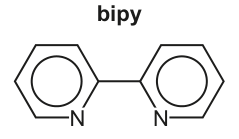
Bipyridine is a bidentate ligand.
Draw three-dimensional diagrams of the two stereoisomers of .
Use to represent the bipy ligand in your structures.
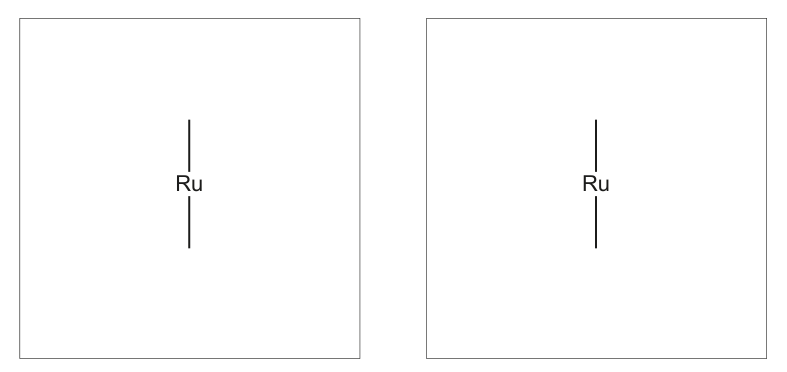
Answer
The two stereoisomers are optical isomers (enantiomers), designated and .
Two enantiomers (Δ and Λ) of [Ru(bipy)3]3+ drawn as 3D octahedral structures with three bidentate N-N ligands shown as arcs connecting adjacent coordination sites
Background Concept
Tris-chelate complexes of the type , where A-A is a bidentate ligand, adopt octahedral geometry. Because the three bidentate ligands wrap around the metal in a propeller-like fashion, two non-superimposable mirror-image arrangements are possible. These are optical isomers (enantiomers), designated (delta, right-handed propeller) and (lambda, left-handed propeller). This is a classic example of stereoisomerism in coordination compounds.
Understanding the Question
We are asked to draw 3D diagrams of the two stereoisomers of , using N⌒N to represent each bidentate bipyridine ligand. The question provides two blank boxes with a vertical line through Ru to guide the drawing.
Approach
- Place Ru at the centre of an octahedron.
- Three bidentate ligands each occupy two adjacent (cis) coordination sites, forming a chelate ring.
- The three chelate rings can be arranged in two ways that are mirror images of each other.
- Use solid wedges (bonds coming towards viewer) and dashed lines (bonds going away) to convey 3D structure.
- Draw one enantiomer, then its mirror image.
Step-by-Step Reasoning
Drawing the first isomer (Δ form):
- Draw Ru at centre with two axial bonds (vertical line, one solid wedge up, one dashed down or both as plain lines in the vertical axis).
- The four equatorial positions are occupied by two pairs of N atoms from two bidentate ligands.
- The third bidentate ligand occupies one axial and one equatorial position (or spans across the top and bottom).
- Connect the N atoms of each bidentate ligand with an arc (N⌒N) to show they are part of the same ligand.
- The arcs should curve in a clockwise sense when viewed along a particular axis → Δ.
Drawing the second isomer (Λ form):
- This is the mirror image: the arcs curve in the opposite sense → Λ.
Both structures must show:
- Correct octahedral geometry (6 N atoms around Ru)
- Three chelate arcs (each connecting two N atoms that are cis to each other)
- Proper 3D notation (wedges and dashes)
- Square brackets with 3+ charge
Key Takeaways
- Tris-bidentate octahedral complexes exhibit optical isomerism due to the propeller arrangement of chelate rings.
- The two forms are non-superimposable mirror images (enantiomers).
- Correct 3D representation requires wedges and dashes to show which bonds project towards or away from the viewer.
Common Mistakes
- Drawing both isomers identically (not as mirror images).
- Placing ligands in trans positions (bidentate ligands must span cis positions in an octahedral complex).
- Forgetting the square brackets and 3+ charge.
- Not using proper 3D notation (wedges/dashes), resulting in a flat drawing that doesn't convey stereochemistry.
Things to Be Careful About
- Each bidentate ligand must connect two adjacent (90°) coordination sites, not opposite (180°) ones.
- The three arcs must be arranged so the overall structure has no plane of symmetry (otherwise it would be achiral).
- The two drawings must be genuine mirror images of each other.
Fig. 4.1 shows another ruthenium complex.
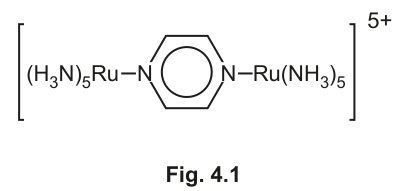
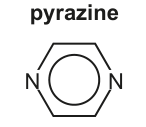
This complex contains the neutral ligand pyrazine.
Answer
Pyrazine has a lone pair on each nitrogen atom. Each lone pair can be donated to a different Ru ion to form a coordinate (dative) bond, allowing pyrazine to act as a bridging ligand between the two metal centres.
Each N atom has a lone pair that can be donated to form a coordinate bond with a separate Ru ion, acting as a bridging ligand
Background Concept
A ligand is a species that donates one or more lone pairs to a metal ion to form coordinate (dative) bonds. Ligands can be classified by the number of donor atoms: monodentate (one donor atom), bidentate (two donor atoms on the same ligand that chelate one metal), or bridging (two donor atoms that connect to two different metal centres). A bridging ligand links two metal ions together, forming a binuclear or polynuclear complex.
Understanding the Question
The complex in Fig. 4.1 is , a binuclear complex where pyrazine sits between two Ru centres. We need to explain how a single pyrazine molecule bonds to two separate Ru ions.
Approach
Identify the donor atoms in pyrazine (the two N atoms at para positions, 1 and 4) and explain that each has a lone pair available for donation to a different metal centre.
Step-by-Step Reasoning
Pyrazine is a six-membered aromatic ring with nitrogen atoms at positions 1 and 4 (para to each other). Each nitrogen atom has a lone pair in an sp² orbital (in the plane of the ring, not part of the π system). These two lone pairs point in opposite directions (180° apart) due to the para arrangement. Each lone pair can be donated to a different Ru ion, forming two separate coordinate bonds. This makes pyrazine a bridging ligand that connects two metal centres.
Key Takeaways
- A bridging ligand uses its donor atoms to connect two (or more) metal centres.
- The para arrangement of N atoms in pyrazine is ideal for bridging, as the lone pairs point in opposite directions.
- Coordinate bonds form when a ligand donates a lone pair to an empty orbital on the metal.
Common Mistakes
- Saying pyrazine forms covalent bonds rather than coordinate/dative bonds.
- Confusing bridging with chelating (chelating means both donor atoms bind to the SAME metal).
- Not mentioning that the lone pairs are donated.
Things to Be Careful About
- Must mention both the lone pair AND the coordinate/dative bond formation.
- The two N atoms must be specified as the donor atoms.
Pyrazine is an aromatic compound. The bonding and structure of pyrazine is similar to that of benzene.
Describe and explain the shape of pyrazine.
In your answer, include:
- the hybridisation of the nitrogen and carbon atoms
- how orbital overlap forms bonds between the atoms in the ring.
Answer
- The ring is planar (hexagonal) with bond angles of .
- All carbon and nitrogen atoms are hybridised.
- Each atom has an unhybridised p orbital perpendicular to the plane of the ring; these p orbitals overlap sideways (laterally) with each other above and below the ring plane, forming a delocalised system.
Planar hexagonal ring, 120° bond angles, all C and N are sp2 hybridised, p orbitals overlap sideways above and below the ring forming delocalised pi bonds
Background Concept
In aromatic compounds like benzene and its heterocyclic analogues, all ring atoms are sp² hybridised. The three sp² orbitals form sigma bonds (to two neighbouring ring atoms and one substituent/lone pair), arranged in a trigonal planar geometry with 120° angles. The remaining unhybridised p orbital on each atom is perpendicular to the ring plane. These p orbitals overlap sideways with adjacent p orbitals, creating a continuous delocalised π system above and below the ring plane. This delocalisation is what gives aromatic compounds their characteristic stability and planar geometry.
Understanding the Question
We are told pyrazine's bonding is similar to benzene. We must describe the shape (planar, 120°), state the hybridisation (sp² for both C and N), and explain how π bonds form (sideways overlap of p orbitals above and below the ring).
Approach
Apply the same reasoning as for benzene: identify hybridisation → deduce geometry → describe π bonding mechanism.
Step-by-Step Reasoning
-
Hybridisation: Each carbon and nitrogen in pyrazine forms three sigma bonds (or two sigma bonds + one lone pair for N). This requires three equivalent orbitals → sp² hybridisation.
-
Shape: sp² hybridisation gives trigonal planar geometry with bond angles of 120°. Since all six ring atoms are sp², the entire ring is planar.
-
π bonding: Each atom retains one unhybridised p orbital oriented perpendicular to the ring plane. Adjacent p orbitals overlap sideways (laterally), and because this happens all around the ring, the six p orbitals merge into a single delocalised π system with electron density distributed above and below the plane of the ring.
Key Takeaways
- Aromatic heterocycles behave like benzene in terms of hybridisation and π bonding.
- The key phrase is 'sideways/lateral overlap of p orbitals above and below the ring'.
- Planarity is a consequence of sp² hybridisation and is necessary for effective p-orbital overlap.
Common Mistakes
- Saying the atoms are sp³ hybridised (which would give non-planar geometry).
- Describing the π overlap as 'end-to-end' (that's sigma bonding) instead of 'sideways/lateral'.
- Forgetting to mention that the p orbitals are perpendicular to the ring plane.
- Not specifying that the delocalisation extends above AND below the ring.
Things to Be Careful About
- The mark scheme requires: planar shape + sp² hybridisation + sideways p-orbital overlap above and below the ring. All three points needed for full marks.
Predict the number of peaks seen in the carbon–13 NMR spectrum of pyrazine.
Explain your answer.
Answer
1 peak
All four carbon atoms in pyrazine are equivalent (in the same chemical environment) due to the symmetrical structure of the molecule.
1 peak; all carbon atoms are equivalent due to the symmetrical structure of pyrazine
Background Concept
In NMR spectroscopy, each chemically distinct carbon environment produces one signal (peak). The number of peaks equals the number of non-equivalent carbon atoms. Symmetry operations (rotation axes, mirror planes) make certain carbon atoms equivalent to each other, reducing the number of signals.
Understanding the Question
Pyrazine is a six-membered ring with N atoms at positions 1 and 4 (para). We need to predict how many NMR peaks it shows and explain why.
Approach
Examine the symmetry of pyrazine. The molecule has a symmetry (like benzene with two CH groups replaced by N). Consider whether all four carbon atoms are in equivalent environments.
Step-by-Step Reasoning
Pyrazine has the following symmetry elements:
- A axis through both N atoms (passing through the ring centre)
- A axis perpendicular to the ring through its centre
- A axis in the plane of the ring, bisecting the C-C bonds
- A mirror plane (the molecular plane)
- A mirror plane perpendicular to the ring through both N atoms
Due to this high symmetry, all four carbon atoms are equivalent to each other. Each carbon is bonded to one N and one C, and by the symmetry operations, any carbon can be mapped onto any other. Therefore, only one NMR signal is observed.
Key Takeaways
- The number of NMR peaks = number of chemically distinct carbon environments.
- High molecular symmetry reduces the number of distinct environments.
- Pyrazine is one of the simplest examples where all carbons are equivalent despite having four of them.
Common Mistakes
- Saying 2 peaks (thinking the carbons adjacent to N are different from those adjacent to C — but by symmetry, all are equivalent).
- Saying 4 peaks (not recognising any symmetry).
- Confusing NMR with NMR (pyrazine has no H on carbon, so no proton NMR signals from the ring carbons).
Things to Be Careful About
- Must state the number AND give the reason (equivalence/symmetry) for both marks.
- The explanation should reference the symmetry or equivalence explicitly.
The overall charge of the ruthenium complex in Fig. 4.1 is .
Deduce the possible oxidation states of the two ruthenium ions in the complex.
Answer
Since and pyrazine are both neutral ligands, the total charge of comes from the two Ru ions combined.
Possible oxidation states: and (or and )
+2 and +3 (or +4 and +1)
Background Concept
The overall charge of a complex equals the oxidation state of the metal(s) minus the total charge of the ligands. Neutral ligands (like NH₃, H₂O, and pyrazine) contribute zero charge. For a binuclear complex, the sum of the two metal oxidation states must equal the overall charge (when all ligands are neutral).
Understanding the Question
The complex has an overall charge of +5. All ligands (NH₃ and pyrazine) are neutral. We must deduce the possible oxidation states of the two Ru ions.
Approach
- Confirm all ligands are neutral → total ligand charge = 0.
- Therefore: oxidation state of Ru₁ + oxidation state of Ru₂ = +5.
- List combinations that give a sum of +5 and are reasonable for Ru.
Step-by-Step Reasoning
- NH₃ is a neutral ligand (charge = 0). There are 10 NH₃ ligands total → contribution = 0.
- Pyrazine is neutral (charge = 0) → contribution = 0.
- Overall charge = +5 = (oxidation state of Ru₁) + (oxidation state of Ru₂) + 0
- So Ru₁ + Ru₂ = +5
Possible pairs: (+2, +3) or (+3, +2) — these are the same combination. Also (+4, +1) or (+1, +4). Ruthenium commonly exhibits +2, +3, +4, and other oxidation states, so both (+2,+3) and (+4,+1) are plausible.
The mark scheme accepts either pair.
Key Takeaways
- In a complex, overall charge = sum of metal oxidation states + sum of ligand charges.
- Neutral ligands don't affect the charge balance.
- For binuclear complexes with neutral ligands, the metal oxidation states must sum to the overall charge.
Common Mistakes
- Forgetting that pyrazine is neutral and assigning it a charge.
- Only giving one oxidation state (e.g. +2.5 each) rather than integer values for two separate ions.
- Not recognising that both Ru ions could have different oxidation states (mixed-valence complex).
Things to Be Careful About
- Must give TWO oxidation states (one for each Ru), not just the average.
- The pair (+2, +3) is the most common answer; (+4, +1) is also accepted.
Osmium tetroxide, , reacts with alkenes in a similar manner to cold dilute acidified .
Fig. 4.2 shows a proposed synthesis of a condensation polymer G.
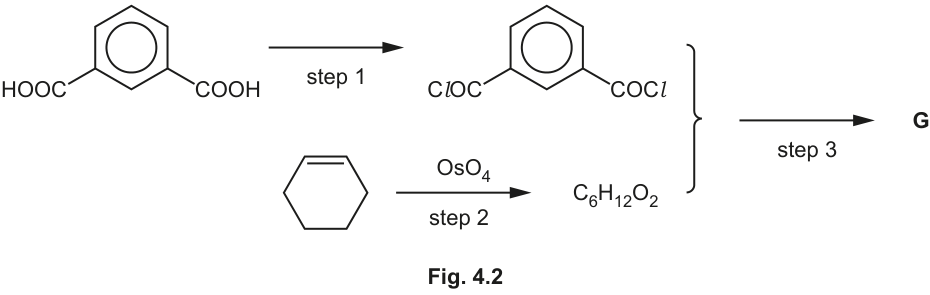
Answer
(thionyl chloride)
(Also acceptable: or )
SOCl2 (or PCl3 or PCl5)
Background Concept
Carboxylic acids can be converted to acyl chlorides (acid chlorides) by reaction with chlorinating agents. The most common reagents are thionyl chloride (), phosphorus(III) chloride (), and phosphorus(V) chloride (). These reagents replace the −OH group of the carboxylic acid with −Cl. is often preferred because the by-products ( and ) are gases that escape, driving the reaction to completion.
Understanding the Question
Step 1 converts benzene-1,3-dicarboxylic acid (isophthalic acid) to benzene-1,3-dicarbonyl chloride (the diacyl chloride). We need to name a suitable reagent.
Approach
Recall the standard reagents for converting −COOH to −COCl.
Step-by-Step Reasoning
The transformation is:
This requires replacing the hydroxyl group with chlorine. Suitable reagents:
- (thionyl chloride) — most commonly cited
- (phosphorus trichloride)
- (phosphorus pentachloride)
Any one of these earns the mark.
Key Takeaways
- The conversion of carboxylic acid to acyl chloride is a nucleophilic acyl substitution.
- is the most frequently used reagent in synthesis problems.
- also works but produces more by-products.
Common Mistakes
- Writing (this doesn't convert acids to acyl chlorides).
- Writing (this would not drive the reaction forward).
- Writing (sulfonyl chloride, different reagent).
Things to Be Careful About
- Must write the correct formula. not .
Draw the structure of exactly one repeat unit of the condensation polymer G.
The ester linkage should be shown fully displayed.
Answer
Repeat unit: 1,3-disubstituted benzene ring with two C(=O)O ester linkages, each connected to adjacent carbons of a cyclohexane ring (1,2-disubstituted), with dashed bonds showing polymer continuation
Background Concept
Condensation polymerisation occurs when a difunctional monomer reacts with another difunctional monomer, eliminating a small molecule (such as HCl or H₂O) at each linkage. When a diacyl chloride reacts with a diol, a polyester forms with ester linkages (−COO−) and HCl is eliminated. The repeat unit of the polymer must show the full structure between the two points of attachment, with the ester linkage drawn out completely (showing the C=O and C−O bonds explicitly).
Understanding the Question
From Fig. 4.2:
- Step 1: Benzene-1,3-dicarboxylic acid → benzene-1,3-dicarbonyl chloride (a diacyl chloride with two −COCl groups meta to each other on the ring)
- Step 2: Cyclohexene + → (cyclohexane-1,2-diol, since performs syn dihydroxylation across the double bond)
- Step 3: Diacyl chloride + diol → condensation polymer G (a polyester)
We must draw exactly one repeat unit with the ester linkage fully displayed.
Approach
- Identify the two monomers: the diacyl chloride (1,3-substituted benzene with two −COCl) and the diol (cyclohexane-1,2-diol).
- Each −COCl reacts with an −OH to form an ester linkage (−COO−), eliminating HCl.
- The repeat unit contains: the benzene ring (1,3-substituted) with two C(=O)O groups, each O connected to an adjacent carbon of the cyclohexane ring (1,2-substituted).
- Show dashed bonds at both ends to indicate the polymer continues.
Step-by-Step Reasoning
Identifying the diol: adds two OH groups across a C=C double bond in a syn (same face) manner. Cyclohexene has its double bond between C1 and C2, so the product is cyclohexane-1,2-diol (two OH groups on adjacent carbons).
Forming the polyester: Each −COCl group on the benzene-1,3-dicarbonyl chloride reacts with an −OH on the diol:
Since both monomers are difunctional (two reactive groups each), a linear polymer forms.
Drawing the repeat unit:
- Central: benzene ring with substituents at positions 1 and 3 (meta)
- Each substituent is −C(=O)−O− (ester linkage, fully displayed showing the double bond to O and single bond to O)
- Each ester oxygen connects to a carbon of the cyclohexane ring
- The cyclohexane ring is 1,2-disubstituted (adjacent carbons bear the two ester oxygens)
- Dashed bonds extend from both ends of the repeat unit to show continuation
Key Takeaways
- gives syn dihydroxylation → 1,2-diol from cyclohexene.
- Diacyl chloride + diol → polyester + HCl (condensation polymerisation).
- The repeat unit must show the ester linkage fully displayed (C=O and C−O bonds explicit).
- Correct substitution patterns on both rings are essential.
Common Mistakes
- Drawing the cyclohexane as 1,4-disubstituted instead of 1,2 (wrong diol position).
- Not fully displaying the ester group (e.g. writing −COO− instead of showing C=O and C−O separately).
- Placing the benzene ring substituents at 1,4 instead of 1,3 (wrong isomer from the starting material).
- Forgetting the dashed bonds showing polymer continuation.
- Drawing two complete repeat units instead of one.
Things to Be Careful About
- The ester must be shown as −C(=O)−O− with the double bond to oxygen explicitly drawn.
- The benzene ring must be 1,3-disubstituted (meta), matching the starting material.
- The cyclohexane ring must be 1,2-disubstituted (adjacent carbons), matching the OsO₄ product.
- Only ONE repeat unit should be drawn, with dashed bonds at each end.
Compound Q can be synthesised from chlorobenzene in seven steps, using the route shown in Fig. 5.1.
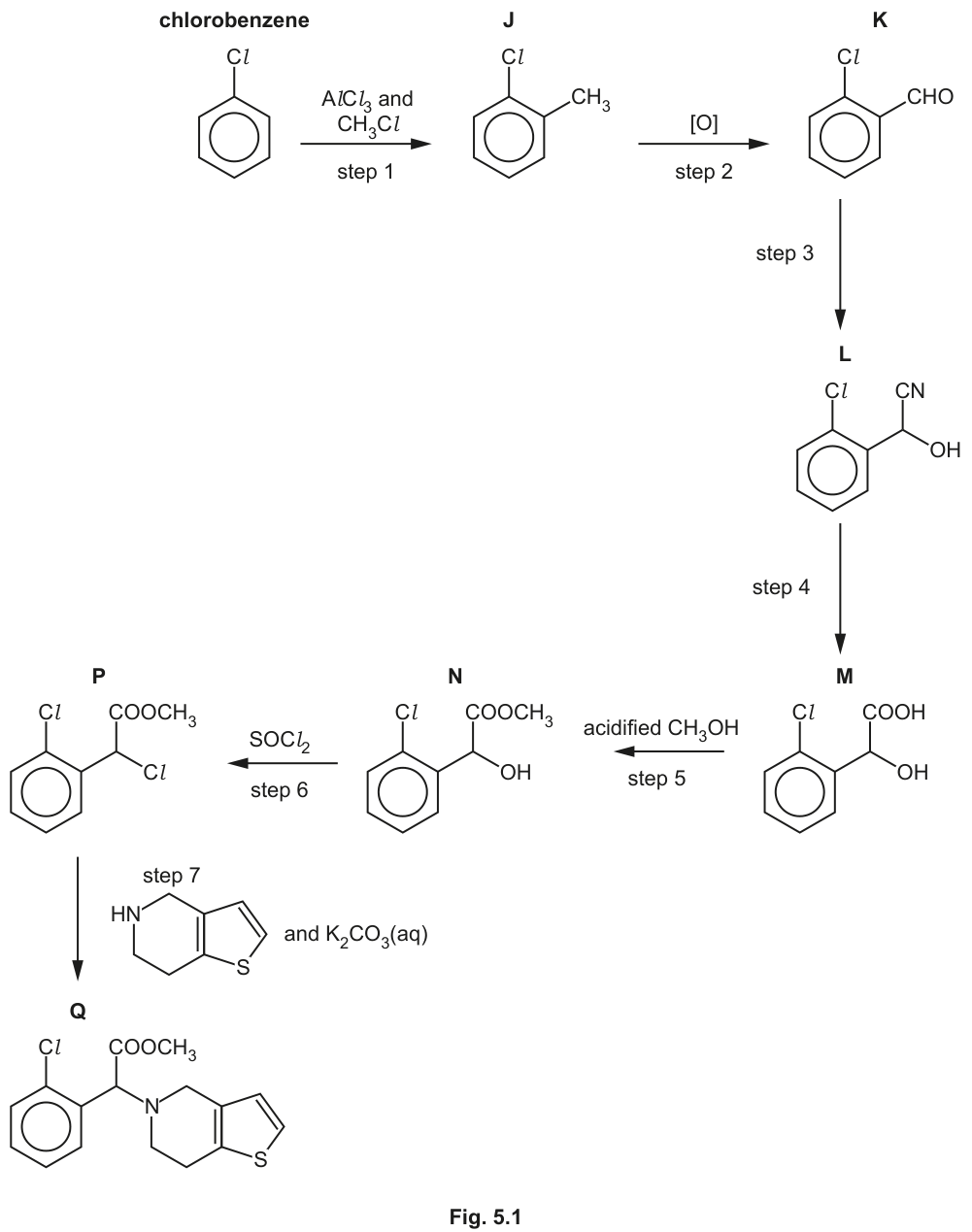
Answer
AlCl3 + CH3Cl → AlCl4⁻ + CH3⁺
Background Concept
In Friedel-Crafts alkylation, a halogenoalkane reacts with a Lewis acid catalyst (typically AlCl₃) to generate a carbocation electrophile. AlCl₃ is electron-deficient (aluminium has only six electrons in its outer shell) and accepts a lone pair from the chlorine atom of the halogenoalkane. This polarises and ultimately breaks the C-Cl bond, producing a carbocation (the electrophile) and the tetrachloroaluminate ion AlCl₄⁻.
Understanding the Question
The question asks specifically for the equation showing how the electrophile is formed in step 1. Step 1 uses AlCl₃ and CHCl to alkylate chlorobenzene. The electrophile is the methyl carbocation, CH₃⁺.
Approach
Write the reaction between the Lewis acid (AlCl₃) and the halogenoalkane (CH₃Cl) that produces the electrophile (CH₃⁺) and the counterion (AlCl₄⁻).
Step-by-Step Reasoning
- AlCl₃ acts as a Lewis acid, accepting a lone pair from the Cl atom of CH₃Cl.
- The C-Cl bond breaks heterolytically, with both bonding electrons going to Cl (forming AlCl₄⁻).
- The remaining CH₃⁺ is the electrophile that attacks the benzene ring.
- The equation is: AlCl₃ + CHCl → AlCl₄ + CH₃⁺
Key Takeaways
- Friedel-Crafts alkylation requires a Lewis acid catalyst to generate the carbocation electrophile.
- The by-product is always AlCl₄⁻ when AlCl₃ is used.
Common Mistakes
- Writing CH₃⁺ without the AlCl₄⁻ counterion (incomplete equation).
- Confusing this with the acylation mechanism (which produces RCO⁺, not R⁺).
- Writing the overall substitution reaction instead of just the electrophile formation step.
Things to Be Careful About
- Include the correct charges on both ions (AlCl₄⁻ and CH₃⁺).
- The equation must be balanced in terms of atoms and charge.
Complete the mechanism in Fig. 5.2 for step 1, the alkylation of chlorobenzene.
Include all relevant curly arrows and charges.
Draw the structure of the intermediate.
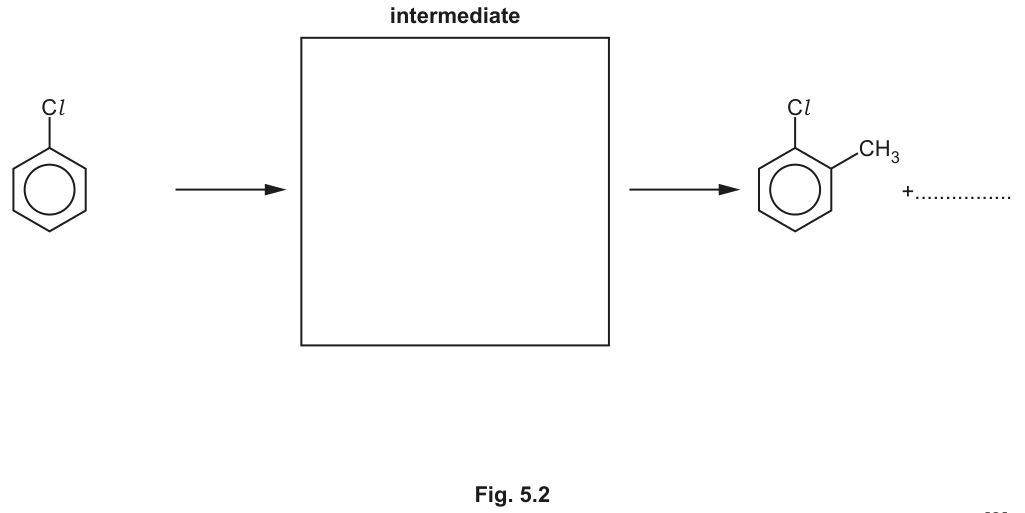
Answer
- Curly arrow from the pi electron system of chlorobenzene to the CH₃⁺ electrophile.
- Intermediate: a cyclohexadienyl cation (arenium ion) with the CH₃ and H attached to the same sp³ carbon, and a positive charge delocalised over the remaining three carbons of the ring.
- Curly arrow from the C–H bond on the sp³ carbon back into the ring, and H⁺ is formed.
See diagram: curly arrow from pi system to CH3+, arenium ion intermediate with CH3 and H on sp3 carbon and positive charge in ring, curly arrow from C-H bond into ring releasing H+
Background Concept
Electrophilic aromatic substitution proceeds via a two-stage mechanism. In the first stage, the pi electrons of the aromatic ring attack the electrophile, breaking aromaticity and forming a positively charged intermediate called the arenium ion (or sigma complex). In the second stage, a base (often AlCl₄⁻) removes the proton from the sp³ carbon, restoring aromaticity and giving the substituted product.
The curly arrow conventions are critical: the first arrow starts from the delocalised pi system (drawn from inside the ring) and points to the electrophile. The second arrow starts from the C–H sigma bond on the sp³ carbon and points into the ring to reform the pi system.
Understanding the Question
The question provides chlorobenzene on the left and 1-chloro-2-methylbenzene on the right of Fig. 5.2, with a blank box for the intermediate. You must add curly arrows and draw the intermediate to complete the mechanism. The electrophile is CH₃⁺ (from part a(i)).
Approach
Draw three stages: (1) chlorobenzene + CH₃⁺ with a curly arrow from the ring to CH₃⁺, (2) the arenium ion intermediate in the box, (3) the product + H⁺ with a curly arrow from the C–H bond into the ring.
Step-by-Step Reasoning
Stage 1 — Attack of electrophile:
- Draw a curly arrow starting from the inside of the benzene ring (representing the delocalised pi electrons) pointing to the carbon of CH₃⁺.
- This forms a new C–C bond between the ring carbon and the methyl group.
Stage 2 — The intermediate (arenium ion):
- The carbon that was attacked becomes sp³ hybridised, bearing both H and CH₃.
- The positive charge is delocalised over the remaining five ring carbons (drawn as a plus sign inside a broken circle, or shown with the charge on specific carbons).
- The Cl substituent remains on the ring.
Stage 3 — Loss of proton:
- Draw a curly arrow from the C–H bond on the sp³ carbon into the ring (reforming the pi system).
- H⁺ is released as the by-product (shown after the '+' in Fig. 5.2).
- Aromaticity is restored, giving 1-chloro-2-methylbenzene.
Key Takeaways
- The arenium ion intermediate has an sp³ carbon bearing both the electrophile and the original hydrogen.
- Curly arrows must start from electron pairs (pi system or sigma bond), not from atoms.
- The positive charge in the intermediate is delocalised, not localised on one carbon.
Common Mistakes
- Drawing the curly arrow from CH₃⁺ to the ring (wrong direction — arrows follow electrons, not positive charges).
- Forgetting the H on the sp³ carbon in the intermediate.
- Not showing the positive charge in the intermediate.
- Drawing the second curly arrow from the ring to H (wrong direction — it should go from the C–H bond into the ring).
- Omitting H⁺ as the by-product.
Things to Be Careful About
- The intermediate must show the correct connectivity: CH₃ and H on the same carbon, with the positive charge delocalised.
- State symbols are not required for mechanisms.
- The position of substitution (ortho to Cl) is already given in the product structure.
Step 2 is an oxidation reaction.
Construct an equation for the reaction in step 2.
Use [O] to represent an atom of oxygen from an oxidising agent.
Answer
C6H4(Cl)CH3 + 2[O] → C6H4(Cl)CHO + H2O
Background Concept
Side-chain oxidation of alkylbenzenes converts a methyl (or other alkyl) group attached to a benzene ring into a carboxylic acid (with strong oxidising agents like acidified KMnO₄ under reflux) or, under milder conditions, to an aldehyde. When using [O] notation, each [O] represents one oxygen atom from the oxidising agent. Converting -CH₃ to -CHO requires removal of two hydrogen atoms and addition of one oxygen atom, which corresponds to 2[O] (one oxygen atom for the C=O, and one to combine with the two removed hydrogens to form H₂O).
Understanding the Question
Step 2 converts compound J (1-chloro-2-methylbenzene, C₆H₄(Cl)CH₃) to compound K (2-chlorobenzaldehyde, C₆H₄(Cl)CHO). The question asks for a balanced equation using [O] notation.
Approach
Write the organic reactant, add [O] to convert CH₃ to CHO, and balance by adding H₂O as the other product.
Step-by-Step Reasoning
- The methyl group (-CH₃) is being oxidised to an aldehyde (-CHO).
- This requires: removal of 2 H atoms and addition of 1 O atom to form the C=O bond.
- The 2 H atoms removed combine with 1 O atom to form H₂O.
- Total oxygen atoms needed: 1 (for C=O) + 1 (for H₂O) = 2[O].
- Balanced equation: C₆H₄(Cl)CH₃ + 2[O] → C₆H₄(Cl)CHO + H₂O
- Check: Left side has 7C, 7H, 1Cl, 2O. Right side has 7C, 7H, 1Cl, 2O. ✓
Key Takeaways
- Oxidation of CH₃ to CHO uses 2[O] and produces H₂O.
- Oxidation of CH₃ to COOH would use 3[O] and produce 2H₂O.
Common Mistakes
- Using 1[O] instead of 2[O].
- Forgetting to include H₂O as a product.
- Writing the formula incorrectly (e.g., omitting the Cl or misplacing it).
Things to Be Careful About
- The question specifies using [O] to represent an atom of oxygen, so the equation must balance in terms of [O] atoms.
- The molecular formula must correctly represent the chloro-substituted benzene ring.
Answer
Step 3: HCN and KCN (catalyst) — or equivalently KCN and dilute H₂SO₄ (or HCl)
Step 4: H₂SO₄(aq) (or HCl(aq)), heat under reflux
Step 3: HCN and KCN (cat) OR KCN and H2SO4/HCl. Step 4: H2SO4(aq) or HCl(aq)
Background Concept
Step 3 converts an aldehyde (K, 2-chlorobenzaldehyde) to a cyanohydrin (L). This is a nucleophilic addition reaction where CN⁻ attacks the carbonyl carbon. HCN is toxic and volatile, so in practice KCN (or NaCN) is used with dilute acid to generate HCN in situ, providing both the nucleophile (CN⁻) and the proton source.
Step 4 converts the nitrile group (-CN) in the cyanohydrin to a carboxylic acid (-COOH), giving compound M (a hydroxy acid). This is acid-catalysed hydrolysis of a nitrile, which proceeds through an amide intermediate to the carboxylic acid. Aqueous acid (H₂SO₄ or HCl) with heating under reflux is required.
Understanding the Question
The question asks for reagents for two consecutive steps: K → L (step 3) and L → M (step 4). The structures are given in Fig. 5.1.
Approach
Identify the functional group change in each step and recall the standard reagents.
Step-by-Step Reasoning
Step 3 (aldehyde → cyanohydrin):
- The -CHO group becomes -CH(OH)CN.
- This is nucleophilic addition of CN⁻ followed by protonation.
- Reagents: HCN with KCN as catalyst, OR KCN with dilute H₂SO₄/HCl (which generates HCN in situ and provides CN⁻).
Step 4 (nitrile → carboxylic acid):
- The -CN group becomes -COOH.
- This is hydrolysis of a nitrile under acidic conditions.
- Reagents: aqueous H₂SO₄ (or HCl), heat under reflux.
Key Takeaways
- Cyanohydrin formation requires both a source of CN⁻ and a proton source (HCN or KCN + acid).
- Nitrile hydrolysis to a carboxylic acid requires aqueous acid and heating under reflux.
Common Mistakes
- Writing only HCN without KCN (or vice versa) for step 3.
- Writing NaOH(aq) for step 4 (this would give the carboxylate salt, not the acid, though with subsequent acidification it could work — but the mark scheme specifies aqueous acid).
- Confusing step 4 with reduction of the nitrile to an amine.
Things to Be Careful About
- Step 3 requires both reagents to be named for full marks.
- The conditions (heat under reflux) for step 4 are important for a complete answer.
Answer
Addition–elimination (condensation)
Addition-elimination / condensation
Background Concept
Esterification between a carboxylic acid and an alcohol (catalysed by acid) is a condensation reaction because a small molecule (water) is eliminated. In terms of mechanism at the carbonyl carbon, it proceeds by addition of the alcohol to the protonated carbonyl followed by elimination of water — hence it is also classified as an addition–elimination reaction.
Understanding the Question
Step 5 converts compound M (a carboxylic acid, -COOH) to compound N (a methyl ester, -COOCH₃) using acidified CH₃OH. The question asks for the type of reaction.
Approach
Recognise that carboxylic acid + alcohol → ester + water is esterification, which is a condensation and mechanistically an addition-elimination at the carbonyl carbon.
Step-by-Step Reasoning
- M has a -COOH group; N has a -COOCH₃ group.
- The reagent is acidified methanol (CH₃OH/H⁺).
- This is Fischer esterification: acid + alcohol → ester + water.
- A molecule of water is eliminated (condensation), and the mechanism involves addition of CH₃OH to the carbonyl followed by elimination of H₂O.
- Therefore the reaction type is addition–elimination (or condensation).
Key Takeaways
- Esterification is both a condensation (water eliminated) and an addition–elimination (mechanism at the carbonyl).
- The mark scheme accepts either term.
Common Mistakes
- Writing 'substitution' (not the standard term used for this reaction type in the A-level context).
- Writing 'hydrolysis' (this is the reverse reaction).
- Writing 'nucleophilic addition' alone (the elimination step is also part of the mechanism).
Things to Be Careful About
- The question asks for the type of reaction, not the mechanism steps. A single term is sufficient.
Step 7 takes place when P is heated with a weak base such as .
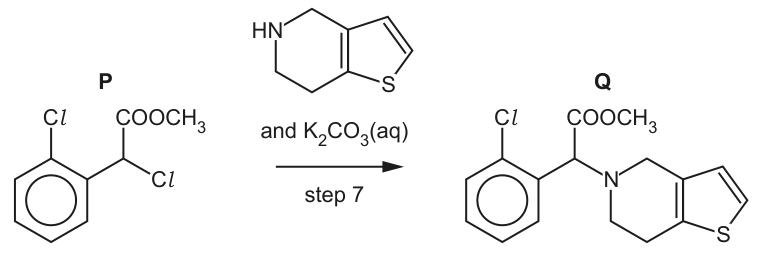
Suggest why a strong base such as is not used for this reaction.
Answer
A strong base such as NaOH(aq) would hydrolyse the ester group (-COOCH₃) present in compound P.
A strong base would hydrolyse the ester group in compound P
Background Concept
Esters undergo alkaline hydrolysis (saponification) readily in the presence of strong bases like NaOH(aq). The hydroxide ion acts as a nucleophile, attacking the carbonyl carbon of the ester in an addition–elimination mechanism, ultimately producing a carboxylate salt and an alcohol. This reaction is essentially irreversible because the carboxylate ion formed is not electrophilic enough to react further.
In step 7, compound P contains both a reactive C-Cl bond (which the amine nucleophile needs to attack) and an ester group (-COOCH₃) that must survive the reaction conditions. A weak base like K₂CO₃ is sufficient to deprotonate the amine (making it nucleophilic) and to neutralise the HCl produced, but is not strong enough to hydrolyse the ester.
Understanding the Question
The question asks why a strong base (NaOH) is not used in step 7, where compound P (which contains an ester group) reacts with an amine to form compound Q.
Approach
Identify the functional groups in P that are vulnerable to strong base — specifically the ester group — and explain the consequence.
Step-by-Step Reasoning
- Compound P contains a -COOCH₃ (methyl ester) group.
- NaOH(aq) is a strong base and a source of OH⁻ ions.
- OH⁻ would attack the ester carbonyl in a nucleophilic addition–elimination, hydrolysing it to give a carboxylate salt (-COO⁻Na⁺) and methanol.
- This would destroy the ester functionality needed in the final product Q.
- K₂CO₃ is a much weaker base — it can deprotonate the amine and neutralise HCl, but cannot hydrolyse the ester.
Key Takeaways
- Esters are susceptible to alkaline hydrolysis by strong bases.
- Weak bases like K₂CO₃ can serve as proton acceptors without attacking ester groups.
- Choice of base depends on chemoselectivity requirements.
Common Mistakes
- Saying NaOH would react with the amine (the amine is the nucleophile, not a target for base).
- Saying NaOH would hydrolyse the C-Cl bond (while possible, the mark scheme focuses on ester hydrolysis).
- Not specifying which functional group is affected.
Things to Be Careful About
- The answer must identify the ester as the vulnerable group and state that hydrolysis is the problem.
Answer
Optically active means (a substance able to) rotate the plane of plane-polarised light.
Able to rotate the plane of plane-polarised light
Background Concept
Optical activity is a property of chiral molecules. When plane-polarised light passes through a solution of a single enantiomer, the plane of polarisation is rotated — either clockwise (dextrorotatory, +) or anticlockwise (laevorotatory, −). A racemic mixture (equal amounts of both enantiomers) shows no net rotation because the effects cancel. The term 'optically active' specifically refers to the ability to rotate plane-polarised light, which is measured using a polarimeter.
Understanding the Question
The question asks for the meaning of 'optically active' in the context of compound Q, which has a chiral centre and exists as a pair of enantiomers.
Approach
Give the precise definition: rotation of the plane of plane-polarised light.
Step-by-Step Reasoning
- 'Optically active' is a specific term in stereochemistry.
- It means the substance rotates the plane of plane-polarised light.
- This is caused by the presence of a chiral centre (asymmetric carbon) that gives rise to non-superimposable mirror-image isomers.
- A single enantiomer is optically active; a racemic mixture is not.
Key Takeaways
- 'Optically active' = rotates plane-polarised light. This is the definition, not an explanation of why.
- The cause is chirality, but the definition is about the observed effect on light.
Common Mistakes
- Saying 'has a chiral centre' (this explains why a substance is optically active but is not the definition of optically active).
- Saying 'has enantiomers' (again, this is the cause, not the definition).
- Omitting 'plane' from 'plane-polarised light'.
Things to Be Careful About
- The mark scheme requires 'rotate the plane of plane-polarised light' — both 'plane' and 'polarised' are needed.
Give two reasons why it might be desirable to synthesise a single optical isomer of Q for use as a drug.
1:
2:
Answer
-
The other enantiomer may have reduced (or different/undesirable) biological activity, so using a single isomer avoids side effects from the inactive or harmful enantiomer.
-
A lower dosage is required (the drug is more potent) because all molecules contribute to the therapeutic effect rather than half being inactive.
- The other enantiomer may have different/reduced biological activity or cause side effects. 2. Lower dosage required / drug is more potent / higher yield of active molecule.
Background Concept
Biological systems (enzymes, receptors, transport proteins) are themselves chiral, so they interact differently with each enantiomer of a chiral drug. One enantiomer may fit the target receptor perfectly (the 'eutomer'), while the other may bind poorly, not at all, or even bind to a different target causing adverse effects. The classic example is thalidomide, where one enantiomer was therapeutic and the other caused birth defects (though in practice, the enantiomers interconvert in vivo).
Synthesising a single enantiomer (asymmetric synthesis or chiral resolution) offers several pharmaceutical advantages over producing a racemic mixture.
Understanding the Question
The question asks for two reasons why it might be desirable to synthesise a single optical isomer of Q (a drug) rather than a racemic mixture.
Approach
Recall the standard advantages listed in the syllabus: biological activity differences, dosage efficiency, side effects, and separation costs.
Step-by-Step Reasoning
The mark scheme accepts any two of:
- Different biological activity: The 'wrong' enantiomer may be inactive or have different (possibly harmful) effects on biological targets.
- Avoids separation: If only one isomer is made, there is no need to resolve a racemic mixture, saving time and cost.
- Lower dosage / more potent: Every molecule administered is the active form, so less total drug is needed for the same effect.
- Higher yield of active molecule: None of the product is 'wasted' as the inactive enantiomer.
- Fewer side effects: The inactive or harmful enantiomer is not present in the administered dose.
Key Takeaways
- Chirality is critically important in drug design because biological receptors are chiral.
- Single-enantiomer drugs offer improved efficacy, reduced side effects, and lower doses.
- The thalidomide tragedy is the historical motivation for enantiopure drug synthesis.
Common Mistakes
- Saying 'the other isomer is toxic' without qualification (it may simply be inactive, not toxic).
- Writing only one reason and leaving the second blank.
- Confusing optical isomers with geometric isomers.
Things to Be Careful About
- The question asks for 'two reasons' — both must be distinct points.
- 'ORA' (or reverse argument) is allowed, so 'the desired enantiomer has greater biological activity' scores equally to 'the other enantiomer has reduced activity'.
Q is commonly used in conjunction with aspirin.
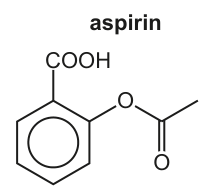
Aspirin is a weak Brønsted–Lowry acid.
The of aspirin is .
of aspirin dissolves in water to form of an aqueous solution.
Calculate the pH of this solution.
[: aspirin, ]
Working
Moles of aspirin:
Concentration:
Hydrogen ion concentration (weak acid approximation):
Answer
pH = 2.93
Background Concept
For a weak acid HA in aqueous solution, the acid dissociation equilibrium is:
with
When the acid is weak (small ) and not extremely dilute, we can use the approximation that and . This gives:
The is related to by .
Understanding the Question
75 mg of aspirin (Mr = 180.0) is dissolved in water to make 100 cm³ of solution. The pKa of aspirin is 3.49. Calculate the pH.
Approach
- Convert mass to moles, then to concentration.
- Convert pKa to Ka.
- Apply the weak acid formula to find [H⁺].
- Calculate pH from [H⁺].
Step-by-Step Reasoning
Step 1 — Concentration of aspirin:
- Mass = 75 mg = 75 × 10⁻³ g = 0.075 g
- Moles = 0.075 / 180.0 = 4.167 × 10⁻⁴ mol
- Volume = 100 cm³ = 0.100 dm³
- [HA] = 4.167 × 10⁻⁴ / 0.100 = 4.17 × 10⁻³ mol dm⁻³
Step 2 — Ka from pKa:
- Ka = 10⁻³·⁴⁹ = 3.236 × 10⁻⁴
Step 3 — [H⁺]:
- Check: Ka/[HA] = 3.24 × 10⁻⁴ / 4.17 × 10⁻³ ≈ 0.078, which is less than 0.05... actually it's about 7.8%, which is borderline. However, the mark scheme uses the approximation, so we proceed with it.
- [H⁺] = (Ka × [HA]) = √(3.236 × 10⁻⁴ × 4.167 × 10⁻³) = √(1.348 × 10⁻⁶) = 1.161 × 10⁻³ mol dm⁻³
Step 4 — pH:
- pH = -log(1.161 × 10⁻³) = 2.935 ≈ 2.93
Key Takeaways
- The weak acid approximation [H⁺] = (Ka[HA]) is the standard method for A-level pH calculations.
- Always convert pKa to Ka before substituting.
- Final answer should be to at least 2 decimal places (the mark scheme says 'min 2sf' for the pH value).
Common Mistakes
- Forgetting to convert mg to g (using 75 instead of 0.075).
- Forgetting to convert cm³ to dm³ (dividing by 100 instead of 0.100).
- Using the pKa value directly instead of converting to Ka.
- Writing pH = 3.49 (confusing pH with pKa).
- Not checking whether the approximation is valid (though at A-level it is almost always accepted).
Things to Be Careful About
- Significant figures: the answer should be given to at least 2 decimal places (2.93 or 2.94).
- The mark scheme accepts 2.93 to 2.94, reflecting rounding differences in intermediate steps.
- Units: concentration must be in mol dm⁻³.
Aspirin undergoes acid hydrolysis in the stomach.
Give the structures of the organic products of this acid hydrolysis.

Answer
The two organic products are:
- Salicylic acid (2-hydroxybenzoic acid): a benzene ring with -OH and -COOH on adjacent carbons.
- Ethanoic acid:
Salicylic acid (2-hydroxybenzoic acid) and ethanoic acid (CH3COOH)
Background Concept
Aspirin (acetylsalicylic acid) contains two functional groups on a benzene ring: a carboxylic acid (-COOH) and an ester (-O-CO-CH₃) in the ortho position. Acid hydrolysis cleaves the ester linkage, producing a phenol (the -OH remains on the ring) and a carboxylic acid (ethanoic acid from the acetyl group). The carboxylic acid group already present on the ring is unaffected by hydrolysis.
The mechanism is nucleophilic addition–elimination at the ester carbonyl: water attacks the protonated carbonyl, the C-O bond to the ring oxygen breaks, giving the phenol and the carboxylic acid.
Understanding the Question
The question asks for the structures of the organic products when aspirin undergoes acid hydrolysis in the stomach (i.e., in aqueous acid). Two blank boxes are provided for drawing.
Approach
Identify the ester group in aspirin, cleave it, and write the two fragments as their neutral acid/phenol forms.
Step-by-Step Reasoning
- Aspirin has the structure: benzene ring with -COOH at position 1 and -O-CO-CH₃ (ester) at position 2.
- Acid hydrolysis cleaves the ester: the C-O bond between the carbonyl carbon and the ring oxygen breaks.
- The ring fragment gains an -OH (becoming a phenol): this gives 2-hydroxybenzoic acid (salicylic acid), with -OH and -COOH on adjacent carbons.
- The acetyl fragment gains -OH at the carbonyl: this gives CH₃COOH (ethanoic acid).
- Both products must be drawn as structures (not just named).
Key Takeaways
- Ester hydrolysis gives an alcohol (or phenol) and a carboxylic acid.
- In aspirin, the 'alcohol' part is a phenol (attached to the aromatic ring), so the product is a hydroxybenzoic acid.
- The existing -COOH group on the ring is unchanged.
Common Mistakes
- Drawing the products as their ionised forms (e.g., carboxylate) — acid hydrolysis gives neutral products.
- Forgetting that the -OH product is a phenol (attached to the ring), not an alcohol.
- Drawing only one product.
- Confusing the positions of -OH and -COOH (they must be ortho/adjacent, as in the original aspirin structure).
Things to Be Careful About
- Full structural formulae are required (showing all bonds), not skeletal or condensed forms, unless the mark scheme allows otherwise.
- The -OH must be shown directly on the benzene ring (phenolic -OH), not as a separate molecule.
Amino acids are molecules that contain and functional groups.
Glycine, , is the simplest stable amino acid.
The isoelectric point of glycine is .
Answer
The pH at which a molecule has no overall charge (exists as a zwitterion; the positive and negative charges cancel out).
The pH at which a molecule has no overall charge / exists as a zwitterion
Background Concept
Amino acids contain both an acidic group () and a basic group (). In aqueous solution, the carboxyl group can donate a proton and the amino group can accept a proton, giving a species with both a positive and a negative charge simultaneously — a zwitterion (). The isoelectric point (pI) is the specific pH at which the molecule exists predominantly as this neutral zwitterion, with no net charge.
Understanding the Question
The command word is "define", so a concise, precise statement is required. The question gives the isoelectric point of glycine as 6.2 as context, but the definition itself is general.
Approach
State the definition clearly: the pH at which the molecule carries no net charge. Mentioning the zwitterion form strengthens the answer.
Step-by-Step Reasoning
At pH = pI, the amino group is protonated () and the carboxyl group is deprotonated (), so the molecule is a zwitterion with no overall charge. Below the pI, the molecule carries a net positive charge; above it, a net negative charge. The definition must capture the idea of zero net charge at a specific pH.
Key Takeaways
- The isoelectric point is a pH value, not a concentration or a temperature.
- At pI, the molecule is a zwitterion with no net charge.
- This concept is essential for understanding electrophoresis and the behaviour of amino acids and proteins in solution.
Common Mistakes
- Saying "the pH at which the amino acid is neutral" without specifying that it means no overall charge (the molecule still has charges, they just cancel).
- Confusing pI with the pH of the solution in which the amino acid is dissolved.
Things to Be Careful About
- Use the phrase "no overall charge" or "net charge is zero", not simply "neutral" which could be misinterpreted as having no charges at all.
Answer
At pH 4 (below the isoelectric point of 6.2), glycine carries a net positive charge. Both the amino group is protonated and the carboxyl group remains protonated:
See diagram: +H3N-CH2-COOH
Background Concept
Amino acids have multiple ionisable groups. Glycine has a carboxyl group (p ≈ 2.3) and an amino group (p ≈ 9.6). The isoelectric point (pI = 6.2) is the pH at which the molecule is a zwitterion () with no net charge. Below the pI, the solution is more acidic, so the carboxylate group picks up a proton to give , while the amino group remains as , giving a net positive charge.
Understanding the Question
The question asks for the structure at pH 4, which is below the pI of 6.2. The command word is "draw", so a structural formula showing the correct protonation states is needed.
Approach
Compare the given pH (4) with the pI (6.2). Since pH < pI, the molecule is in acidic conditions relative to its isoelectric point, meaning it carries a net positive charge. The amino group is protonated () and the carboxyl group is also protonated ().
Step-by-Step Reasoning
- At pH 4, the solution is more acidic than the pI.
- The carboxylate group () is protonated back to .
- The amino group remains protonated as .
- The overall charge is +1 (cationic form).
- The structure is .
Key Takeaways
- Below pI: net positive charge (both groups protonated).
- At pI: zwitterion, no net charge.
- Above pI: net negative charge (both groups deprotonated).
Common Mistakes
- Drawing the zwitterion form () instead of the cation.
- Forgetting the positive charge on nitrogen or the H on the carboxyl group.
- Drawing (the uncharged form) which does not exist significantly in aqueous solution.
Things to Be Careful About
- The mark scheme accepts the structure with shown with a circled plus. Ensure the positive charge is clearly indicated on the nitrogen.
Fig. 6.1 shows two syntheses starting with glycine.
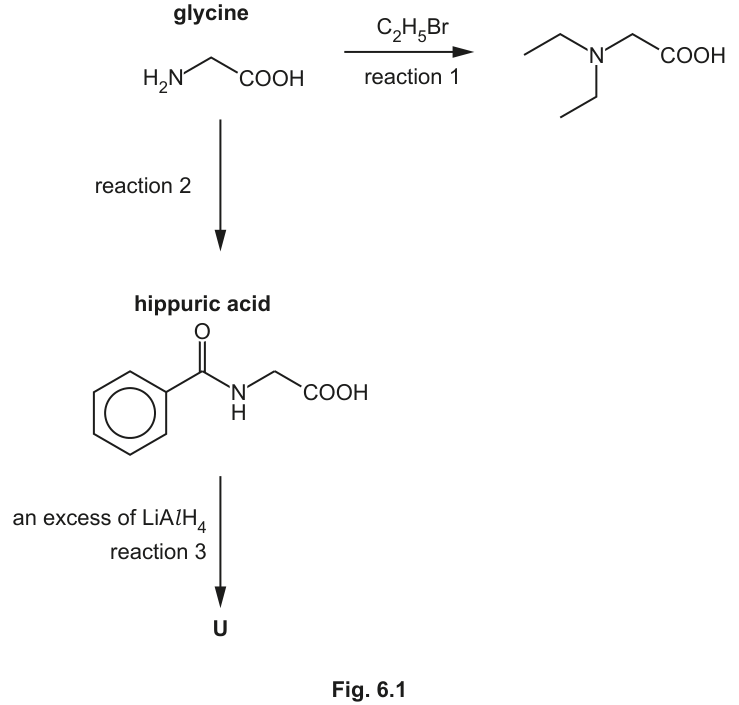
Answer
Ethanol as solvent AND heat in a sealed tube (or high pressure).
Ethanol and heat in a sealed tube (or high pressure)
Background Concept
The reaction of a halogenoalkane with an amine is a nucleophilic substitution. The amine acts as a nucleophile, attacking the electron-deficient carbon bonded to the halogen. To drive the reaction to completion and achieve multiple alkylations (here, two ethyl groups are added to the nitrogen), the reaction is heated with excess halogenoalkane in ethanol as a solvent, in a sealed tube to prevent the volatile reactants from escaping.
Understanding the Question
The command word is "state", requiring a brief statement of conditions. Reaction 1 converts glycine's amino group into a tertiary amine by adding two ethyl groups from .
Approach
Recall the standard conditions for nucleophilic substitution of halogenoalkanes with amines: ethanol solvent, heat, sealed tube (or high pressure to contain volatile reactants).
Step-by-Step Reasoning
- is a volatile liquid (b.p. ≈ 38 °C), so a sealed tube or high pressure is needed.
- Ethanol dissolves both the ionic amino acid and the halogenoalkane.
- Heat provides the activation energy for substitution.
- Both conditions (ethanol AND heat/sealed tube) are needed for the mark.
Key Takeaways
- Nucleophilic substitution with halogenoalkanes requires ethanol solvent and heat in a sealed tube.
- Excess halogenoalkane favours further alkylation (to give tertiary amines rather than stopping at secondary).
Common Mistakes
- Writing only "heat" or only "ethanol" — both are required.
- Confusing with the conditions for forming nitriles (ethanolic KCN, heat under reflux).
- Writing "reflux" instead of "sealed tube" — reflux would lose the volatile bromoethane.
Things to Be Careful About
- The mark scheme requires BOTH conditions linked by "AND". Stating only one earns no mark.
Answer
Benzoyl chloride, (or benzoic anhydride).
C6H5COCl (benzoyl chloride)
Background Concept
Hippuric acid is , an amide formed by acylation of the amino group of glycine. Acylation of amines is achieved using an acyl chloride (or acid anhydride). The benzoyl group () in hippuric acid indicates that benzoyl chloride () was the acylating agent.
Understanding the Question
The command word is "identify", so the name or formula of the reagent is required. The product hippuric acid contains a benzoyl group attached to the nitrogen of glycine, so the reagent must be a benzoyl donor.
Approach
Examine the product structure: hippuric acid has attached to N. This is a benzoyl group, introduced by acylation. The reagent is therefore benzoyl chloride or benzoic anhydride.
Step-by-Step Reasoning
- Hippuric acid = N-benzoylglycine.
- The benzoyl group () must come from an acylating agent.
- Benzoyl chloride () reacts with the group of glycine via nucleophilic addition-elimination to form the amide bond.
- Alternatively, benzoic anhydride could be used.
Key Takeaways
- Amides are formed by reacting amines with acyl chlorides or acid anhydrides.
- Identifying the acyl group in the product reveals the reagent.
Common Mistakes
- Writing "benzoic acid" instead of "benzoyl chloride" — benzoic acid is too unreactive to acylate an amine directly under mild conditions.
- Writing the formula incorrectly.
Things to Be Careful About
- The mark scheme accepts either the name (benzoyl chloride) or the formula (), or benzoic anhydride.
Draw the structure of the organic product U that forms when hippuric acid reacts with an excess of in reaction 3.
Answer
reduces both functional groups:
- (carboxylic acid to primary alcohol)
- (amide to amine)
The product U is:
C6H5CH2NHCH2CH2OH
Background Concept
Lithium aluminium hydride () is a powerful reducing agent that reduces multiple functional groups:
- Carboxylic acids () → primary alcohols ()
- Amides () → amines ()
- The carbonyl carbon is reduced from C=O to CH in both cases.
Hippuric acid () contains both an amide and a carboxylic acid group, so both are reduced by excess .
Understanding the Question
The command word is "draw", requiring the full structural formula of product U. The question specifies excess , confirming both reducible groups are affected.
Approach
Identify the functional groups in hippuric acid: an amide () and a carboxylic acid (). Apply the reduction to each:
- The amide C=O becomes CH, giving
- The carboxylic acid C=O becomes CHOH, giving
Step-by-Step Reasoning
- Hippuric acid:
- Reduce the amide carbonyl:
- Reduce the carboxylic acid:
- Product U = 2-(benzylamino)ethanol
The mark scheme awards: bullet (benzene ring correct), tick (amide→amine reduction correct), tick (COOH→CH2OH reduction correct).
Key Takeaways
- reduces amides to amines (C=O → CH).
- reduces carboxylic acids to primary alcohols (COOH → CHOH).
- Excess reagent ensures all reducible groups are affected.
Common Mistakes
- Only reducing the carboxylic acid and leaving the amide intact.
- Only reducing the amide and leaving the acid intact.
- Reducing the benzene ring (LiAlH does not reduce aromatic rings under normal conditions).
- Drawing the wrong number of carbons in the chain.
Things to Be Careful About
- The amide reduction removes the oxygen entirely (C=O → CH), not just to CHOH.
- The carboxylic acid gives a primary alcohol (CHOH), not an aldehyde.
- The benzene ring and its connection to the chain must be preserved.
A molecule of phenylalanine, R, can react with a molecule of glycine to form two dipeptides, S and T.
S and T are structural isomers.
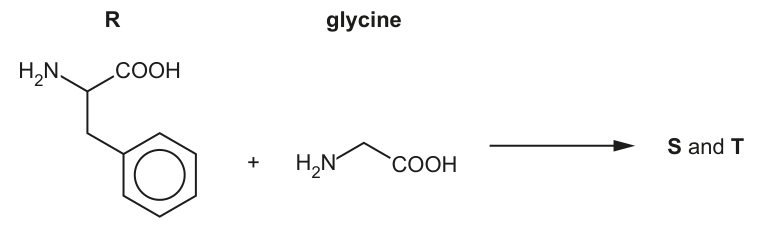
Draw the structures of these dipeptides. The peptide bond formed should be shown fully displayed.
Answer
Two dipeptides are formed depending on which amino acid contributes the carboxyl group and which contributes the amino group:
S (Phe–Gly):
T (Gly–Phe):
See diagram: two dipeptide structures with fully displayed peptide bonds
Background Concept
A peptide bond forms between the carboxyl group of one amino acid and the amino group of another, with elimination of water. When two different amino acids react, two dipeptides are possible because either can be the N-terminal (contributing the free ) or the C-terminal (contributing the free ). These two dipeptides are structural isomers.
Phenylalanine has the side chain , and glycine has the side chain .
Understanding the Question
The command word is "draw", and the question specifies that the peptide bond must be shown fully displayed (i.e., all atoms in the linkage must be shown). Two boxes are provided for the two isomers.
Approach
- Identify the two amino acids: phenylalanine () and glycine ().
- Form dipeptide S: phenylalanine's COOH reacts with glycine's NH → Phe-Gly.
- Form dipeptide T: glycine's COOH reacts with phenylalanine's NH → Gly-Phe.
- Draw both with the peptide bond fully displayed.
Step-by-Step Reasoning
- In Phe-Gly: the free amino group is on phenylalanine, the free carboxyl group is on glycine. The peptide bond links Phe's COOH to Gly's NH.
- In Gly-Phe: the free amino group is on glycine, the free carboxyl group is on phenylalanine. The peptide bond links Gly's COOH to Phe's NH.
- Both contain the linkage, which must be drawn fully displayed (showing C, O, N, and H explicitly).
- The side chain of phenylalanine () must be shown attached to the correct carbon.
Key Takeaways
- Two different amino acids give two possible dipeptides (structural isomers).
- The peptide bond is and must be fully displayed in the answer.
- N-terminus has the free ; C-terminus has the free .
Common Mistakes
- Drawing only one dipeptide.
- Not showing the peptide bond fully displayed (e.g., writing -CONH- as a group without showing all atoms).
- Attaching the phenylalanine side chain to the wrong carbon.
- Drawing the same dipeptide twice (not recognising they must be different isomers).
Things to Be Careful About
- The peptide bond C=O and N-H must both be shown explicitly.
- The benzene ring in phenylalanine's side chain must be drawn correctly.
- The question does not specify which is S and which is T, so either assignment is acceptable.
A student proposes a synthesis of hippuric acid by the reaction of benzamide, , and chloroethanoic acid, .
The reaction does not work well because benzamide is a very weak base.
Answer
- The lone pair on the nitrogen in amides is delocalised into the adjacent group (overlap with the system of the carbonyl).
- This makes the lone pair less available to accept/donate to , so amides are weaker bases than amines.
The nitrogen lone pair in amides is delocalised into the C=O group, making it less available to accept a proton.
Background Concept
Basicity of nitrogen compounds depends on the availability of the lone pair on nitrogen to accept a proton. In amines, the lone pair is localised on nitrogen and readily available for donation. In amides, the nitrogen is directly bonded to a carbonyl carbon, and the lone pair on nitrogen overlaps with the orbital of the group. This delocalisation (resonance) means the lone pair is partially shared with the oxygen, reducing electron density on nitrogen and making it much less available to accept .
Understanding the Question
The command word is "explain", requiring a cause-and-effect chain. Two marks are available: one for identifying delocalisation, one for explaining the consequence.
Approach
- State that the lone pair on N is delocalised into the C=O group.
- Explain that this reduces availability of the lone pair for proton acceptance.
Step-by-Step Reasoning
- In an amide (), the nitrogen lone pair is in a p-orbital that overlaps with the system of the carbonyl.
- This creates partial double-bond character in the C-N bond and delocalises electron density onto the oxygen.
- The nitrogen therefore has less electron density and its lone pair is less available to form a bond with .
- In contrast, in an amine (), the lone pair is fully localised on nitrogen and readily available.
- Hence amides are much weaker bases than amines.
Key Takeaways
- Delocalisation of a lone pair reduces its availability for proton acceptance.
- Amide resonance involves the N lone pair and the C=O system.
- This is why amides do not react with acids to form salts as readily as amines.
Common Mistakes
- Saying "the lone pair is used in bonding" (it is delocalised, not used in a sigma bond).
- Not connecting the delocalisation to the reduced basicity (must state both points for full marks).
- Confusing with the effect of the carbonyl being electron-withdrawing by induction alone.
Things to Be Careful About
- The mark scheme specifically requires mention of delocalisation with C=O (M1) and the consequence for proton acceptance (M2). Both are needed.
The of chloroethanoic acid is whereas the of ethanoic acid is .
Explain the difference between these two values.
Answer
- Chloroethanoic acid is a stronger acid than ethanoic acid (lower means stronger acid).
- The electronegative chlorine atom exerts an electron-withdrawing inductive effect ( effect), which stabilises the carboxylate anion (conjugate base) and/or weakens the OH bond, making proton loss easier.
Cl has an electron-withdrawing inductive effect that stabilises the carboxylate anion, making chloroethanoic acid a stronger acid (lower pKa).
Background Concept
Acid strength is measured by (or ). A lower means a stronger acid (more dissociation). The strength of a carboxylic acid depends on the stability of its conjugate base (the carboxylate anion, ). Electron-withdrawing groups stabilise the negative charge on the carboxylate through the inductive effect (), making the acid stronger.
Understanding the Question
The command word is "explain", requiring a causal explanation for why the values differ. Two marks: one for identifying which is stronger and the relationship to , one for the inductive effect explanation.
Approach
- State that chloroethanoic acid is the stronger acid (lower = stronger acid).
- Explain why: the Cl atom withdraws electron density through the -bond framework (inductive effect), stabilising the conjugate base.
Step-by-Step Reasoning
- of chloroethanoic acid = 2.86 < of ethanoic acid = 4.76.
- Lower → higher → stronger acid → more dissociation.
- Chlorine is highly electronegative and pulls electron density through the C-C and C-H bonds (inductive effect, ).
- This delocalises/stabilises the negative charge on the carboxylate anion () more than in .
- A more stable conjugate base means the equilibrium lies further to the right (more released).
- The inductive effect also weakens the OH bond by pulling electron density away from it.
Key Takeaways
- Lower = stronger acid.
- Electron-withdrawing groups (like halogens) increase acid strength by stabilising the conjugate base.
- The inductive effect operates through bonds and decreases with distance.
Common Mistakes
- Saying "chlorine is more electronegative so it pulls the H off" without mentioning stabilisation of the anion.
- Not connecting lower to stronger acid explicitly.
- Saying "resonance effect" instead of "inductive effect" — the effect here is through bonds, not bonds.
Things to Be Careful About
- Must state that chloroethanoic acid is the stronger acid AND give the reason (inductive effect / stabilisation of anion). Both are needed for 2 marks.
Compound V is another amino acid.
The proton () NMR spectrum of V shows hydrogen atoms in five different environments, a, b, c, d and e, as shown in Fig. 6.2.
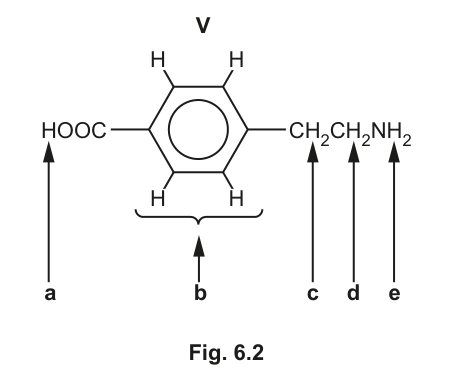
Complete Table 6.2 for the proton () NMR spectrum of V taken in .
Table 6.1 gives some relevant data.
Table 6.1
| environment of proton | example | chemical shift range, |
|---|---|---|
| alkane | , , | |
| alkyl next to C=O | , , | |
| alkyl next to aromatic ring | , , | |
| alkyl next to electronegative atom | , , , | |
| attached to alkene | ||
| attached to aromatic ring | ||
| aldehyde | ||
| alcohol | ||
| phenol | ||
| carboxylic acid | ||
| alkyl amine | ||
| aryl amine | ||
| amide |
Table 6.2
| proton | a | b | c | d | e |
|---|---|---|---|---|---|
| chemical shift range, | |||||
| name of splitting pattern | multiplet |
Answer
| proton | a | b | c | d | e |
|---|---|---|---|---|---|
| chemical shift range, | 9.0–13.0 | 6.0–9.0 | 2.3–3.0 | 3.2–4.0 | 1.0–5.0 |
| name of splitting pattern | singlet | multiplet | triplet | triplet | singlet |
Reasoning for splitting:
- a (): no adjacent H → singlet
- b (aromatic H): adjacent to other aromatic H → multiplet (given)
- c ( next to ring): adjacent to (2H) → triplet
- d ( next to N): adjacent to (2H) → triplet
- e (): no coupling shown in → singlet
a: 9.0-13.0, singlet; b: 6.0-9.0, multiplet; c: 2.3-3.0, triplet; d: 3.2-4.0, triplet; e: 1.0-5.0, singlet
Background Concept
In NMR, the chemical shift () depends on the electronic environment of the proton — deshielding by electronegative atoms, aromatic ring currents, and hydrogen bonding all affect it. The splitting pattern follows the rule: a proton coupled to equivalent neighbouring protons is split into peaks. Exchangeable protons (OH, NH) in often appear as broad singlets because exchange is fast enough to decouple them.
Understanding the Question
Compound V is 4-(2-aminoethyl)benzoic acid: . Five proton environments are labelled a–e. The table requires both the chemical shift range (from the provided data table) and the splitting pattern for each. Four marks are available on a graduated scale (3 correct = 1, 5 = 2, 7 = 3, 9 = 4).
Approach
For each proton environment:
- Identify what type of proton it is (COOH, aromatic, alkyl next to ring, alkyl next to N, NH).
- Match to the correct range in Table 6.1.
- Count neighbouring non-equivalent protons to determine splitting.
Step-by-Step Reasoning
Proton a (): Carboxylic acid proton. From Table 6.1: 9.0–13.0. No adjacent H atoms (the next carbon is part of the aromatic ring with no H on the ipso carbon). → Singlet.
Proton b (aromatic H): Four equivalent aromatic protons. From Table 6.1: 6.0–9.0. Coupled to neighbouring aromatic H atoms → multiplet (given in the question).
Proton c ( next to aromatic ring): Alkyl next to aromatic ring. From Table 6.1: 2.3–3.0. Adjacent to (2H on proton d). . → Triplet.
Proton d ( next to N): Alkyl next to electronegative atom (N). From Table 6.1: 3.2–4.0. Adjacent to (2H on proton c). . → Triplet.
Proton e (): Alkyl amine protons. From Table 6.1: 1.0–5.0. In , NH protons typically do not show coupling to adjacent CH (exchange broadens the signal). → Singlet.
Key Takeaways
- Use the provided data table to assign chemical shift ranges — do not rely on memorised values.
- Apply the rule for splitting based on neighbouring non-equivalent protons.
- NH and OH protons in usually appear as singlets due to exchange.
Common Mistakes
- Assigning proton c to the "alkyl next to electronegative atom" range (3.2–4.0) instead of "alkyl next to aromatic ring" (2.3–3.0).
- Saying proton e is a triplet (coupling to adjacent CH) — NH protons typically do not show splitting in .
- Saying proton a is a doublet or triplet — there are no adjacent H atoms.
Things to Be Careful About
- The question uses a graduated marking scheme (any 3 = 1, any 5 = 2, any 7 = 3, all 9 = 4), so partial credit is available.
- Chemical shift ranges must match the table exactly (e.g., 2.3–3.0 not 2.2–3.0).
- "Singlet" not "single"; "triplet" not "three peaks".
Complete Table 6.3 by placing a tick () to indicate any protons whose peaks are still present in the proton () NMR spectrum of V taken in .
Table 6.3
| proton | a | b | c | d | e |
|---|---|---|---|---|---|
| present in |
Answer
| proton | a | b | c | d | e |
|---|---|---|---|---|---|
| present in |
Protons a () and e () are exchanged with deuterium and disappear. Protons b, c, and d (CH) remain.
Ticks on b, c, and d only
Background Concept
When a sample is run in instead of , any proton attached to an electronegative atom (OH, NH, SH) undergoes rapid exchange with deuterium: . Since deuterium does not produce a signal in a NMR experiment, these peaks disappear. Protons attached to carbon (CH) do not exchange and their peaks remain.
Understanding the Question
The command word is to "complete" the table by placing ticks. The question asks which peaks are still present after running the spectrum in . This tests whether the student can identify exchangeable protons.
Approach
Identify which labelled protons are attached to heteroatoms (O or N):
- a: → OH → exchanges → gone
- b: aromatic CH → stays
- c: CH (alkyl) → stays
- d: CH (alkyl) → stays
- e: → NH → exchanges → gone
Step-by-Step Reasoning
- Proton a is the carboxylic acid OH proton. In , it exchanges to give , so the peak disappears.
- Proton e is the amine NH proton. In , it exchanges to give , so the peak disappears.
- Protons b, c, and d are all attached to carbon atoms. CH bonds do not undergo exchange with , so these peaks remain.
Key Takeaways
- exchange is a diagnostic test for OH and NH protons in NMR.
- Only protons on heteroatoms (O, N, S) are exchanged; CH protons are unaffected.
- This technique helps assign peaks to specific functional groups.
Common Mistakes
- Ticking proton a (thinking COOH is not exchangeable — it is, because the H is on oxygen).
- Not ticking proton b (thinking aromatic protons exchange — they do not).
- Ticking all protons or none.
Things to Be Careful About
- Only one mark is available, and it requires ALL correct ticks (b, c, d ticked; a, e blank). A single error loses the mark.