Chemistry 9701/43 — October/November 2023
Cambridge A-Level · A Level Structured Questions · worked solutions for every part, with the mark scheme
Topics Transition Elements · Hydrocarbons · Reaction Kinetics · Introduction to A Level Organic Chemistry · Analytical Techniques · Halogen Compounds · +7 more
Fluorine reacts with chlorine dioxide, , as shown.
The rate of the reaction is first order with respect to the concentration of and first order with respect to the concentration of . No catalyst is involved.
Suggest a two-step mechanism for this reaction.
step 1
step 2
Identify the rate-determining step in this mechanism. Explain your answer.
When the rate of the reaction is measured in the numerical value of the rate constant, , is 1.22 under certain conditions.
Complete the rate equation for this reaction, stating the overall order of the reaction.
overall order of reaction =
Use your rate equation in (i) to calculate the rate of the reaction when the concentrations of and are both .
Under different conditions, and in the presence of a large excess of , the rate equation is as shown.
The half-life, , of the concentration of is under these conditions.
Calculate the numerical value of , giving its units.
Give your answer to three significant figures.
An experiment is performed under these conditions in which the starting concentration of is .
Draw a graph on the grid in Fig. 1.1 to show how the concentration of changes over the first of the reaction.
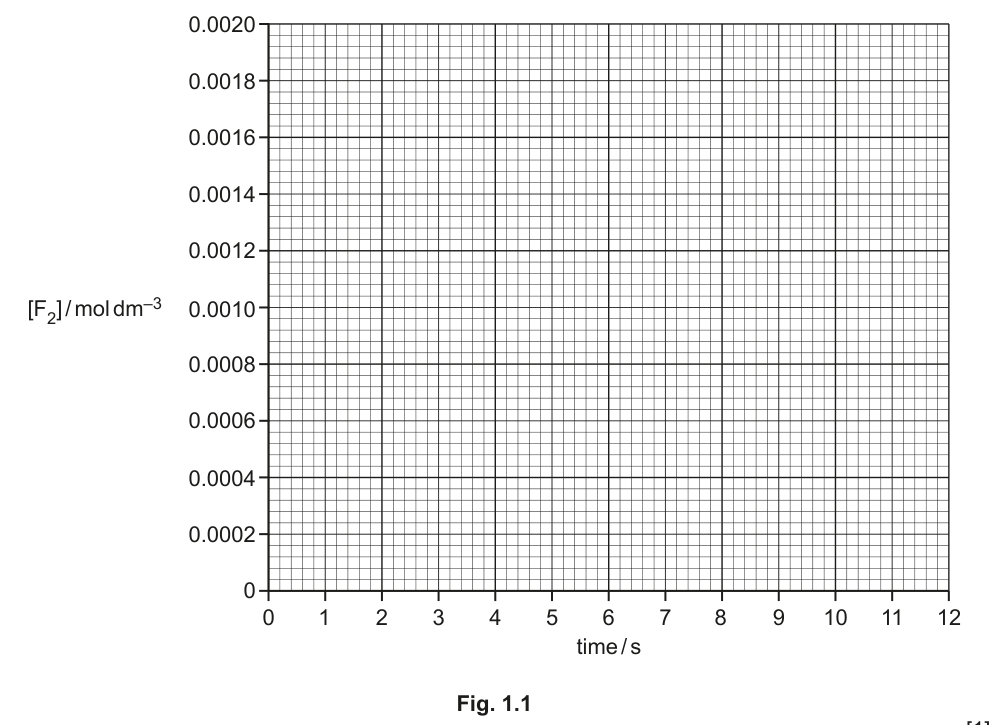
Use your graph in Fig. 1.1 to find the rate of the reaction when the concentration of is . Show your working on the graph.
The rest of this paper
8 more questions- Q2Equilibria14M
- Q3Chemical Energetics · Reaction Kinetics · Electrochemistry17M
- Q4Transition Elements · Group 27M
- Q5Transition Elements12M
- Q6Transition Elements6M
- Q7Introduction to A Level Organic Chemistry · Hydrocarbons · Analytical Techniques8M
- Q8Introduction to A Level Organic Chemistry · Hydrocarbons · Halogen Compounds · Analytical Techniques · Nitrogen Compounds · Hydroxy Compounds14M
- Q9Hydrocarbons · Carboxylic Acids and Derivatives · Halogen Compounds13M