Chemistry 9701/42 — October/November 2023
Cambridge A-Level · A Level Structured Questions · worked solutions for every part, with the mark scheme
Topics Equilibria · Transition Elements · Analytical Techniques · Reaction Kinetics · Electrochemistry · Chemical Energetics · +6 more
Propanone, , reacts with iodine, , in the presence of an acid catalyst.
The rate equation for this reaction is shown.
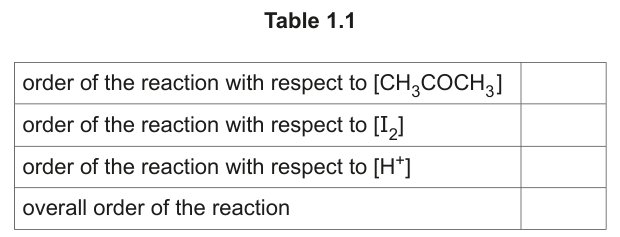
Complete Table 1.1 to describe the order of the reaction.
Answer
| Value | |
|---|---|
| Order with respect to | 1 |
| Order with respect to | 0 |
| Order with respect to | 1 |
| Overall order | 2 |
1, 0, 1, 2
Background Concept
The rate equation expresses the relationship between the rate of a reaction and the concentrations of the reactants (and sometimes catalysts). The exponent of each concentration term gives the order of the reaction with respect to that species. The overall order is the sum of all individual orders. A species not appearing in the rate equation has an order of zero, meaning its concentration has no effect on the rate.
Understanding the Question
The rate equation is given as rate = k[CH₃COCH₃][H⁺]. We must read off the order with respect to each species and calculate the overall order. I₂ does not appear in the rate equation, so its order must be identified as zero.
Approach
Look at each species in the rate equation. The power to which its concentration is raised is the order with respect to that species. If a species does not appear, its order is zero. Sum all orders for the overall order.
Step-by-Step Reasoning
- [CH₃COCH₃] appears to the first power → order = 1
- [I₂] does not appear → order = 0
- [H⁺] appears to the first power → order = 1
- Overall order = 1 + 0 + 1 = 2
Key Takeaways
The order with respect to a species is the exponent of its concentration in the rate equation. Species absent from the rate equation have zero order. Overall order is the sum of individual orders.
Common Mistakes
- Assuming I₂ must have a positive order because it is a reactant in the overall equation. The rate equation is determined experimentally, not from the stoichiometry.
- Forgetting to include the zero order when calculating overall order (though it does not change the sum).
Things to Be Careful About
- The order with respect to I₂ is zero, not absent — it must be stated as 0 in the table.
- Overall order is the sum of all orders including zeros.
An experiment is performed using a large excess of and a large excess of . The initial concentration of is . The initial rate of decrease in the concentration is .
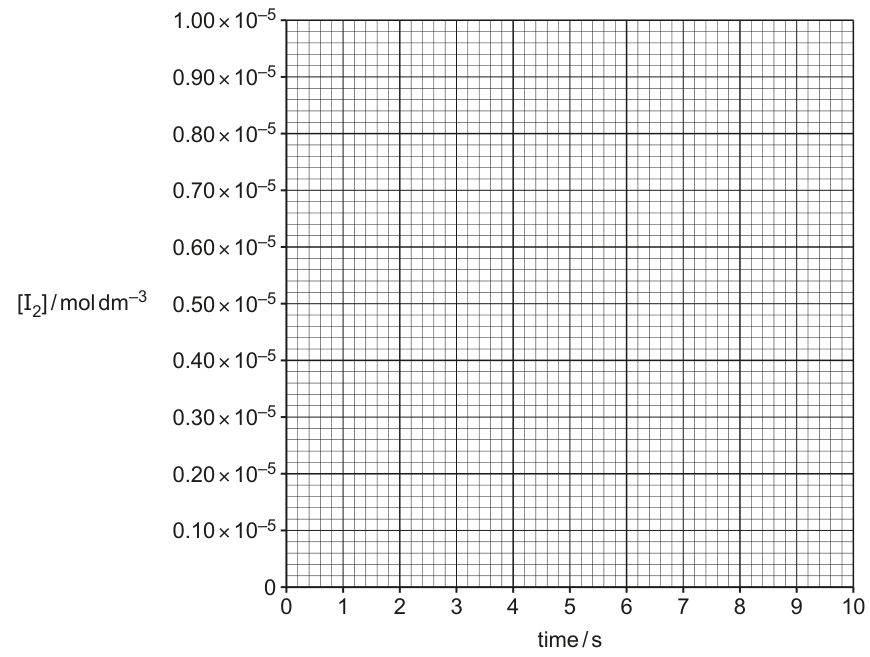
Use the axes to draw a graph of against time for the first 10 seconds of the reaction.
Working
With large excess of and , the rate is effectively constant (zero order in ).
Change in over 10 s:
Final :
Answer
A straight line from at to (i.e. ) at s.
Straight line from 1.00 × 10⁻⁵ to 7.73 × 10⁻⁶ mol dm³ over 10 s
Background Concept
When a reactant is present in large excess, its concentration remains effectively constant throughout the reaction. This means the rate does not depend on that reactant's concentration, and the reaction appears zero-order with respect to it. A zero-order reaction has a constant rate, so the concentration of the limiting reactant decreases linearly with time.
Understanding the Question
CH₃COCH₃ and H⁺ are in large excess, so their concentrations are essentially constant. The rate equation rate = k[CH₃COCH₃][H⁺] therefore becomes rate = k' (a constant). Since the rate of decrease of [I₂] equals this constant rate, [I₂] falls linearly. We need to plot [I₂] against time for 10 seconds.
Approach
- Recognise that with excess CH₃COCH₃ and H⁺, the rate is constant → zero order in I₂ → linear decrease.
- Calculate the total decrease in [I₂] over 10 s using the given initial rate.
- Subtract from initial [I₂] to find the final value.
- Draw a straight line between the two points.
Step-by-Step Reasoning
- Initial [I₂] = 1.00 × 10⁻⁵ mol dm³
- Rate of decrease = 2.27 × 10⁻⁷ mol dm³ s⁻¹ (constant because rate depends only on [CH₃COCH₃] and [H⁺], both in large excess)
- Decrease over 10 s = 2.27 × 10⁻⁷ × 10 = 2.27 × 10⁻⁶ mol dm⁻³
- Final [I₂] = 1.00 × 10⁻⁵ − 2.27 × 10⁻⁶ = 7.73 × 10⁻⁶ mol dm⁻³ = 0.773 × 10⁻⁵ mol dm⁻³
- The graph is a straight line (not curved) because the rate is constant.
Key Takeaways
- Large excess of other reactants → pseudo-zero-order behaviour with respect to the monitored species.
- Zero order → constant rate → linear concentration-time graph.
- The gradient of a concentration-time graph gives the rate (negative for reactants).
Common Mistakes
- Drawing a curve (exponential decay) instead of a straight line. The reaction is zero-order in I₂, not first-order.
- Calculating the final concentration incorrectly (e.g. forgetting to convert 2.27 × 10⁻⁶ to the same power as 10⁻⁵).
- Starting the line at 0 instead of at 1.00 × 10⁻⁵.
Things to Be Careful About
- The line must be straight (constant gradient), not curved.
- The endpoint must be at 0.773 × 10⁻⁵ (or equivalently 7.73 × 10⁻⁶), which is between 0.70 × 10⁻⁵ and 0.80 × 10⁻⁵ on the given axis.
State whether it is possible to calculate the numerical value of the rate constant, , for this reaction from your graph. Explain your answer.
Answer
No, it is not possible to calculate because the concentrations of and (which appear in the rate equation) are not known.
No; the concentrations of CH₃COCH and H⁺ in the rate equation are not known.
Background Concept
The rate constant k can be calculated from rate = k[A]ᵐ[B]ⁿ only if the rate and all concentrations appearing in the rate equation are known. The rate can be obtained from the gradient of a concentration-time graph, but if any concentration term in the rate law is unknown, k cannot be isolated.
Understanding the Question
We are told CH₃COCH₃ and H⁺ are in 'large excess' but their actual concentrations are not given. The rate equation depends on these concentrations. Can we still find k?
Approach
Identify what information the graph provides (the rate) and what information the rate equation requires (concentrations of CH₃COCH₃ and H⁺). Check whether all required values are known.
Step-by-Step Reasoning
- From the graph, we can determine the rate (gradient = 2.27 × 10⁻⁷ mol dm⁻³ s⁻¹).
- The rate equation is rate = k[CH₃COCH₃][H⁺].
- To find k, we need: k = rate / ([CH₃COCH₃][H⁺]).
- The actual concentrations of CH₃COCH₃ and H⁺ are not given (only that they are in 'large excess').
- Therefore k cannot be calculated.
Key Takeaways
- 'Large excess' tells us the concentration is approximately constant, but does not give its numerical value.
- To calculate k, every quantity in the rate equation must have a known numerical value.
Common Mistakes
- Saying 'yes' because the rate can be read from the graph, forgetting that the concentrations in the rate law are still needed.
- Saying 'no' without explaining why — the mark requires both the statement and the reason.
Things to Be Careful About
- The answer must include both parts: (1) it is not possible, and (2) the reason (concentrations in the rate law are unknown).
The experiment is repeated at a different temperature. The initial concentrations of ions, and are all .
The value of at this temperature is .
Calculate the initial rate of this reaction.
Working
Answer
mol dm s
9.24 × 10⁻⁷ mol dm⁻³ s⁻¹
Background Concept
The rate equation relates the rate of a reaction to the concentrations of the species involved, raised to powers equal to their respective orders. Given the rate constant and all concentrations, the rate can be calculated by direct substitution.
Understanding the Question
All values needed are given: k = 2.31 × 10⁻⁵ mol¹ dm³ s⁻¹, [CH₃COCH] = 0.200 mol dm⁻³, [H⁺] = 0.200 mol dm⁻³. The rate equation is rate = k[CH₃COCH₃][H⁺]. Simply substitute and multiply.
Approach
Substitute the three known values into the rate equation and compute the product.
Step-by-Step Reasoning
- rate = k × [CH₃COCH] × [H⁺]
- rate = (2.31 × 10⁻⁵) × (0.200) × (0.200)
- 0.200 × 0.200 = 0.0400
- 2.31 × 10⁻⁵ × 0.0400 = 2.31 × 4.00 × 10⁻⁷ = 9.24 × 10⁻⁷ mol dm⁻³ s⁻¹
Key Takeaways
- When all concentrations and k are known, the rate is a straightforward multiplication.
- Check units: mol⁻¹ dm³ s⁻¹ × mol dm⁻³ × mol dm⁻³ = mol dm⁻³ s⁻¹ ✓
Common Mistakes
- Arithmetic errors with the powers of ten.
- Including [I₂] in the calculation (it does not appear in the rate equation).
Things to Be Careful About
- The answer should be given to 3 significant figures to match the precision of the data.
The experiment is repeated using an excess of . The new rate equation is shown.
The value of is . Calculate the value of the half-life, .
Working
The rate equation rate = [CH₃COCH] is first order in CH₃COCH₃.
Answer
s
630 s
Background Concept
For a first-order reaction, the half-life is constant and independent of the initial concentration. The relationship between half-life and the rate constant is t₁/₂ = ln2 / k. This is a defining feature of first-order kinetics.
Understanding the Question
The new rate equation is rate = k₁[CH₃COCH₃], which is first order in CH₃COCH₃ (overall order = 1). Given k₁ = 1.1 × 10⁻³ s¹, calculate the half-life.
Approach
Identify the order (first order from the single concentration term to the power 1), then apply t₁/₂ = ln2/k₁.
Step-by-Step Reasoning
- rate = k₁[CH₃COCH₃] → first order in CH₃COCH₃
- For first order: t₁/₂ = ln2 / k₁
- ln2 = 0.693
- t₁/₂ = 0.693 / (1.1 × 10⁻³) = 630 s
Key Takeaways
- First-order reactions have a constant half-life independent of concentration.
- The units of k₁ (s⁻¹) confirm first-order kinetics (rate has units mol dm⁻³ s¹, concentration has units mol dm⁻³, so k must have units s⁻¹ for first order).
Common Mistakes
- Using the zero-order half-life formula t₁/₂ = [A]₀/(2k) instead.
- Forgetting to convert ln2 ≈ 0.693 correctly.
- Arithmetic error: 0.693/1.1 = 0.63, then × 10³ = 630 (not 63).
Things to Be Careful About
- The answer should be given to 2 significant figures (matching k₁ = 1.1 × 10⁻³), giving 630 s.
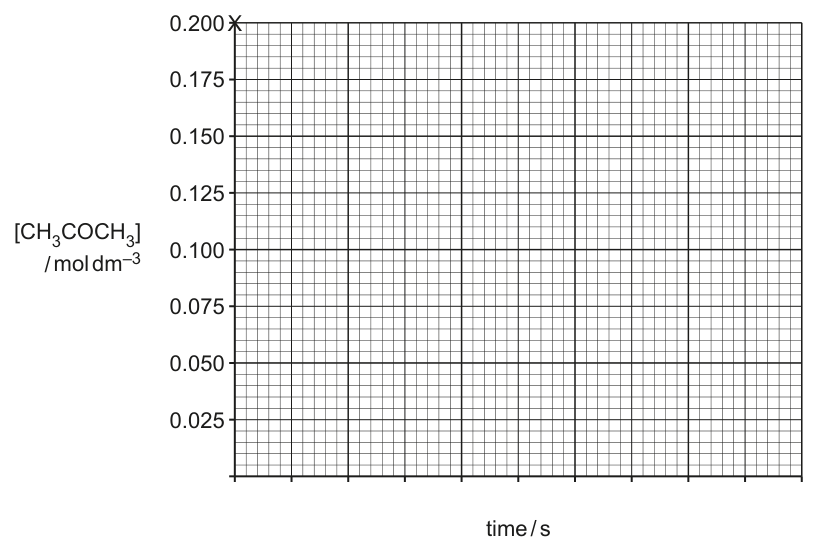
Use your answer to (i) to draw a graph of against time for this reaction. The initial value of on your graph should be . The final value of on your graph should be .
Answer
A smooth exponential decay curve starting at 0.200 mol dm⁻³, halving three times at equal intervals of 630 s:
- :
- s:
- s:
- s:
The curve is smooth and concave up, with each halving taking the same time (630 s).
Smooth exponential decay curve with three halvings at 630 s intervals from 0.200 to 0.025 mol dm⁻³
Background Concept
A first-order reaction shows exponential decay of reactant concentration with time. The defining feature is that the half-life is constant: the time for the concentration to halve is the same regardless of the starting concentration. On a concentration-time graph, this produces a smooth curve that gets progressively shallower, with equal horizontal distances between successive halvings.
Understanding the Question
We need to draw [CH₃COCH₃] against time showing decay from 0.200 to 0.025 mol dm⁻³. Since 0.200 → 0.100 → 0.050 → 0.025 is three halvings, and each takes 630 s, the total time is 1890 s. The x-axis has no numbered values, so we must label the time values ourselves.
Approach
- Calculate the concentration after each half-life: 0.200, 0.100, 0.050, 0.025.
- Calculate the times: 0, 630, 1260, 1890 s.
- Draw a smooth exponential curve through these points, ensuring the time intervals between halvings are equal.
Step-by-Step Reasoning
- Start: [CH₃COCH₃] = 0.200 at t = 0
- After 1st half-life (630 s): [CH₃COCH₃] = 0.100
- After 2nd half-life (1260 s): [CH₃COCH₃] = 0.050
- After 3rd half-life (1890 s): [CH₃COCH] = 0.025
- The curve must be smooth (not straight lines between points), concave upward, showing the characteristic exponential shape.
- Equal time intervals (630 s) between each halving confirm first-order behaviour.
Key Takeaways
- First-order decay: constant half-life, exponential curve.
- Three halvings from 0.200 to 0.025 (0.200/2³ = 0.025).
- The graph must show equal time intervals between successive halvings.
Common Mistakes
- Drawing straight-line segments instead of a smooth curve.
- Making the time intervals unequal (which would suggest non-first-order behaviour).
- Not labelling the x-axis with time values (the axis has no pre-printed numbers).
- Drawing the curve going to zero rather than to 0.025.
Things to Be Careful About
- The times marked must agree with the answer to (d)(i) (630 s per half-life).
- The curve should be smooth and show the characteristic exponential shape.
- Label the time axis clearly with 0, 630, 1260, 1890 s.
A four-step mechanism is suggested for the overall reaction.
Part of this mechanism is shown.
Write an equation for step 3.
Answer
CH₃C(OH)=CH₂ + I₂ → CH₃C⁺(OH)CH₂I + I⁻
Background Concept
In a multi-step mechanism, the sum of all elementary steps must give the overall reaction. Each step must be balanced in both atoms and charge. If a step is missing, it can be deduced by identifying what the previous step produces and what the next step consumes, then using the overall equation to determine any other reactants or products needed.
Understanding the Question
Step 2 produces CH₃C(OH)=CH₂ (the enol form of propanone). Step 4 begins with CH₃C⁺(OH)CH₂I. The overall reaction consumes I₂. So step 3 must convert CH₃C(OH)=CH₂ into CH₃C⁺(OH)CH₂I using I₂.
Approach
- Identify the product of step 2: CH₃C(OH)=CH₂
- Identify the reactant of step 4: CH₃C⁺(OH)CH₂I
- Note that I₂ is consumed in the overall reaction but does not appear in steps 1, 2, or 4.
- Therefore I₂ must be a reactant in step 3.
- The difference between CH₃C(OH)=CH₂ and CH₃C⁺(OH)CH₂I is the addition of I to the terminal carbon and loss of the C=C double bond, with a positive charge on the carbon bearing OH.
- I₂ provides one I atom (as I⁺ equivalent) and the other becomes I⁻.
Step-by-Step Reasoning
- CH₃C(OH)=CH₂ has the formula C₃H₆O (as the enol)
- CH₃C⁺(OH)CH₂I has the formula C₃H₆IO⁺
- Difference: +I and charge goes from 0 to +1
- I₂ → I (added) + I⁻ (released)
- So: CH₃C(OH)=CH₂ + I₂ → CH₃C⁺(OH)CH₂I + I⁻
- Check atom balance: C₃H₆O + I₂ → C₃H₆IO + I ✓
- Check charge balance: 0 + 0 → +1 + (−1) = 0 ✓
Key Takeaways
- Missing mechanism steps can be deduced by comparing adjacent steps and the overall equation.
- Always check both atom and charge balance.
- I₂ acts as an electrophilic iodine source (I⁺) in this step, generating I⁻ as the leaving species.
Common Mistakes
- Writing I⁺ as a product instead of I⁻.
- Forgetting the positive charge on the carbon in CH₃C⁺(OH)CH₂I.
- Not including I₂ as a reactant (it must appear somewhere in the mechanism since it's in the overall equation but not in steps 1, 2, or 4).
Things to Be Careful About
- The charge on CH₃C⁺(OH)CH₂I must be shown as + on the carbon (or the whole species as a cation).
- The equation must be balanced in both atoms and charge.
Suggest the slowest step of the mechanism. Explain your answer.
Answer
Step 1 is the slowest step (rate-determining step) because it is the only step that involves both and , which are the two species appearing in the rate equation.
Step 1; it involves both CH₃COCH₃ and H⁺ which appear in the rate equation.
Background Concept
The rate-determining step (RDS) is the slowest step in a reaction mechanism. The species that appear in the rate equation are those involved in or before the RDS. If a species appears in the rate equation, it must be a reactant in the RDS or in a fast pre-equilibrium step before the RDS. The simplest case is when the RDS directly involves the species in the rate law.
Understanding the Question
The rate equation is rate = k[CH₃COCH₃][H⁺]. We need to identify which of the four steps is the RDS. The RDS must involve both CH₃COCH₃ and H⁺ as reactants (since both appear in the rate law).
Approach
Examine each step to see which one has both CH₃COCH₃ and H⁺ as reactants.
Step-by-Step Reasoning
- Step 1: CH₃COCH₃ + H⁺ → CH₃C⁺(OH)CH₃ — involves both species in the rate equation ✓
- Step 2: CH₃C⁺(OH)CH₃ → CH₃C(OH)=CH₂ + H⁺ — does not involve CH₃COCH
- Step 3: CH₃C(OH)=CH₂ + I₂ → ... — involves neither CH₃COCH₃ nor H⁺
- Step 4: CH₃C⁺(OH)CH₂I → ... — involves neither
Only step 1 involves both species that appear in the rate equation, so step 1 must be the RDS.
Key Takeaways
- The rate equation reflects the composition of the transition state of the RDS.
- Species in the rate equation must be present in or before the RDS.
- The RDS is the step whose reactants match the rate equation.
Common Mistakes
- Choosing step 3 because it involves I₂ (which is in the overall equation but NOT in the rate equation — it has zero order).
- Saying 'step 1 because it's first' without linking to the rate equation.
Things to Be Careful About
- The explanation must explicitly state that step 1 involves both species in the rate equation. Simply naming the step is not enough.
Identify one conjugate acid-conjugate base pair in the mechanism.
Answer
Conjugate acid: Conjugate base:
(These differ by one , as seen in step 1.)
Conjugate acid: CH₃C⁺(OH)CH₃; Conjugate base: CH₃COCH
Background Concept
A conjugate acid-base pair consists of two species that differ by exactly one proton (H⁺). The acid has the extra proton; the base is what remains after the acid donates H⁺. In the Brønsted-Lowry theory, every acid-base reaction involves two such pairs. In a mechanism, proton transfer steps create conjugate pairs between the species before and after the transfer.
Understanding the Question
We need to find any pair of species in the mechanism that differ by one H⁺. Looking at the steps:
- Step 1: CH₃COCH₃ gains H⁺ to become CH₃C⁺(OH)CH₃ → these are a conjugate pair
- Step 2: CH₃C⁺(OH)CH₃ loses H⁺ to become CH₃C(OH)=CH₂ → these are a conjugate pair
- Step 4: CH₃C⁺(OH)CH₂I loses H⁺ to become CH₃COCH₂I → these are a conjugate pair
Any one of these is acceptable.
Approach
Scan the mechanism for pairs of species that differ by exactly one H⁺ (i.e., one proton transfer between them).
Step-by-Step Reasoning
- In step 1: CH₃COCH₃ + H⁺ → CH₃C⁺(OH)CH₃. The product has one more H⁺ than the reactant. So CH₃C⁺(OH)CH₃ is the conjugate acid of CH₃COCH₃.
- In step 2: CH₃C⁺(OH)CH₃ → CH₃C(OH)=CH₂ + H⁺. The reactant has one more H⁺ than the organic product. So CH₃C⁺(OH)CH₃ is the conjugate acid of CH₃C(OH)=CH₂.
- In step 4: CH₃C⁺(OH)CH₂I → CH₃COCH₂I + H⁺. So CH₃C⁺(OH)CH₂I is the conjugate acid of CH₃COCH₂I.
Key Takeaways
- Conjugate acid-base pairs differ by exactly one H⁺.
- In a mechanism, any proton transfer step creates a conjugate pair between the species on either side.
- The acid is the species with the extra proton; the base is the deprotonated form.
Common Mistakes
- Pairing species that differ by more than one H⁺ or by something other than a proton (e.g., pairing CH₃COCH₃ with CH₃C(OH)=CH₂ — these differ by H⁺ but are not directly related in a single proton transfer in this mechanism... actually they could be argued, but the mark scheme specifically lists the three valid pairs).
- Confusing conjugate pairs with the same species appearing in different steps.
Things to Be Careful About
- The pair must differ by exactly one H⁺ (one proton), not one hydrogen atom.
- Only the three pairs listed in the mark scheme are accepted.
The rest of this paper
8 more questions- Q2Equilibria11M
- Q3Electrochemistry · Chemical Energetics18M
- Q4Transition Elements8M
- Q5Group 2 · Equilibria6M
- Q6Transition Elements10M
- Q7Hydrocarbons · Analytical Techniques · Carboxylic Acids and Derivatives11M
- Q8Polymerisation · Analytical Techniques12M
- Q9Nitrogen Compounds · Introduction to A Level Organic Chemistry14M