Chemistry 9701/41 — October/November 2023
Cambridge A-Level · worked solutions for every part, with the mark scheme
Topics Transition Elements · Hydrocarbons · Reaction Kinetics · Carboxylic Acids and Derivatives · Nitrogen Compounds · Analytical Techniques · +7 more
Fluorine reacts with chlorine dioxide, , as shown.
The rate of the reaction is first order with respect to the concentration of and first order with respect to the concentration of . No catalyst is involved.
Suggest a two-step mechanism for this reaction.
step 1
step 2
Answer
Step 1:
Step 2:
(These two steps add to give the overall equation .)
Step 1: F₂ + ClO₂ → FClO₂ + F; Step 2: ClO₂ + F → FClO₂
Background Concept
A reaction mechanism is a sequence of elementary steps that together describe how reactants are converted to products at the molecular level. Each elementary step involves one or more molecules colliding and rearranging. The sum of all elementary steps must give the overall balanced equation. The rate-determining step (RDS) is the slowest step in the mechanism and determines the form of the rate equation — the species appearing in the RDS (with their stoichiometric coefficients) correspond to the orders in the rate equation.
Understanding the Question
The overall reaction is with rate = . We need a two-step mechanism where:
- The two steps add to give the overall equation.
- The slow (first) step involves one and one to match the rate equation.
Approach
Since the rate equation is first order in both and , the RDS must involve exactly one molecule of each. So step 1 should be: something. This produces an intermediate that then reacts with the second in step 2 to give the remaining product.
If step 1 is , then is the intermediate. Step 2 consumes it: . Adding both steps: ✓
Step-by-Step Reasoning
Step 1 (slow, RDS):
This involves one and one , matching the rate equation orders. A fluorine atom is released as an intermediate.
Step 2 (fast):
The highly reactive fluorine atom immediately reacts with the second molecule.
Verification: Adding steps 1 and 2:
Cancel the intermediate from both sides:
✓
Alternative mechanism (also accepted):
- Step 1:
- Step 2:
Here the intermediate is rather than a free atom.
Key Takeaways
- The RDS must contain exactly the species and stoichiometry that appear in the rate equation.
- Intermediates appear in the mechanism steps but cancel when the steps are summed.
- Always verify that the steps add to give the overall equation.
Common Mistakes
- Writing a first step that doesn't match the rate equation orders (e.g., involving two in step 1).
- Forgetting to check that the two steps sum to the overall equation.
- Including the intermediate in the final overall equation (it must cancel out).
Things to Be Careful About
- Both steps must be balanced (same number of each atom on both sides).
- The intermediate must appear as a product of one step and a reactant of the next.
- The mark scheme requires the steps to add to give the overall equation — always verify this.
Identify the rate-determining step in this mechanism. Explain your answer.
Answer
The rate-determining step is step 1.
Step 1 involves one molecule of and one molecule of , which matches the first-order dependence on each reactant in the rate equation.
Step 1; it involves one F₂ and one ClO₂, matching the orders in the rate equation
Background Concept
The rate-determining step (RDS) is the slowest step in a reaction mechanism. Because it is the bottleneck, the overall rate depends only on the species involved in this step. The orders in the experimentally determined rate equation therefore tell us which species (and how many of each) are involved in the RDS.
Understanding the Question
We are told the rate equation is rate = — first order in each. We must identify which step in our proposed mechanism is the RDS and explain why.
Approach
Compare the reactants in each step with the orders in the rate equation. The step whose reactants match the rate equation (one , one ) must be the slow step.
Step-by-Step Reasoning
The rate equation shows first order in and first order in . This means the RDS involves exactly one molecule of and one molecule of .
In our mechanism:
- Step 1: — involves one and one ✓
- Step 2: — involves one and one (not ) ✗
Therefore step 1 is the RDS.
Key Takeaways
- The species in the RDS directly determine the rate equation.
- If a species appears in a later (faster) step, it does not affect the rate and does not appear in the rate equation.
Common Mistakes
- Saying step 2 is the RDS because it involves (but step 2 also involves , an intermediate, not ).
- Failing to explicitly state that the reactants in the RDS match the orders in the rate equation.
Things to Be Careful About
- The explanation must link the RDS to the rate equation — simply saying "step 1 is slowest" without justification earns no mark.
When the rate of the reaction is measured in the numerical value of the rate constant, , is 1.22 under certain conditions.
Complete the rate equation for this reaction, stating the overall order of the reaction.
rate =
overall order of reaction =
Answer
rate =
overall order of reaction = 2
rate = k[F₂][ClO₂]; overall order = 2
Background Concept
The rate equation expresses the rate of reaction as proportional to the concentrations of reactants raised to powers equal to their respective orders. The overall order is the sum of the individual orders. For a reaction that is first order in A and first order in B, rate = and the overall order is 1 + 1 = 2.
Understanding the Question
We are told the reaction is first order with respect to and first order with respect to . We must write the rate equation and state the overall order.
Approach
Simply write rate = and sum the exponents.
Step-by-Step Reasoning
- First order in : exponent of is 1.
- First order in : exponent of is 1.
- Rate equation: rate =
- Overall order: 1 + 1 = 2
Key Takeaways
- The rate equation is determined experimentally, not from the stoichiometric coefficients of the balanced equation (though in this case they happen to coincide for the RDS).
- Overall order = sum of individual orders.
Common Mistakes
- Writing rate = by using the stoichiometric coefficient of from the balanced equation (the question states it is first order, not second order).
Things to Be Careful About
- The overall order must be stated as well as the rate equation — both are required for the mark.
Use your rate equation in (i) to calculate the rate of the reaction when the concentrations of and are both .
Working
Answer
rate =
4.88 × 10⁻⁶ mol dm⁻³ s⁻¹
Background Concept
Once the rate equation and the numerical value of are known, the rate at any given concentrations can be calculated by direct substitution. This is the practical utility of the rate equation — it allows prediction of reaction rates under any conditions.
Understanding the Question
We are given (in units consistent with for rate), and both and are . We substitute into the rate equation from part (b)(i).
Approach
rate = ; substitute the three values and multiply.
Step-by-Step Reasoning
First multiply the concentrations:
Then multiply by :
Key Takeaways
- The rate equation is a direct calculation tool once and the orders are known.
- When multiplying numbers in standard form, multiply the coefficients and add the exponents.
Common Mistakes
- Using because the balanced equation has coefficient 2 for — the rate equation uses the experimental order (1), not the stoichiometric coefficient.
- Arithmetic errors with powers of ten.
Things to Be Careful About
- The mark scheme allows error carried forward from part (b)(i), so if the rate equation was written incorrectly there, a consistent substitution still earns the mark.
- Minimum 2 significant figures accepted.
Under different conditions, and in the presence of a large excess of , the rate equation is as shown.
The half-life, , of the concentration of is under these conditions.
Calculate the numerical value of , giving its units.
Give your answer to three significant figures.
Working
For a first-order reaction:
Answer
0.173 s⁻¹
Background Concept
For a first-order reaction, the half-life is independent of the initial concentration and is related to the rate constant by . The rate constant for a first-order reaction has units of (or ), because rate = means = rate/ = = .
Understanding the Question
Under pseudo-first-order conditions (large excess of ), the rate equation simplifies to rate = . The half-life of is 4.00 s. We must find with correct units to 3 significant figures.
Approach
Rearrange the first-order half-life equation to solve for , then determine the units from the rate equation.
Step-by-Step Reasoning
Finding the value:
Finding the units:
From rate = :
Key Takeaways
- The half-life formula applies ONLY to first-order reactions.
- The units of depend on the overall order: for first order, for second order.
- Under pseudo-first-order conditions (one reactant in large excess), the observed rate constant is related to the true rate constant by .
Common Mistakes
- Using (forgetting the factor).
- Giving units of (these are units of rate, not of ).
- Rounding to 2 significant figures instead of 3.
Things to Be Careful About
- The answer must be to exactly 3 significant figures: 0.173, not 0.17.
- The unit is a separate marking point — omitting it loses a mark.
An experiment is performed under these conditions in which the starting concentration of is .
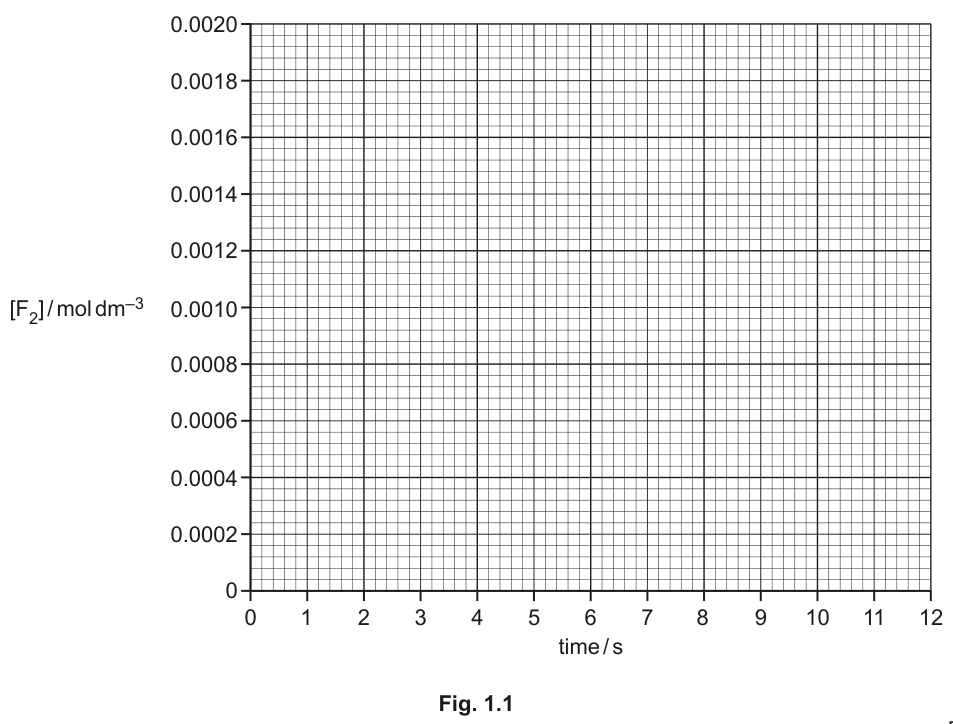
Draw a graph on the grid in Fig. 1.1 to show how the concentration of changes over the first of the reaction.
Answer
The concentration of halves every 4.00 s:
- s:
- s:
- s:
- s:
Plot these points and draw a smooth exponential decay curve through them.
Smooth exponential decay curve passing through (0, 0.00200), (4, 0.00100), (8, 0.00050), (12, 0.00025)
Background Concept
In a first-order reaction, the concentration of the reactant decreases exponentially with time. The key feature is that the half-life is constant — the time for the concentration to halve is the same regardless of the starting concentration. This produces a characteristic exponential decay curve that never quite reaches zero.
Understanding the Question
We are given the initial concentration () and the half-life (4.00 s). We must plot against time from 0 to 12 s on the provided grid (Fig. 1.1), which has on the y-axis (0 to 0.0020) and time on the x-axis (0 to 12 s).
Approach
Calculate the concentration at each half-life interval, then plot the points and draw a smooth curve connecting them.
Step-by-Step Reasoning
Generating data points:
Starting concentration:
After one half-life (4 s):
After two half-lives (8 s):
After three half-lives (12 s):
Plotting:
Plot the four points on the grid:
- (0, 0.00200)
- (4, 0.00100)
- (8, 0.00050)
- (12, 0.00025)
Drawing the curve:
Connect the points with a smooth, continuously decreasing curve that is concave up (steepest at the beginning, flattening as time increases). The curve should not be a series of straight line segments — it must be smooth.
Key Takeaways
- Constant half-life is the defining feature of first-order kinetics.
- The exponential decay curve has a decreasing gradient (rate) as concentration decreases.
- The curve never reaches zero in finite time.
Common Mistakes
- Drawing straight lines between points instead of a smooth curve.
- Incorrectly calculating the concentrations (e.g., subtracting a fixed amount instead of halving).
- Plotting a curve that reaches zero at 12 s.
Things to Be Careful About
- All four points must be correct AND the curve must be smooth — the mark scheme requires all correct for the mark.
- The curve should be steepest at t = 0 and flatten towards t = 12 s.
Use your graph in Fig. 1.1 to find the rate of the reaction when the concentration of is . Show your working on the graph.
Working
At (i.e. at s), draw a tangent to the curve.
Gradient of tangent =
Using a large triangle on the tangent (e.g. from s to s):
Answer
Rate (accept –)
1.7 × 10⁻⁴ mol dm⁻³ s⁻¹
Background Concept
The instantaneous rate of reaction at a particular concentration is the gradient of the tangent to the concentration–time curve at that point. For a first-order reaction, rate = , so at , the rate should be . The graphical method should give a value consistent with this.
Understanding the Question
We must use the graph drawn in part (c)(ii) to find the rate when . This means drawing a tangent at that concentration (which occurs at s) and calculating its gradient. The working must be shown on the graph.
Approach
- Locate the point on the curve where (at s).
- Draw a tangent to the curve at this point.
- Choose two well-separated points on the tangent line.
- Calculate gradient = .
- The magnitude of the gradient is the rate (ignore the negative sign since rate is always positive).
Step-by-Step Reasoning
Locating the point: occurs at s (after one half-life).
Drawing the tangent: The tangent at s should be a straight line touching the curve at that point, with a negative slope (concentration is decreasing).
Calculating the gradient: Using a large triangle for accuracy:
- At s: the tangent gives approximately (reading from the tangent line)
- At s: the tangent gives approximately
The rate is the magnitude: .
Cross-check: rate = ✓ (consistent with the graphical value)
Key Takeaways
- The gradient of a concentration–time curve at any point gives the instantaneous rate.
- A tangent must be drawn carefully using a ruler, touching the curve at only one point.
- Use a large triangle (spanning at least half the tangent) to minimise reading errors.
- The sign of the gradient is negative (concentration decreases), but the rate is reported as a positive value.
Common Mistakes
- Drawing a line through two points on the curve rather than a tangent at one point.
- Using a small triangle, leading to large percentage error in the gradient.
- Including the negative sign in the final answer (the mark scheme says IGNORE sign).
- Calculating the average rate over 4 s instead of the instantaneous rate at .
Things to Be Careful About
- The tangent must be drawn at exactly the point where , not at some other concentration.
- The mark scheme accepts a gradient in the range –, so reasonable reading precision is sufficient.
- The working must be shown on the graph (draw the triangle and label the points used).
The rest of this paper
8 more questions- Q2Equilibria · Carboxylic Acids and Derivatives14M
- Q3Chemical Energetics · Reaction Kinetics · Electrochemistry17M
- Q4Transition Elements · Group 27M
- Q5Transition Elements12M
- Q6Transition Elements6M
- Q7Hydrocarbons · Nitrogen Compounds · Analytical Techniques8M
- Q8Introduction to A Level Organic Chemistry · Hydroxy Compounds · Hydrocarbons · Analytical Techniques · Nitrogen Compounds14M
- Q9Hydrocarbons · Carboxylic Acids and Derivatives · Halogen Compounds13M