Chemistry 9701/53 — May/June 2023
Cambridge A-Level · Planning, Analysis and Evaluation · worked solutions for every part, with the mark scheme
Topics Analysis, Conclusions and Evaluation · Planning
The partition coefficient, , shows the distribution of a solute between two immiscible solvents. is determined by measuring the concentration of the solute in each solvent.
The organic solvent ethoxyethane, , and water are immiscible. A student is asked to find of butanedioic acid, , between ethoxyethane and water.
The expression for when butanedioic acid is in equilibrium between ethoxyethane and water is shown.
[density: ethoxyethane, ; water, ]
The student uses the following method to find the partition coefficient. A diagram of the apparatus is shown in Fig. 1.1.
step 1 Add of distilled water to a separating funnel.
step 2 Weigh by difference of butanedioic acid into the separating funnel.
step 3 Stopper the separating funnel and shake it until the butanedioic acid has dissolved.
step 4 Remove the stopper and add of ethoxyethane to the separating funnel.
step 5 Replace the stopper and shake the separating funnel gently.
step 6 Place the separating funnel into a clamp. Allow the liquids to settle so that the two layers can be seen.
step 7 Remove the stopper and open the separating funnel tap to allow the lower layer to run into a beaker labelled A. Run the upper layer into a beaker labelled B.
step 8 Transfer of the aqueous layer into a conical flask. Titrate with . Use thymolphthalein as the indicator.
step 9 Take of the ethoxyethane layer and add of water to it. Titrate this mixture with . Use thymolphthalein as the indicator.
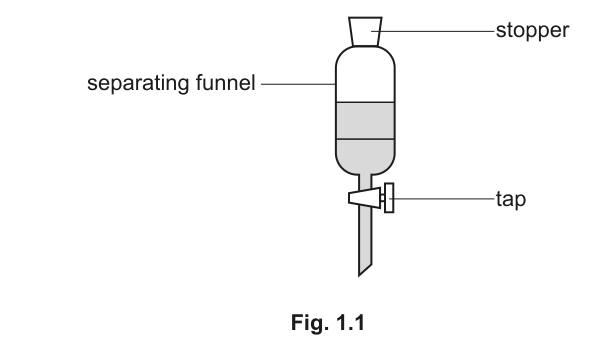
State whether beaker A in step 7 contains the aqueous layer or the ethoxyethane layer.
Explain your answer.
Beaker A contains the ................................................. layer.
explanation ........................................................................................................................
Identify the piece of apparatus that should be used in step 8 to transfer of the aqueous layer.
Suggest why water is added to the ethoxyethane layer in step 9 before the titration can take place.
For a sample of butanedioic acid, the titre for the aqueous layer is and the titre for the ethoxyethane layer is .
The equation for the reaction between butanedioic acid and sodium hydroxide is shown.
Calculate the concentration of butanedioic acid in the aqueous layer.
concentration of butanedioic acid = ..............................
Calculate the partition coefficient, .
= ..............................
Explain why the student is only able to repeat the titration in step 8 once.
Suggest how you would modify the procedure to ensure the student can repeat the titration in step 8 more than once.
A different student forgets to shake the separating funnel in step 5.
Describe the effect this would have on the calculated value. Explain your answer.
effect on ......................................................................................................................
explanation ........................................................................................................................
The rest of this paper
2 more questions- Q2Analysis, Conclusions and Evaluation7M
- Q3Planning · Analysis, Conclusions and Evaluation14M