Chemistry 9701/51 — May/June 2023
Cambridge A-Level · Planning, Analysis and Evaluation · worked solutions for every part, with the mark scheme
Topics Planning · Analysis, Conclusions and Evaluation
The partition coefficient, , shows the distribution of a solute between two immiscible solvents. is determined by measuring the concentration of the solute in each solvent.
The organic solvent ethoxyethane, , and water are immiscible. A student is asked to find of butanedioic acid, , between ethoxyethane and water.
The expression for when butanedioic acid is in equilibrium between ethoxyethane and water is shown.
[density: ethoxyethane, ; water, ]
The student uses the following method to find the partition coefficient. A diagram of the apparatus is shown in Fig. 1.1.
step 1 Add of distilled water to a separating funnel.
step 2 Weigh by difference of butanedioic acid into the separating funnel.
step 3 Stopper the separating funnel and shake it until the butanedioic acid has dissolved.
step 4 Remove the stopper and add of ethoxyethane to the separating funnel.
step 5 Replace the stopper and shake the separating funnel gently.
step 6 Place the separating funnel into a clamp. Allow the liquids to settle so that the two layers can be seen.
step 7 Remove the stopper and open the separating funnel tap to allow the lower layer to run into a beaker labelled A. Run the upper layer into a beaker labelled B.
step 8 Transfer of the aqueous layer into a conical flask. Titrate with . Use thymolphthalein as the indicator.
step 9 Take of the ethoxyethane layer and add of water to it. Titrate this mixture with . Use thymolphthalein as the indicator.
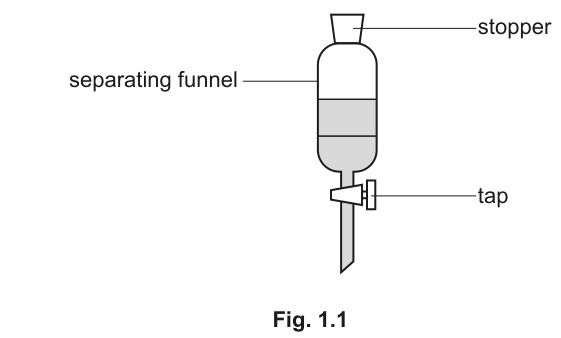
State whether beaker A in step 7 contains the aqueous layer or the ethoxyethane layer.
Explain your answer.
Beaker A contains the ................................................. layer.
explanation ........................................................................................................................
Answer
Beaker A contains the aqueous layer.
Explanation: Water has a greater density (1.00 g cm) than ethoxyethane (0.71 g cm), so the aqueous layer forms the lower layer and is drained from the tap first into beaker A.
aqueous layer; water is denser than ethoxyethane so it forms the lower layer
Background Concept
When two immiscible liquids are placed in a separating funnel, they separate into distinct layers based on their densities. The liquid with the higher density will sink to the bottom, forming the lower layer, while the less dense liquid will float on top. In a separating funnel, the lower layer is drained out first through the tap at the bottom, and the upper layer is poured out from the top.
Understanding the Question
The question asks which layer ends up in beaker A. From the procedure, beaker A collects the liquid drained from the tap (the lower layer), and beaker B collects the remaining liquid (the upper layer). We are given the densities: water = 1.00 g cm and ethoxyethane = 0.71 g cm.
Approach
Compare the given densities to determine which liquid is denser. The denser liquid will be the lower layer and will be collected in beaker A.
Step-by-Step Reasoning
- Water has a density of 1.00 g cm and ethoxyethane has a density of 0.71 g cm.
- Since 1.00 > 0.71, water is denser than ethoxyethane.
- Therefore, the aqueous (water) layer will be the lower layer in the separating funnel.
- Step 7 states that the lower layer is run into beaker A.
- Thus, beaker A contains the aqueous layer.
Key Takeaways
Always check the densities of immiscible liquids to predict which will be the top or bottom layer in a separating funnel. The lower layer is always removed via the tap first.
Common Mistakes
- Assuming the organic layer is always on top or bottom. While often true for simple organic solvents, halogenated solvents (like dichloromethane) are denser than water and form the lower layer.
- Forgetting to mention density in the explanation. Simply stating "it is the lower layer" is not enough; the mark scheme requires the reason (greater density).
Things to Be Careful About
- Read the procedure carefully: beaker A is for the lower layer (drained via tap), beaker B is for the upper layer (poured out).
Identify the piece of apparatus that should be used in step 8 to transfer of the aqueous layer.
Answer
A 10.0 cm volumetric pipette (or burette/pipette filler).
(Note: A volumetric pipette is the standard apparatus for transferring a fixed, precise volume like 10.0 cm.)
10.0 cm^3 volumetric pipette
Background Concept
In quantitative analysis, transferring precise volumes of liquid is essential. A volumetric pipette (or measuring pipette) is designed to deliver a single, highly accurate fixed volume (e.g., 10.0 cm, 25.0 cm). A burette can also deliver precise volumes but is typically used for variable volumes during a titration. For simply transferring a fixed 10.0 cm aliquot from a beaker to a conical flask, a volumetric pipette is the most appropriate and standard piece of apparatus.
Understanding the Question
Step 8 requires transferring exactly 10.0 cm of the aqueous layer into a conical flask for titration. We need to name the apparatus used for this.
Approach
Identify the standard laboratory apparatus used to accurately measure and transfer a fixed volume of 10.0 cm.
Step-by-Step Reasoning
- The volume to be transferred is exactly 10.0 cm.
- A volumetric pipette is calibrated to deliver a specific fixed volume with high accuracy.
- Therefore, a 10.0 cm volumetric pipette is the correct apparatus.
Key Takeaways
- Volumetric pipette: transfers a fixed, precise volume (e.g., 10.0 cm).
- Burette: delivers variable, precise volumes (used during the titration itself).
- Measuring cylinder: less accurate, not suitable for precise quantitative transfers in titrations.
Common Mistakes
- Writing "pipette" without specifying "volumetric". A standard Pasteur pipette or measuring pipette would not be accurate enough.
- Writing "burette" for the transfer step. While a burette can measure 10.0 cm, it is inefficient and not the standard method for a simple fixed-volume transfer into a flask.
Things to Be Careful About
Always include the volume specification (10.0 cm) if possible, and use the full term "volumetric pipette" to ensure full marks.
Suggest why water is added to the ethoxyethane layer in step 9 before the titration can take place.
Answer
The butanedioic acid must dissolve in water to react with the aqueous sodium hydroxide during the titration. Adding water allows the acid to transfer from the ethoxyethane layer into the aqueous phase where the reaction with NaOH can occur.
to allow the acid to dissolve/transfer into the water for reaction with NaOH
Background Concept
Acid-base titrations require the acid and base to be in the same phase (typically aqueous) so they can mix and react. Butanedioic acid is a dicarboxylic acid that is partially soluble in both water and ethoxyethane. However, the sodium hydroxide titrant is aqueous. If the acid remains entirely in the ethoxyethane layer, it will not mix with the aqueous NaOH, and the reaction will not proceed at a measurable rate or at the correct stoichiometry.
Understanding the Question
In step 9, 10.0 cm of the ethoxyethane layer is taken, and 10.0 cm of water is added before titrating with 0.100 mol dm NaOH. Why is this water added?
Approach
Consider the physical state of the reactants and the requirement for a homogeneous reaction mixture during titration.
Step-by-Step Reasoning
- The ethoxyethane layer contains dissolved butanedioic acid.
- Ethoxyethane and water are immiscible. If NaOH(aq) is added directly to the ethoxyethane layer, the reaction will only occur at the interface between the two liquid layers, which is very slow and incomplete.
- By adding water, a larger aqueous phase is created.
- The butanedioic acid, being somewhat soluble in water, will partition/dissolve into this new aqueous phase.
- Once in the aqueous phase, the acid can mix homogeneously with the aqueous NaOH, allowing the titration to proceed rapidly and completely.
Key Takeaways
When titrating a solute from an organic solvent, ensure it is in an aqueous environment (or at least mixed well) so it can react with the aqueous titrant. Adding water extracts the acid into a phase where it can react with the aqueous NaOH.
Common Mistakes
- Saying "to dilute the acid". While dilution occurs, the primary reason is to provide an aqueous medium for the reaction.
- Saying "to dissolve the indicator". Thymolphthalein is typically dissolved in alcohol or added as a solution; it doesn't require bulk water to dissolve.
Things to Be Careful About
Focus on the reaction requirement: acid and base must be in the same phase (aqueous) for a rapid, complete titration.
For a sample of butanedioic acid, the titre for the aqueous layer is and the titre for the ethoxyethane layer is .
The equation for the reaction between butanedioic acid and sodium hydroxide is shown.
Calculate the concentration of butanedioic acid in the aqueous layer.
concentration of butanedioic acid = .................... mol dm
Working
Step 1: Calculate moles of NaOH used in the titre.
Step 2: Use stoichiometry to find moles of butanedioic acid.
From the equation:
Ratio is 1 : 2.
Step 3: Calculate concentration in the 10.0 cm aqueous aliquot.
Rounding to 3 significant figures:
Answer
concentration of butanedioic acid = 0.681 mol dm
0.681 mol dm^-3
Background Concept
In an acid-base titration, the concentration of an unknown acid can be determined if the concentration of the base (titrant) is known. The key steps are:
- Calculate moles of titrant used from its concentration and titre volume.
- Use the balanced chemical equation to find the mole ratio between titrant and analyte.
- Calculate moles of analyte.
- Divide moles of analyte by the volume of the aliquot taken to find the concentration.
Butanedioic acid is a dicarboxylic acid, meaning it has two acidic protons (–COOH groups). It reacts with sodium hydroxide in a 1:2 molar ratio:
Understanding the Question
We are given:
- Volume of aqueous aliquot = 10.0 cm
- Titre volume of NaOH = 27.25 cm
- Concentration of NaOH = 0.500 mol dm
We need to find the concentration of butanedioic acid in the aqueous layer.
Approach
Apply the standard titration calculation sequence: moles NaOH → moles acid (using 1:2 ratio) → concentration of acid.
Step-by-Step Reasoning
-
Moles of NaOH:
-
Moles of butanedioic acid:
The stoichiometric ratio is 1 mol acid : 2 mol NaOH.
-
Concentration of acid:
The volume of the aqueous aliquot is 10.0 cm = 0.0100 dm.
-
Significant figures:
The given data (27.25, 0.500, 10.0) have at least 3 significant figures. The answer should be given to at least 3 s.f.: 0.681 mol dm.
Key Takeaways
- Always check the stoichiometry of the balanced equation. For dicarboxylic acids, the ratio with NaOH is 1:2, not 1:1.
- Convert volumes from cm to dm by dividing by 1000.
- Carry extra digits through intermediate calculations to avoid rounding errors.
Common Mistakes
- Forgetting the 1:2 ratio and calculating moles of acid = moles of NaOH. This would give an answer twice as large (1.36 mol dm).
- Dividing by the wrong volume (e.g., using 30.0 cm instead of the 10.0 cm aliquot).
Things to Be Careful About
- The mark scheme accepts 0.6813 (4 s.f.) or 0.681 (3 s.f.). Ensure at least 2 s.f. are used.
- Do not round intermediate values like 0.0068125; keep it exact for the next step.
Calculate the partition coefficient, .
= ....................
Working
Step 1: Calculate concentration of butanedioic acid in the ethoxyethane layer.
In step 9, 10.0 cm of ethoxyethane layer is mixed with 10.0 cm of water, then titrated.
Titre = 22.50 cm of 0.100 mol dm NaOH.
Moles of NaOH:
Moles of acid in the mixture (from 10.0 cm ethoxyethane):
This amount of acid was originally in the 10.0 cm of ethoxyethane layer. Calculate its concentration:
Step 2: Calculate .
From part (b)(i), .
Rounding to 3 significant figures:
Answer
= 0.165
0.165
Background Concept
The partition coefficient () describes the ratio of concentrations of a solute in two immiscible solvents at equilibrium:
A value less than 1 indicates the solute is more soluble in the aqueous layer; a value greater than 1 indicates it is more soluble in the organic layer.
In this experiment, the concentration in the aqueous layer is found directly from a titration of a 10.0 cm aliquot. However, for the ethoxyethane layer, the student added 10.0 cm of water to the 10.0 cm sample before titrating. This dilutes the sample but does not change the total moles of acid present from the original 10.0 cm of ethoxyethane.
Understanding the Question
We need to find using:
- from part (b)(i) = 0.68125 mol dm
- calculated from the step 9 titration data.
Approach
- Calculate moles of NaOH used in step 9.
- Find moles of acid that came from the 10.0 cm ethoxyethane sample.
- Calculate the concentration of acid in the original ethoxyethane layer.
- Apply the formula.
Step-by-Step Reasoning
1. Moles of NaOH in step 9 titre:
2. Moles of butanedioic acid:
Using the 1:2 ratio:
3. Concentration in ethoxyethane layer:
These 0.001125 mol of acid were present in the 10.0 cm of ethoxyethane layer that was taken for the test. The added water does not change the number of moles from the ethoxyethane layer.
4. Calculate :
Rounding to 3 significant figures: 0.165.
Key Takeaways
- When a sample is diluted before titration, calculate the moles of analyte from the titration data, then divide by the original volume of the sample to find its original concentration.
- is dimensionless (concentration units cancel out), but ensure both concentrations are in the same units (mol dm).
Common Mistakes
- Dividing the moles of acid by the total volume (10.0 + 10.0 = 20.0 cm) instead of the original ethoxyethane volume (10.0 cm). This would give 0.05625 mol dm, leading to an incorrect of 0.0826.
- Using the wrong NaOH concentration (e.g., 0.500 instead of 0.100 for step 9).
- Forgetting the 1:2 stoichiometric ratio.
Things to Be Careful About
- The mark scheme shows the expected answer as 0.165 (range 0.1614–0.1662 allowing for ecf from part b(i)).
- has no units.
Explain why the student is only able to repeat the titration in step 8 once.
Answer
It is not possible to pipette all 30.0 cm of the aqueous layer from beaker A because some liquid will always remain in the beaker (or the separating funnel). Therefore, only one accurate 10.0 cm aliquot can be taken for titration.
cannot pipette all 30 cm^3 from the beaker; some liquid always remains behind
Background Concept
In this experiment, the total volume of the aqueous layer collected in beaker A is 30.0 cm. To perform a titration, a precise aliquot (10.0 cm) is taken using a volumetric pipette. To repeat the titration, the student would need to take another 10.0 cm aliquot from the same beaker.
However, volumetric pipettes and beakers are not designed to transfer 100% of a liquid volume. A beaker will retain a film of liquid on its walls, and a pipette will retain a small amount in its tip. Therefore, you cannot extract all 30.0 cm from the beaker.
Understanding the Question
The student has 30.0 cm of aqueous layer in beaker A. They take one 10.0 cm titration. Why can they only repeat it once (i.e., take a second titration, but not a third)?
Approach
Consider the practical limitations of transferring liquid from a beaker using a pipette.
Step-by-Step Reasoning
- The total volume in beaker A is 30.0 cm.
- The student takes a 10.0 cm aliquot using a pipette. Volume remaining ≈ 20.0 cm.
- The student can take a second 10.0 cm aliquot. Volume remaining ≈ 10.0 cm.
- To take a third aliquot, they would need to pipette from the remaining ~10.0 cm. However, some liquid is lost to the beaker walls and pipette tip during the first two transfers. The remaining volume is likely less than 10.0 cm, or it is not possible to accurately transfer exactly 10.0 cm from such a small remaining amount without significant loss.
- More fundamentally, the mark scheme points out that "some will always be left behind" in the beaker, meaning the total recoverable volume is less than 30.0 cm. Thus, you cannot reliably get three 10.0 cm aliquots.
Key Takeaways
- When performing replicate titrations from a bulk sample, ensure the initial volume is large enough to account for liquid lost to apparatus (beaker walls, pipette tips).
- A general rule: initial volume should be at least 3-4 times the aliquot volume to allow for repeats and losses.
Common Mistakes
- Saying "the sample is used up after one titration." This is incorrect; 20 cm remains.
- Saying "the student only has one pipette." A student can reuse the same pipette.
Things to Be Careful About
- Focus on the volume loss to the apparatus. The beaker retains liquid; the pipette retains liquid. This reduces the total recoverable volume below the nominal 30.0 cm.
Suggest how you would modify the procedure to ensure the student can repeat the titration in step 8 more than once.
Answer
Use a larger initial volume of water (e.g., >30 cm, such as 50.0 cm or 100.0 cm) in step 1.
This would result in a larger total volume of aqueous layer being collected, allowing multiple 10.0 cm aliquots to be taken for repeat titrations.
use a larger volume of water in step 1 (e.g., >30 cm^3)
Background Concept
To obtain reliable results in a titration, at least two concordant titres are needed (typically within 0.10 cm of each other). This requires taking at least two 10.0 cm aliquots from the separated layer.
If the initial volume of water used in the extraction is too small, liquid losses to the apparatus (separating funnel, beaker walls, pipette tips) will prevent the collection of enough volume for multiple aliquots.
Understanding the Question
How can the procedure be modified so the student can repeat the titration in step 8 more than once (i.e., take at least two or three 10.0 cm aliquots from the aqueous layer)?
Approach
Increase the total volume of the aqueous layer collected, so that after losses and taking aliquots, enough volume remains.
Step-by-Step Reasoning
- The current method uses 30.0 cm of water. After extraction and separation, some volume is lost to the separating funnel and beaker walls.
- To take two 10.0 cm aliquots (20.0 cm total) plus allow for losses, at least 35-40 cm of aqueous layer should be collected.
- Therefore, increasing the initial volume of distilled water in step 1 (e.g., to 50.0 cm or 100.0 cm) will produce a larger aqueous layer, allowing multiple accurate aliquots to be taken.
Key Takeaways
- When designing or evaluating an extraction/titration procedure, consider the total volume needed: aliquot volume × number of repeats + estimated losses.
- Increasing the initial volume of the extracting solvent is a simple and effective improvement.
Common Mistakes
- Suggesting "use a larger separating funnel." This doesn't solve the volume problem; the aqueous layer is still only 30.0 cm.
- Suggesting "use a smaller aliquot (e.g., 5.0 cm)." While this would allow more repeats, it reduces the precision of the titration and is not the best improvement.
Things to Be Careful About
- The improvement must be specific: "use a larger volume of water" or "use >30 cm of water in step 1". Vague answers like "use more water" may not score if not linked to the procedure step.
A different student forgets to shake the separating funnel in step 5.
Describe the effect this would have on the calculated value. Explain your answer.
effect on ......................................................................................................................
explanation ........................................................................................................................
Answer
Effect on : The calculated value would be smaller (or decrease).
Explanation: If the separating funnel is not shaken, equilibrium is not attained. More butanedioic acid will remain in the aqueous layer (and less will transfer to the ethoxyethane layer). This results in a lower concentration in the organic layer and a higher concentration in the aqueous layer, making the ratio smaller.
Kpc would be smaller; equilibrium not attained, more acid remains in aqueous layer
Background Concept
The partition coefficient is defined at equilibrium, when the rate of transfer of solute from one solvent to the other equals the rate of transfer back. Shaking the separating funnel increases the surface area between the two immiscible layers, allowing the solute to distribute between them until equilibrium is reached.
If equilibrium is not reached, the concentrations in each layer will not reflect the true partition coefficient.
Understanding the Question
The student forgets to shake the separating funnel in step 5. We need to predict the effect on the calculated and explain why.
Approach
- Determine what happens to the solute distribution if shaking is omitted.
- Relate this to the concentrations in each layer.
- Apply these to the formula to determine the effect on the calculated value.
Step-by-Step Reasoning
- Without shaking: The two liquids remain largely unmixed. The butanedioic acid, which was added to the water (step 2) and partially dissolved, will not have sufficient contact with the ethoxyethane to distribute according to its partition coefficient.
- Distribution: Most of the butanedioic acid will remain in the aqueous layer (where it was initially dissolved and where it is more soluble, as indicated by ). Very little will transfer to the ethoxyethane layer.
- Concentrations:
- will be higher than at equilibrium.
- will be lower than at equilibrium.
- Effect on : Since the numerator is smaller and the denominator is larger than their true equilibrium values, the calculated will be smaller than the true value.
Key Takeaways
- Shaking is essential to reach equilibrium in partition experiments.
- If equilibrium is not reached, the solute distribution reflects kinetics (where it started) rather than thermodynamics (equilibrium partitioning).
- For a solute more soluble in water (), lack of shaking leaves more in water, lowering the calculated .
Common Mistakes
- Saying " would be larger." This would be true if the solute were more soluble in the organic layer and failed to transfer to water, but here the solute is more soluble in water.
- Not mentioning "equilibrium" in the explanation. The mark scheme specifically looks for the concept that equilibrium was not attained.
Things to Be Careful About
- Always link the effect on concentration to the effect on the ratio. Lower organic / higher aqueous = lower .
- The explanation must state that equilibrium was not attained or that more acid remains in the aqueous layer.
The rest of this paper
2 more questions- Q2Planning · Analysis, Conclusions and Evaluation7M
- Q3Planning · Analysis, Conclusions and Evaluation14M