Chemistry 9701/42 — May/June 2023
Cambridge A-Level · A Level Structured Questions · worked solutions for every part, with the mark scheme
Topics Introduction to A Level Organic Chemistry · Carboxylic Acids and Derivatives · Chemical Energetics · Electrochemistry · Hydrocarbons · Nitrogen Compounds · +7 more
Group 2 carbonates decompose when heated to form the metal oxide and carbon dioxide.
Suggest a mechanism for the decomposition of the carbonate ion by adding two curly arrows in Fig. 1.1.
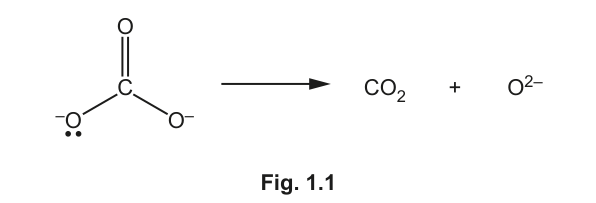
Answer
Arrow 1: from a lone pair on one to the bond (forming a double bond).
Arrow 2: from the bond on the other oxygen to that oxygen atom (releasing ).
Arrow 1 from lone pair on O⁻ to C–O bond; Arrow 2 from C–O bond to other O⁻
Background Concept
The thermal decomposition of a carbonate ion involves the redistribution of electrons within the ion. The carbonate ion, , has a central carbon bonded to three oxygen atoms: one double bond and two single bonds. On heating, the ion breaks down into and .
Curly arrows in mechanisms always show the movement of an electron pair (not a single electron). A curly arrow starts from a source of electrons (a lone pair or a bond) and points to where those electrons end up.
Understanding the Question
The question asks you to add two curly arrows to the given structure of the carbonate ion to show how it decomposes into and . You need to show the electron redistribution that converts two single bonds into one double bond (in ) and releases an oxide ion.
Approach
Work backwards from the products: has two double bonds, and has three lone pairs. Starting from the carbonate ion (one , two ), you need to:
- Convert one into a — a lone pair on that oxygen moves to form the pi bond.
- Break the other bond heterolytically — the bonding pair moves onto the oxygen, giving it an extra lone pair and a 2− charge.
Step-by-Step Reasoning
Arrow 1: Start from a lone pair on one of the atoms and point it toward the bond. This shows the lone pair being donated to form a new bond between C and that O, converting the single bond into a double bond.
Arrow 2: Start from the bond on the other oxygen and point it toward that oxygen atom. This shows the bonding pair of electrons moving entirely onto the oxygen, breaking the bond heterolytically and giving that oxygen a full negative charge of 2− (it already had one negative charge plus the bonding pair = ).
The net result: the carbon now has two double bonds to oxygen (= ) and one oxygen leaves as .
Key Takeaways
- Curly arrows always start from electrons (lone pair or bond) and end at the destination.
- In decomposition of carbonate, one oxygen donates a lone pair to form a double bond while the other oxygen takes the bonding pair to leave as .
- This is a heterolytic cleavage — both electrons from the broken bond go to one atom.
Common Mistakes
- Drawing the arrow from the bond to the carbon (wrong direction — the electrons go to oxygen, not carbon).
- Drawing only one arrow instead of two.
- Starting an arrow from a positive charge or from an atom rather than from electrons.
- Pointing an arrow to an atom rather than to a bond or lone pair.
Things to Be Careful About
- Ensure both arrows are clearly drawn with correct direction.
- The arrow must start from a lone pair (on ) or from a bond, never from an atom symbol.
- State symbols are not required here as the question shows the mechanism.
Describe the variation in the thermal stability of Group 2 carbonates. Explain your answer.
Answer
- Thermal stability increases down the group.
- The ionic radius of the cation increases (or equivalently, the charge density of decreases) down the group.
- Therefore there is less polarisation (distortion) of the carbonate ion (), making it harder to decompose.
Thermal stability increases down the group because the larger cation has lower charge density, causing less polarisation of the carbonate ion.
Background Concept
Group 2 metal carbonates decompose on heating: . The ease of this decomposition depends on how strongly the metal cation distorts (polarises) the carbonate ion.
A cation with high charge density (small radius, high charge) strongly attracts the electron cloud of the large anion, polarising it. This weakens the bond within the carbonate ion, making it easier to break and release . The result is lower thermal stability.
Understanding the Question
The command word is "Describe" and "Explain". You must state the trend (what happens to thermal stability down the group) and then give the reason using the concepts of ionic size and polarising power.
Approach
- State the trend: thermal stability increases from Mg to Ba.
- Explain why: the cation gets larger → charge density decreases → less polarisation of → the C–O bond is less weakened → more energy needed to decompose.
Step-by-Step Reasoning
M1 — The trend: Thermal stability increases down Group 2. decomposes at the lowest temperature; at the highest.
M2 — The reason (size/charge density): Down the group, the number of electron shells in the ion increases, so the ionic radius increases. Since the charge remains +2, the charge density (charge/volume ratio) decreases.
M3 — The consequence (polarisation): A cation with lower charge density exerts a weaker electrostatic pull on the electron cloud of the large anion. Less polarisation means the bonds within the carbonate ion are less distorted and less weakened, so a higher temperature (more energy) is required to break them and release .
Key Takeaways
- Thermal stability of Group 2 carbonates increases down the group.
- The explanation always follows: larger cation → lower charge density → less polarisation → harder to decompose.
- This is a classic anion-polarisation argument applicable to nitrates and carbonates alike.
Common Mistakes
- Saying "the charge increases down the group" — the charge stays +2; it is the radius that changes.
- Confusing polarisation of the anion with lattice energy arguments (both are valid but this question asks for the polarisation explanation).
- Stating the trend backwards (stability decreases).
Things to Be Careful About
- You must give all three points (trend, size/charge density, polarisation) for full marks.
- Use the word "polarisation" or "distortion" — not just "attraction".
- The mark scheme accepts either "ionic radius increases" or "charge density decreases" for M2.
Define lattice energy.
Answer
The energy released when one mole of an ionic solid is formed from its gaseous ions under standard conditions.
The energy released when one mole of an ionic solid is formed from its gaseous ions under standard conditions.
Background Concept
Lattice energy () is a thermodynamic quantity that measures the strength of the ionic bonds in a crystal lattice. It is defined as the enthalpy change when one mole of an ionic compound is formed from its constituent ions in the gas phase. Since gaseous ions are infinitely separated (no interaction), bringing them together to form a solid lattice releases energy — hence lattice energy is always exothermic (negative).
Understanding the Question
The command word is "Define". A definition must include all the qualifying conditions precisely. For lattice energy, the mark scheme requires two elements: (1) energy released when one mole of ionic solid forms, and (2) from gaseous ions under standard conditions.
Approach
Recall the standard definition verbatim, ensuring both the "one mole of ionic solid formed" and "from gaseous ions" components are present.
Step-by-Step Reasoning
M1: "Energy released when one mole of an ionic solid (or compound) is formed" — this specifies what happens (formation) and the quantity (one mole).
M2: "From gaseous ions (under standard conditions)" — this specifies the starting state. The ions must be in the gas phase because lattice energy measures only the ionic bonding, not any other interactions.
Both elements are needed for full marks. Omitting "gaseous" or "one mole" loses a mark.
Key Takeaways
- Lattice energy is always negative (exothermic) by this definition.
- The key qualifiers are: one mole, ionic solid, gaseous ions, standard conditions.
- Do not confuse with lattice dissociation energy (the reverse process, which is endothermic).
Common Mistakes
- Saying "energy required to break apart" — that is lattice dissociation energy, not lattice formation energy.
- Omitting "gaseous" — if you say "from its elements" you are describing enthalpy of formation, not lattice energy.
- Saying "one mole of ions" instead of "one mole of ionic solid/compound".
Things to Be Careful About
- The definition must specify the state of the ions (gaseous) — this is the most commonly missed element.
- "Standard conditions" is part of the full definition but the mark scheme may accept without it depending on the exact wording.
The lattice energy of the Group 2 carbonates, , becomes less exothermic down the group.
The lattice energy of the Group 2 oxides, , also becomes less exothermic down the group.
and change by different amounts going down the group.
Suggest how the standard enthalpy change of the decomposition reaction for Group 2 carbonates changes down the group.
Explain your reasoning in terms of the relative sizes of the anions and the relative changes in lattice energy down the group.
Answer
- becomes more positive (less negative) down the group.
- The oxide ion is smaller than the carbonate ion.
- Therefore becomes less exothermic faster (changes more) than down the group, so the difference between them increases, making more positive.
ΔH_decomp becomes more positive down the group because the smaller oxide ion causes a faster decrease in lattice energy for the oxide compared to the carbonate.
Background Concept
The decomposition reaction is:
Using a Born-Haber-type cycle, can be expressed in terms of lattice energies:
More precisely, is approximately equal to the lattice energy of the carbonate (which must be overcome) minus the lattice energy of the oxide (which is released). Since both are negative (exothermic), .
The key insight is that lattice energy depends on the size of the ions: smaller ions give more exothermic (more negative) lattice energies. As the cation gets larger down the group, both lattice energies become less exothermic, but they change by different amounts because the anions have different sizes.
Understanding the Question
The question states that both and become less exothermic down the group, but they change by different amounts. You must deduce how changes and explain using anion size arguments.
Approach
- Recognise that depends on the difference between the two lattice energies.
- Compare the sizes of the anions: is much smaller than .
- The smaller anion means the oxide lattice energy is more sensitive to changes in cation size (the cation radius is a larger fraction of the total interionic distance).
- Therefore decreases (becomes less exothermic) faster than .
- Since , and the subtracted term becomes less negative faster, the result becomes more positive.
Step-by-Step Reasoning
Point 1 — Direction of change: becomes more positive (or less negative) down the group. This is consistent with increasing thermal stability.
Point 2 — Relative anion sizes: The oxide ion () is much smaller than the carbonate ion (). The interionic distance in MO is dominated by the cation radius change, whereas in the large carbonate ion means the cation radius change is a smaller proportion of the total distance.
Point 3 — Consequence for lattice energy change: Because is smaller, is more sensitive to the increasing cation size and becomes less exothermic faster than down the group.
Since involves subtracting (which is negative), a faster decrease in its magnitude means the overall increases (becomes more positive).
Key Takeaways
- Lattice energy is more sensitive to cation size when the anion is small.
- depends on the difference between two lattice energies, so you must compare their rates of change.
- This connects the polarisation argument (part a) with the thermodynamic (lattice energy) argument.
Common Mistakes
- Saying becomes more negative (wrong direction).
- Saying the carbonate ion is smaller than the oxide ion (backwards).
- Not linking the anion size difference to the rate of change of lattice energy.
- Confusing this with the polarisation explanation — both give the same trend but through different reasoning.
Things to Be Careful About
- The mark scheme gives 2 marks for all three points, 1 mark for any two. Ensure you state the direction, the size comparison, and the consequence.
- "ORA" (or reverse argument) is accepted for the size comparison — you could say the carbonate is larger instead of the oxide is smaller.
- Use precise language: "less exothermic faster" or "changes more" rather than vague "changes differently".
Potassium sulfite, , is used as a food additive.
The concentration of sulfite ions, , can be determined by titration using aqueous acidified manganate(VII) ions, .
- A solution contains of impure .
- of this solution requires of acidified to reach the end-point. All the ions are oxidised. None of the other species in the impure are oxidised.
The reaction occurs as shown by the two half-equations.
Give the ionic equation for the reaction between and acidified .
Working
Multiply the first half-equation by 5 and the second by 2 to give 10 electrons in each:
Adding and cancelling , (from 16 on left minus 10 on right = 6 on left), and (from 8 on right minus 5 on left = 3 on right):
Answer
2MnO4⁻ + 6H⁺ + 5SO3²⁻ → 2Mn²⁺ + 3H2O + 5SO4²⁻
Background Concept
To combine two half-equations into an overall redox equation, the number of electrons lost in the oxidation half-equation must equal the number gained in the reduction half-equation. You multiply each half-equation by an appropriate factor so that the electrons cancel when the equations are added together.
Understanding the Question
Two half-equations are given:
- Oxidation:
- Reduction:
You must give the overall balanced ionic equation.
Approach
- Find the LCM of the electrons: LCM(2, 5) = 10.
- Multiply the oxidation by 5 and the reduction by 2.
- Add the two equations and cancel electrons, then cancel any species appearing on both sides.
Step-by-Step Reasoning
Step 1: Multiply oxidation by 5:
Step 2: Multiply reduction by 2:
Step 3: Add left sides and right sides:
Left:
Right:
Step 4: Cancel from both sides.
Step 5: Cancel : 16 on left − 10 on right = 6 remaining on left.
Step 6: Cancel : 8 on right − 5 on left = 3 remaining on right.
Final equation:
Check: atoms balance (Mn: 2=2, S: 5=5, O: 8+15=23 left, 12+3+20=35... let me recount. Left: 2×4 + 6×0 + 5×3 = 8+15 = 23 O. Right: 2×0 + 3×1 + 5×4 = 3+20 = 23 O ✓. H: 6 left, 6 right ✓. Charge: 2(−1)+6(+1)+5(−2) = −2+6−10 = −6 left. Right: 2(+2)+5(−2) = +4−10 = −6 ✓.
Key Takeaways
- Always equalise electrons first, then add and cancel.
- After cancelling electrons, check for common species on both sides (here and ).
- Verify the final equation by checking atom and charge balance.
Common Mistakes
- Forgetting to cancel or that appear on both sides.
- Writing the equation with electrons still present.
- Incorrect stoichiometric coefficients from arithmetic errors in the cancellation step.
Things to Be Careful About
- The equation must be balanced for both atoms and charge.
- State symbols are not required by the mark scheme for this equation.
- This is the ionic equation, not the full molecular equation.
Calculate the percentage purity of the sample of .
Show your working.
Working
Moles of used:
Moles of in :
From the equation, , so:
Moles of in :
Mass of pure :
Percentage purity:
Answer
65.2%
Background Concept
Percentage purity is calculated as:
In a redox titration, the moles of titrant give the moles of analyte via the stoichiometric ratio from the balanced equation. If only an aliquot of the original solution is titrated, the result must be scaled up to the full volume.
Understanding the Question
A solution contains of impure . A aliquot requires of . Find the percentage purity.
Approach
- Calculate moles of from concentration × volume.
- Use the 2:5 ratio from the ionic equation to find moles of in the aliquot.
- Scale up by ×10 (250/25) to get moles in the full solution.
- Convert to mass using of .
- Divide by the mass of the impure sample and multiply by 100.
Step-by-Step Reasoning
Step 1 — Moles of :
Step 2 — Moles of in :
From the balanced equation:
Step 3 — Moles in :
The aliquot is of the total, so multiply by 10:
Step 4 — Mass of :
Step 5 — Percentage purity:
The mark scheme accepts 65.2% or 65.3% (depending on rounding of intermediate steps) to a minimum of 2 significant figures.
Key Takeaways
- Always identify the stoichiometric ratio from the balanced equation.
- Remember to scale from the aliquot to the full solution volume.
- The moles of equal the moles of (1:1 ratio within the compound).
Common Mistakes
- Forgetting to scale from to (gives 6.52% instead of 65.2%).
- Using the wrong mole ratio (e.g. 2:1 instead of 2:5).
- Using the wrong (e.g. for instead of ).
- Not converting to when calculating moles.
Things to Be Careful About
- The mark scheme allows ecf (error carried forward) at each step, so a correct method with an arithmetic error still earns method marks.
- Give the final answer to at least 2 significant figures (3 s.f. preferred).
- The ratio is 5 per 2 , not the other way around.
Potassium disulfite, , is another food additive. The disulfite ion, , has the displayed formula shown in Fig. 1.2.
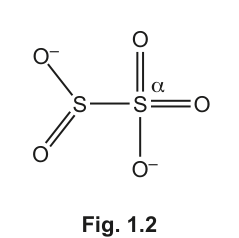
Deduce the geometry (shape) around the atom in .
Answer
Tetrahedral.
has 3 bonding pairs (to , , and ) and 1 lone pair, giving 4 electron domains arranged tetrahedrally.
Tetrahedral
Background Concept
VSEPR (Valence Shell Electron Pair Repulsion) theory predicts molecular geometry based on the number of electron domains (regions of electron density) around a central atom. Each single bond, double bond, triple bond, or lone pair counts as one electron domain.
- 2 domains → linear
- 3 domains → trigonal planar
- 4 domains → tetrahedral
- 5 domains → trigonal bipyramidal
- 6 domains → octahedral
A double bond counts as one domain (the electrons are in the same region of space).
Understanding the Question
The displayed formula of is given. You must identify the geometry around the sulfur labelled (the right-hand sulfur in Fig. 1.2).
Looking at : it is bonded to one (double bond), one (single bond), and one (single bond to the other sulfur). Sulfur is in Group 16 with 6 valence electrons. Three bonds use 3 electrons, leaving 3 electrons = 1 lone pair + 1 unpaired... Actually, let me count more carefully.
Sulfur has 6 valence electrons. In : one double bond (=O) uses 2 electrons from S, one single bond (–O⁻) uses 1 electron from S, one single bond (–S) uses 1 electron from S. Total used in bonding = 4 electrons. Remaining = 2 electrons = 1 lone pair.
So has: 3 bonding domains + 1 lone pair = 4 electron domains → tetrahedral arrangement.
Approach
- Identify all bonds to from the displayed formula.
- Determine the number of lone pairs on sulfur.
- Count total electron domains.
- Apply VSEPR to get the geometry.
Step-by-Step Reasoning
Bonds to :
- One double bond → 1 domain
- One single bond → 1 domain
- One single bond → 1 domain
Lone pairs on :
Sulfur has 6 valence electrons. Bonds account for 4 electrons (2 in the double bond, 1 in each single bond). Remaining: 6 − 4 = 2 electrons = 1 lone pair.
Total electron domains: 3 + 1 = 4
Geometry: 4 electron domains → tetrahedral (the molecular shape considering the lone pair would be trigonal pyramidal, but the question asks for the geometry which the mark scheme states as tetrahedral — referring to the electron domain geometry).
The mark scheme answer is simply "tetrahedral", which refers to the arrangement of the 4 electron domains.
Key Takeaways
- A double bond counts as one electron domain in VSEPR.
- Always check for lone pairs by counting valence electrons minus electrons used in bonding.
- Sulfur in this environment has 4 electron domains → tetrahedral arrangement.
Common Mistakes
- Counting the double bond as two domains (it is one).
- Forgetting the lone pair on sulfur (giving trigonal planar instead of tetrahedral).
- Confusing electron domain geometry (tetrahedral) with molecular geometry (trigonal pyramidal) — the mark scheme accepts "tetrahedral".
Things to Be Careful About
- The question asks for the geometry around specifically, not the other sulfur.
- The mark scheme gives 1 mark for "tetrahedral" — no further explanation is required but showing your domain count is good practice.
The rest of this paper
8 more questions- Q2Transition Elements12M
- Q3Chemical Energetics · Equilibria12M
- Q4Reaction Kinetics10M
- Q5Hydrocarbons · Introduction to A Level Organic Chemistry · Carboxylic Acids and Derivatives14M
- Q6Introduction to A Level Organic Chemistry · Carboxylic Acids and Derivatives · Nitrogen Compounds8M
- Q7Hydroxy Compounds · Hydrocarbons8M
- Q8Halogen Compounds · Carboxylic Acids and Derivatives · Introduction to A Level Organic Chemistry · Nitrogen Compounds · Analytical Techniques15M
- Q9Electrochemistry8M