Chemistry 9701/41 — May/June 2023
Cambridge A-Level · A Level Structured Questions · worked solutions for every part, with the mark scheme
Topics Introduction to A Level Organic Chemistry · Transition Elements · Nitrogen Compounds · Analytical Techniques · Chemical Energetics · Equilibria · +5 more
Group 2 nitrates decompose when heated.
Describe how the thermal stability of Group 2 nitrates changes with increasing proton number.
Explain your answer.
Copper(II) nitrate decomposes in a similar manner to Group 2 nitrates.
Write an equation for the decomposition of .
is added to water to form solution A.
Fig. 1.1 shows some reactions of solution A.
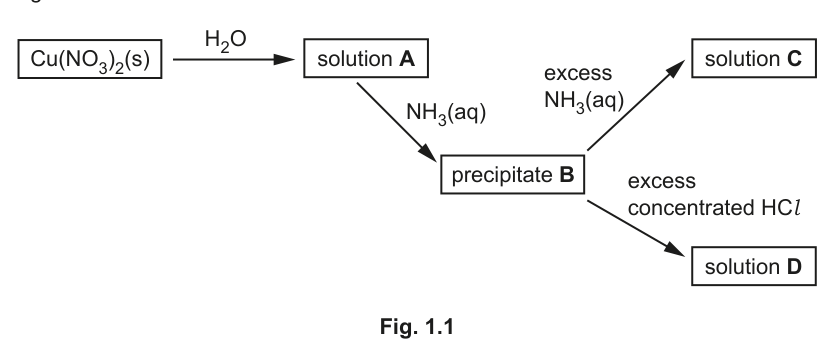
Complete Table 1.1 to show the formula and colour of each of the copper-containing species present in A, B, C and D.
Table 1.1
| formula of copper-containing species formed | colour of copper-containing species formed | |
|---|---|---|
| A | ||
| B | ||
| C | ||
| D |
is a polydentate ligand.
Explain what is meant by a polydentate ligand.
Group 2 metal ions can form complexes similar to those of transition elements.
A solution of is added to water containing to form a new complex, , as shown.
Circle on the structure of in Fig. 1.2 the six atoms that form bonds with the metal ion.
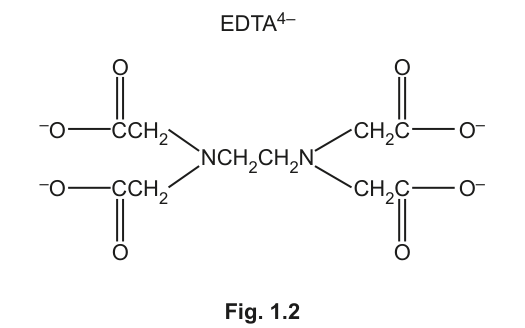
The calcium ions in and have a coordination number of 6.
Explain what is meant by coordination number.
The complex can be used to remove toxic metals from the body.
Table 1.2 shows the numerical values for the stability constants, , for some metal ions with .
Table 1.2
| complex | |
|---|---|
An aqueous solution containing is added to a solution containing equal concentrations of , and . The resulting mixture is left to reach a state of equilibrium.
State the type of reaction when reacts with , and .
Deduce the relative concentrations of , and present in the resulting mixture.
Explain your answer.
The number of moles of water of crystallisation in a hydrated ionic salt can be determined by titration using aqueous ions with a suitable indicator.
- 0.255 g of hydrated chromium(III) sulfate, , is dissolved in water and made up to in a volumetric flask.
- of this solution requires of aqueous ions to reach the end-point.
The reaction occurs as shown.
Use the data to calculate the value of in the formula of .
Show your working.
A solution of and a solution of have different colours.
Explain why the two complexes have different colours.
The rest of this paper
7 more questions- Q2Transition Elements · Introduction to A Level Organic Chemistry11M
- Q3Reaction Kinetics10M
- Q4Introduction to A Level Organic Chemistry · Hydrocarbons · Nitrogen Compounds · Analytical Techniques10M
- Q5Transition Elements · Chemical Energetics · Introduction to A Level Organic Chemistry · Equilibria13M
- Q6Nitrogen Compounds · Carboxylic Acids and Derivatives · Introduction to A Level Organic Chemistry · Polymerisation10M
- Q7Nitrogen Compounds · Equilibria · Analytical Techniques18M
- Q8Chemical Energetics9M