Chemistry 9701/42 — February/March 2023
Cambridge A-Level · A Level Structured Questions · worked solutions for every part, with the mark scheme
Topics Transition Elements · Equilibria · Electrochemistry · Carboxylic Acids and Derivatives · Halogen Compounds · Nitrogen Compounds · +7 more
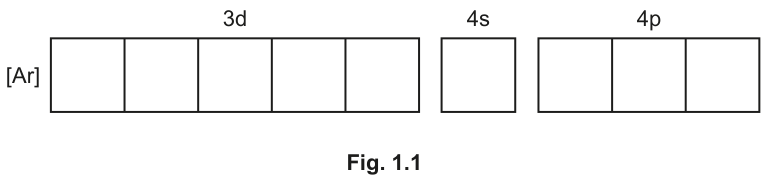
The most common zinc mineral contains zinc(II) sulfide, ZnS.
Complete the electrons in boxes diagram in Fig. 1.1 to show the electronic configuration of a zinc(II) ion.
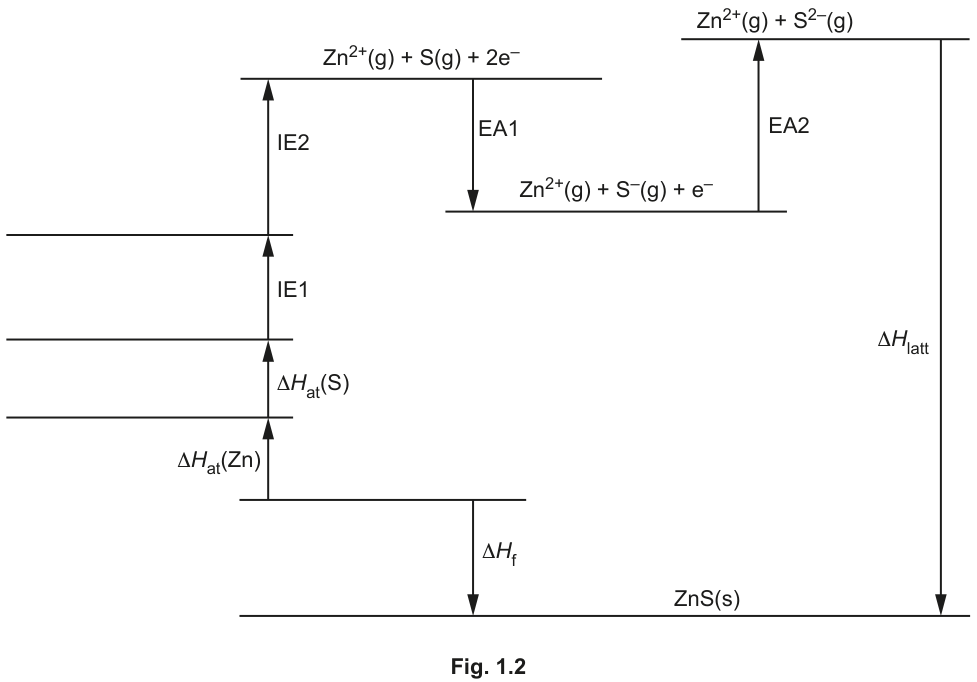
Complete Fig. 1.2 to show the Born–Haber diagram for the ionic solid ZnS.
Include state symbols of relevant species.
Describe the trend in the first electron affinity of the Group 16 elements S to Te.
Explain your answer.
Explain why the lattice energy, , of ZnO is more exothermic than that of ZnS.
Zinc metal can be obtained in a two-step process as shown.
The reactions are carried out at 800 °C.
Predict the sign of the entropy change, , of the reaction in step 1.
Explain your answer.
Use the data in Table 1.1 to calculate of the reaction shown in step 2.
Table 1.1
| chemical | ZnO(s) | C(s) | Zn(l) | CO(g) |
|---|---|---|---|---|
| 43.7 | 5.7 | 50.8 | 197.7 |
An equation for the direct reduction of ZnS by carbon is shown.
This reaction is not feasible at 800 °C.
Calculate for this reaction at 800 °C.
undergoes thermal decomposition when heated. The reaction is similar to the thermal decomposition of Group 2 nitrates.
Construct an equation for the thermal decomposition of .
The radii of some Group 2 cations and are shown in Table 1.2.
Table 1.2
| cation | |||||
|---|---|---|---|---|---|
| radius / pm | 65 | 99 | 113 | 135 | 74 |
State and explain the trend in thermal stability of the Group 2 nitrates down the group.
Use Table 1.2 to suggest which Group 2 nitrates are less thermally stable than zinc nitrate.
The rest of this paper
5 more questions- Q2Equilibria · Electrochemistry · Reaction Kinetics17M
- Q3Transition Elements · Electrochemistry9M
- Q4Carboxylic Acids and Derivatives · Halogen Compounds · Nitrogen Compounds · Hydrocarbons · Transition Elements · Equilibria27M
- Q5Introduction to A Level Organic Chemistry · Hydrocarbons · Carboxylic Acids and Derivatives · Halogen Compounds · Organic Synthesis · Nitrogen Compounds · Analytical Techniques22M
- Q6Analytical Techniques · Transition Elements · Equilibria9M