Chemistry 9701/43 — October/November 2022
Cambridge A-Level · A Level Structured Questions · worked solutions for every part, with the mark scheme
Topics Transition Elements · Introduction to A Level Organic Chemistry · Hydrocarbons · Chemical Energetics · Electrochemistry · Equilibria · +6 more
Potassium chloride, , and magnesium chloride, , are both ionic solids.
Table 1.1
| energy change | |
|---|---|
| standard enthalpy change of solution, , of | |
| lattice energy, , of | |
| standard enthalpy change of hydration, , of | |
| standard enthalpy change of hydration, , of | |
| standard enthalpy change of solution, , of | |
| lattice energy, , of |
Complete the energy cycle involving the enthalpy change of solution and the lattice energy of potassium chloride, , and the relevant enthalpy changes of hydration. Label your diagram.
State symbols should be used.
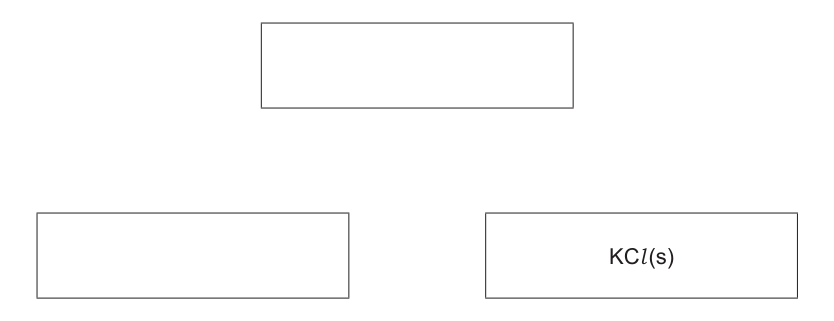
Use the data in Table 1.1 to calculate the enthalpy change of hydration of magnesium ions, . Show your working.
Explain the reasons why the lattice energy of is more exothermic than the lattice energy of .
Define the following terms.
enthalpy change of atomisation
first electron affinity
Explain what is meant by entropy, .
Potassium chloride is very soluble in water at .
Explain the solubility of potassium chloride by reference to change in entropy, .
Use the Gibbs equation and your answer to (e)(ii) to predict whether potassium chloride is more soluble in water at or at . Explain your answer.
The rest of this paper
8 more questions- Q2Transition Elements10M
- Q3Electrochemistry10M
- Q4Equilibria9M
- Q5Transition Elements · Group 212M
- Q6Transition Elements11M
- Q7Introduction to A Level Organic Chemistry · Carboxylic Acids and Derivatives · Nitrogen Compounds · Hydrocarbons · Polymerisation17M
- Q8Introduction to A Level Organic Chemistry · Hydrocarbons · Halogen Compounds8M
- Q9Analytical Techniques12M