Chemistry 9701/53 — May/June 2022
Cambridge A-Level · Planning, Analysis and Evaluation · worked solutions for every part, with the mark scheme
Topics Analysis, Conclusions and Evaluation · Planning
A student plans an investigation to find the molar ratio of the reaction between sodium chloride, NaCl, and a lead compound.
The student is provided with solid NaCl and aqueous lead compound.
The reaction between NaCl(aq) and the aqueous lead compound produces an insoluble compound as a precipitate.
The student prepares NaCl(aq).
Calculate the mass of NaCl(s) needed to make of NaCl(aq).
mass of NaCl = .............................. g
The student weighs the mass of NaCl(s) calculated in (a) in a weighing boat. The solid mass is then transferred into a small beaker.
Describe how the student should accurately weigh by difference so the exact mass of NaCl transferred into the small beaker is known.
The student is given a small beaker containing the mass of NaCl calculated in (a).
Describe how the student should prepare of NaCl(aq).
Include the names and capacities of each piece of apparatus used in the preparation of the solution.
The student plans the following method using the aqueous lead compound and the NaCl(aq) prepared in (c).
Step 1 Mix the NaCl(aq) and the aqueous lead compound in eight separate beakers in the proportions by volume shown in Table 1.1.
Table 1.1
| beaker | volume of NaCl(aq) / | volume of aqueous lead compound / |
|---|---|---|
| 1 | 10.00 | 40.00 |
| 2 | 15.00 | 35.00 |
| 3 | 20.00 | 30.00 |
| 4 | 25.00 | 25.00 |
| 5 | 30.00 | 20.00 |
| 6 | 35.00 | 15.00 |
| 7 | 40.00 | 10.00 |
| 8 | 45.00 | 5.00 |
Step 2 Filter the contents of each beaker to collect the precipitate.
Step 3 Dry the precipitate for 3 minutes in an oven and allow to cool.
Step 4 Weigh and record the mass of precipitate produced in each beaker.
State one extra step that would improve this method. Explain why this step is necessary.
extra step:
explanation:
The volumes of solutions are measured using a burette.
Calculate the percentage error when measuring of solution.
Show your working.
percentage error = ..............................
Explain how you would ensure that the results of the investigation are reliable.
The results of the investigation are shown on the graph in Fig. 1.1.
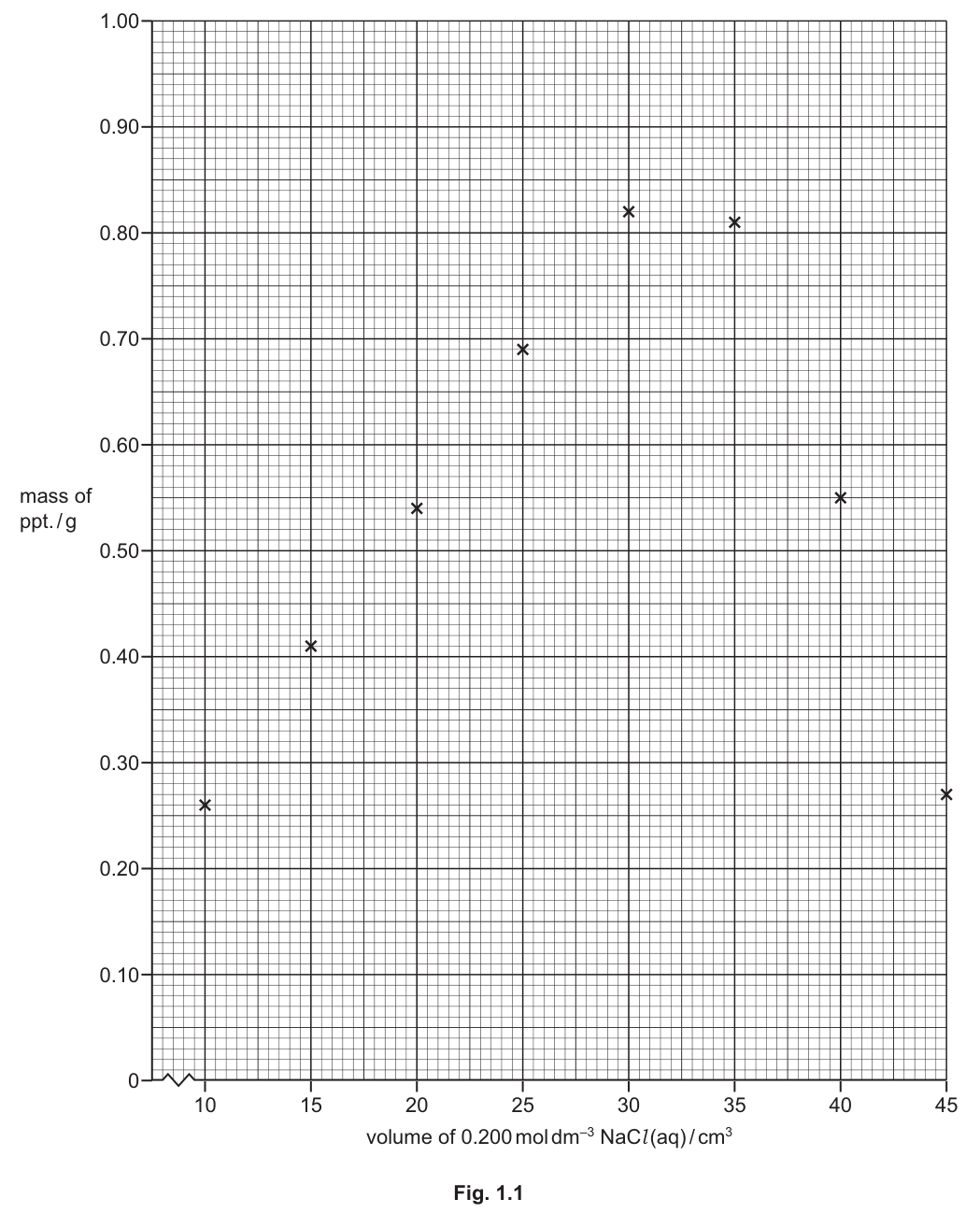
Draw two straight lines of best fit through the points. Extrapolate both lines so they intersect.
Using Fig. 1.1 and Table 1.1, state the volumes of NaCl(aq) and aqueous lead compound which produce the maximum mass of precipitate.
Calculate the molar ratio in which the NaCl and the lead compound react.
volume of NaCl(aq) = ..............................
volume of aqueous lead compound = ..............................
molar ratio of NaCl : lead compound = ................. : .................
Use the molar ratio in (e)(ii) to deduce the formula of the precipitate.
formula = ..............................
A student suggests that a simpler method can be used to find the molar ratio.
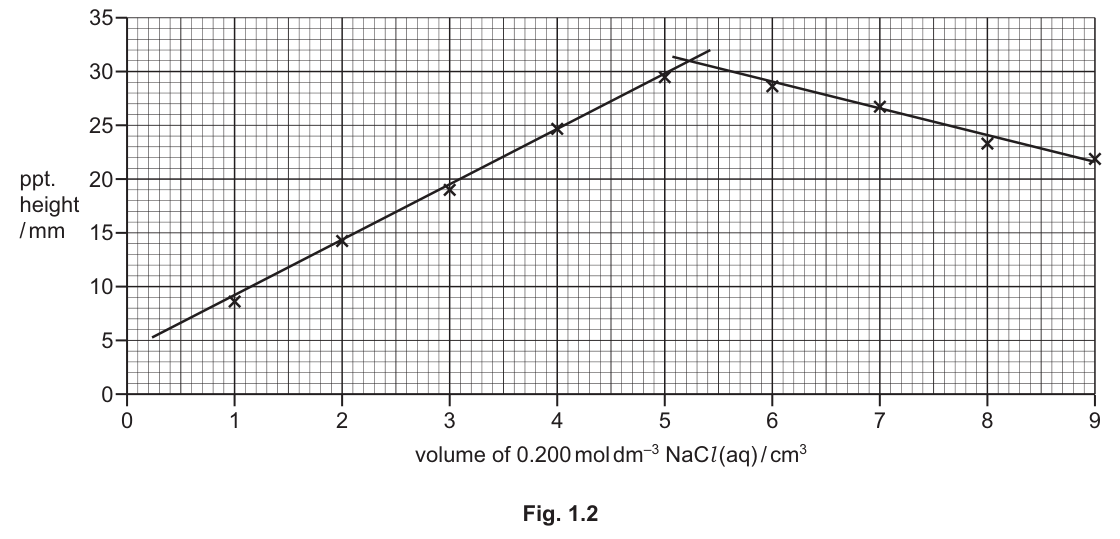
Different volumes of NaCl(aq) and aqueous lead compound are mixed in test-tubes. The resulting precipitates are allowed to settle. The height of each precipitate is then measured.
A further two investigations are carried out. The volumes used and the results of the two investigations are shown.
Investigation 1
Precipitate heights are measured after 1 minute.
Table 1.2
| volume NaCl(aq) / | 1 | 2 | 3 | 4 | 5 | 6 | 7 | 8 | 9 |
|---|---|---|---|---|---|---|---|---|---|
| volume aqueous lead compound / | 9 | 8 | 7 | 6 | 5 | 4 | 3 | 2 | 1 |
Investigation 2
Precipitate heights are measured after 5 minutes.
Table 1.3
| volume NaCl(aq) / | 1 | 2 | 3 | 4 | 5 | 6 | 7 | 8 | 9 |
|---|---|---|---|---|---|---|---|---|---|
| volume aqueous lead compound / | 5 | 5 | 5 | 5 | 5 | 5 | 5 | 5 | 5 |
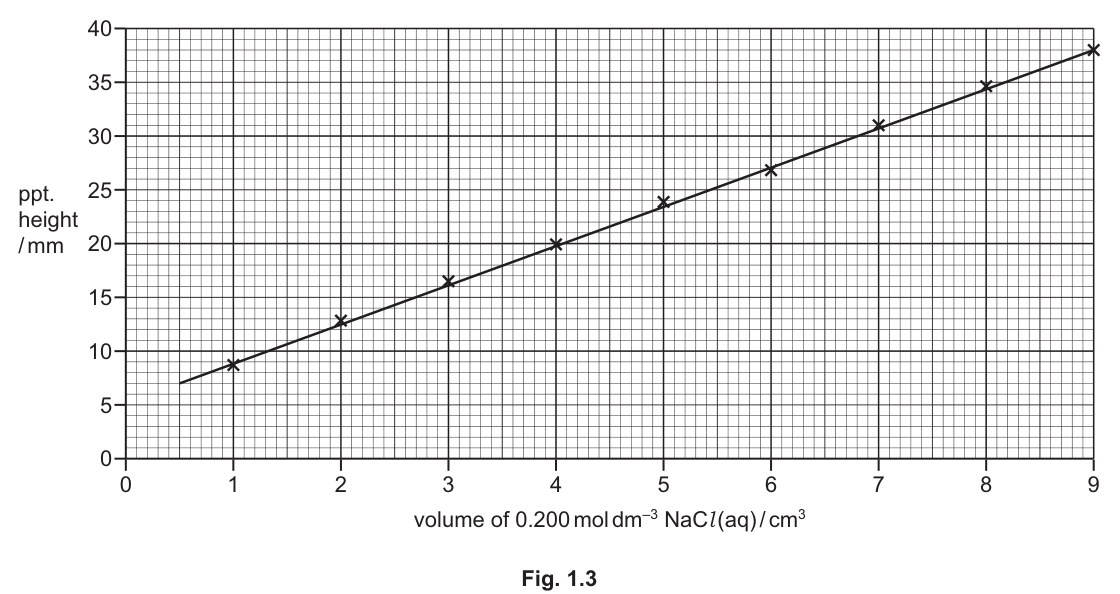
Neither investigation produced the expected results. Both investigations, 1 and 2, contain weaknesses in the experimental procedure.
State how you would modify the experimental procedure in each case so that the expected results are obtained.
modification for investigation 1:
modification for investigation 2:
The rest of this paper
1 more questions- Q2Planning · Analysis, Conclusions and Evaluation16M