Chemistry 9701/52 — May/June 2022
Cambridge A-Level · Planning, Analysis and Evaluation · worked solutions for every part, with the mark scheme
Topics Planning · Analysis, Conclusions and Evaluation
A student plans an experiment to find a value for the molar volume, , of hydrogen gas at room conditions.
Hydrogen gas is formed when magnesium reacts with dilute hydrochloric acid, .
The student is provided with the following materials:
- a piece of magnesium ribbon
- a water trough
- a side-arm conical flask
- a measuring cylinder with graduations for the collection of gas
- a measuring cylinder
- a balance that measures to 2 decimal places
- access to any necessary laboratory equipment, except gas syringes.
The student plans the following procedure.
- Step 1 Prepare the piece of magnesium ribbon for use in the experiment.
- Step 2 Measure of and pour into a side-arm conical flask.
- Step 3 Attach the conical flask to a collection system for the hydrogen gas.
- Step 4 Place the magnesium ribbon in the conical flask.
- Step 5 Stopper the flask.
- Step 6 Wait until the final volume of gas collected is constant.
- Step 7 Wait for an additional 2 minutes, then measure and record the final volume of gas collected.
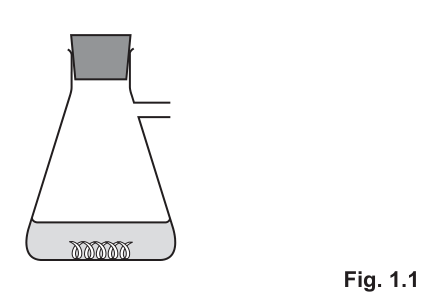
Complete Fig. 1.1 to show how the apparatus should be assembled for the collection and measurement of gas.
Label your diagram.
The surface of the magnesium ribbon has an oxide layer.
State how the student should prepare the piece of magnesium ribbon before it is used in this experiment.
State what additional information about the magnesium is required before the experiment is performed.
Show by calculation that a volume of of is enough to react with of magnesium ribbon. Show your working.
State why it is not necessary to use a burette to measure of .
The student waits for 2 minutes before taking a reading of the volume.
Suggest why the student waits for 2 minutes before measuring the volume of gas in step 7.
The student collects of hydrogen gas during the experiment.
Calculate the percentage error in collecting the hydrogen gas. Show your working.
Calculate the molar volume of hydrogen gas using the student's results from this experiment.
molar volume = ..............................
The student's experimental value for the molar volume of hydrogen is lower than the value quoted in the table of important values, constants and standards on page 11.
Suggest one experimental weakness that might have led to this outcome.
Explain how the method could be improved to overcome the weakness you have noted.
experimental weakness
improvement
The rest of this paper
1 more questions- Q2Planning · Analysis, Conclusions and Evaluation18M