Chemistry 9701/51 — May/June 2022
Cambridge A-Level · Planning, Analysis and Evaluation · worked solutions for every part, with the mark scheme
Topics Analysis, Conclusions and Evaluation · Planning
1 A student plans an investigation to find the molar ratio of the reaction between sodium chloride, NaCl, and a lead compound.
The student is provided with solid NaCl and aqueous lead compound.
The reaction between NaCl(aq) and the aqueous lead compound produces an insoluble compound as a precipitate.
The student prepares NaCl(aq).
Calculate the mass of NaCl(s) needed to make of NaCl(aq).
Working
Answer
2.925 g
2.925 g
Background Concept
To prepare a solution of a known concentration, you must first calculate the amount of solute required. The amount of substance (in moles, ) is related to concentration (, in mol dm) and volume (, in dm) by the equation:
Once the moles are known, the mass () can be found using the molar mass ():
Understanding the Question
The student needs to make 250.0 cm of 0.200 mol dm NaCl(aq). The question asks for the mass of solid NaCl required. Note that the volume must be converted from cm to dm by dividing by 1000.
Approach
- Convert the volume from cm to dm.
- Calculate the moles of NaCl using .
- Calculate the molar mass of NaCl (Na = 23.0, Cl = 35.5).
- Calculate the mass using .
Step-by-Step Reasoning
- Volume conversion: .
- Moles calculation: .
- Molar mass: .
- Mass calculation: .
Key Takeaways
Always ensure volume is in the correct units (dm) when using . The molar mass is the sum of the relative atomic masses of all atoms in the formula.
Common Mistakes
- Forgetting to divide the volume by 1000 to convert cm to dm.
- Using the wrong atomic masses (e.g., using Cl = 35.45 instead of 35.5, though 35.5 is standard for CIE unless specified).
Things to Be Careful About
- Significant figures: The answer 2.925 g is appropriate given the data (0.200 has 3 s.f., 250.0 has 4 s.f.).
The student weighs the mass of NaCl(s) calculated in (a) in a weighing boat. The solid mass is then transferred into a small beaker.
Describe how the student should accurately weigh by difference so the exact mass of NaCl transferred into the small beaker is known.
Answer
Measure the mass of the weighing boat containing the NaCl before transfer, then measure the mass of the weighing boat and any residue after transfer. The difference is the exact mass transferred.
Measure mass of weighing boat + NaCl before transfer, then mass of weighing boat + residue after transfer.
Background Concept
Weighing by difference is a standard technique used when a precise mass of a substance is needed but it is difficult to weigh exactly that mass directly onto a container. Instead, you weigh the container with the substance, transfer the substance, and then weigh the container again. The mass transferred is the difference between the two measurements.
Understanding the Question
The student has weighed out the calculated mass of NaCl in a weighing boat and transferred it to a small beaker. The question asks how to accurately determine the exact mass that actually ended up in the beaker.
Approach
Describe the two weighing steps: before and after the transfer. The difference gives the mass actually transferred.
Step-by-Step Reasoning
- Step 1: Weigh the weighing boat with the NaCl inside it before any transfer occurs. Record this mass.
- Step 2: Transfer the NaCl to the small beaker.
- Step 3: Weigh the weighing boat again. It will contain a small amount of residue (NaCl that stuck to the boat).
- Calculation: Mass transferred = (Mass before transfer) - (Mass after transfer).
Key Takeaways
Weighing by difference is more accurate than trying to weigh a specific mass directly onto a beaker because it accounts for any material left behind in the original container.
Common Mistakes
- Saying "weigh the beaker before and after". This doesn't account for the mass of the weighing boat or any residue left in it.
- Not mentioning that the difference between the two weighing boat masses is the transferred mass.
Things to Be Careful About
- Ensure you mention both weighing steps clearly. The mark scheme requires measuring the mass before and after the transfer of the solid from the weighing boat.
The student is given a small beaker containing the mass of NaCl calculated in (a).
Describe how the student should prepare of NaCl(aq).
Include the names and capacities of each piece of apparatus used in the preparation of the solution.
Answer
Add a small volume of distilled water to the small beaker and dissolve the sodium chloride. Transfer the solution and washings into a 250 cm volumetric flask and make up to the mark with distilled water.
Dissolve in a small beaker with distilled water, transfer solution and washings to a 250 cm³ volumetric flask, and make up to the mark with distilled water.
Background Concept
To prepare a solution of precise concentration, a volumetric flask is used. The procedure involves dissolving the solute in a small amount of solvent, transferring it quantitatively to the volumetric flask (including washing the dissolving vessel to ensure all solute is transferred), and then adding solvent until the meniscus touches the calibration mark.
Understanding the Question
The student has the solid NaCl in a small beaker. They need to make exactly 250.0 cm of 0.200 mol dm solution. The question asks for the description of the procedure, including apparatus names and capacities.
Approach
- Dissolve the solid in a small amount of water in the beaker.
- Transfer to a 250 cm volumetric flask.
- Ensure all solute is transferred (washing).
- Make up to the mark.
Step-by-Step Reasoning
- M1: Add a small volume of distilled water to the small beaker containing the NaCl and stir/dissolve the sodium chloride. (Do not add 250 cm yet, as the solid volume will affect the final volume if added directly).
- M2: Transfer the solution from the beaker into a 250 cm volumetric flask. Also wash the beaker and the stirring rod with distilled water, and add these washings to the flask to ensure all the NaCl is transferred. Finally, add distilled water to the flask until the bottom of the meniscus is exactly on the 250 cm mark.
Key Takeaways
Always dissolve the solute in a small amount of solvent first. The volumetric flask is calibrated to contain a specific volume when filled to the mark.
Common Mistakes
- Saying "add 250 cm of water to the beaker". This is incorrect because the volume of the dissolved solid adds to the total volume, so the final concentration would be wrong.
- Forgetting to mention washing the beaker and transferring the washings. This is a critical step for quantitative transfer.
- Not specifying the capacity of the volumetric flask (250 cm).
Things to Be Careful About
- The mark scheme specifically asks for the names and capacities of the apparatus. You must say "250 cm volumetric flask".
The student plans the following method using the aqueous lead compound and the NaCl(aq) prepared in (c).
Step 1 Mix the NaCl(aq) and the aqueous lead compound in eight separate beakers in the proportions by volume shown in Table 1.1.
Table 1.1
| beaker | volume of NaCl(aq) / | volume of aqueous lead compound / |
|---|---|---|
| 1 | 10.00 | 40.00 |
| 2 | 15.00 | 35.00 |
| 3 | 20.00 | 30.00 |
| 4 | 25.00 | 25.00 |
| 5 | 30.00 | 20.00 |
| 6 | 35.00 | 15.00 |
| 7 | 40.00 | 10.00 |
| 8 | 45.00 | 5.00 |
Step 2 Filter the contents of each beaker to collect the precipitate.
Step 3 Dry the precipitate for 3 minutes in an oven and allow to cool.
Step 4 Weigh and record the mass of precipitate produced in each beaker.
State one extra step that would improve this method. Explain why this step is necessary.
Answer
Extra step: Wash the precipitate with cold distilled water (or reheat and reweigh until mass is constant).
Explanation: This removes unreacted sodium chloride and/or lead compound from the precipitate (or ensures all water has been removed from the solid).
Wash the precipitate with cold distilled water to remove unreacted reactants.
Background Concept
In gravimetric analysis or precipitation experiments, the precipitate collected on filter paper is often contaminated with the mother liquor (the solution it was filtered from), which contains unreacted reactants and soluble by-products. If not washed, these impurities will add to the mass of the dried precipitate, leading to an inaccurate result. Alternatively, if the precipitate is not dried thoroughly, residual water will add to the mass.
Understanding the Question
The method involves mixing solutions, filtering, drying for 3 minutes in an oven, and weighing. The question asks for one extra step to improve the method and the reason for it.
Approach
Identify potential sources of error in the drying/weighing process: impurities in the precipitate or residual water. Propose a standard improvement for each and explain why it helps.
Step-by-Step Reasoning
- Option 1: Washing. After filtering, wash the precipitate on the filter paper with cold distilled water. Reason: To remove any adhering mother liquor containing unreacted NaCl or the lead compound, which would otherwise add to the final mass.
- Option 2: Drying to constant mass. Reheat the precipitate in the oven and reweigh it. Repeat until the mass does not change. Reason: To ensure all water (and possibly volatile impurities) has been completely removed from the solid. A 3-minute drying time might not be enough to remove all water, especially if the precipitate is thick.
- Option 3: Quantitative transfer. Rinse the beakers into the filter. Reason: To ensure all precipitate is collected on the filter paper.
Any one of these pairs (step + explanation) is acceptable.
Key Takeaways
Precipitates must be washed to remove soluble impurities and dried to constant mass to ensure accurate gravimetric measurements.
Common Mistakes
- Suggesting "use a better oven" without explaining why.
- Saying "wash to make it pure" without specifying what impurities are being removed (unreacted reactants/soluble salts).
- Not linking the improvement to the specific error it prevents.
Things to Be Careful About
- The explanation must directly justify the extra step. For washing, mention removing unreacted ions. For re-drying, mention removing water.
The volumes of solutions are measured using a burette.
Calculate the percentage error when measuring of solution.
Show your working.
Working
The absolute error for a single burette reading is . For a volume measured by difference (initial and final readings), the total absolute error is .
Answer
1.0%
1.0%
Background Concept
Percentage error is a measure of the uncertainty in a measurement relative to the measured value. For instruments like burettes, pipettes, and balances, the absolute error is typically half the smallest scale division. For a burette, the smallest division is 0.1 cm, so the absolute error for a single reading is cm.
When measuring a volume by difference (final reading - initial reading), the errors from both readings add up. So the total absolute error for a titre or volume measured from a burette is cm.
Understanding the Question
The student measures 10.00 cm of solution using a burette. Calculate the percentage error.
Approach
- Determine the total absolute error for a burette measurement (0.10 cm).
- Apply the percentage error formula.
Step-by-Step Reasoning
- Absolute error: A burette has markings every 0.1 cm. The error for one reading is cm. Since a volume is measured as the difference between two readings (initial and final), the maximum possible error is cm.
- Percentage error calculation:
Key Takeaways
Always remember that a burette volume measurement involves two readings, so the absolute error is doubled. Percentage error = (absolute error / measured value) 100.
Common Mistakes
- Using an absolute error of 0.05 cm (forgetting to double it for two readings).
- Not showing the working, as the mark scheme explicitly requires it.
Things to Be Careful About
- The working must be shown. The final answer is 1.0% (or 1%).
Explain how you would ensure that the results of the investigation are reliable.
Answer
Repeat the experiment (or have other students carry out the investigation) and check that consistent (concordant) results are obtained.
Repeat the experiment and ensure consistent results are obtained.
Background Concept
In scientific investigations, reliability refers to the consistency of results. If an experiment is repeated and gives the same (or very similar) results, it is considered reliable. This helps to identify and reduce the effect of random errors and anomalous results.
Understanding the Question
The question asks how to ensure the results of the investigation are reliable.
Approach
State the standard method for ensuring reliability: repetition and comparison.
Step-by-Step Reasoning
- Repetition: Repeat the experiment (carry out the mixing, filtering, and weighing again for the same or different volumes).
- Comparison: Compare the results from the repeats, or compare with results from other students carrying out the same method.
- Criterion: The results must be consistent (concordant) to be considered reliable. If there is a large spread, the method may have high random error.
Key Takeaways
Reliability is achieved through repetition and consistency. Do not confuse reliability with accuracy (which is about how close to the true value you are).
Common Mistakes
- Saying "use more accurate apparatus". This improves accuracy, not necessarily reliability (though it can help reduce random error).
- Saying "calculate a mean". A mean is only meaningful if the results are reliable (consistent). You must state that consistent results are obtained.
Things to Be Careful About
- The mark scheme requires two parts: the action (repeat/compare) AND the criterion (consistent results).
The results of the investigation are shown on the graph in Fig. 1.1.
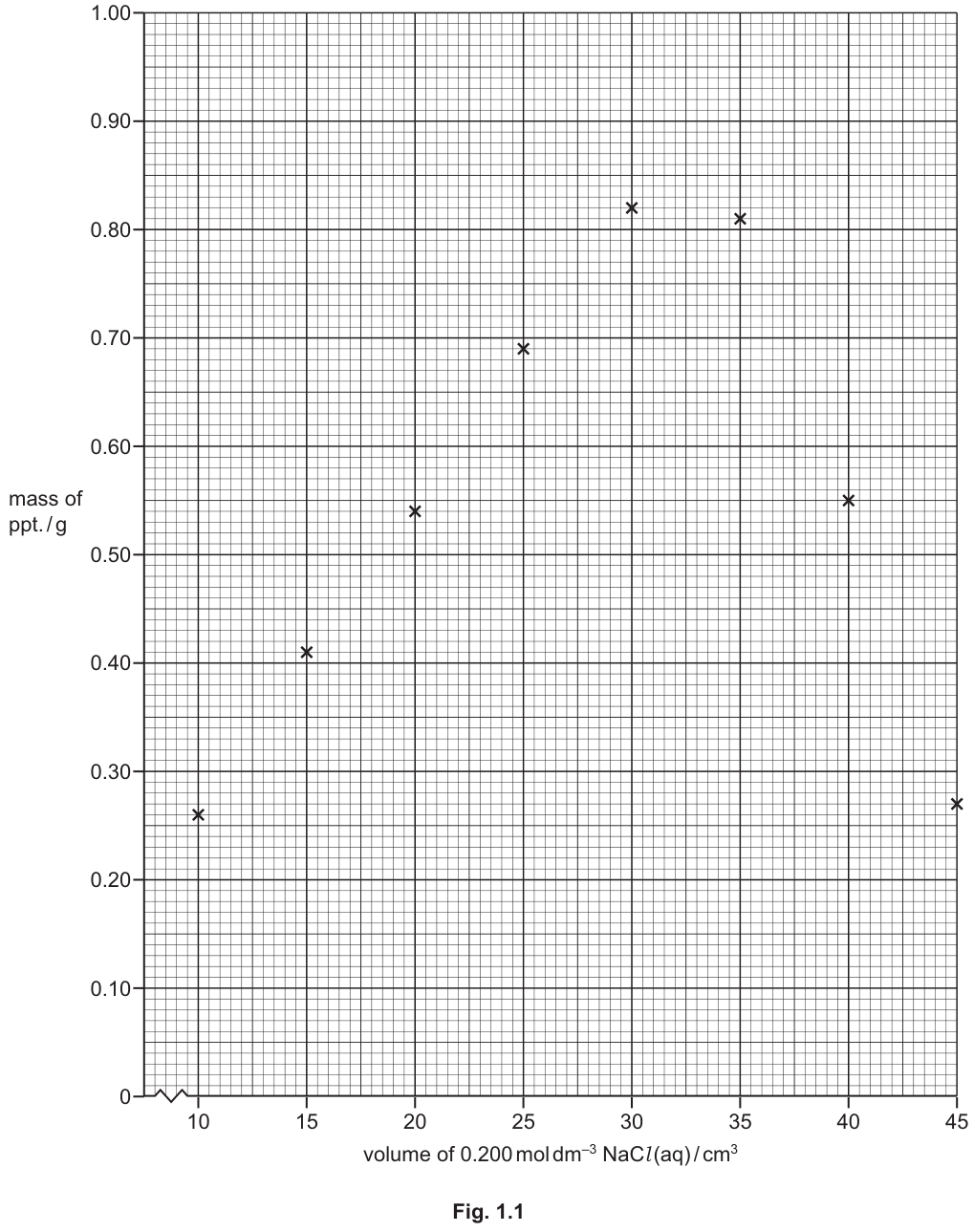
Draw two straight lines of best fit through the points. Extrapolate both lines so they intersect.
Answer
Two straight lines of best fit are drawn: one ascending through the points from 10.00 to 30.00 cm of NaCl, and one descending through the points from 35.00 to 45.00 cm of NaCl. Both lines are extrapolated to intersect at the peak.
The intersection occurs at approximately volume of NaCl(aq) = 33.25 cm and volume of lead compound(aq) = 16.75 cm.
See diagram. Intersection at ~33.25 cm³ NaCl and ~16.75 cm³ lead compound.
Background Concept
In a precipitation reaction where two solutions are mixed in varying proportions but the total volume is kept constant (here, 50.00 cm total), the mass of precipitate will increase as the limiting reactant is added, reach a maximum when both reactants are in stoichiometric proportions, and then decrease as the other reactant becomes in excess (and the total amount of precipitate is limited by the decreasing amount of the other reactant).
Plotting mass of precipitate against volume of one reactant gives a graph with two linear sections: an ascending line (where the plotted reactant is limiting) and a descending line (where the plotted reactant is in excess). The intersection of the two best-fit lines gives the stoichiometric point (maximum precipitate).
Understanding the Question
The student has plotted 8 points on a graph of mass of precipitate vs. volume of NaCl(aq). The task is to draw two straight lines of best fit and extrapolate them to find their intersection.
Approach
- Identify the ascending points (10.00 to 30.00 cm NaCl) and draw a line of best fit through them.
- Identify the descending points (35.00 to 45.00 cm NaCl) and draw a line of best fit through them.
- Extrapolate both lines to find where they intersect.
Step-by-Step Reasoning
- Ascending line: Fits points (10, 0.26), (15, 0.41), (20, 0.54), (25, 0.69), (30, 0.82). Extend this line upwards.
- Descending line: Fits points (35, 0.81), (40, 0.55), (45, 0.27). Extend this line upwards to the left.
- Intersection: The lines intersect at the peak. Reading from the graph (as per the mark scheme), the intersection is at approximately cm (volume of NaCl) and g. The corresponding volume of lead compound is cm.
Key Takeaways
The intersection of the two lines of best fit on a precipitation graph gives the exact stoichiometric ratio of the reactants.
Common Mistakes
- Drawing a single curved line of best fit through all points. The mark scheme requires two straight lines.
- Not extrapolating the lines to find the intersection. The intersection is rarely at a measured data point.
- Reading the intersection incorrectly from the graph.
Things to Be Careful About
- Use a sharp pencil and a ruler.
- The lines must be straight, not curved.
- The intersection point gives the volumes at maximum precipitation, which are used to calculate the molar ratio.
Using Fig. 1.1 and Table 1.1, state the volumes of NaCl(aq) and aqueous lead compound which produce the maximum mass of precipitate.
Calculate the molar ratio in which the NaCl and the lead compound react.
Answer
Volumes at maximum precipitate:
Volume of NaCl(aq)
Volume of lead compound(aq)
Molar ratio calculation:
Since both solutions have the same concentration (0.200 mol dm), the molar ratio is equal to the volume ratio.
The molar ratio of NaCl to lead compound is 2 : 1.
NaCl: 33.25 cm³, lead compound: 16.75 cm³. Molar ratio = 2 : 1
Background Concept
At the point of maximum precipitate, both reactants are completely consumed (they are in stoichiometric proportions). The moles of each reactant used can be calculated from their volumes and concentrations. Since the concentrations are the same, the ratio of moles is equal to the ratio of volumes.
If is constant, .
Understanding the Question
Using the graph from part (e)(i), find the volumes of NaCl and lead compound at the intersection point (maximum precipitate). Then calculate the molar ratio.
Approach
- Read the x-coordinate of the intersection from the graph (volume of NaCl).
- Calculate the volume of lead compound (total volume - volume of NaCl = 50.00 cm - volume of NaCl).
- Calculate the ratio of volumes, which equals the molar ratio since concentrations are equal.
Step-by-Step Reasoning
- Read volumes: From the intersection of the two lines in (e)(i), the volume of NaCl(aq) is approximately 33.25 cm.
- Calculate lead compound volume: The total volume in each beaker is cm (constant for all beakers). So, volume of lead compound = cm.
- Calculate molar ratio:
The molar ratio of NaCl to the lead compound is 2 : 1.
Key Takeaways
When concentrations are equal, the volume ratio at the stoichiometric point directly gives the molar ratio.
Common Mistakes
- Reading the intersection point incorrectly (e.g., reading 30.00 instead of ~33.25).
- Forgetting that the total volume is constant (50 cm) and trying to read the lead compound volume directly from a non-existent axis.
- Not simplifying the ratio to whole numbers (2 : 1).
Things to Be Careful About
- The volumes read from the graph will have some uncertainty (e.g., 33.0 to 33.5 cm). The ratio should still be clearly 2 : 1.
- State the ratio clearly as NaCl : lead compound = 2 : 1.
Use the molar ratio in (e)(ii) to deduce the formula of the precipitate.
Answer
The molar ratio of NaCl to the lead compound is 2 : 1. Since NaCl provides Cl ions and the lead compound provides Pb ions, the precipitate is lead(II) chloride, PbCl.
Formula of precipitate: PbCl
PbCl2
Background Concept
The reaction is between sodium chloride (NaCl) and a lead compound. NaCl dissociates to give Na and Cl ions. The lead compound is aqueous and likely contains Pb ions (as lead(II) is the common stable oxidation state in such precipitation reactions, e.g., lead(II) nitrate or lead(II) acetate). The insoluble precipitate formed from Pb and Cl is lead(II) chloride, PbCl.
Understanding the Question
Use the molar ratio found in (e)(ii) (which is 2 : 1 for NaCl : lead compound) to deduce the formula of the precipitate.
Approach
- Identify the ions involved: Na, Cl, and Pb (and the anion from the lead compound, which is a spectator ion).
- Use the molar ratio to determine the stoichiometry of the precipitate.
- Write the formula.
Step-by-Step Reasoning
- The molar ratio is 2 moles of NaCl to 1 mole of lead compound.
- 2 moles of NaCl provide 2 moles of Cl ions.
- 1 mole of the lead compound provides 1 mole of Pb ions (assuming it's a lead(II) salt like Pb(NO)).
- The precipitate is formed from Pb and Cl in a 1 : 2 ratio.
- Therefore, the formula is PbCl.
Ionic equation:
Key Takeaways
The molar ratio of reactants in a precipitation reaction directly relates to the stoichiometry of the ions in the precipitate.
Common Mistakes
- Guessing the formula without using the molar ratio.
- Writing PbCl instead of PbCl (ignoring the charges).
- Not recognizing that the ratio 2:1 for NaCl:lead compound means 2 Cl : 1 Pb.
Things to Be Careful About
- The question asks for the formula of the precipitate, not the full molecular equation. Just writing PbCl is sufficient.
A student suggests that a simpler method can be used to find the molar ratio.
Different volumes of NaCl(aq) and aqueous lead compound are mixed in test-tubes. The resulting precipitates are allowed to settle. The height of each precipitate is then measured.
A further two investigations are carried out. The volumes used and the results of the two investigations are shown.
Investigation 1
Precipitate heights are measured after 1 minute.
Table 1.2
| volume NaCl(aq) / | 1 | 2 | 3 | 4 | 5 | 6 | 7 | 8 | 9 |
|---|---|---|---|---|---|---|---|---|---|
| volume aqueous lead compound / | 9 | 8 | 7 | 6 | 5 | 4 | 3 | 2 | 1 |
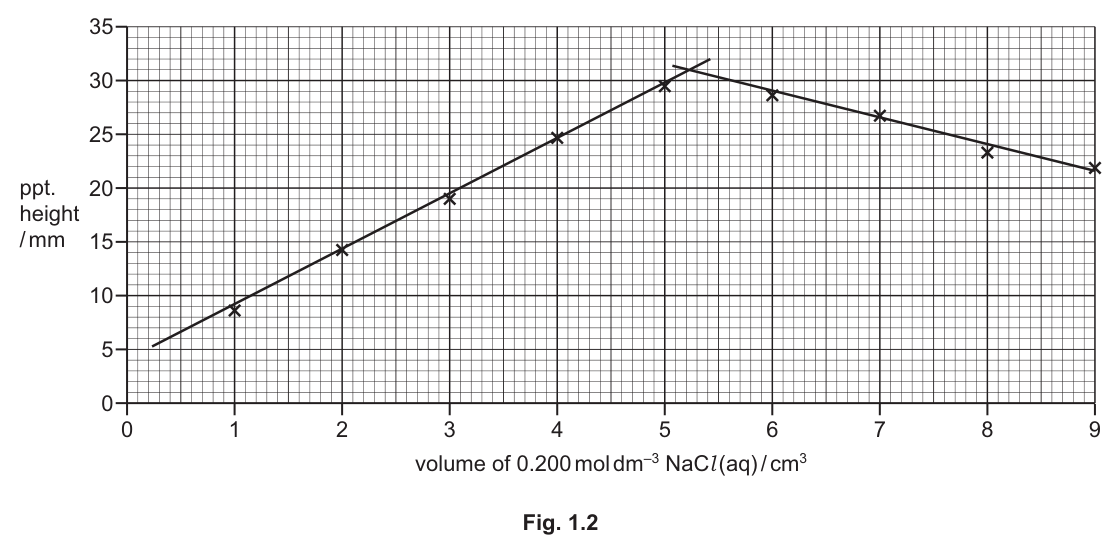
Investigation 2
Precipitate heights are measured after 5 minutes.
Table 1.3
| volume NaCl(aq) / | 1 | 2 | 3 | 4 | 5 | 6 | 7 | 8 | 9 |
|---|---|---|---|---|---|---|---|---|---|
| volume aqueous lead compound / | 5 | 5 | 5 | 5 | 5 | 5 | 5 | 5 | 5 |
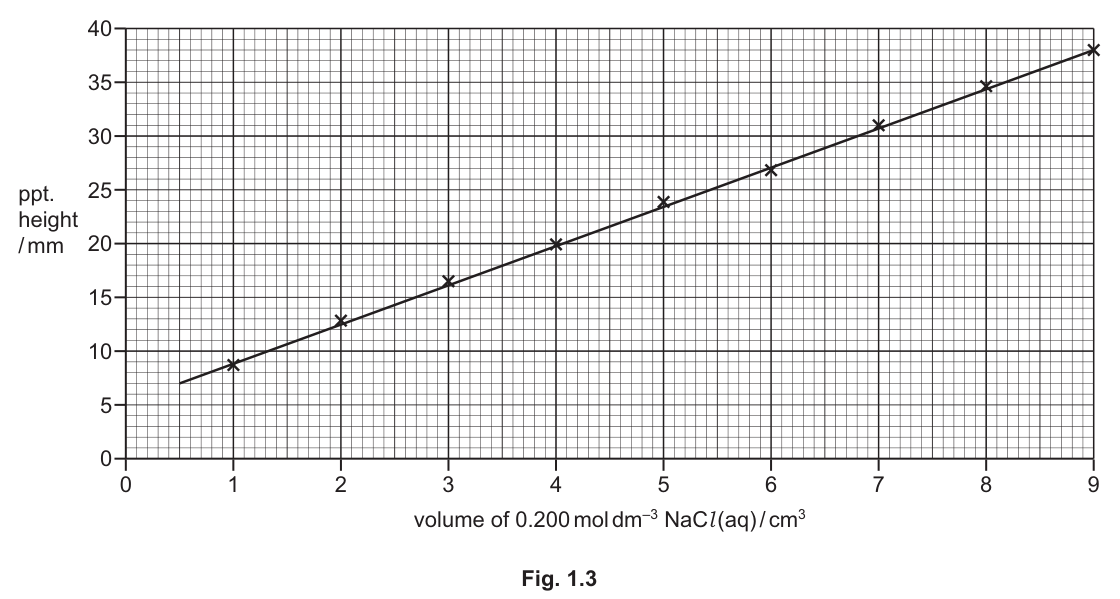
Neither investigation produced the expected results. Both investigations, 1 and 2, contain weaknesses in the experimental procedure.
State how you would modify the experimental procedure in each case so that the expected results are obtained.
modification for investigation 1:
modification for investigation 2:
Answer
Modification for investigation 1:
Repeat the measurement of the precipitate height until it is constant (or leave for a longer time until the height is constant before measuring).
Modification for investigation 2:
Use a smaller volume of the lead compound in each case (or add larger volumes of sodium chloride until it is in excess), so that the lead compound is not always in excess and a peak can be observed.
Inv 1: Repeat measurements until height is constant. Inv 2: Use smaller volumes of lead compound (or larger volumes of NaCl) to ensure lead compound is not always in excess.
Background Concept
In this alternative method, the height of the precipitate in a test-tube is used as a proxy for the mass of precipitate. This assumes that the height is proportional to the mass (which is true if the test-tubes have a uniform cross-section).
For this method to work and produce a clear peak (like the graph in Fig 1.1), the experiments must cover the region where one reactant is limiting and the region where the other is in excess. The height should increase to a maximum and then decrease.
Understanding the Question
Two investigations are described with flawed procedures. We need to identify the flaws and propose modifications.
Investigation 1: Volumes of NaCl and lead compound vary from (1, 9) to (9, 1). Precipitate height is measured after 1 minute. The graph (Fig 1.2) shows a peak around 5 cm NaCl, but the descending line does not go down to zero; it stays high (21.5 mm at 9 cm NaCl). This suggests the precipitate has not fully settled.
Investigation 2: Volumes of NaCl vary from 1 to 9 cm, but the volume of lead compound is fixed at 5 cm for all. The graph (Fig 1.3) shows a continuously increasing line. This means the lead compound is always the limiting reactant (or NaCl is always in excess), so no peak is reached.
Approach
- Investigation 1: The issue is timing. Precipitates take time to settle. Measuring after only 1 minute means the precipitate hasn't fully settled, especially when there is less of it (or the settling is slower). The modification is to wait longer or measure until constant.
- Investigation 2: The issue is the range of volumes. The lead compound volume is fixed at 5 cm. Since the total volume of NaCl goes up to 9 cm, and the stoichiometric ratio is 2:1 (NaCl:lead), 5 cm of lead compound requires 10 cm of NaCl for complete reaction. Since max NaCl used is 9 cm, the lead compound is always in excess (or NaCl is always limiting). No peak is formed. The modification is to vary the lead compound volume or use larger volumes of NaCl.
Step-by-Step Reasoning
Investigation 1:
- Problem: Measuring height after only 1 minute. Fine precipitates can take time to settle. If measured too early, the height will be artificially high and variable.
- Modification: Leave the test-tubes for a longer, fixed time (e.g., 5 minutes) until the height of the precipitate is constant before measuring. Or, repeat the measurement at intervals until the height does not change.
- Why: Ensures all precipitate has settled, giving a consistent and accurate height measurement.
Investigation 2:
- Problem: The volume of lead compound is fixed at 5 cm for all runs. The volume of NaCl ranges from 1 to 9 cm. The stoichiometric ratio is 2:1, so 5 cm of lead compound needs 10 cm of NaCl to react completely. Since max NaCl is 9 cm, NaCl is always the limiting reactant. The amount of precipitate increases linearly with NaCl volume, and no maximum/peak is reached.
- Modification: Use a smaller fixed volume of lead compound (e.g., 2 cm) so that 9 cm of NaCl is in excess, OR vary the volume of lead compound so that some mixtures have excess lead compound. Alternatively, add larger volumes of NaCl (up to 12 cm or more) so that NaCl is in excess for some runs.
- Why: To ensure that both reactants are in excess at different points, creating a peak in the graph that allows the stoichiometric ratio to be determined.
Key Takeaways
When designing an experiment to find a molar ratio by varying volumes, ensure the range of volumes covers both the limiting and excess regions for both reactants. Also, allow sufficient time for physical processes (like settling) to complete before measuring.
Common Mistakes
- For Investigation 1: Saying "use a better test-tube". The issue is time, not apparatus.
- For Investigation 2: Saying "measure the mass instead of height". The question asks to modify the procedure of the investigation as described, not to change the measurement method entirely. The flaw is in the volumes chosen.
- Not explaining why the modification is needed (optional for this mark scheme, but good practice).
Things to Be Careful About
- The mark scheme specifically asks for the modification for each investigation.
- For Inv 2, the key is that the lead compound must not always be in excess. The fixed volume of 5 cm is too large for the range of NaCl volumes used (1-9 cm).
The rest of this paper
1 more questions- Q2Planning · Analysis, Conclusions and Evaluation16M