Chemistry 9701/42 — February/March 2022
Cambridge A-Level · A Level Structured Questions · worked solutions for every part, with the mark scheme
Topics Introduction to A Level Organic Chemistry · Electrochemistry · Nitrogen Compounds · Equilibria · Chemical Energetics · Transition Elements · +6 more
Iodine is found naturally in compounds in many different oxidation states.
Iodide ions, , react with acidified to form iodine, , and water.
This reaction mixture is shaken with cyclohexane, , to extract the .
Cyclohexane is immiscible with water.
Identify the role of in its reaction with ions in acidic conditions.
Write an ionic equation for the reaction.
of is shaken with of an aqueous solution containing until no further change is seen.
It is found that of is extracted into the .
The partition coefficient of between and water, , is .
Calculate the mass of that remains in the aqueous layer.
Show your working.
Suggest how the value of of between hexan-2-one, , and water compares to the value given in (a)(ii).
Explain your answer.
The Group 1 iodides all form stable ionic lattices and are soluble in water.
Define enthalpy change of solution.
Use the data in Table 1.1 to calculate the enthalpy change of solution of potassium iodide, .
Table 1.1
| process | enthalpy change, |
|---|---|
Suggest the trend in the magnitude of the lattice energies of the Group 1 iodides, , , .
Explain your answer.
The concentration of in a solution can be determined by the reaction of ions with ions.
The produced in reaction 1 is titrated against a solution containing thiosulfate ions, , using a suitable indicator.
A portion of a solution reacts with an excess of .
The end-point of the titration occurs when of is added.
Calculate the concentration of in the original solution.
Identify a suitable indicator for the titration.
Copper(I) and copper(II) both contain electrons in all five 3d orbitals.
Sketch the shape of a orbital on the axes provided.
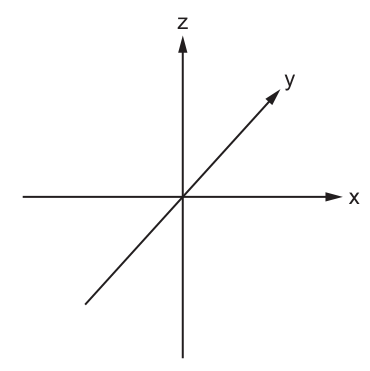
The reaction of ions with persulfate ions, , can be catalysed by ions.
Write equations to show how catalyses this reaction.
An orange precipitate of forms when ions are added to .
The solubility of at is .
Calculate the solubility product, , of .
Include units in your answer.
[: , ]
The rest of this paper
5 more questions- Q2Chemical Energetics · Electrochemistry9M
- Q3Transition Elements · Electrochemistry19M
- Q4Introduction to A Level Organic Chemistry · Hydrocarbons · Nitrogen Compounds · Carboxylic Acids and Derivatives · Hydroxy Compounds18M
- Q5Equilibria · Introduction to A Level Organic Chemistry · Nitrogen Compounds · Polymerisation · Reaction Kinetics21M
- Q6Carboxylic Acids and Derivatives · Introduction to A Level Organic Chemistry · Nitrogen Compounds · Analytical Techniques14M