Chemistry 9701/53 — October/November 2021
Cambridge A-Level · Planning, Analysis and Evaluation · worked solutions for every part, with the mark scheme
Topics Planning · Analysis, Conclusions and Evaluation
Potassium hydrogencarbonate, , decomposes when strongly heated to form potassium carbonate, .
A student plans to determine the value for the enthalpy change for this reaction, , which cannot be determined directly. The student carries out two separate experiments using the following apparatus.
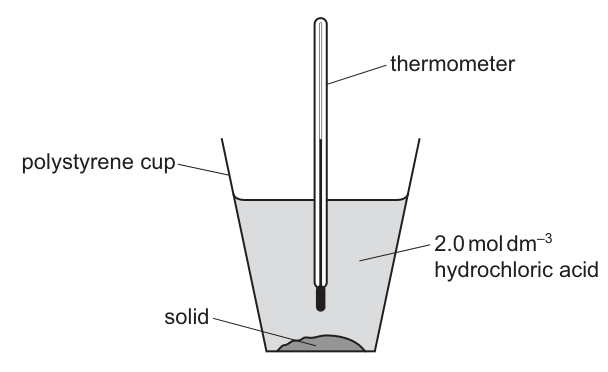
Experiment 1 uses solid .
Experiment 2 uses solid .
The following method is used for both experiments:
- Transfer , an excess, of hydrochloric acid into a cup.
- After 2 minutes, record the temperature of the acid.
- Weigh approximately moles of solid.
- Add the solid to the acid, stir the mixture using a thermometer and record the temperature throughout the reaction.
Hazard information: hydrochloric acid is irritant, solid potassium hydrogencarbonate and solid potassium carbonate may cause irritation to the skin and eyes.
The equations for the two reactions are:
Suggest why it is not possible to measure for the decomposition reaction directly.
Calculate the mass of moles of each solid. Give your answers to three decimal places.
[: K, 39.1; H, 1.0; C, 12.0; O, 16.0]
mass of = .............................. g
mass of = .............................. g
The masses of solid are measured using a three decimal place balance.
Calculate the percentage error in the measurement of the mass of .
Show your working.
percentage error = ..............................
The student obtained the following results.
| solid | initial temperature/ °C | maximum/minimum temperature/ °C | temperature change, / °C |
|---|---|---|---|
| 17.5 | 14.0 | ||
| 19.0 | 20.5 |
Complete the table by calculating temperature change.
Use the formula to determine the energy change, , that took place during experiment 1. Use to calculate the enthalpy change of reaction 1, , in .
Include a sign in your answer.
Assume of solution has a mass of .
= ..............................
Use the formula to determine the energy change, , that took place during experiment 2. Use to calculate the enthalpy change of reaction 2, , in .
Include a sign in your answer.
Assume of solution has a mass of .
= ..............................
Use the following cycle to calculate .
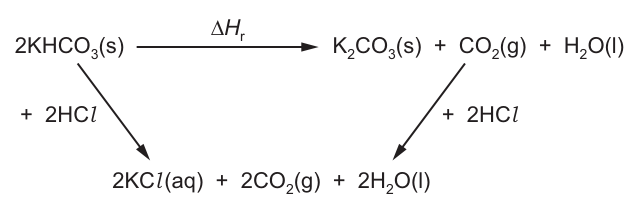
= ..............................
A textbook states the value of the enthalpy change for the decomposition of potassium hydrogencarbonate as .
Suggest two reasons why the experimental value is different to the actual value.
1 .................................................................................................................................................
2 .................................................................................................................................................
Suggest one improvement to the apparatus which would reduce the difference between the experimental value and the actual value.
Name a suitable piece of apparatus which should be used to measure the volume of acid used in experiment 1.
Apart from wearing safety glasses and a lab coat, state one safety precaution which must be taken during experiment 1. Explain your answer.
The rest of this paper
1 more questions- Q2Planning · Analysis, Conclusions and Evaluation16M