Chemistry 9701/52 — October/November 2021
Cambridge A-Level · Planning, Analysis and Evaluation · worked solutions for every part, with the mark scheme
Topics Analysis, Conclusions and Evaluation · Planning
It is possible to measure the enthalpy change of combustion, , of ethanol, , using the following apparatus.
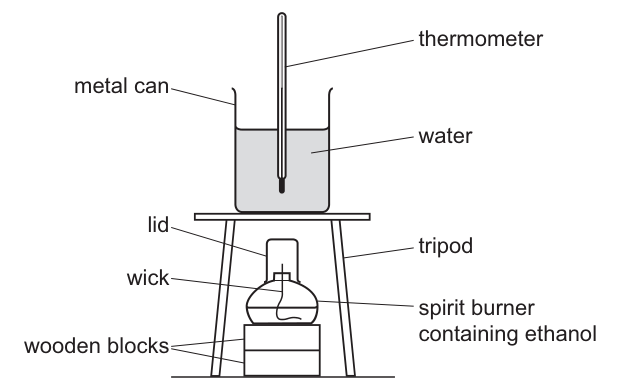
A student carries out an experiment to determine the value for of ethanol using the following instructions:
- Weigh the spirit burner with ethanol and lid, record the starting mass to two decimal places.
- Measure of water and place it into the metal can.
- Place a thermometer, with graduations, into the water and stir it, wait for 2 minutes.
- Record the temperature of the water.
- Light the wick and allow the flame to heat the water.
- Continue to stir the water using the thermometer.
- After the temperature has risen by approximately place the lid on the flame to extinguish it.
- Record the maximum temperature of the water.
- Weigh the spirit burner and record the final mass.
The student obtained the following results.
| initial temperature of water/ | maximum temperature of water/ | change in temperature of water, / | initial mass of spirit burner/g | final mass of spirit burner/g | mass of ethanol burned/g |
|---|---|---|---|---|---|
| 18.1 | 38.2 | 153.29 | 152.76 |
Complete the table. Record your answers to the correct number of decimal places.
Calculate the number of moles of ethanol burned. Give your answer to three significant figures.
Use the formula to determine the energy change, , that took place during the experiment. Use and your answer to (b) to calculate the enthalpy change of combustion of ethanol, , in .
Include a sign in your answer.
of water has a mass of
Calculate the percentage error of the temperature change recorded in the table in (a).
Show your working.
State the effect, if any at all, on the accuracy of the experiment if the spirit burner was allowed to burn for longer. Explain your answer.
The flame was extinguished, but the lid of the spirit burner was not replaced immediately.
Predict how this would affect the value of . Explain your answer.
The value for of ethanol under standard conditions is .
Other than the reaction not being carried out under standard conditions, suggest two reasons why the value the student obtained in (c) is different from the actual value.
It is possible to calculate of ethanol using average bond enthalpies and the chemical equation for the reaction.
Using average bond enthalpies, of ethanol is .
Explain why this value is different from the actual value for of ethanol under standard conditions.
The rest of this paper
1 more questions- Q2Planning · Analysis, Conclusions and Evaluation19M