Chemistry 9701/42 — May/June 2021
Cambridge A-Level · A Level Structured Questions · worked solutions for every part, with the mark scheme
Topics Transition Elements · Electrochemistry · Nitrogen Compounds · Equilibria · Introduction to A Level Organic Chemistry · Organic Synthesis · +7 more
An aqueous solution of chromium(III) contains the green complex ion.
Complete the electronic configuration of an isolated, gaseous ion.
............................................................................................................................................
Answer
1s²2s²2p⁶3s²3p⁶3d³
Background Concept
Chromium (Z = 24) has an anomalous ground-state electron configuration of rather than the expected . This occurs because the half-filled d subshell provides extra stability. When forming ions, transition metals lose their 4s electrons before 3d electrons because the 4s orbital is at a higher energy level in the ion.
Understanding the Question
The question asks for the full electronic configuration of an isolated, gaseous ion. The word "isolated" and "gaseous" confirm we are dealing with the free ion, not a complex. We need to remove 3 electrons from neutral chromium.
Approach
- Write the ground-state configuration of neutral Cr:
- Remove the 4s electron first (highest energy in the ion), then two 3d electrons.
- This leaves .
Step-by-Step Reasoning
Neutral Cr (Z = 24):
To form , remove 3 electrons. The 4s electron is removed first (it is the outermost/highest energy electron in the ion), then two electrons from the 3d subshell.
After removing :
After removing two more from 3d:
Key Takeaways
- Chromium has an anomalous configuration with a half-filled 3d subshell.
- When forming ions, 4s electrons are removed before 3d electrons.
- has a configuration.
Common Mistakes
- Writing the neutral configuration as (ignoring the anomaly) and then removing electrons to get — this gives the wrong answer.
- Removing 3d electrons before the 4s electron.
- Forgetting to include the full configuration from onwards when the question provides as a starting point.
Things to Be Careful About
- The question already provides as a given, so the answer must continue from there.
- Ensure the total electron count is 21 (24 − 3 = 21).
Define the term complex ion.
Answer
A complex ion is a central metal atom/ion surrounded by (bonded to) one or more ligands.
A central metal atom/ion surrounded by (bonded to) one or more ligands.
Background Concept
In transition metal chemistry, a complex ion consists of a central metal ion (usually a transition metal cation) surrounded by ligands — molecules or ions that donate lone pairs of electrons to form coordinate (dative covalent) bonds with the metal. The number of coordinate bonds to the metal is the coordination number.
Understanding the Question
The command word is "define", so a precise, concise definition is required. The question uses as context — a chromium(III) ion surrounded by six water ligands.
Approach
State the essential features: a central metal atom/ion, and ligands bonded to it.
Step-by-Step Reasoning
The definition must include:
- A central metal atom or ion (this is the key species)
- Ligands bonded to it (one or more)
- The bonding is via coordinate/dative covalent bonds (implied by "bonded to")
The mark scheme accepts: "(a molecule or ion formed by a central) metal atom/ion surrounded by / bonded to one or more ligands"
Key Takeaways
- A complex ion requires a central metal species and at least one ligand.
- The bonding involves donation of lone pairs from ligands to the metal.
Common Mistakes
- Saying only "a metal ion bonded to ligands" without specifying that the ligands donate electron pairs.
- Omitting the word "ion" or "atom" for the central species.
- Confusing a complex with a simple ionic compound.
Things to Be Careful About
- The definition should mention the central metal specifically, not just any atom.
- "One or more ligands" is more precise than just "ligands".
shows some similar chemical properties to .
Samples of are reacted separately with either , , or excess .
Use this information and the Data Booklet to suggest the formula of the chromium species formed. State the type of reaction taking place in each case.
| reagent added to | formula of chromium species formed | type of reaction |
|---|---|---|
| an excess of |
Answer
| Reagent added to | Formula of chromium species formed | Type of reaction |
|---|---|---|
| (or ) | precipitation | |
| (or ) | redox / oxidation | |
| Excess | ligand substitution |
One mark for each correct chromium species. Two marks for all three types of reaction correct (or one mark for two correct).
NaOH → Cr(OH)₃, precipitation; H₂O₂ → Cr₂O₇²⁻, redox/oxidation; excess NH₃ → [Cr(NH₃)₆]³, ligand substitution
Background Concept
Aqueous transition metal aqua complexes undergo three main types of reaction:
- Precipitation: Addition of a base (NaOH) deprotonates the coordinated water molecules, forming an insoluble metal hydroxide.
- Ligand substitution: Addition of a stronger ligand (like NH₃) replaces the water ligands. For chromium(III), unlike cobalt(II), ammonia does form a substitution product.
- Redox: An oxidising or reducing agent changes the oxidation state of the metal. Hydrogen peroxide is an oxidising agent that can oxidise Cr(III) to Cr(VI) (dichromate or chromate).
The Data Booklet provides standard electrode potentials that confirm H₂O₂ can oxidise Cr³⁺ to Cr₂O₇²⁻ or CrO₄²⁻.
Understanding the Question
The question states that shows similar properties to , but we must use chromium-specific chemistry. We need to identify the product and reaction type for each reagent.
Approach
- NaOH: Base removes protons from coordinated water → insoluble hydroxide precipitates. Cr(OH)₃ is amphoteric but with just NaOH(aq) it precipitates.
- H₂O₂: An oxidising agent. Check Data Booklet — E°(H₂O₂/H₂O) = +1.77 V, which is greater than E°(Cr₂O₇²⁻/Cr³⁺) = +1.33 V, so oxidation occurs. Cr³⁺ → Cr₂O₇²⁻ (or CrO₄²⁻ in alkaline conditions).
- Excess NH₃: NH₃ is a stronger ligand than H₂O for Cr³⁺, so substitution occurs to give [Cr(NH₃)₆]³.
Step-by-Step Reasoning
NaOH(aq):
- The hexaaquachromium(III) ion is acidic (like all small, highly charged metal aqua ions). Adding OH⁻ removes protons from coordinated water.
- Cr(OH)₃ is a grey-green precipitate. Type: precipitation.
H₂O₂(aq):
- H₂O₂ is an oxidising agent. From the Data Booklet, E°(H₂O₂ + 2H⁺ + 2e⁻ → 2H₂O) = +1.77 V.
- E°(Cr₂O₇²⁻ + 14H⁺ + 6e⁻ → 2Cr³⁺ + 7H₂O) = +1.33 V.
- Since 1.77 > 1.33, H₂O₂ can oxidise Cr³⁺ to Cr₂O₇²⁻.
- Product: Cr₂O₇²⁻ (orange) or CrO₄²⁻ (in alkaline solution). Type: redox/oxidation.
Excess NH₃(aq):
- Ammonia is a stronger ligand than water for Cr³⁺.
- All six water ligands are replaced:
- Type: ligand substitution.
Key Takeaways
- Cr(III) aqua complexes undergo precipitation with base, oxidation with strong oxidising agents, and ligand substitution with stronger ligands.
- Unlike Co(II), Cr(III) does undergo ligand substitution with ammonia (though it is slow due to the kinetic inertness of d³ complexes).
- The Data Booklet is essential for predicting redox feasibility.
Common Mistakes
- Writing Cr(OH)₃(H₂O)₃ when the question asks for the chromium species — both are accepted but the simpler form is preferred.
- For H₂O₂, suggesting no reaction (confusing with the fact that Cr³⁺ is kinetically inert to substitution — but redox is thermodynamically favourable).
- For excess NH₃, writing "no reaction" (this is true for Co²⁺ but not Cr³⁺).
- Writing [Cr(NH₃)₆]²⁺ (wrong charge — the oxidation state of Cr remains +3).
Things to Be Careful About
- The charge on the product must be correct: Cr(OH)₃ is neutral, Cr₂O₇²⁻ has 2− charge, [Cr(NH₃)₆]³ has 3+ charge.
- "Precipitation" is the accepted term for the NaOH reaction (not "acid-base" or "neutralisation").
- "Ligand substitution" is preferred over "ligand exchange" for the ammonia reaction.
and are both complexes of chromium(II) and have different colours.
Explain why the colours of these complexes are different.
Answer
- The energy gap () between the split d-orbitals is different in the two complexes (different ligands cause different splitting).
- Therefore a different frequency (wavelength) of light is absorbed, giving a different observed colour.
Different ΔE between d-orbitals due to different ligands → different frequency/wavelength of light absorbed → different colour.
Background Concept
Transition metal complexes are coloured because the d-orbitals are split into different energy levels by the electrostatic field of the ligands. When visible light shines on the complex, an electron can absorb a photon and be promoted from a lower-energy d-orbital to a higher-energy one. The energy of the absorbed photon equals , the splitting energy. The observed colour is the complementary colour to the wavelength absorbed.
The magnitude of depends on:
- The identity of the metal and its oxidation state
- The nature of the ligands (spectrochemical series)
- The geometry of the complex
Understanding the Question
has water ligands, while has ethanoate ligands (and a Cr-Cr bond). The question asks why the colours differ.
Approach
Identify that different ligands → different splitting of d-orbitals → different → different wavelength of light absorbed → different observed colour.
Step-by-Step Reasoning
M1: The two complexes have different ligands (water vs ethanoate). Different ligands produce different crystal field splitting, so (the energy gap between the d-orbitals) is different in the two complexes.
M2: Since is different, the energy (and hence frequency/wavelength) of the photon absorbed for the d-d transition is different. A different wavelength of visible light is absorbed, so the complementary colour observed is different.
Key Takeaways
- Colour in transition metal complexes arises from d-d transitions.
- The wavelength absorbed depends on , which depends on the ligands.
- Different ligands → different splitting → different colour.
Common Mistakes
- Saying "different colours because they contain different ligands" without explaining the mechanism (d-orbital splitting and light absorption).
- Confusing the absorbed colour with the observed colour.
- Not mentioning that the energy gap is different (M1) — just saying "different wavelengths absorbed" without the reason.
Things to Be Careful About
- Both marking points are needed: the reason (different ΔE) AND the consequence (different frequency absorbed).
- Use "energy gap between d-orbitals" or "ΔE" — not just "energy levels are different".
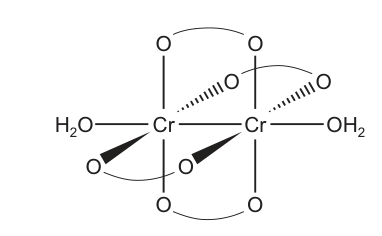
The structure of is shown. Ethanoate ions act as ligands in this complex. The ethanoate ligand, , is shown as .
Water and ethanoate ions behave as different types of ligand in this complex.
Suggest an explanation for this statement.
Answer
Ethanoate ions are bidentate (form two dative covalent bonds / donate two lone pairs per ligand), whereas water molecules are monodentate (form one dative covalent bond / donate one lone pair per ligand).
Ethanoate is bidentate; water is monodentate.
Background Concept
Ligands are classified by their denticity — the number of donor atoms (and hence coordinate bonds) each ligand forms to a single metal centre:
- Monodentate: forms one coordinate bond (e.g. H₂O, NH₃, Cl⁻)
- Bidentate: forms two coordinate bonds (e.g. ethanedioate C₂O₄²⁻, 1,2-diaminoethane)
- Multidentate/chelating: forms more than two
In the chromium(II) acetate structure, each ethanoate ion bridges between two Cr atoms, donating one oxygen lone pair to each Cr. However, from the perspective of a single Cr centre, each ethanoate contributes one bond. But looking at the bridging mode, each ethanoate uses both oxygen atoms — one to each Cr — so it acts as a bridging bidentate ligand overall. Actually, re-examining: the mark scheme says ethanoate is bidentate because it forms two dative bonds (one from each oxygen). In this bridging structure, each ethanoate donates to two different Cr atoms, but the key point is that each ethanoate ion uses two donor atoms (two oxygens) to form bonds, making it bidentate.
Understanding the Question
The structure shows four ethanoate groups, each with two oxygen atoms bonded to chromium centres. Water has only one oxygen donor atom. The question asks us to explain why they behave as "different types" of ligand.
Approach
Compare the number of coordinate bonds each ligand type forms: ethanoate forms two (bidentate), water forms one (monodentate).
Step-by-Step Reasoning
Looking at the structure:
- Each ethanoate ion (CH₃COO⁻) has two oxygen atoms, each with lone pairs. In this complex, both oxygens form coordinate bonds to chromium (one to each Cr in the bridging arrangement). Thus ethanoate is bidentate.
- Each water molecule has one oxygen atom with two lone pairs, but only one coordinate bond is formed to Cr. Thus water is monodentate.
Key Takeaways
- Denticity refers to the number of donor atoms from a single ligand that bond to metal centre(s).
- Ethanoate has two oxygen donor atoms → bidentate.
- Water has one oxygen donor atom → monodentate.
Common Mistakes
- Saying ethanoate is "bridging" without mentioning bidentate/monodentate distinction (though bridging is related, the mark scheme specifically wants the denticity argument).
- Saying water is bidentate because it has two lone pairs (it only forms one bond to one metal).
Things to Be Careful About
- The key distinction is the number of dative bonds/donor atoms per ligand, not the number of lone pairs available.
- Use precise language: "bidentate" and "monodentate", or "forms two dative bonds" and "forms one dative bond".
Deduce the coordination number of and the geometry around each atom in this structure.
coordination number ...........................................................................................................
geometry around atom ...........................................................................................................
Answer
Coordination number: 6
Geometry around Cr atom: octahedral
Coordination number = 6; geometry = octahedral
Background Concept
The coordination number of a metal in a complex is the total number of coordinate (dative covalent) bonds formed between the metal and its ligands. For a coordination number of 6, the geometry is octahedral (or sometimes distorted octahedral). The geometry is determined by minimising electron-pair repulsions around the central metal.
Understanding the Question
We need to examine the structure of and count the bonds to one Cr atom.
Approach
Count all coordinate bonds to one Cr centre from the diagram:
- 1 bond from the water molecule (axial)
- 4 bonds from the four bridging ethanoate groups (each ethanoate donates one oxygen to this Cr)
- 1 bond to the other Cr atom (the Cr-Cr bond)
Total = 6
Step-by-Step Reasoning
Looking at the left Cr atom in the structure:
- One H₂O ligand bonded axially (left) → 1 bond
- Four ethanoate ligands each donate one oxygen atom to this Cr → 4 bonds
- One Cr-Cr bond to the other chromium → 1 bond
Total coordinate bonds = 1 + 4 + 1 = 6
A coordination number of 6 corresponds to octahedral geometry.
Key Takeaways
- Coordination number counts all dative bonds to the metal centre.
- CN = 6 → octahedral geometry.
- The Cr-Cr bond counts towards the coordination number.
Common Mistakes
- Counting only 5 (forgetting the Cr-Cr bond or miscounting the bridging ethanoates).
- Saying the coordination number is 4 or 5.
- Confusing the number of ligands with the coordination number (there are 6 ligands bonded but through different donor atoms).
Things to Be Careful About
- Both parts (coordination number AND geometry) must be correct for the single mark.
- The Cr-Cr bond is a coordinate bond and counts toward the coordination number.
State the type of bond between the two atoms in the bond.
Answer
Coordinate (dative covalent) bond
Coordinate (dative covalent) bond
Background Concept
In transition metal complexes, bonds between the metal and ligands are coordinate (dative covalent) bonds — both electrons in the bond come from one atom (the ligand). In metal-metal bonded complexes like chromium(II) acetate, the Cr-Cr bond can also be described as a coordinate/dative covalent bond in the context of coordination chemistry, where one metal donates electron density to the other.
Understanding the Question
The structure shows a direct bond between the two chromium atoms. The question asks for the type of this bond.
Approach
In the context of coordination chemistry and this structure, the Cr-Cr bond is a coordinate (dative covalent) bond.
Step-by-Step Reasoning
The Cr-Cr bond in this complex is formed by donation of electron density from one Cr to the other. In coordination chemistry terminology, this is a coordinate (dative covalent) bond. The mark scheme accepts "coordinate" or "dative covalent".
Key Takeaways
- Metal-metal bonds in coordination complexes can be described as coordinate/dative covalent bonds.
- This is consistent with the bonding model used for metal-ligand interactions.
Common Mistakes
- Saying "covalent" alone (the mark scheme specifically requires "coordinate" or "dative covalent").
- Saying "metallic bond" — this is not a metallic lattice.
- Saying "ionic" — the bond involves electron sharing.
Things to Be Careful About
- The answer must include "coordinate" or "dative covalent" — just "covalent" is insufficient for this mark scheme.
The complex reacts with aqueous acid to form ions.
ions react with under acidic conditions. ions are formed.
Use the Data Booklet to answer the following questions.
Construct an ionic equation for the reaction of with under acidic conditions.
Working
Oxidation half-equation:
Reduction half-equation (from Data Booklet):
Multiply oxidation by 4 and add:
Answer
4Cr²⁺ + O₂ + 4H⁺ → 4Cr³⁺ + 2H₂O
Background Concept
To construct a balanced ionic redox equation, we combine an oxidation half-equation with a reduction half-equation, ensuring that electrons lost equal electrons gained. The Data Booklet provides standard reduction half-equations for common oxidising agents including O₂.
Under acidic conditions, oxygen is reduced to water:
(E° = +1.23 V)
Alternatively, in less acidic conditions, oxygen can be reduced to hydrogen peroxide:
(E° = +0.68 V)
Understanding the Question
Cr²⁺ is a reducing agent (it can be oxidised to Cr³⁺). O₂ is an oxidising agent. Under acidic conditions, they react together. We need to write the balanced ionic equation.
Approach
- Write the oxidation half-equation for Cr²⁺ → Cr³⁺
- Write the reduction half-equation for O₂ in acidic solution (from Data Booklet)
- Balance electrons and combine
Step-by-Step Reasoning
Oxidation:
Reduction:
Multiply oxidation by 4:
Add together (electrons cancel):
Check: atoms balanced (4 Cr, 2 O, 4 H on each side), charge balanced (left: 8+ + 0 + 4+ = 12+; right: 12+ + 0 = 12+) ✓
Alternative (if H₂O₂ is the product):
Key Takeaways
- Always use the Data Booklet for reduction half-equations of common oxidising agents.
- Balance electrons between half-equations before combining.
- Check both atom and charge balance in the final equation.
Common Mistakes
- Forgetting H⁺ on the left side (not balancing hydrogen).
- Writing O₂⁻ or other incorrect oxygen species.
- Not balancing the number of electrons (writing Cr²⁺ + O₂ + H⁺ → Cr³⁺ + H₂O without coefficients).
- Writing state symbols when not required (the question asks for an ionic equation, state symbols are not needed but not penalised).
Things to Be Careful About
- M1 is for correct species (all reactants and products present), M2 is for correct balancing.
- The equation must be charge-balanced: total charge on left = total charge on right.
- If using the H₂O₂ alternative, the E°cell calculation must match the equation chosen.
Calculate for the reaction in (e)(i).
Working
From the Data Booklet:
- (cathode, reduction)
- (anode, oxidation)
Answer
+1.64 V
Background Concept
The standard cell potential is calculated from the difference between the standard electrode potentials of the cathode (reduction) and anode (oxidation) half-cells:
A positive indicates a thermodynamically feasible (spontaneous) reaction under standard conditions. The Data Booklet lists all standard reduction potentials, so we use the values directly without reversing signs.
Understanding the Question
We need to calculate for the reaction in (e)(i). The value must be consistent with the equation chosen — if we used the O₂/H₂O half-equation, we use +1.23 V; if we used O₂/H₂O₂, we use +0.68 V.
Approach
- Identify the reduction half-cell (cathode): O₂ being reduced → use E°(O₂/H₂O) = +1.23 V
- Identify the oxidation half-cell (anode): Cr²⁺ being oxidised → use E°(Cr³⁺/Cr²⁺) = −0.41 V
- Apply the formula
Step-by-Step Reasoning
The reaction in (e)(i) is:
- O₂ is reduced (cathode):
- Cr²⁺ is oxidised (anode):
Alternative: If the equation in (e)(i) was :
The mark scheme states the value must be linked to (e)(i).
Key Takeaways
- (both as reduction potentials from the Data Booklet).
- The sign convention: subtract the anode value (do NOT reverse its sign first).
- The answer must be consistent with the equation written in the previous part.
Common Mistakes
- Reversing the sign of the anode potential before subtracting (double-counting the negative).
- Using the wrong O₂ value (e.g. using +1.77 V for H₂O₂/H₂O instead of O₂/H₂O).
- Writing −1.64 V (forgetting the subtraction of a negative gives addition).
- Not linking the E°cell value to the equation chosen in (e)(i).
Things to Be Careful About
- The positive sign should be included in the answer.
- The value must match the half-equation used for O₂ reduction in (e)(i) — +1.23 V if H₂O is the product, +0.68 V if H₂O₂ is the product.
- Units (V) must be given.
The rest of this paper
7 more questions- Q2Group 2 · Transition Elements · Equilibria12M
- Q3Electrochemistry · Transition Elements · Equilibria15M
- Q4Chemical Energetics · Electrochemistry15M
- Q5Nitrogen Compounds · Introduction to A Level Organic Chemistry · Organic Synthesis · Hydrocarbons13M
- Q6Analytical Techniques · Introduction to A Level Organic Chemistry · Hydrocarbons · Organic Synthesis · Carboxylic Acids and Derivatives11M
- Q7Reaction Kinetics · Nitrogen Compounds9M
- Q8Halogen Compounds · Carboxylic Acids and Derivatives · Nitrogen Compounds · Analytical Techniques10M