Chemistry 9701/42 — October/November 2020
Cambridge A-Level · A Level Structured Questions · worked solutions for every part, with the mark scheme
Topics Equilibria · Chemical Energetics · Nitrogen Compounds · Reaction Kinetics · Group 2 · Electrochemistry · +6 more
The rate of the reaction is studied.
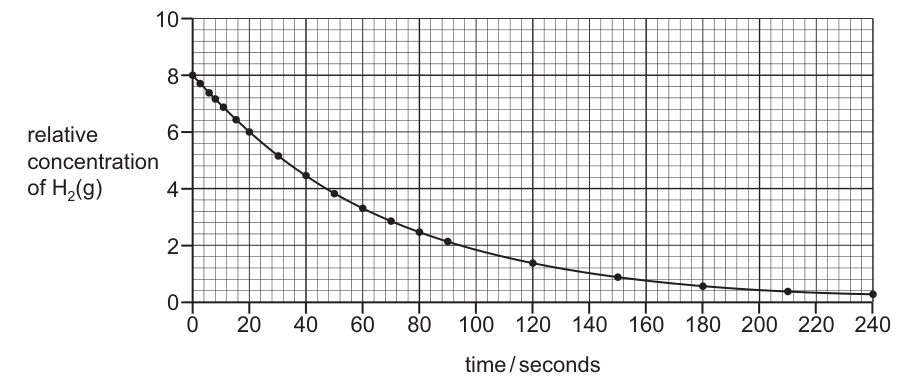
A small amount of is mixed with a large excess of at a temperature of and the reaction is monitored. The graph obtained is shown.
Suggest why a large excess of is used in this experiment.
The reaction is first order with respect to .
Use data from the graph to confirm this statement.
Three separate experiments were carried out at with different starting concentrations of and . The results are shown in the table.
| experiment | rate of reaction / | ||
|---|---|---|---|
| 1 | |||
| 2 | |||
| 3 |
Use the data, and the order of reaction with respect to given in (a)(ii), to deduce the order of reaction with respect to .
Explain your answer, giving data in support of your explanation.
Use information from (a)(ii) and your answer to (b)(i) to write the rate equation for the forward reaction.
Use your rate equation and data from experiment 1 to calculate the value of the rate constant, , for the forward reaction at . Include units for .
At the rate constant for the forward reaction is approximately 1000 times greater than the rate constant for the backward reaction. The overall orders of the forward and backward reactions are the same.
Use this information to explain what will happen if equal concentrations of , and are mixed at .
You should comment on:
- the relative initial rates of the forward and backward reactions
- the position of the equilibrium reached.
At the rate constant for the forward reaction is approximately 50 times greater than the rate constant for the backward reaction.
Use this information and the information in (c)(i) to deduce the signs of the values of the forward and backward reactions. Explain your answer.
The rest of this paper
6 more questions- Q2Equilibria6M
- Q3Chemical Energetics · Group 213M
- Q4Electrochemistry12M
- Q5Transition Elements20M
- Q6Carboxylic Acids and Derivatives · Analytical Techniques · Nitrogen Compounds17M
- Q7Introduction to A Level Organic Chemistry · Hydrocarbons · Nitrogen Compounds · Polymerisation20M