Chemistry 9701/53 — May/June 2020
Cambridge A-Level · Planning, Analysis and Evaluation · worked solutions for every part, with the mark scheme
Topics Planning · Analysis, Conclusions and Evaluation
Trichloromethane and propanone are both organic liquids. The molecules within each liquid are attracted to each other by relatively weak permanent dipole-dipole interactions.
When trichloromethane is mixed with propanone a strong electrostatic attraction forms between the two different molecules.
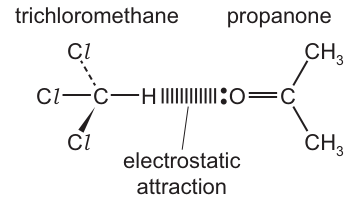
A student plans to perform an experiment to investigate the strength of this electrostatic attraction by finding the temperature change when equal volumes of trichloromethane and propanone are mixed together.
State and explain your prediction for the temperature change for this experiment.
Answer
Temperature increases.
The electrostatic attraction between trichloromethane and propanone molecules is stronger than the permanent dipole-dipole interactions within each pure liquid, so energy is released when the new attractions form.
Temperature increases; the electrostatic attraction between the different molecules is stronger than the attractions within each pure liquid.
Background Concept
When two liquids are mixed, the temperature change depends on the balance of energy required to break the intermolecular forces within the pure liquids and the energy released when new intermolecular forces form between the different molecules. If the new attractions are stronger, more energy is released than is absorbed, resulting in an exothermic process and a temperature increase. If they are weaker, the process is endothermic and the temperature decreases.
Understanding the Question
The question asks for a prediction of the temperature change when trichloromethane and propanone are mixed, along with an explanation. The stem tells us that pure liquids have 'relatively weak permanent dipole-dipole interactions', but mixing them forms a 'strong electrostatic attraction' between the different molecules.
Approach
Compare the strength of the intermolecular forces in the pure liquids with those in the mixture. Stronger forces in the mixture mean energy is released as heat.
Step-by-Step Reasoning
- Prediction: The mixture forms a strong electrostatic attraction (shown in Fig. 1.1 between the H of trichloromethane and the O of propanone). Because this new attraction is stronger than the original dipole-dipole interactions in the pure liquids, the formation of these new bonds releases net energy to the surroundings.
- Explanation: Energy is released when strong intermolecular attractions form. Since the attraction between unlike molecules is stronger than the attractions within each pure liquid, the overall process is exothermic, causing the temperature of the mixture to increase.
Key Takeaways
Mixing liquids that form stronger intermolecular attractions than those present in the pure liquids results in an exothermic process and a rise in temperature.
Common Mistakes
- Predicting a temperature decrease because 'mixing is usually endothermic'. This is not a universal rule; it depends entirely on the relative strengths of the intermolecular forces.
- Forgetting to explain why the temperature changes by simply stating 'heat is released' without referencing the relative strengths of the intermolecular attractions.
Things to Be Careful About
Ensure the explanation explicitly compares the strength of the new intermolecular forces to the old ones. Mark schemes require both the prediction (temperature increases) and the comparative explanation to score full marks.
The student is given only the following equipment and chemicals for the experiment.
1 × 25 cm³ beaker
2 × thermometers
2 × 25 cm³ measuring cylinders
50 cm³ trichloromethane
50 cm³ propanone
Outline the method the student should use in this one experiment to find the temperature change when trichloromethane is mixed with propanone. Give details of the volumes of liquids used and any readings taken.
volumes used
readings taken
method used
Answer
volumes used:
12.5 cm³ of trichloromethane and 12.5 cm³ of propanone (any two equal volumes totalling less than 25 cm³, e.g., 10 cm³ each).
readings taken:
Initial temperature of each liquid before mixing, and the maximum temperature reached after mixing.
method used:
Measure the equal volumes using the measuring cylinders and leave them to equilibrate to room temperature. Pour both liquids into the 25 cm³ beaker. Insert a thermometer, stir the mixture, and record the temperature every minute until it reaches a maximum and begins to fall.
Use 12.5 cm³ of each liquid (total < 25 cm³). Measure initial temperatures, mix in the beaker, and record the maximum temperature reached.
Background Concept
A simple calorimetry experiment to measure enthalpy changes or temperature changes from mixing involves combining known volumes of reactants in an insulated container and monitoring the temperature. Key considerations include ensuring the container is not overfilled, allowing liquids to reach thermal equilibrium before mixing, and capturing the peak temperature before heat loss to the surroundings causes cooling.
Understanding the Question
The student has a 25 cm³ beaker, two thermometers, two 25 cm³ measuring cylinders, and 50 cm³ of each liquid. The task is to outline a method to find the temperature change, specifying volumes used, readings taken, and the procedure.
Approach
- Volumes: Must be equal (as per the experiment design) and must not exceed the beaker's capacity (total < 25 cm³). So, 12.5 cm³ each is ideal.
- Readings: Need the initial temperature (baseline) and the final temperature (maximum, since heat will be lost after the peak).
- Method: Logical sequence: measure -> equilibrate -> mix -> monitor -> record peak.
Step-by-Step Reasoning
- Volumes used: The experiment requires equal volumes. Using 12.5 cm³ of trichloromethane and 12.5 cm³ of propanone gives a total of 25 cm³, which fits in the beaker. (Any equal volumes totalling < 25 cm³, like 10 cm³ each, are acceptable).
- Readings taken: Before mixing, measure the initial temperature of both liquids to ensure they are at the same starting temperature (room temperature). After mixing, the temperature will rise and then fall due to heat loss. The maximum temperature reached is the true final temperature for the calculation.
- Method used:
- Use the measuring cylinders to measure 12.5 cm³ of each liquid.
- Leave them in the room to equilibrate so both are at the same initial temperature.
- Pour both liquids into the 25 cm³ beaker.
- Insert a thermometer and stir continuously.
- Record the temperature every minute until it reaches a peak and starts to fall. The highest reading is the maximum temperature.
Key Takeaways
When designing a simple mixing experiment, ensure the total volume fits the container, allow for thermal equilibration, and record the maximum temperature to account for inevitable heat loss.
Common Mistakes
- Suggesting volumes that total more than 25 cm³ (e.g., 20 cm³ each), which would overflow the beaker.
- Forgetting to leave the liquids to equilibrate before mixing, leading to an inaccurate initial temperature reading.
- Recording the temperature at a fixed time (e.g., 'after 5 minutes') instead of the maximum temperature, which would underestimate the temperature change due to heat loss.
Things to Be Careful About
The mark scheme explicitly requires 'two equal volumes' and 'total volume < 25 cm³'. Be precise in stating the volumes. Also, 'monitor temperature every minute until it starts to fall' or 'read the maximum temperature' are key phrases that earn the final method mark.
The apparatus used leads to significant heat loss.
State one improvement the student could make to the apparatus to reduce heat loss.
Answer
Use a polystyrene cup instead of a glass beaker (or cover the beaker with a lid / insulate the beaker).
Use a polystyrene cup instead of a glass beaker (or cover with a lid).
Background Concept
In simple calorimetry experiments, heat loss to the surroundings is the largest source of error. Glass beakers are poor insulators; heat is lost through the glass by conduction and through the open top by convection and evaporation. Polystyrene is an excellent thermal insulator, and lids prevent convective heat loss and evaporation.
Understanding the Question
The apparatus (a glass beaker) leads to significant heat loss. State one improvement to reduce this.
Approach
Identify a better insulating container or a way to trap heat at the top.
Step-by-Step Reasoning
- Polystyrene cup: Polystyrene contains trapped air and is a much poorer thermal conductor than glass. Replacing the beaker with a polystyrene cup significantly reduces conductive heat loss.
- Lid: Covering the beaker with a lid (or a piece of cardboard with holes for the thermometer) reduces heat loss by convection and evaporation from the surface.
- Insulation: Wrapping the glass beaker in insulating material (like cotton wool or foil) also reduces heat loss.
Key Takeaways
Polystyrene cups and lids are standard improvements for simple calorimetry experiments to minimize heat loss to the surroundings.
Common Mistakes
- Suggesting 'use a better thermometer'. This improves accuracy of temperature reading but does not reduce heat loss.
- Vague answers like 'insulate the beaker' without specifying how (e.g., 'wrap in cotton wool'). 'Use a polystyrene cup' or 'cover with a lid' are preferred specific answers.
Things to Be Careful About
The question specifically asks to reduce heat loss. Ensure the improvement directly addresses thermal insulation, not measurement precision.
Trichloromethane and propanone are both volatile and flammable.
State one relevant precaution that should be taken when carrying out this experiment.
Answer
Ensure there are no naked flames nearby (or use an electric heater instead of a Bunsen burner).
Perform the experiment away from naked flames (or use an electric heater).
Background Concept
Volatile liquids produce flammable vapours at room temperature. If these vapours mix with air and encounter an ignition source (naked flame, hot surface, spark), they can ignite or explode. Standard safety protocols for flammable liquids require eliminating ignition sources.
Understanding the Question
Both trichloromethane and propanone are volatile and flammable. State one relevant precaution.
Approach
Identify the ignition risk and state the corresponding safety measure.
Step-by-Step Reasoning
- Risk: Volatile flammable liquids release vapours that can travel and ignite near a flame.
- Precaution: Remove all naked flames (Bunsen burners, matches) from the vicinity of the experiment. If heating is needed (not in this case, but generally), use an electric heater which does not produce a naked flame.
Key Takeaways
Always state 'no naked flames' or 'use an electric heater' when dealing with volatile flammable organic liquids.
Common Mistakes
- Suggesting 'wear gloves' or 'wear goggles'. While good general lab practice, these do not address the specific risk of flammability and volatility highlighted in the question.
- 'Do not breathe the vapours'. While trichloromethane is toxic, the question specifically highlights 'volatile and flammable', so the expected answer relates to fire safety.
Things to Be Careful About
Match the precaution to the specific hazard mentioned in the question stem ('volatile and flammable').
State one change, apart from reducing heat loss, that could be made to improve the accuracy of this experiment.
Answer
Use a burette or graduated pipette instead of a measuring cylinder (or use a more accurate thermometer / use larger volumes of liquids).
Use a burette or graduated pipette to measure the volumes (or use a more accurate thermometer).
Background Concept
Accuracy in calorimetry depends on the precision of all measurements: volumes, masses, and temperatures. Measuring cylinders have relatively low accuracy (e.g., ±0.5 cm³ for a 25 cm³ cylinder). Burettes and graduated pipettes offer much higher precision (±0.05 cm³ or better). Additionally, using larger volumes increases the total thermal mass, resulting in a larger temperature change for the same enthalpy change, which reduces the percentage uncertainty in the temperature reading.
Understanding the Question
State one change, apart from reducing heat loss, to improve the accuracy of the experiment.
Approach
Think about sources of measurement error: volume measurement and temperature measurement.
Step-by-Step Reasoning
- Volume measurement: Measuring cylinders are not very accurate. Using a burette or graduated pipette to measure the 12.5 cm³ volumes will reduce the uncertainty in the amount of reactants.
- Temperature measurement: A standard laboratory thermometer might only read to the nearest 0.5 °C or 1 °C. A more accurate thermometer (reading to 0.1 °C) reduces the percentage uncertainty in the temperature change.
- Larger volumes: Using larger volumes (e.g., 20 cm³ each, if the container allows) means more molecules are reacting, releasing more total heat. This produces a larger temperature change, making the relative error in the temperature reading smaller.
Key Takeaways
Accuracy can be improved by using more precise measuring instruments (burettes, accurate thermometers) or by increasing the scale of the reaction to produce a larger measurable signal.
Common Mistakes
- Suggesting 'repeat the experiment and take an average'. This improves precision (reliability), not accuracy.
- Suggesting 'insulate the beaker'. The question explicitly says 'apart from reducing heat loss'.
Things to Be Careful About
Distinguish between accuracy (reducing systematic or random errors in measurement) and reliability (repeating to find anomalies). The question asks for accuracy.
In another experiment, a student uses 37.50 g of trichloromethane and 19.75 g of propanone and determines that the energy released is 1.67 kJ.
Calculate the number of moles of each compound in this mixture.
trichloromethane = 119.5
propanone = 58.0
moles of trichloromethane = .............................. mol
moles of propanone = .............................. mol
Working
Answer
moles of trichloromethane = 0.314 mol
moles of propanone = 0.341 mol
trichloromethane: 0.314 mol; propanone: 0.341 mol
Background Concept
The number of moles () of a substance is calculated by dividing its mass () in grams by its relative molecular mass ():
This is a fundamental calculation in stoichiometry and energetics.
Understanding the Question
Given masses of trichloromethane (37.50 g) and propanone (19.75 g), and their values (119.5 and 58.0 respectively), calculate the number of moles of each.
Approach
Apply the formula for each compound.
Step-by-Step Reasoning
- Trichloromethane: mol (to 3 s.f.).
- Propanone: mol (to 3 s.f.).
Key Takeaways
Always use the correct and ensure mass is in grams. Round to an appropriate number of significant figures (usually 3 for A-Level data).
Common Mistakes
- Using atomic mass instead of molecular mass (not applicable here as is given).
- Arithmetic errors in division.
- Incorrect significant figures (e.g., 0.3138 instead of 0.314).
Things to Be Careful About
The mark scheme accepts 0.314 and 0.341. Ensure calculations are carried to at least 3 significant figures to avoid rounding errors in subsequent parts.
Calculate the enthalpy change, , of the electrostatic attraction formed between trichloromethane and propanone. You must include a sign in your answer.
Working
The limiting factor is trichloromethane (0.314 mol), as it is present in fewer moles than propanone (0.341 mol).
Energy released = 1.67 kJ
Answer
-5.32 kJ mol^-1
Background Concept
Enthalpy change () is the heat energy transferred per mole of reaction. When energy is released (exothermic process), is negative. To find in kJ mol, divide the total energy change by the number of moles of the limiting reagent (the reactant that is completely consumed and determines the extent of the reaction).
Understanding the Question
Given 37.50 g trichloromethane (0.314 mol) and 19.75 g propanone (0.341 mol), and energy released = 1.67 kJ, calculate of the electrostatic attraction. Include a sign.
Approach
- Identify the limiting reagent.
- Calculate using (negative because energy is released).
Step-by-Step Reasoning
- Limiting factor: The reaction forms attractions between trichloromethane and propanone in a 1:1 ratio (one H from trichloromethane interacts with one O from propanone). Since 0.314 mol < 0.341 mol, trichloromethane is the limiting factor. Only 0.314 mol of attractions can form.
- Enthalpy change: The energy released is 1.67 kJ. Since energy is released, the process is exothermic, so must be negative.
Key Takeaways
Always identify the limiting reagent before calculating molar enthalpy changes. Remember that 'energy released' means is negative.
Common Mistakes
- Using the moles of the excess reagent (propanone, 0.341 mol) to calculate , giving kJ mol.
- Forgetting the negative sign. 'Energy released' explicitly indicates an exothermic process.
- Dividing by the total moles (0.314 + 0.341), which is incorrect because the reaction is limited by the smaller amount.
Things to Be Careful About
The mark scheme requires the use of the limiting factor (0.314) for M1, and the correct calculation with sign for M2. Ensure the sign is explicitly included in the final answer.
Suggest an experiment the student could carry out to test whether the number of moles of trichloromethane affects the temperature change.
Answer
Keep the volume of trichloromethane the same and vary the volume of propanone, then record the temperature change for each mixture.
Keep volume of trichloromethane constant and vary volume of propanone, recording the temperature change.
Background Concept
To investigate how the number of moles of one reactant affects a dependent variable (temperature change), the independent variable must be the amount of that reactant. All other variables that could affect the outcome (volume of the other reactant, total volume, initial temperature, apparatus) must be kept constant (controlled variables).
Understanding the Question
Suggest an experiment to test whether the number of moles of trichloromethane affects the temperature change.
Approach
Vary the amount of trichloromethane (independent variable) while keeping the amount of propanone (and other conditions) constant (controlled variables). Measure the temperature change (dependent variable).
Step-by-Step Reasoning
- Independent variable: Number of moles of trichloromethane. Since volume is proportional to moles (assuming constant density), vary the volume of trichloromethane.
- Dependent variable: Temperature change ().
- Controlled variables: Volume of propanone must be kept constant. Total volume could be kept constant by adjusting volumes, but the simplest correct answer is to keep propanone constant and vary trichloromethane.
- Method: Carry out the experiment multiple times. In each trial, use a fixed volume of propanone (e.g., 12.5 cm³) and different volumes of trichloromethane (e.g., 5 cm³, 10 cm³, 15 cm³, 20 cm³). Record the temperature change for each.
Key Takeaways
To test the effect of one variable, vary it while keeping all other relevant variables constant.
Common Mistakes
- Varying both volumes simultaneously, which makes it impossible to determine which variable caused the change.
- Forgetting to state that the volume of propanone should be kept constant.
Things to Be Careful About
The question asks to test the effect of trichloromethane moles. Therefore, trichloromethane is the independent variable (vary it), and propanone is the controlled variable (keep it constant).
The rest of this paper
1 more questions- Q2Planning · Analysis, Conclusions and Evaluation19M