Chemistry 9701/52 — May/June 2020
Cambridge A-Level · Planning, Analysis and Evaluation · worked solutions for every part, with the mark scheme
Topics Analysis, Conclusions and Evaluation · Planning
A student plans to carry out an experiment to find the relative molecular mass, , of a soluble acidic gas, X, by finding the mass of a measured volume of gas X. Gas X can be prepared by the reaction between concentrated sulfuric acid and copper.
Two methods of gas collection are available to the student, as shown.
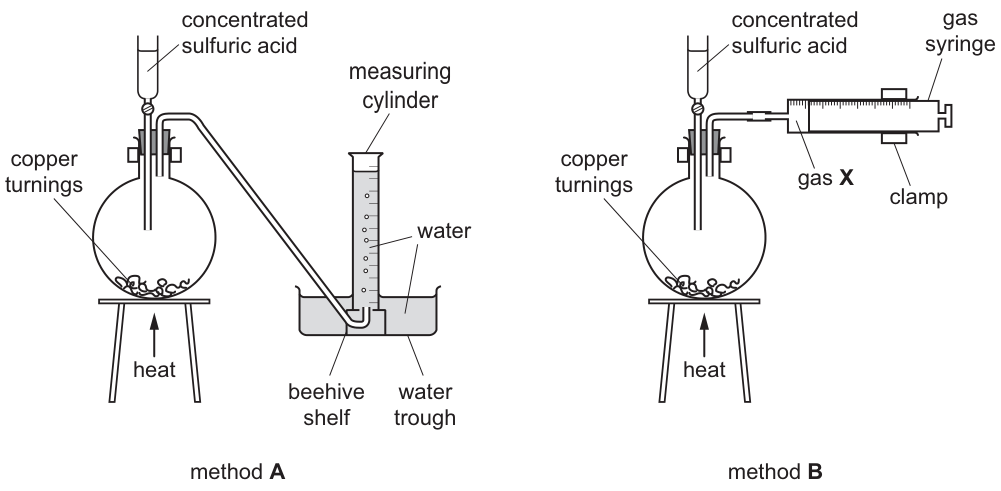
Explain why the first sample of gas collected from either apparatus should not be used for the determination of gas X.
Answer
The first sample of gas will contain air originally present in the apparatus (or the gas mixture is not pure gas X).
The first sample contains air from the apparatus (or is not pure gas X).
Background Concept
When collecting a gas for quantitative analysis, the system (flasks, delivery tubes, collection vessel) initially contains atmospheric air. The first portion of gas generated will displace this air rather than being pure product.
Understanding the Question
The question asks why the initial gas collected should be discarded. This is a standard practical technique when collecting gases for accurate mass or volume measurements.
Approach
Consider what is in the apparatus before the reaction starts. The reaction generates gas X, which will push the existing contents out of the apparatus first.
Step-by-Step Reasoning
Before the reaction begins, the round-bottom flask, delivery tube, and collection vessel are filled with air. As the reaction starts and gas X is produced, the first gas to exit the apparatus is a mixture of the newly formed gas X and the displaced air. For a precise determination of , the volume and mass must correspond to pure gas X only. Therefore, the first sample is discarded to ensure the subsequent sample collected is pure gas X.
Key Takeaways
Always discard the initial gas collected in quantitative gas experiments to remove air from the system.
Common Mistakes
Stating "the gas is impure" without explaining why (i.e., mixing with air from the apparatus).
Things to Be Careful About
Ensure the explanation clearly identifies that the impurity is air from the apparatus, not just a vague "impurity".
Give two reasons, other than your answer to (a)(i), why, for this experiment, the apparatus in method A is less suitable than the apparatus in method B for collecting a sample of gas X.
reason 1
reason 2
Answer
Reason 1: Gas X is soluble in water, so it cannot be collected over water (Method A) as some will dissolve and the volume will be inaccurate.
Reason 2: There is a danger of suck-back (water being drawn back into the hot reaction flask), which could crack the flask or cause an explosion.
Reason 1: Gas X is soluble in water. Reason 2: Danger of suck-back.
Background Concept
Gas collection methods must be matched to the properties of the gas. Water displacement (Method A) is suitable only for gases that are insoluble or very slightly soluble in water. Gas syringes (Method B) are suitable for any gas, provided the syringe is compatible and leak-free.
Understanding the Question
The question asks for two reasons why Method A (water displacement) is unsuitable for gas X, which is produced from concentrated sulfuric acid and copper (likely , a soluble acidic gas).
Approach
Consider the physical and chemical properties of gas X and the mechanics of Method A. Solubility and pressure changes during heating/cooling are key factors.
Step-by-Step Reasoning
Reason 1: Gas X (e.g., ) is soluble in water. If collected over water, a significant portion will dissolve, leading to an inaccurate (lower) measured volume. The mark scheme accepts "gas is soluble so should not be collected over water".
Reason 2: Method A involves heating the reaction flask. If the heat is removed or the reaction stops, the gas in the flask cools and contracts, reducing the pressure. This can cause water from the trough to be sucked back up the delivery tube into the hot flask (suck-back), potentially cracking the glass or causing a hazard. Method B uses a gas syringe, avoiding this risk.
Key Takeaways
Always consider solubility and the risk of suck-back when choosing a gas collection method.
Common Mistakes
Suggesting that gas X reacts with water as the primary reason (while true, solubility is the direct mark). Forgetting to mention the physical danger of suck-back.
Things to Be Careful About
The question asks for reasons other than the first sample containing air (part a(i)). Ensure both reasons are distinct and directly address the apparatus or gas properties.
The student is told to use the U-tube shown to find the mass of a sample of gas X.
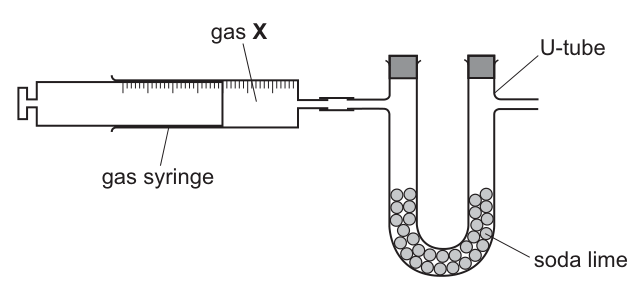
A sample of pure gas X is placed in a gas syringe. The gas syringe is attached to a U-tube containing small lumps of solid soda lime, a mixture of sodium hydroxide and calcium hydroxide. All of gas X is slowly passed into the U-tube and the mass of gas X absorbed determined.
The temperature and the pressure of the room are recorded.
State the measurements that are needed to determine the mass of gas X absorbed.
Answer
The mass of the U-tube containing soda lime before the experiment and the mass of the U-tube containing soda lime after the experiment. The difference gives the mass of gas X absorbed.
Mass of U-tube + soda lime before and after the experiment.
Background Concept
To determine the mass of a gas absorbed by a solid, a gravimetric analysis approach is used. The solid is weighed before and after exposure to the gas. The increase in mass is attributed to the absorbed gas.
Understanding the Question
The question asks for the specific measurements needed to find the mass of gas X absorbed by the soda lime in the U-tube.
Approach
Identify the initial and final states of the absorbing medium (soda lime in the U-tube) that need to be measured.
Step-by-Step Reasoning
The mass of gas X absorbed is the difference between the final mass and the initial mass of the absorbing system. Therefore, the student must measure:
- The mass of the U-tube plus the soda lime before the gas is passed through.
- The mass of the U-tube plus the soda lime after all the gas has been passed through and absorbed.
Subtracting the initial mass from the final mass gives the mass of gas X.
Key Takeaways
Gravimetric absorption requires pre- and post-experiment mass measurements of the absorbent.
Common Mistakes
Only stating "mass before and after" without specifying that it is the U-tube + soda lime. Forgetting that the U-tube itself has mass.
Things to Be Careful About
Ensure both "before" and "after" measurements are explicitly stated, as the mark scheme requires both (AND).
Suggest why soda lime is used to absorb gas X.
Answer
Soda lime is alkaline (a mixture of sodium hydroxide and calcium hydroxide), so it will undergo a neutralisation reaction with the acidic gas X, ensuring it is fully absorbed.
Soda lime is alkaline and will neutralise the acidic gas X.
Background Concept
Soda lime is a mixture of and , both of which are strong bases. Acidic gases (like , , ) react with bases to form salts and water.
Understanding the Question
The question asks why soda lime is specifically chosen to absorb gas X, which is identified as an acidic gas in the stem.
Approach
Connect the chemical nature of gas X (acidic) with the chemical nature of soda lime (alkaline) to explain the absorption mechanism.
Step-by-Step Reasoning
Gas X is described as an acidic gas. Soda lime is alkaline. When an acidic gas comes into contact with an alkaline solid, an acid-base neutralisation reaction occurs (e.g., ). This chemical reaction ensures the gas is permanently and effectively removed from the gas stream and retained in the U-tube, allowing its mass to be measured accurately.
Key Takeaways
Match the chemical properties of the gas (acidic) with the absorbent (alkaline) for effective absorption.
Common Mistakes
Suggesting soda lime is used because it is "dry" or "porous" without mentioning the chemical neutralisation reaction.
Things to Be Careful About
The mark scheme specifically looks for "alkaline" or "neutralisation reaction". Ensure these key terms are used.
Gas X can cause respiratory distress.
State an appropriate precaution that should be taken when doing this experiment.
Answer
Carry out the experiment in a fume cupboard (or fume hood) to prevent inhalation of the toxic gas.
Carry out the experiment in a fume cupboard.
Background Concept
Gases that cause respiratory distress (toxic, corrosive, or irritating) must be handled in a controlled environment that prevents their release into the general laboratory air.
Understanding the Question
Gas X can cause respiratory distress. The question asks for an appropriate safety precaution.
Approach
Identify the standard laboratory safety equipment for handling toxic gases.
Step-by-Step Reasoning
The standard precaution for experiments involving toxic or respiratory-irritating gases is to perform them in a fume cupboard. This ensures that any leaked or escaped gas is extracted and vented safely outside the building, protecting the student and others.
Key Takeaways
Always use a fume cupboard for toxic gases.
Common Mistakes
Suggesting "wear a mask" or "work in a well-ventilated room" without specifying a fume cupboard. While ventilation is good, a fume cupboard is the specific, correct technical answer.
Things to Be Careful About
Be specific: "fume cupboard" is the required term, not just "ventilation".
Experiment 1 is carried out at a temperature of , a pressure of , and uses of pure gas X.
Calculate the number of moles of gas X present in Experiment 1.
You should assume that gas X behaves like an ideal gas and so use .
Working
Convert temperature to Kelvin:
Convert volume to cubic metres:
Rearrange to solve for :
Substitute the values:
Answer
4.01e-3 mol
Background Concept
The ideal gas equation relates pressure (), volume (), number of moles (), the gas constant (), and absolute temperature (). For the equation to work with (which uses SI units), must be in pascals (Pa), in cubic metres (), and in kelvin (K).
Understanding the Question
Calculate the number of moles of gas X using the given , , and values and the ideal gas law.
Approach
- Convert all given values to SI units.
- Rearrange the equation to solve for .
- Substitute and calculate.
Step-by-Step Reasoning
Step 1: Unit conversions
- Temperature:
- Volume: . Since ,
- Pressure: (already in SI units)
- Gas constant:
Step 2: Rearrange and substitute
Step 3: Final answer
Rounding to 3 significant figures: .
Key Takeaways
Always check units when using the ideal gas equation. requires , Pa, and K.
Common Mistakes
Forgetting to convert to (using instead of ). Forgetting to convert to K. Arithmetic errors in the calculation.
Things to Be Careful About
The mark scheme awards method marks for correct and conversions, and accuracy marks for the final value. Show your working clearly.
The sample of gas X is found to have a mass of .
Explain how the student should use this information and their results to determine the of X.
Answer
Divide the mass of gas X () by the number of moles calculated in part (d)(i):
Divide mass of X by number of moles calculated in (d)(i).
Background Concept
Relative molecular mass () is numerically equal to the molar mass in . The relationship is:
Understanding the Question
The student has the mass of the gas sample () and has just calculated the number of moles (). Explain how to find .
Approach
Use the formula .
Step-by-Step Reasoning
The student already has the mass of gas X () from the U-tube experiment and the number of moles () from the ideal gas calculation in (d)(i). To find the relative molecular mass, simply divide the mass by the number of moles:
The question asks to "explain how", so stating "divide mass by number of moles" is sufficient, but showing the calculation confirms understanding.
Key Takeaways
.
Common Mistakes
Using the wrong formula (e.g., multiplying mass and moles). Forgetting to use the moles from (d)(i) instead of calculating new moles.
Things to Be Careful About
The question asks to "explain how", so a verbal explanation (divide mass by moles) is acceptable and often preferred over just a number, though showing the number is good practice.
Not all of gas X is absorbed by the soda lime.
State what effect, if any, this has on the student’s calculated value of the of gas X.
Answer
If not all gas X is absorbed, the measured mass of gas X will be lower than the true value. Since , a lower mass will result in a lower calculated value for .
Lower value.
Background Concept
Error analysis in calculations requires tracing how an error in a measured quantity propagates through the formula to affect the final result.
Understanding the Question
Not all gas X is absorbed by the soda lime. This means the mass increase of the U-tube is less than it should be. How does this affect the calculated ?
Approach
- Determine the effect on the measured mass.
- Use the formula to determine the effect on .
Step-by-Step Reasoning
Step 1: Effect on mass
If not all gas X is absorbed, the mass of gas X recorded (final mass - initial mass of U-tube) will be less than the actual mass of gas X that was in the syringe ().
Step 2: Effect on
The formula for is:
Since the number of moles is calculated from the gas volume, pressure, and temperature (which are assumed correct), is unchanged. However, the numerator (mass) is smaller than it should be. Dividing a smaller number by the same gives a smaller result.
Therefore, the calculated will be lower than the true value.
Key Takeaways
If the measured mass is too low and is constant, will be too low.
Common Mistakes
Saying "no effect" or "higher " without tracing the logic through the formula.
Things to Be Careful About
Clearly state the direction of the error (lower) and briefly explain why (smaller mass / same moles).
In Experiment 2, the same mass of gas X is used, but the student did not record the temperature and pressure.
The calculated of X for Experiment 2 is higher than the value calculated by the student for Experiment 1.
State and explain how the value of changes from Experiment 1 to Experiment 2.
Answer
State: The value of is less in Experiment 2.
Explain: If the calculated is higher, and mass is constant, then the calculated number of moles () must be less. From , . Since is less (and , are constant), must be less.
P/T is less; because if Mr is higher, n is less and therefore P/T is less.
Background Concept
The ideal gas equation can be rearranged to relate pressure and temperature directly:
This shows that is directly proportional to the number of moles (assuming and are constant).
Understanding the Question
In Experiment 2, the same mass of gas is used, but and are not recorded. The student calculates a higher for Experiment 2 than for Experiment 1. We need to state and explain how changes from Exp 1 to Exp 2.
Approach
- Relate to using the constant mass.
- Relate to using the ideal gas equation.
- Combine to find the relationship between and .
Step-by-Step Reasoning
Step 1: Effect on
We know . Rearranging gives .
The mass is the same in both experiments. If the calculated for Experiment 2 is higher, then the calculated number of moles must be less.
Step 2: Relate to
From , we can rearrange to:
Since is a constant and () is the same in both experiments, is directly proportional to .
Step 3: Conclusion
Since is less in Experiment 2, must also be less in Experiment 2 compared to Experiment 1.
Key Takeaways
and , so . A higher calculated implies a lower .
Common Mistakes
Stating is higher without explaining the link through . Failing to mention that is less.
Things to Be Careful About
The question asks to "State and explain". You must explicitly state "P/T is less" and then provide the logical explanation involving .
State how the reliability of the results in Experiment 1 could be improved.
Answer
Repeat the experiment at least 3 times and calculate an average (mean) value for the results to identify and reduce the effect of anomalies.
Repeat the experiment (x3) and take an average.
Background Concept
Reliability refers to the consistency of results. The standard way to improve reliability in any quantitative experiment is to repeat the measurements and take a mean.
Understanding the Question
How can the reliability of the results in Experiment 1 be improved?
Approach
Identify the standard method for improving reliability: repetition and averaging.
Step-by-Step Reasoning
To improve reliability, the student should repeat the entire experiment (or at least the key measurements) multiple times (typically at least 3 times). By calculating an average (mean) of the results, any anomalous results can be identified and excluded, and the overall reliability of the final value is increased.
Key Takeaways
Repeats and averages improve reliability.
Common Mistakes
Suggesting "more accurate apparatus" (this improves accuracy, not reliability). Suggesting "better technique" without specifying repetition.
Things to Be Careful About
Use the word "repeat" or "repeats" and "average" or "mean". Simply saying "do it again" is not precise enough.
A different gas, methylamine, is alkaline.
State a change that would have to be made to the apparatus so that the of methylamine could be determined.
Answer
Replace the soda lime (alkaline absorbent) with an acid (e.g., dilute hydrochloric acid or sulfuric acid) to absorb the alkaline gas methylamine.
Replace the soda lime with an acid (to absorb the alkaline gas).
Background Concept
Absorption of gases for mass determination requires a chemical reaction between the gas and the absorbent. Acidic gases are absorbed by alkaline solids (like soda lime), and alkaline gases are absorbed by acids.
Understanding the Question
Methylamine () is an alkaline gas. The current apparatus uses soda lime (alkaline) to absorb the acidic gas X. What change is needed for methylamine?
Approach
Match the chemical nature of the new gas (alkaline) with the appropriate absorbent (acidic).
Step-by-Step Reasoning
Soda lime is alkaline and will not react with or absorb an alkaline gas like methylamine. To absorb methylamine, an acidic absorbent is needed. The student would need to replace the soda lime in the U-tube with an acid (such as dilute or , though a solid acid or acid-soaked material might be more practical for a U-tube; the mark scheme simply accepts "an acid"). The acid will undergo a neutralisation reaction with the alkaline methylamine gas.
Key Takeaways
Match absorbent to gas: acid for alkaline gas, base for acidic gas.
Common Mistakes
Suggesting a different collection method instead of changing the absorbent. Forgetting to mention why (to neutralise the alkaline gas).
Things to Be Careful About
The mark scheme accepts "replace the soda lime with an acid". Be specific about replacing the absorbent.
The rest of this paper
1 more questions- Q2Analysis, Conclusions and Evaluation17M