Chemistry 9701/51 — May/June 2020
Cambridge A-Level · Planning, Analysis and Evaluation · worked solutions for every part, with the mark scheme
Topics Analysis, Conclusions and Evaluation · Planning
Trichloromethane and propanone are both organic liquids. The molecules within each liquid are attracted to each other by relatively weak permanent dipole-dipole interactions.
When trichloromethane is mixed with propanone a strong electrostatic attraction forms between the two different molecules.
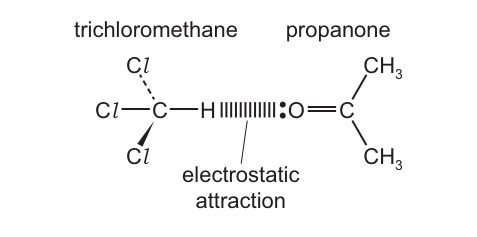
A student plans to perform an experiment to investigate the strength of this electrostatic attraction by finding the temperature change when equal volumes of trichloromethane and propanone are mixed together.
State and explain your prediction for the temperature change for this experiment.
The student is given only the following equipment and chemicals for the experiment.
beaker
thermometers
measuring cylinders
trichloromethane
propanone
Outline the method the student should use in this one experiment to find the temperature change when trichloromethane is mixed with propanone. Give details of the volumes of liquids used and any readings taken.
volumes used
readings taken
method used
The apparatus used leads to significant heat loss.
State one improvement the student could make to the apparatus to reduce heat loss.
Trichloromethane and propanone are both volatile and flammable.
State one relevant precaution that should be taken when carrying out this experiment.
State one change, apart from reducing heat loss, that could be made to improve the accuracy of this experiment.
In another experiment, a student uses of trichloromethane and of propanone and determines that the energy released is .
Calculate the number of moles of each compound in this mixture.
trichloromethane = 119.5
propanone = 58.0
moles of trichloromethane = .............................. mol
moles of propanone = .............................. mol
Calculate the enthalpy change, , of the electrostatic attraction formed between trichloromethane and propanone. You must include a sign in your answer.
Suggest an experiment the student could carry out to test whether the number of moles of trichloromethane affects the temperature change.
The rest of this paper
1 more questions- Q2Planning · Analysis, Conclusions and Evaluation19M