Chemistry 9701/41 — May/June 2020
Cambridge A-Level · A Level Structured Questions · worked solutions for every part, with the mark scheme
Topics Equilibria · Electrochemistry · Transition Elements · Analytical Techniques · Group 2 · Nitrogen Compounds · +6 more
An aqueous solution of cobalt(II) contains the complex ion.
Define the term complex ion.
Samples of are reacted separately with aqueous sodium hydroxide and with an excess of aqueous ammonia.
Give the following information about these reactions.
- the reaction of with aqueous sodium hydroxide
- colour and state of the cobalt-containing species
- ionic equation
- type of reaction
- the reaction of with an excess of aqueous ammonia
- colour and state of the cobalt-containing species
- ionic equation
- type of reaction
When concentrated hydrochloric acid is added to a solution containing , a blue solution of is formed and the following equilibrium is established.
Use Le Chatelier’s principle to suggest the expected observations when silver nitrate solution is added dropwise to the blue solution of . Explain your answer.
The complex shows stereoisomerism.
Complete the three-dimensional diagrams to show the two isomers of .
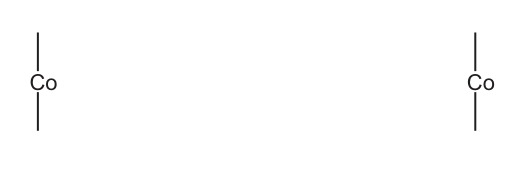
Suggest the type of stereoisomerism.
Compound X, , is a tetradentate ligand.
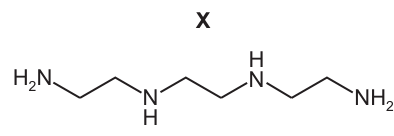
Suggest why one molecule of X can form four dative bonds.
reacts with aqueous cobalt(II) ions, , in a 1:1 ratio to form a new complex ion.
Construct an equation for this reaction.
The rest of this paper
9 more questions- Q2Group 26M
- Q3Electrochemistry7M
- Q4Nitrogen Compounds7M
- Q5Introduction to A Level Organic Chemistry · Hydrocarbons · Hydroxy Compounds · Analytical Techniques14M
- Q6Carboxylic Acids and Derivatives · Equilibria · Analytical Techniques23M
- Q7Equilibria · Electrochemistry · Chemical Energetics10M
- Q8Equilibria8M
- Q9Electrochemistry · Reaction Kinetics7M
- Q10Transition Elements5M