Chemistry 9701/42 — February/March 2020
Cambridge A-Level · A Level Structured Questions · worked solutions for every part, with the mark scheme
Topics Carboxylic Acids and Derivatives · Nitrogen Compounds · Transition Elements · Electrochemistry · Equilibria · Introduction to A Level Organic Chemistry · +9 more
Iron is a transition element in the fourth period. Iron forms compounds containing the ions Fe²⁺ and Fe³⁺.
Define the term transition element.
Compare the melting point and density of iron with those of calcium, an s-block element in the fourth period.
melting point .......................................................................................................................
density ................................................................................................................................
Complete the electronic configuration of an isolated gaseous Fe²⁺ ion.
1s² .................................................................................................................................
Aqueous Fe³⁺ ions form coloured complexes.
Explain the origin of the colour in transition element complexes.
When an excess of ions is added to green ions, yellow complex ions are formed.
Heating with dilute nitric acid and then neutralising the product with produces red crystals, containing the complex ion.
NO is a neutral, monodentate ligand.
State the shape of the complex ion.
Write the equation for the reaction between ions and an excess of ions.
Deduce the oxidation states of iron in:
................................................ . ................................................
Define the term monodentate ligand.
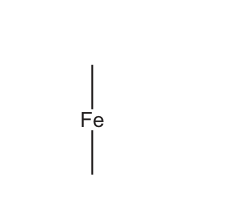
Complete the diagram to show the three-dimensional structure of the complex ion.
The two complex ions and are different colours.
Explain why the colours of the two complex ions are different.
E is a complex ion, , containing with a coordination number of 6.
Define the term coordination number.
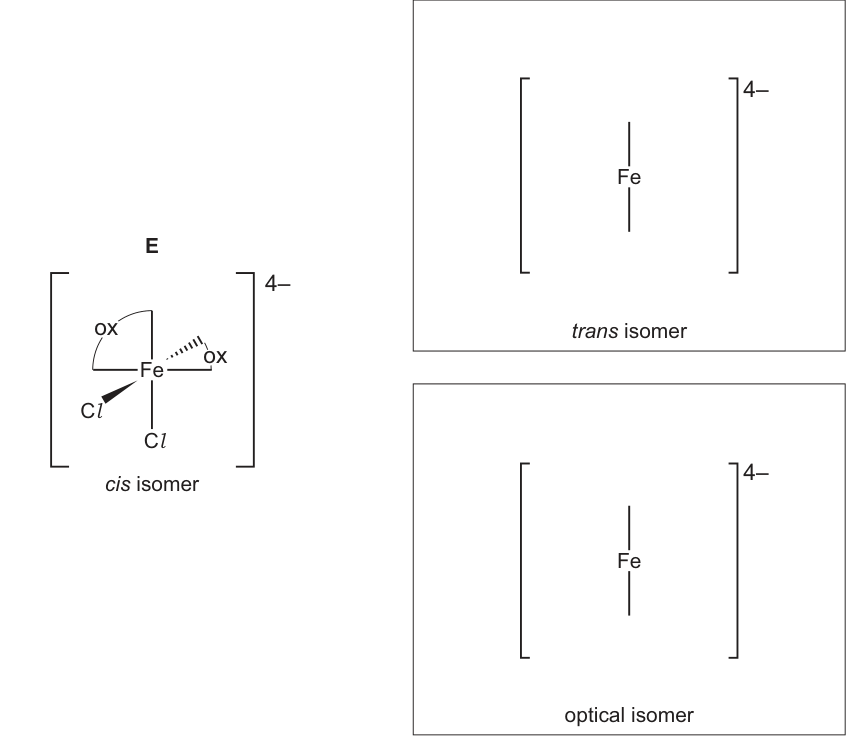
E shows both optical isomerism and cis-trans isomerism.
One isomer of E is shown. The ion is represented as

.
In the boxes, draw three-dimensional diagrams to show:
- the trans isomer of E
- the optical isomer of E.
contains ligands which are anions of ethanedioic acid, .
Complete the table to show any observations for the reactions of with the named reagents.
Where no change is observed, write ‘none’.
| reagent | observations with |
|---|---|
| warm acidified manganate(VII) | |
| 2,4-dinitrophenylhydrazine | |
| warm Tollens’ reagent |
The rest of this paper
5 more questions- Q2Group 2 · Electrochemistry11M
- Q3Electrochemistry · Reaction Kinetics · Chemical Energetics · Equilibria25M
- Q4Introduction to A Level Organic Chemistry · Nitrogen Compounds · Hydrocarbons · Analytical Techniques12M
- Q5Carboxylic Acids and Derivatives · Hydroxy Compounds · Equilibria · Hydrocarbons · Nitrogen Compounds · Analytical Techniques21M
- Q6Organic Synthesis · Carboxylic Acids and Derivatives · Halogen Compounds · Nitrogen Compounds · Polymerisation · Introduction to A Level Organic Chemistry · Transition Elements11M