Chemistry 9701/52 — October/November 2019
Cambridge A-Level · Planning, Analysis and Evaluation · worked solutions for every part, with the mark scheme
Topics Analysis, Conclusions and Evaluation · Planning
Many organic reactions performed in the laboratory require heating under reflux.
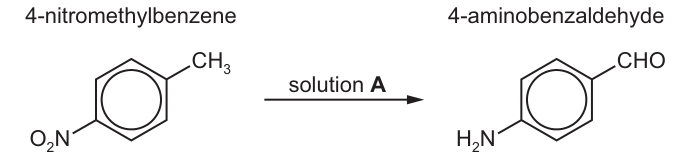
4-nitromethylbenzene can be converted directly to 4-aminobenzaldehyde by heating it under reflux with an excess of solution A. Solution A is an aqueous alkaline mixture of and . Ethanol is used as a solvent for the reaction.
The apparatus for this reaction is shown in the diagram.
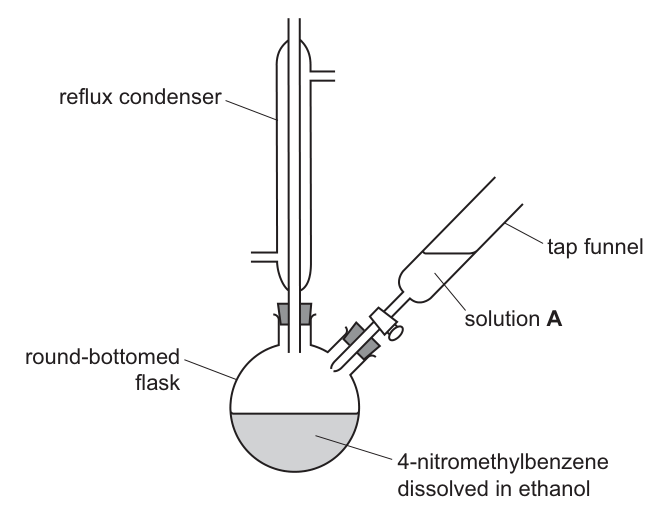
Show, using a labelled arrow, where the cooling water enters the reflux condenser.
After the complete addition of solution A to the solution in the round-bottomed flask, a vigorous exothermic reaction takes place.
What should be done to control the vigorous exothermic reaction during the addition of solution A?
The mixture is heated to increase the rate of reaction. This is carried out under reflux.
Other than to increase the rate of reaction, explain why a reflux process is used for heating the mixture.
A student suggests that placing a bung in the top of the condenser would improve the experiment.
Comment on whether the student is correct. Explain your answer.
Once the reaction is complete, the round-bottomed flask is removed from the set-up on page 2 and included in a new set-up for distillation.
The distillation process separates the substances in the mixture in the flask.
Complete and label the diagram to show how the apparatus could be set up for distillation.
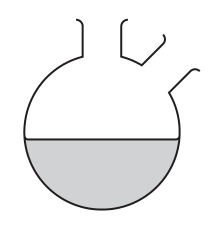
The mixture in the round-bottomed flask is heated until all of the first substance distils off. The heating is then stopped. After distillation a hot solution remains in the round-bottomed flask.
The table shows some data relevant to the experiment.
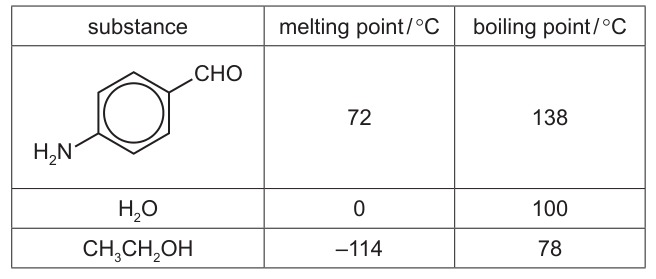
Use the data to identify the liquid that is first distilled off.
Explain your answer.
4-aminobenzaldehyde is soluble in hot water, but not in cold water.
Starting with the hot solution in the round-bottomed flask, suggest how pure crystals of 4-aminobenzaldehyde can be obtained.
Under acidic conditions, 4-aminobenzaldehyde () forms a solid compound with molecular formula .
A student carries out two experiments according to the method on page 2 to make .
In Experiment 1, the student obtains of solid.
In Experiment 2, the student uses the same method as in Experiment 1 but adds acid to neutralise the alkali in the mixture in the flask after heating under reflux.
The same quantities of reagents are used in Experiment 1 and Experiment 2.
Suggest how the mass of solid obtained in Experiment 2 compares to that of Experiment 1.
Explain your answer.
4-aminobenzaldehyde can be reacted with a halogenoalkane to form 4-(dimethylamino)benzaldehyde, compound D.
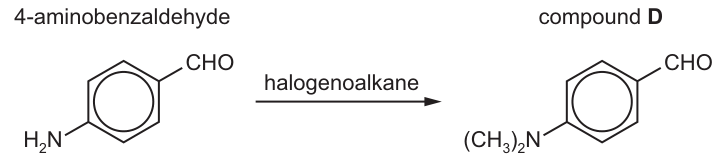
Some data is given that is relevant to this reaction.
| halogenoalkane | boiling point / °C | carbon-halogen bond energy / |
|---|---|---|
| -97 | 340 | |
| 4 | 280 | |
| 43 | 240 |
Give two reasons why is the preferred halogenoalkane in the conversion of 4-aminobenzaldehyde to compound D.
1
2
The rest of this paper
1 more questions- Q2Analysis, Conclusions and Evaluation17M