Chemistry 9701/42 — May/June 2019
Cambridge A-Level · A Level Structured Questions · worked solutions for every part, with the mark scheme
Topics Introduction to A Level Organic Chemistry · Nitrogen Compounds · Transition Elements · Chemical Energetics · Carboxylic Acids and Derivatives · Analytical Techniques · +6 more
Complete the electronic configuration of the copper(II) ion.
.......................................................................................................................
State the colour of the solutions containing the following ions.
- ...........................................................................................................
- ................................................................................................................
Octahedral complexes of with different ligands can have different colours.
Explain why.
Copper(I) and silver(I) salts are colourless.
Suggest why.
Consider the following two equilibria and associated data values at 298 K.
The equilibrium constant for equilibrium 1 is the solubility product, , of . The equilibrium constant for equilibrium 2 is the stability constant, , for the formation of .
Calculate the solubility of at 298 K in .
Use Le Chatelier’s principle as applied to equilibria 1 and 2 to suggest why dissolves in concentrated .
Use equilibria 1 and 2 to construct an equation for the reaction of with concentrated . This is equilibrium 3.
Write an expression for the equilibrium constant of equilibrium 3, , in terms of for equilibrium 1 and for equilibrium 2.
Define the term standard electrode potential, .
Complete and label the diagram to show how the standard electrode potential, , of could be measured under standard conditions.
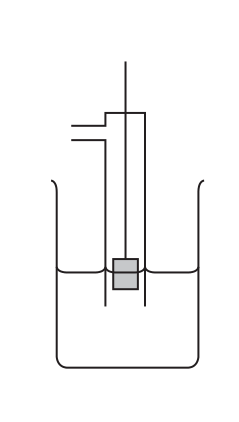
Use the Data Booklet to label the diagram in (e)(i) to show
- which is the positive electrode,
- the direction of electron flow in the external circuit when a current flows.
The rest of this paper
7 more questions- Q2Group 29M
- Q3Transition Elements · Chemical Energetics13M
- Q4Reaction Kinetics11M
- Q5Chemical Energetics9M
- Q6Introduction to A Level Organic Chemistry · Hydrocarbons · Nitrogen Compounds · Carboxylic Acids and Derivatives16M
- Q7Nitrogen Compounds · Analytical Techniques · Introduction to A Level Organic Chemistry · Carboxylic Acids and Derivatives15M
- Q8Introduction to A Level Organic Chemistry · Analytical Techniques · Hydroxy Compounds · Nitrogen Compounds10M