Chemistry 9701/42 — February/March 2019
Cambridge A-Level · A Level Structured Questions · worked solutions for every part, with the mark scheme
Topics Equilibria · Group 2 · Chemical Energetics · Transition Elements · Organic Synthesis · Carboxylic Acids and Derivatives · +8 more
State one natural and one man-made occurrence of oxides of nitrogen.
Under conditions of high pressure and a catalyst, nitrogen monoxide, , forms two other oxides of nitrogen, dinitrogen monoxide, , and dinitrogen trioxide, .
Balance the equation above for the formation of and from .
State how the oxidation number of nitrogen changes during this reaction.
from ............................... to ...............................
from ............................... to ...............................
Calculate the entropy change for the reaction at . Include the units in your answer.
State whether the sign of calculated in (iii) agrees with that predicted from your balanced equation in (i). Explain your answer.
At room temperature dissociates.
Write the expression for for this equilibrium. Include the units in your answer.
A flask at is filled with pure at an initial pressure of .
At equilibrium, the partial pressure of is .
Calculate the partial pressures of and at equilibrium. Hence calculate the value of at .
NO reacts readily with oxygen.
The table shows how the initial rate of this reaction at depends on the initial concentrations of the reactants.
| / | / | initial rate / |
|---|---|---|
| 0.100 | 0.0500 | 3.50 |
| 0.0500 | 0.100 | 1.75 |
| 0.0500 | 0.0500 | 0.875 |
Deduce the order of reaction with respect to each reactant. Explain your reasoning.
order with respect to : ..............................................................................................
order with respect to : ................................................................................................
State the rate equation for this reaction. Use the rate equation to calculate the rate constant. Include the units for the rate constant in your answer.
NO reacts with iron pentacarbonyl, , as shown. NO and CO are both monodentate ligands.
During this reaction the co-ordination number of the iron changes.
State what is meant by the term co-ordination number.
Describe how the co-ordination number of the iron changes during this reaction.
from ............................................................... to ...............................................................
Only one stereoisomer of exists.
Use this information to suggest the geometry of the complex.
The complex exists in three isomeric forms. L represents the monodentate ligand .
Complete the three-dimensional diagrams to show the three isomers of .
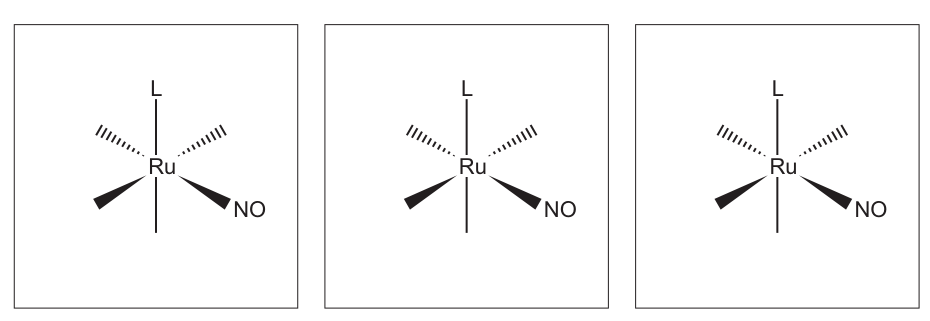
Suggest the type of isomerism shown.
The rest of this paper
6 more questions- Q2Group 2 · Chemical Energetics · Equilibria13M
- Q3Equilibria7M
- Q4Transition Elements · Electrochemistry17M
- Q5Polymerisation · Organic Synthesis · Carboxylic Acids and Derivatives11M
- Q6Introduction to A Level Organic Chemistry · Equilibria · Nitrogen Compounds · Analytical Techniques15M
- Q7Carboxylic Acids and Derivatives · Organic Synthesis · Hydrocarbons · Hydroxy Compounds · Nitrogen Compounds17M