Chemistry 9701/53 — October/November 2018
Cambridge A-Level · Planning, Analysis and Evaluation · worked solutions for every part, with the mark scheme
Topics Planning · Analysis, Conclusions and Evaluation
The Finkelstein reaction is a nucleophilic substitution reaction in which a halogen atom in a halogenoalkane is replaced by another halogen atom. The reaction is carried out using dry propanone as a solvent.
One example of the Finkelstein reaction is given.
Explain why it is important for dry propanone to be used as a solvent for this reaction.
The solubilities of NaBr and NaI in propanone are shown.
| compound | solubility at in g / 100 g of propanone |
|---|---|
| NaBr | 0.00841 |
| NaI | 39.9 |
Use this information to explain why, although the reaction between and NaI is reversible, the reaction produces a very high yield.
Some safety information for the organic compounds used in this reaction is shown.
- 1-bromopropane is highly flammable and moderate health hazard. It is irritating to eyes, the respiratory system and skin.
- 1-iodopropane is flammable and moderate health hazard. It is irritating to eyes, the respiratory system and skin.
- Propanone is highly flammable and moderate health hazard. It is irritating to eyes, and may cause dizziness and drowsiness.
Identify two different precautions, other than using protective equipment such as gloves, a lab coat or eye protection, that should be taken when carrying out this experiment. Explain each answer.
A student plans an experiment to show that the rate of the reaction is proportional to the concentration of NaI.
Propanone is used as the solvent in this reaction.
(pr) = substance is dissolved in propanone
The student plans to record the time it takes for the solid formed to obscure a cross on a piece of paper below the conical flask, as shown.
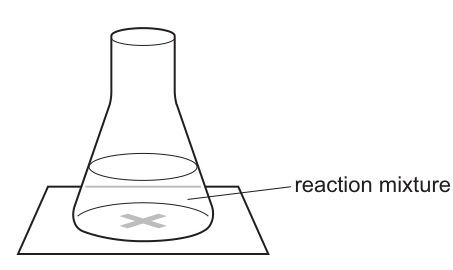
To carry out this experiment, the following materials are available.
- dry propanone,
- usual laboratory apparatus
Calculate the masses of NaI(s) and that would be needed to make of NaI(pr). Assume of propanone are required. Give your answers to one decimal place.
The density of is .
[: Na, 23.0; I, 126.9]
Part of the table the student used to record data is given.
Complete the table with appropriate volumes that the student could have used in four further experiments.
| volume of NaI(pr) / | volume of / | volume of / | total volume / | time / s |
|---|---|---|---|---|
| 10.0 | 2.0 | 30.0 | 42.0 | |
The student uses the same experimental set-up each time.
In this experiment, identify the dependent variable.
Write an expression to show how the student could calculate the rate of the reaction.
Identify the major source of inaccuracy of measurement in this reaction.
Suggest an improvement to the experiment to make it more accurate.
The reaction between and NaI proceeds via an mechanism.
The student repeated the experiment in (c) using an isomer of that reacts via both and mechanisms.
State and explain whether the student will be able to show that the rate of this reaction is proportional to the concentration of NaI.
The rest of this paper
1 more questions- Q2Planning · Analysis, Conclusions and Evaluation16M