Chemistry 9701/52 — October/November 2018
Cambridge A-Level · Planning, Analysis and Evaluation · worked solutions for every part, with the mark scheme
Topics Planning · Analysis, Conclusions and Evaluation
A sample of waste water contains calcium ions, copper(II) ions and lead(II) ions.
You are to plan an experimental procedure to separate the metal ions in the waste water sample by forming precipitates of the metal ions.
The table shows the numerical values of the solubility products, , of some compounds.
For example, the solubility product of calcium chloride, .
The smaller the solubility product, the easier it is for a precipitate to form.
You are provided with
- a sample of waste water containing , and ,
- ,
- ,
- .
No other reagents should be used. Standard laboratory equipment is available.
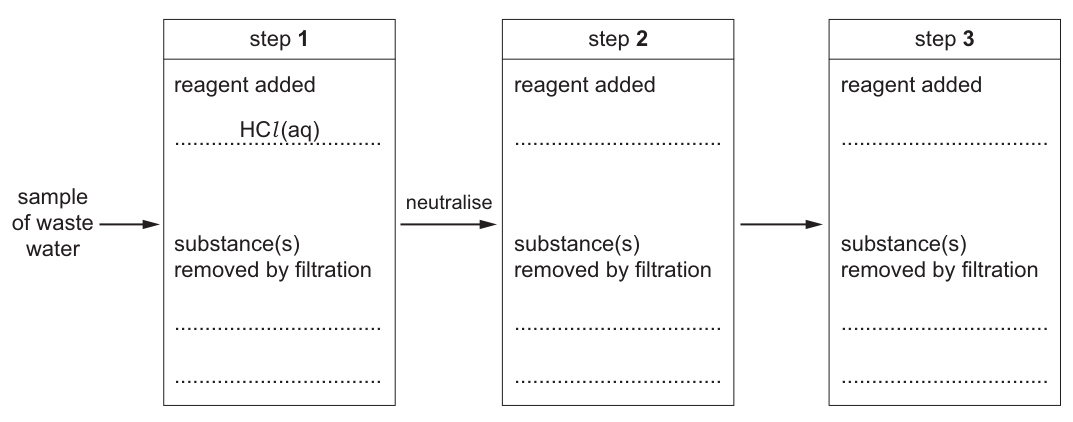
The flowchart below is provided to plan the order of steps for the separation by filtration of the precipitates from the sample of waste water.
Complete the flowchart. For each step state the reagent added and the substance(s) removed by filtration.
After the substances formed in each step in (a) have been removed by filtration, a further drop of the reagent used for that step is added to the waste water sample.
Suggest why this is necessary.
Between steps 1 and 2, the waste water sample is neutralised. This is so that steps 2 and 3 will work.
Suggest a reagent that should be added to neutralise the waste water sample. State how you could test that the waste water sample had been neutralised.
A student completes the reactions in (a) with a sample of waste water and obtains one of the precipitates produced, .
The student plans to calculate the concentration of ions present in this sample of waste water by measuring the mass loss on heating the freshly filtered sample of .
Draw and label a diagram of the experimental set-up the student should use.
Your diagram should show how loss of solid during heating would be prevented.
The student weighs the precipitate and records its mass. The student then heats the precipitate strongly for five minutes and weighs it again. The student records the difference in mass and from this calculates .
The precipitate thermally decomposes according to the following equation.
Identify two problems with this method. Explain the effect that each problem has on the calculated concentration of .
The rest of this paper
1 more questions- Q2Planning · Analysis, Conclusions and Evaluation18M