Chemistry 9701/42 — October/November 2018
Cambridge A-Level · A Level Structured Questions · worked solutions for every part, with the mark scheme
Topics Nitrogen Compounds · Introduction to A Level Organic Chemistry · Analytical Techniques · Transition Elements · Group 2 · Chemical Energetics · +7 more
An alkene, a carboxylic acid and a ketone, all of similar volatility, are mixed together. The mixture is then analysed by gas chromatography.
The gas chromatogram produced is shown.
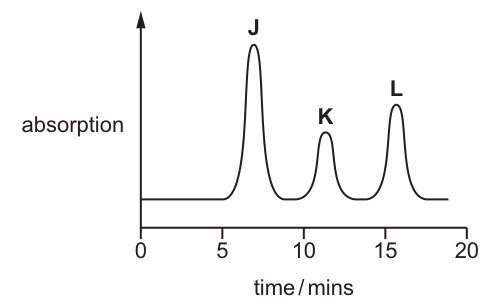
The separation of the three compounds depends on their relative solubilities in the liquid stationary phase. The liquid stationary phase is an alkane.
Complete the table to suggest which compound in the mixture is responsible for each peak J, K and L. Explain your answer by reference to the intermolecular forces of each compound.
| peak | organic compound | explanation |
|---|---|---|
| J | ||
| K | ||
| L |
A student calculates the areas underneath the three peaks in the chromatogram.
| peak | J | K | L |
|---|---|---|---|
| area / | 46 | 18 | 28 |
The area underneath each peak is proportional to the mass of the respective compound.
Calculate the percentage by mass in the original mixture of the compound responsible for peak K.
Chlorobenzene can be prepared from benzene as shown.
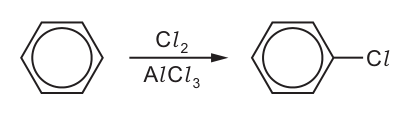
Aluminium chloride, , catalyses this reaction.
Write an equation to show how generates the electrophile needed in this reaction.
Draw the mechanism of the reaction between this electrophile and benzene to form chlorobenzene. Include all relevant curly arrows and charges.
Write an equation to show how the catalyst is regenerated.
Catalysts can be heterogeneous or homogeneous.
Explain what is meant by a homogeneous catalyst.
Complete the table by placing one tick () in each row to indicate the mode of action of the catalyst in each reaction.
| heterogeneous | homogeneous | |
|---|---|---|
| Rh in the removal of from exhaust gases of cars | ||
| in the reaction |
The rest of this paper
8 more questions- Q2Transition Elements7M
- Q3Transition Elements13M
- Q4Nitrogen Compounds · Group 2 · Chemical Energetics · Equilibria11M
- Q5Group 2 · Electrochemistry · Equilibria · Organic Synthesis · Analytical Techniques22M
- Q6Carboxylic Acids and Derivatives · Organic Synthesis · Nitrogen Compounds · Polymerisation9M
- Q7Introduction to A Level Organic Chemistry · Polymerisation8M
- Q8Introduction to A Level Organic Chemistry · Chemical Energetics · Nitrogen Compounds14M
- Q9Nitrogen Compounds5M