Chemistry 9701/41 — October/November 2018
Cambridge A-Level · A Level Structured Questions · worked solutions for every part, with the mark scheme
Topics Equilibria · Analytical Techniques · Introduction to A Level Organic Chemistry · Transition Elements · Nitrogen Compounds · Carboxylic Acids and Derivatives · +7 more
An aldehyde, an alkane and a carboxylic acid, all of similar volatility, are mixed together. The mixture is then analysed in a gas chromatograph.
The gas chromatogram produced is shown.
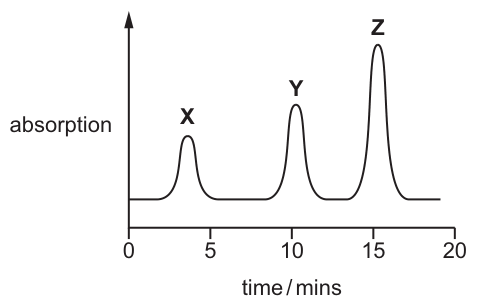
The separation of the compounds depends on their relative solubilities in the stationary phase. The stationary phase is a liquid alcohol.
Complete the table to suggest which compound in the mixture is responsible for each peak X, Y and Z. Explain your answer by reference to the intermolecular forces of the compounds.
| peak | organic compound | explanation |
|---|---|---|
| X | ||
| Y | ||
| Z |
A student calculates the areas underneath the three peaks in the chromatogram.
| peak | X | Y | Z |
|---|---|---|---|
| area / | 19 | 32 | 47 |
The area underneath each peak is proportional to the mass of the respective compound.
Calculate the percentage by mass in the original mixture of the compound responsible for peak Z.
The mass spectrum of a halogenoalkane containing one chlorine atom or bromine atom will show an additional peak at M+2.
State the isotopes of chlorine and bromine responsible for M+2 peaks.
The mass spectrum of bromochloromethane, , has a molecular ion peak, M, at an value of 128. It also has M+2 and M+4 peaks.
Suggest the identity of the molecular ions that give rise to these peaks.
M peak .................................................
M+2 peak .............................................
M+4 peak .............................................
Halogenoalkanes can be formed from the reaction of an alkene with a hydrogen halide.
Methylpropene reacts with hydrogen bromide to form 2-bromo-2-methylpropane.
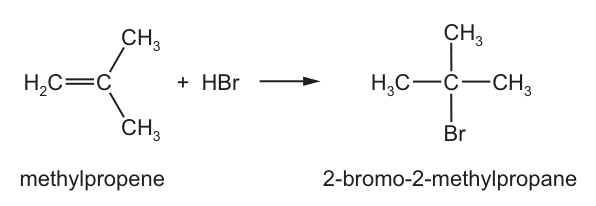
Draw the mechanism of this reaction. Include all relevant curly arrows, dipoles and charges.
1-bromo-2-methylpropane is also formed in this reaction.
Explain why 2-bromo-2-methylpropane will be the major product in this reaction.
Explain what is meant by the term partition coefficient, .
The partition coefficient of organic compound H between dichloromethane and water is 4.75.
- of compound H was dissolved in water and made up to in a volumetric flask.
- of this aqueous solution were shaken with of dichloromethane.
Calculate the mass of compound H that was extracted into the dichloromethane.
The rest of this paper
7 more questions- Q2Transition Elements · Equilibria7M
- Q3Transition Elements19M
- Q4Group 2 · Equilibria19M
- Q5Analytical Techniques · Polymerisation · Introduction to A Level Organic Chemistry11M
- Q6Nitrogen Compounds7M
- Q7Halogen Compounds · Hydroxy Compounds · Hydrocarbons · Nitrogen Compounds11M
- Q8Chemical Energetics · Electrochemistry12M