Chemistry 9701/52 — May/June 2018
Cambridge A-Level · Planning, Analysis and Evaluation · worked solutions for every part, with the mark scheme
Topics Analysis, Conclusions and Evaluation · Planning
When concentrated iron(III) chloride is added to water at just below boiling point, a reaction occurs and produces , seen as a red colour in the water. This is a ‘sol’ of . A sol contains particles that are insoluble but do not form a precipitate.
A student prepared a concentrated solution of iron(III) chloride by dissolving in distilled water.
Hazard information for hydrated iron(III) chloride is given.
For this hazard, state a precaution, other than eye protection and a lab coat, that the student could take when preparing a solution of concentrated iron(III) chloride.
hazard: solid is irritating to the skin
precaution
Particles of a sol can be positively or negatively charged. The student used the experimental set-up shown to confirm that the sol particle is positively charged.
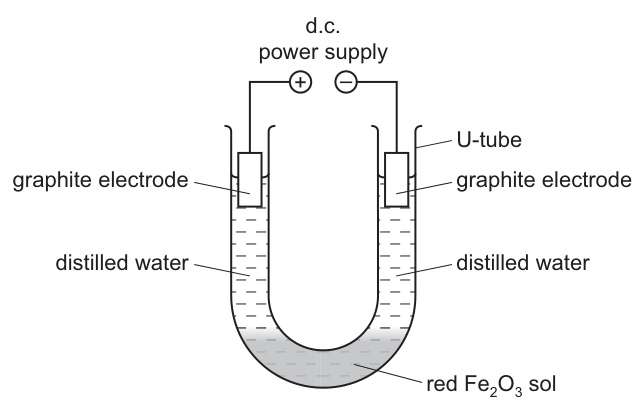
The student placed a few of the sol at the bottom of the U-tube and poured of distilled water into each side of the U-tube, without disturbing the sol. The two layers of distilled water were colourless at the beginning of the experiment. Graphite electrodes were inserted and a current was passed. After 30 minutes a difference was noted between the distilled water in the two sides of the U-tube.
Predict the colour of the distilled water in both sides of the U-tube after 30 minutes, if the sol particle is positively charged.
observation in side with positive electrode
observation in side with negative electrode
Salt solutions can be added to sols to cause them to precipitate. This method is used in water purification.
The student made up of standard solutions containing of the following ions.
What mass of solid potassium sulfate, , did the student use to make up exactly of ?
[: K, 39.1; S, 32.1; O, 16.0]
mass of =
Describe how the student should have accurately prepared this volume of standard solution from a sample of of mass calculated in (c)(i).
The student carried out an experiment to precipitate the sol, using . Only one drop of was needed for the complete precipitation of sol.
Calculate how many moles of were added. Assume that one drop is .
moles of added =
The student decided to dilute the standard solution of to make of .
Calculate the volume of standard solution required to make exactly of .
volume of standard =
Name a piece of apparatus that could be used to measure accurately the volume of solution calculated in (e)(i).
In an alternative method, of could be prepared by using of .
Explain why the dilution method used by the student to prepare of is the more accurate of the two methods.
The student carried out experiments to investigate how much of a particular salt solution was required to fully precipitate all the sol in a sample. The salt solutions used were all of concentration with respect to the ion being investigated.
Experiment 1
| identity of salt solution | charge on anion | minimum amount of anion required for complete precipitation of sol/mol |
|---|---|---|
| -1 | ||
| -2 | ||
| -3 |
Experiment 2
| identity of salt solution | charge on cation | minimum amount of cation required for complete precipitation of sol/mol |
|---|---|---|
| +1 | ||
| +2 | ||
| +3 |
Describe the effect of changing the charge on the anion from –1 to –2 to –3 on the precipitation of the sol in Experiment 1.
Identify the independent variable in Experiment 2.
Arsenic sulfide, , is highly toxic and should be removed from drinking water.
The sol particles are positively charged.
The sol particles are negatively charged.
Based on the student’s results, which salt used in either Experiment 1 or Experiment 2 would be the most effective at removing from drinking water?
Explain your answer.
salt
explanation
The rest of this paper
1 more questions- Q2Analysis, Conclusions and Evaluation17M